Spider-view: "Blown Circuits" (Spider-Man 2099, Part 11)
A visually lacking gimmick does allow Peter David to toy with colliding character arcs in this four-parter
—by Nathan on November 12, 2026—
In 1994, the World Wide Web had been open to the public for three years. There was no Facebook, no YouTube, no Instagram, no Tik Tok, no Reddit. Cellular devices weren't commonplace. You couldn't hail a taxi or order dinner through an app. Amazon was founded that year, eBay in 1995, yet neither nascent company could dream of the overwhelming presence online shopping would have just a handful of years down the road.
How much the world has changed.
Sci-fi has a remarkable ability to map the possible future applications of available technology–look no further than 1984 or Fahrenheit 451–and humanity has had a remarkable ability to treat such imagination as a blueprint. So if you opened an issue of Spider-Man 2099 in 1994, you would have found the future beckoning you into a world more unbelievable then than it is now. Predating The Matrix's virtual landscape by about five years, today's arc plugs us into a digital world that feels surprisingly prescient, with all the advertised wonders and undisclosed dangers and temptations such coded countrysides contain.
"Blown Circuits"
Writer: Peter David
Pencilers: Ron Lim and Rick Leonardi
Inkers: Greg Adams and Al Williamson
Colorists: Steve Buccellato, George Roussos, and Jon Andreani
Letterers: Ken Lopez and Jon Babcock
Issues: Spider-Man 2099 #18-20, #22
Publication Dates: April 1994-June 1994, August 1994
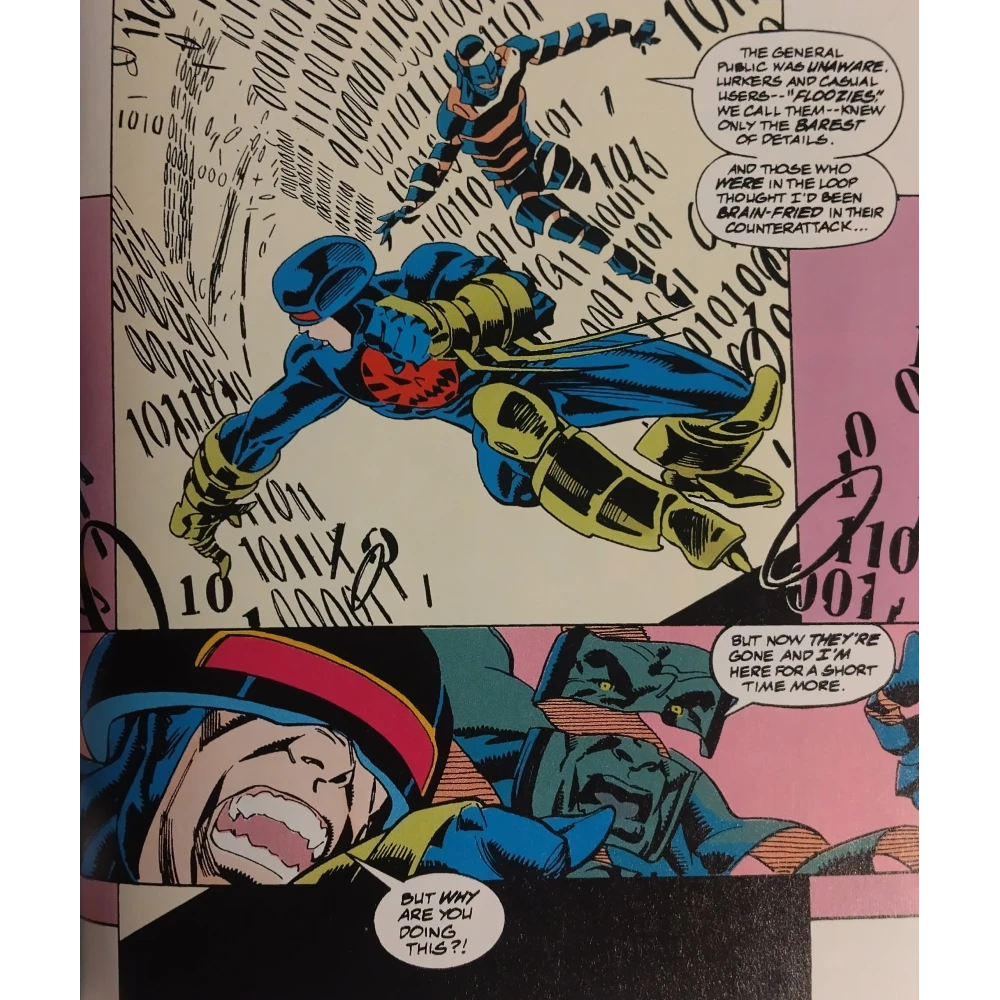
When I was a kid in the early 2000s (yeah, I'm not that old, okay?), I watched an episode of a television series where a computer whiz needed to hack into a program. Executing a nonsensical flurry of randomly typing keys, he breaks in, but not before he utters the line, "Just gotta get past this firewall." Younger (but not much younger!) me thought the guy was actually referencing a wall made out of fire, kinda like Syndrome's volcano base in The Incredibles. Shows you what I knew. The image of a hacker using some computer-generated character to break through a flaming obstacle was burned (sorry) into my brain for a long while afterward.
Had I read Peter David and Rick Leonardi's four-part arc shortly afterward, my young mind may have been forever stuck thinking about digital landscapes in physical terms.
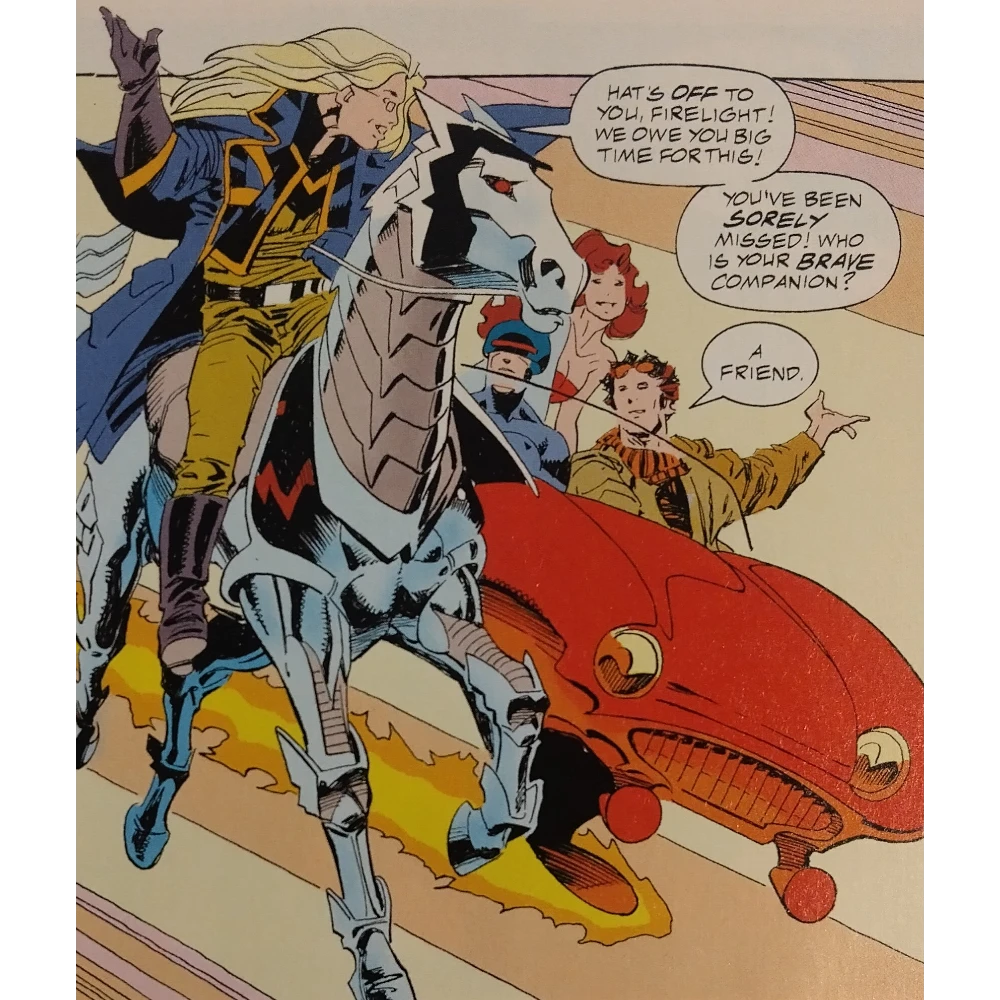
David crafts what amounts to a VR environment through this issue, and while it feels somewhat dated in execution, the world he briefly offers is intended to draw us into the narrative. Miguel's brother Gabe, frustrated with his current relationship with lady love Kasey, plugs back into a virtual world where he's known by his online avatar Firelight. It's cyberspace, presented as a vast frontier that's being tapped into and explored the same way one would explore actual space or the deep ocean.
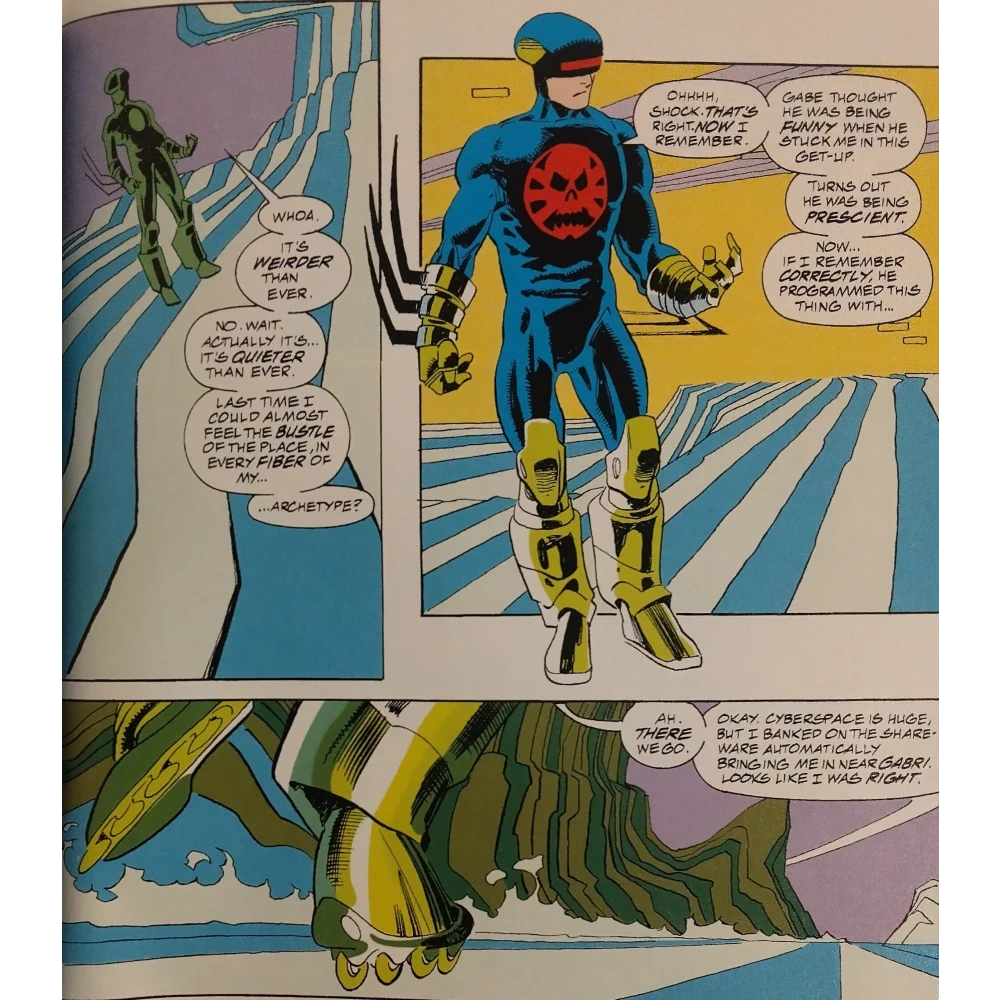
Cyberspace itself is what carries that dated quality, mainly in how it's represented visually. Obviously, there wasn't much context at the time David could draw from to help Leonardi visualize an environment that feels properly populated. There aren't many people, no cityscapes, not much other than a perpetual emptiness dominated by various colors. It's sort of a letdown, and though it factors into David's conflict, the space is underutilized, which is especially a shame as David provides some hints toward Gabe's history within that landscape, providing a unique sampling of worldbuilding which could have been used more effectively.
The narrative portions set outside the digital world fare much better, David crafting a story which feels nicely reliant on and a culmination of different subplots sewn in earlier issues. Having just wrapped up the "Fall of the Hammer" crossover, David seeds his next larger arc; this is solely a Spider-Man tale–no future Punisher, future Doom, future X-Men–but it represents an important pivot point in the life of Miguel O'Hara worth exploring.
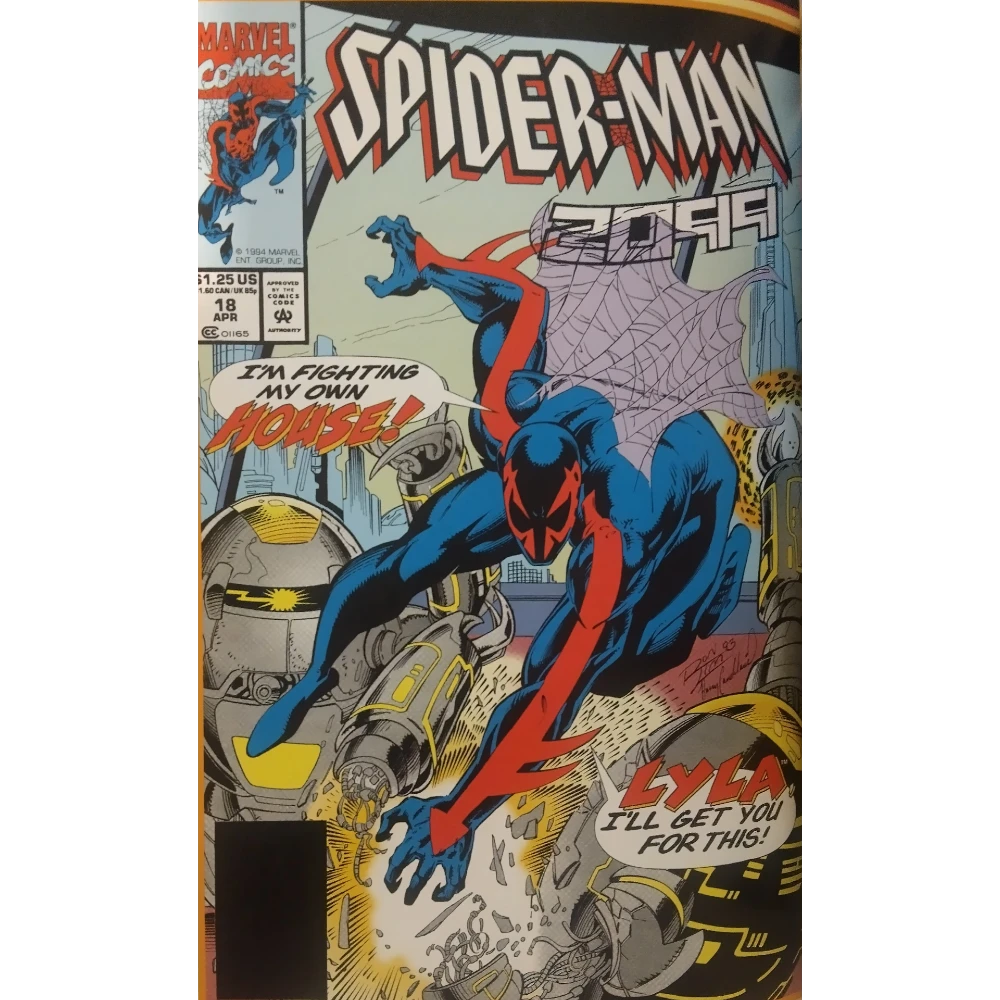
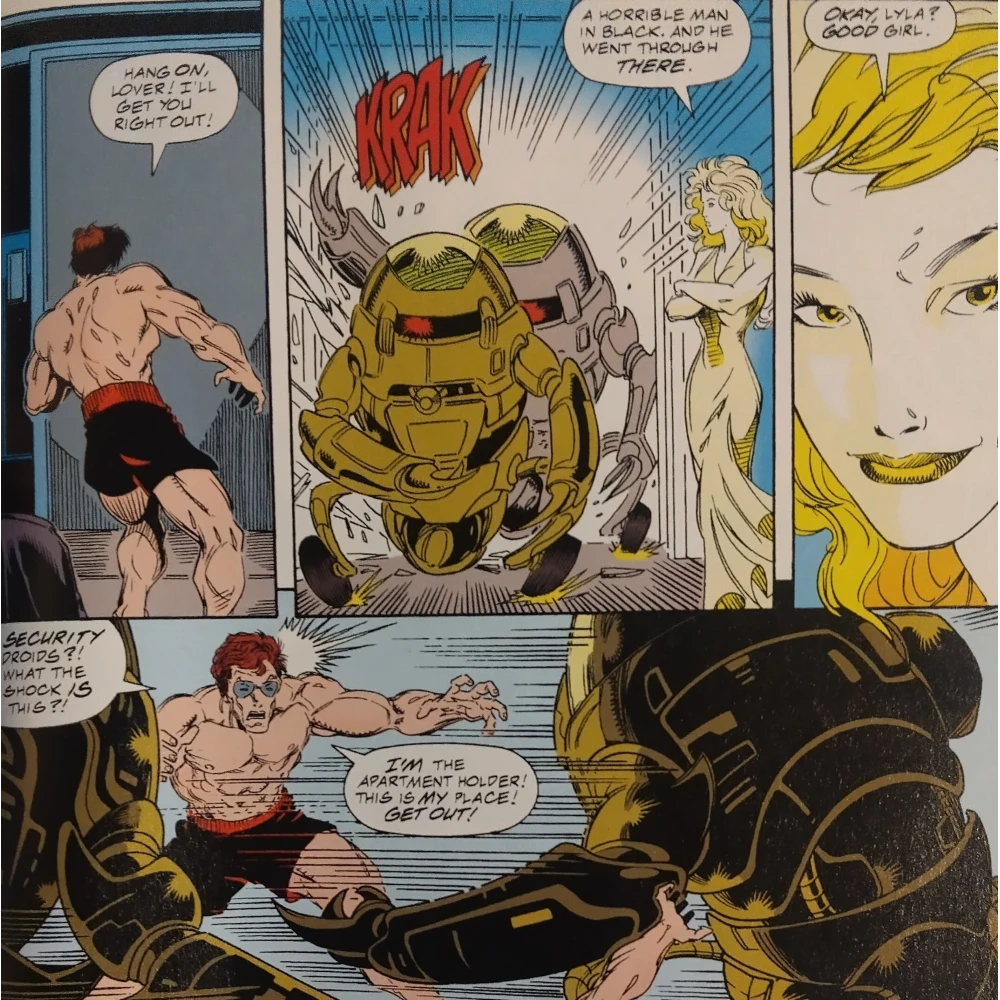
A long-running subplot featuring Miguel's malfunctioning AI companion Lyla–beginning, essentially, in David and Leonardi's first arc–is brought to a head, delivered through conflict involving killer robots and Miguel's apartment turned topsy-turvy. Throughout previous issues, David had hinted at Lyla's growing defectiveness and possible sentience (such as through having her repeat the phrase "There's a horrible man in black! He went through there!" which makes an effective return here), with Miguel's own involvement being implicated. Her deviation from her standard programming has been treated as a miniature "arc" until now, a distinct humanity infiltrating her system; all that comes to a head, leading to Miguel's recognition of his own complicity in her inability to properly weigh her strict programming with developing emotions.
Miguel's relationship with Gabe, specifically Gabe's suspicions of Miguel's dual identity, also factors nicely into these issues; as Miguel braves colorful cyberspace to draw his brother from its clutches, tensions surface between the siblings regarding Miguel's secretive lifestyle. Again, as early as David and Leonardi's first issues, Gabe has suspected, with pretty good reason (dude wears a costume Gabe knows Miguel wore at a festival, with Spidey donning a manifestation of that outfit when he enters cyberspace), his brother's transformation into a superhero and symbol of anti-capitalist Thorites. Like Lyla's lean toward human emotions, so has Gabe begun critically eyeing his brother…
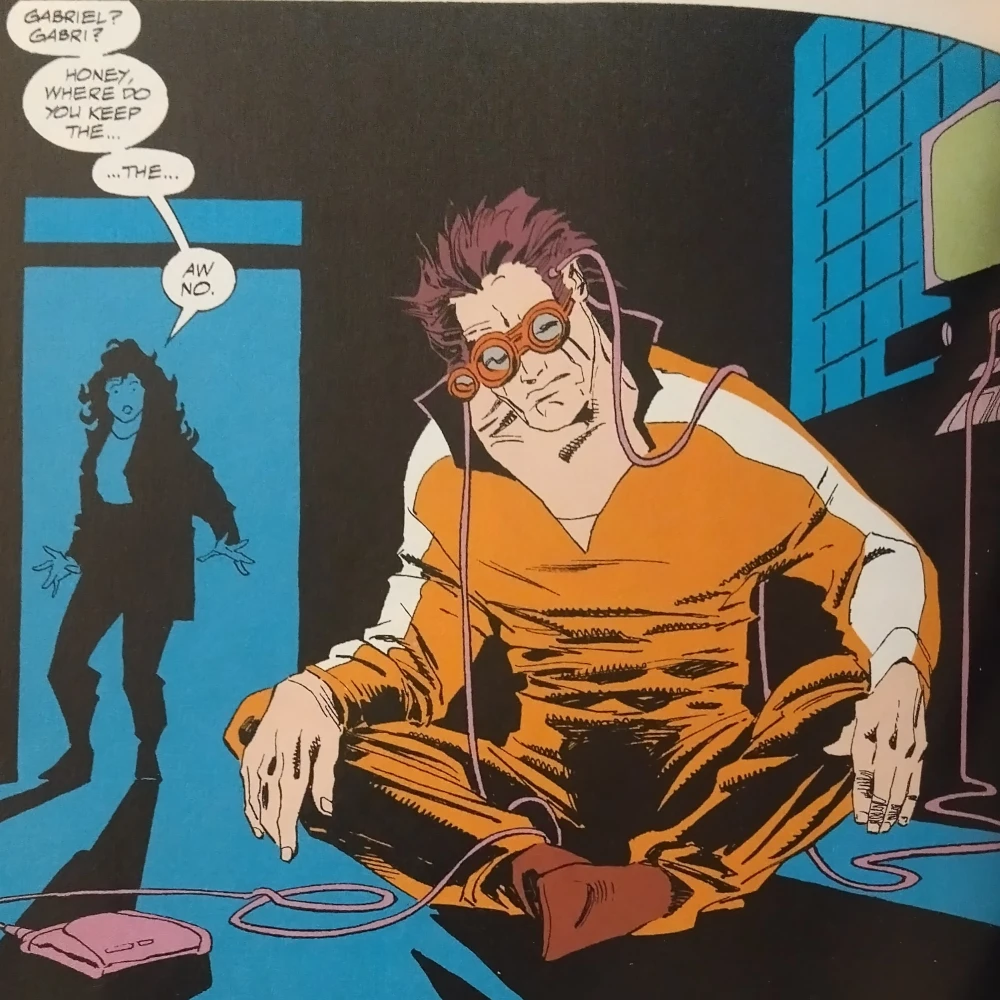
…especially as Gabe's unaddressed misgivings collide with both his unaddressed frustrations with Kasey (founded in her own interest in Spider-Man and how that has shaped her relationship with Gabe). This has been building for some time, and David indicates Gabe chooses to release his mounting vexation through plugging into cyberspace as Firelight. Gabe's addicted to the internet, an idea which, I assume, was somewhat foresighted at the time. Gabe chooses the escapist route; instead of drugs, he isolates himself and dives into a different world where he actually is somebody, or at least appears to be somebody. David never makes the direct comparison to a drug addiction, but you see the concept play out uniquely and can understand the root of it: Gabe, crippled by insecurity, embraces the dangerous habit which provides him comfort and an identity he believes he can rely on to crowd out the world.
The cyberspace aspect comes a little out of nowhere, not addressed in previous narratives. But certain ideas have been sufficiently teased to make its introduction less awkward than it could be. Gabe's occupation in digital art points to his interest and adeptness in futuristic technology, and Lyla's own malfunctioning dovetails nicely with David's overarching plot, especially as he introduces a sinister figure serving as the arc's antagonist. The villain himself is a simply constructed character, less interesting for who he is and more present to craft conflict through Lyla, Gabe, and a slightly bigger threat Miguel must face in Nueva York.
That describes the whole narrative well: the binary underpinnings–be they the digital world or digital antagonist–serve to brace the character tensions David is developing here, whether through Miguel's conflict with Lyla or Miguel's face-to-face with Gabe. As with other narratives, David crafts a concept to serve as a backdrop against which tensions can be painted. Subplots which we've sampled finally transition to main course territory, and though cyberspace may seem a little bare in the visual department, it provides the necessary setting through which David can unravel some of the personal problems plaguing our protagonists thus far.