Distinguished Critique: Batman: Knightquest: The Search Review
Bruce's "Knightquest"-adjacent escapades rely on spotty plotting and convenience rather than Batman's determination
—by Nathan on November 16, 2026—
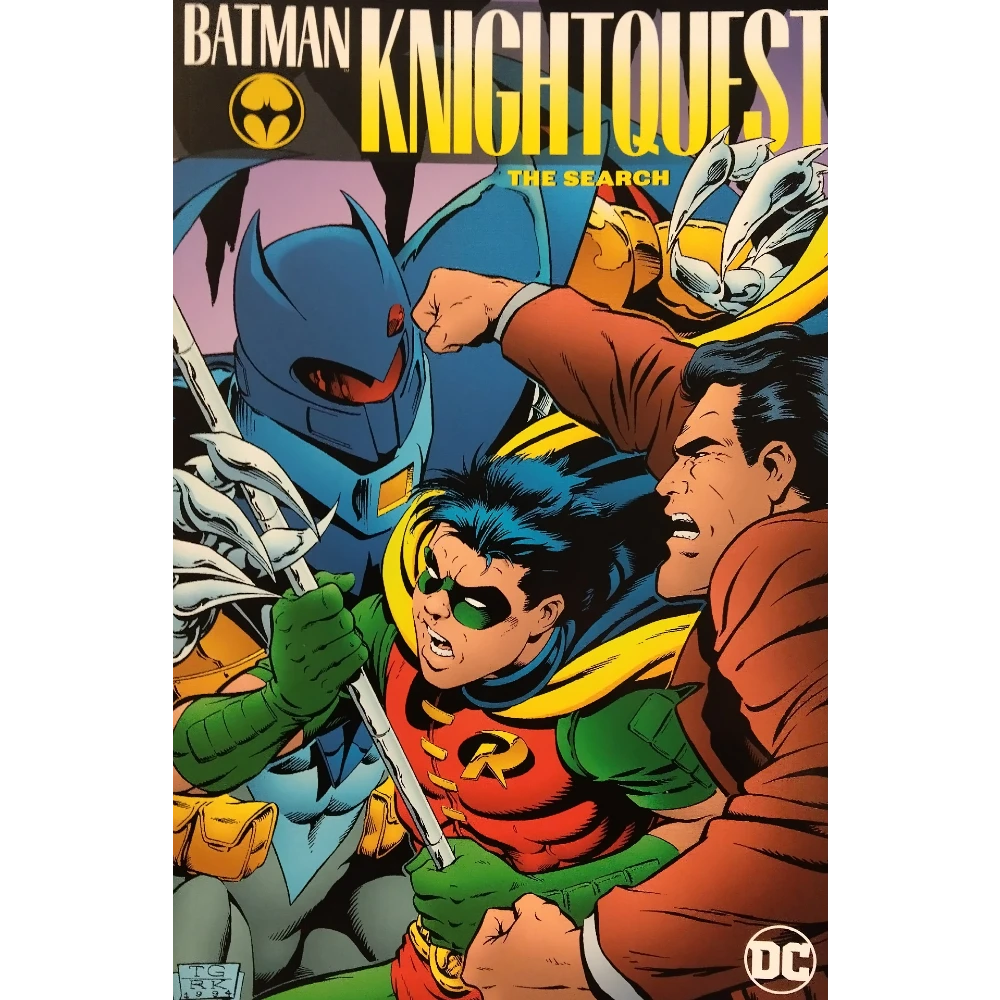
It's been a rough few months for Bruce Wayne.
See, this buff guy in a luchadore mask really wanted his head on a pike, so he started running Bruce ragged. Opened the brand-new Arkham Asylum wide like a lanced pimple and let an already exhausted Batman clean up all the escapees (they're the pus in this metaphor). Then the buff guy invaded Wayne Manor, confronted Bruce in his home, and broke Batman over his knee in the Batcave after a ridiculously one-sided fight.
But we're not done.
While Bruce was convalescing, he witnessed his doctor, Shondra Kinsolving–who's kinda, sorta seeing Bruce as more than a patient–get kidnapped, along with Jack Drake, Robin's father. So Bruce, still convalescing, still in a wheelchair, has hopped a flight out of the country along with his stalwart butler to save these people, the woman he loves and the father of his sidekick.
From my understanding, "The Search" was not collected until the nine-volume set celebrating the twenty-fifth anniversary of "Knightfall." It's not included in the "phonebook" versions I have of "Knightquest" or "Knightsend," and its exclusion confused me when I first read through the saga a few years ago. I managed to find a cheap enough copy to review today, but this volume has gone out of print and is currently difficult to find for a reasonable price.
In other words, if you want your own copy, you're gonna have to "search" for it.
However, if you believe the internet, this is considered the saga's "low point." Based on what I have to say here, maybe you're better off not searching for "The Search"?
Let's look and see.
Batman: Knightquest: The Search
Writers: Dennis O'Neil, Alan Grant, and Chuck Dixon
Pencilers: Sal Velluto, Bret Blevins, Ron Wagner, Eduardo Barreto, and Tom Grummett
Inkers: Jeff Albrecht, Steve George, Ron McCain, Ray Kryssing
Colorists: Glen Whitmore, Adrienne Roy, and Digital Chameleon
Letterers: Clem Robins, Todd Klein, Willie Schubert, and Albert DeGuzman
Issues: Justice League Task Force #5-6, Shadow of the Bat #21-23, Legends of the Dark Knight #59-61, and Robin #7
Publication Dates: October 1993-January 1994, April 1994-June 1994
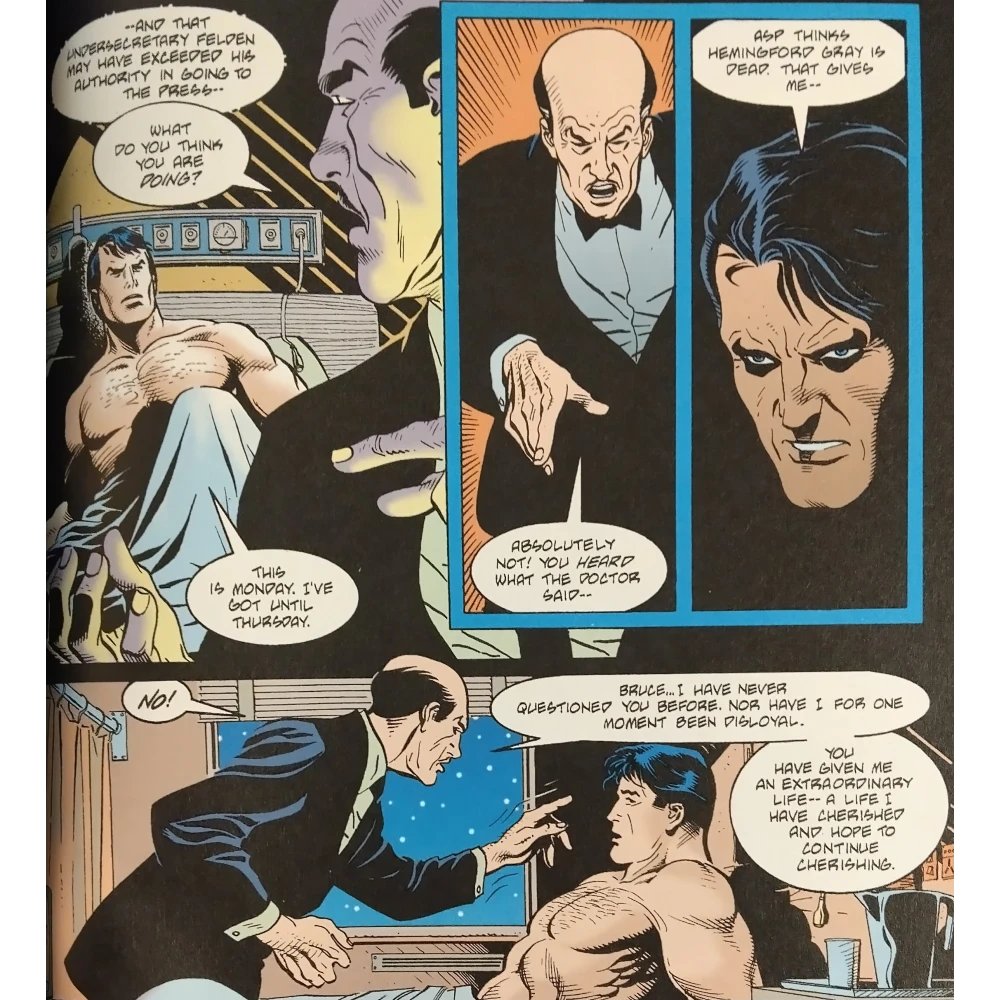
If you read only the "phonebook" editions of the "Knightfall" saga, you realize pretty quickly that, near the end of the first volume, shortly after Bruce's back-breaking beatdown by Bane, Gotham's favorite son ups and vanishes…and doesn't really appear in the following collection. Hopping on that plane with faithful Alfred, Bruce leaves Gotham in the hands of his trustworthy sidekick and the maniac in the armor. To him, his beloved city is safe, protected by a worthy replacement while he hunts for his latest lady love and Tim Drake's dad, hoping to not fail the boy the way he believes he did with Robin's mom.
If you're among the curious (like myself) who genuinely wanted to know what happened to Bruce during the events of "Knightquest," this is the volume for you. Bruce's adventures needed to continue in some fashion; it's not like he was "dead" for months while someone else replaced him! Injured, without a costume, relying on alternate identities and disguises, plainclothes Bruce needs to fight through the pain wracking his body and rescue Shondra and Jack, espionage style. This is the James Bond version of Batman [editor's note: this was written before today's announcement that Robert Pattinson is the next Bond], if James Bond scoured the world in a wheelchair or on crutches and relied on his old butler instead of a brilliant quartermaster.
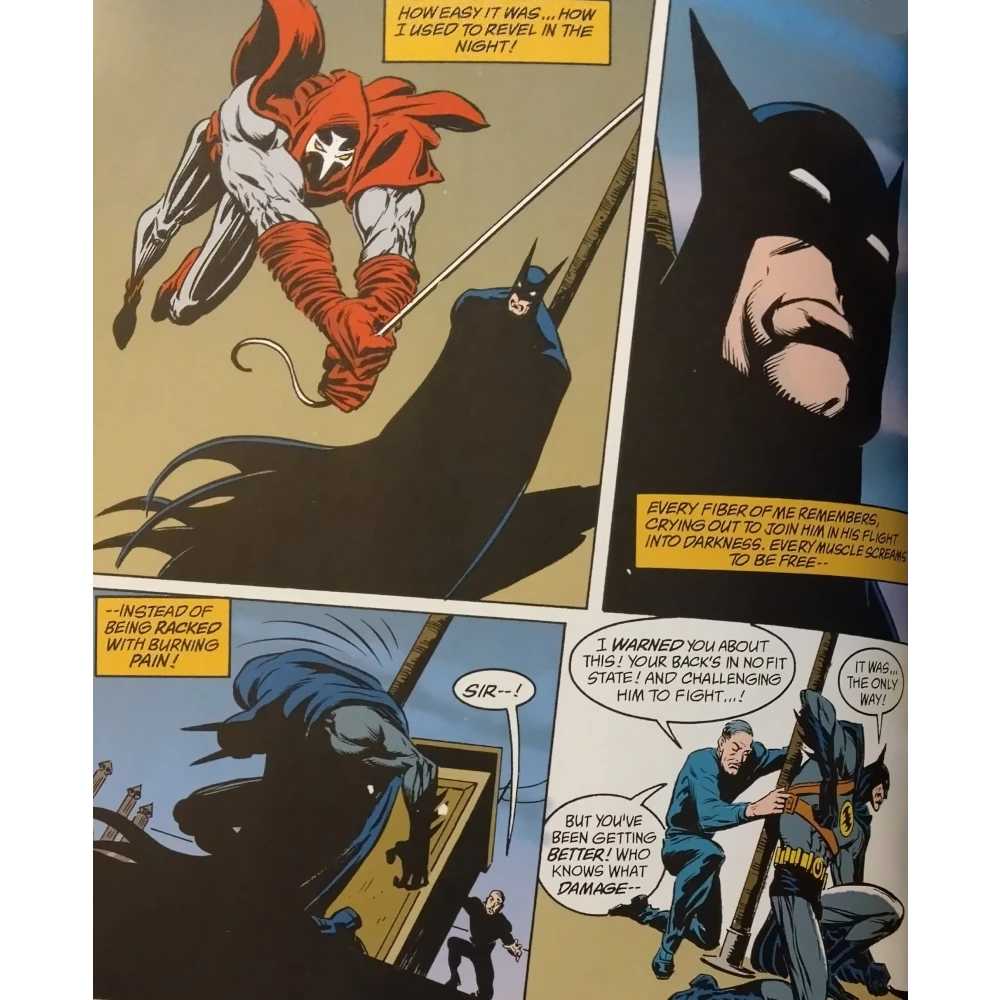
The physical limitations on Bruce are what make–or should make–this particular arc compelling. When writers lean into the injury, such as Alan Grant having Bruce collapse under the strain of standing while disguised or Dennis O'Neil having him flinch painfully during a fight, the idea works well enough. Always pushing himself, injuries or no injuries, Bruce is forced to work with his limitations, using his brains, skills, technology, Alfred, and a few Justice League allies to undertake this dangerous rescue mission.
(yes, I know I said "limitations" and then followed it up with a list of traditional Batman qualities–point is, he's not at his fighting best and can't go scrambling over rooftops or grappling across buildings the way he generally does, so though he retains certain indispensable skills, he's not nearly at his peak)
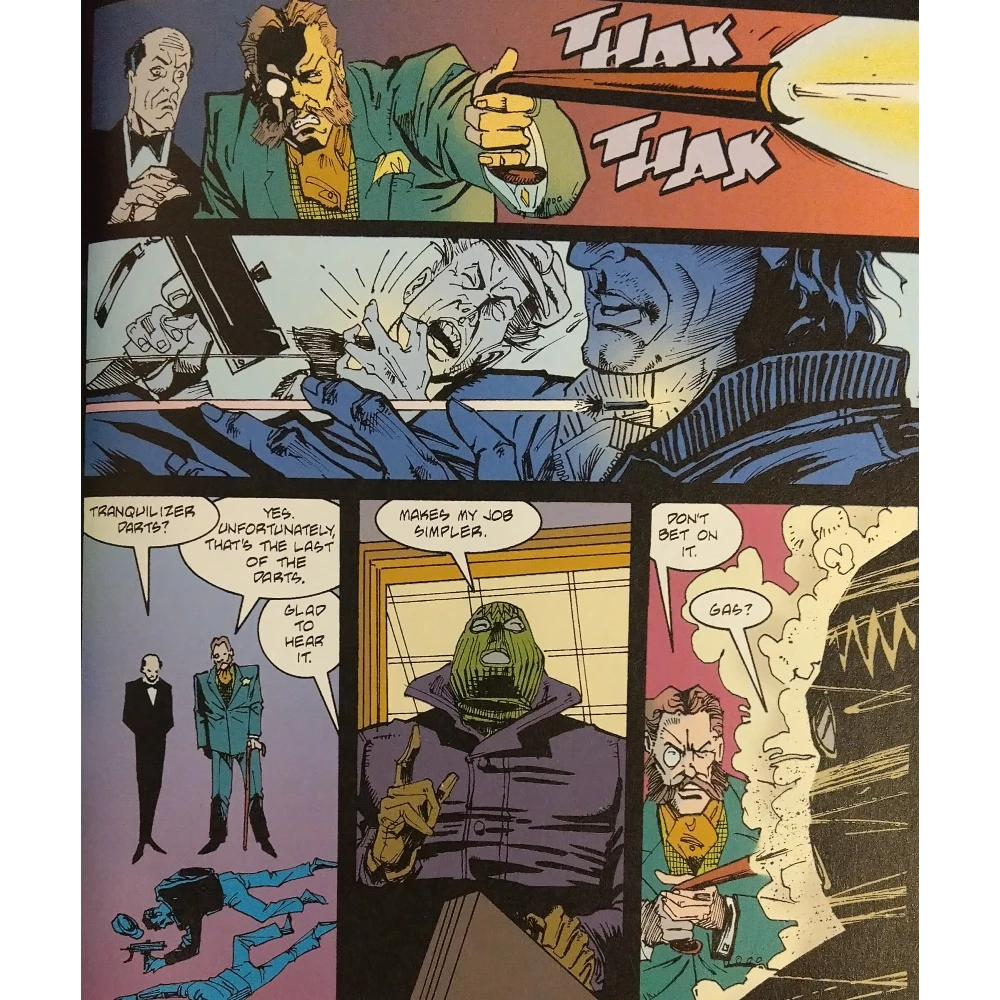
The struggle this leads to, naturally, is our writers presenting the believability of this entire concept. Even though he's Batman and can typically push himself beyond the edges of human endurance, would Bruce, in his injured state, still be as proficient as he manages to be? Dude's more fallible than he normally is, sure, but the guy still blocks and flips knives (in a really dope sequence) and beats attackers with his trusty canes, employing a certain grace to all his movements. It's really not until a final confrontation that Bruce seems to be the most at-risk physically, despite a few doctors noting he could damage his back permanently. Though that threat is floated by Bruce, it never tangibly shows itself.
So believable? Not really. You never get the sense Bruce will actually do something to outrageously jeopardize his recovery, despite his fairly consistent moving about and occasional brush with combat. The arc isn't so much about his convalescence until the very end, making me believe our writers realized, after Bruce's injury, they still needed to have the guy whose alter ego graces the covers of these series involved even though another dude was borrowing that moniker. So why not send Bruce Wayne on a globetrotting mission to give him a sense of control over something? Remove him from Gotham, giving Jean Paul Valley free rein over the city and isolating Robin outside the occasional phone call. Distance him from the crossover's central events to, perhaps, make his return all the grander when it happens.
I assume that was the point and that most plotting occurred after our writers decided to have Bruce temporarily abscond from his beloved city. That is, at least, my chosen reason for explaining why this arc appears plotted on the fly, anchored by convenience. The ending especially has become, from what I can find online, contentious for a few reasons, which I'll discuss below, but other particulars boggle the senses. Several developments coalesce out of thin air–Bruce comes to discount and suspect the trustworthiness of a valuable individual after what amounts to an awkward brush-off; Alfred essentially abandons his master, arguing he's grown tired of Bruce's exertion and agenda, despite having not expressed much contention prior to the issue where he leaves; Bruce at one point disguises himself to look like–who else?–Bruce Wayne, hoping to throw off the scent of some temporary allies believing him to be Batman by making himself appear as the Dark Knight disguised as the billionaire industrialist. Makes complete sense, right?
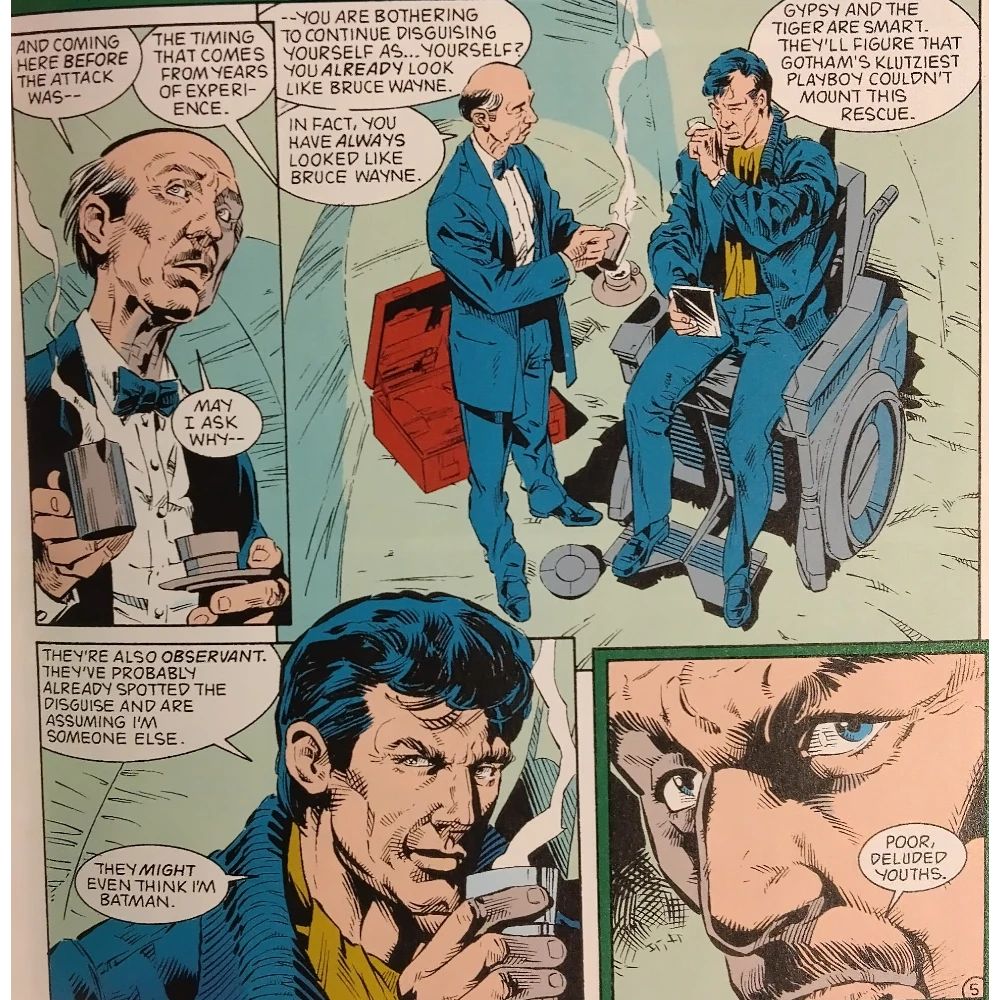
This is really a six-issue arc, eight if you count the Justice League Task Force installments, which feels like cheating as Bruce and Alfred are guest stars in that particular title. O'Neil and Grant try to do what they can to develop a plot in the space provided, but because this feels off-the-cuff, they never manage to quite find that balance between allowing the arc to showcase Bruce's strengths beyond his injuries and tell a compelling story. Convenience dogs the ending of most chapters, as Bruce gets close, so close, with victory stolen from his grasp at the last second, leading into the next issue's continued chase. And so on, and so forth.
Less globetrotting and a more centralized locale may have been appreciated–the Scottish Alan Grant provides some interesting commentary on British politics and the introduction of a new vigilante, but between him and O'Neil, Bruce bops around a few too many places. O'Neil smartly entrenches part of the plot in Santa Prisca, the island nation he introduced in The Question and used during "Venom," the same island housing the prison where Bane was born. Little is made of that specific connection, but I was grateful to see O'Neil ground the story in some of his previous narratives.
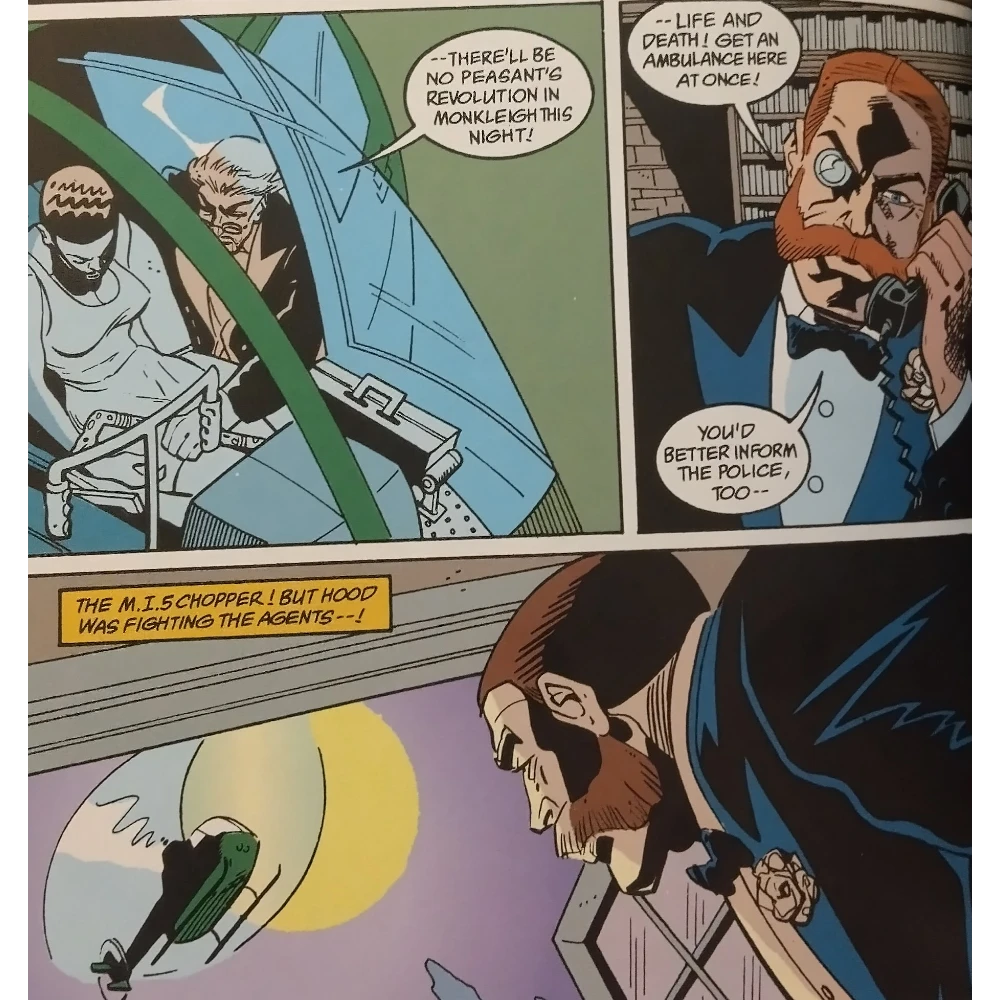
As noted, folks find umbrage with the ending, for two reasons: it mishandles a supporting character's story, and it offers a fairly convenient conclusion to an ongoing thread. On the second point, I agree. The character in question isn't a bad addition to the Batman mythos, yet their specific reason for appearing and reappearing feels rather forced and unlikely. I won't argue with their dismissal This conclusion, however, removes them from their current role by relegating them to a suboptimal situation that feels mean-spirited, as if the writers realized assigning them such high importance was a mistake, rectified it quickly, and then made like Pontius Pilate and a basin.
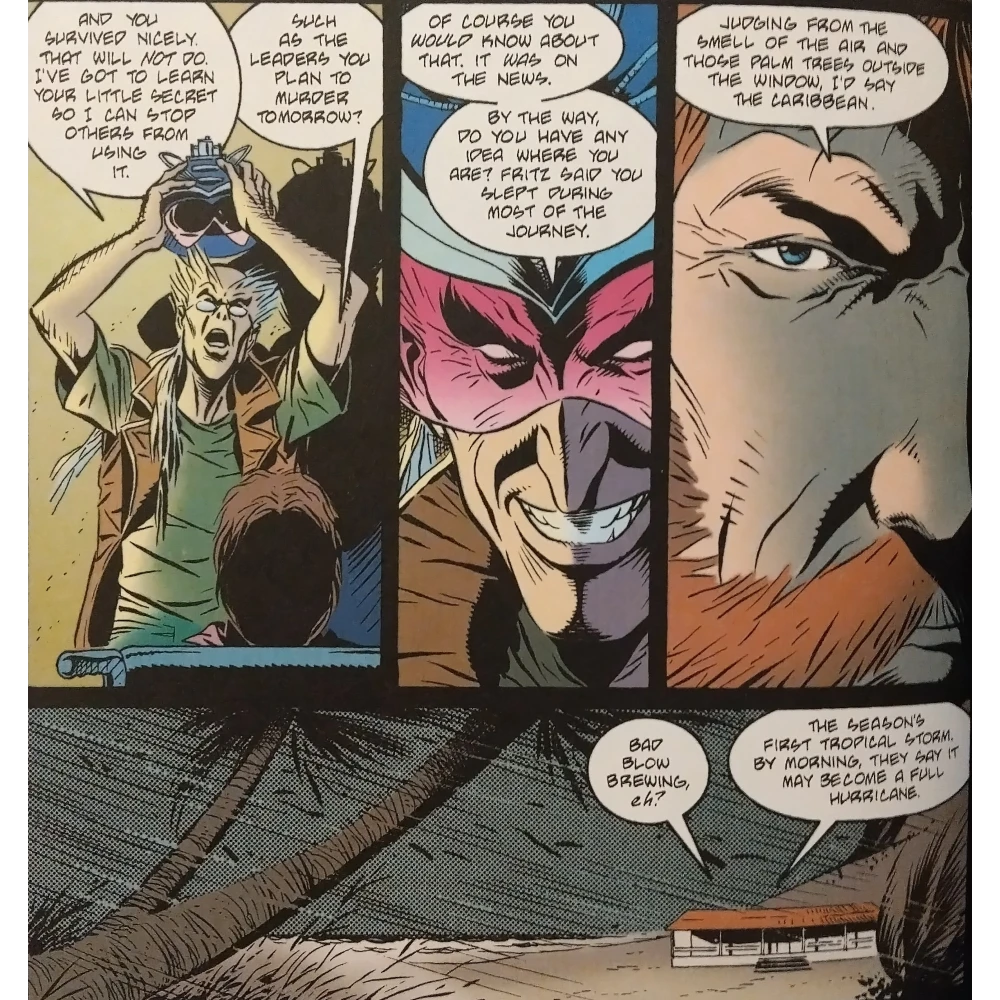
On the first point, I don't feel as strongly. Grant and O'Neil's plot has a pseudo-scientific element which works moderately well, if not a little strange for Batman's more grounded adventures. Folks complain this specific element lends the ending convenience. I'd like to agree, except for the fact that both Grant and O'Neil utilize this element enough in previous issues to, at least, justify the conclusion it provides. Does this plot element's introduction smack of convenience from the start, that Grant and O'Neil likely turn to this particular development just so they can use it for the conclusion? Sure, but they're still a tad subtle about it, letting the convenient moment occur the second it happens without teasing it obviously. Or maybe I just feel like an idiot that I didn't catch on to their machinations sooner than I did. Either way, I'm willing to offer leniency.
Compared to some of the other "Knightfall" sections I've read, "The Search" does feel like the weakest part of the overarching narrative so far. It's akin to when Marvel moved Peter Parker and Mary Jane to Portland when Ben Reilly took over the Spider-Man mantle–you want the guy who's been heading up the books for decades to still appear, even if he can't headline in the same capacity he did previously. Gotta give broken Bruce something to do. What he's given isn't as thrilling as what's going in Gotham, nor is it quite as dynamic from a character perspective. The idea has merit, and when our writers can focus on his lingering pains and the possible steps taken on recovery, "The Search" works. But it mostly unravels a pseudo-scientific plotline, relies on convenience, and hinges on spur-of-the-moment developments…leaving "The Search" feeling like it should be looking for itself.