Distinguished Critique: Batman: Knightquest Review
Azrael may occasionally be dull, but his arc as Batman is palpable commentary on 90s tropes
—by Nathan on August 29, 2026—
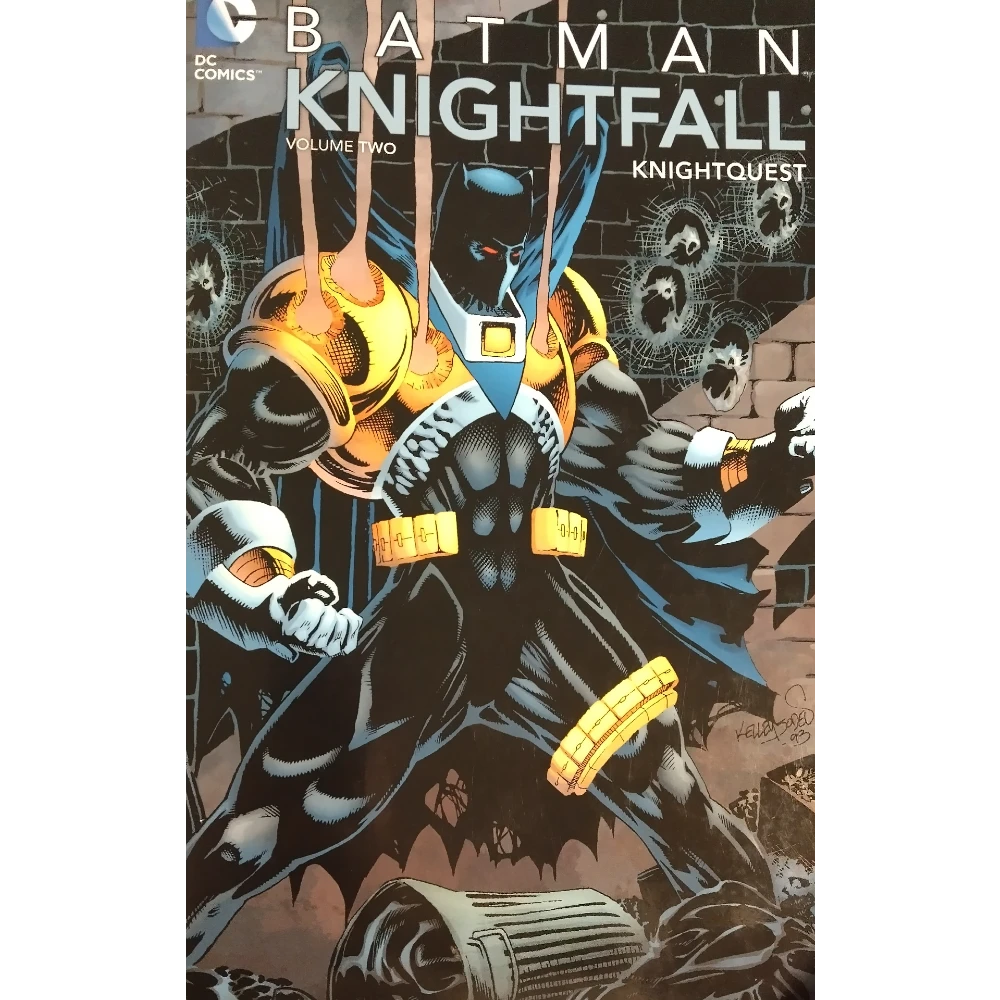
The Bat has fallen.
Long live the Bat.
During the first third of the crossover event known as "Knightfall," the Dark Knight Detective came face-to-face with the man-mountain known as Bane. Despite his prodigious skills and intelligence, Batman, worn down by weeks of dispensing justice against a laundry list of rogues, succumbed to the beating of a lifetime. Raising him above his head, Bane brought Bruce down and broke Batman's back over his knee like you would a twig for kindling. And much like you might use a twig, Bane was more than happy to cast Batman on the pyre of Gotham and watch the city burn.
Before you begin fretting, our assembled creators provided a glimmer of hope in the wake of Bruce's abysmal defeat: a new Batman, come to take the city back from Bane and the cavalcade of crooks still running loose. But instead of an experienced member of the Bat family taking the mantle, like Nightwing, the relatively inexperienced and headstrong Jean Paul Valley, the formerly brainwashed Azrael, took the Batsuit for a spin…and found it wanting.
As this volume opens, Bruce is still convalescing from his wounds (though we'll see more from him in a later review). Tim Drake, the third Robin, is flitting about, wondering about his role in the new regime. Because Jean Paul has ideas about how a Batman should be–a different outfit, a different attitude, a different method of crimefighting. Unfortunately for criminals everywhere, "different," our writers will soon make clear, may just mean "more brutal." And that's bad news for even the good guys.
Where's Nightwing when you need him? Heck, we'll take Alfred at this point.
Batman: Knightquest
Writers: Doug Moench, Chuck Dixon, Alan Grant, and Jo Duffy
Pencilers: Graham Nolan, Vince Giarrano, Mike Manley, Barry Kitson, Jim Balent, Bret Blevins, and Tom Grummett
Inkers: Scott Hanna, Vince Giarrano, Mike Manley, Eduardo Barreto, Dick Giordano, Bob Wiacek, John Beatty, Josef Rubinstein, Frank McLaughlin, Robert R. Smith, and Ray Kryssing
Colorists: Adrienne Roy and Buzz Setzer
Letterers: John Costanza, Todd Klein, Ken Bruzenak, Bob Pinaha,Willie Schubert, and Albert DeGuzman
Issues: Detective Comics #667-675, Shadow of the Bat #19-20, #24-28, Batman #501-508, Catwoman #6-7, and Robin #7
Publication Dates: October 1993-June 1994
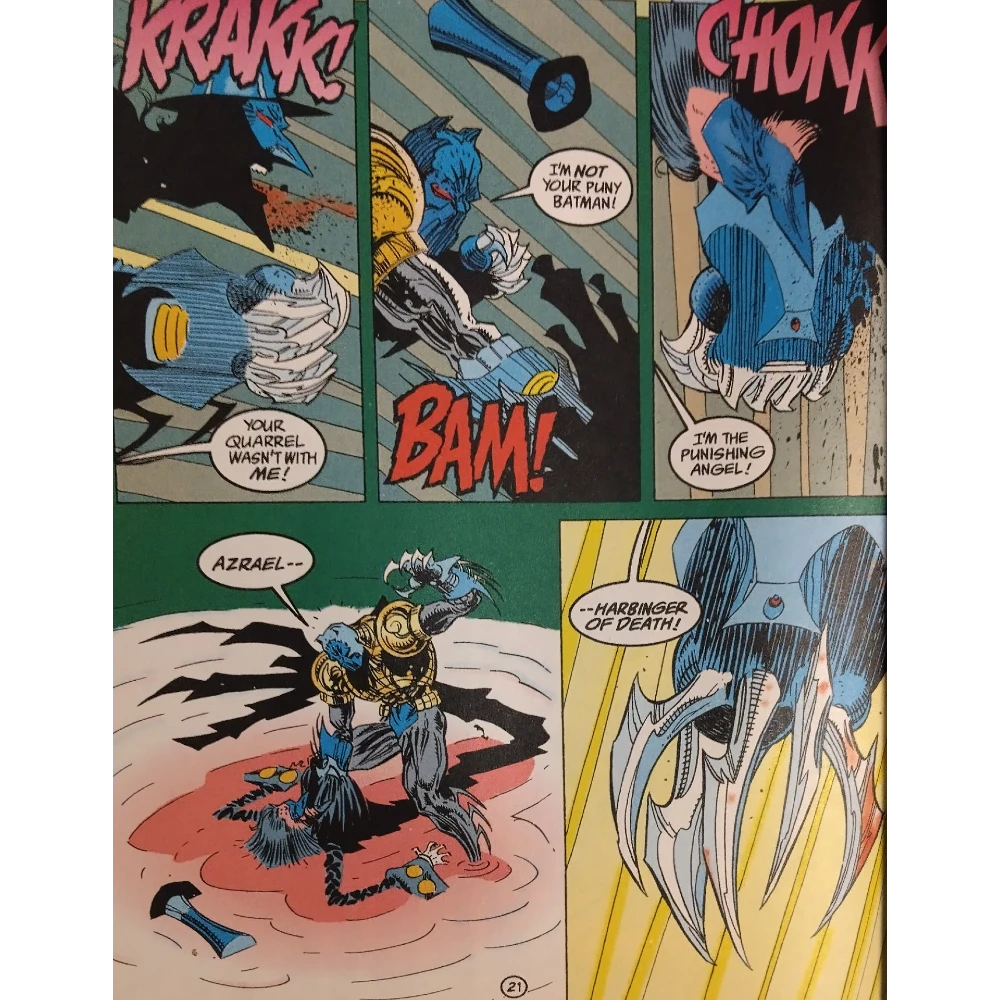
I groused somewhat in the "Knightfall" review that I felt Moench and Dixon's establishment of "AzBats" as the wrong replacement for Bruce Wayne occurred too quickly. Right out the gate, Jean Paul is a far more brutal Batman in how he handles criminals and callous in how he treats Robin. The mistake is clear from the start: Bruce has selected the wrong guy. Course, he just had his back broken, so no criticism on clouded character judgment. Azrael is selected out of desperation–again, where's Nightwing when you need him?–though he attends to filling the role with gusto…
…gusto which quickly turns "filling" into "supplanting." Moench, Dixon, and Grant aren't just interested in a Batman who's more physically violent than Bruce. The driving factor behind Jean Paul's personality, which is fleshed out fairly well, is his need to be better. This is like Otto Octavius overriding Peter Parker's mind and his determination to become the "Superior Spider-Man." Though not a villain, per se, Azrael is driven to construct for himself an unmatched legacy as the Dark Knight, even as he wars against the brainwashing he experienced at the Order of St. Dumas. Will he follow the path of St. Dumas in tracing an assassin's footsteps? Or a hero in how his father would have wished him to be?
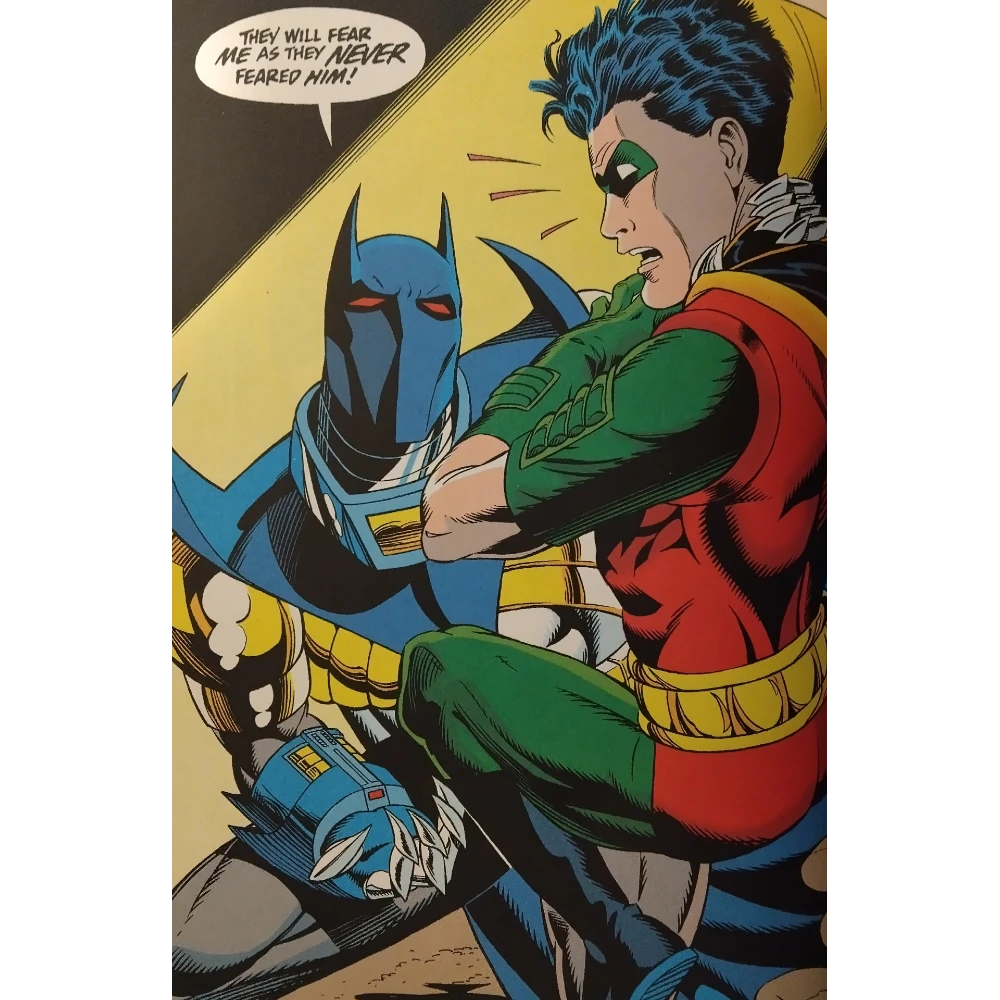
Azrael is not wholly unlikable, yet aside from this internal whirlpool of intentions, he's not much of a sympathetic character, which is a complaint I've had since first reading the character. More often than not, he's stalking the streets of Gotham in increasingly complex suits of bat-armor, tricked out with better weapons systems to enhance his effectiveness. Aside from a brief infatuation with Catwoman, Jean Paul has no personal life whatsoever to speak of, barely emerging from the Bat-cave in street clothes. I made the Superior Spider-Man comparison above, but it's also apt to compare Jean Paul to Ben Reilly: the Scarlet Spider, after taking over the Spider-Man identity from Peter, worked to develop a life for himself outside the costume. A job, a girlfriend, anything tangible. Such paltry interests have no hold on Jean Paul.
I struggle with criticizing that approach too much; I would have liked to have seen Jean Paul develop a deeper personality outside of his crusade, but from my understanding, this is exactly the point the creators are endeavoring to make. What makes Batman a fascinating character is precisely his humanity, his divide between the night-cloaked vigilante and the somewhat oblivious billionaire (though that obliviousness, admittedly, is itself a mask). Strip that away, and you get either a regular Joe with a lot of money or a hard-edged vigilante unable to make peace with himself. AzBats fits the latter definition; separated from any lifestyle outside the suit, he proves himself inferior to the original even as he claims superiority. Being a better Batman isn't just about who can pummel the most jerks.
The downside, of course, is what I noted above: Azrael isn't terribly interesting as a character. What this means is that the individuals and environments around the new Batman must step up to pull the heavy lifting. Instead of sympathizing with the new Batman, you're asked to sympathize with a young mother looking for her missing child, two different Clayfaces seeking to make something out of their unorthodox version of matrimony, a police force scrambling to cope with Jean Paul's violent methods, a frustrated Robin who is literally locked out of the Bat Cave, and a serial killer's victims. In proving himself, Jean Paul becomes embroiled in the lives of others, and how he affects those lives, positively and negatively, adds weight to the scales of his ability or inability to be Batman.
Even if you don't appreciate his personality, you may wind up enjoying Jean Paul's tenacity. There's no arguing his is a unique take on the mantle, perfect for this era of excess. He's armed to the teeth. He installs a rocketcar that jets him across the city faster than any Batmobile. First opportunity he gets, he beats the living daylights out of the Joker. There's heroic goodness lodged within his heart–he rescues a young woman from falling, saves a bus full of children, prevents a baby from dying–but that nobility is warped. In certain situations, such as saving the bus, he makes the right decision, rescuing the school kids instead of pursuing a criminal…
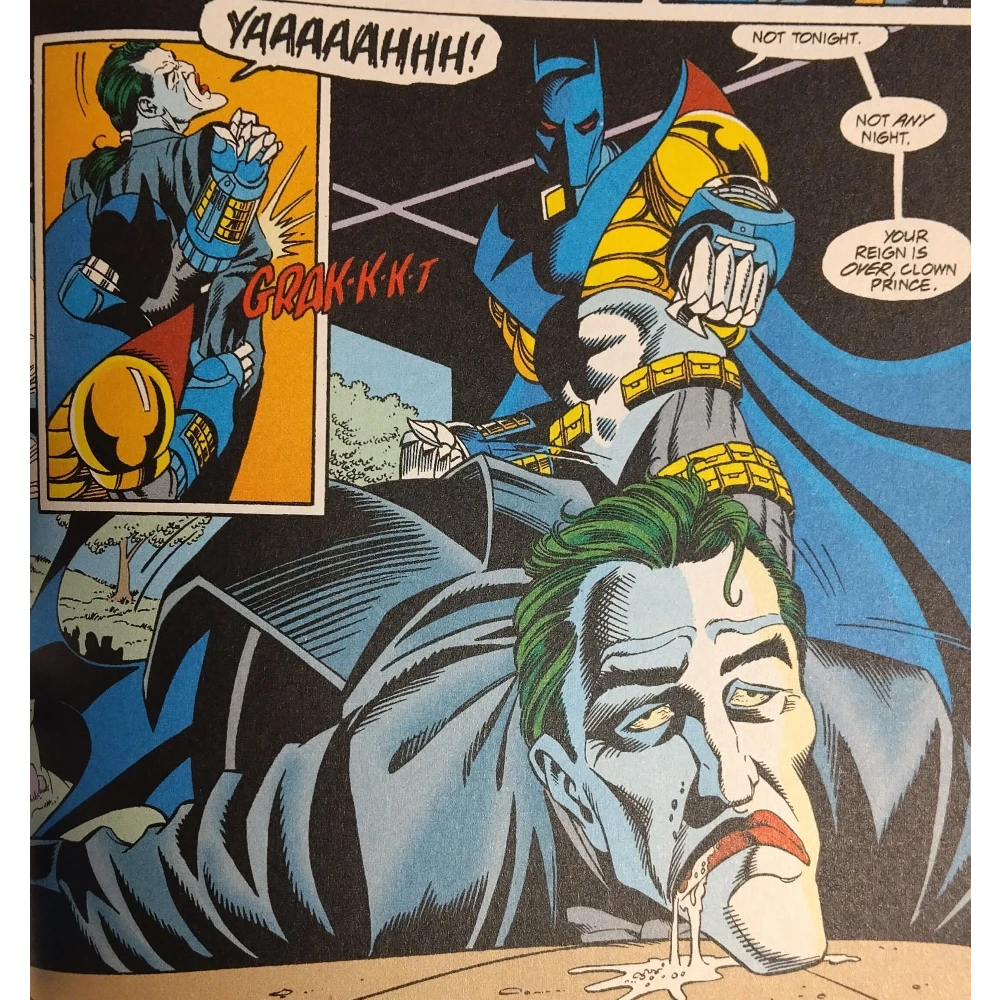
…yet his darker instincts emerge elsewhere, and this is particularly where Moench and Dixon condemn our new Batman's version of vigilante justice. This is, perhaps, the best example of an "arc" given Jean Paul, that as he becomes more effective by his own definition, as he eclipses Bruce Wayne's legacy in his own mind, he stumbles and bumps along in everyone else's eyes. In the volume's most poignant arc, Jean Paul engages a serial killer targeting several members of his own family (the serial killer's, not Jean Paul's). Across all three titles, our writers draw out a few confrontations between hero and villain, Jean Paul's determination blinding him (aside from the initial decision to save those schoolkids), particularly when his heroics are needed most. The resulting climactic confrontation leads to two deaths Jean Paul could prevent, and though he walks away free from having murdered anyone, he skirts that edge fairly closely.
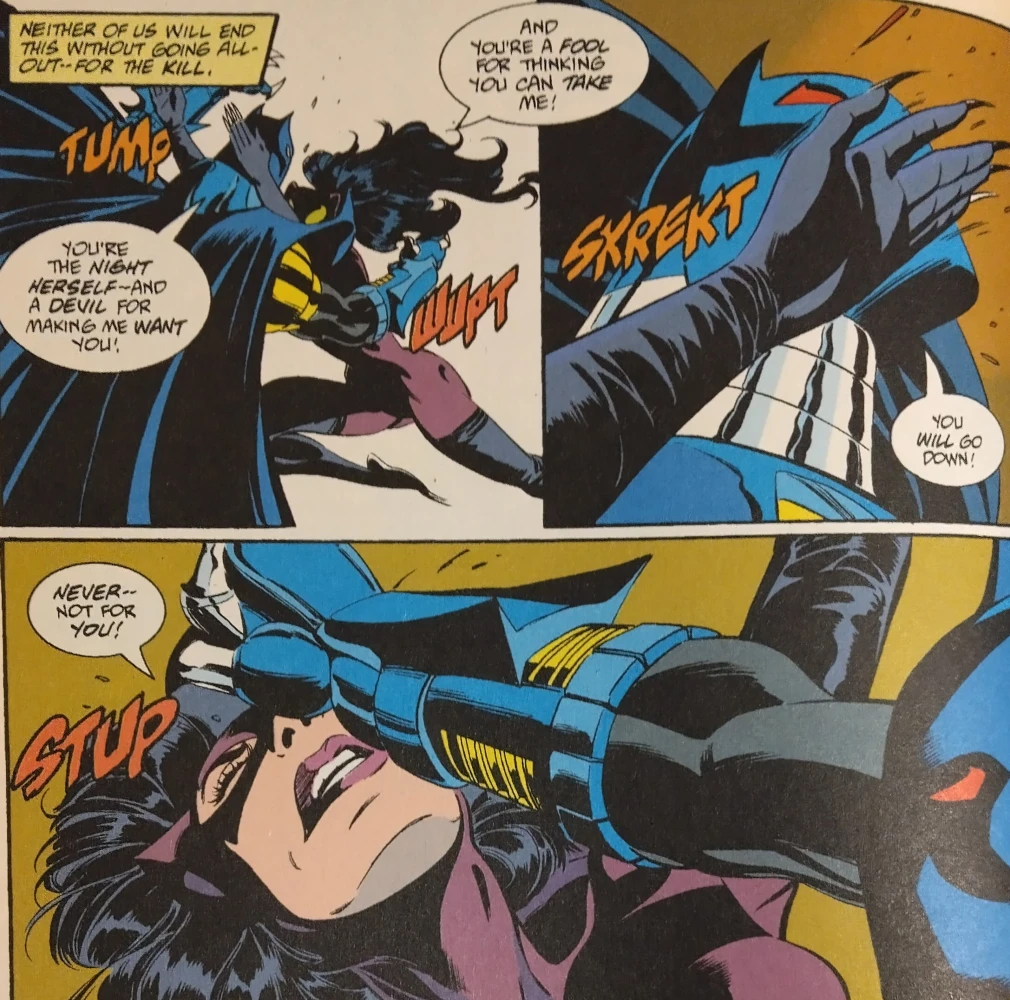
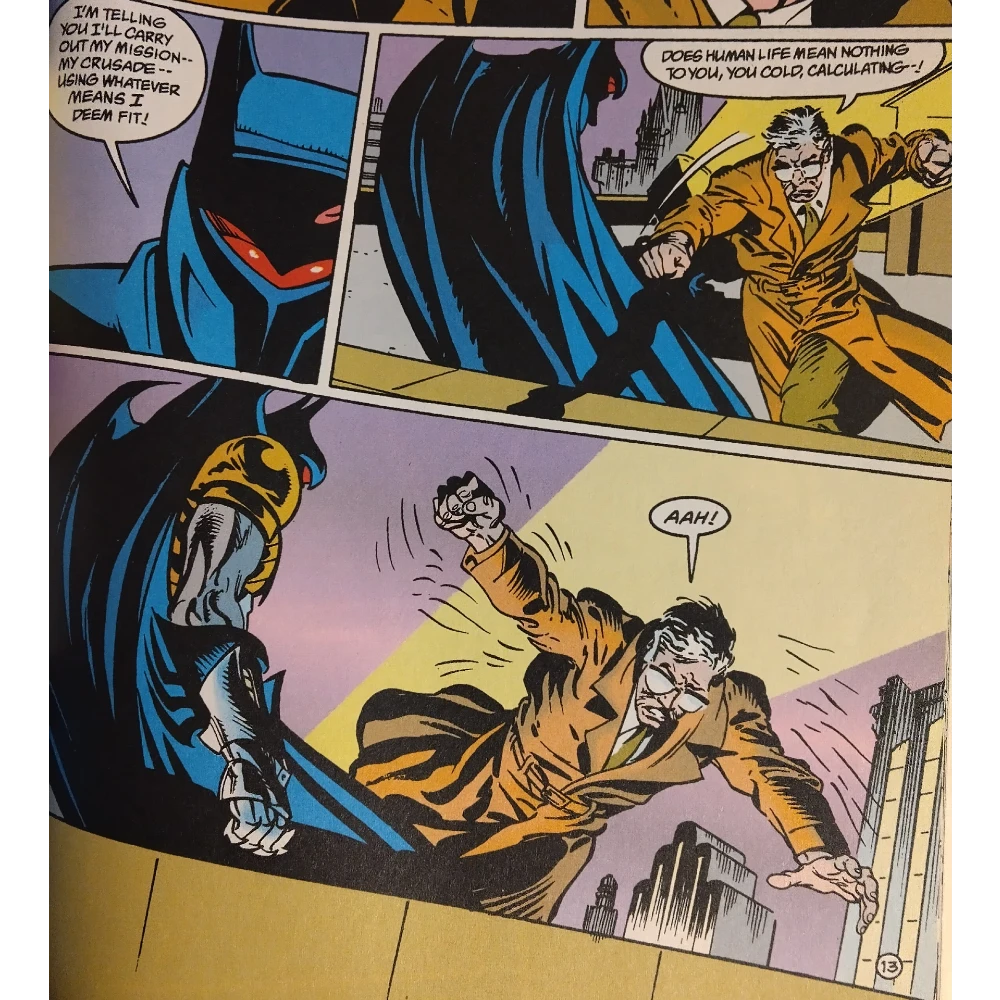
Moench, Dixon, and Grant each like to toy with the brutal irony of Jean Paul's decisions, specifically his disintegrating relationships. Grant uses one powerful sequence to show how much trust James Gordon has lost in Batman, the GCPD commissioner practically demanding to know his identity, convinced this armored knight is not the same man he's served alongside for years (and given that certain stories have implied Gordon knows Bruce is Batman, his reactions feel justified). Despite his momentary infatuation with Catwoman, Jean Paul treats her coarsely, his demeanor during their first interaction convincing her, like Gordon, he isn't Bruce (even if he wasn't copyright infringing on Iron Man's look) and proving his interest is nothing but a passing fancy, unlike Bruce's longstanding admiration. He may think himself the better Batman, but on the outside, Jean Paul fools no one.
I (somewhat recently) reviewed a few stories, such as Kurt Busiek's Marvels and Astro City and Warren Ellis' brief Thor run, which attempted to pull back from the darkness enveloping the 90s. Ellis' run found itself mired in the era's trappings, through no fault of his own, corporate policy dictating an emphasis on status quo rather than change. Both of Busiek's series capitalized on the joy inherent in the comic concept, colorful heroes either styled after their Silver Age selves or representing versions of Silver Age characters. "Knightquest" avoids any of that joyful reflection, choosing to wade through the mire–Jean Paul faces serial killers, armored mercenaries, jingoistic assassins. The malleable Tally Man wouldn't look out of place in a Spawn comic, the durable Ballistic could fight Cable to a standstill, a rejuvenated Mr. Freeze has more in common with Mr. Zsasz than his typical frosty self.
Yet "Knightquest" escapes the critiques I tend to lob towards these "extreme" comics, because it uses these tropes intentionally. Batman, as a man, is wholly unique. As Jean Paul warps the mantle into this edgier titan of violent vigilantism, so too is he drawn into a world surrounded by other violent killers and fiends. Like begets like. As commentary, "Knightquest" isn't boisterously derisive, showing us through Jean Paul's crusade the era's foibles. Just like "The Death of Superman" removed Clark Kent's alter ego so writers and artists could explore a world without Superman, so has "Knightfall" broken a Bat for "Knightquest" to explore a world without the true Batman. As much of an epic as Bruce's defeat at Bane's hands was, this second part of the saga is telling the real story. AzBats himself could use some color in his personality, but even this could be a critique against him wearing the cape and cowl. "Knightquest" may feature a bland hero, but perhaps that's just to make you root for the real Batman's return. To paraphrase Steve Rogers: "There's only one Batman, ma'am, and I'm pretty sure he doesn't dress like that."