Distinguished Critique: Batman: Knightfall Review
Even with a few poorly paced moments, this opening salvo successfully breaks one Batman and watches a new vigilante rise
—by Nathan on June 25, 2026—
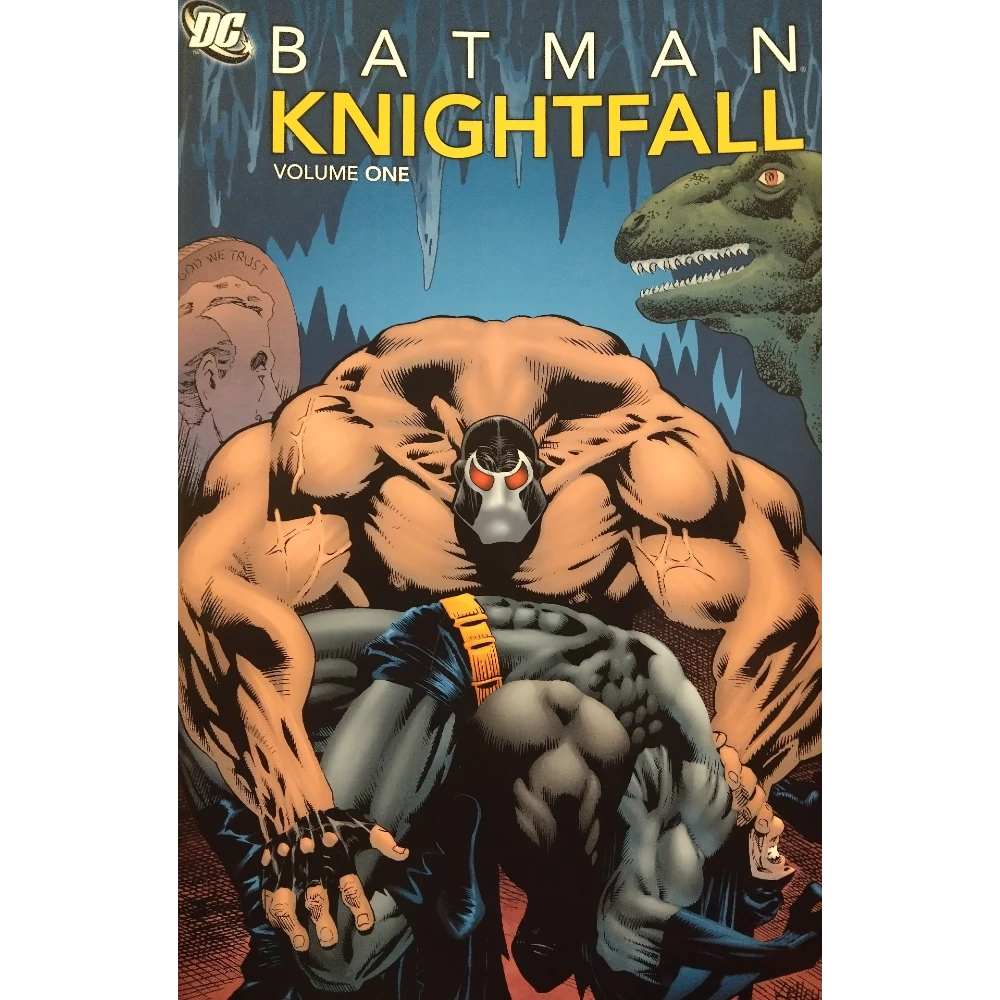
The term "main event" often describes the most prominent bout during a night of wrestling, the match-up audiences are dying to witness. As someone who has never watched wrestling, I'm more familiar with the term applied elsewhere in a colloquial fashion. Today, we're using it to describe a showdown between two opponents, though without the benefit of a referee.
We've been building, across several posts, to this particular event: the dramatic confrontation between Batman and Bane. For a few posts now, I've been teasing connections to this arc, whether through similar plots or themes, important supporting characters, or the serum from which Bane derives his strength. Last pre-"Knightfall" post, we watched as events spiraled outside Bruce's control and his attempts to regain that control. Those efforts pushed him closer and closer to exhaustion, and he sits on the brink of it as we open here. Yet more damaging circumstances are awaiting him…and that's even before he reaches that climactic "main event" with the man who has sworn to break him.
Batman: Knightfall
Writers: Doug Moench, Chuck Dixon, and Alan Grant
Pencilers: Jim Aparo, Norm Breyfogle, Graham Nolan, Jim Balent, Bret Blevins, Klaus Janson, and Mike Manley
Inkers: Scott Hanna, Norm Breyfogle, Jim Aparo, Tom Mandrake, Bob Wiacek, Josef Rubinstein, Dick Giordano, Mike Manley, Brett Blevins, Steve George, Terry Austin, Rick Burchett
Colorists: Adrienne Roy and Klaus Janson
Letterers: Richard Starkings, John Costanza, Tim Harkins, Ken Bruzenak, Todd Klein, and Bob Pinaha
Issues: Batman: Vengeance of Bane #1, Batman #491-#500, Detective Comics #659-666, Showcase '93 #7-8, and Batman: Shadow of the Batman #16-18
Publication Dates: January 1993, April 1993-October 1993
There are two different stories told in this volume: the tale of the broken bat, and the tale of the bat who replaces him. Together, they form the first third of this epic trilogy crossing different Batman titles, the same way "The Death of Superman" and its subsequent chapters ran across different Superman series. Normally, I would complain and say this crossover is just a cashgrab tactic to spread a thin story over more issues than necessary; though that argument is valid for other stories, most of what we see here factors into the full "Knightfall" saga. Not all of it is necessary, as I will note, but all of it functions under the direction of telling a complete story.
I complained in my "Prelude" review that the Batman and Detective Comics issues seemed a little divided in how they told the story of Bruce nearing crippling levels of exhaustion. Chuck Dixon didn't emphasize the point nearly as much as Doug Moench, with Moench providing symbolism to indicate Bruce's decaying physical and mental state and Dixon doing little more than having him fall asleep in an armchair. Not the same level of intensity. In this volume, Moench and Dixon appear to be more on the same (comic) page, each man doing his part to lead Batman through this latest gauntlet. Where Bruce battled less-known and new rogues in the "Prelude" issues, he goes toe-to-toe with several of his arch-foes here as he draws ever nearer to the brink of total collapse…and Bane.
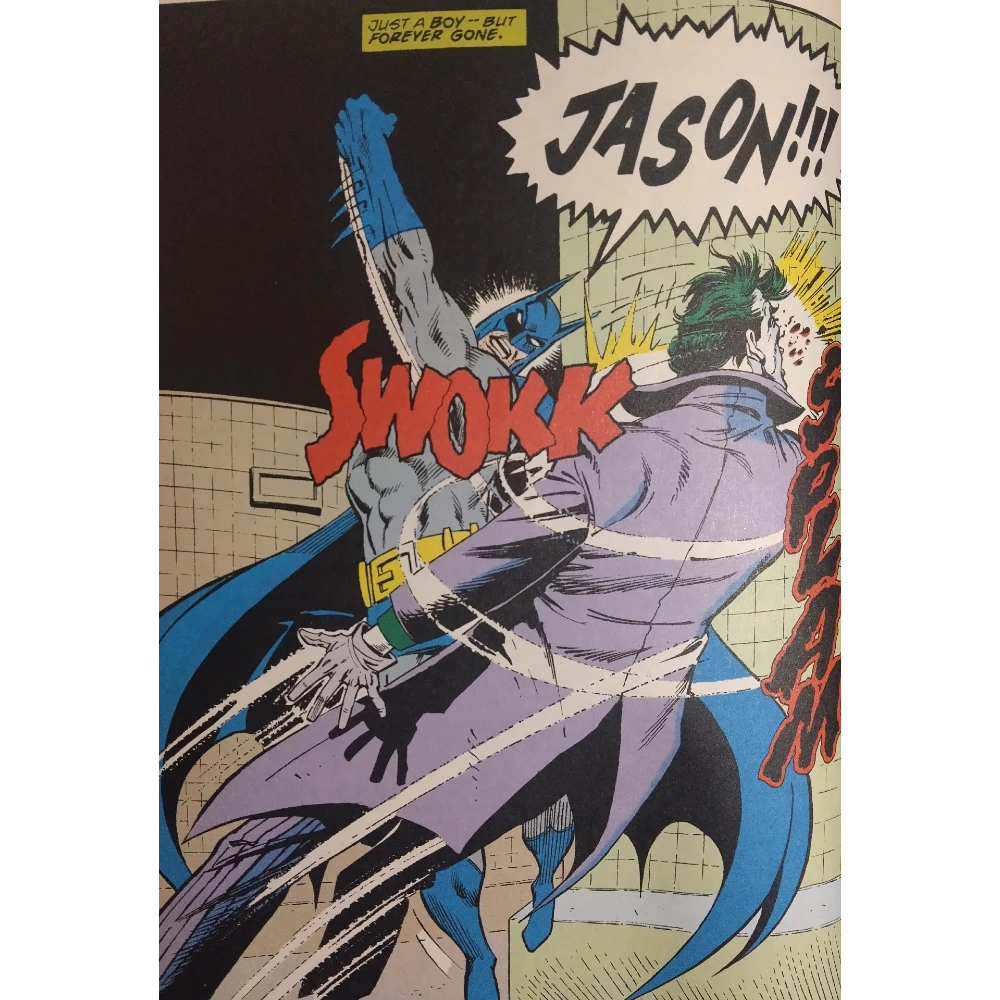
For about half the total volume, discounting the Vengeance of Bane one-shot also found in the "Prelude" volume, Bruce runs the gamut on classic adversaries, all freed during a recent Arkham breakout. Whether it's beating the Joker to a pulp while feverishly remembering Jason Todd's untimely murder, putting the kibosh on a twisted tea party thrown by the Mad Hatter, or preventing Alan Grant's serial killer Mr. Zsasz from adding another notch to his body count, Batman is put through even more of a physical wringer. Norm Breyfogle provides the sheer exhaustion on Bruce's face the best–even masked, the downturned mouth and dipped eyes silently beg for the consistent flow of torment to end.
In concept, it's a great gauntlet, a showcase of all of Bruce's worst enemies and demons coming out to give him a hard time. Plots involve the Joker and Scarecrow kidnapping the mayor, Zsasz holding a girl's school hostage, Firefly burning down places important to his childhood…they're not gunning after Batman specifically, and they don't even know they're pawns in Bane's scheme. They've been given carte blanche to run wild and do their absolute best at doing their absolute worst, sowing discord and death, with a bedraggled Batman putting up the best fight he possibly can.
This new round of battles and bruisings does make the "Prelude" issues feel a tad superfluous in retrospect–the point of those narratives was to pit Batman against villains who weren't the crème de la crème of Gotham supervillainy, to show that Batman was so broken already he could barely hold his own against idiots like the General and Headhunter. With all that in the rear view mirror, Bruce still has to contend with all his regular foes! If he could barely handle those wannabes, we're supposed to believe he can still dig down and pull out whatever reserves of strength he has left? Of course he can–he's Batman! It's what he does, pushing beyond the possibility of pushing. Fun as it is, the cycle does get redundant, and I would argue it may have been better for these issues directly leading to Bruce's battle with Bane to serve as the prologue. They're more interesting, dishing up classic crooks who know how to contend with a Batman hunting them.
I will admit I was attempting a bit of snark with the exultation toward Bruce's strength above. The character, by this time, had grown into the legend he's known as, a man of indomitable will and resolve. You want to see Batman succeed, regardless of how miserable he is. Yet the efforts become somewhat repetitive and a little difficult to swallow each time. He's so bedraggled, so run down, that you begin questioning whether he could actually withstand all of this punishment and still keep fighting. Yes, he's a comic book character, but he's also a man, and though his weaknesses and defeats show that humanity, it does tip towards ridiculousness at times.
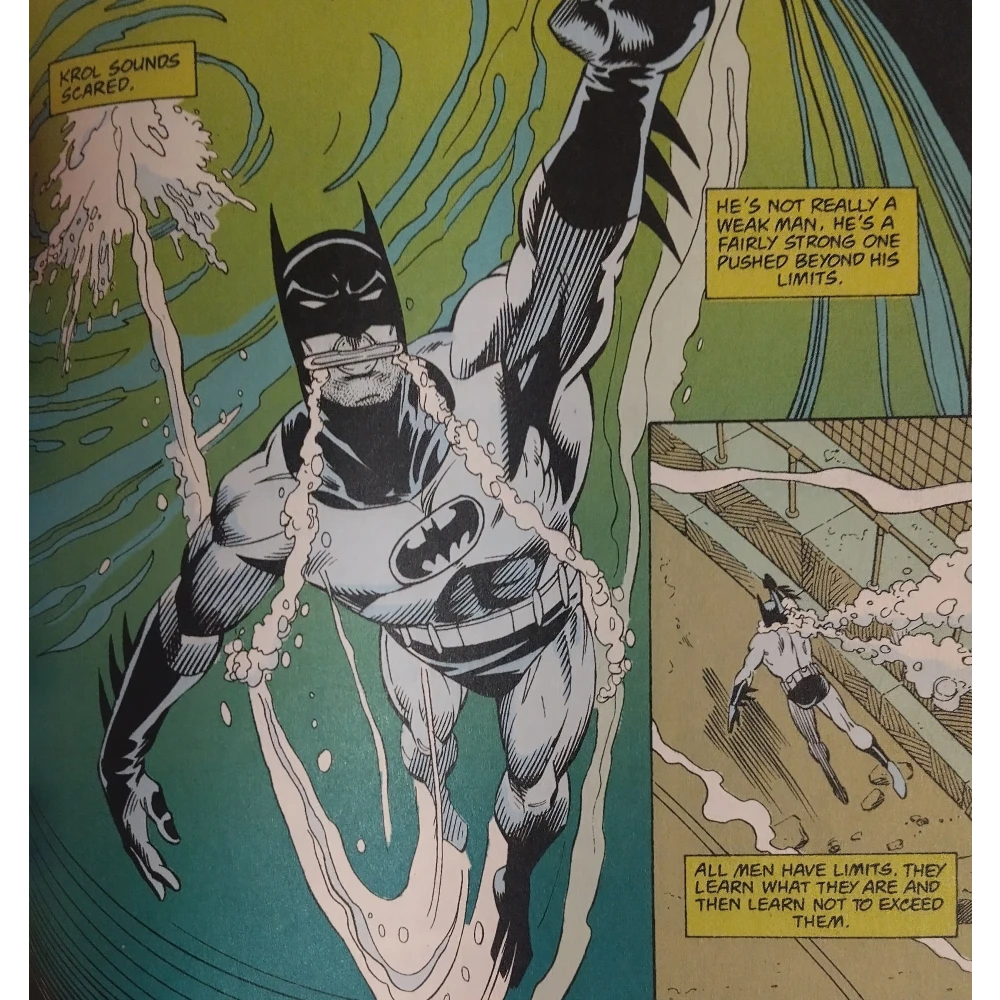
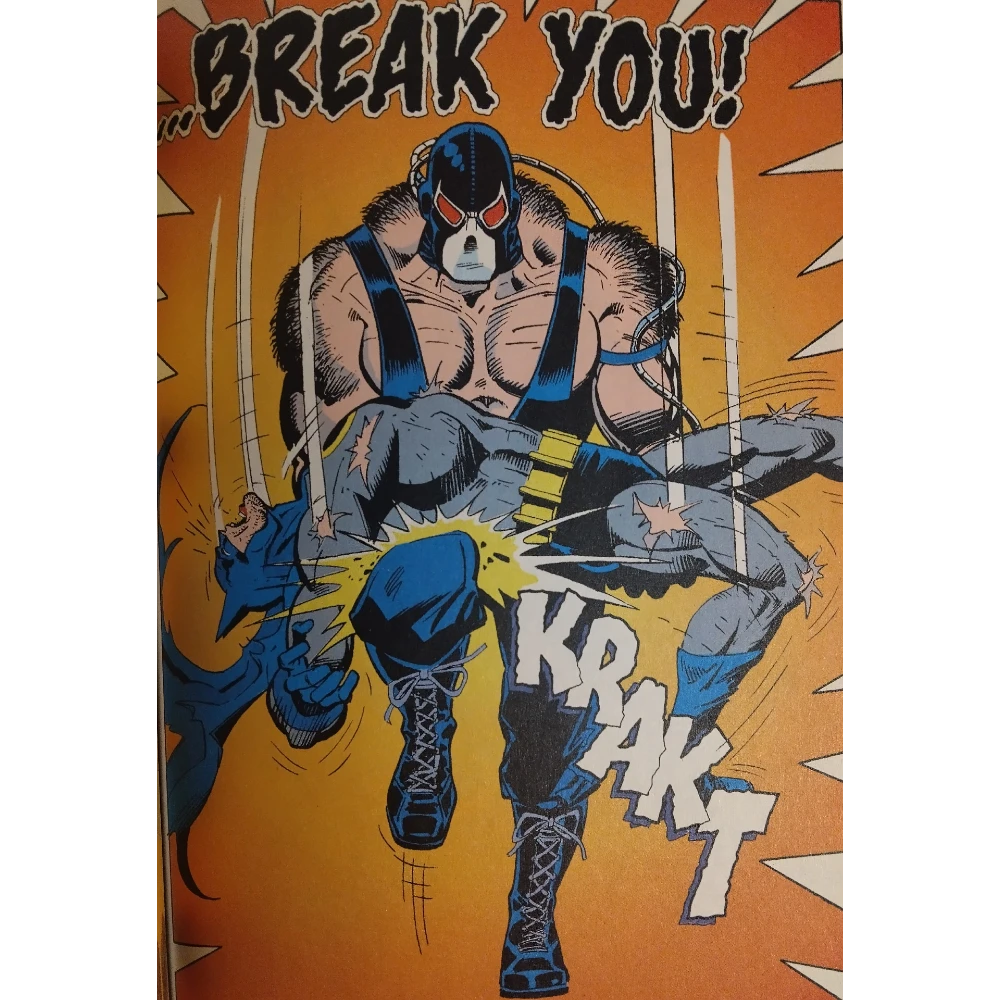
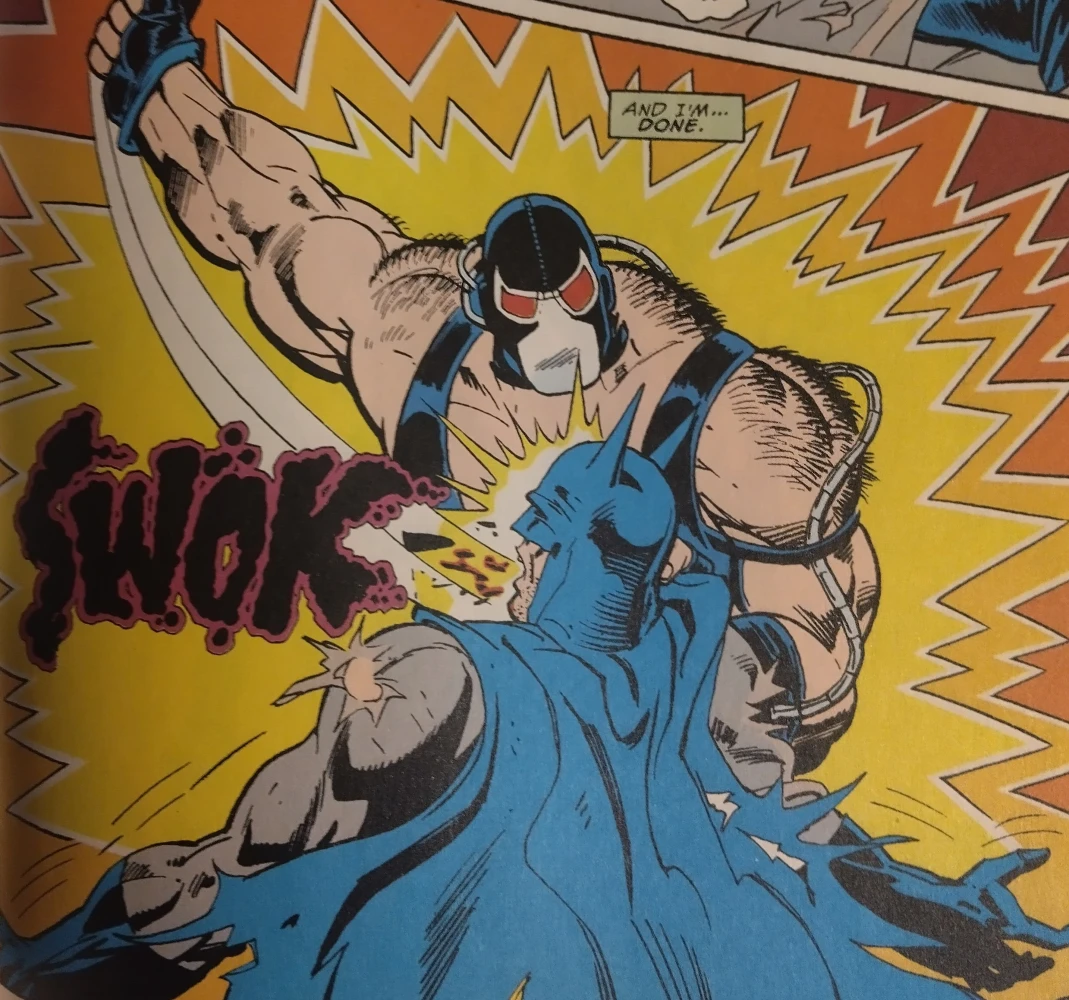
What is more palatable is believing that Batman's at his lowest point physically when Bane finally decides to show up…and, oh, man, does Moench use Batman #497 brutally. Folks are, naturally, aware of the iconic image of Bane breaking Batman over his knee (if not, refer to the image after the credits above), but that's just the red icing on a very bloody cake. The Bane/Batman fight is an absolute massacre, difficult to read for just how one-sided it is. The unfairness of the fight is palpable from the start, and instead of some master planner who's orchestrated all the events leading to this moment, Bane comes off looking like an absolute coward.
I feel it's intentional, and it lets Moench double down on Bruce's defeat. "Knightfall" is a commentary on 90s comics, something that will feel more tangible when Jean Paul Valley carries the mantle in the next volume, but even here, that symbolism can be found. A really big, really tough, really muscle-bound dude in a mask comes basically out of nowhere and pulverizes Batman, without putting a lot of work into the events previously. In some ways, Bane has planned and acted, but he's left so much work to either the new, edgy villains or the old, classic foes, that his moment feels somewhat subdued by his inaction. He shatters a Batman at the edge of breaking. Again, it's unfair, but it marks the shifting of a status quo. Batman, that man in a cape and cowl who's become a legend through the likes of Dennis O'Neil and Frank Miller, is broken by this punk on steroids.
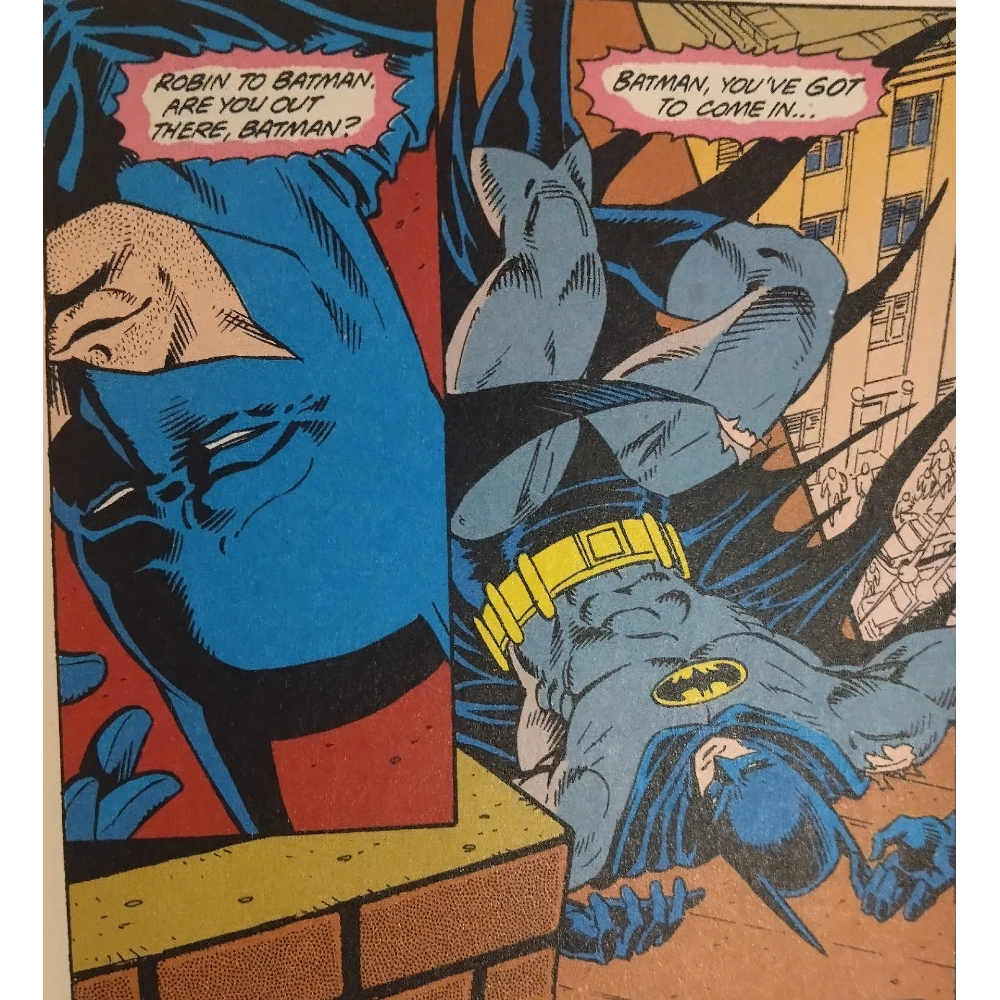
Moench and Dixon organically unfurl the effect of Bruce's defeat, from its impact on Batman's allies to the city at large. A broken Batman is tossed in the middle of a public street, terrifying the populace. Alfred and Tim Drake, recovering Bruce's battered body, worry over the Dark Knight's health–is he so broken he won't survive his injuries? Uncertainty ripples through the GCPD as they cope with a city without Batman. Dixon and Moench cleanly divide the ongoing conflict–we worry for a Gotham now in the grip of Bane, yet we're concerned with busted-up Bruce.
Thus, Jean Paul Valley enters the scene, and I'll note a bit more frustration with his character. I noted, in the "Prelude," I felt Dixon nicely teased Valley's penchant for violence and recklessness under the influence of the "system," brainwashing he underwent as part of his father's religious order. Here, the writers make it absolutely clear, from the moment Jean Paul accepts the Batman mantle, that this is going to be an ongoing problem. Though teased by Dixon previously, I feel that the near immediate indication that Jean Paul is the wrong choice occurs too quickly. He's instantly smug in accepting the position, noting he'll be better than Bruce. He's immediately hyperviolent, he physically threatens fellow vigilante Anarchy, and he's dismissive of Tim almost as soon as he dons the mask. Very little about him speaks to him being even a halfway decent replacement.
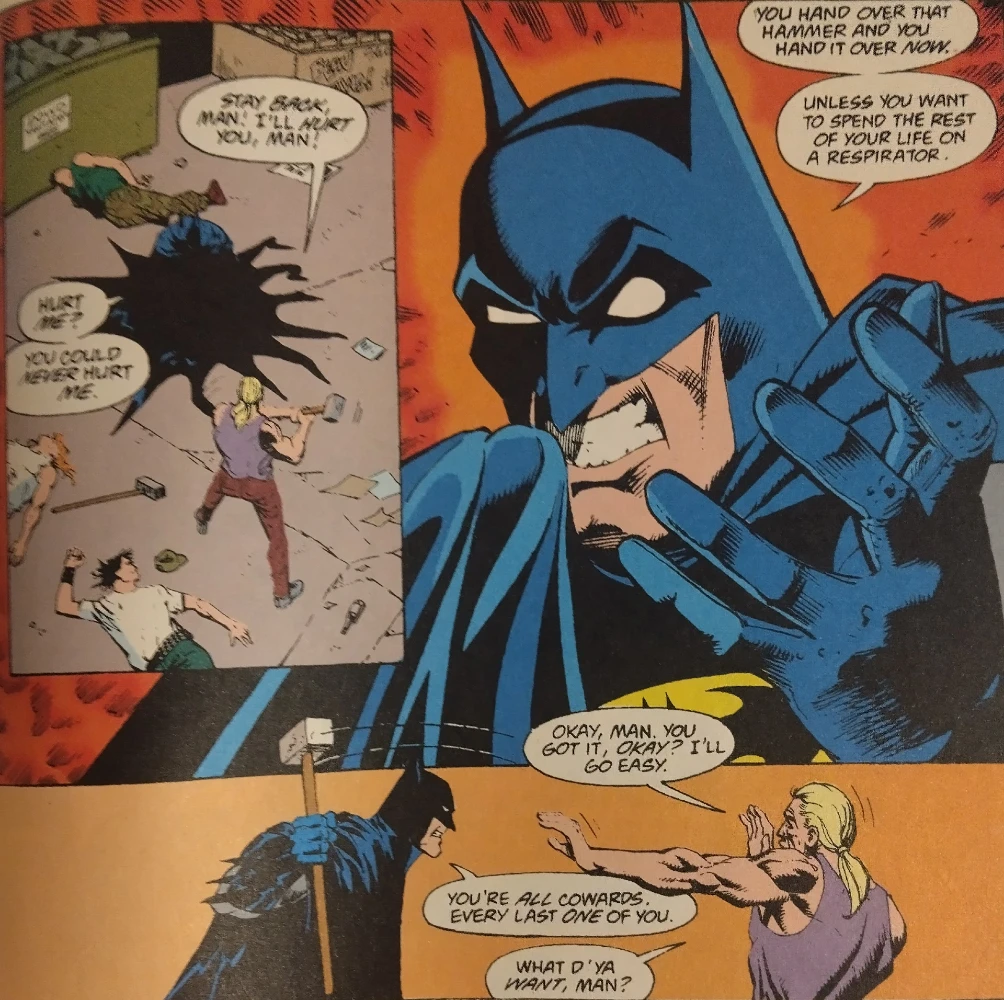
I hoped for a more gradual adjustment to his character, even a bit of hope that, just maybe, Jean Paul understands the brief while slowly losing the reader's confidence over time. Maybe there were people who really liked Jean Paul as Batman when this was being published! I don't, and I recognize that's the point of the arc, to show how Jean Paul's edgier methods of vigilantism pale in comparison to the nobility inherent in Bruce. Alan Grant, in a three-part Shadow of the Bat arc featuring the Scarecrow, has somewhat of a better grasp on this, allowing Jean Paul some backsliding, if "backsliding" could be considered a form of backwards character development, rather than shoving him into "definitely not Batman" territory. Jean Paul, at least, feels a bit more dimensional than he does in other issues.
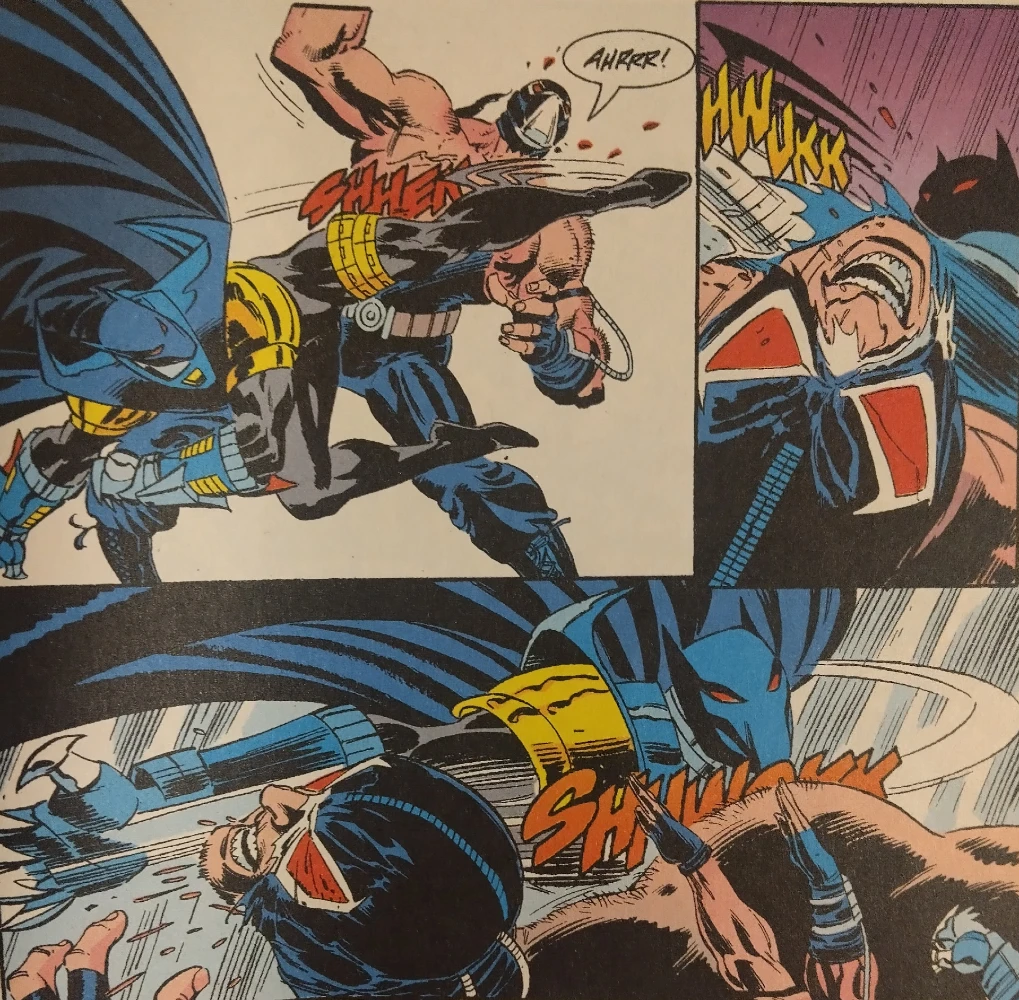
Where Moench and Dixon succeed is in this volume's final arc, a two-parter between Detective Comics #666 and Batman #500. As Bane cracked Bruce like an eggshell, so does Jean Paul, combining his Azrael know-how with Batman tech, absolutely trounce the man who broke the Bat. A fairly even opening fight leads to a well-deserved walloping later on, the new Batman securing his status in the minds and hearts of (most) people by soundly and brutally humiliating Bane. Even when you know Jean Paul will ultimately fail, and even when you know this beatdown is yet another example of his intentionally frustrating fierceness, it's a heckuva sequence. The Bat gets vengeance on Bane, and even if it isn't the same guy, it's the same symbol, it's a similar mask, it's the same name. Batman breaks Bane, and the fight's one-sided nature is a great callback to the first unfair fight in the cave.
Even after all these words, I feel I haven't completely covered everything this 600-plus-page tome has to offer. Fortunately, I have the paperback, so it isn't gonna break my toes if I drop it. What weight can be found lies inside, with these first culminating moments in the "Knightfall" saga. We end with one Bat broken by Bane and one Bane broken by another Bat. In-between is developed the weight of choices as Bruce pushes himself beyond exhaustion for the safety of his city, only to be replaced by a guy with souped-up tech and few of the morals Bruce ascribes to, even as a creature of the night. There's a lot here to appreciate, and even if some of the writing pushes Jean Paul Valley forward a little quickly, it's paced well in other places. A dreadful building of tension, followed by a precipitous fall, and the hints of a different rising tension, leaving us wondering how a new Batman will embrace, or perhaps erase, the mantle of the fallen Dark Knight.