Random Reviews: American Flagg!: Definitive Collection (vol. 1)
Howard Chaykin's dystopian series is dated in some ways yet feels insightful in several others
—by Nathan on August 2, 2026—

Close to a month ago, the United States celebrated its 250th birthday as a nation. To commemorate the occasion, I wrote a trilogy of reviews highlighting Jack Kirby's 1970s Captain America run, including a special issue intended to celebrate the nation's bicentennial. But there's another comic series with this country's name in its title which I could have reviewed as well.
It's about a guy named Flagg.
Reuben Flagg.
The brainchild of controversial writer/artist Howard Chaykin, American Flagg! (yes, with the exclamation mark) debuted as one of the first comics published by, well, First Comics, alongside creator-owned titles such as Mike Baron's Badger, Mike Grell's Jon Sable, and Baron and Steve Rude's Nexus. Perhaps in honor of First's Illinois roots, Chaykin set his series in the heart of a futuristic Chicago (not wholly unlike Mike Saenz and Peter Gillis' Shatter), starring actor-turned-law-officer Flagg.
The year is 2031, just a few short twelve-month hops from the day this blog is published (and if you're reading this five years from now, I appreciate it! Welcome! Stay a while). As the series opens, Flagg has faced a demotion of sorts, from that fairly popular actor gig to security officer. It's not flashy, but it has its perks…yet, as Flagg is soon to learn, there's a cost that comes with combating crime.
American Flagg!: Definitive Collection (vol. 1)
Writer: Howard Chaykin
Penciler: Howard Chaykin
Inker: Howard Chaykin
Colorists: Lynn Varley, Leslie Zahler
Letterer: Ken Bruzenak
Issues: American Flagg! #1-6
Volume Publication Date: January 2009
Issue Publication Dates: October 1983-March 1984
Publisher: First Comics (original issues), Image Comics and Dynamic Forces (volume)
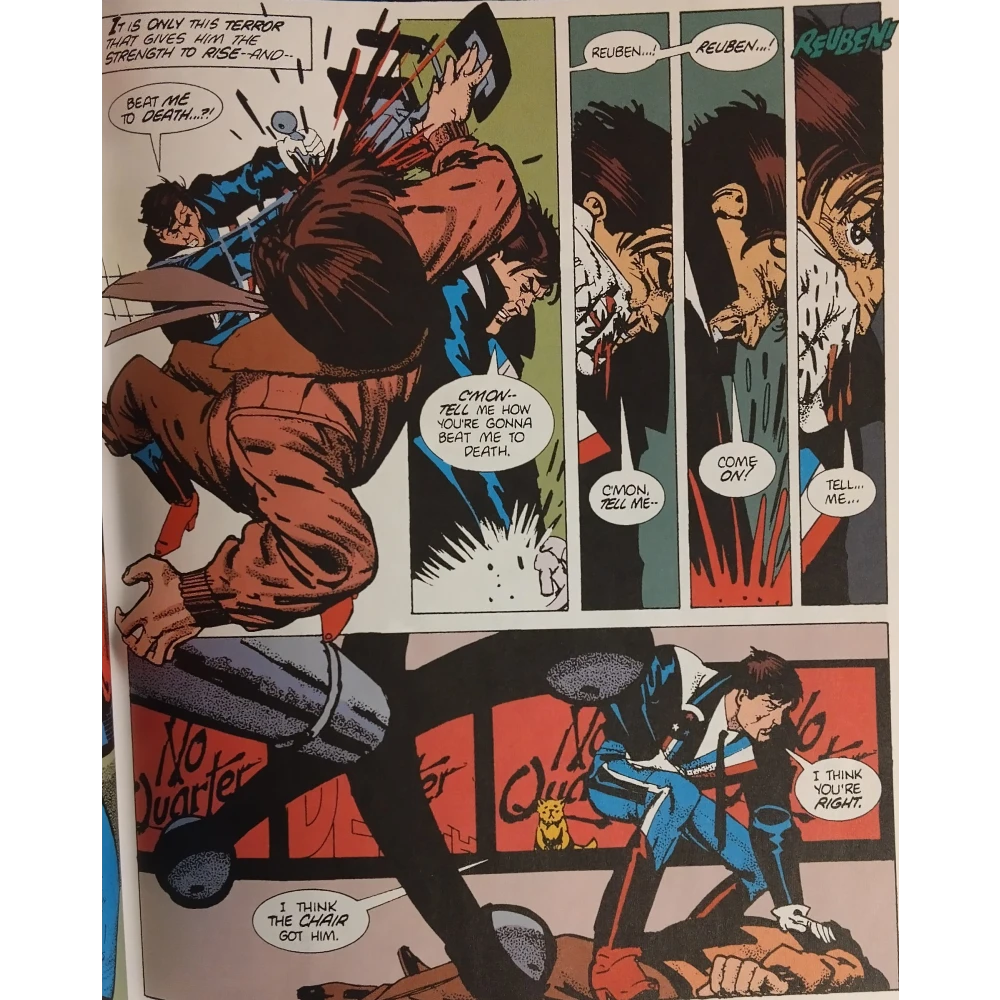
When I first read Fahrenheit 451, as a high school senior, I found Ray Bradbury's depiction of the American future chillingly relevant. "Prescient," I'll call it here. Bradbury takes the guts of American civilization and extends them in engaging yet not-too-far-fetched directions. The real world has televisions; Fahrenheit 451 has screens built into living room walls. Folks even use those walls to communicate with other people face-to-face virtually. Guy Montag's wife falls asleep listening to music on her thimble-sized earplugs, akin to our earbuds or earpods. You get the sense Bradbury saw the development of the world around him and asked what logical extensions he could invent. The results are uncanny.
There's a lesson within, of course. Technology invading the household, making for a more convenient yet less focused or purposeful life. Thoughtless individuals get swept into the maddening hate for printed literature, creating a world where firefighters now burn instead of save. In reading American Flagg!, I couldn't help but notice the similarities between Bradbury and Chaykin, in concept if not exactly in execution. Chaykin looks at the world of 1983, drawing details from his environment, and projects a vision of the future across the pages.
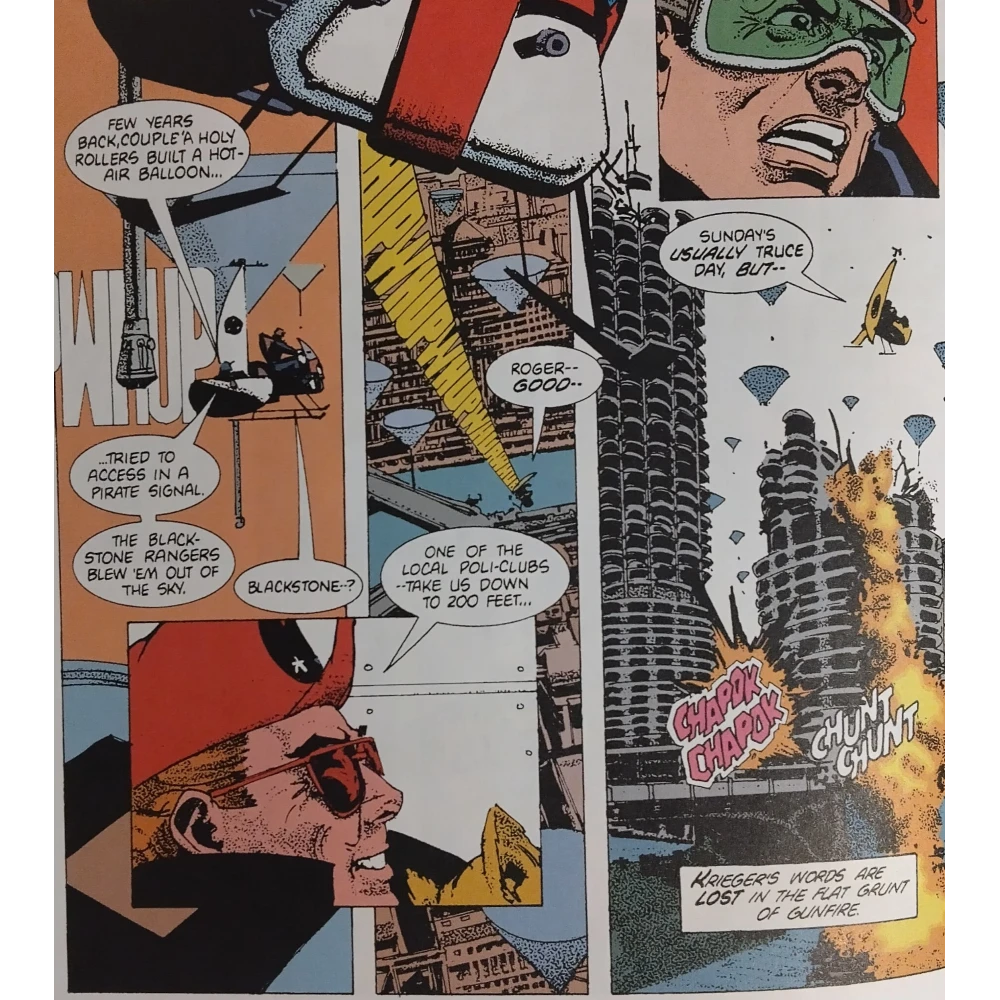
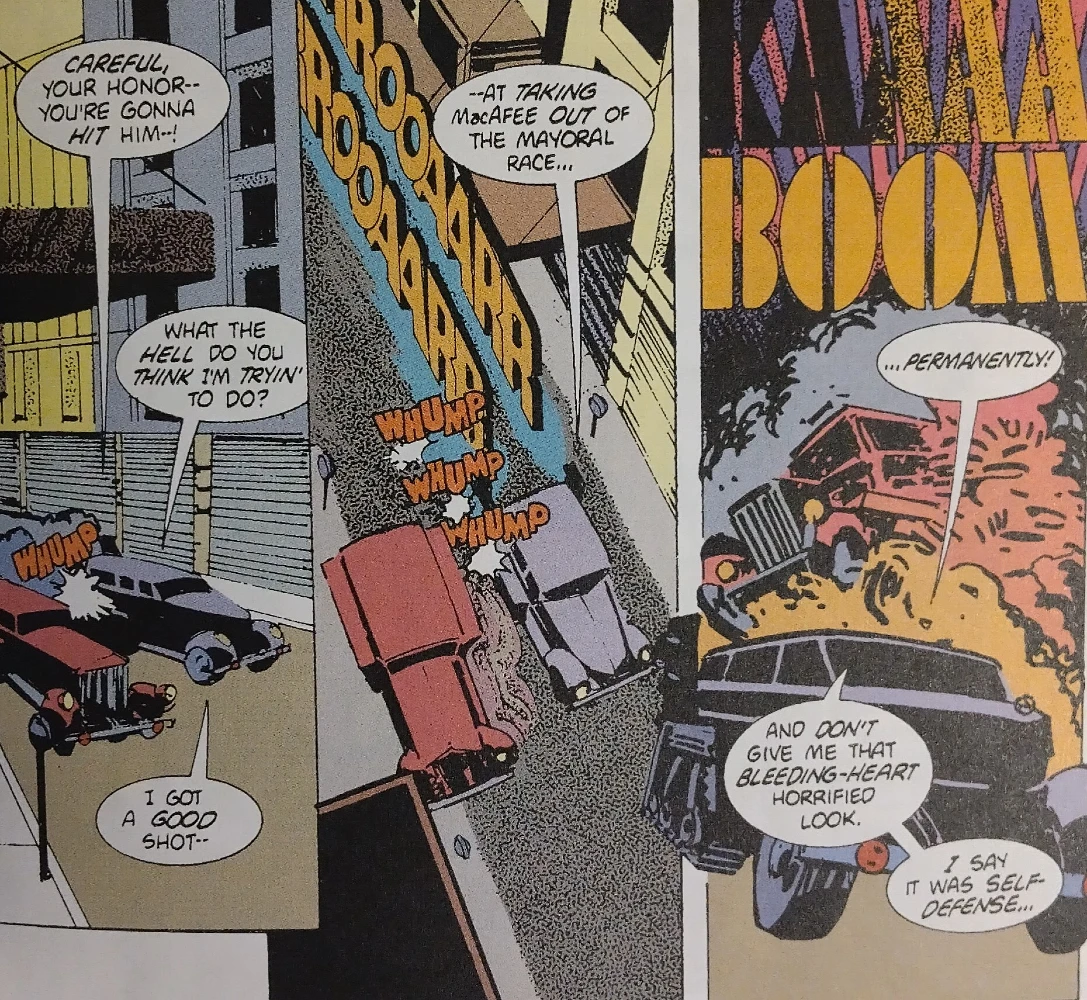
The beauty of alternate futures such as these is their effectiveness is based on how well a writer and artist can translate reality into some time distant from us (though growing closer with the passing days and years). I doubt we'll have the technologically advanced world Reuban Flagg inhabits five years from now, but you can see the genesis and maintained reality of certain ideas. A mayor is protected by robot bodyguards, a necessity given a sci-fi facelift; basketball exists, but it's been outlawed, leading to an underground athletic institution that specializes, not in dogfighting, but in shooting hoops; the popularized forms of violence found in the ancient gladiatorial ring and translated, less lethally, to the gridiron stadium is perpetuated for audiences through a television series centered on urban warfare. To an extent, you recognize this world, this America, this Chicago.
And yet it's different, and those differences display deep dysfunction.
You are, from the start, supposed to think that, maybe, something is just inherently wrong with this world (inherent, I'll note, like ours, yet perhaps somewhat different from ours...hopefully?). Or at least that this future–one where violence and debauchery are publicly advertised; where a U.N.-style meeting can't happen without representatives attempting to kill each other; where the mayor of Chicago, up for reelection, has no qualms about murdering his political opponents, who are trying to murder him first–is just so naturally debased it's lost all sense of reason and morality. That's clear from almost the start. Yet, as you read, you've realized Chaykin has lulled you into a false sense of security. Violence and immorality appear to be the status quo…but there's more to it.
That's, at least, what it seems Reuben Flagg's experiences are, touching down in Chicago after spending a lifetime on Mars. He's a former actor, replaced on his popular TV series by a digital simulacrum (which is really pushing the boundaries of a realistic future!), and made a Plexus Ranger, becoming the very law enforcement officer he lampooned on screen. He stumbles in, unaware, yet with a hefty dose of street smarts to help him acclimate to an unfamiliar world. You almost pity the guy, initially, as he comes into contact with a futuristic version of an America we can imagine all too well and learns to either cope or, more often than not, rebel in his own way.
Flagg, at moments, seems somewhat ignorant, yet that appears to be a tactic Chaykin uses to develop some amount of empathy for the guy. He's far more likable than other Chaykin protagonists, such as the Shadow, and though he possesses some of the womanizing qualities seen in other of Chaykin's heroes, he's less crude and pushy. Stumbling upon a woman who's sneaked into his apartment, he apologizes. He refuses to take advantage of people. He's not a complete straight arrow, but there's more to Flagg to appreciate as he adjusts.
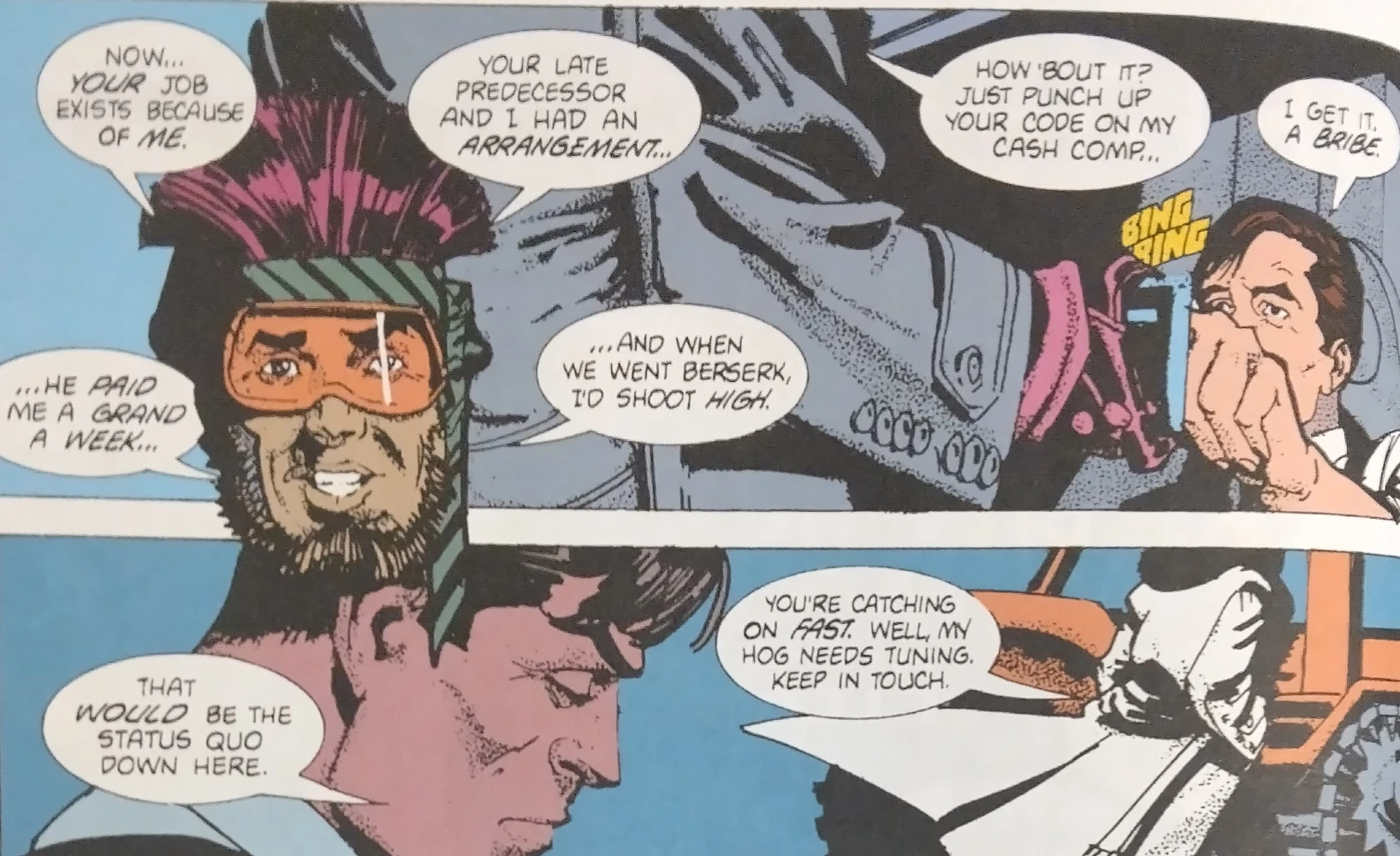
Chaykin says nothing about whether those adjustments include the atmosphere, but what troubles with gravity Flagg does encounter are through weighty situations. Likely thanks to his upbringing on Mars, Flagg can see through the weaponized advertising utilized by the Plex, a union of government officials and their corporate backers that keep the American populace placated. As Chaykin's first arc closes, Flagg's ability to perceive the traps which keep folks oblivious pulls him in the direction of a larger conspiracy that eventually involves enemy agents and whispers of an anti-Plex uprising.
Flagg isn't a morally frustrated protagonist; he notes the subliminal messaging pumped into ads and television quickly, like Nada from They Live! (just without the sunglasses), and decides to act against it. At this stage, we're not given much backstory for the character, with Chaykin hoping he does enough introducing Flagg and setting up some quick characteristics to make you appreciate his instant heroic bent. I'd argue Flagg is neatly established as an engaging protagonist, his relative obliviousness mirroring the reader's unfamiliarity with Chaykin's world and his growing confidence mirroring the trust the reader develops in the writer/artist.
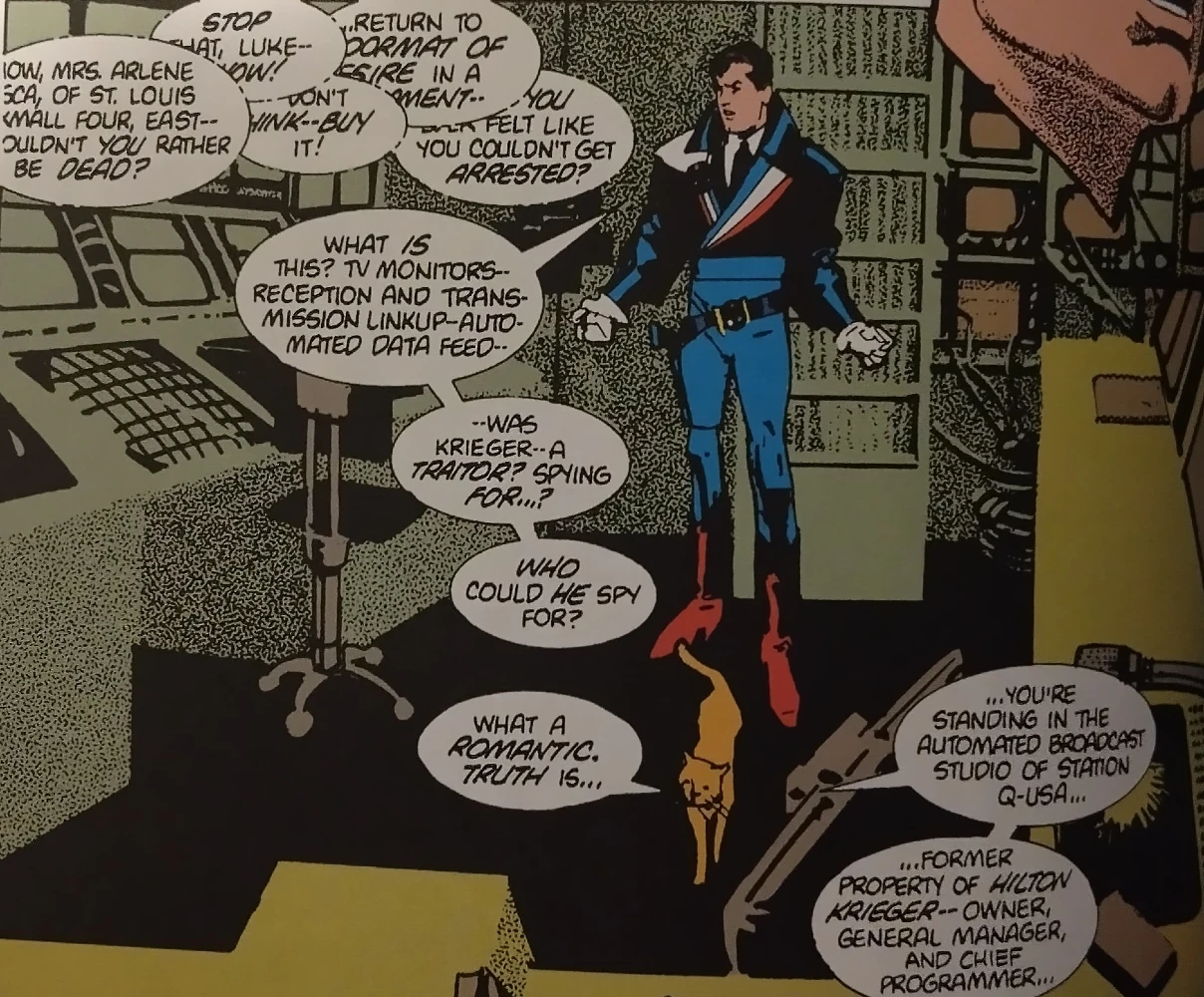
Where Chaykin's work may rankle readers is the same issues which mark his other works: his penchant for weak female characters, plus a few comments on gender in general which may frustrate some folks. Reuben, class act as he tends to be, is not without his proclivities, yet Chaykin often has him the willing subject of several women's advances. Perhaps it's meant to be a role reversal? Women pursuing Flagg instead of the other way around? Readers may not take to liking such storytelling; most of Chaykin's female characters seem to straddle a fine line between intellectually methodical and downright manipulative. Up to you to determine who exists on which side.
Readers may, and hopefully will, be more supportive of Chaykin's artistic merits. His designs aren't overly inspiring–Flagg looks very much like his take on the Shadow, leading me to wonder if Chaykin has one design for "chiseled male hero." More artistry is found in Chaykin's storytelling, which predates (and, according to an introduction by Michael Chabon, likely inspired) Frank Miller's Dark Knight Returns. Page layouts pull in those same ads Flagg decries, and with an assortment of talking heads and news reports factoring into the structure, provide a unique reading experience. Panels become TV screens and camera lenses, at times kept to the background, other times more directly in the foreground, physical reminders of that invasive technology Bradbury commented on in his novel.
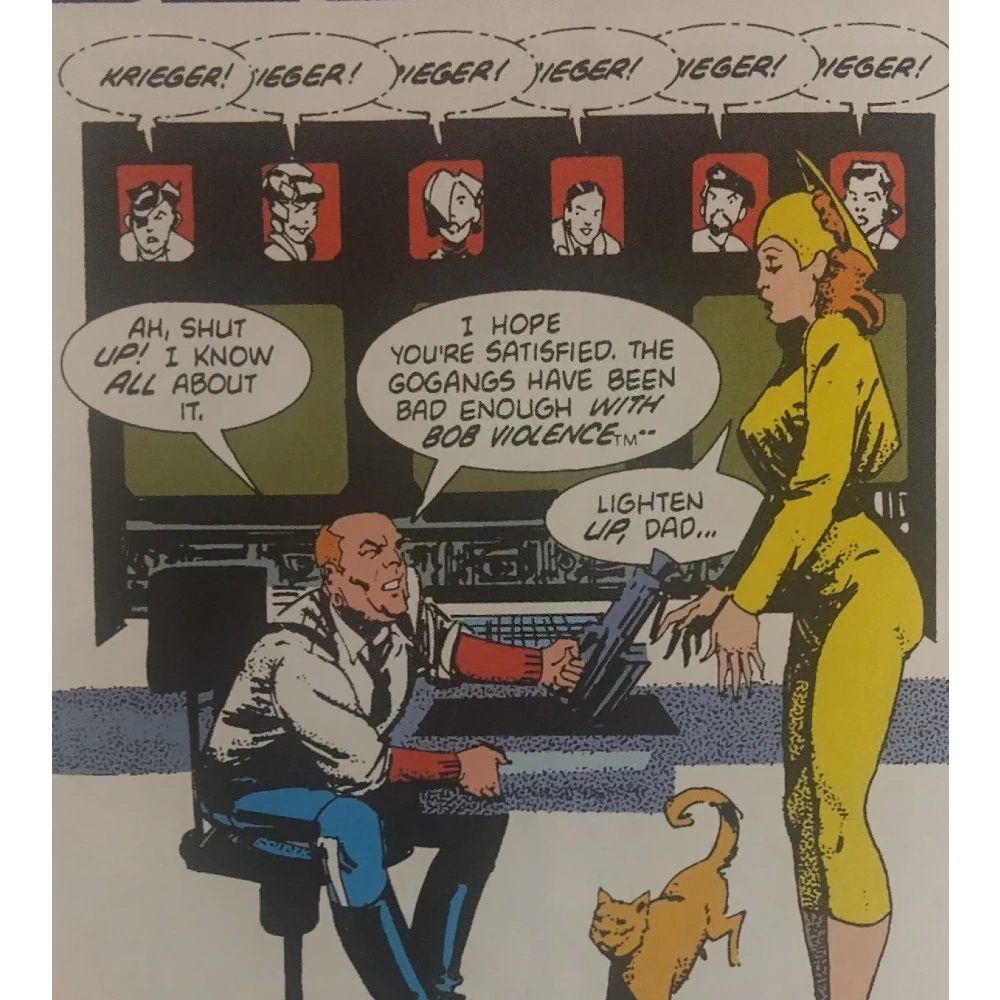
Chaykin's environments factor into that idea of twisted reality I discussed, as he creates a Chicago that, in some ways, feels familiar, with its monolithic skyscrapers (see the above image with Flagg zipping by the Marina Towers), yet has been remolded into a world beyond what we know, with flying cars and hot air balloons that beam video signals. Other locales contain noticeable features, such as a Midwest cornfield and South American metropolis, with trademark twists–massive harvesters line the cornfield, and a fancy Trans-American cruise from that metropolis takes place, not on the water, but in the air. The world is just distant enough to seem ever so slightly surreal yet near enough for the reader to capably imagine how we'd reach such a point ourselves.
American Flagg! is unique, both in subject matter and presentation. Featuring a stalwart hero who feels a cut above some of Chaykin's other protagonists, the series envisions an America in need of saving. Not from aliens or time traveling overlords, and not by a dude in a cape and costume. This dude wears a uniform. Plexus Ranger Reuben Flagg, learning to navigate an unfamiliar world, brings a clear vision to a space kept placated by the powers-that-be. Though Flagg is a step up in the characterization department, some readers may still feel frustrated by certain circumstances he winds up in and what those circumstances say about Chaykin's treatment of women. So maybe the series doesn't sit full staff at the top of the flagpole, but to me, it doesn't slide halfway down either.