Random Reviews: The Complete Badger (vol. 1)
Mike Baron's classic series kicks off with an engaging examination of vigilantism and violence in the mid-80s
—by Nathan on February 12, 2026—

Last year, I reviewed a black-and-white collection of Mike Baron and Steve Rude's independent sci-fi series Nexus. Compiling a brief limited series and the first four issues of an ongoing series, the volume was the cheapest, easiest method for me to peer into the universe of Nexus and his adventures as a starborn superhero.
What stands out about Nexus is how uniquely Baron twists the character, taking what could be yet another "swashbuckler in space" type yarn and wrenching the hero's motivations in a unique direction. Nexus fights crime, simply, because he must, driven by agonizing dreams which cause him pain until whatever evildoer he dreams of is dispatched forthwith! The concept is entertainingly self-indulgent on Baron's part, allowing him to dive into the violence of vigilante narratives while providing a more interesting and morally debatable justification than "This guy wants to kill people because they killed his family."
As we shall see, Badger is a similar experiment.
Beginning publication with Capital Comics shortly after Nexus was begun, Badger journeyed with Nexus and other titles on an exodus over to First Comics after the former company closed. Under First Comics, the series ran for 70 issues before First went (temporarily) bankrupt itself.
I've seen tidbits here and there noting that, similar to Nexus, Badger is a fairly acclaimed series. Therefore, it's surprising to me how little of the actual series has been collected, a little less than half of its total run across volumes which were not recently published. The guy's popped up in a few other stories and graphic novels in the time since–including a more recent short series I picked up directly from First Comics at a convention last April–but the paucity of collected material is puzzling. It'd be great to see Baron's entire original series picked up at some point, especially because some of the older collections are out of print and a tad pricey.
But that's enough guff from me–I'm huffing and puffing like a tornado generated by a crazy weather wizard. No, not the Flash's enemy. I mean Ham, the weather wizard who kicks off the events sparking Baron's exploration of the fragility of the superhuman psyche in these first few issues of Badger.
The Complete Badger (vol. 1)
Writer: Mike Baron
Penciler: Jeff Butler, Rick Burchett, and Bill Reinhold
Inkers: Jeff Butler, Dennis Wolf, and Jeff Dee
Colorist: Les Dorscheid, and Rick Taylor
Letterers: Mary Pulliam, John Workman, and Linda Lessmann
Issues: Badger #1-6
Volume Publication Date: December 2007
Issue Publication Dates: September 1983, December 1983, February 1984, April 1984, May 1985, and July 1985
Publisher: Capital Comics (issues #1-4), First Comics (issues #5-6); IDW (collection)
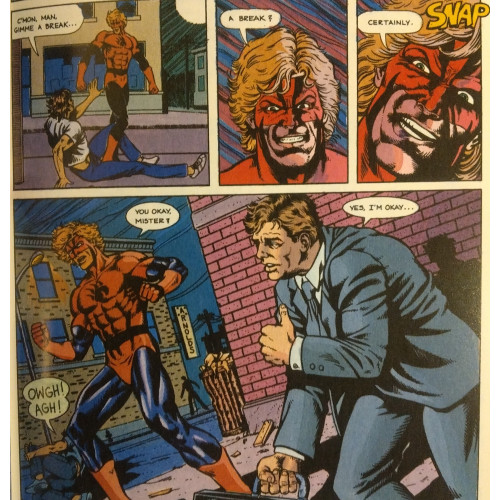
Ham, the aforementioned weather wizard, was a dastardly devil in his day, murdering innocent children until a coalition of the world's wizards placed him in a coma and had his prone form sailed from Wales halfway across the world, where he inexplicably ended up in what would become Madison, Wisconsin. That was over 500 years ago. At some point, Ham woke up, wandered aimlessly around for a while, and wound up in a mental health facility. Here, he came to his senses and encountered Norbert Sykes, a former Vietnam vet who now fights crime as the Badger, calls everyone "Larry" for some explicable reason, and starts working for Ham as a bodyguard.
All that clear? "Ancient Welsh wizard winds up in Wisconsin and picks up mentally ill former soldier who dresses in spandex and beats the crud out of muggers."
Like Nexus, Badger is an examination of the superhero, taking the concept and diving down to one its grittiest questions: why? Why dress up as a creature of the night, or a spider, or a short-legged mammal that burrows underground? Baron earnestly wishes to discern why it is a man like Norbert would choose this very particular, peculiar career path, hinting at a troubled past and circumstances which have weakened his grip on reality and his way of thinking, contributing to the violence he indulges in as the Badger.
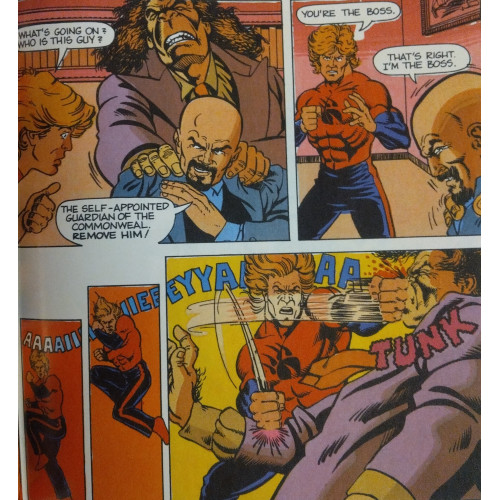
I feel I have touched on this before, but comics, specifically older comics, really assign no psychological reasoning behind the decision to wear a mask and fight criminals. Bruce Wayne decided to avenge his parents, Peter Parker decided to avenge his uncle, the Fantastic Four chose to use their newfound abilities for altruistic purposes. These comics and characters take the concept at face value; it's only later narratives that ask what may have lurked within Bruce Banner before he was irradiated by a gamma bomb or why Bruce Wayne puts on a bat costume and fights criminal clowns. Comics became more introspective over time, and the benefit that transformation gives Baron is that he can begin exploring those deeper touchpoints from the jump.
As a reader, you're meant to feel torn about the Badger's one-man war on crime–you're not morally wrestling with the punishment he dishes out (we're not talking Frank "the Punisher" Castle, whose adventures Baron also wrote); Badger just leaves dudes busted and bloodied. Instead, you're grappling with whether he should be the man to dish out punishment in the first place. Placed under arrest by officers after beating a mugger, the Badger concedes that it's a just action: "Every time you flout the law, you erode the fabric of civilization." When asked by a citizen why it's okay for him to do so, Sykes simply replies, "I'm the Badger." And then after a police chief tells Badger that Madison, Wisconsin will not tolerate vigilantism, Sykes agrees…and then goes on to beat up more muggers.
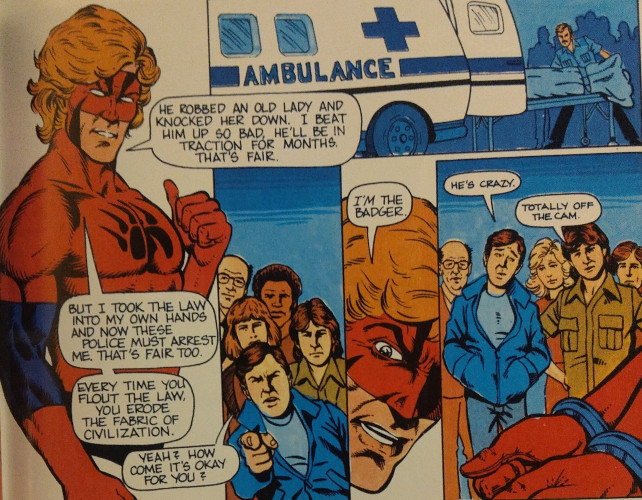
The Badger is apparently a study in contradictions, amicable to police officers and other authority figures in these panels yet staunch in his personal mission against criminality. You could chalk this up to mental instability–which Baron obviously notes is a factor–but I think calling the Badger unwell and closing your case is disingenuous to the character. The contradictions are intentional by Baron, pointing to the deep oddity that is superhero comics: our masked men and women are, at once, on the side of the law and at odds with it, dishing out justice on the periphery of legal action. Sykes is simultaneously respectful of authority and their opinions on extrajudicial violence and continuously indulgent in meting out his own definition of "citizen's arrest." By agreeing with the chief earlier, Sykes is merely recognizing that other people have valid opinions on the matter of vigilantism, just as he does in discussion with other characters. It doesn't mean he's going to give up beating on muggers.
Baron isn't necessarily arguing the merits of vigilante violence–you're not meant to take Sykes' words and actions to heart and start sewing your own animal-influenced outfit. What Baron is indicating is the Badger's uncanny ability to justify his worldview in relation to other people's, to find a very jagged way in which his scattered pieces of reality fit incredibly haphazardly with everyone else's. And because he doesn't view himself as unstable, Sykes behaves with a confidence that borders a childlike view of the world and his own personality. When told violent solutions aren't the answer to resolving problems, the Badger notes that "Violence solves a lot" and runs down a laundry list of examples.
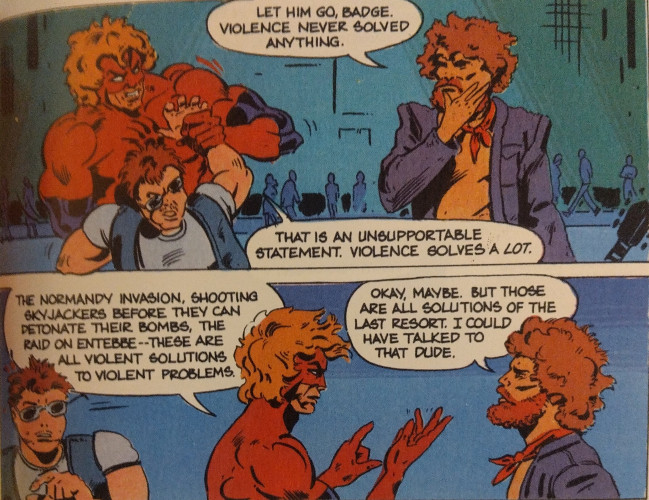
Sykes possesses a simple outlook and personality, yet the earnestness with which he acts is surprisingly endearing. The poor guy is ignorant and acts in ways, even outside gratuitous violence, which feel off the wall but are belayed by a strange innocence. He comes to break up an illegal dog fight and brings a wild badger to represent him; he races to see his mother after she's hurt, quoting screwball comedy It's a Mad, Mad, Mad, Mad, Mad World; he fails to understand when a woman tries to flirt with him, treating her like a perfectly normal person. You'd like to be frustrated with him at times, you want him to maybe shape up a little and use reason more often, but you understand that he doesn't understand, you sympathize with the issues he has.
While Baron develops the Badger through a unique lens, he also develops a somewhat ongoing narrative through which other characters and the all-important location of Madison are woven. Ham the Wizard feels like our primary antagonist, a crafty villain who conjures up torrential rains and tornadoes and uses the Badger's ignorance against him, and Daisy Fields, a budding case worker, becomes Ham's personal assistant, studying how Ham and Sykes' minds operate. Daisy is our human connection, the one normal person surrounded by insanity. And the book feels like a love letter to this Wisconsin burg, culture and locations neatly brought into the narrative. Plotwise, Baron establishes relationships between our characters which, I assume, became more important later in the series, hinting at a possible shared past between our central characters and secrets which he intends to uncover.
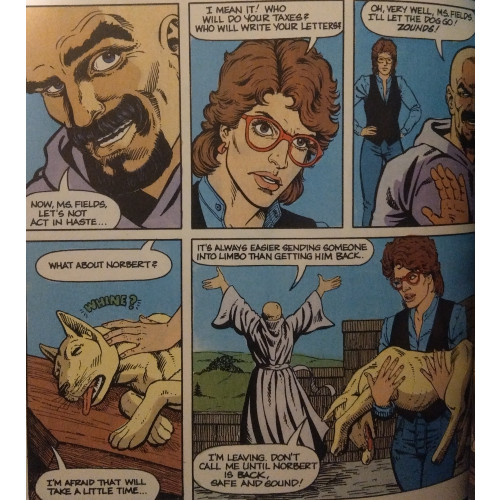
These first issues of Badger prove to be an engaging examination of a man in a mask, a man who leans into the inherent instability which leads one to dedicating your life to breaking jaws and noses. Baron and Company handle the issue with the seriousness it deserves–Sykes is not treated with contempt or as a joke; his condition is given appropriate weight and empathy, his actions feel diverse and understandable, and his personality is more than just "I punch guys while dressed as a dirt-digging mammal." Blessed with strong supporting characters and a central locale treated with love by Baron, Badger is a fun independent series that really should, darn it, be made more easily accessible to the reading masses.
You hear me, Larry? Make Badger convenient to collect again!