Distinguished Critique: The Huntress: Darknight Daughter Review
Some occasionally misguided characterization doesn't deeply damage narratives centered on an original vigilante
—by Nathan on February 15, 2026—
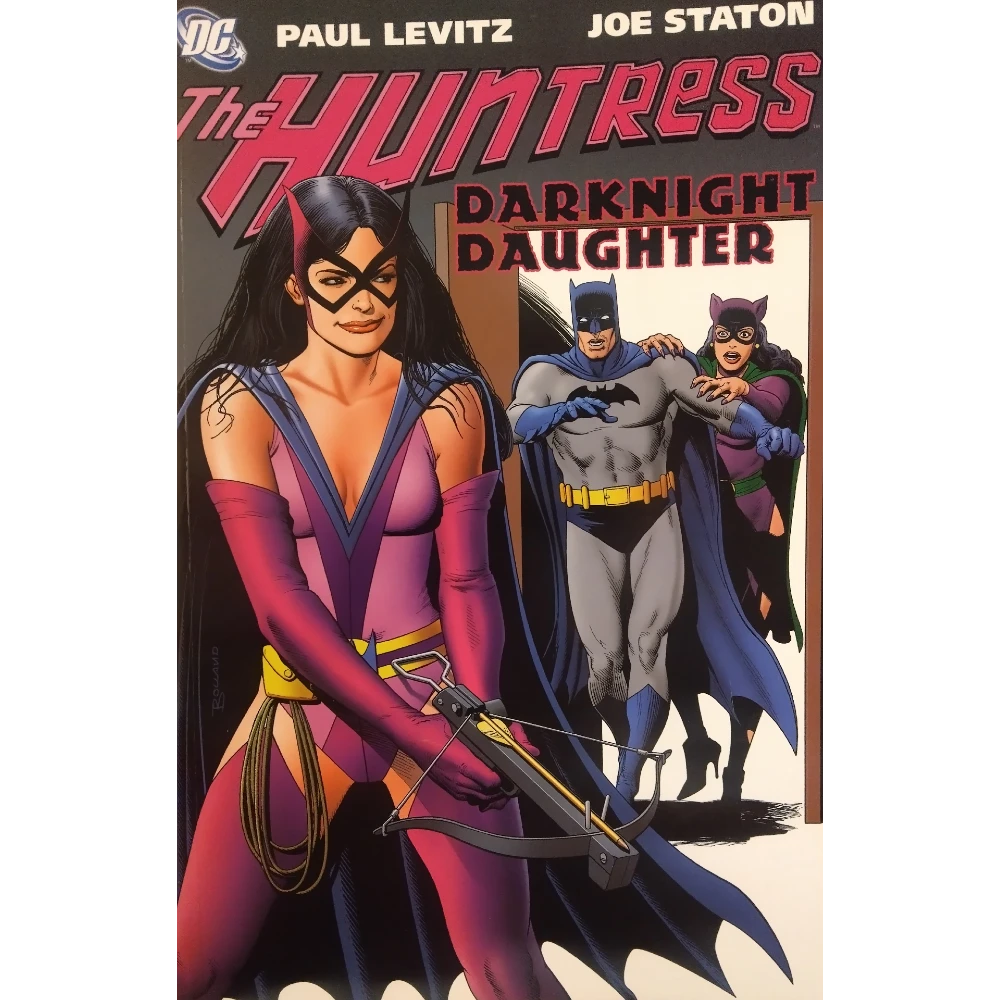
Welcome back, everyone, to Earth-Two, that alternate universe separate from the main DC Universe most readers are familiar with. I previously examined two volumes collecting the adventures of that world's primary group of heroes, the Justice Society of America (formerly known as the All-Star Squadron), made up of older heroes such as the Flash (Jay Garrick), Green Lantern (Alan Scott), and Dr. Fate (Kent Nelson), along with some younger blood including Robin (a grown Dick Grayson), Power Girl (the Supergirl of Earth-Two), and the Star-Spangled Kid.
During his tenure on the title, writer Paul Levitz, along with artist Joe Staton, introduced readers to the vigilante known as the Huntress, shortly thereafter unmasked as Helena Wayne, daughter of Earth-Two's version of Bruce Wayne. Better known as the Batman, Bruce had married a reformed Catwoman, meaning Helena's parentage was unique. The blood of a cat thief and a vigilante ran through her veins, and after both her parents were killed, Helena had a choice: live an average, normal life…or embrace her birthright. Selecting her mother's primary color scheme and her father's angular aesthetic, Helena decided to take up the Wayne family's penchant for vigilante mischief. Levitz and Staton, passionate about the character, continued telling her tale across back-up strips in other titles, keeping Helena's presence on Earth-Two a mainstay until Crisis on Infinite Earths destroyed Earth-Two.
The original hope for Huntress was to bring a version of Batgirl to this other universe, someone who, similar to Power Girl, was a familiar Earth-One concept with a twist. Levitz and Staton, as we will see, utilized these narratives to develop the uniqueness of the character, creating a concept akin to Batgirl yet far more different from Barbara Gordon's caped alter ego.
The Huntress: Darknight Daughter
Writer: Paul Levitz
Penciler: Joe Staton
Inkers: Steve Mitchell, Bob Layton, Bruce Patterson, Jerry Ordway, Bob Smith, and Mike DeCarlo
Colorists: Adrienne Roy, Anthony Tollin, and Gene D'Angelo
Letterers: Todd Klein, John Costanza, Ben Oda, Janice Chiang, Bruce Patterson, Jean Simek, Milt Snapinn
Issues: Material from DC Super Stars #17, Batman Family #18-20, and Wonder Woman #271-287, #289-290, #294-295
Publication Dates: December 1977, July 1978, September 1978, November 1978, September 1980-January 1982, March 1982-April 1982, August 1982-September 1982
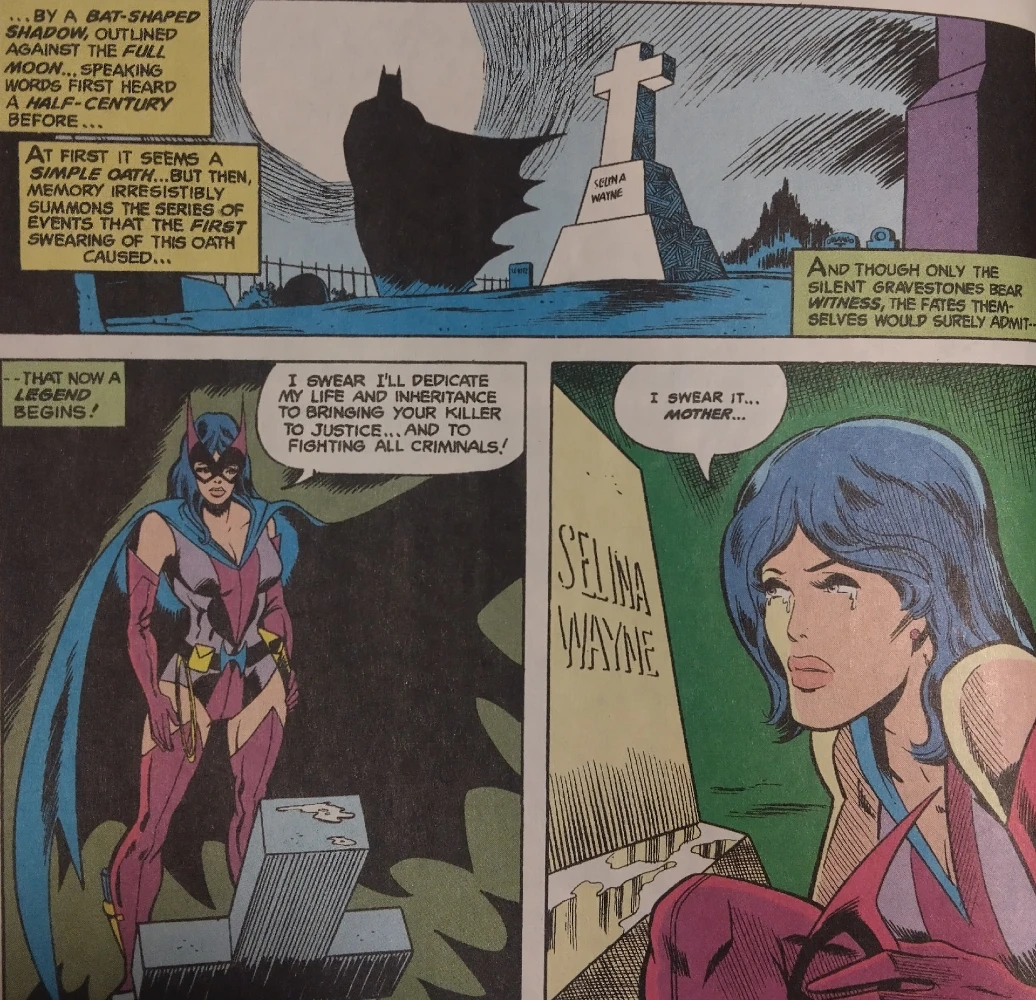
Throughout the issues collected in this volume, Joe Staton, either at Levitz's direction or his own self-guided creativity, develops a motif through a recurring image–Helena's headpiece, purple and pointed, casting a shadow across some surface, looking very much like her father's famous bat-cowl. Levitz even refers to the visual gimmick as a "bat-shaped shadow" the first time it's used, showing Helena standing over her parents' graves and making an oath very similar to that of her father's. Her mother murdered by a criminal, her father slain by a supervillain in an earlier JSA adventure, Helena must now strike out on her own. I'll note that Helena had already been the Huntress prior to her father's death; his loss only compounds her intentionality in following in his booted footsteps.
The visual gimmick Staton establishes goes beyond superficial costume comparisons, representing a very apparent theme across these narratives. The element repeats, not enough to annoy, but enough to remind the reader of Helena's parentage and the heroic tradition she nobly carries on in her parents' names. She is her father's daughter, sworn to uphold the very principles the Batman once upheld, yet in her own way. One can tell Levitz and Staton are very deliberate in making sure the Huntress isn't just "Batman but a woman." I'll admit that part of me wanted to see a bit more of Selena Kyle in her, and perhaps I'm meant to associate her acrobatics and some of her tools with the famed former thief, but I feel some of those aspects relate to her father as well. Perhaps it was enough for Levitz and Staton to develop a female character rather than give Bruce a son to carry the mantle?
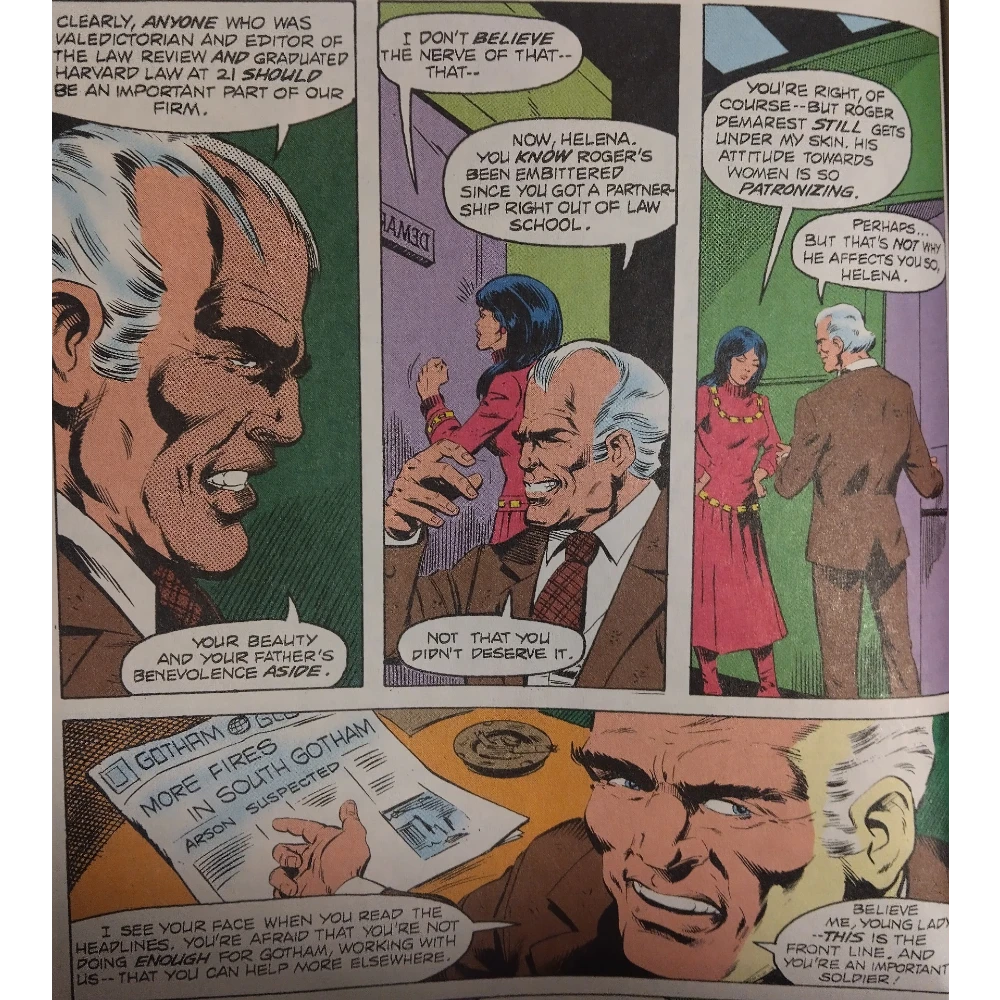
Helena's femininity is an important aspect to these stories, becoming both Levitz and Staton's greatest weapon in their arsenal as well as a bit of a sticking point, particularly for readers with more modern sensibilities. The creators don't treat her poorly, and they do quite a bit to ensure the Huntress is an incredibly intelligent vigilante (save for the occasional blunder into a death trap) and a smart partner in a law firm in her non-costumed identity. Whereas Bruce Wayne relied heavily on the aloof billionaire playboy routine, Helena's able to show her book smarts and street smarts in both aspects of her life, maintaining consistency across her dual identities that eases the transition between daytime scenes in office hallways and nighttime sequences in warehouses and on rooftops. Levitz and Staton achieve a decent flow to these narratives, which is especially noteworthy considering these are all back-up strips in other titles. With the shorter page count, the creators deliver well-paced action yarns that feel buttoned up with little fluff.
Helena's character can suffer, from time to time, from what I assume was Levitz's unfamiliarity with developing female characters. Both he and Staton are darned certain about making Helena a credible character, and they do well, but old habits seemingly die a little harder than Bruce Wayne of Earth-Two. The occasional panel reinforces a few of the tropes Levitz and Staton wish to abolish, such as the male gaze (from an artistic perspective), as well as a few instances where Levitz's attempts at "allyship" towards Helena's position as a woman come off as stilted. By intentionally presenting certain situations or individuals–such as a fellow law partner or another vigilante–as sexist, Levitz attempts to let Helena's individuality stand out, but I feel these men instead just reinforce the challenge Helena must overcome rather than afford her the proper opportunity to do so. Better presented are Helena's moments of heroism against foes often stronger than herself, such as Solomon Grundy or Lionmane, allowing Staton to visually present her strength and raw determination.
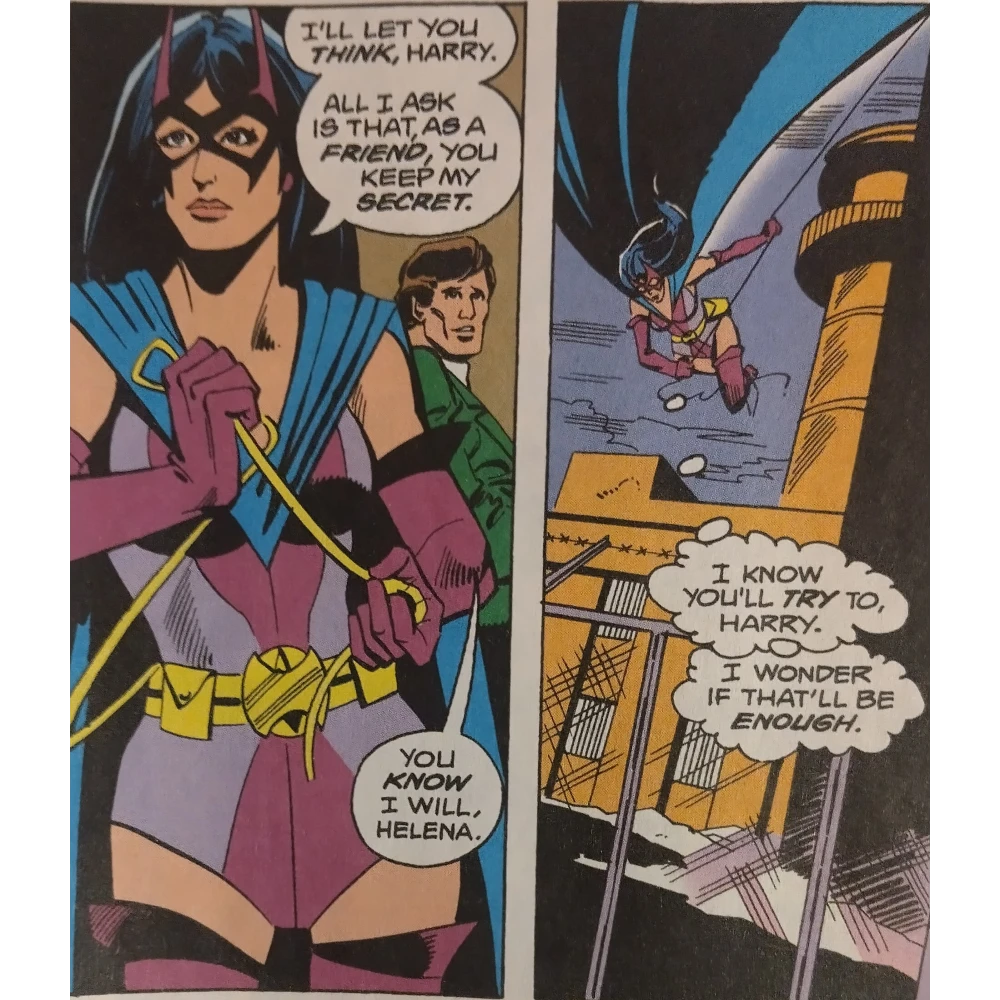
Though these stories are all presented as singular chapters in other series, they do form a narrative crux which Levitz and Staton use effectively, specifically in how supporting cast members are utilized. Harry Sims, Gotham's district attorney, is the most effective side character, developing feelings beyond friendship for Helena; Levitz explores the attorney's arc effectively, giving him an integral role in certain plots, making him a sometimes victim/hostage, and providing conflict between himself and Helena when he learns the Huntress' greatest secret. He's not unlike other "love interest" characters in comics, in that while he's never responsible for carrying the weight of a full story, he's also more than someone for Helena to pursue romantically. The frustration behind him learning her secret, though somewhat clumsily inserted by Levitz, nevertheless gives Harry a lift in importance.
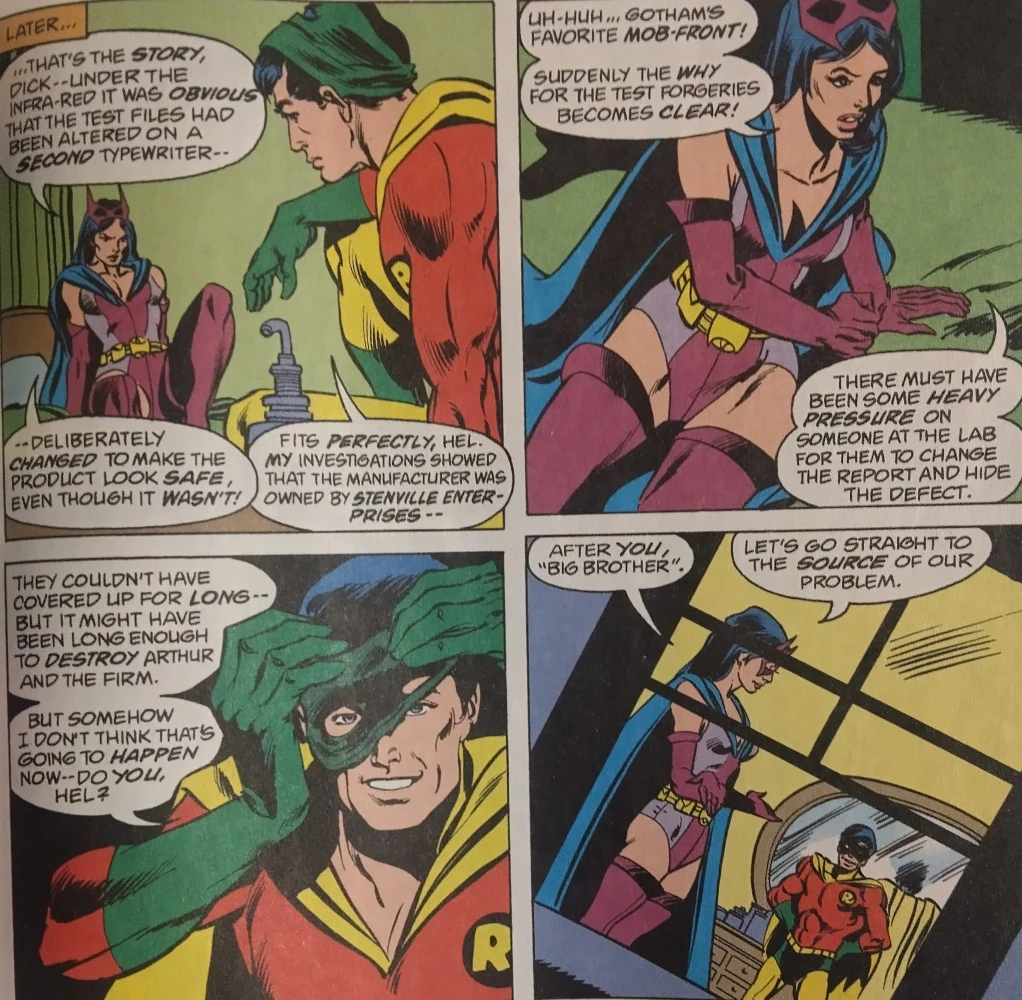
Elsewhere, minor characters such as Dick Grayson's Robin (in a world where the adult ward of Batman never became Nightwing, particularly as these tales predate that transformation) and Helena's assistant Carol are given a semblance of story, either roped into Helena's adventures or becoming the impetus for her adventuring. Levitz does what he can to lace in a subplot or two–Carol getting in deep with loan sharks, for example–carrying smaller pieces here and there across tales which are already shorter than the average issue. Again, the main plots are fairly fluid, and his work in developing supporting characters is admirable, but it's understandable that there are times where Levitz doesn't juggle all the pieces adequately.
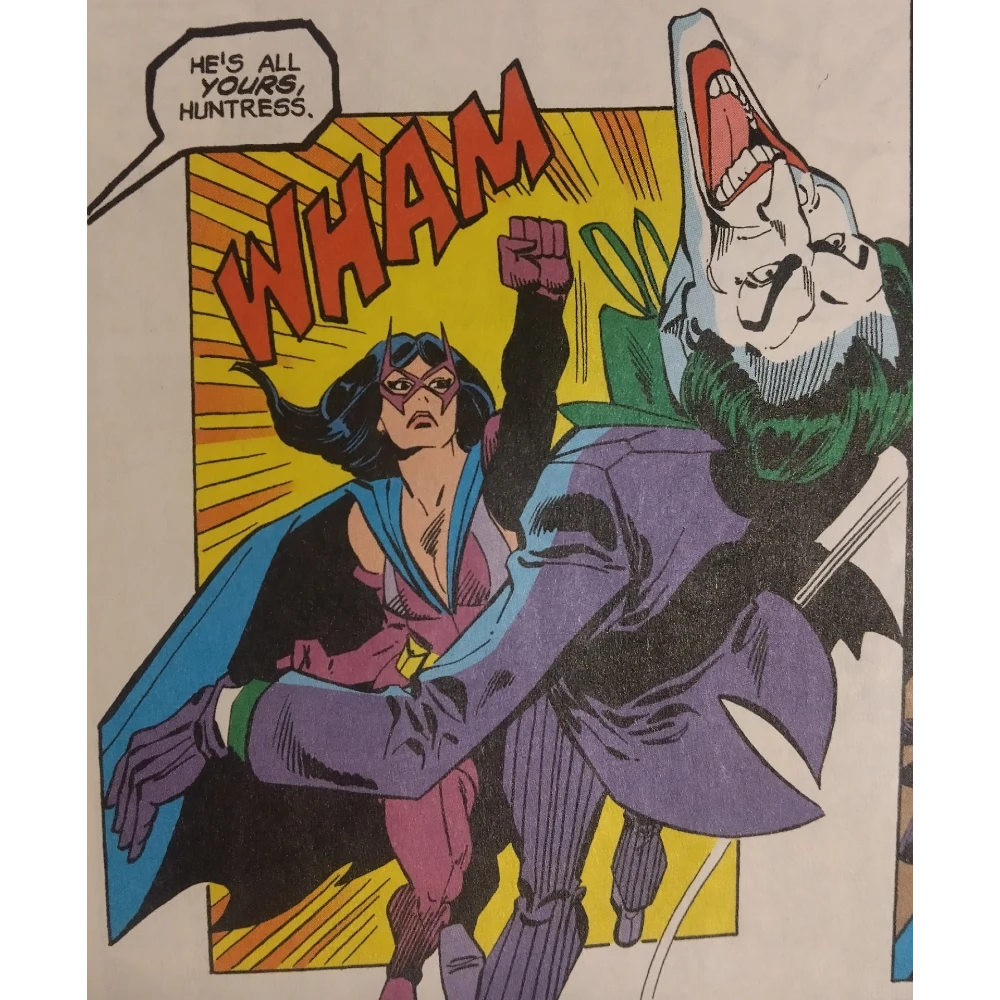
Levitz also has some fun with the "alternate" aspect of this other universe, toying with a few threads which make this world different from Earth-One. A few of these had already been established through All-Star Comics' Justice Society, such as Dick Grayon's job as an ambassador or Bruce's death, but Levitz works to either capitalize on those elements or introduce concepts of his own. His strongest contribution is the Joker, visually inspired by Marshall Rogers' interpretation of the character, conceived as a vengefully dramatic murderer feeling cheated of his revenge, seeking mayhem in the wake of learning of Batman's death. Helena's battle against him feels like Levitz and Staton's version of a "baptism of fire" for the heroine–imagine her credibility as a vigilante if she could defeat the main villain who constantly pestered her father.
I do wish Levitz had relied a bit more heavily on the "alternate universe" concept. Where he uses it is appropriately effective, but I do love my parallel worlds, especially when they take familiar characters and concepts and give them a twist. The rage-filled Joker is a nice touch, and Dick Grayson's growth as a character and his brotherly affections towards Helena feel very plausible, but I just wanted more. We're given a district attorney, and nobody mentions that Harvey Dent guy! No other old Batman villains come out to give Helena a difficult time. I understand the need for Levitz to be creative, choosing instead to give Helena her own rogues gallery, as well as finding the balance between introducing new material and gussying up old concepts. But a bit more twisting would have been appreciated.
The Huntress may have been given a new name and origin when the concept was brought over to DC's post-Crisis universe, but Helena Wayne is an original character unique to the former Earth-Two. These aren't perfect stories–in an introduction, Levitz himself recognizes he's grown as a writer in the decades since he wrote these issues at 20 years old–and some aspects may rankle a few folks. Collectively, they present a fairly straightforward look at a young woman building upon the legacy of her fallen family, juggling upholding her father's crime-fighting efforts while maintaining her individuality. That's who Helena is, and though some of the specifics may be a little more difficult to encounter, the premise behind her creation provides the impetus necessary to craft some compelling narratives.