Spider-view: "An Obituary for an Octopus"
Forgettable back-up strips don't detract from a central narrative that generates significant interest and empathy in one of Spidey's oldest foes
—by Nathan on February 19, 2026—
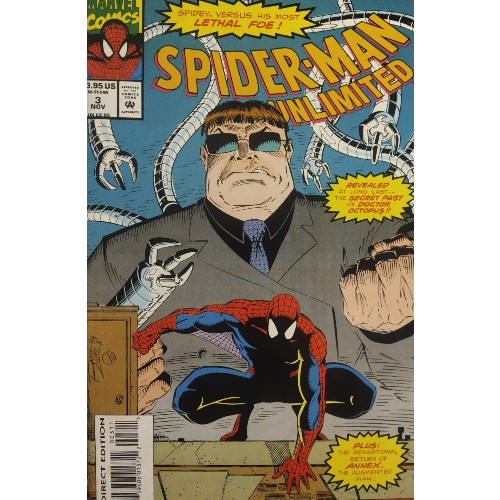
Near the end of Danny Fingeroth's Lethal Foes of Spider-Man limited series, infamous supervillain Doctor Octopus flees a hideout after an altercation alerts the police to his whereabouts, noting important business he must attend to that arrest and imprisonment cannot be allowed to upend. In his wake, he leaves a defeated villain known as the Answer and a cousin on his mother's side, Elias Hargrove. Octavius tells Hargrove specifically that he's sparing the man because of their kinship and the memory of his dearly departed mother.
That "important business" Doc Ock refers to is uncovered here, in the third issue of the spinoff series Spider-Man Unlimited. With Tom DeFalco having the first two Unlimited issues serve as bookends to the crossover event known as "Maximum Carnage," he and artist Ron Lim apply the brakes for this third chapter. No surge of symbiote slayings here. A more dramatic touch is needed, maybe with some help from four metallic arms, to uncover the life story of Otto Gunther Octavius.
"An Obituary for an Octopus"
Writers: Tom DeFalco, Kurt Busiek, Jack C. Harris
Pencilers: Ron Lim, Aaron Lopresti, Jesse Orozco
Inkers: Jim Sanders III, Sam de la Rosa, Mark Stegbauer
Colorists: John Kalisz and Renee Wittersteatter
Letterer: Dave Sharpe
Issue: Spider-Man Unlimited #3
Publication Date: November 1993
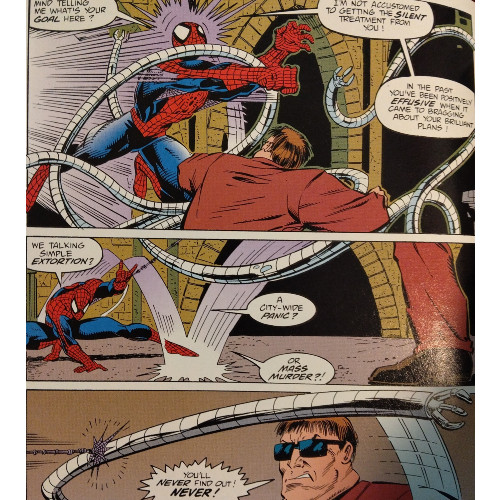
This issue is big enough to include a few backup features touching on other members in Spidey's cast of superhuman associates, but we're focusing most of the review discussing the narrative focused on one of Spidey's first-ever enemies: Doctor Octopus. Framing the narrative around an obituary writer detailing Doc Ock's life–just in case the multi-armed adversary ever bit the big one, which is actually a bit of foreshadowing for a later 90s story–DeFalco tells two tales: the birth of our cephalopod-inspired master of sinister scheming and his present day shenanigans…along with a certain Web-Head's efforts to stop him.
The framing device allows for DeFalco to fairly seamlessly weave these two stories together; never once do transitions feel awkward and never is there a sense that one story is usurping the other. Watching Spidey go head-to-head (arm-to-arm…to-arm?) with his arch foe is as enticing as seeing Otto's backstory uncovered. I already knew much of the material DeFalco presents, but he writes the history portions in a way which endeavor to explain how Doc Ock became the man he is today, similar to how DeFalco presented Mary Jane's past a handful of years prior to this issue. What could be mere summary or exposition is handled with a sense of story in mind, and as DeFalco travels down memory lane, he maintains momentum in the present.
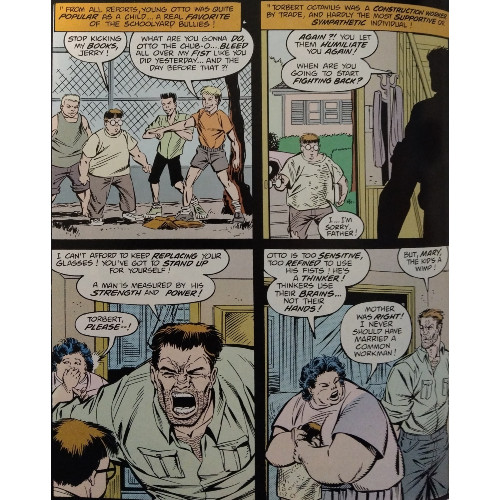
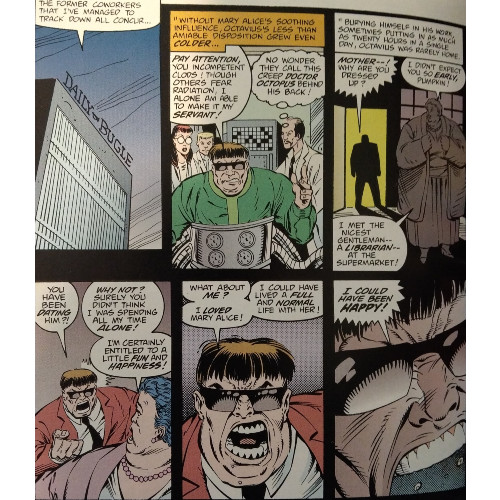
DeFalco's greatest trick is stirring up empathy for the brilliant scientist-turned-supervillain, tethering his turn towards crime not just to the accident which first gave him control over his extra limbs but to deeper, more personal reasons. The accident, for example, is not just a result of Ock's arrogance or carelessness; that arrogance and carelessness is rooted in a man lost in grief over the death of his mother, which itself is connected to earlier incidents. There is, fittingly, a long arm of history stretching through Otto's past, and DeFalco does well to make the story develop naturally. An abusive father, a coddling mother, a failed romantic relationship, and brilliance turned to arrogance are all ingredients in the explosion which created Doctor Octopus, and DeFalco nicely gives each element the weight it deserves.
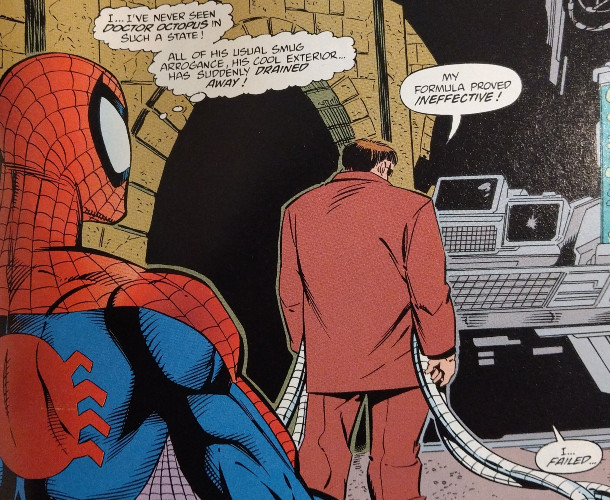
It means our octopus is layered, and I appreciate even the base hints of personality DeFalco and Lim imbue Doc Ock with. Some are more intentional, like Lim's image of a disheartened Otto standing in silent defeat, his shoulders slumped, his metal arms useless weights at his side. Others are implied on my part, such as when Otto announces his engagement to a young woman by telling his mother "She consented! Doctor Anders agreed to be my wife!" "Consented" feels technical, and referring to his fiancee (Mary Alice Anders) by her title and last time is far too formal, as if Otto's just signed a business deal with her rather than proposing to the love of his life. It's a small moment, but it's a great use of dialogue to remind us of how awkward Otto has always been, more brilliant than sociable.
Though the past and present are treated fairly evenly, I found I enjoyed the flashback scenes more than the "modern day" events. The present day story DeFaco and Lim concoct isn't bad: Spidey attempts to stop Doc Ock from stealing chemicals after he procures the blood of AIDS patients, though this plot point veers into somewhat cumbersome social commentary territory that makes one portion of the narrative feel like an early 90s PSA. The fights between our foes are engaging, driven by pitting Spidey's youthful athleticism against Otto's snaking limbs. The action combined with the flashbacks hone in on the idea that Otto is Spidey's foil–he's suffered tragedy, was bullied for being smart, applied his scientific know-how to better himself educationally, and became a member of the costumed community after a freak accident. Yet DeFalco points to where Otto's story diverges–instead of a loving aunt and uncle, for example, Otto had a cruel father and blubbering mother–and it is in those changes, some outside of Otto's control, others within, where his story separates from Peter's and leads him down a winding path of crime and failure.
DeFalco and Lim should also be commended for the tale's twist ending, teased fairly well very early in the issue and made apparent by the final panel. The twist allows insight into Doc Ock's entire scheme and tethers nicely into the backstory the creators have developed; the fact this is never completely verbalized or made known to the characters adds a good level of situational irony, and it allows even more empathy with Otto as the issue ends. It's executed well and left for the reader to ponder rather than for characters to comment on or unravel themselves.
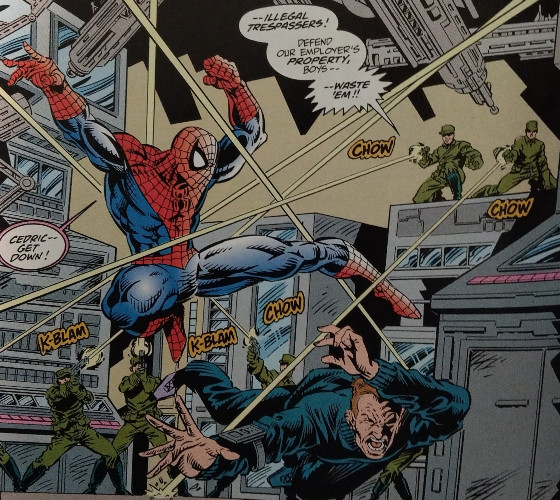
Two backup strips bring other Spidey characters into the mix, including the villainess Corona (no relation to the virus or the beer) and Annex, the armored vigilante Jack C. Harris introduced in an Amazing Spider-Man annual I reviewed a while back. I'm not familiar with Corona as a character, so while I found her story nicely drawn by Aaron Lopestri, it didn't astound me by any means. Kurt Busiek is generally an exceptional writer, and while he allows Spidey some amusing turns of phrase, his script is trying and failing to breathe life into a middling character who didn't appear after this issue until 2004, where she cameoed during Mark Millar's Marvel Knights: Spider-Man run.
Likewise, Jack C. Harris is still trying to make Annex a "thing" in his backup strip, likely in anticipation of the character's own limited series. The story is middling, the plot fairly dull. I wasn't overly thrilled with the character when he appeared in the annual; I'm not hugely invested in his other appearances either. I'm honestly a bit surprised the character appeared a few other times, even after this backup story. "Annex is here to stay!" the character himself proclaims at the end of the story, which feels like a self-important statement by Harris to hopefully drum up further interest in the vigilante.
The Corona story ends with a request for readers to write in and let Marvel know if they wanted to see more of her. Given that her only appearance since was a cameo eleven years after her debut, that ploy failed spectacularly. Neither backup narrative holds up nearly as well as DeFalco and Lim's exploration of Doc Ock's past. It makes sense why: Otto had the benefit of thirty years of stories and staying power that made additional complexity enticing. He's worthy of a backstory and the ensuing empathy which should be generated within the audience as a result. Aside from an awkward moment or two, DeFalco and Lim pass with flying colors, a result worthy of Otto Octavius' genius. Fittingly, the evil doctor would need an obituary a few years after this story was written, so we should all give DeFalco and Lim a hand (and a hand, and a hand, and a hand…) for their forethought in sinking their tentacles into Otto's past.