Spider-view: Venom: The Madness (Venom, Part 12)
Some silliness aside, this series asks readers to reconsider their perspective of our symbiotic anti-hero
—by Nathan on March 12, 2026—
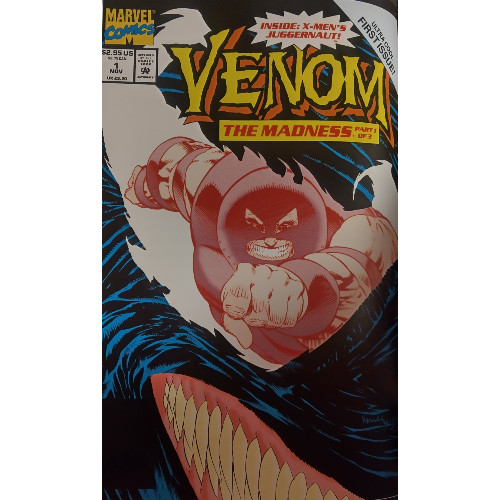
You don't have to be a Reed Richards or Tony Stark to take a look at Edward Brock, especially when he's bonded to his alien alter ego, and determine he's a few strands short of a spider's web. Even before the spurned journalist and the suit were melded, both were somewhat unstable, but together, the unraveling began in earnest, especially as they directed their hatred towards Peter Parker. Oh, sure, Venom's been trying his hand at the whole "superhero" bit the last few times we've seen him, but the anti-hero's still more likely to rip somebody apart and leave them for dead than web them to a lamppost for the cops.
This latest limited series wishes to take a good long look at that more insane side of our parasitic vigilante. Ann Nocenti, whose Daredevil work I've enjoyed so far yet whose Spider-Man I am decidedly torn on, teams with a pretty spectacular artist to dive into the fragmented mind or symbiotic superstar. If you like his "Batman as a vampire," maybe you'll learn to appreciate Kelley Jones' "Venom as multi-limbed monster playing at something more righteous."
Venom: The Madness
Writer: Ann Nocenti
Penciler: Kelley Jones
Inkers: John Beatty, Al Milgrom, and Keith Williams
Colorists: Tom Smith
Letterers: Richard Starkings, Susan Crespi, and Loretta Krol
Issues: Venom: The Madness #1-3
Publication Dates: November 1993-January 1993
To reach this limited series after Venom's last solo outing (in a three-issue series where he tackled the Punisher), I skipped over a little over 100 pages of material in the Venomnibus (catchy, right?) I've been reading from. The material I maneuvered around consisted of Venom guest starring in other characters' books, from Iron Man, to Darkhawk, to Daredevil, to Silver Sable and the Wild Pack. None of those narratives really interested me–I remembered being fairly bored when I read the omnibus through the first time–so I decided to leap from Venom series to Venom series. But I say this to note that Venom did appear elsewhere before The Madness after his wrassle with the Castle.
As I mentioned above, I'm split on Ann Nocenti as a writer. On the one hand, I have enjoyed the little of her Daredevil run I've read, and I do plan to dive deeper in the future. On the other hand, my last forays into her take on denizens of the Spidey side of Marvel left me less than enthused, so I entered this narrative not quite sure what to expect. I figured that if she threw in a few characters and told an interesting story with perhaps a singular subplot (too many of which, I'd argue, spoiled her "Return to the Mad Dog Ward" for me), she'd win me over. Fortunately, she did.
Though having Kelley Jones in your corner goes a long way to get me on your side.
Nocenti quickly recognizes the integral elements needed to tell a Venom story: a struggling supervillain looking to redeem himself as a protector who often finds lethal ways to indulge in his new vigilante routine. Even when believing his actions morally justified, Venom isn't completely sane, and though co-creator David Michelinie has always understood this, his version of Venom became a little "ho-hum." Once it was established that Eddie Brock was a journalist who bonded with an alien and decided to unleash his brand of violent justice upon those who would threaten people Eddie determined were "innocent," his shtick got old fairly quickly. I don't know if Nocenti put conscious thought into recognizing this, but she grasps those core elements and decides to repurpose them.
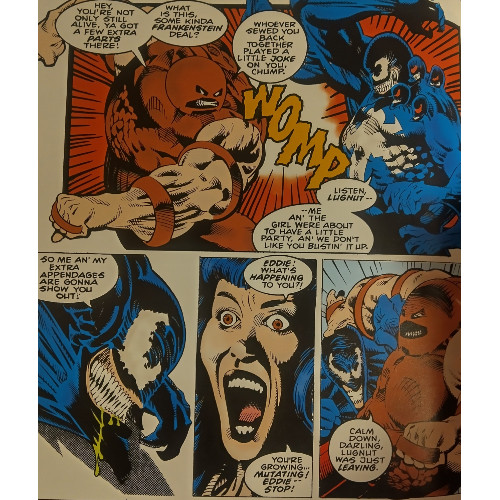
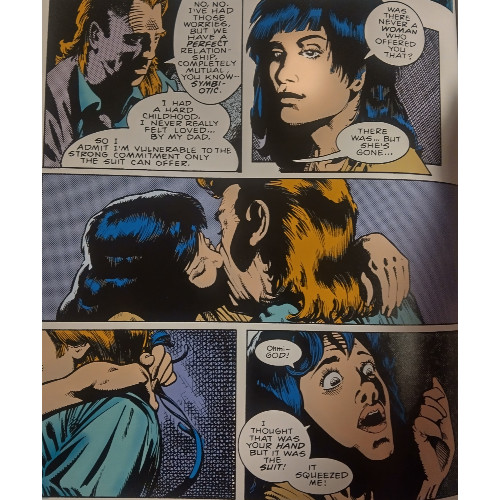
We're given a Venom who is still a defender, particularly of the downtrodden, as we see Eddie and the symbiote work to help out a crusading social activist take down the corrupt CEO of a cosmetics company. And I do mean "Eddie" and "the symbiote." One of Nocenti's most interesting contributions is the interplay between the two–she knows that Venom is made up of two intertwined personalities, yet she weaves in enough individuality for Eddie that he feels like his own person, which is a strong take. We get scenes of Eddie without Venom's fright face as he pursues a romantic relationship, his efforts stymied by the suit's constant presence and the constant need to be present, Eddie's own desires be hanged. One moment, he's bashing bad guys; the next, he's casting a suave charm upon his lady love. Nocenti moves him between personalities fluidly enough that you feel you're dealing with three characters: Eddie, the suit, and Venom.
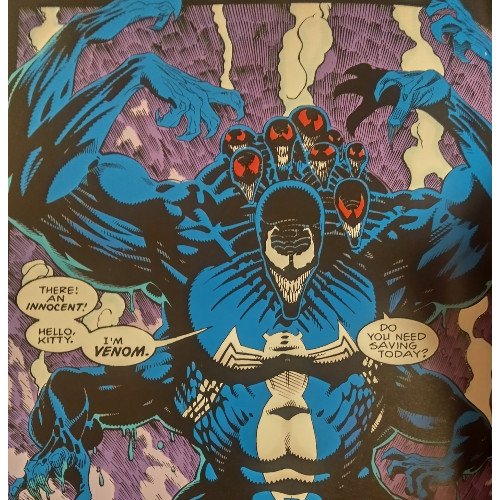
Nocenti also does well to grapple with Eddie's mental state, particularly as Venom. After a fight with the Juggernaut, Venom ends up doused in fetid chemicals which react poorly with him, causing him to descend into the subtitular "madness." Nocenti uses most of the second issue to play with this insanity, showing how this little dip has caused Venom to become even more unhinged than he generally is. In this state, Venom mistakes an innocent for a target and kills them; he grows additional heads; he lies to himself that he's in control of the symbiote when it's an outside force controlling him. You're meant to believe that these chemicals are working alongside Eddie's already fragile psyche to heighten his twisted outlook on life.
I don't believe Nocenti sees Venom as the same hero that someone like Michelinie would like us to see Eddie as; she's aware of his mental brokenness, and by placing him in a state where his control is all the weaker, Eddie cannot as naturally resist his own violent, disturbed urges, already heightened by bonding with the symbiote. There is an inherent sickness working through him which he manages to suppress or at least indulge in only periodically. This chemical removes that strain of morality coursing through him, transforming Venom into even more of a monster. His good intentions are twisted, his love becomes obsessive, and a second fight with the Juggernaut is less about saving those in danger and more about getting revenge on the big red brute after an earlier trouncing.
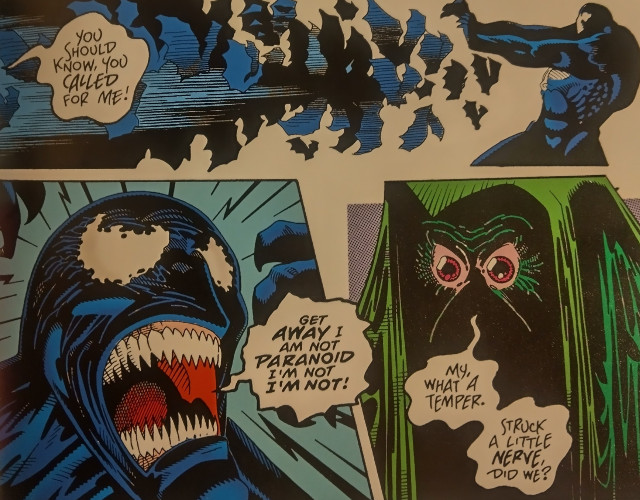
You are meant, I would also wager, to end the series believing that Eddie fully buys into the lie of his heroism. Not that this is a new idea necessarily: Michelinie always wrote Eddie as drunk on his own Kool-Aid, his brutal brand of morality and justice driving him to the edge. But here, without voices of reason like Spider-Man to try and draw him back or offer a counterpoint, Eddie fully embraces his own "main character energy" with a complete straight face. We're not given another character to try and convince him he's wrong; instead, Nocenti leans heavily into how easy it is for Eddie to lie to himself about his intentions, about Venom's heroism, and she leaves us feeling chilled as a result. The redemption Michelinie seems to wholeheartedly endorse, Nocenti sees as a smokescreen, a trick Venom is pulling on himself and the audience…and this happens even after Venom rids himself of the chemicals which cause even greater madness. Eddie may feel more clear-headed, but we're meant to feel a great deal of distrust. He's the untrustworthy narrator of his own life, but he isn't trying to fool us because he buys the lie he's selling. We've gotta be mindful to understand otherwise.
Appropriate for the narrative Nocenti is telling, horror infuses every inch of the art Kelley Jones develops for this series. Paired with one of the inkers he'd later work with on Batman: Bloodstorm and Batman: Crimson Mist, Jones delivers a level of grimness and grime which sneaks around the gritty 90s notions of "Extreme! Cool! Awesome!" and goes right for the jugular instead. No big guns or packs holding endless bullets; Jones is more interested in monstrous, gothic impressions–Eddie Brock delivering a Joker-sized grin when the symbiote forms around his face; psychedelic nightmare sequences featuring oozing tendrils and bats; creepy underground caverns and sewers shrouded in shadows and filth. At moments, Jones' Venom can feel a tad outlandish–the final issue often depicts the vigilante with a silly overbite not featured in other issues–but he's otherwise properly bulky and imposing elsewhere. It's a surreal style of horror perfectly suited to the subject matter.
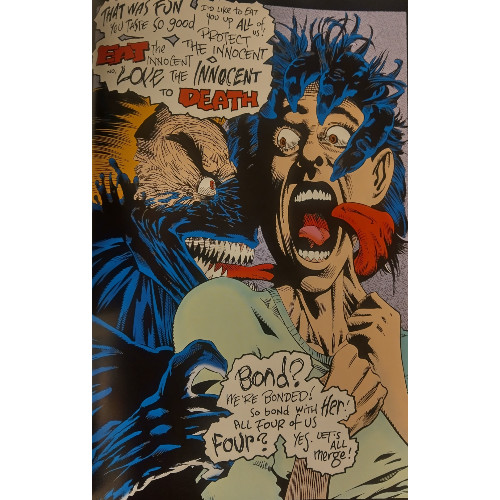
Certain pieces here and there are more fragile than others. A later trip through another dimension is necessary for the story, but Nocenti brings in some former Ghost Rider foes to menace Venom, and their sudden inclusion feels awkward. They weave into Venom's confrontation with the "madness" plaguing him, but they seem out of place and far too suddenly introduced to leave any lingering impact. I wondered for a moment if this was a tie-in to another ongoing narrative but such was not the case. Nocenti just popped them over in what feels like an odd decision from a narrative perspective.
Aside from occasionally goofy art and story decisions, Venom: The Madness holds up better than my first readthrough and is probably more interesting than the two previous Venom limited series I've reviewed. Nocenti does not take the common characteristics foisted upon our symbiote sinner-turned-saving hero for granted; she's interested in reapplying some of those quirks, not just assuming that the brokenness Eddie and Venom experience is a strength or a natural part of who they are. She's willing to let the character wrestle with himself a little in this series, and though I don't think future writers got the hint, Nocenti gives us a little nudge in another direction, suggesting Eddie's journey towards redemption and heroism (or, at least, anti-heroism) is a harder trek than other writers have indicated.