Random Reviews: John Constantine, Hellblazer: Dangerous Habits
Some thematic scruples notwithstanding, "Dangerous Habits" delivers a narrative grounded in the real struggle against impending death
—by Nathan on May 17, 2026—
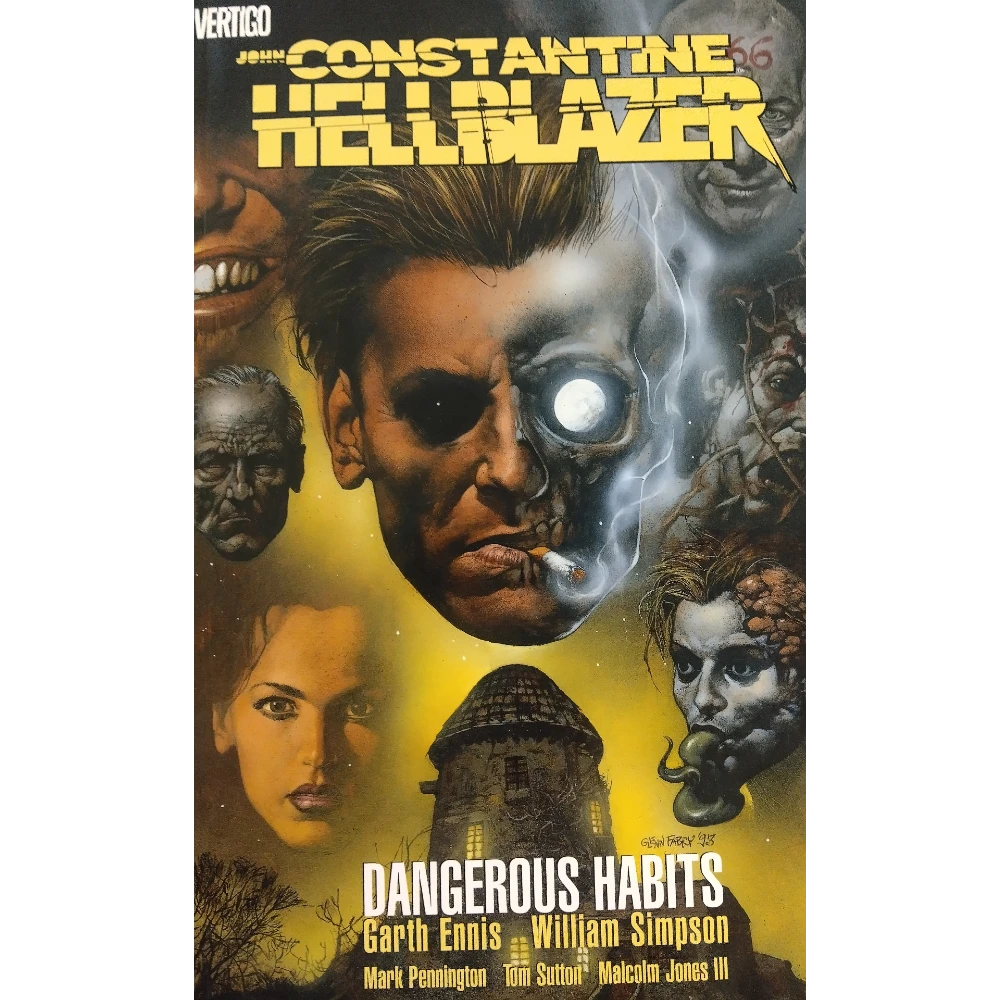
About a year-and-a-half ago, I dove into a volume collecting the inaugural issues of Hellblazer, starring John Constane, a British mystic introduced by Alan Moore in his Swamp Thing run. Written initially by Jamie Delano, the series crafted quite the character out of Johnny–a hard-drinking, ghost-chatting, demon-taunting sunuvagun. Two facts about Constantine are etched into his personality pretty quickly: first, for all his cussing and conniving, he fights for the things and people he believes in most. Second, he's absolutely addicted to substances.
Comic characters suffering from substance abuse isn't a new thing, and it certainly wasn't when writer Garth Ennis took over Hellblazer. Constantine had been smokin' and drinkin' his way through plenty of Hellblazer issues by this point, his way of coping with the demon-darkened days he walks through. I do have one other volume of Hellblazer, but I'm jumping to this point for a reason: like Johnny himself does, I made a mistake. Got my writers mixed up. I reviewed a few volumes of Thor and Ultimate Universe comics recently, short runs written by a different British writer, Warren Ellis, and decided to review his contribution to Hellblazer...which this is not. See the confusion? Ellis? Ennis? No? I'm just an idiot? 'Kay, moving on.
(though, as an aside, Ellis did write Hellblazer comics in the late 90s, so I'm not entirely mistaken! Just accidentally read the wrong story)
By the time I recognized my error, I was an issue away from finishing today's arc and, thinking I wouldn't have time to read the Hellblazer volume immediately numerically after the first one, decided to do a very un-Constantine thing and surrender to the consequences of my actions. No magic spells or consulting with otherworldly beings to reclaim my lost time. I'm here, at the doorstep of defeat, and must pay the price.
Speaking of prices, "Dangerous Habits" is all about cost, exploring what happens when you come face-to-face with ramification and how you choose to respond when that's the only choice you have.
John Constantine, Hellblazer: Dangerous Habits
Writer: Garth Ennis
Penciler: William Simpson
Inkers: Mark Pennington, Tom Sutton, Malcolm Jones III, Mark McKenna, Jim DeMulder, and Stan Woch
Colorist: Tom Ziuko
Letterer: Gaspar Saladino
Issues: Hellblazer #41-46
Volume Publication Date: March 1994
Issue Publication Dates: May 1991-October 1991
Publisher: Vertigo (DC Comics imprint)
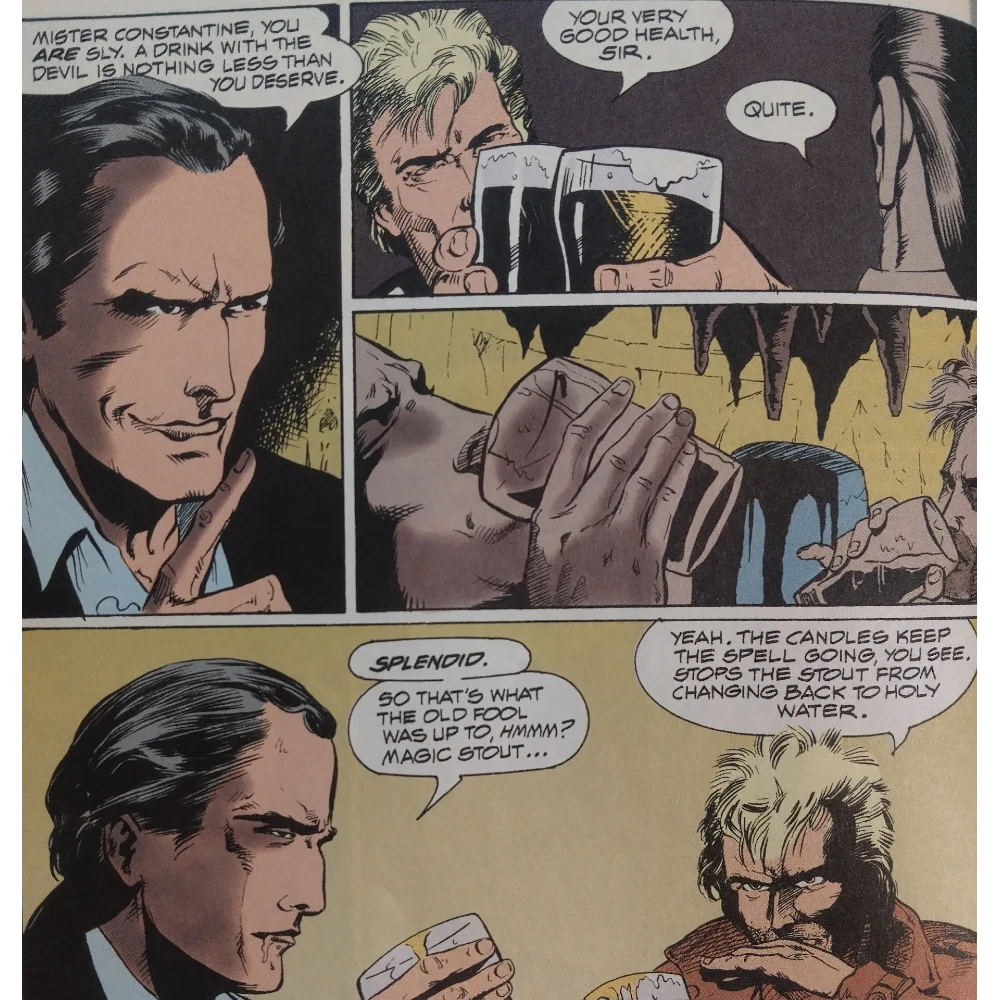
"Dangerous Habits" exists at the intersection of comics dealing with two subjects: drugs and death. These subjects aren't always treated exclusively, but sometimes, honing in on just the one makes all the impact. Sure, substance-related narratives such as Buzzkill, "Snowbirds Don't Fly," "Demon in a Bottle," "Venom," and the "Harry Osborn on pills" arc dangle the looming threat of overdosing, but they work with other consequences. You're less concerned about Tony Stark drinking himself to death as you are with him drinking himself to moral oblivion and losing all he holds dear. Similarly, you likely assume Harry Osborn and Speedy aren't going to OD; you're more interested in seeing how they climb out of a hole of unraveled relationships with mentors and peers.
Slipping over to the concept of death, some of the strongest comics out there deal with death as an unfair, unwarranted occurrence. Captain Marvel doesn't choose cancer, but it happens anyway, sapping his strength instead of offering a nobler passing. The Silver Surfer experiences much the same, in an alt universe limited series. Jason Todd is beaten to death with a crowbar (sans retcon), and while you can argue his own idiocy leads to his fatal interaction with the Joker (sans retcon), Jason doesn't actively engage the Clown Prince of Crime understanding death's looming proximity.
It's at this intersection John Constantine's own upcoming end exists, combining the best of both styles of narrative: he's dying…and his own actions have delivered the death sentence. When I say "best," I mean "best for us," but it's often "worst" for our characters. "Best for us" because drugs provide an adversary to overcome, usually in the form of self-inflicted addiction, and because death provides a certain sense of uncomfortable closure. "Death of Captain Marvel" wouldn't work nearly as well if Mar-Vell overcame cancer; all his ruminations on his past adventures, all his emotional goodbyes, wouldn't amount to much if he won. For Constantine, there's the reality that smoking has led to the threat of an untimely passing, plus the indication his interactions with otherworldly, demonic forces have played a hand in his fate. You sympathize with him, yet you recognize this is what the story needs, conflict propelled by choices he's made–he's smoked twenty or thirty cigs a day (by his reckoning), he's toyed with sorcery–and the choices he makes in responding to his diagnosis.
The story is peppered with dark humor, and its bleakest joke may be that this plot exists at all. A few pages into the first issue of this trade, boom, Constantine's been diagnosed with terminal cancer. No build-up; just sudden, cruel reality. Just the overwhelming understanding that this is going to be an incredibly painful journey with no light at the end. John had been smoking since his very first appearance, and what Alan Moore introduced as a visual detail becomes a reasonable plot point. You can just picture Ennis looking at the character, recognizing the trademark cigarette, and deciding to turn it into a whole story. That this is Ennis' inaugural Hellblazer arc is also meaningful: he's putting his stamp on this title immediately by having Constatine face, as one house ad touted, "one demon he never expected."
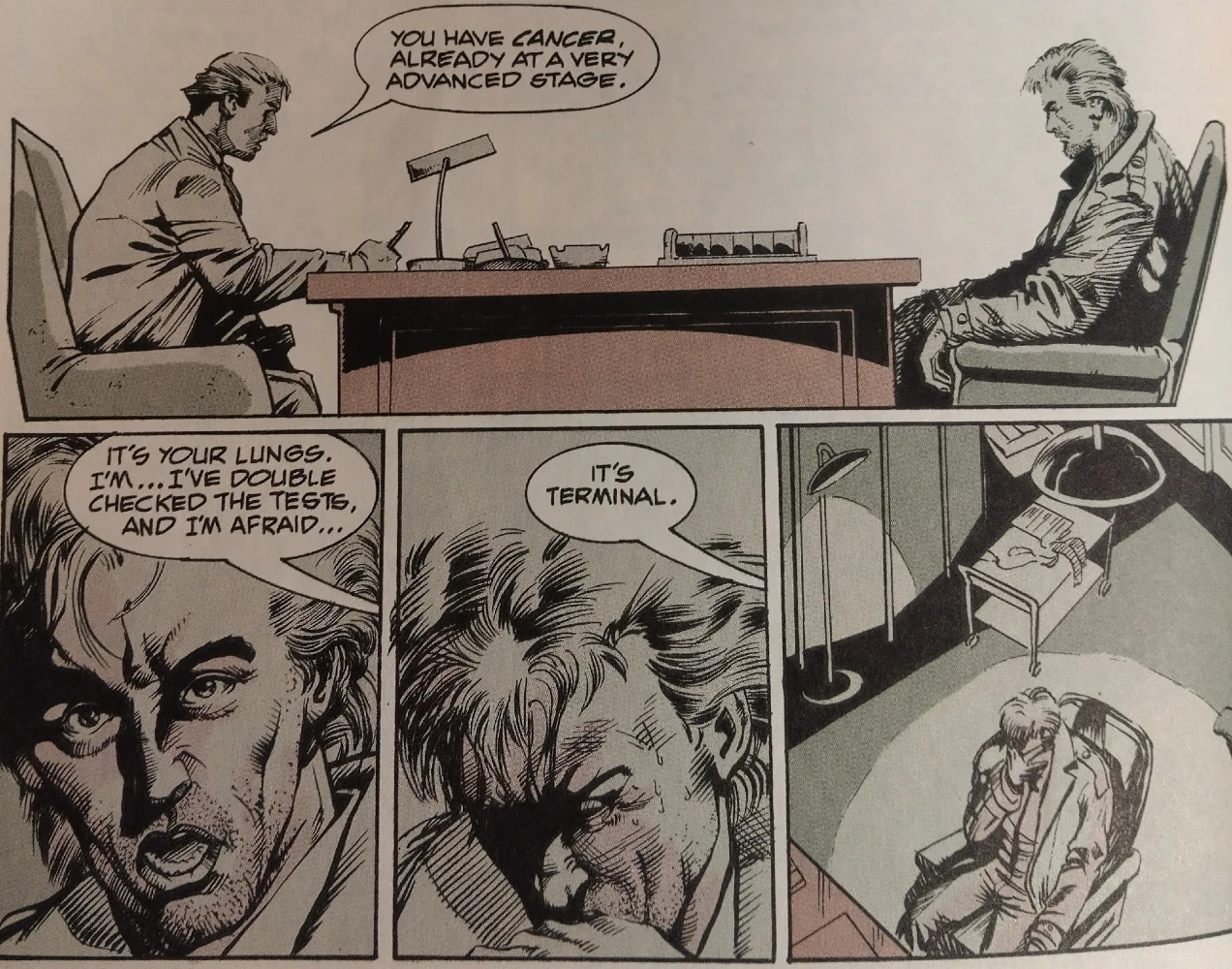
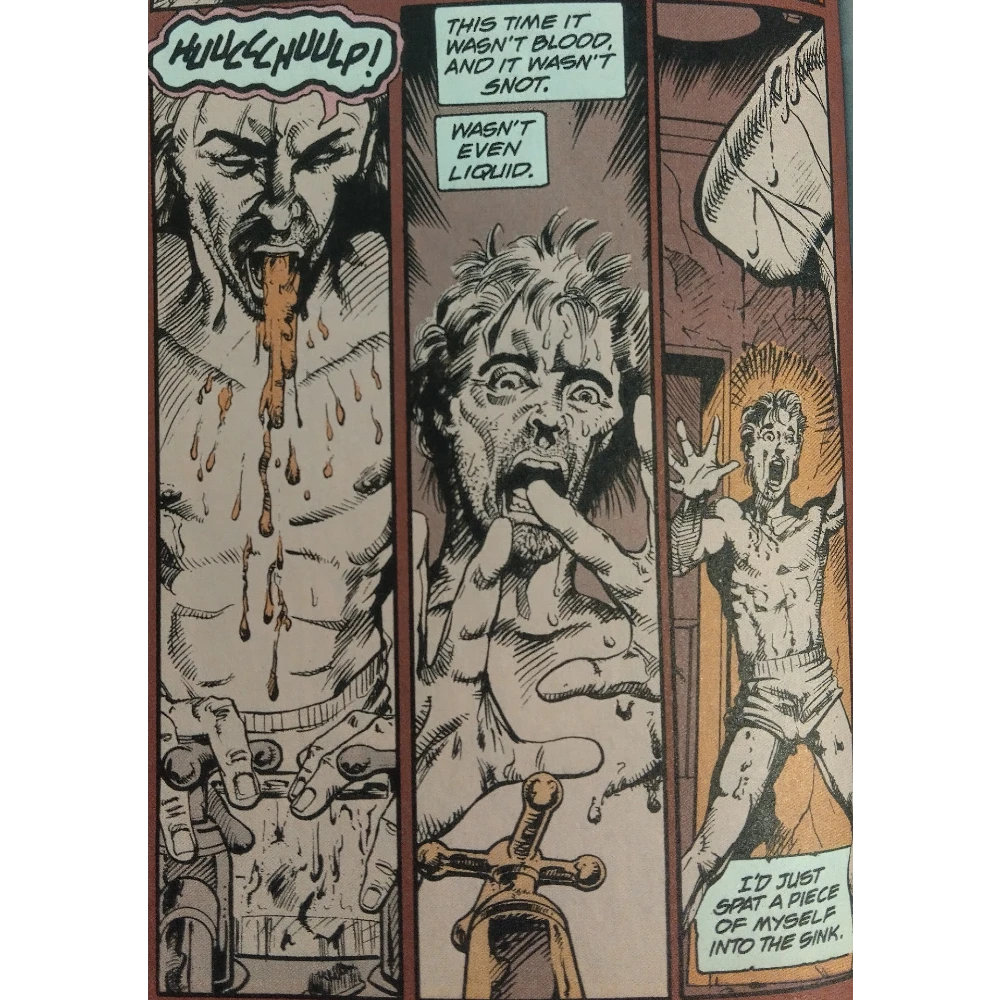
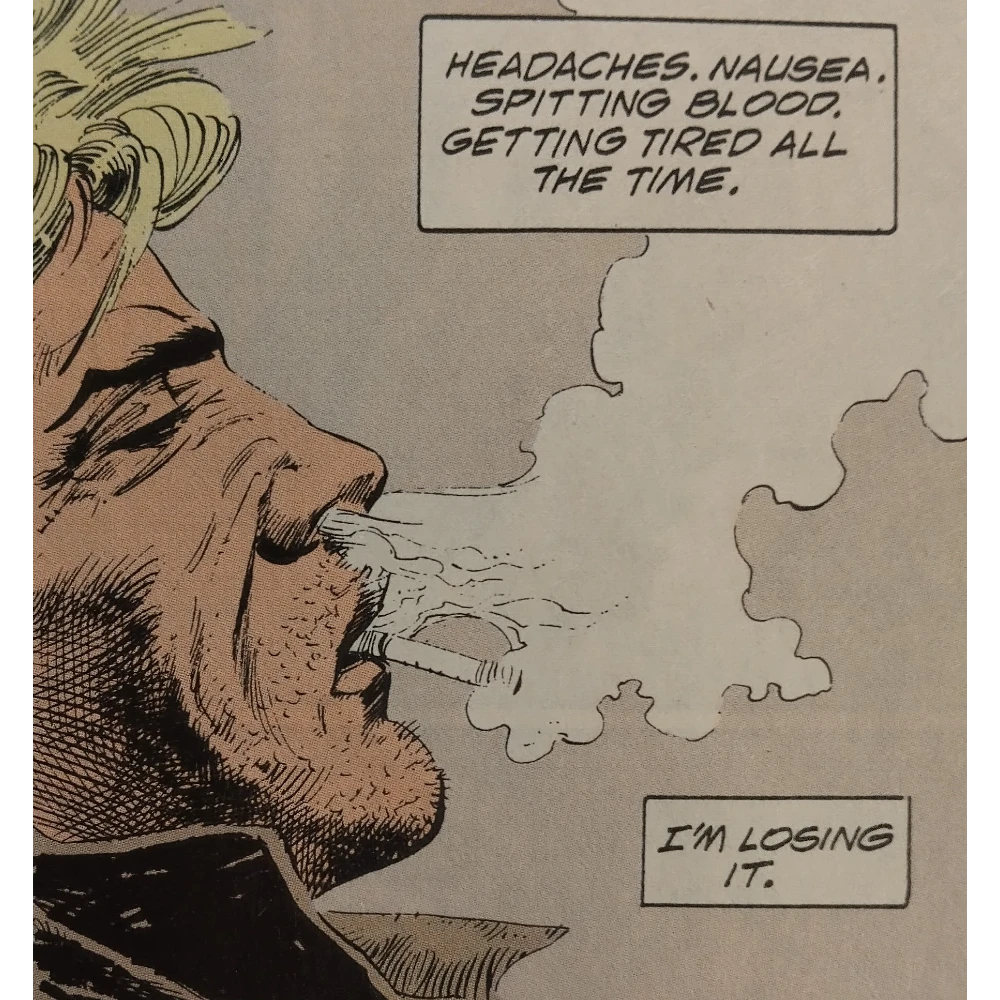
Like Mar-Vell, cosmic superhero, was stricken with an all-too-human disease, the terminal diagnosis serves as a devastating blow to Constantine. He's wrestled with demons, been to hell and back, and though he consorts with all manner of supernatural beings in this arc, he's faced with the grounded harshness of his situation. He can't talk his way out of a cancer diagnosis; there's no con he can pull to get his rebelling cells to stop growing abnormally. Though horror comes from supernatural means, William Simpson also disturbs the senses through the common and ordinary disquiet of Constanine's situation. Vomiting on the regular, sweating, considering suicide…much eeriness comes from just Constantine physically, emotionally, and mentally processing the entire situation and the unfortunate symptoms which only build as the cancer settles into his system.
John runs the gamut of emotions, from despair to conviction, yet Ellis plugs into that underlying spirit which so often animates the character to action. His vigor, even in the throes of bouts of nausea and pain, feels real, not just a defense against the pain. Yet, in the moments where he's vomiting up some part of himself, Constantine is illuminated in very human brushstrokes. He's not always in tip top shape, beaten and battered by the effects of his cancer. Perhaps most interestingly, despite the diagnosis, he still smokes–it's actually the first thing he does after receiving the diagnosis. It's such a human response, to lean into the very thing killing him. He copes with dying by inhaling death. You want to be frustrated by it, but at the same time, you understand. It's a moment which Ennis uses to capitalize on the character's complexity, a comment on humanity's penchant for contradiction.
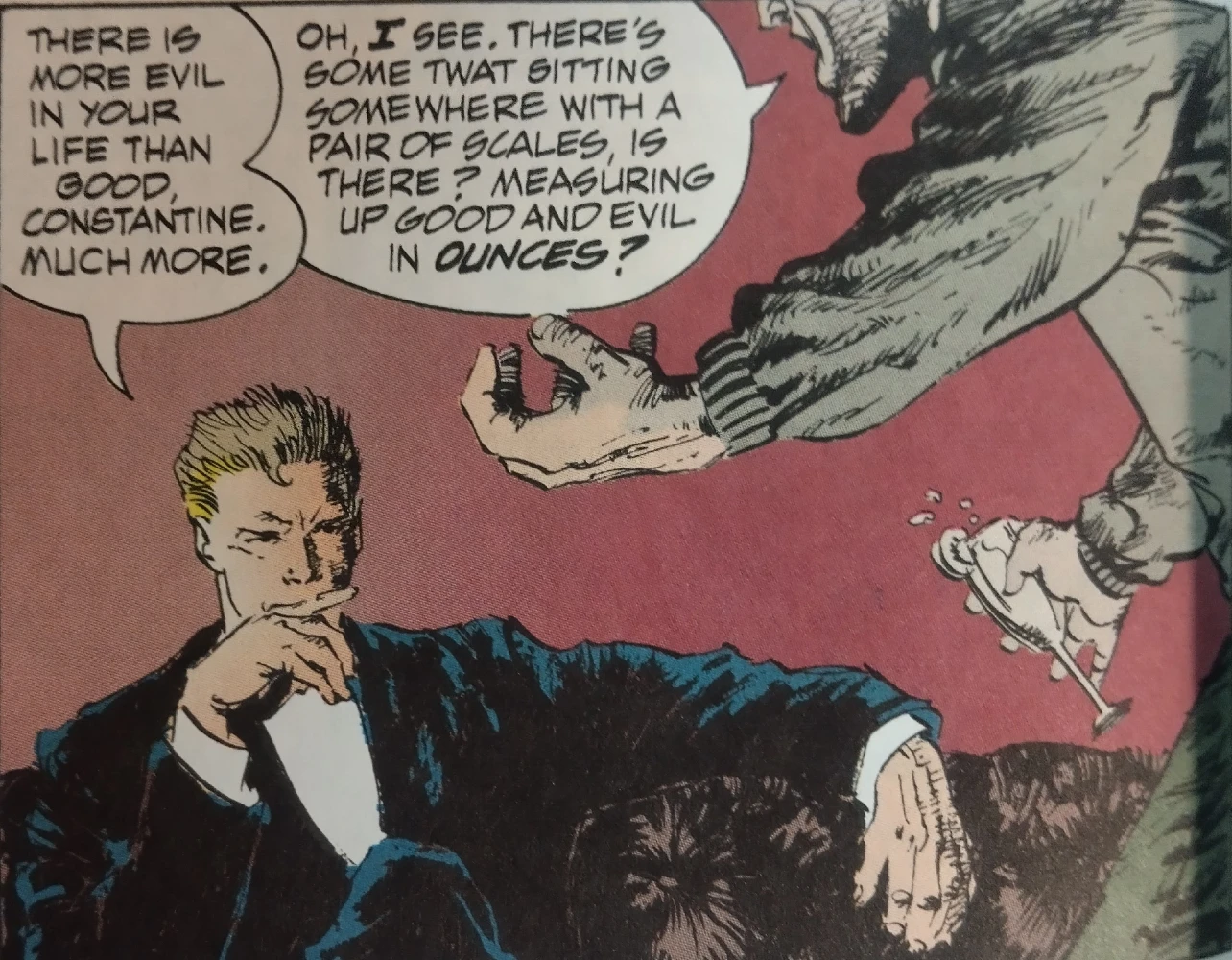
Throughout, as Constantine engages with supernatural beings from heaven and hell, Ennis punctuates the tale with a bit of religious theming. It's a fairly bitter outlook, which I tend to find frustrating, but similar to Constantine's choice to return to his cigarettes, you recognize the point Ennis is making. Constantine's bravado when dealing with angels and devils focuses the seeming unfairness and arbitrariness it appears Ennis sees within reality. No matter where cosmic deities fall on how we define "good" and "evil," humanity will pay the price for how they behave.
I can't say I'm on the same page as Ennis with this, nor do I subscribe to how he showcases DC's cosmology in this narrative. It narrows down to that definition I mentioned in the previous paragraph. There are no absolutes here other than a casual cruelty snaking its way through all levels of spiritual forces. This idea lances through Constantine's character, putting him in a position where he not only defends humanity against supernatural threats but rebels against the very nature of their existence. But it's all based on Ennis' definition, driven by Constantine's demeanor. Ennis is well within his rights to pass such judgement, and I think I am within mine to say that I just don't completely agree.
Yet such thinking stabs at what makes this arc so effective: the cruelty of a cancer diagnosis, regardless of an individual's culpability, regardless of where you lay the blame or whether blame is deserved. A medical death sentence. Though Ennis doesn't delve into histrionics the same way Starlin does, Constantine must still confront his future and make some amends with his past. Old friends flare up, a new friend's journey parallels Constantine's own in some ways, and goodbyes are said. Important as these moments are, Ennis pumps the brakes on wringing all the emotions out. His focus, interestingly enough, is the reality of it. The sight of Constantine heaving is more effective than him hugging a loved one for, seemingly, the last time. It's where Ennis' focus lies, and for this narrative, that focus is accurate.
I may have read "Dangerous Habits" because of a mistake, but reading it wasn't one. I've seen several people mark this as the absolute highpoint of the entire Hellblazer series, and it's easy to see why. I struggle with some of the worldview Ennis plugs into the narrative, but there's a sensible grounding here. An important detail is lifted from Constantine's personality like smoke and wrapped around him like a prison cell, guiding him not only through metaphysical horrors but the shadows of everyday living. But don't despair too much. "Dangerous Habits" is dark, but it isn't hopelessly bleak. It's serious. It's real. And in a story where demons and angels fling arbitrary judgement on humanity, something concrete and grounded helps the reader find purchase in relating to Constantine as he chooses to confront the grim possibility of death.