(Strand)om Stories: Thor: Worldengine Review (Thor-oughly 90s, Part 1)
A valiant effort against the 90s dark demeanor is quashed by the grim whims of business
—by Nathan on May 11, 2026—
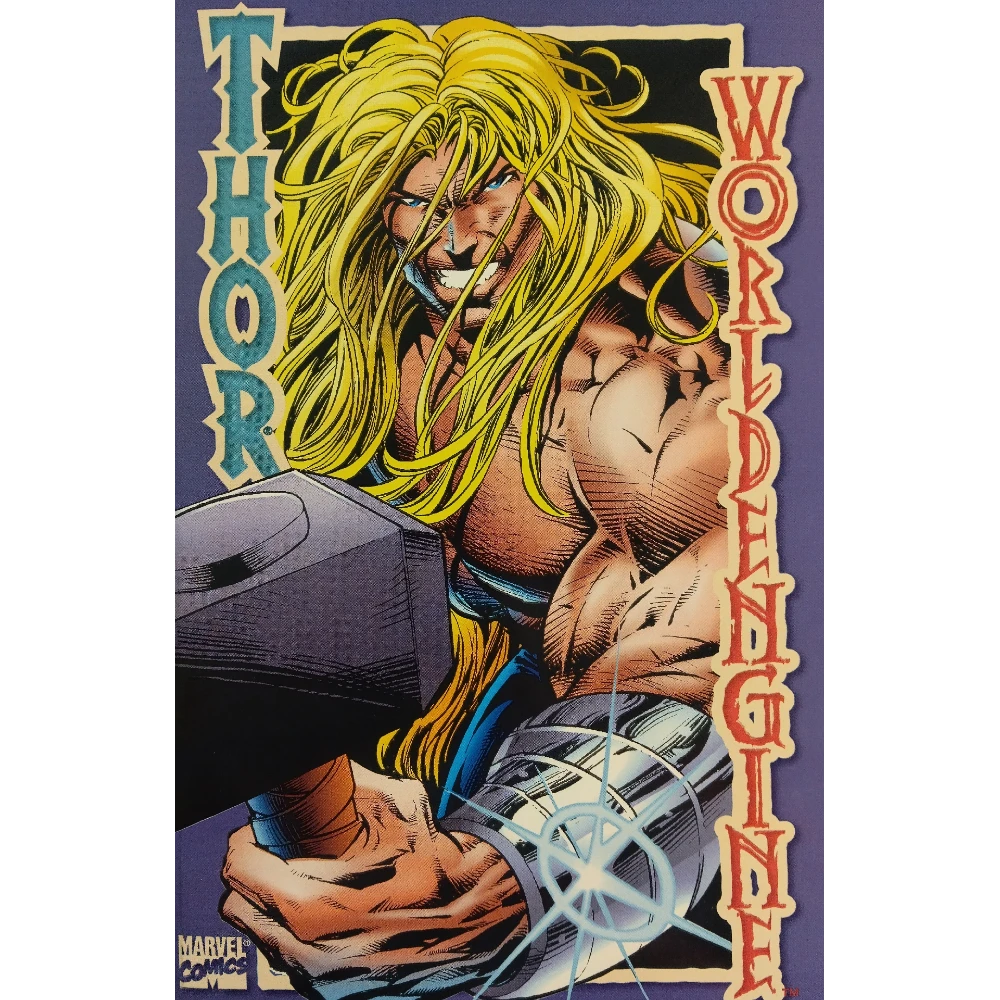
For quite some time, this blog was firmly entrenched in the 80s, exploring multiverse-ending events, the dawning days of the limited series, acclaimed runs on famous characters and teams, and timeless tales showing the ongoing development of the medium's complexity. We've danced over to the 90s periodically, and we've swung over to that decade completely in examining Spidey's history, but more often these days, the transition into the medium's "Dark Ages" has been more complete. I'll always love the 80s, and I will absolutely be returning there any opportunity I get, but for now, we seem enmeshed in the decade where I was born.
That's only going to get more prominent here on out. From exploring the birth pangs of Valiant, to early Image narratives, to reviews building towards the iconic "Knightfall" saga, I'm becoming somewhat more comfortable with this era. This post intends to kick off a "series within a series" grouping of posts, following the path of a certain Norse God of Thunder.
Why Thor? Mostly convenience's sake. In my last "Spider-view" post, I examined a Spider-Man 2099 crossover dealing with a long-gestating plotline centered on the return of Thor. Reading that narrative kicked off an interest in some 90s Thor narratives which are fairly easy to collect in volume format, the first of which I'm reviewing today. Similar to my "Knightfall"-centric reviews, I'll be using a handful of "(Strand)om Stories" posts to explore where Mjolnir's owner was during this era, specifically in the mid-90s, as he and other Marvel heroes moved further into those "dark ages."
To get us started, I'm diving into a four-issue arc that, as I've read, lifted some spirits in regards to the reading populace's view of Thor as a character. We'll see if that spirit exists down the line, but for now, we're tackling a reimagining of Don Blake's alter ego, courtesy of the guy who would go on to reinvent the Thunderbolts, Stormwatch, and Iron Man.
Thor: Worldengine
Writer: Warren Ellis
Penciler: Mike Deodato Jr.
Inker: Mike Deodato Jr.
Colorist: Marie Javins
Letterer: Jonathan Babcock
Issues Collected: Thor #491-494
Volume Publication Date: August 1996
Issue Publication Dates: October 1995-January 1996
The 90s were a time of reinvention, though the argument can certainly be made whether that reinvention worked. Spidey a clone? Superman killed? Daredevil with an armored suit? Batman's back broken? And all those guys getting replaced. You got yerself a Superboy over here, AzBats over there, Ben Reily over yonder, and elsewhere in the mix, Kyle Rayner as Green Lantern, a kid version of Tony Stark as Iron Lad, and Artemis as Wonder Woman. Change, change, change. Some of it good (I know a lotta folks like Rayner), some of it bad…and mercifully impermanent. We'll get to some of those changes in a few posts, but for now, we're gonna focus on the fact that not even an immortal god was immune to the whims of mortal writers, artists, and editors.
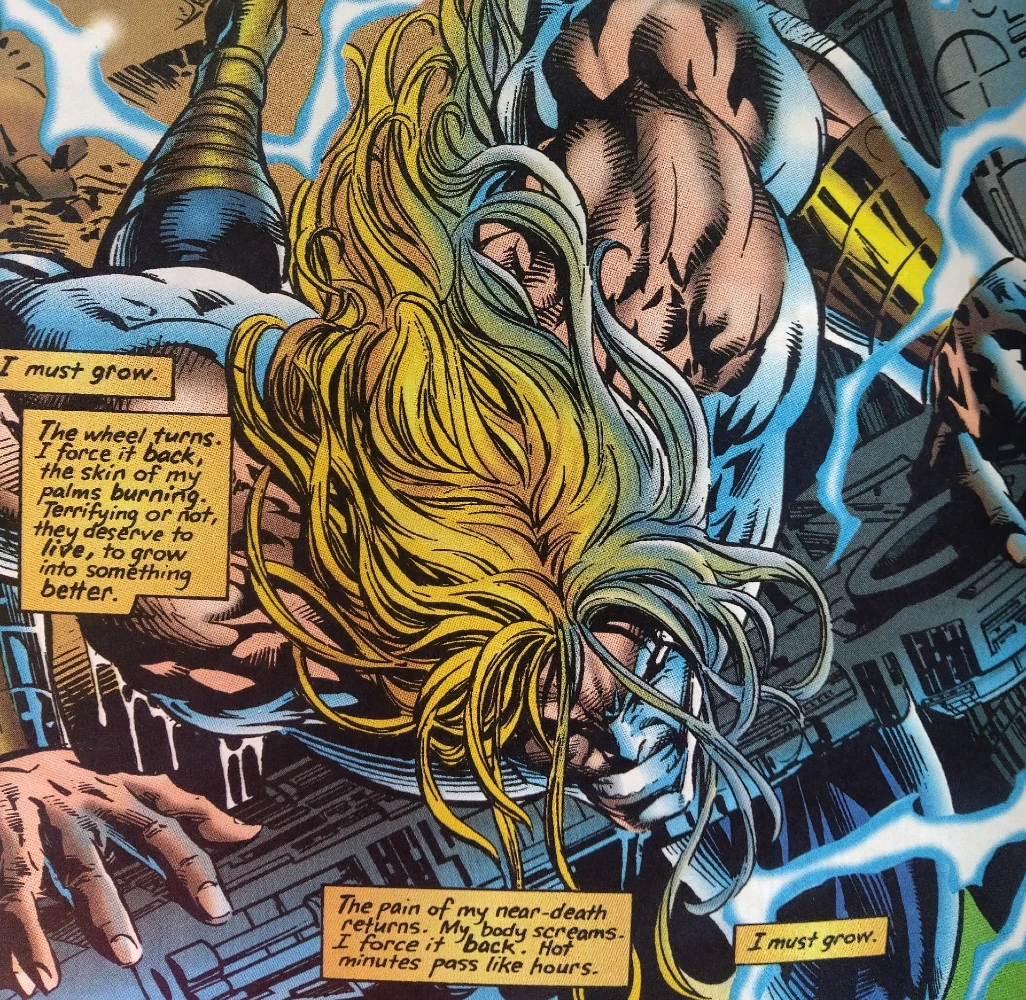
At the same time Mark Waid de-powered Captain America by taking away the ol' super soldier serum, Warren Ellis was playing a similar game with Thor, stripping the hammer-hefting hero of his godhood. And not in a "If he doesn't touch the hammer in 60 seconds, he turns back into Don Blake" kinda way. Thor starts this run broken, dying. Yes, a god, dying. Course it wouldn't last, not even to the end of this particular arc, but Ellis changes up the status quo by bringing a very human Thor to his knees…before forcing him to stand.
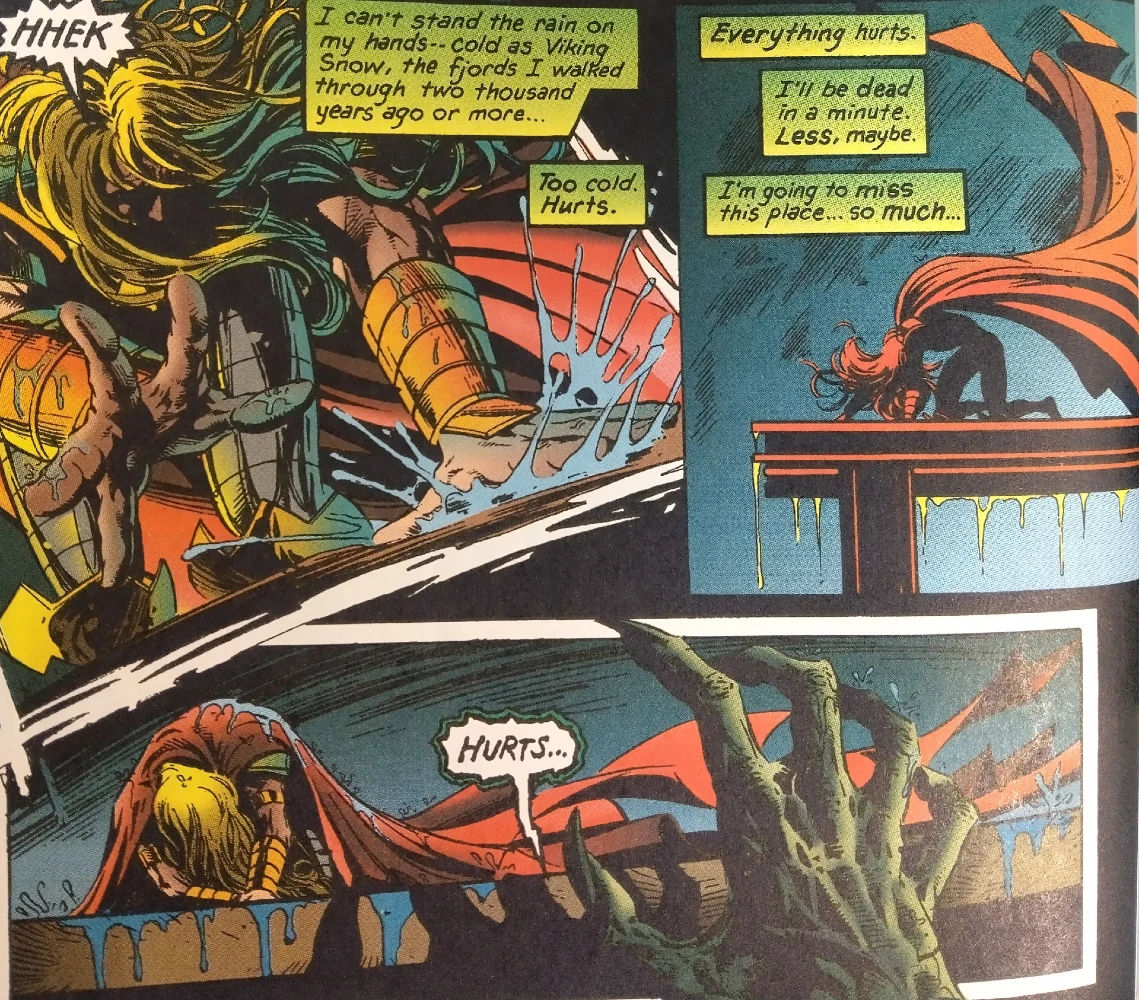
Ellis, fairly early in his career at this stage, having written for British publishers and several lesser-known Marvel titles before hitting his stride with Stormwatch, endeavors to juggle a satisfying story, decent characterization, and his own penchant towards bizarre plotting in these four issues. Ellis is someone I would consider one of those "heady" writers, along with Grant Morrison, who generally attempts to use narrative as a method of staging grander concepts that speak to humanity's understanding of itself and maybe some more esoteric ideas. With Morrison, you get an Animal Man run where Buddy Baker meets a seemingly un-killable parody of Wile E. Coyote, a Thangarian warrior who wants to destroy Earth through a song-based nuclear device, and eventually Morrison himself. With Ellis, you get a Thor who learns that someone is attempting to hijack Yggdrasil, the World Tree, and as a result, is threatening not only the Norse pantheon but the firmament of creation…and yet some of the very humanity Ellis seeks to imbue Odin's first son is lost in all that.
It's fairly high concept, and when blended with Ellis' attempts to reframe not just Thor but his entire background, the efforts feel too constrained for these four issues, especially since Ellis did not return to Thor after this arc (more on that in a moment). The plot is serviceable, meandering between Thor trying his best just to stay alive and a British detective whose penchant for smoking and saying "bloody" every other word is a pretty blatant nod to DC's own chainsmoking, investigative Englishman. It's the detective who pries most of the truth from the events encircling Thor, coming to believe the Thunder God and his kind are likely technologically advanced aliens, not gods. So beyond the ken of normal humanity is Asgardian science, it's been mistaken for magic, not unlike the explanation we're given for the Norse pantheon's power in the MCU.
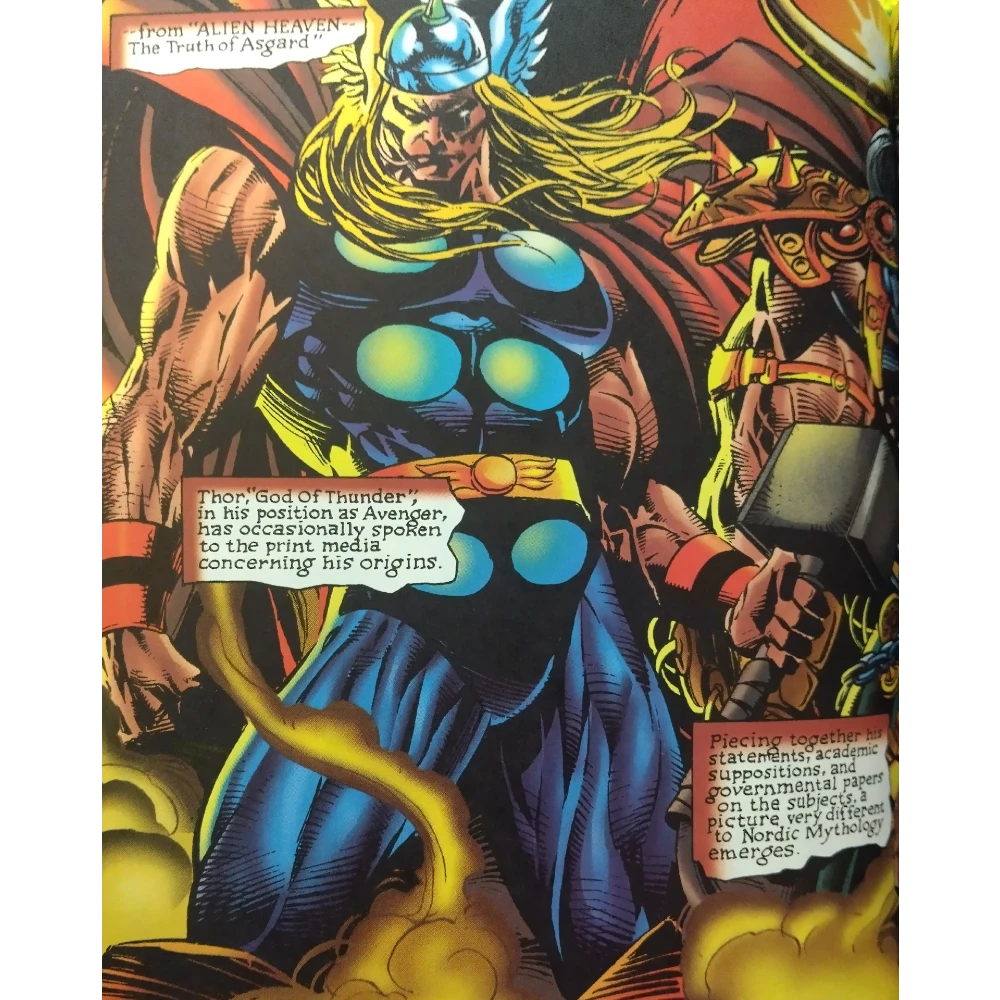
Presented in quite stunning illustrative quality by Mike Deodato Jr., the twist is meant, I feel, to shake the foundations of who Thor and the rest of Norse friends are. "It's a story about change," Ellis writes in a mid-volume prose piece, and it certainly guides us in that direction. It's an effort to restore wonder to a demigod who, like many of his friends, had been subsumed by the chaos of the 90s. See, reader? Ellis seems to say. Thor isn't some god above you! He's a very human extraterrestrial who, like you, feels pain and can even die. He's knowable!
The intention is noble, and thirty years ahead of the same sense of awe Lee and Kirby steeped their original creation in, attempts to deliver that wonder in a more streamlined, somewhat darker fashion. We can't step out of the 90s totally, but we can rebel somewhat. Deodato Jr. presents legions of grim-looking skeletal adversaries a dying Thor wades through; the World Tree's hijacking for a mystery villain feels like an ecological nod, subtle enough to tickle the senses without preaching; hints of Ragnarok prick the ears of gods, summoning the ever-lingering threat of the ultimate end. Shadows hang all around, and Thor must be the lightning which drives them away. Real world threats loom, and unlike some writers, Ellis can at least deliver something which feels like commentary without sounding too much like it. The 90s edginess is here, but it carries greater heft than other narratives I've reviewed of late.
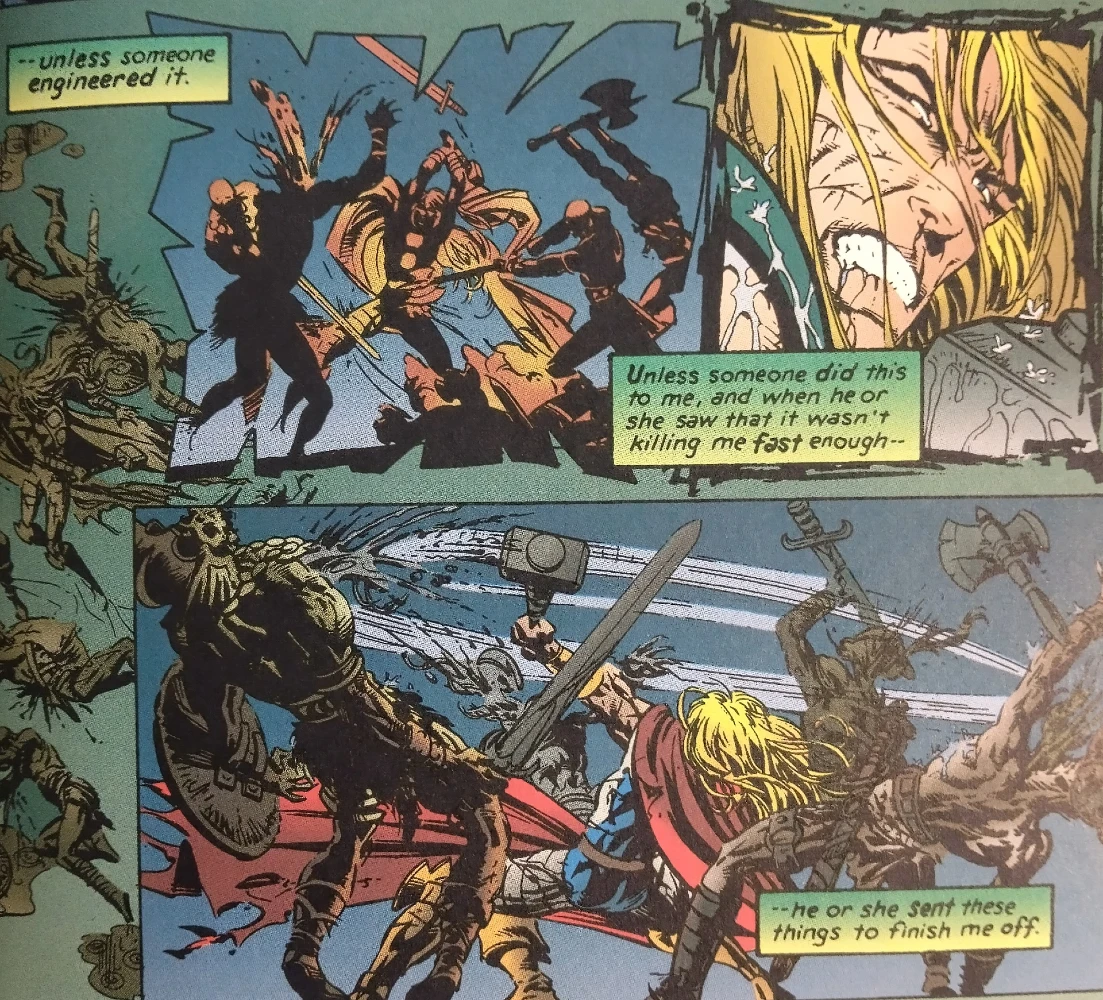
Yet the success of Ellis' endeavors comes down to his time on the title, which feels truncated. Perhaps this was deliberate. I'm not sure. But four issues are enough to offer a glimmer of that restoration of wonder, to pull a bit away from the darkness, while failing to tear away completely. It's a story about change, well enough, but oh, that change is limited. Thor and the Enchantress fall in love, Ellis moving Amora in a somewhat less "villain" direction while allowing the antagonist-turned-love-interest her tricky personality. Thor is saved from death, but his actions late in the story have a lingering cost which generates just another limitation upon his godly frame. Ellis even turns the tables on readers with a fairly unsuspecting villain, whom Thor initially believes to be his conniving half-brother. There's mystery, intrigue, stakes. The old order changeth, but the change is impermanent.
In the wake of this arc, Thor would be pulled into a crossover arc I'll review later and then a few more issues of his own series before Marvel's "Onslaught" crossover added even more upending. Any change promised by Ellis was quickly brushed under the rug. This isn't a mark against Ellis–again, I am not aware if he intended to stay longer than four issues. He does what he can with the space allotted, but either through his own choosing or Marvel's, can only serve his ends somewhat adequately. His last issue feels particularly rushed, and though Thor is given a pretty solid heroic moment, the larger unraveling of Ellis' plot and the tying up of one loose end is crammed into the final pages. We're not given the space we need to adequately explore the changes Ellis is trying to accommodate, whether that's Thor and Amora's new relationship, Thor's pivot towards humanity, or the firmament-shaking threat posed by this arc's adversary.
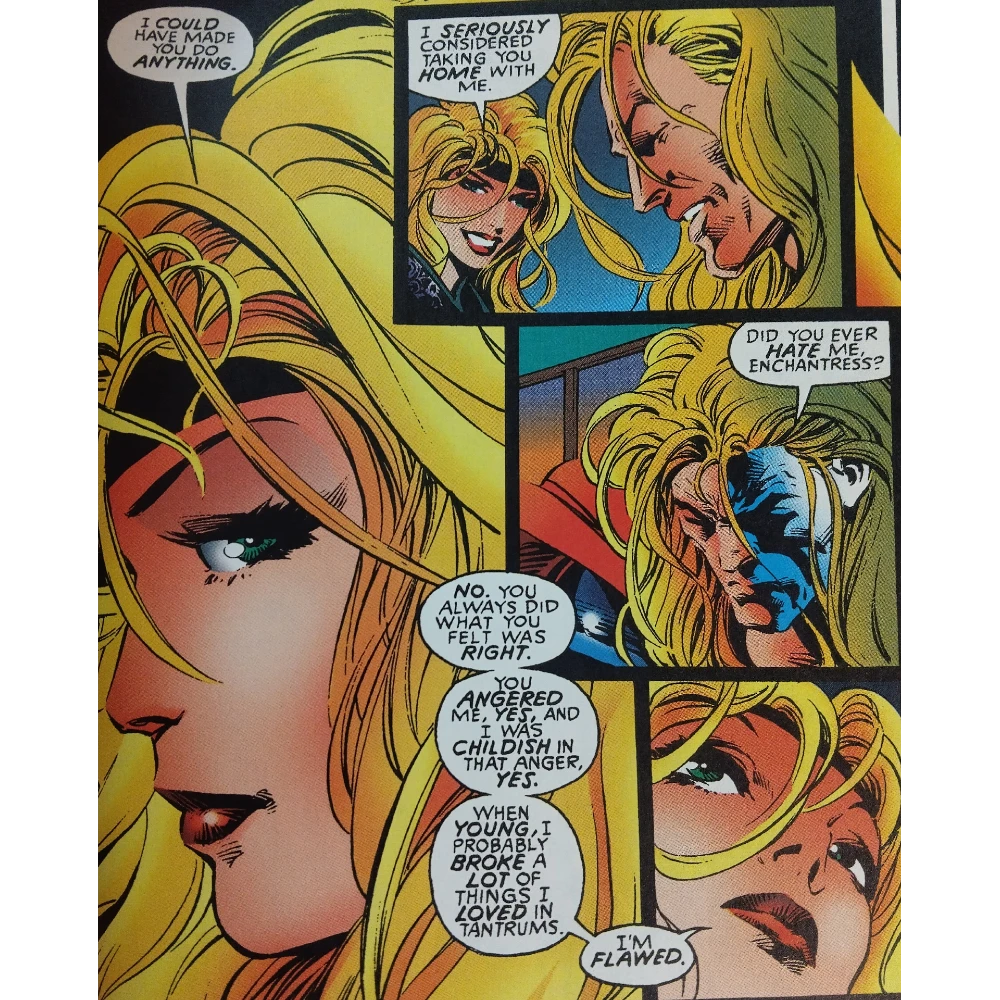
"Worldengine" is a well-intentioned arc that seeks to draw Thor away from the murkiness of 90s excess while a company and industry around Ellis is screaming for the exact opposite. The writer, aided by Deodato Jr., seeks genuine growth in utilizing the decade's own pitfalls against themselves, weaving in shadows and themes to further illuminate Thor as a character. Ellis nearly kills the Thunder God! That's how serious he is in resurrecting the hero metaphorically; he nearly does so physically. The arc, from what I can tell, sold well at the time, though it seems to have been overshadowed by other narratives. Worst of all, Ellis lost against the forces of business, his vision quickly scrapped for "Onslaught" and "Heroes Reborn." We'll have to keep moving through Thor's next several issues to see how this reborn god tangled with the darkness of the 90s. I know what's coming up is bad. Maybe Thor will offer some lightning to guide us through.