(Strand)om Stories: Avengers/Iron Man: First Sign Review (Thor-oughly 90s, Part 2)
These issues exemplify the awkward transitions Marvel was forcing upon its heroes in the 90s, swapping development for spectacle
—by Nathan on May 19, 2026—
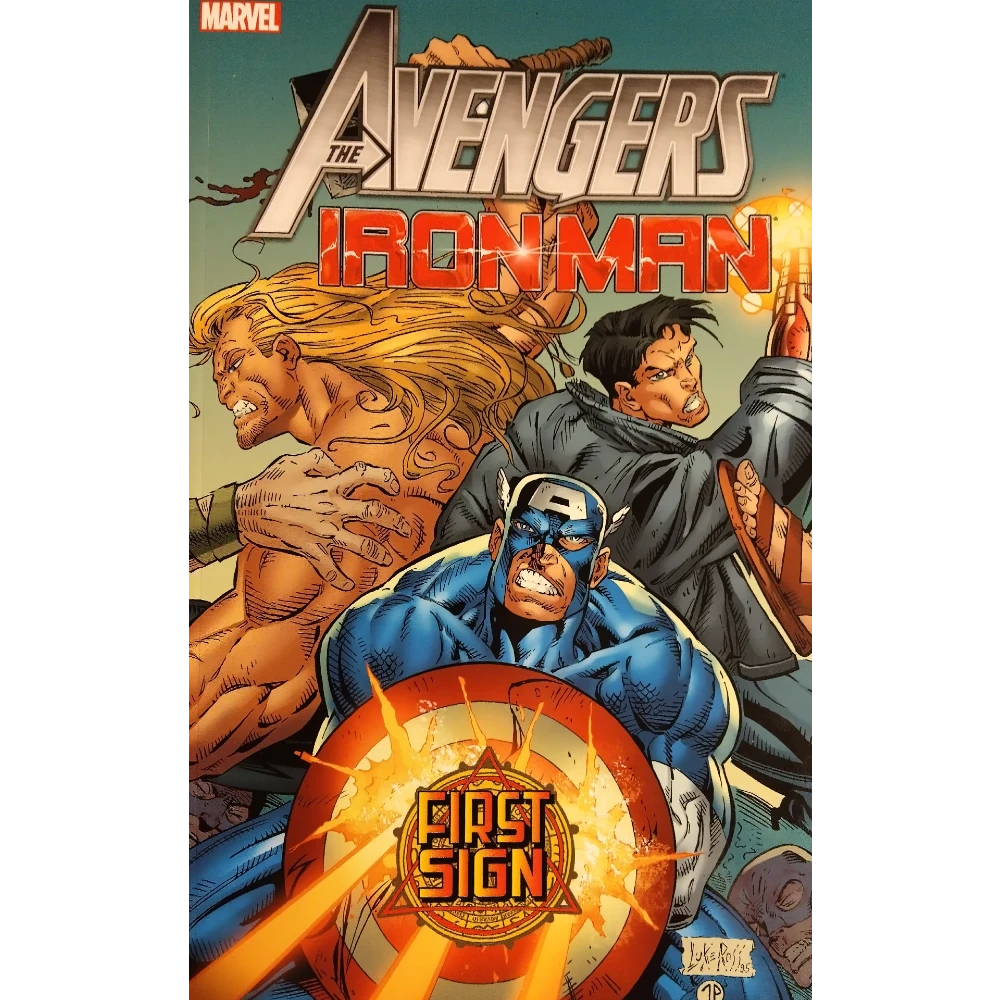
In a recent "(Strand)om Stories" review, I unpacked a four-issue arc on Thor, written by Warren Ellis and illustrated by Mike Deodato Jr. Today's volume immediately proceeds from that narrative, along with capturing some of what was a-happenin' with Captain America, Iron Man, and the Avengers juuust before a certain melding of mutant minds tried to kidnap Franklin Richards, leading to a good chunk of Marvel's heroes getting whisked off to a different universe.
But more on that in the future.
Today, we find ourselves in the wake of a crossover with perhaps the most on-the-nose name ever for an intracompany event: "The Crossing." That multi-series crossover–which I likely won't be reviewing anytime soon, as (1. it's considered to be pretty horrible and, more importantly, (2. it's only ever been collected in an out-of-print, expensive omnibus–frustrated fans by revealing that Iron Man was, in fact, a double agent working for Kang the Conqueror, brainwashed at some point in the past. Seeking to save the world from Kang, the Avengers slipped into the past, bringing back a young Tony Stark, but not before the young man's parents were killed by Kang's agents. In the present, both Starks battled, with the younger Tony killing his older self and assuming the Iron Man mantle.
As I noted in my "Worldengine" review, this was an era of changes. Ben Reilly was Spider-Man, Jean-Paul Valley was Batman, Captain America had lost his serum-derived strength, Thor was stripped of his godly powers…and Tony Stark was a young man, driftless in what was the future for him. Today's volume collects a decent chunk of issues coming right before the aforementioned "Onslaught" arc, showing the state of the Marvel Universe for some of our favorite Avengers before their world was pulled inside out.
Avengers/Iron Man: First Sign
Writers: Mark Waid, William Messner-Loebs, Terry Kavanagh, Ben Raad, Howard Mackie, and James Felder
Pencilers: Mike Deodato Jr., Jim Cheung, John Statema, Dave Hoover, Mike Wieringo, Joe Bennet, Ron Garney, Sandu Florea, Hector Collazo, Steve Ellis, and Marc Campos
Inkers: Mike Deodato Jr., Mark McKenna, Tom Palmer, Dennis Rodier, Scott Koblish, Sandu Florea, Andy Lanning, Steve Moncuse, Don Hudon, and Tim Dzon
Colorists: John Kalisz, Marie Javins, Frank Lopez, Tom Palmer, and Malibu
Letterers: Michael Higgins, Jon Babcock, Phil Felix, Bill Oakley, Njo
Issues Collected: Captain America #449, Thor #496, Iron Man #326-331, and Avengers #394-400
Volume Publication Date: October 2013
Issue Publication Dates: March 1996-August 1996
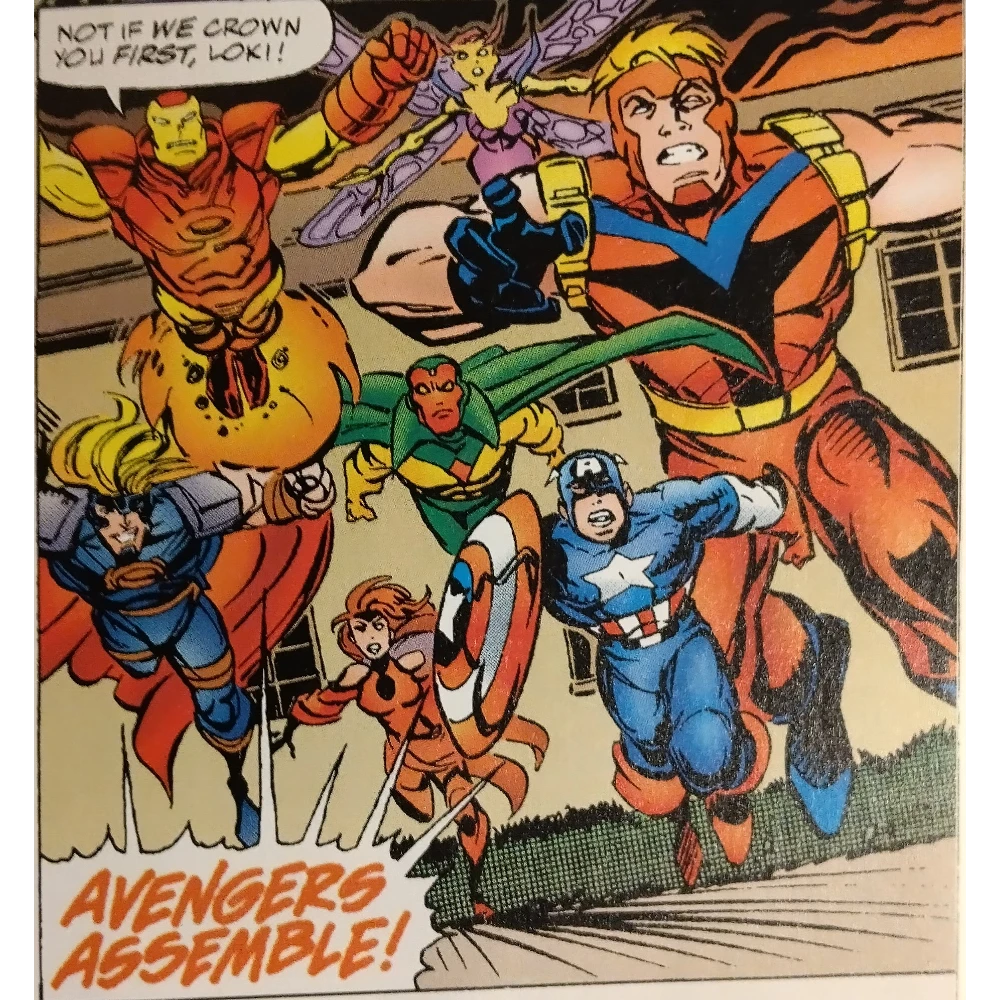
My primary complaint with the previous volume I reviewed was that Warren Ellis was not allowed the necessary space to flesh out certain ideas with Thor. The God of Thunder falls in love with the Enchantress, receives a new lease on life after slipping close to death, and seemingly loses his great abilities. He has a chance at some normalcy…right before Marvel rips the rug out from under him. We'll get to those pre-Onslaught Thor issues in a later post, but the importance of noting them, as well as the Norse god's appearance here, is to highlight the concept that Marvel, at this time, seemed really lost with what they were doing with some of their characters. And I haven't even reached the "Clone Saga" over in "Spider-view" yet!
Thor and Captain America pop up fairly briefly in this volume, primarily for a four-part crossover narrative preceding the main Avenger and Iron Man issues filling most of the volume. Throughout these narratives, the assembled writers and artists feel they're divided with what they're trying to establish: there's a sense that Marvel is trying to reassert the strength of some their characters after a few difficult years of odd storytelling decisions, yet they feel compelled to do so through other awkward storytelling decisions and strange character developments.
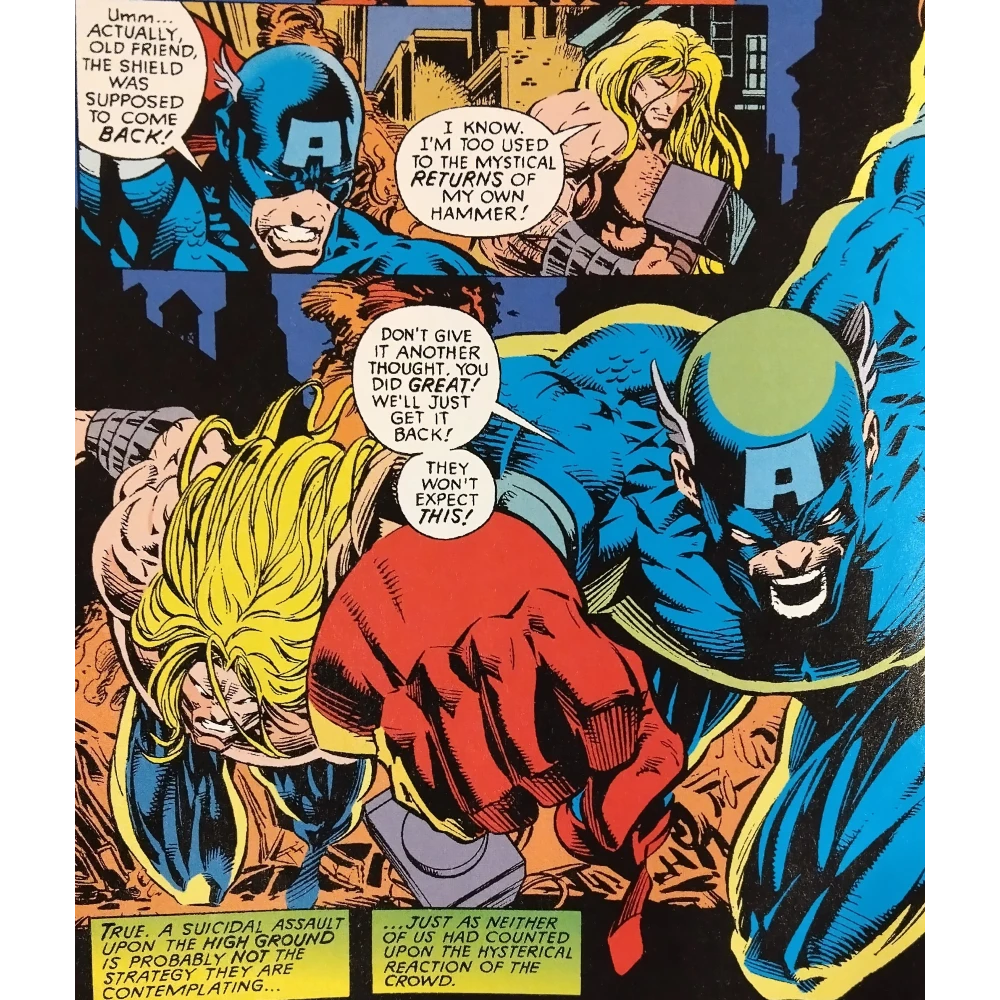
You feel an arc moving through the background, that the Avengers are getting their mojo back after the disastrous "Crossing" and other events such as "Bloodlines" and the dismantling of the West Coast Avengers. Maybe there's hope. The opening arc sees a fairly thrilling pairing of Thor and Captain America, courtesy of Mark Waid and William Messner-Loebs. Thor, depowered, still battles with relentless fervor, even wielding Cap's shield for a time. With other Avengers on the scene, they squash a threat from Zodiac, creating a feeling which is meant to be victorious.
Maybe the changes aren't all that bad! Maybe a depowered Thor and teenage Tony Stark could provide the heft needed to carry these characters through troubled waters! Forget how abysmal "The Crossing" was. Forget that somebody decided to turn Janet VanDyne into an actual bug-looking creature. Forget the absolutely awkward, contrived tension between Vision and the Scarlet Witch. And let's forget the really forced enmity Tarry Kavanagh and Ben Raab are trying to insert between Black Widow and Masque, former-Iron-Man-enemy-turned-ally. Gosh, it's all just so weird and random. But our heroes seem to be together again! That's something…isn't it?
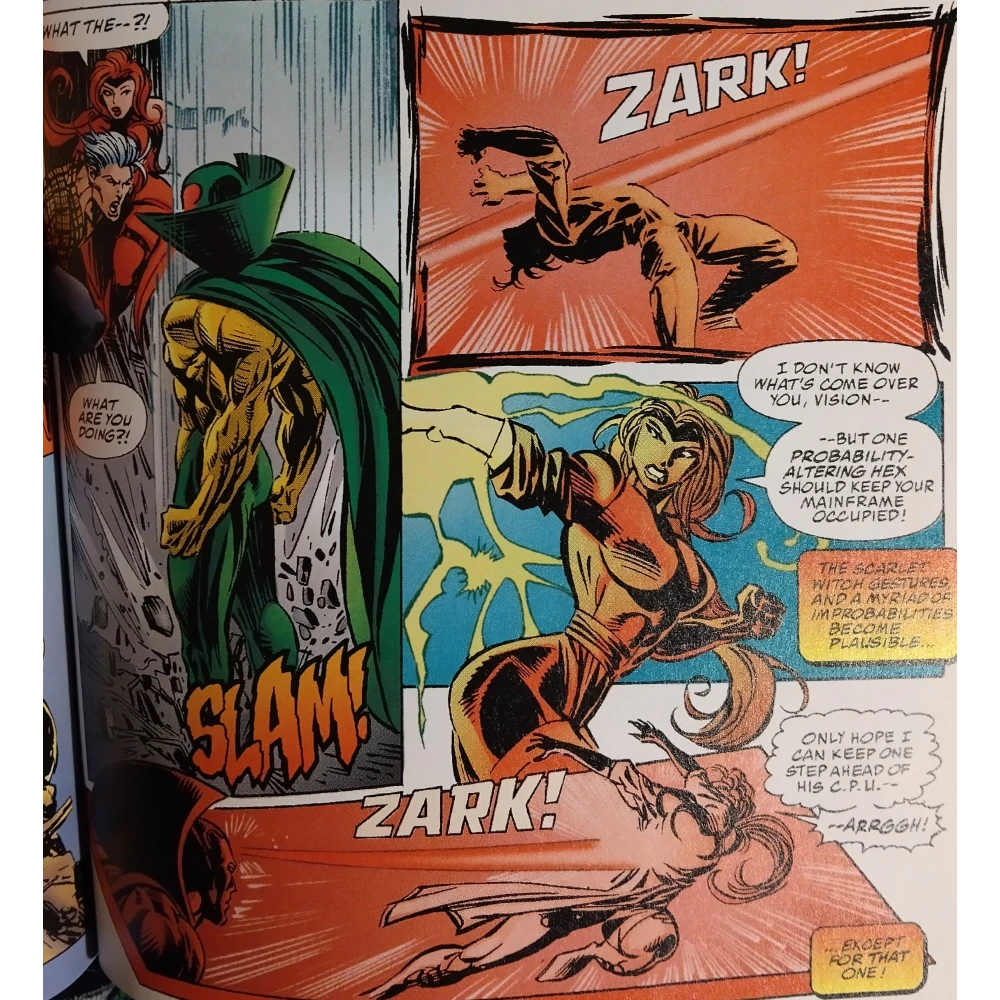
Yet the writing from Messner-Loebs and Kavanagh is cliche, the dialogue somewhat stilted, and odd attempts at humor and camaraderie fail to create the sense of hurrah it feels the writers are going for here. The Avengers' 400th issue is a rare misfire, in my estimation, from the typically stalwart team of Waid and the late Mike Wieringo; meant to be a celebration of the team's legacy, with a premise predicated on what is admittedly a strong twist, the issue is a strange standalone adventure completely cut off from preceding plot developments while leading directly into "Onslaught." At least two plots sewn in earlier issues remain awkwardly unfinished because of this diversion, staying that way, as I understand it, until after "Onslaught" was resolved. Mysterious villains are introduced, a seeming ally is made to look suspicious, and characters are captured off-planet…but nothing happens.
Elsewhere, Waid's solo contribution is reflective of the strength he was pouring into Captain America at the time, proving himself head-and-shoulders above his peers on similar titles, despite the relative disappointment of the anniversary issue. For a single issue, the writing feels fresh and the action fluid. It may be the highlight of the volume, and unlike other issues, it feels very natural. Waid weaves words well, making Steve Rogers a noble, staunch defender of New York in the middle of the "First Sign" arc from which this volume draws its name. Other writers cannot boast the same.
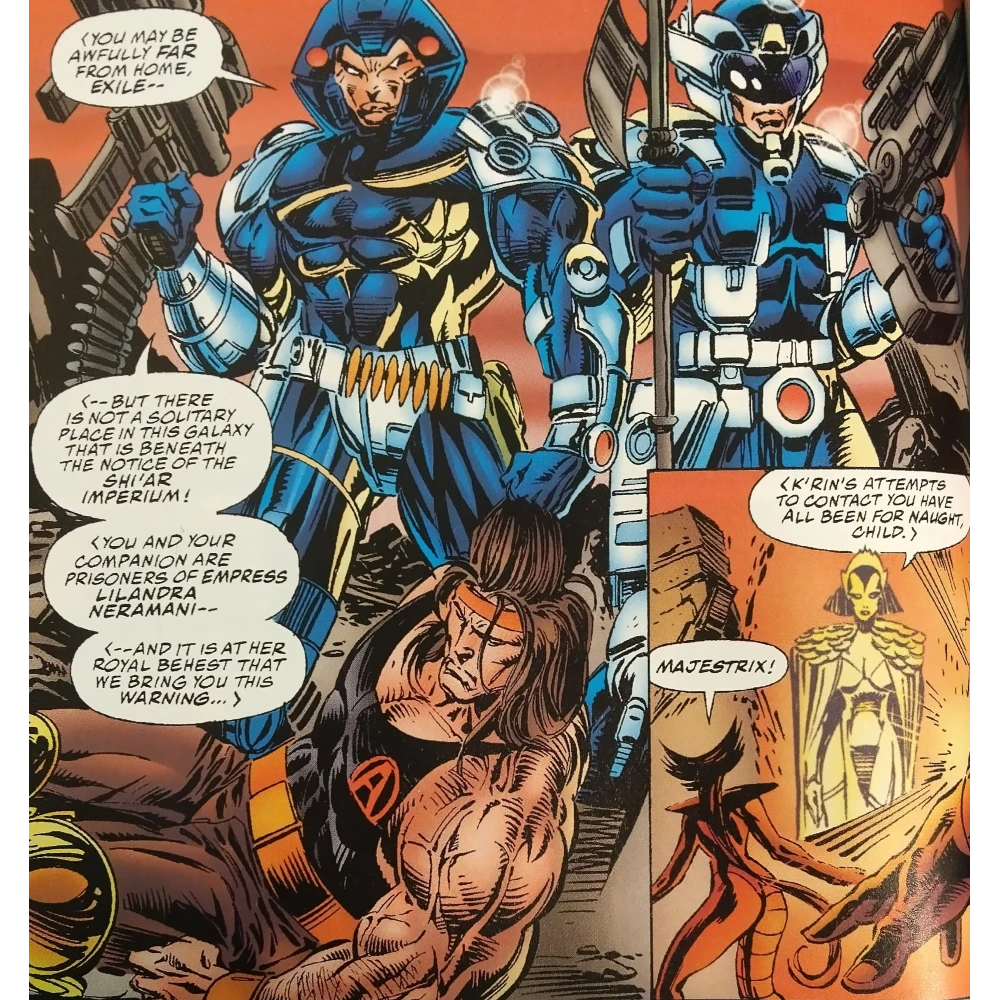
Though Kavanagh gets a tad closer with his use of the teenage Tony Stark. I'll say this: Kavanagh does the best he can with a rough premise. You've got fans mad at you for turning the original Tony Stark rogue and then having his younger self kill the guy (though this would be all resolved post-"Onslaught"), and you've still decided to run with this plot as long as you can. And while youthful Tony is a downgrade from the original Iron Man, this opportunity allows for some unique character development intent on appealing to younger fans. This Tony's in college, an orphan, trying to reconcile facts from his past life that have changed since the era from where (when?) he traveled.
Kavanagh posits connections between this Tony and his older self, with the implication that, just maybe, this younger Tony has taken on the powers and responsibilities of Iron Man without first learning the necessary maturity. He's a bit more naive, prone to mistakes. Surrounded by women and alcohol on campus, he falls prey to his older self's predilections earlier than the older Stark did. It's an interesting examination of the character, weaving the notion that some of Tony's demons may have existed prior to when they appeared in the original comics, the younger man placing himself in situations where those proclivities have greater reign. Even with James "Rhodey" Rhodes serving as a kind of mentor, Tony is still a lost young man…and not just because he isn't at home in his own timeline.
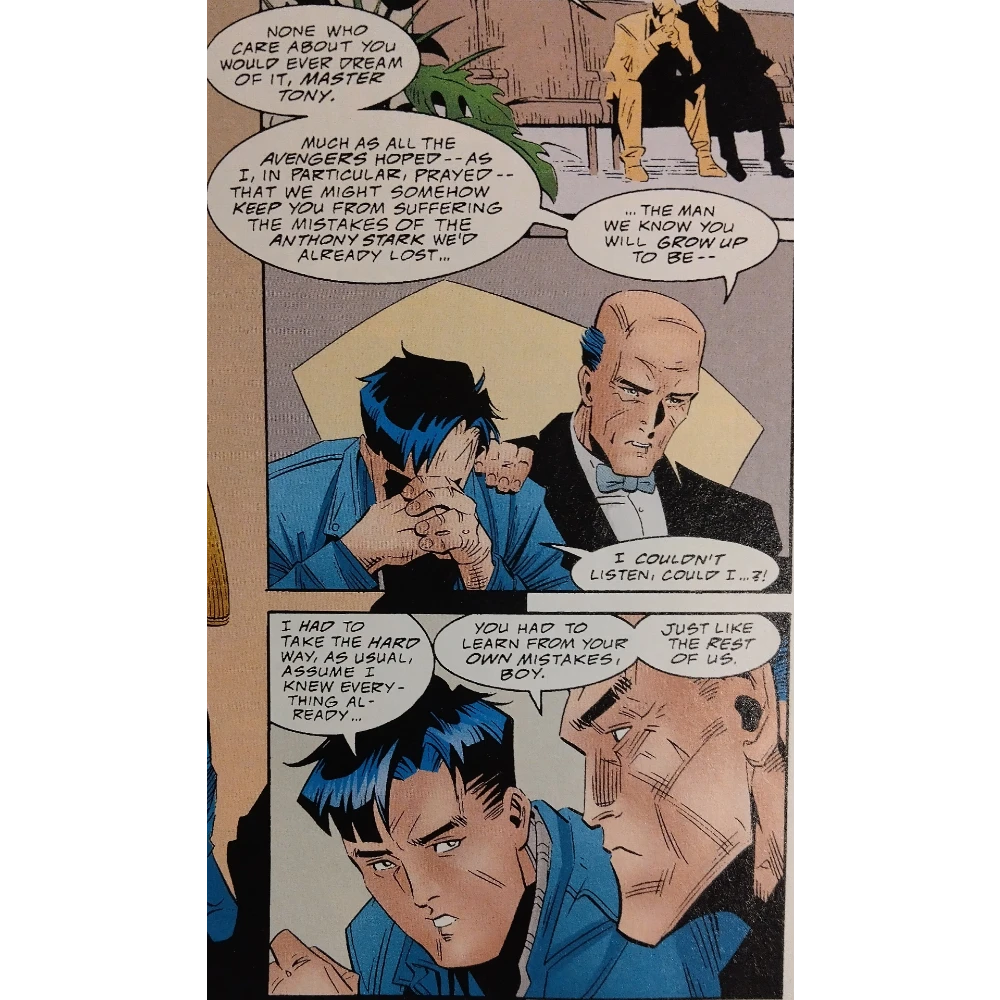
It's a neat idea, and with other heroes similarly in their own shifting environments, I wish writers would have focused more on these character-centered concepts. "Young Tony Stark encountering alcoholism" earlier is an idea worth exploring, as is "More human Captain America" and "Powerless Thor." Alas, these changes were not meant to last. Sure, I don't have the history with encountering these alterations when they were first published as other readers do, so I'm not perturbed with Iron Boy popping up in place of his famed older self. But there are seeds of interesting ideas here, and I will explore them a bit further in Thor's own title before the "Onslaught."
Seeds aren't enough, however, Hope needs to bloom, and it's too little, too late for most of the characters represented in this volume. Marvel was building towards the two-pronged attack of "Onslaught" and "Heroes Reborn," as a few Image creators were coerced back to the House of Ideas to sculpt the likes of Cap, Thor, and the Fantastic Four (SPOILER alert: people don't like this stuff either). We'll see how far we actually go down that rabbit trail. For now, we've hit another low blow in the saga of the 90s. Narrative pieces find themselves clicking into place, like elements of Iron Man armor. But we have an inoperable bootjet, a missing pulse emitter, a helmet cracked open, and the all-important chest-plate that's...too small? Whose is this? Doesn't matter. The armor that is Marvel's storytelling prowess is malfunctioning, but they're trying to fly anyway. They don't get very far off the ground with this volume.