(Strand)om Stories: Avengers: The Death of Mockingbird Review
Plagued by ill-considered storytelling decisions, the West Coast Avengers' final issues provide a dour ending
—by Nathan on April 8, 2026—
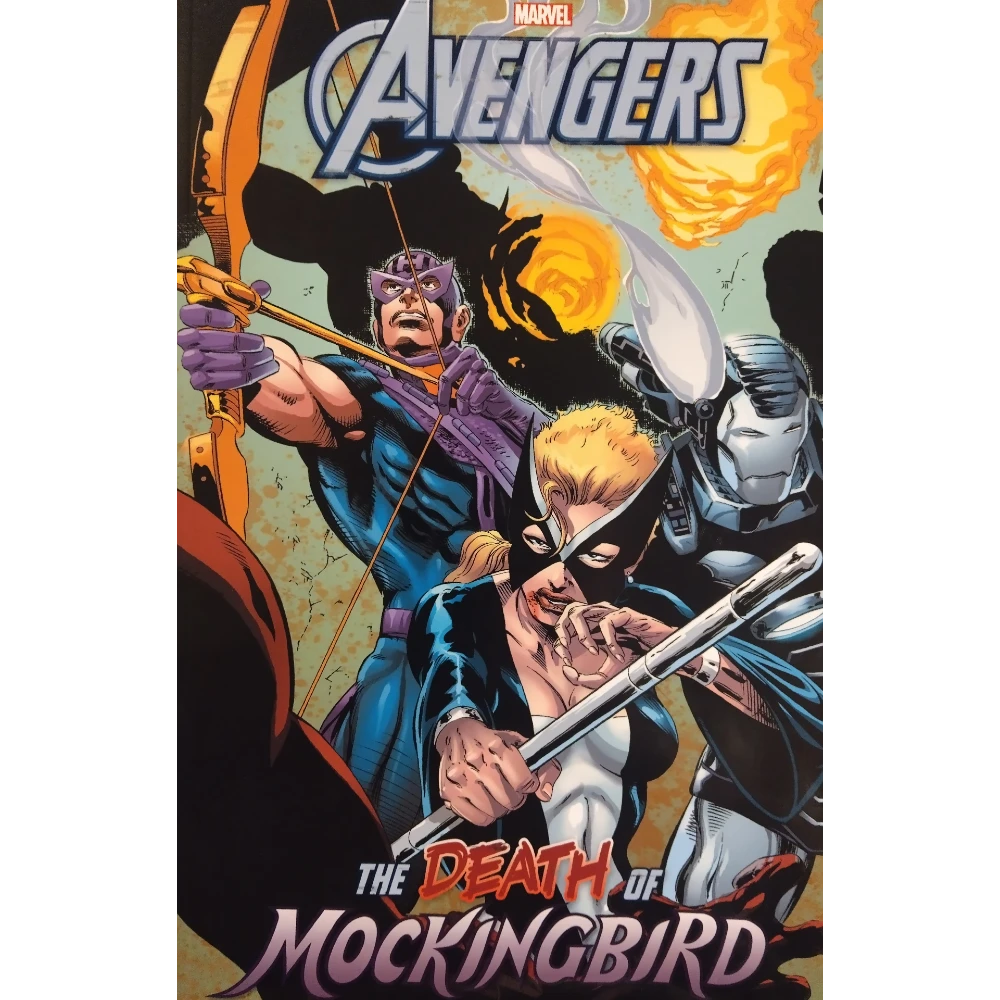
In my next review, I intend to post a "Spider-view" entry which is somewhat related to the narratives I'm reviewing today. A four-part Spider-Woman limited series, found near the back of this very volume, caught my interest when I noticed an advert in Amazing Spider-Man #383, and in determining how best to pick up the series, I found it had been collected here.
I will admit right now that I hoped this review would serve as a nice segue or prelude into that series. It doesn't. A few tangential strands connect to it, but this volume is its own spider weaving its own web…
…and considering the controversial nature of its title, that's likely for the best that it weaves alone.
I am very unfamiliar with the history of the West Coast branch of the Avengers, having only ever read one WCA annual which told half a sequel to the original Contest of Champions. The "Wackos" (as they were affectionately nicknamed) were the first spin-off of the Avengers, set as far geographically as one could be while still remaining in the United States. The team, as I understand it, was generally made up of less-powerful members of the overarching Avengers group, setting aside Captain America and Thor in favor of Hawkeye, Tigra, and Moon Knight (not to diss Moon Knight, though, dude's awesome–all three of him). Heavy-hitters like Iron Man and the Scarlet Witch had their day, but the team always seemed like just an offshoot, grafted into the main branch.
As we enter this volume, Julia Carpenter's husband has been recently murdered and the team's compound has just been ravaged by Ultron, and the Wackos–made up of folks like Spider-Woman, US Agent, Mockingbird, and Goliath/Hawkeye–are doing what they can to hang onto hope. What hope? I guess that stuff, in whatever vagueness you want to attach to that term, will get better. Fat chance, though. Unbeknownst to the West Coast folks, these issues are the beginning, middle, and end of the end, thanks to a celestial goddess, a variety of corny villains, an errant fireball from a demon, and the Avengers themselves.
Avengers: The Death of Mockingbird
Writers: Roy Thomas, Dann Thomas, Dave Ross, Jim Novak, Len Kaminski, Cefn Ridout, Dan Abnett, and Andy Lanning
Pencilers: Dave Ross, Andrew Currie, John Czop, Steven Ellis, Don Hudson, Tom Tenney, Tom Morgan, and Charlie Adlard
Inkers: Tim Dzon, Don Hudson, Fred Fredericks, Aaron McClellan, Charles Barnett III, Michael Avon Oeming, Don Cameron, and Charlie Adlard
Colorists: Bob Sharen, Joe Andreani, George Roussos, Ariane Lenshoek, and Woodrow Phoenix
Letterers: Steve Dutro, Pat Brousseau, John Costanza, Chris Eliopoulos, and Woodrow Phoenix
Issues Collected: Avengers West Coast #92-100, #102, Spider-Woman #1-4, and material from Marvel Comics Presents #143-144
Volume Publication Date: January 2016
Issue Publication Dates: March 1993-February 1994
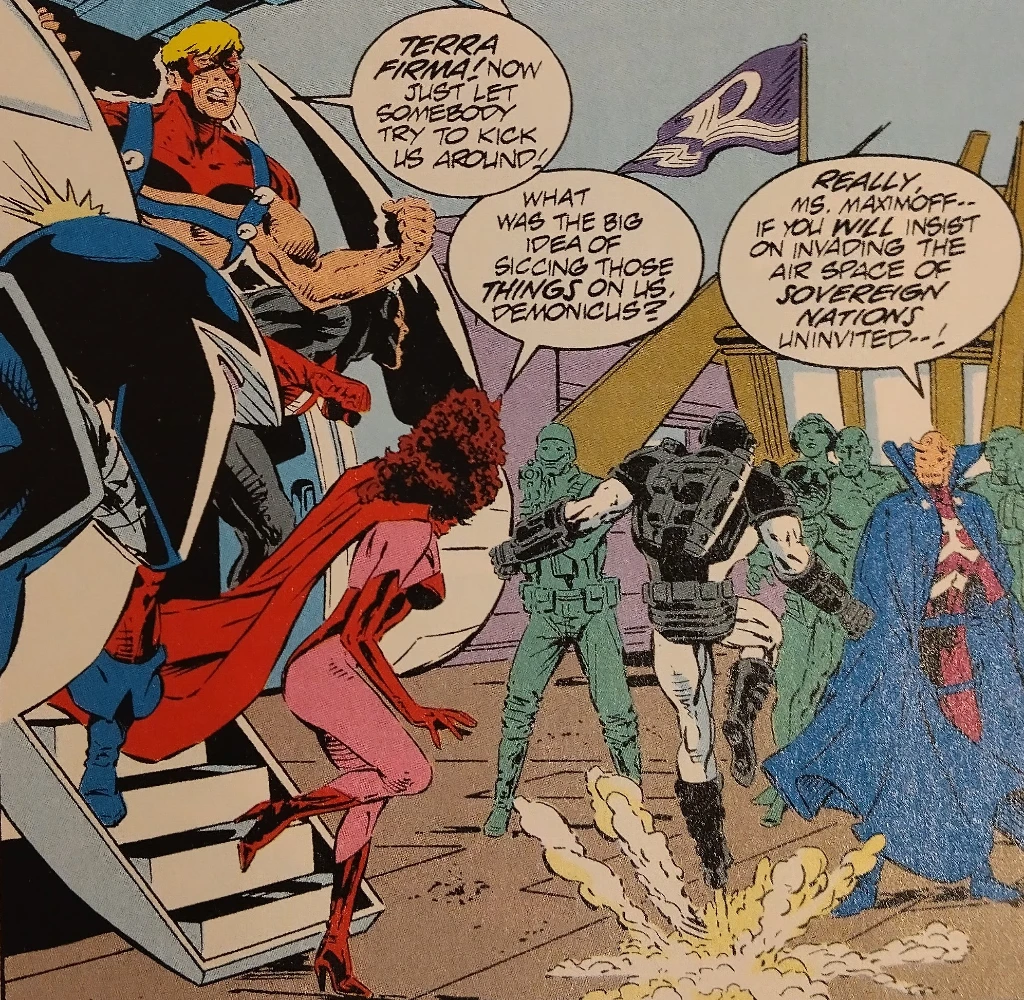
With all respect to Harper Lee, this volume really should have been subtitled "How Not to Kill a Mockingbird."
No need to warn about spoilers; you knew as soon as you saw the title. The West Coast Avenger known as Mockingbird, Bobbi Morse, Hawkeye's wife, is killed in this volume, in the Wackos 100th issue to boot! If you're gonna "celebrate" a milestone such as this, I guess you really go down swinging…?
Or you would go down swinging if you allowed Bobbi some semblance of an interesting death, and I guess by "you," I'm referring to writer Roy Thomas. Thomas, I hate to say it, has faced some criticism in a few of my recent reviews, and that critical stance continues here. Actually, I should first note that centering the volume's subtitle around Bobbi's demise is a bit unfair, as the death itself happens late in the featured issues and, somewhat surprisingly, has little impact on the few narratives which come after. The volume really focuses on the death of the West Coast Avengers as a team (even if their name doesn't appear specifically in the collection's title!), but we'll unpack that after some words on the sub-titular Mockingbird.
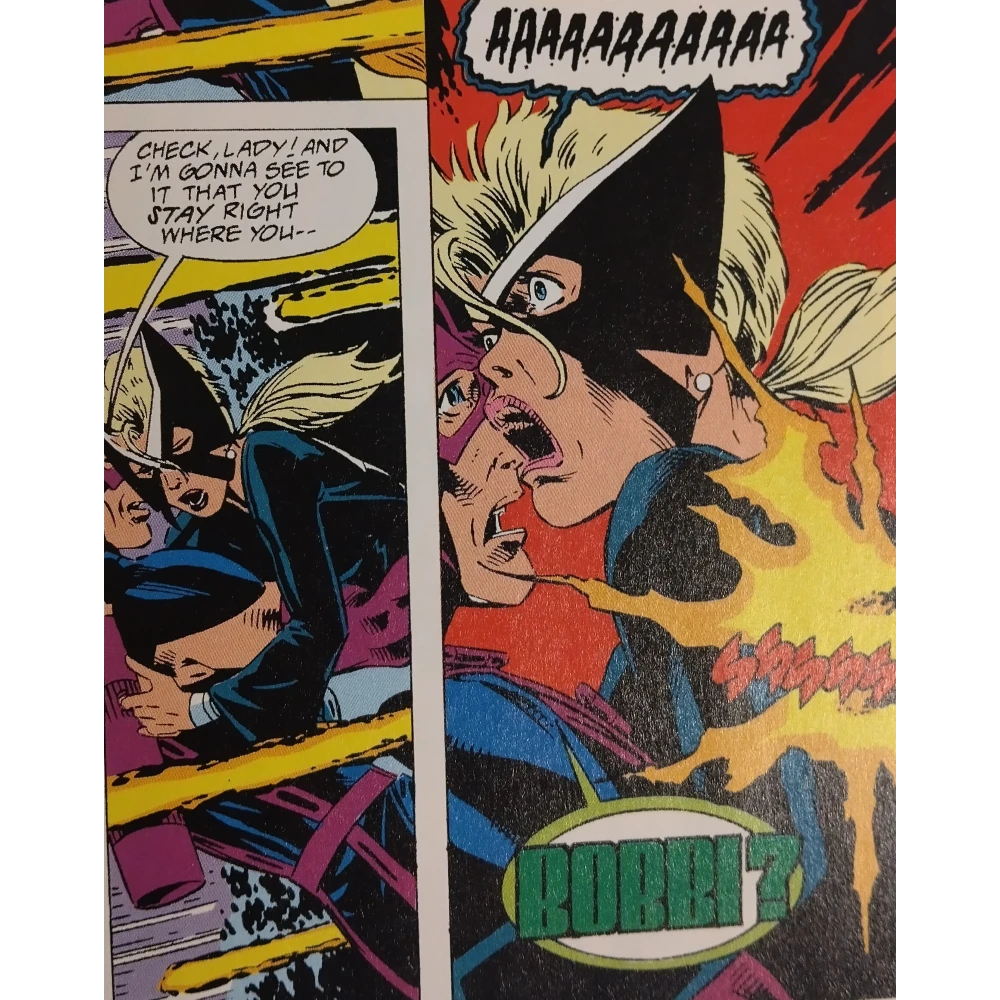
Writer Brian Michael Bendis once referred to Mockingbird's demise as the worst death in Marvel Comics (funny statement coming from a man who killed off Bobbi's beau in a method fairly ridiculed and despised by readers). While I wouldn't label it such, Mockingbird's death is a fairly decent example for what exactly is going wrong in this stretch of comics. Though heroic in nature–Bobbi is struck by a fireball flung by Mephisto while trying to save her husband–the moment feels random and, more egregiously, almost passed over. Panels later, she's gone. Panels after that, we get a funeral. There's very little in the way of build up, thematically, and very little in the way of a satisfying payoff, which describes this volume fairly well.
I don't know the state of the West Coast Avengers book at this time, whether flagging sales or editorial direction led to its cancellation two issues after Bobbi's death. But just looking at the issues presented here, you can tell Roy Thomas is struggling to create something viable in terms of storytelling. We're given attempts, some genuine in their earnestness, to generate interest in these characters and emotional connections with where they're headed, but it feels too strewn about haphazardly to make an impact.
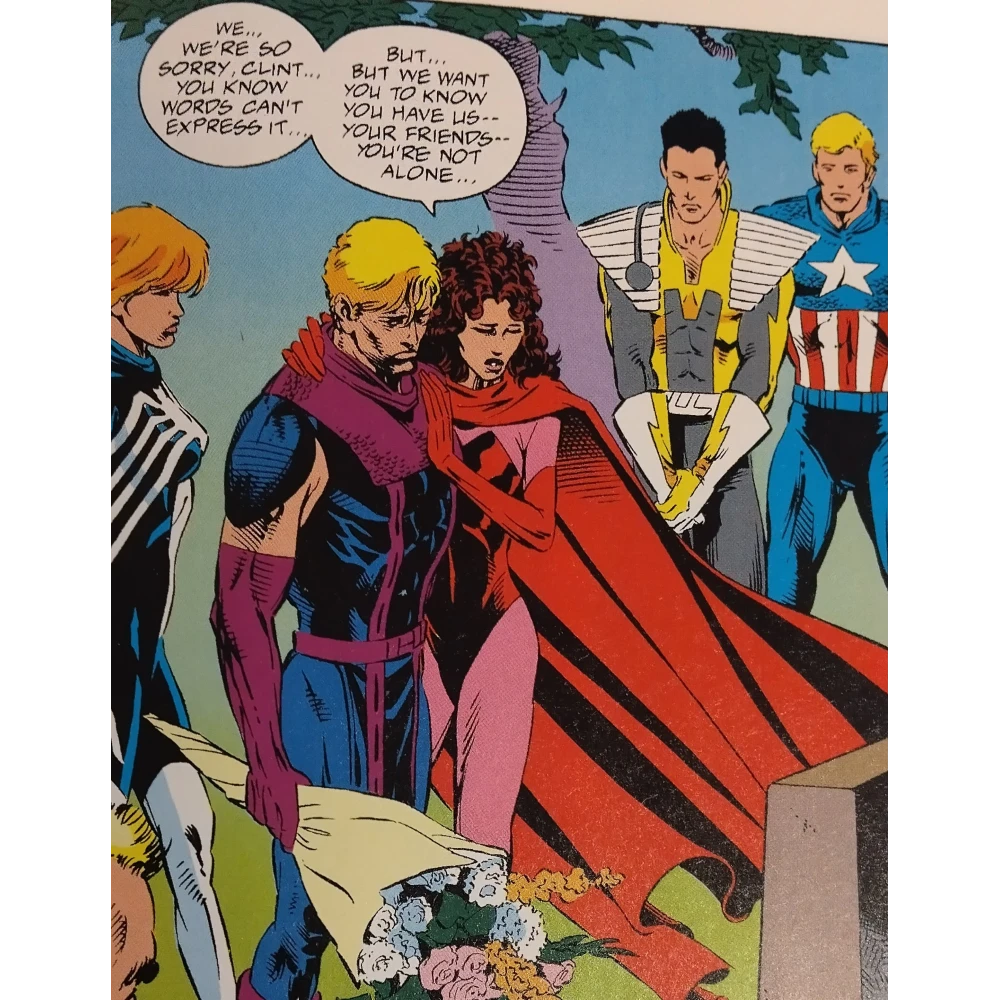
Take the Bartons, our lovable bowman and his loving bride. Facing tensions in their marriage, Clint and Bobbi have reached a point where they begin reconciling. They consider stepping away from Avengers business, starting a family. There may be a life for them on the other side of the bow and battle staves. This promise filters through these issues, guiding their characters, until that aforementioned fireball wrecks it all. In hindsight, you wonder if Thomas was intentionally building false hope for the couple, only to tear it away at the last moment. The gesture could be seen as clever, subverting expectations by lobbing in a tragedy, but the suddenness and seeming randomness of it all twists the moment into feeling cruel. The treatment of the aftermath, or how lacking that aftermath seems, only escalates the frustration.
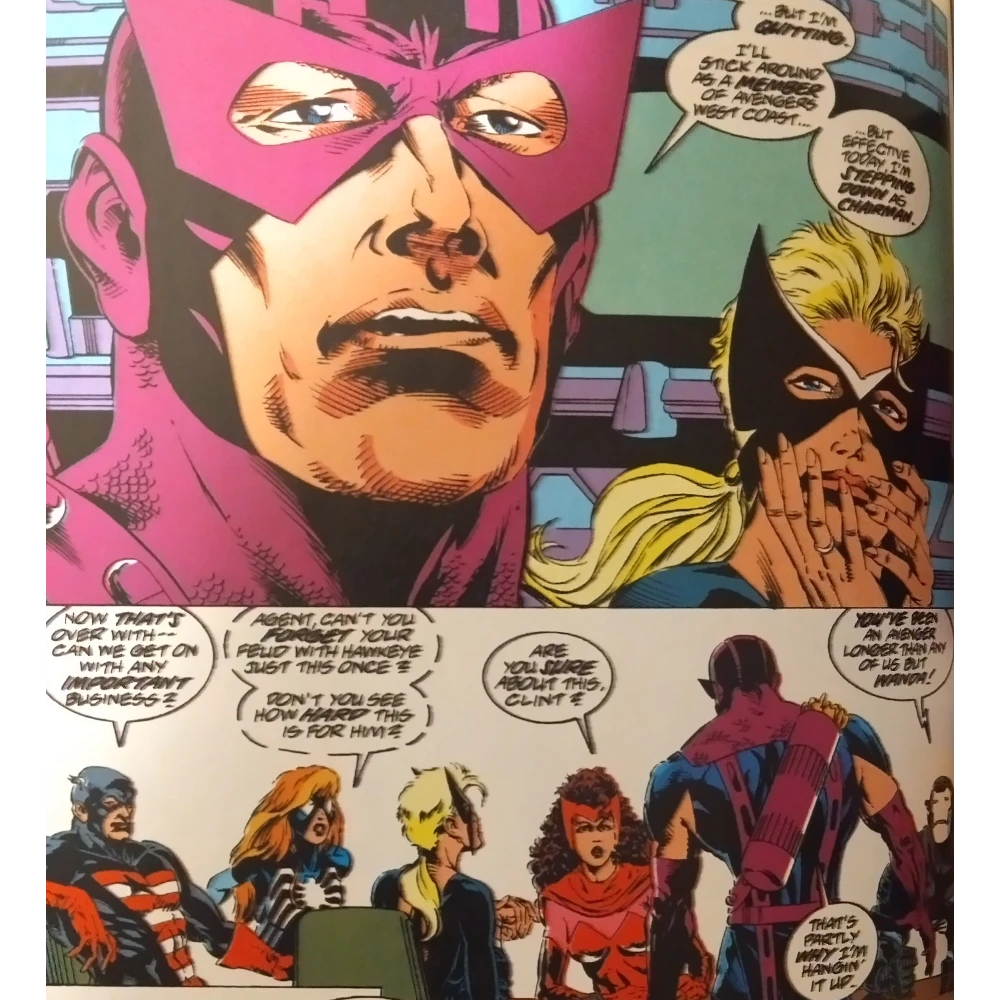
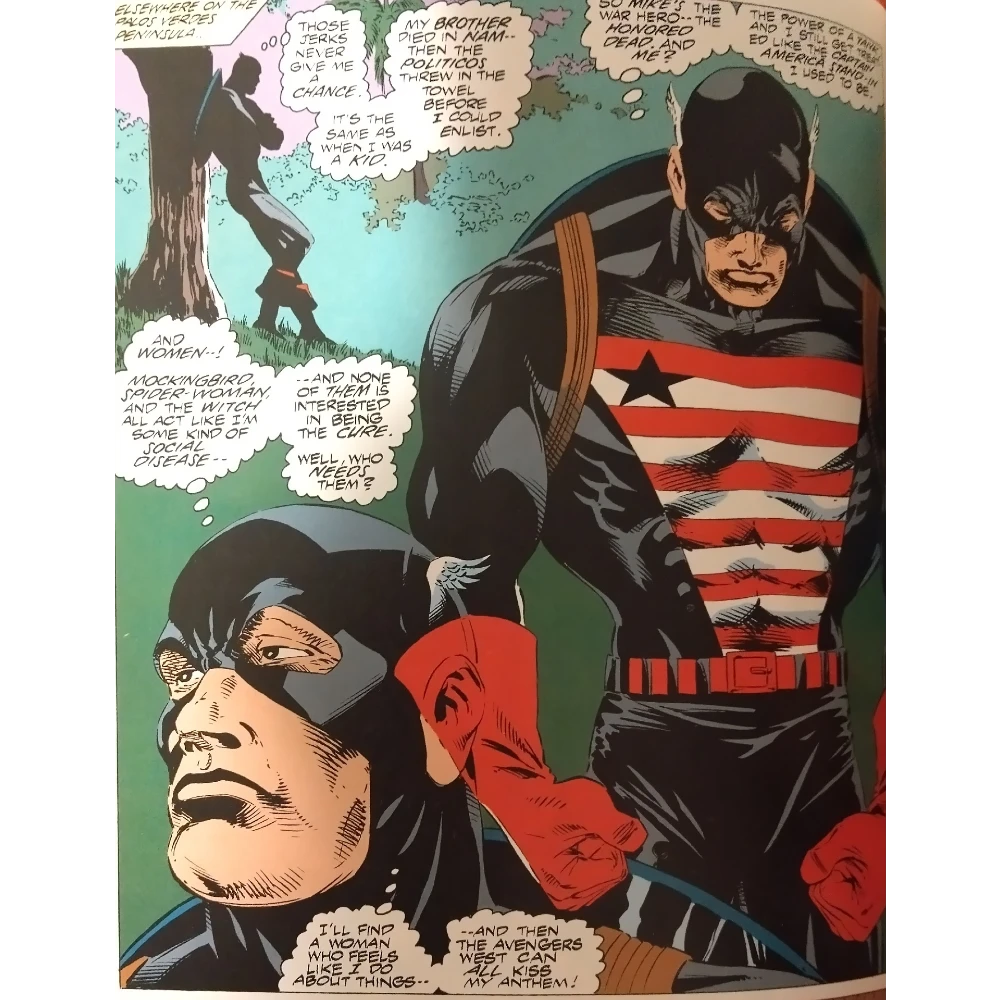
Other characters receive similar attempts at characterization, but these too only work somewhat. US Agent, tired of living in the shadow of Captain America, leans into his conservative bullying, bashing heads and feeling sick of taking orders from Clint (a clever inversion of the Avengers' early days, when Hawkeye repeatedly clashed with Captain America over the latter's leadership). James Rhodes, debuting as War Machine in these issues, seeks to move away from Tony Stark, feeling betrayed by the industrialist at the time and hoping to find his own place with the team. Even the Scarlet Witch is given some brief internal tension as she's elected chairwoman of the West Coast branch in what becomes a fairly inauspicious term, all things considered.
Problematically, brief character moments are generally absorbed by a litany of pulse-pounding episodes as the Wackos clash with enemies old and new. Thomas can, occasionally, use these skirmishes to shed some introspection on our characters–Clint (as Goliath) and Bobbi work well to defeat the original Goliath (who's still mad at Luke Cage for "stealing" his first moniker, Power Man), and US Agent endures a brutal beating while bravely trying to stop the latest incarnation of the Lethal Legion. Bits of development lie scattered across these pages, but they're ultimately consumed by adventures to an island ruled by Dr. Demonicus, the sudden appearance of Wundarr the Aquarian, and a fairly boring tie-in to the Infinity Crusade crossover.
The plots themselves, aside from the very forced-feeling Crusade tie-in issues, aren't bad, if you're seeking pure entertainment. The Wackos tackle Dr. Demonicus and a host of winged monsters on an island he's trying to tout as a legitimate nation in the first few included issues, which has its moments. War Machine and Darkhawk blast some demons outta the sky, which is fun. Even the build-up to Bobbi's death has overarching stakes as the Avengers become embroiled in a larger skirmish between demonic forces. Nothing here is brilliant, and some of its feels like Thomas scrambling to have these Avengers-lite do something, but there is an engagement factor.
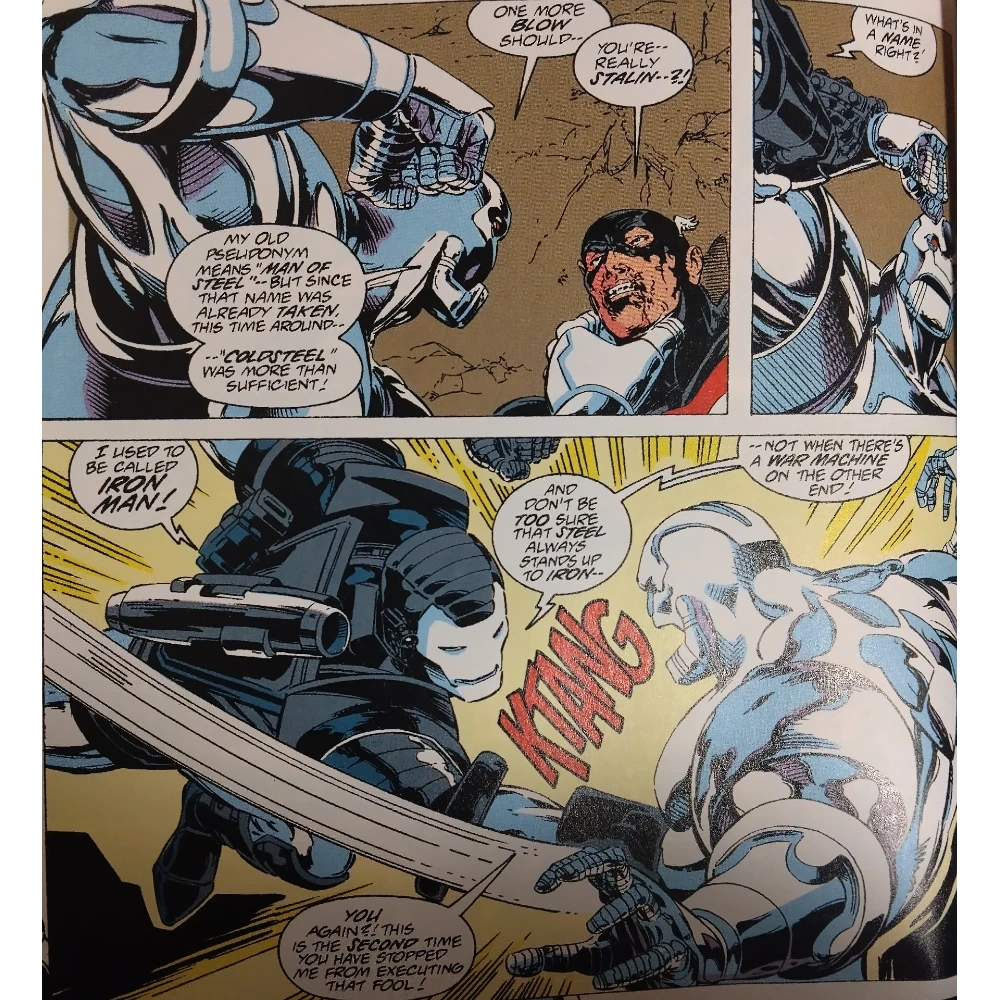
And then there's material which is just…not for me. Thomas weaves in a mystery surrounding the Lethal Legion, revealing they're reincarnated versions of Joseph Stalin, Heinrich Himmler, Lucrezia Borgia, and Lizzie Borden. Thomas attempts to generate great turmoil from this revelation, like the West Coast Avengers are facing the absolute worst of the worst humanity had to offer, which would work better if these villains had been on equal levels of vile when they were living. I'll grant you Stalin and Himmler, but I just tend not to equate the lady who gave her father forty whacks with dudes who murdered millions of people. Seems a bit unbalanced, and the resulting "surprise" when Thomas pulls the curtain falls flat. Throw in an awkward reference by Stalin to another certain "Man of Steel" to generate an odd slice of humor, and the whole bit feels hastily considered and poorly plotted.
As the volume ends, so do the West Coast Avengers. An issue tethered to an X-Men crossover isn't collected, meaning we jump from Mockingbird's death to the Spider-Woman series and a really boring Marvel Comics Presents story about the Scarlet Witch and then skip over to West Coast Avengers #102, where the team formally disbands. This issue, written by Dan Abnett and Andy Lanning, is the highlight of the volume. Not that you want the torture to end, but it's written far more competently than the preceding issues. The team's troubles are unpacked well, tension rises between the West Coast and East Coast branches, and the arguments for the Wackos' dissolution are given heft. Again, I don't know if this was an editorial decision due to sales, but the in-universe explanations work well. The team had been hit a lot, and a certain instability ran through the roster Oddly enough, no one addresses Mockingbird's death, though Clint isn't present, but you'd think it'd factor into the reasons to close up shop.
It's a pretty unfortunate dissolution for the team, though some members would find an immediate future in Force Works, and that final issue almost seems a critique about the state of the series' writing as it is the characters themselves. Thomas tries to find something invigorating to write about, but as hard as he turns the starter, the engine just keeps groaning. You want to care for these heroes–for Clint and Bobbi's relationship, for US Agent and Rhodey to walk out from under the shadows they live in–but Thomas doesn't give much reason to cheer them on as they limp across the finish line. Some oddball plotting decisions, a tragically random death not unpacked for emotional impact, and a fairly dull attempt at capitalizing on a crossover event prevent the Wackos from having one final hurrah before the team's development is shuttered for good.