Distinguished Critique: America vs. the Justice Society Review
This limited series trades storytelling for summary that somehow concludes decently despite a painfully methodical build-up
—by Nathan on March 29, 2026—
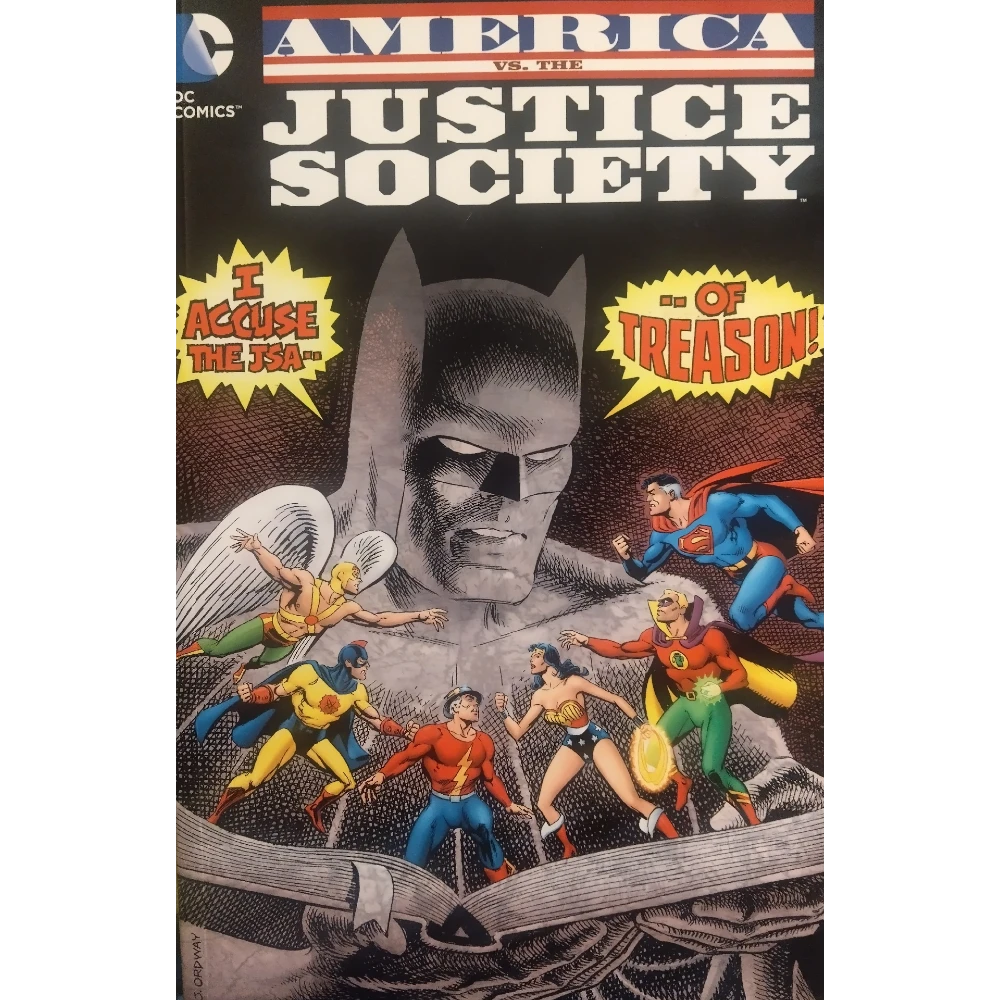
I've published a few posts in 2026 that cover some late 70s/early 80s adventures of the Justice Society, the premiere super-team of Earth-Two, an alternate universe where there was never a Justice League. This team featured some of the same heroes–Superman, Batman, Wonder Woman–and variations of some heroes, such as Alan Scott's Green Lantern and Jay Garrick's Flash, but it was still a different world. They would even cross over with Earth-One on occasion, like in the famous issue of The Flash where Jay teamed up with Earth-One's Barry Allen. But their world was not the same as the mainstream DC universe...and certain paths twisted in different directions.
I've admitted in other reviews how unfamiliar I am with the JSA's history overall, having only ever read the two volumes I reviewed earlier this year. The team had been around for much longer than that, in terms of both comic history and publication history, but for anyone interested in the team but dreading scouring decades of issues, have no fear! In the mid-80s, just months before DC obliterated the multiverse during Crisis on Infinite Earths, JSA super-fan and comic writer Roy Thomas, who'd also been responsible for planting the idea in writer Gerry Conway's head for resurrecting the JSA in the first place, would pen his own take on the characters. His four-issue limited series would draw in the team's entire history, telling you everything you ever wanted to know about Society…and maybe everything you didn't.
America vs. the Justice Society
Writers: Roy Thomas, with Dann Thomas
Pencilers: Rafael Kayanian, Rich Buckler, Jerry Ordway, Mike Hernandez, and Howard Bender
Inkers: Alfredo Alcala and Bill Collins
Colorists: Adrienne Roy and Carl Gafford
Letterer: David Cody Weiss
Issues: America vs. the Justice Society #1-4
Publication Dates: January 1985-April 1985
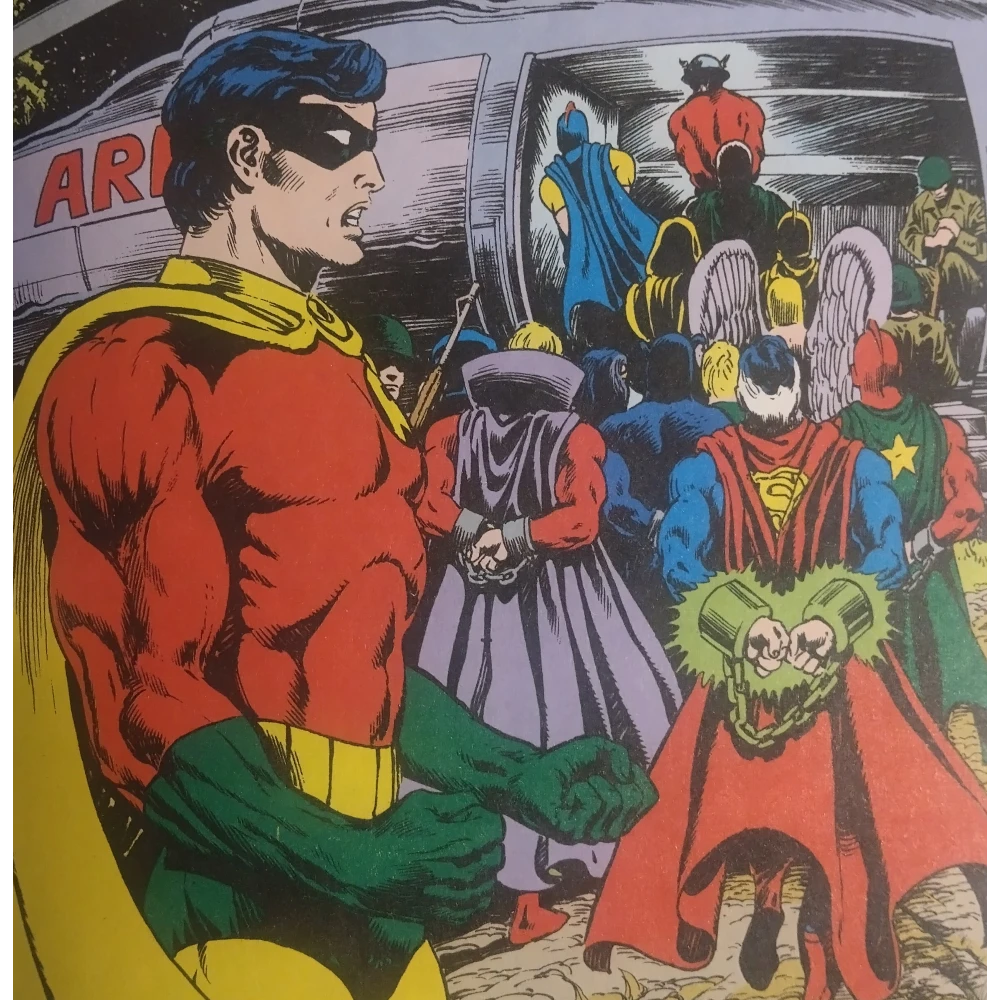
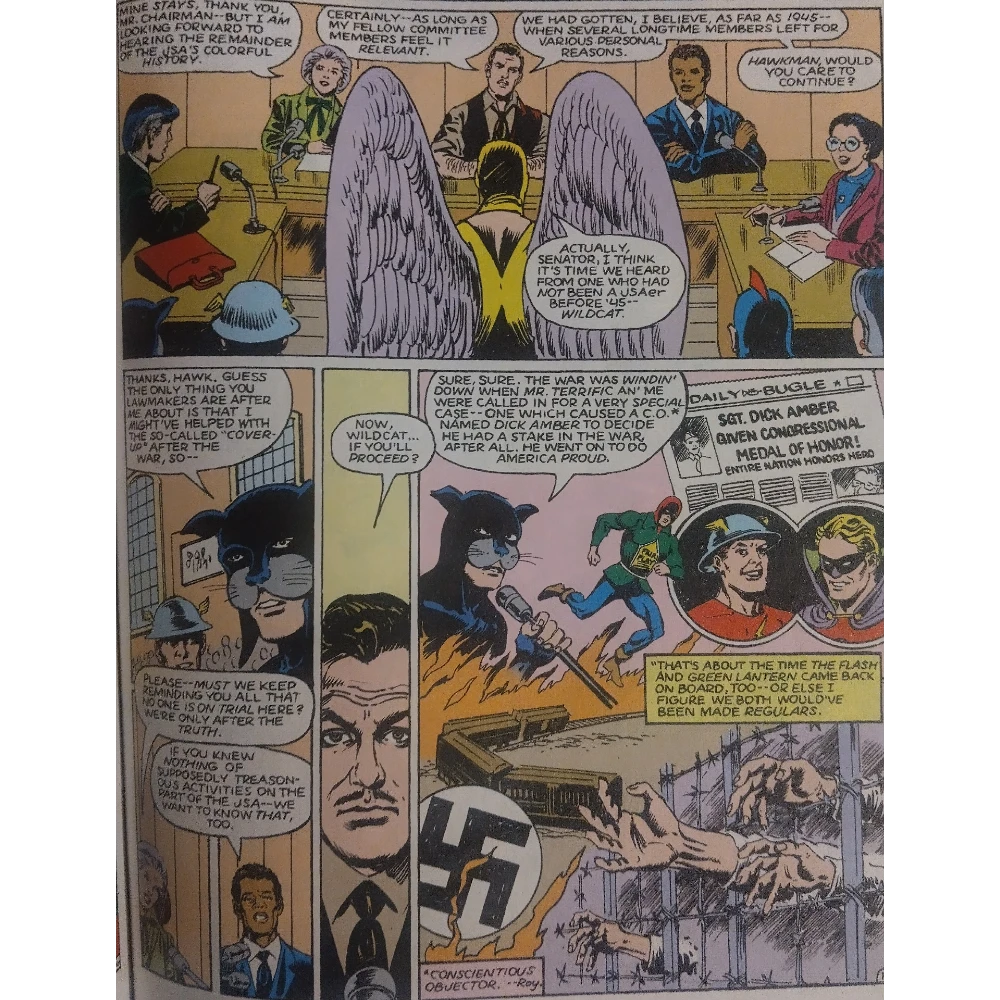
In the final issue of Adventure Comics, published 1979, the JSA had been brought before the House Un-American Activities Committee and commanded to unmask themselves; refusing, the team had vanished and disbanded. As this series opens, the JSA has seemingly banded together again, meeting to discuss a startling revelation: the diary of the late Batman, killed in battle by a madman during those earlier issues I reviewed, has been published, insinuating the JSA as willing participants in Nazi schemes during World War II, swearing allegiance to Hitler and sabotaging one highly important American military experiment. The crew, along with Superman (who isn't accused! He just goes with his friends), is brought before a Congressional hearing (not a trial! Just a hearing!) and asked to detail their history to get to the bottom of these heinous accusations.
The parenthetical asides above are meant to be a tad humorous, poking a bit of fun at the series' biggest weakness: its tendency towards repetition. And it isn't that, across these four issues, we are consistently reminded that Superman has come willingly of his accord and is not among those accused or that this Congressional hearing isn't an official trial but a chance for the Society to be weighed by public opinion…it's the whole story which feels cyclical.
I recently reviewed a collection from Marvel where Roy Thomas, along with his wife Dann, covered the histories of famed heroes Prince Namor and the original Human Torch (Jim Hammond, not Johnny Storm). I criticized the repetitive nature of both series, though noted this was through no fault of the Thomases. The histories they were endeavoring to reconstruct there were never meant to be extended storylines, with ongoing subplots and character development, thus putting both writers in the awkward position of trying to assemble an ongoing story where one couldn't really be found.
I have similar complaints here, but in this case, I can more fully blame Thomas for the awkward reading experience found in this volume.
The frame tale has merit, Batman's journal causing a host of dramatic issues for the Society as they recount their history before the hearing (not a trial!). It's a clever way to place the Society in a position where they have to comb through their history; unlike with Namor and the Human Torch, where the Thomases offered no such structure, America vs. the Justice Society weaves between past and present, the frame narrative providing conflict between characters as the Society reflects on the past. We are given, at the very least, a reason to want to hear their narratives recounted, rather than having decades worth of stories shoved down our throats for no apparent reason.
Thomas, having a strong understanding of the Society's history, does capably draw a primary threat from the past, threading references throughout the series so that when the culprit's identity is revealed as the series' primary antagonist, you shouldn't be surprised. Even if this villain isn't known to the reader beforehand, his appearance as an arch-foe syncs up with his previous plots. But throughout the series are also discussions of and references to stories and narratives that really have nothing to do with the legal proceedings, with even the committee members themselves wondering if recounting everything is worth their time.
It isn't, and speaking frankly, it's not an exercise worth the reader's time either. It seems nearly every Society appearance is discussed, including the villains they fought and the permutations of their team. Their origin is recounted in triplicate, the stories detailing the charges they're up against are referenced multiple times, and heroes double back to remind us of certain plot elements. Unlike the Namor and Human Torch series, Thomas isn't trying to convince us that this history makes up one giant extended story; he's just telling us what happened, in the way events happened, with some detours. Weirdly, Thomas doesn't seem wholly convinced by this method himself, with committee members seeking clarification at moments that don't seem connected to Batman's accusations. But it's part of the history, so we've gotta tell it! When even your characters comment on elements which are confusing, repetitive, or uninteresting, maybe a moment should be taken to reevaluate the structure of the narrative and see if a better, more interesting method could be applied.
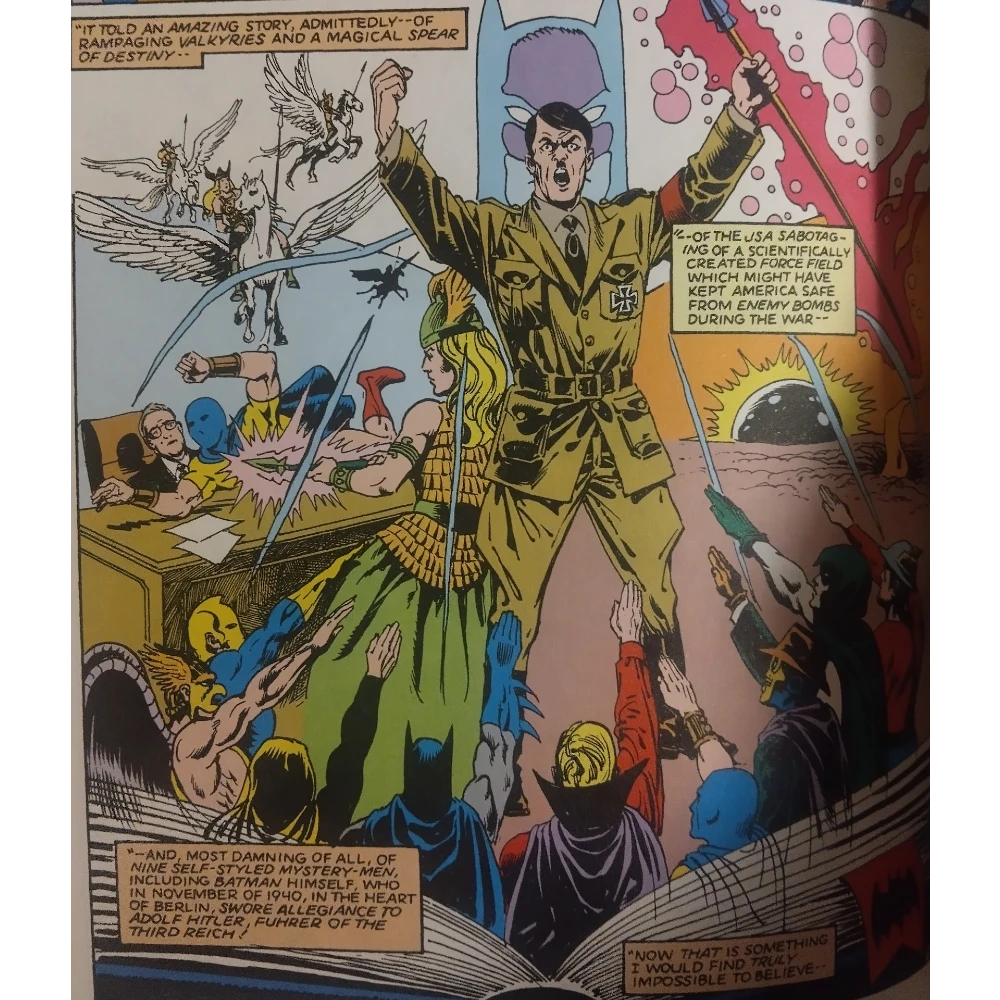
The structure ends up being Thomas' biggest issue. He's cramming so many decades of stories into four issues and feels so compelled to tell all of it when he, in my opinion, should have been more selective in his telling. He does make sure that arch-fiend appears enough to spark your memory at the narrative's climax, meaning you have to pay attention to at least some of the details. But all of this could have been painted in broader strokes. Elements which factored directly into the case are fine to keep–this seeming rewrite of history, casting the Society as Nazi agents, can be a fun clash with previous stories from the 70s, and a twisted retelling of the team's origin can be an entertaining thought experiment. Suddenly, a narrative I critiqued in my previous review where Superman prevented a Nazi bombing due to the Society's potential ineffectiveness cast doubts on the telling…is that really what happened? Audiences may not be led to believe the Society ever served Hitler and his regime, but for the sake of the narrative, it can be entertaining to consider.
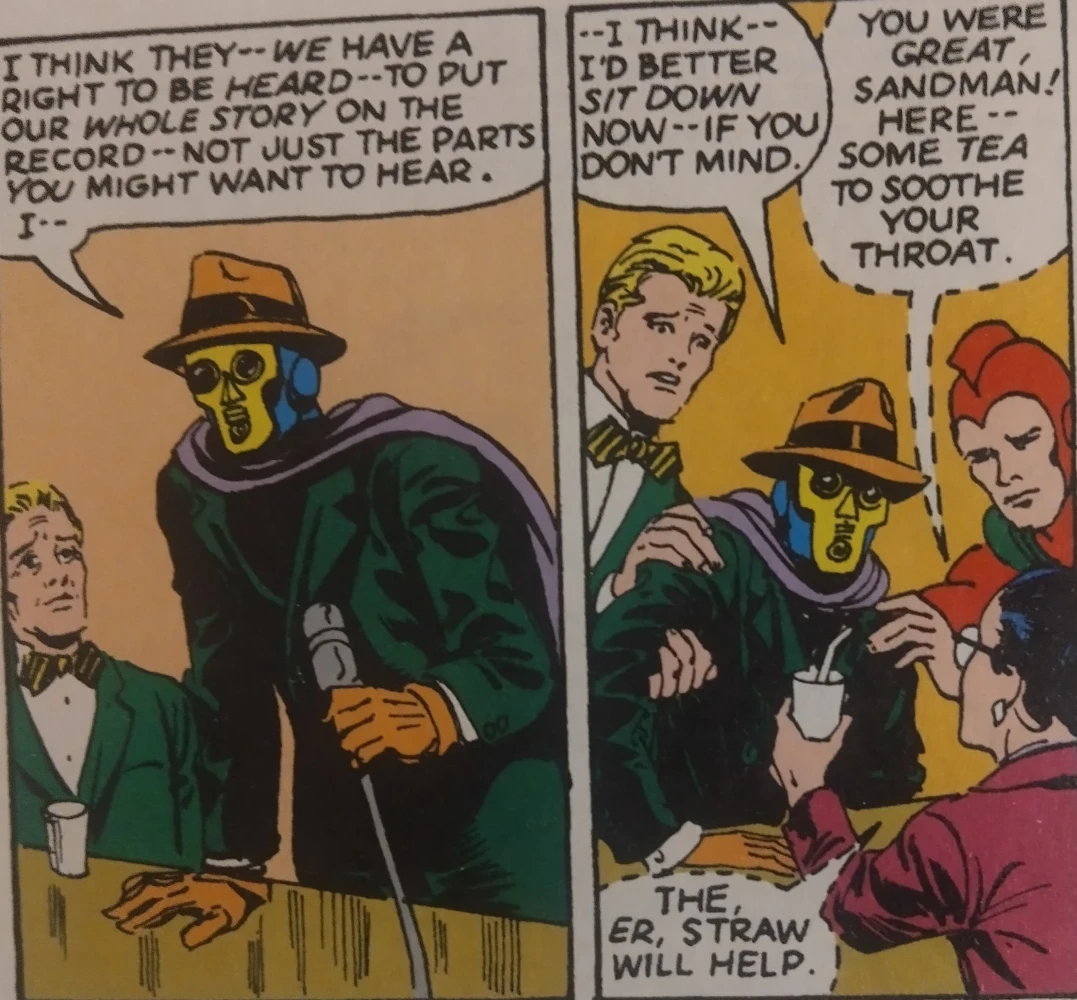
This also means the Society members themselves are largely used as mouthpieces, here to tell their history at appropriate moments and offer little else. Moments during the frame tale do allow some internal conflict between members who wish to handle the situation differently, but those tempers flare faintly. A few characters are given somewhat interesting personal conflicts to raise the stakes–Wonder Woman worries about her husband Trevor, recuperating on Paradise Island following a grievous injury in a previous tale; Society member the Sandman exerts himself, despite having suffered a recent heart attack, standing up for his friends despite his physical weakness; characters such as the Flash who have family present at the hearings express concern for their loved ones. But these are small moments, crushed by the weight of retelling.
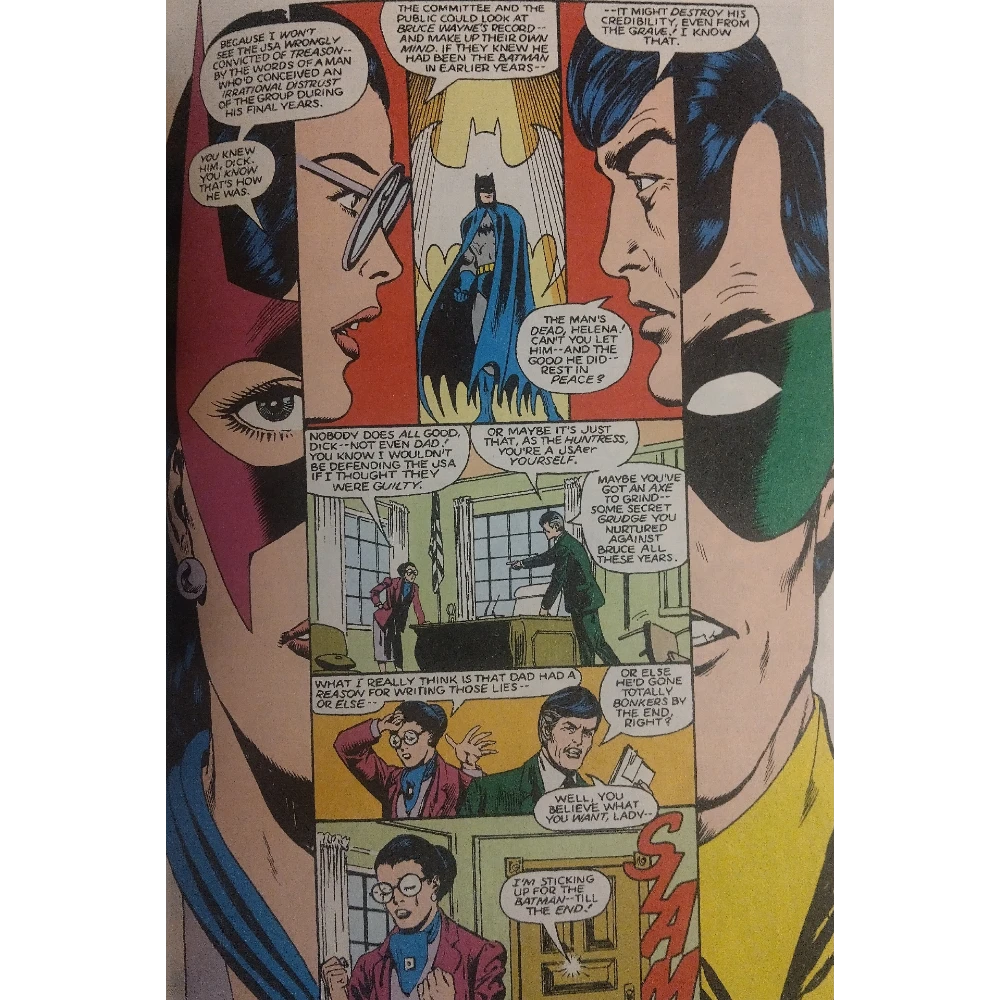
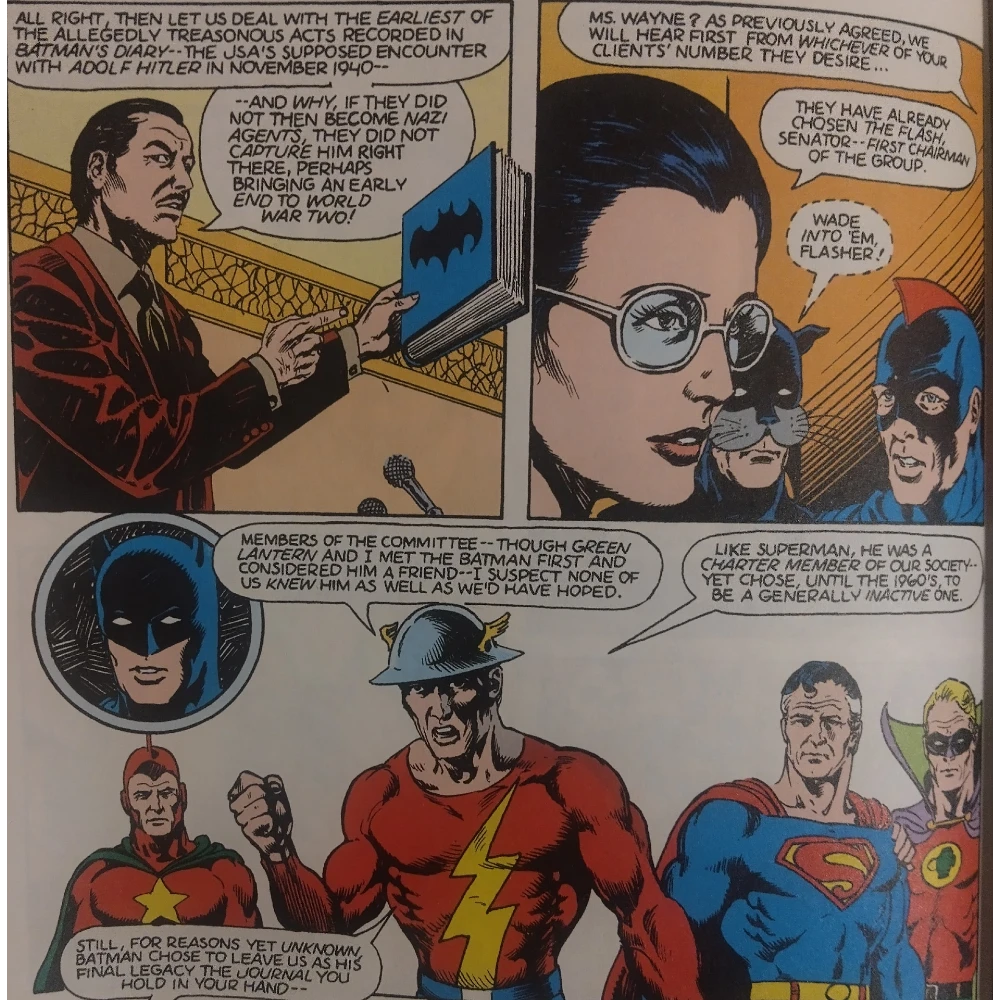
Our most interesting characters wind up being two of the youngest, Dick Grayson and Helena Wayne. Typically known as Robin and Huntress, respectively, both characters are at their most impactful outside of costume, with Helena defending the Society and Dick serving as legal counsel for the Congressional committee. These two decently embody the primary conflict raging around the accusations–Dick staunchly defending the honor of the man who raised him and advocating the seeming truthfulness of his accusations, while Helena seeks what she believes is just, regardless of her father's purported claims.
This is the kind of material I wish Thomas had capitalized on, using his characters to represent the tensions rather than writing a history lesson. In Helena, we find a woman struggling with upholding the truth against the seeming claims of the man who raised her, and in Dick, we find a man convinced in the absolute rightness of Batman, who believes that failure on his part constitutes unraveling Bruce Wayne's legacy. Their roles in the narrative's conclusion, including the revelation of the series' main antagonist, are satisfying, creating decent character growth and ending the series plausibly. But that comes largely in the final issue, after all the talking, talking, talking.
I don't consider myself a Justice Society fan (my eternal love for JSA: The Golden Age notwithstanding), and I probably would never feel compelled to track down their old adventures, so this four-issue limited series is maybe the best place for someone like me to learn of the Society's entire history. If that's what you want to read this for, then congratulations, Roy Thomas has given you a gift. If you're more interested in an actual story, however, then this series is going to fail dramatically, dragging you deep into a mindless slog of exhaustive detail. There is a story, and man, it could've been interesting. Batman calling the Justice Society traitors! The Society appearing before Congress! History is reframed, and our heroes need their names cleared! Neat setup. Except Thomas doesn't do anything to move you deeper into those ideas, opting to tell and retell the JSA's tales of old instead of good old fashioned detective work. Maybe it's because the actual detective died and is now pointing at the team and yelling "J'accuse!" from beyond the grave.
If Thomas had been more selective in the history he retold, or if he had crafted more scenes in the present, or if he had deepened the character work, this series would have been a much easier read. Hints of all that flit around, weighed down by a mind-numbing trek from past to present. Were I a judge, I'd bring a gavel down with a resounding "Guilty!" verdict. Guilty of causing disinterest, guilty of repetition, guilty of weak characterization.
Case closed.