Spider-view: Marvels
A genuine classic, this series presents heroes and stories of yesteryear through a real, human, hopeful lens
—by Nathan on May 23, 2026—
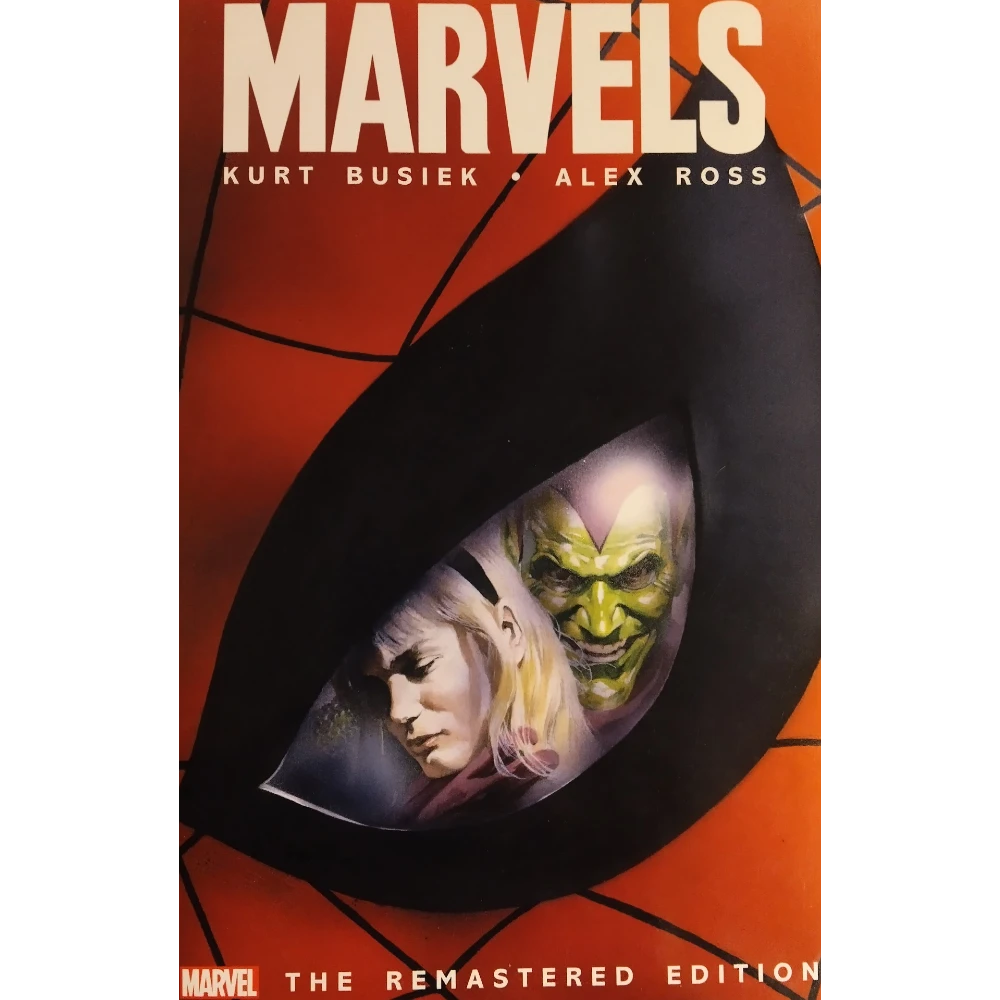
We are stepping aside, momentarily, from stories centered on Spider-Man or different versions of Spider-Man and reviewing a series which incorporates Spider-Man…and a whole lot of other history. This isn't a crossover event like Jim Starlin's "Infinity Trilogy"; this series is a love letter to a bygone era which continues to influence our present understanding of comics.
Two years before storming onto the DC Comics scene with his and Mark Waid's Kingdom Come, painter Alex Ross broke into the mainstream with this four-issue limited series with writer Kurt Busiek. Marvels was an instant hit, winning three Eisner awards in 1994. On a personal note, Marvels is one of the first comics I remember ever reading–I have a very fond memory of sitting in the back of my parents' van, driving into Chicago for a field trip, pouring over a trade copy my dad borrowed from the library. If you've seen the Alex Ross cover of Spider-Man scaling the side of a building, you'll know the volume.
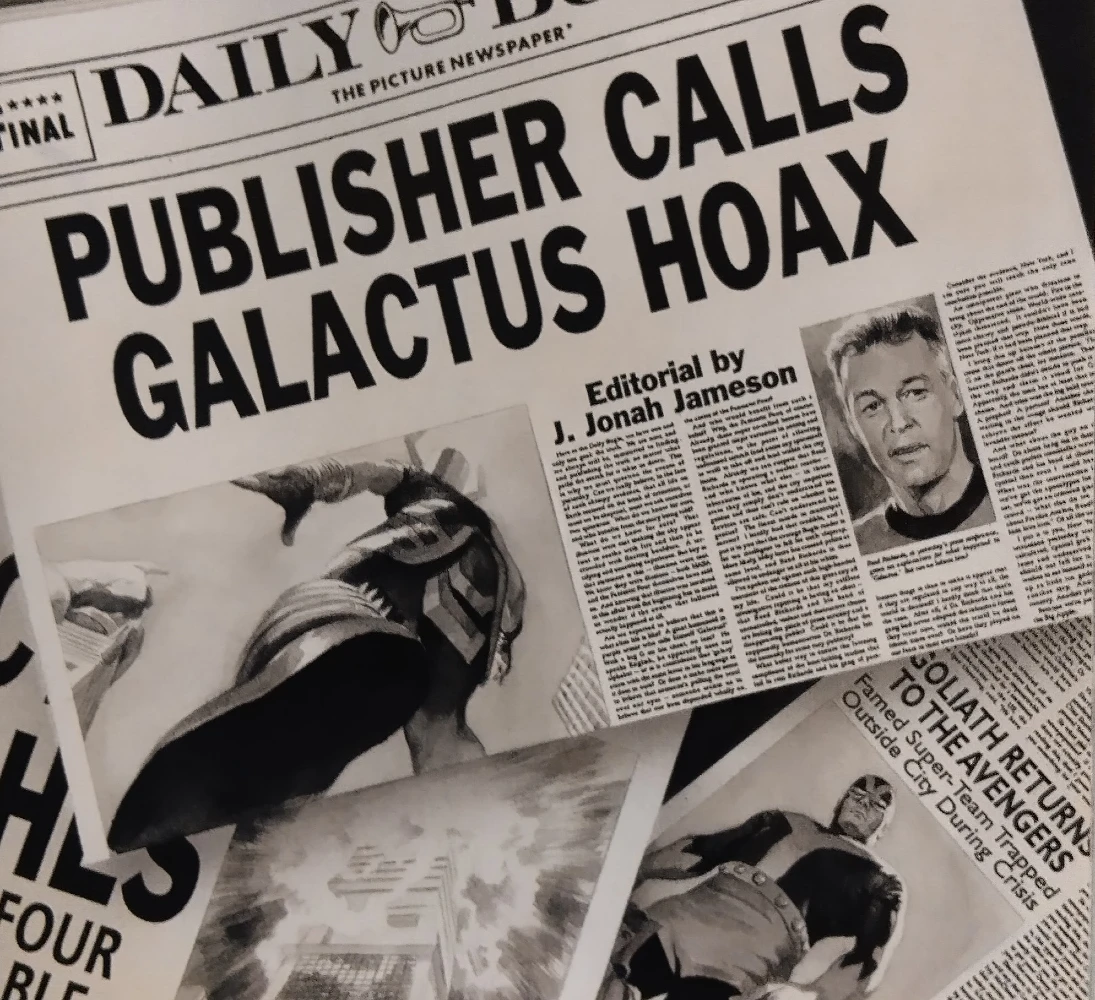
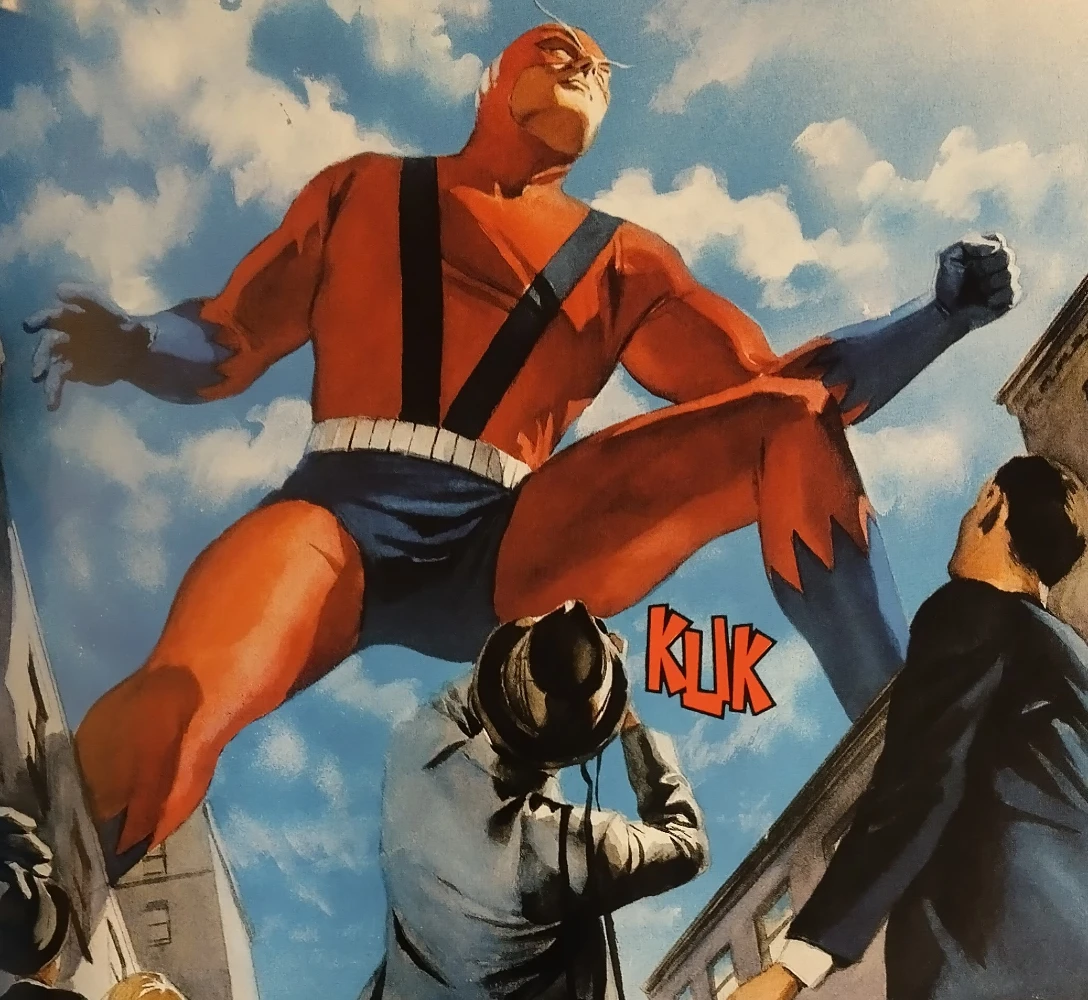
Marvels sat somewhere in my brain for years, primarily because I was darned confused for quite some time. I had just gotten into comics, and though Marvels is an absolute treasure trove of history, I found that initial reading experience somewhat jarring. Time and nostalgia have reformed that memory into a happier one, especially after re-reading the series a few times, but I feel I remember needing to just accept what was happening without context instead of fully understanding what was happening. I knew of Captain America, but who the heck were all these other costumed guys and gals helping the Allies during World War II? Radioactive Man pops up on one page without being named, and I had no idea who he was. A panel where two newspapers sit side-by-side, one citing the defeat of Galactus, the other noting Goliath's return to the Avengers, had me convinced that both giants were the same dude, that Goliath was just Galactus in a heroic disguise.
Ah, the naivety of youth.
Again, re-reads have been an absolute boon in better appreciating this series, and I'll be using some digital space to gush about its worth today. I don't normally come out swinging with an opinion in a review's introduction, but I'm gonna do Daily Bugle owner publisher J. Jonah Jameson proud but refusing to bury the lede: Marvels is an essential must-read for any comic aficionado. Story continues on Page 14.
Marvels
Writers: Kurt Busiek, with Steve Darnell and Alex Ross
Penciler: Alex Ross
Inker: Alex Ross
Colorist: Alex Ross
Letterers: Richard Starkings John Gaushell
Issues: Marvels #0-4
Publication Dates: January 1994-March 1994, August 1994
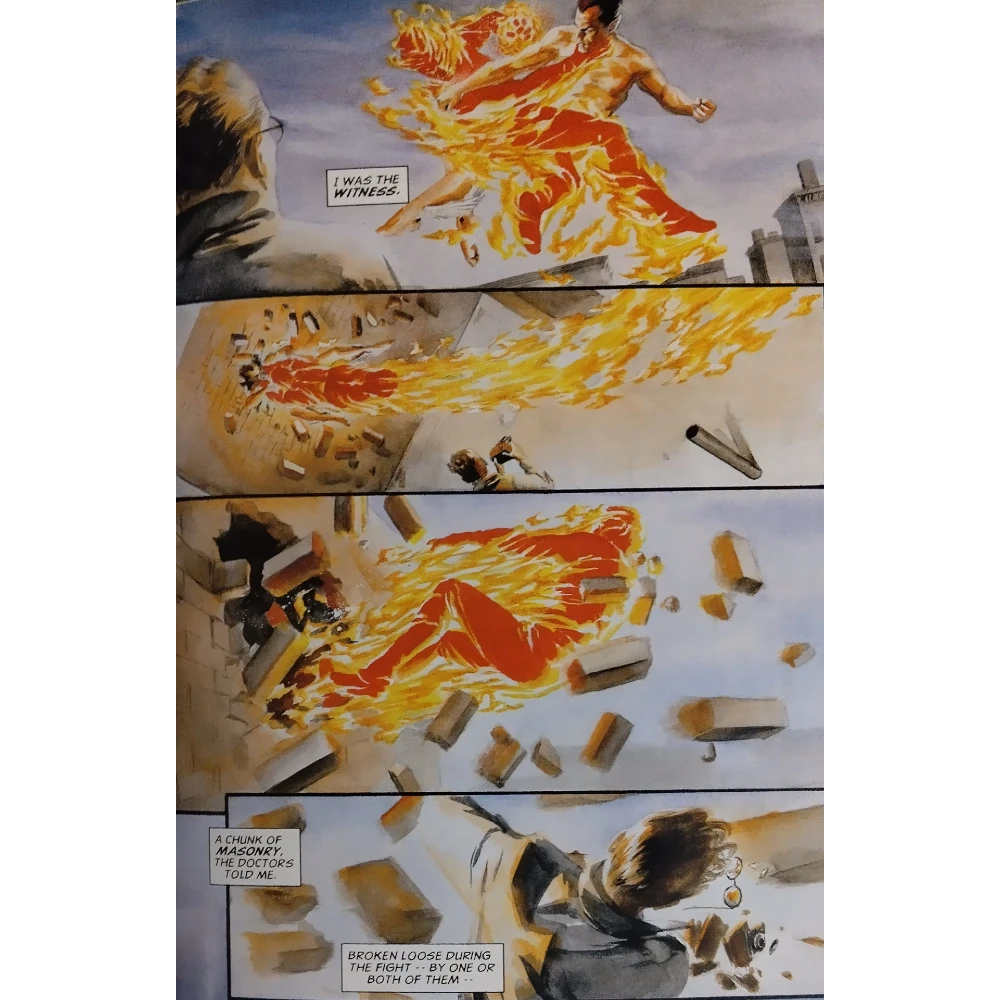
I noted my childhood confusion above, but if you're even the least bit familiar with Marvel Comics continuity, this book is for you. You're likely not a nine- or ten-year-old reading this (but if you are, thanks for checking this out). You've got greater reading comprehension skills. And if you know even just of the basics–who the Avengers, Spider-Man, and Fantastic Four are–you're likely able to follow along. Marvels isn't meant to be confusing, but it is an heaping helping of history, running from the first Namor/Human Torch fight all the way to the death of Gwen Stacy. The Golden and Silver Ages of comics are given much love, decades of narratives drawn into a singular story.
A book such as this needs a driving factor to make it a story; otherwise, it becomes a series of events recorded in chronological order. Busiek and Ross avoid that mistake by centering on Phil Sheldon, news photog, who represents not only the reader but also the Marvel everyman pulled into this burgeoning world of living androids, super-soldiers, mutants, famed families, and wall-crawling weirdos. Losing an eye during an early Namor/Torch scuffle, Sheldon is scarred from the beginning, and his perspective on the world, physically limited but thoughtfully rich, develops and grows as the decades pass.
Through Phil, Busiek charts the changes between two eras of comics publication very intentionally, honing in on the impact these "Marvels" have on the human world around them, from the awe-inspiring newsreels of Captain America punching Nazis, to the Beatlemania-esque fervor over the wedding of Sue Storm and Reed Richards, to the lambast heaped upon Spider-Man for the death of Captain Stacy. Phil, in some ways, is an outsider; though drawn into the excitement of these new colorful characters, he maintains a staunch appraisal that generates tension with prevailing public perception, especially when that perception can turn on a dime.
Busiek has found common threads between different books from the 60s and 70s and woven them together in an impressive feat of storytelling. That very human presence, originally sewn by Stan Lee, Jack Kirby, Steve Ditko, Roy Thomas, Gerry Conway, Don Heck and so, so many others, is maintained here and, in my opinion, amplified. All the diverse pockets of human emotion and connection found in different books such as Fantastic Four, X-Men, Avengers and Amazing Spider-Man are interwoven, tied together like a bank robber in webbing.
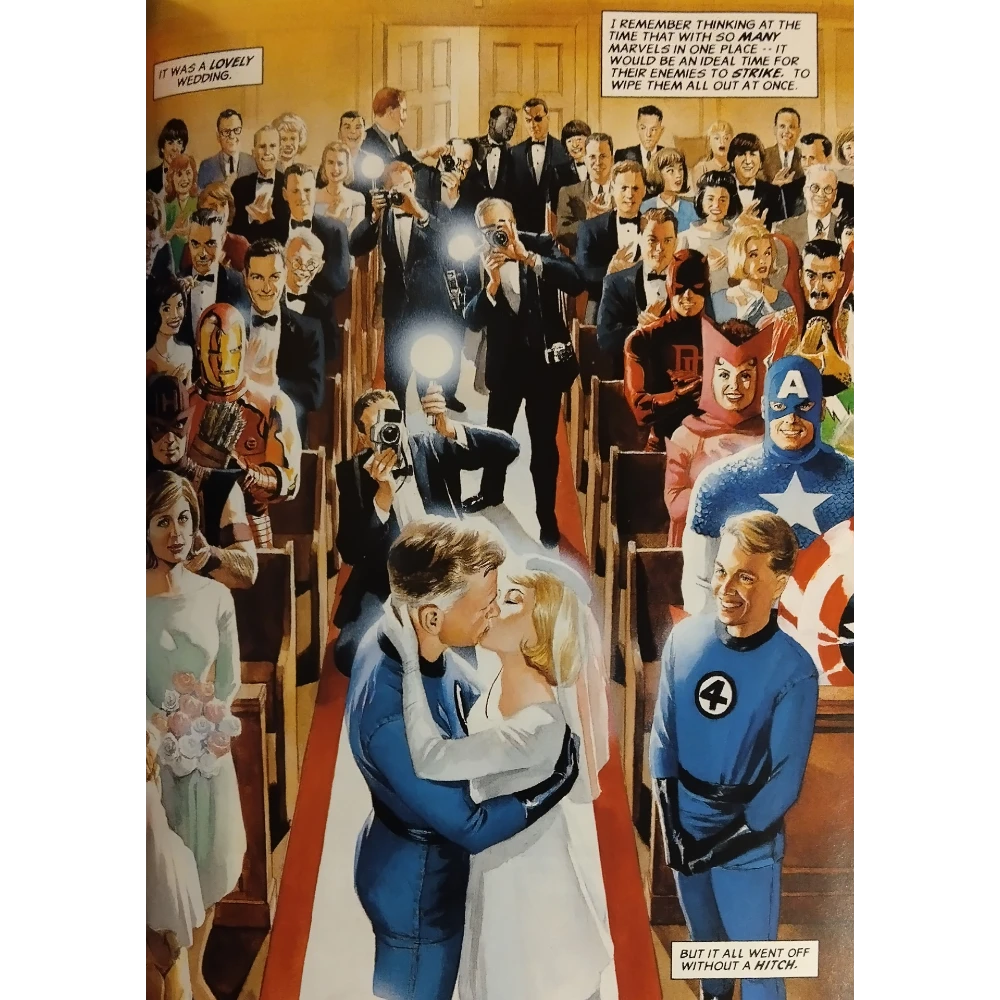
In so doing, Busiek delivers a streamlined timeline that nicely places seemingly disparate events in chronological sequence. Prince Namor becomes a recurring character, popping up as an enemy during World War II, then later as an Invader, and later still as a different kind of invader when he tries a few times to conquer New York. A later invasion is set on the same day Gwen Stacy dies, weaving the two tales together. Elsewhere, Busiek posits Reed and Sue's wedding as happening on the same day the Sentinels debut and suggests an early battle between the Avengers and Attuma occurs around the same time Galactus first appears. Occasionally, the process feels a little haphazard–there's no narrative reason why some of the events are related chronologically–but it helps nail key moments and provides a guide for the reader.
Busiek and Ross are also keenly aware of the events which need focus and which events need a passing reference or handful of panels. The Kree/Skrull War, though an epic of cosmic proportions, receives a single broad panel dedicated to it–as a conflict occurring in the depths of space, it has little to no impact on our characters, and therefore we don't need to see much of it either. But Galactus' first appearance is covered in greater detail, particularly as folks grapple with the possible impending end of the world. And Gwen Stacy's death, especially as she fashions a professional relationship with Sheldon, is presented in all its terrible tragedy. For folks who believe the Silver Age ended with Gwen's death, Busiek and Ross seem to be in your corner.
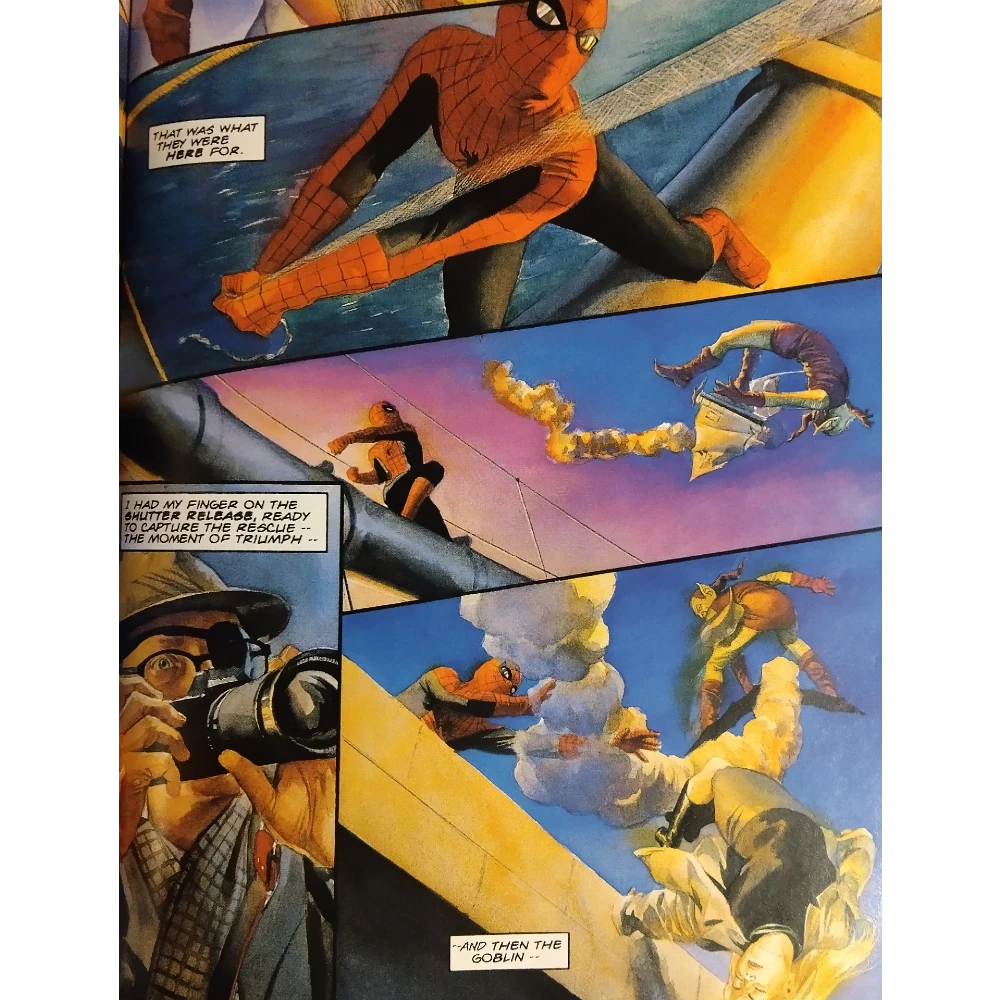
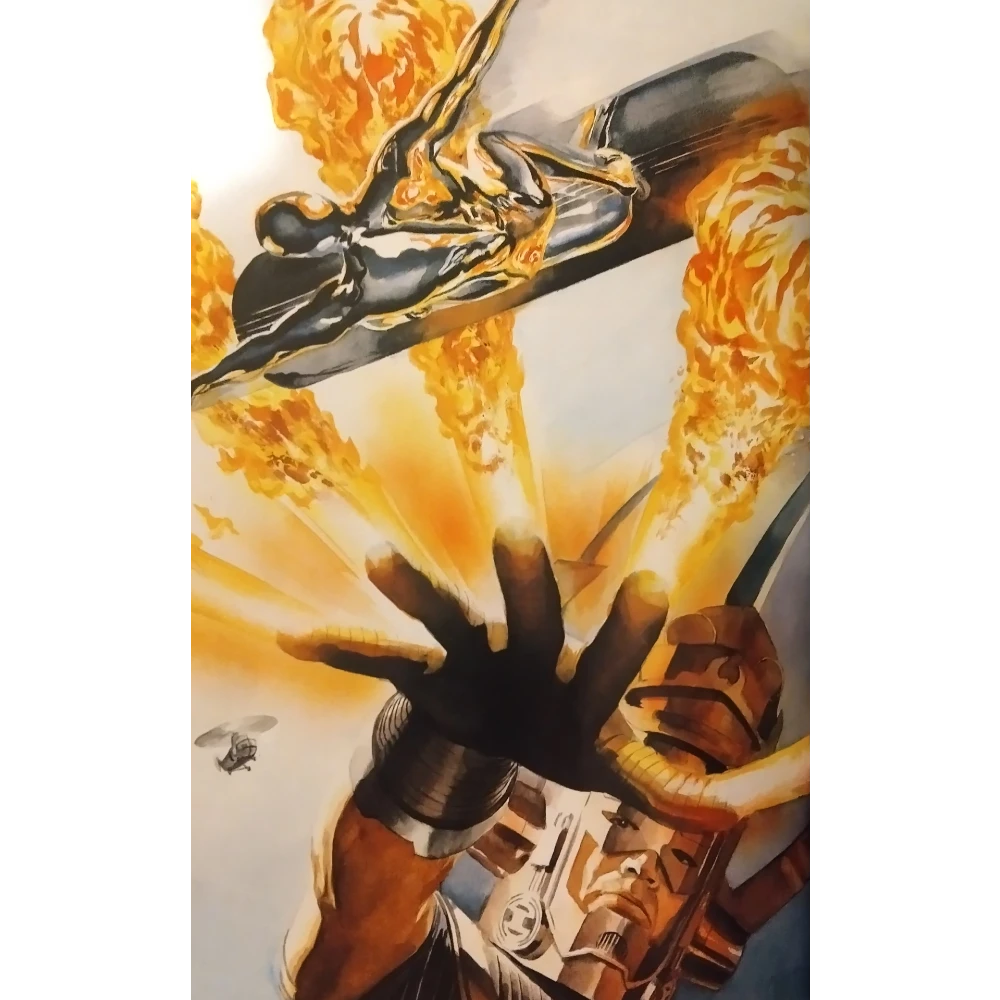
Marvel has always touted themselves as the "world outside your window," but most comics focus on the heroes flying or swinging by that window. Busiek steps outside, gets on the ground, and examines the hopes and fears of everyday people whose lives are directly affected by superhuman appearances and events. The FF wedding brings hope, the appearance of the X-Men delivers fearmongering and hate, the first coming of Galactus is awash in end times-inspired iconography and dialogue. Busiek keeps our focus on the people who witness these events, grounding their emotions and reactions in very understandable moods. You may not agree with an angry mob grabbing torches and pitchforks and hunting mutants, but their fear feels more justified than when Lee and Kirby developed their original issues–bathed in red lightning, the X-Men seem more unknowable, perhaps slightly monstrous. Towering above New York, Galactus' godlike aura is beyond impressive, perhaps the most frighteningly detailed he's been since Lee and Moebius' Parable.
Busiek's writing and narrative direction is beyond solid, but this series would not have the impact it does were it not for Alex Ross. He's the series' true star, delivering detailed, realistic visuals across each page. His painterly style feels somewhat alien to the medium, but it grabs at the humanity of each character and offers a level of nuance that I'd argue is difficult to always achieve in regular comic art. It's a different way of seeing these heroes–again, like with the X-Men, that's sometimes because your perspective is based on the people. But, oftentimes, it's because of how remarkably human Ross makes his heroes. As supplemental materials in the back attest, Ross did a vast amount of research and often used human models as references for poses and body proportions, achieving a beautiful amount of lifelikeness. You could adapt this comic, panel-by-panel, as a movie, and you'd already have all the necessary storyboards.
Ross' work always feels fresh, and through his specific medium, you recognize how incredible it is to perceive the way he adds wrinkles to costumes, minute differences in changing faces, and even hints of emotion through eyes. As time passes, so do our characters age–Phil and his wife grow older, their children grow up. One of my favorite visuals happens in the first issue's first page, where a young J. Jonah Jameson, sans mustache, looks the spitting image of the man he'll grow into as the years progress; without the comic even naming him, you know who he is. It's a testament to the series' interior continuity, and it's just a fun detail noticing how the world actually progresses from World War II to the 70s, changing in real time, quite a different perspective in a medium where time feels often as frozen as Captain America.
Those details also provide the series an extensive array of Easter eggs and references, particularly for those familiar with Marvel's history between the 40s and early 70s. Several of these references, such as newspaper headlines or character names used, point to specific stories or people in a fairly blatant manner, but they add to the world's livable quality. Other nods rely on the reader's understanding of original comics, making the series all the more impactful the more Marvel you read. Ten-year-old me would have never caught Gabe Jones whispering to Nick Fury in the background of Reed and Sue's wedding or shots of heroes in their civilian identities interacting with sculptures of their costumed selves at an art gallery. Your appreciation for this series may not necessarily rely on your interest with those older comics, but it's absolutely helpful, and it makes this series imminently re-readable.
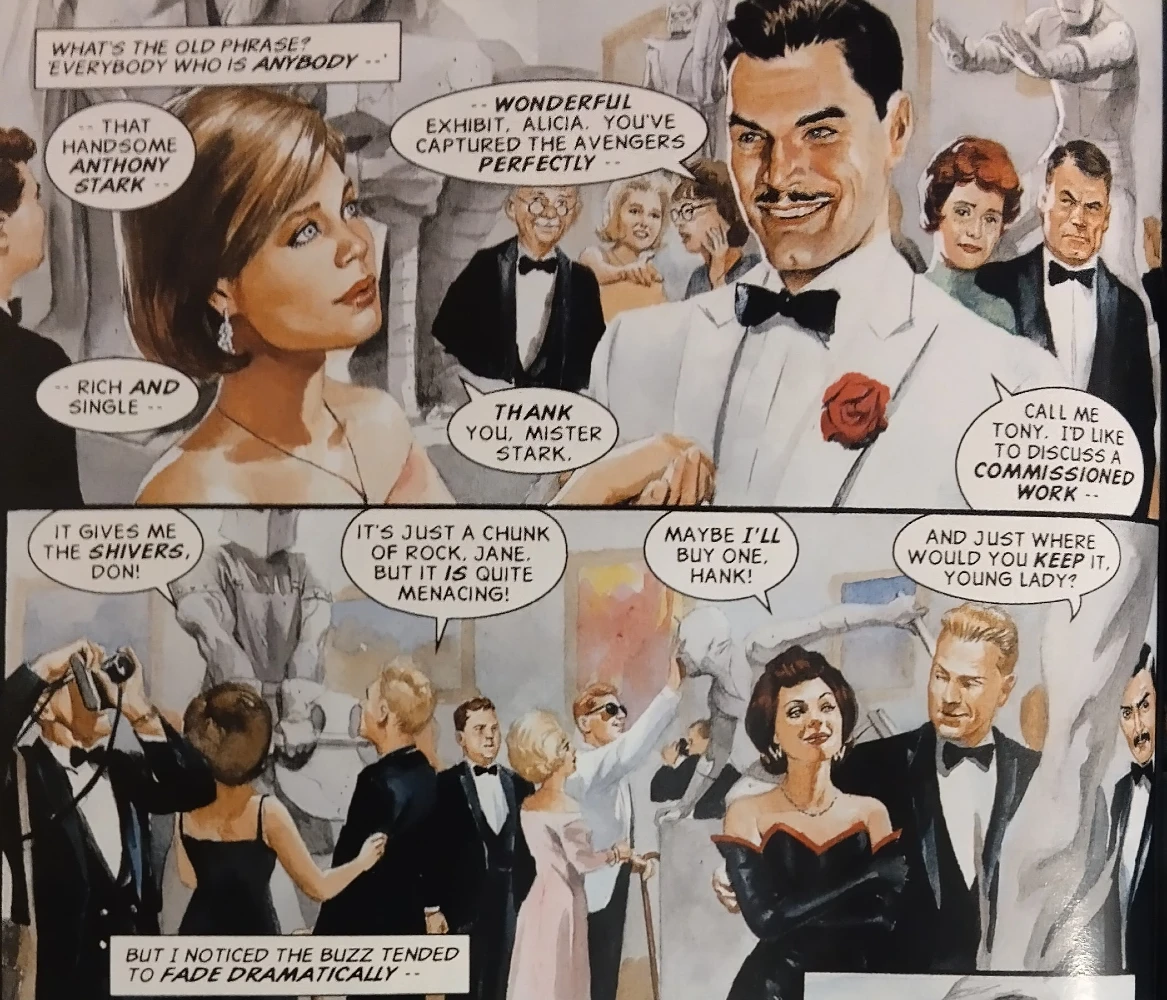
References such as the art gallery also add to the delightful sense of irony peppering the pages: you often catch what the human characters like Phil won't or can't catch, or you're aware of what they aren't. Phil mentally critiques fellow freelance photographer Peter Parker for the seemingly unscrupulous way Peter sells "incriminating" photos of Spider-Man to Jameson, unaware of Peter's dual identity. Most superhuman battles are shown in snippets, such as Galactus' first invasion or the Kree/Skrull war, highlighting the series' everyman focus but also the relative obliviousness with which people conduct themselves. And, just as one of my favorite images comes from the first page, one of my favorite references happens on the last: Phil taking a photo with a "nice, normal, ordinary boy" delivering papers named Danny Ketch. For all the ways in which superhuman events impact people's lives, there's also so much that people don't know and don't understand, and images such as these dovetail nicely into Busiek's overarching theme of perspective.
A short while back, in my Thor: Worldengine review, I commented on how Warren Ellis endeavored to restore a sense of wonder to the Norse god of Thunder during the 90s yet noted how, confined as he was to a few issues and draped in the darkness of the era, he and Mike Deodato Jr. couldn't quite pull it off. Marvels, published a year before, does exactly what Ellis hoped to do: it restores the Marvel Universe. Published during a dark period in the comics publishing industry, Marvels reminds you of what these heroes are meant to be: colorful, exciting, real. The series is not without its shadowier patches–the global threat of Galactus, the mutant-hunting Sentinels, Gwen's murder–but those areas aren't the exact center where this series operates. Gwen's death marks an ending of eras, and what comes before is meant to create hope and joy. Captain America bounding through Manhattan streets, the Silver Surfer shining against the sky, even the Human Torch casting a giant flaming 4 over New York…those moments inspire. This series reminds us of who our heroes are supposed to be, human beacons of hope. It's not a message you'll find much of in subsequent "Spider-view" installments, but for now, it's important, and it's what makes Marvels a timeless classic that deserves to be read far more than once.