Distinguished Critique: The Life Story of the Flash Review
This graphic novel uniquely retells Barry Allen's life by prioritizing narrative over mere history
—by Nathan on June 2, 2026—
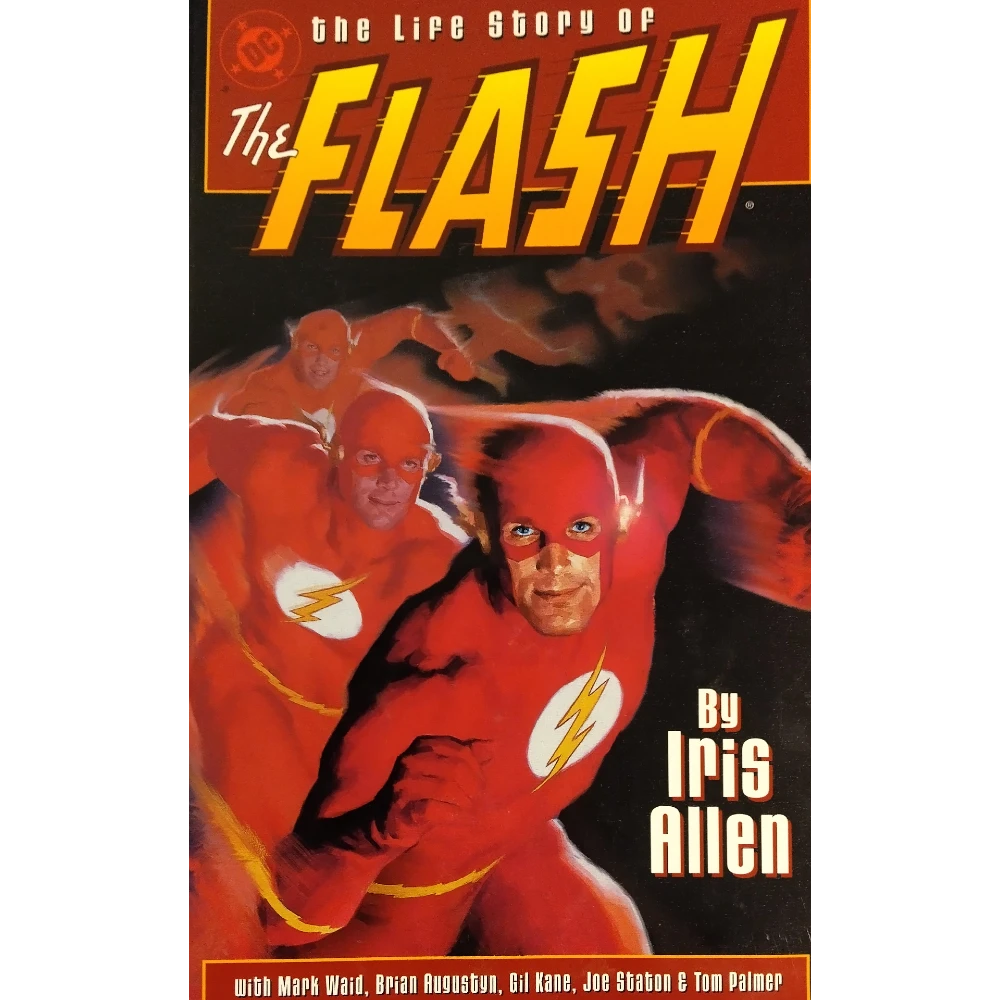
While reviewing Justice League: The World's Greatest Superheroes, a collection of graphic novels by Paul Dini and Alex Ross, I mentioned remembering reading the individual comics as a kid, my dad picking up the oversized versions for me from the library. Since a few recent reviews have found me rereading stories I first encountered as a young'in, I've decided to keep the memory lane train going a little longer. It's why I picked up some of these stories to begin with!
The effect is certainly born from nostalgia, to see if I can recapture some wisp of memory or glimpse of greatness from when I first encountered these stories. I'll admit a certain tempering of expectations in some cases, but I also hope that, as I've gotten older, I've come to a better understanding of unraveling stories (if the last six years of blogging don't attest to that, then what am I doing!). Appropriately, for this first intentional stop on the past's path, I selected a narrative which also dwells on yesteryear.
Mark Waid wrote, as I understand it, one of the best runs on the Flash of all time, finding in Wally West a worthwhile character intent on becoming his own hero rather than just filling his uncle's boots. I've only read a handful of issues from Waid's run, and though I would love to explore it with a more serious eye, I'm sticking for now with a different Flash story Waid produced, along with his writing partner and mentor, the late Brian Augustyn. Using the premise of Iris Allen writing a biography of her husband after his noble sacrifice during Crisis on Infinity Earths, Waid and Augustyn bring the Flash's history to the fore, covering decades of history in what seems the blink of an eye.
The Life Story of The Flash
Writers: Mark Waid and Brian Augustyn
Pencilers: Gil Kane and Joe Staton
Inker: Tom Palmer
Colorists: Lovern Kindierski and Digital Chemeleon
Letterer: Gaspar Saladino
Issue: The Life Story of the Flash graphic novel
Publication Dates: December 1997
We've been down a similar road twice this year already with comics such as these, stories which hope to take decades of continuity and streamline them into a singular story. Whether it was Roy Thomas and Rich Buckler unpacking the histories of Prince Namor and the original Human Torch, or Roy Thomas, Rich Buckler, and others diving into the extended past of the Justice Society of America, these stories have not been terribly enjoyable. And I know what you're thinking: Thomas and Buckler are to blame. I would disagree. It's mainly Thomas' fault. Buckler's art is great, but the stories lacked coherence and a central plot to develop interest in combing through years and years of continuity.
Part of the blame, admittedly, can be laid at the feet of the original comics themselves; their nature as disposable forms of entertainment for kids did not allow for great, interconnected stories with complex characters and stirring themes to be woven from the get-go. That came later. Waid and Augustyn face the same exact enemy for this graphic novel, their success dependent on finding a story woven by the Flash's fleet feet or creating one themselves that tries to make sense of years of continuity.
Fortunately, they largely succeed.
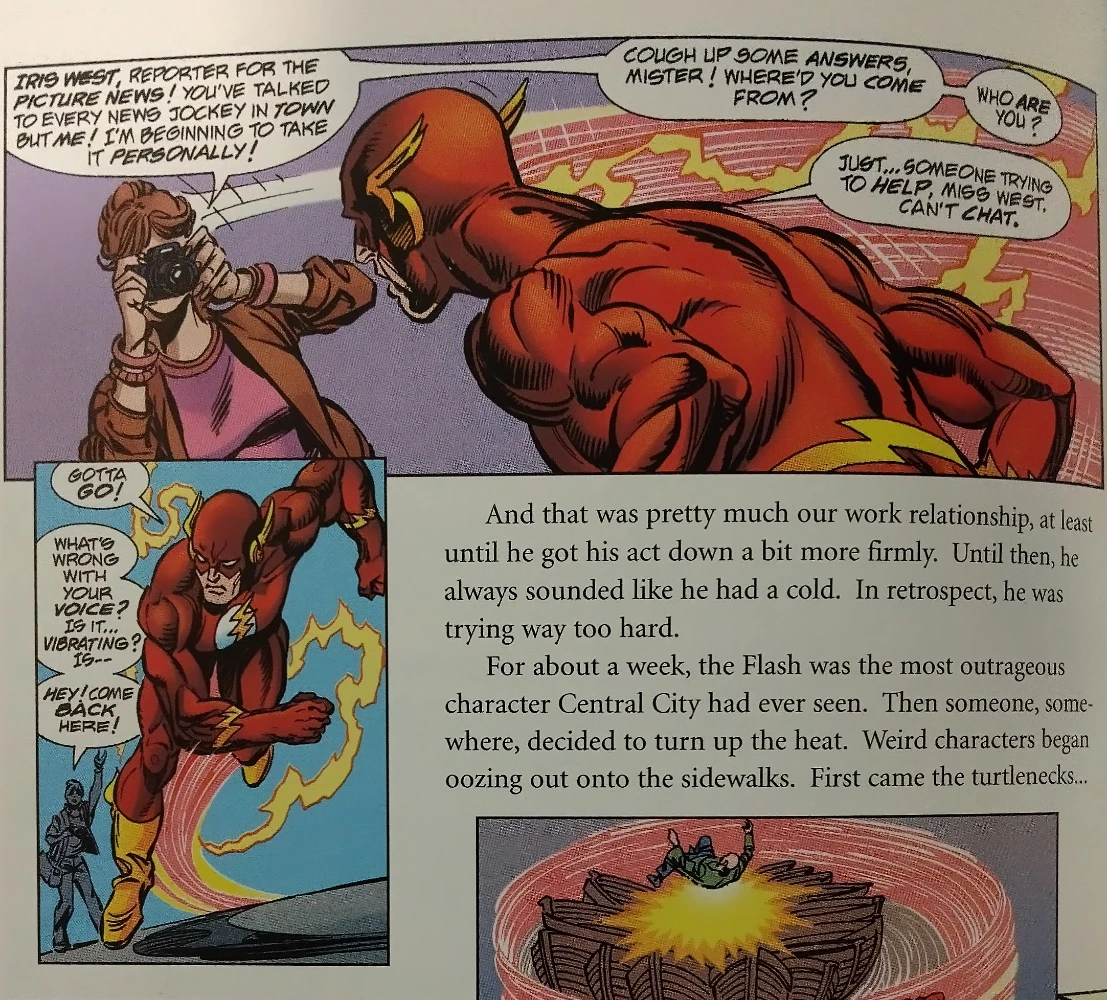
As I mentioned in the intro, Waid and Augustyn devise their graphic novel as a biography written by Iris Allen, Barry Allen's widow, combining prose paragraphs and panels to generate a unique reading experience. The biography is all the premise we're given. We're not told that Iris has been contracted by a publisher, or that she's writing this as a form of closure, or that she even intends to spring it upon the masses at all. There's no hand-wringing about whether she should tell the public who her husband really was and what kind of danger that could potentially place her in were she to do so. There's no frame tale whatsoever, aside from a few panels at the very end as Iris looks longingly outside for a husband who'll never return…in 1997.
By taking on Iris' voice, Waid and Augustyn provide themselves a strong "in" to the Flash's history, for reasons inside and outside the DC Universe. Iris is the appropriate person, as Barry's wife and as a reporter, to tell this story. It'd be like if DC had Lois Lane write Clark Kent's biography after Superman was killed by Doomsday. She's obviously not overly objective, but her perspective lends the events credence and provides a unique perspective rather than just having several stories retold directly by some other "writer." Her story is as important as Barry's, linked to his from basically the beginning.
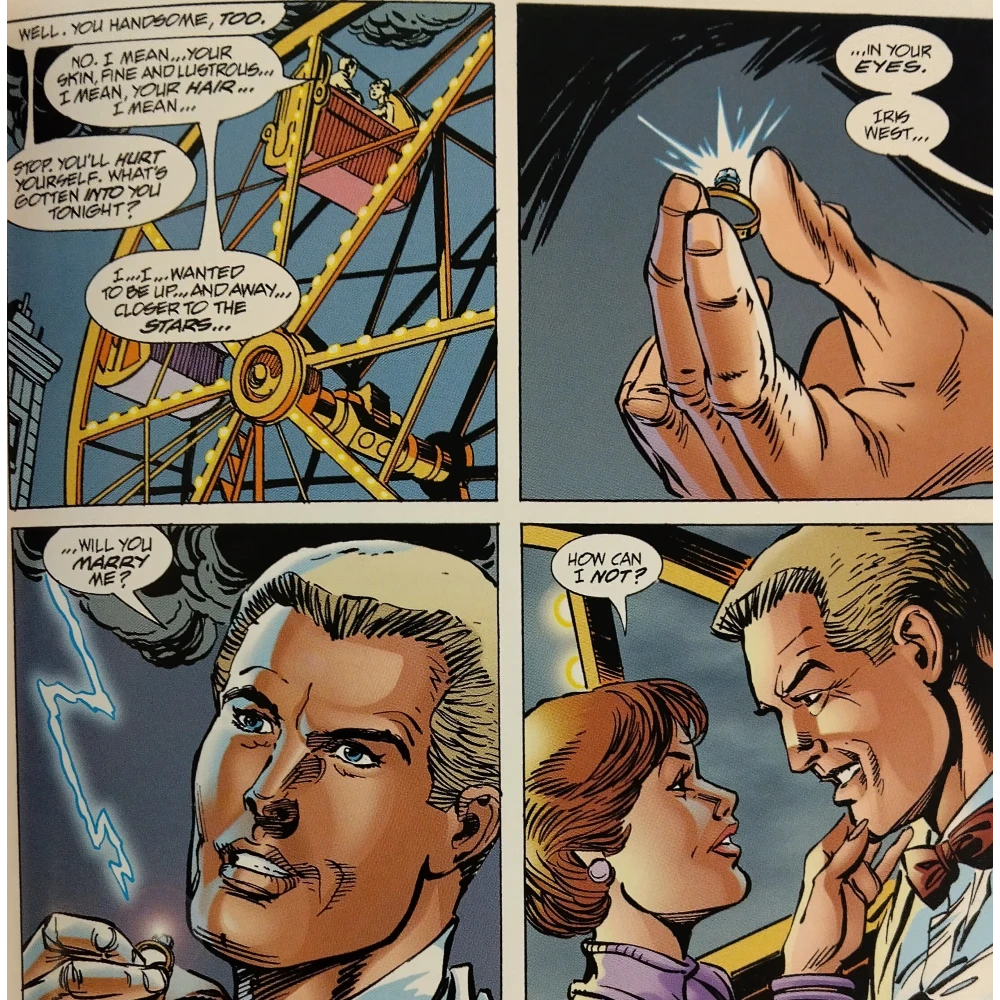
Through Iris, we see not only her love for Barry blossom but her own role in his history made front-and-center. She's not only a crusading reporter hoping to follow the Flash's career; she's Barry Allen's girlfriend and then wife and Wally West's aunt. Waid and Augustyn showcase the scope of her agency in those original narratives, making her feel more than a supporting character in a Flash comic, even if this is primarily Barry's story. Though he grows as a person, so does she, and as I assume the older comics Waid and Augustyn recap failed to give her much of a personality or direction, it's nice to see she's given some development here.
Most importantly, as our narrator, Iris is allowed a voice, to guide the story as she sees fit, at moments offering commentary that feels like a clever insertion of Waid and/or Augustyn's opinions on particular stories (commenting on a narrative featuring a seemingly unfinished bridge that secretly led to Central City's "sister" Keystone City, "Iris" writes, "It seems odd now that a city the size of ours had built such a bridge, and odder still that no one wondered why"). A bit of tongue-and-cheek humor that helps to make light of some of comics' strange decisions. Elsewhere, Waid and Augustyn are more willing to skirt around some of the Flash's odder adventures and adversaries. They take the past at face value, that creators invented scenarios and sinners without considering the greater ramifications. These things happened, and Waid and Augustyn are merely there to report just the facts, ma'am.
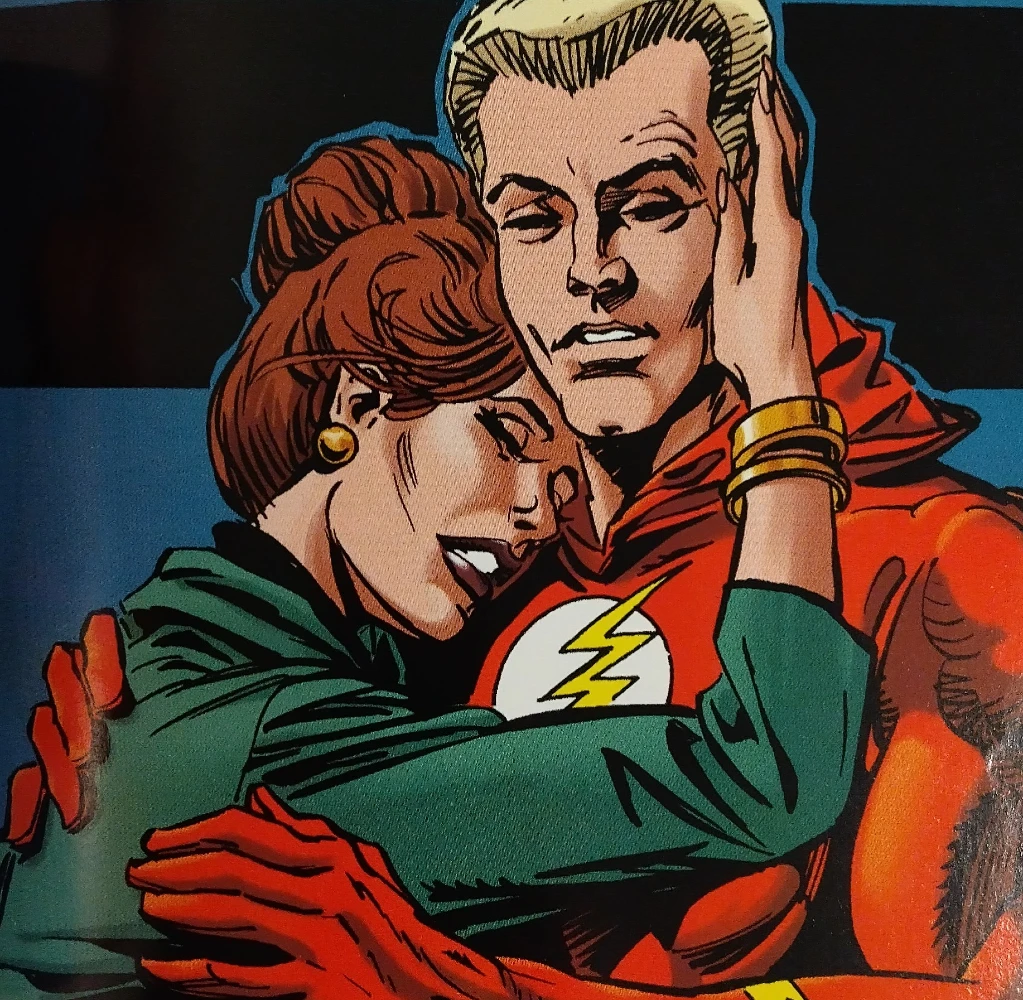
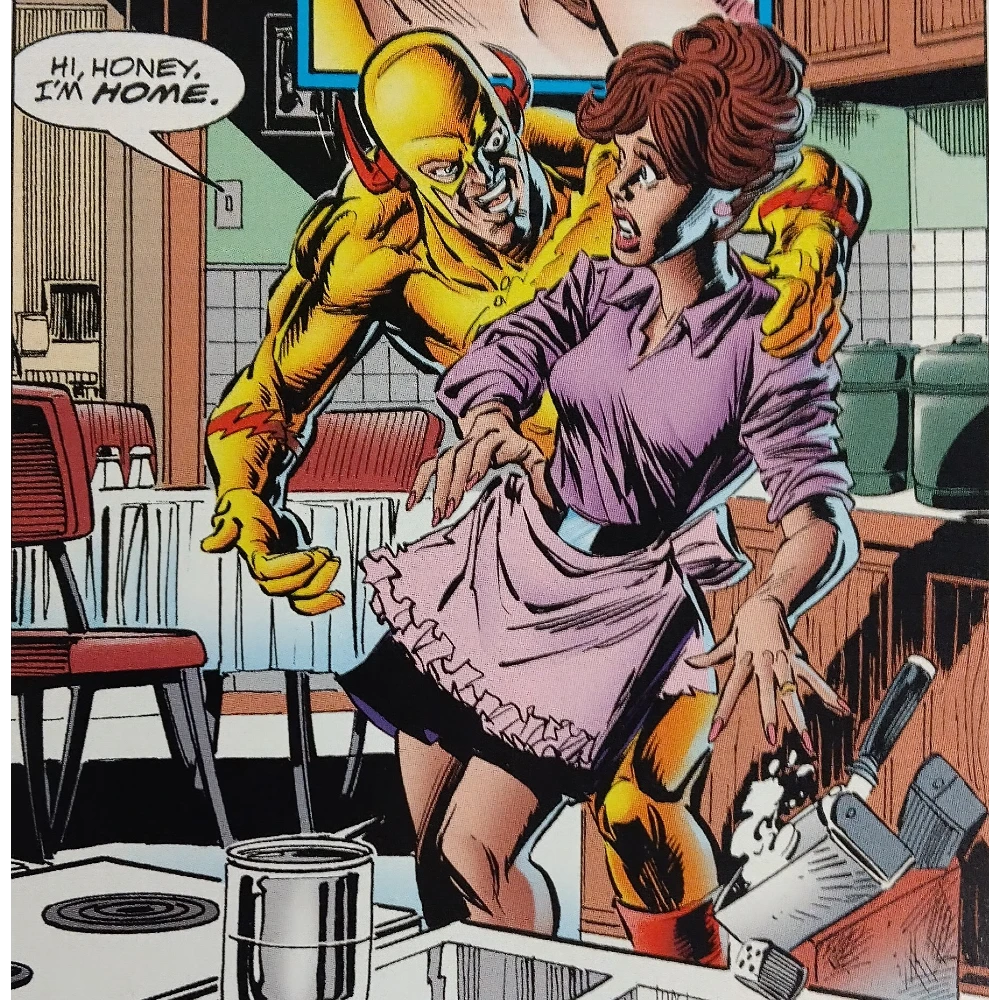
The major throughline provided is Barry and Iris' relationship, the whole graphic novel hinging on watching it develop and flourish, regardless of the speedbumps and potholes in the way. Since they're writing in such a matter-of-fact manner, Waid and Augustyn are more interested in chronicling the stories that happened, finding characters to refer back to or developing plot points to make the reading experience coherent. Professor Zoom, the Reverse Flash, becomes the standout villain, his threat always looming over the Allens and their love. Through the romance and Zoom's involvement, Waid and Augustyn work to polish the illusion that these stories were always intended to build on each other, that plots seemed fairly seamless.
Any additional commentary, from what I can tell, comes from our writers honing in on Barry's personality, taking aspects of his inner self and threading them through the narrative. Barry's bravery is apparent at every turn, from his early bouts with criminals, to his climactic showdowns with Zoom, to his ultimate demise against the Anti-Monitor. Waid and Augustyn manage to remind us consistently of Barry's penchant for running late despite his speed; his drive to be his own person, by asking for Jay Garrick's blessing to assume the Flash mantle; and the responsibility with which he tends to others, such as sidekick Kid Flash. Some of their conclusions feel generated on the spot–we're told, early on, that Barry's sense of order dovetailed nicely with his fantastic speed to resolve criminal messes quickly–but these deductions don't come straight from nowhere.
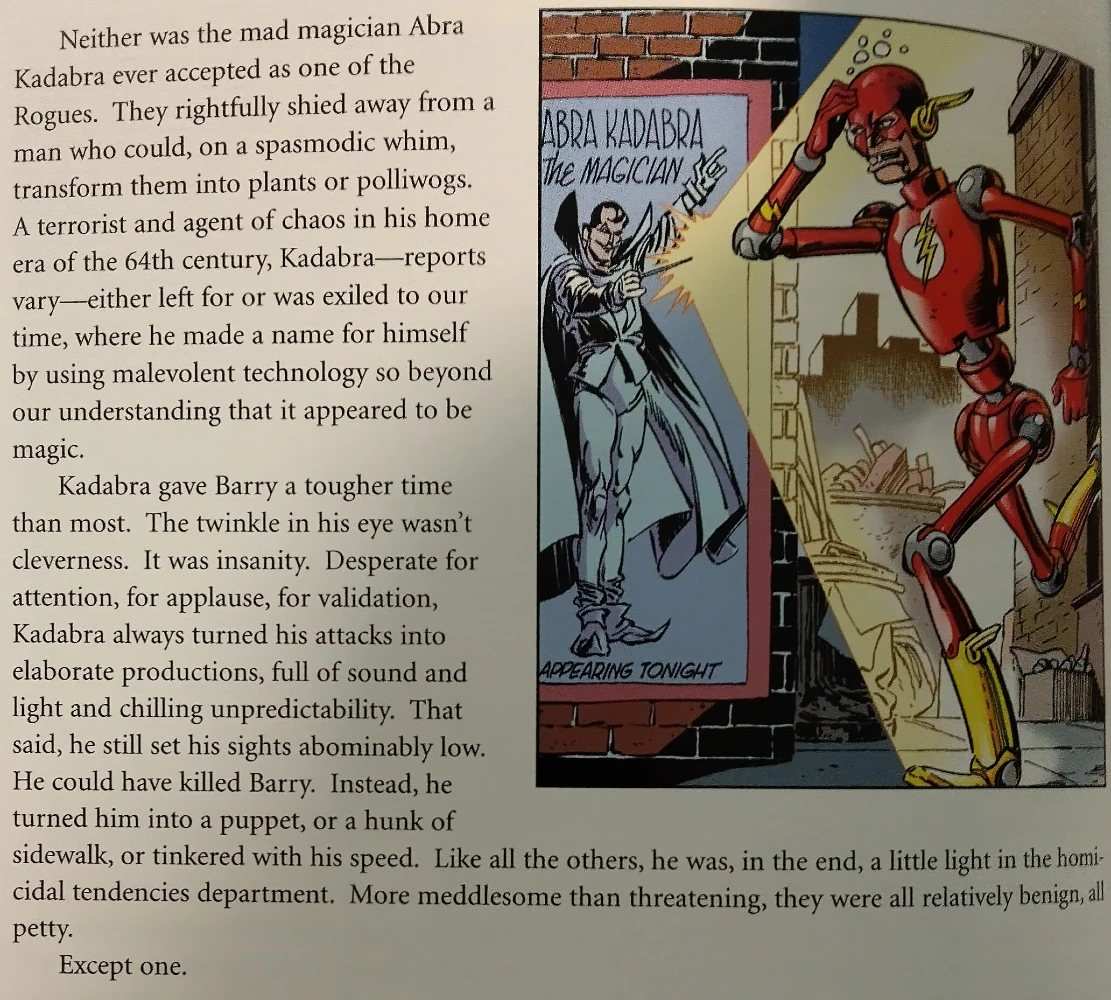
If any weakness can be found, it's honestly in the material that Waid and Augustyn are adapting. Some stories discussed here are straight-up bonkers, such as the revelation that Iris was originally born in the 30th century, a plot where Abra Kadabra turns the Flash into a living puppet, or the aforementioned "unfinished bridge" that nobody has ever asked about. And some of these narratives just don't lend themselves well to the historical perspective the writers are trying to organically create. Pages regarding Barry's rogues are entertaining, running the gamut of his foes, but they're mere summary, reminding you of these villains while keeping them outside the scope of the main story. None of this can be blamed on Waid and Augustyn, who are simply chronicling the material provided them from past writers and artists.
If memory serves, this was my introduction to the Flash's comic history. It's been so long since I originally read this graphic novel that I couldn't quite tell you if this was the first Flash comic I read–that honor may go to Geoff John's early 2000s run on the character–but it was certainly one of the earliest. I've fondly remembered it as a good primer on Barry Allen's history as a character, and to this day, it remains so. Waid and Augustyn can't dim the bizarreness of the Silver Age–which Barry, with his creation, is said to have kicked off–but they do find strands to pull together, primarily through the love Barry and Iris share. This graphic novel provides a unique reading experience and, if you're willing to overlook some Silver Age silliness, is a fairly fun, fittingly quick summary of the Fastest Man Alive's race through history.