(Strand)om Stories: Devil Dinosaur: The Complete Collection Review
Kirby's last 70s series at Marvel, Devil Dinosaur showcases a lush imagination while thrashing in the death throes of plotting
—by Nathan on July 9, 2026—
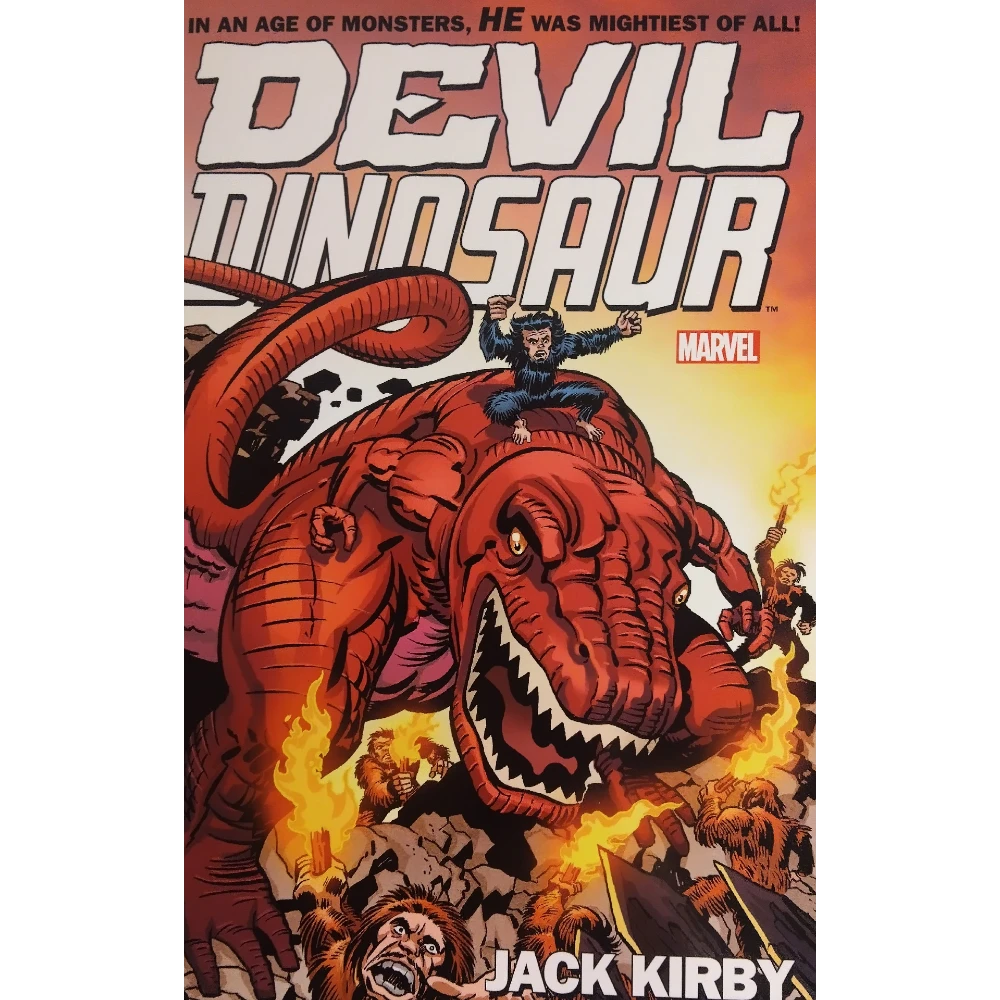
Since we've been exploring Jack "King" Kirby's contributions to comics in the 70s through his Jimmy Olsen stories and his mid-70s Captain America run, I wanted to take the opportunity to tackle one of his few 70s projects at Marvel which I have not yet touched. I wish it were Machine Man, but that volume is massively out-of-print, only available at ridiculously high prices. Maybe I'll snap up a used copy somewhere cheap someday. A man can wish.
So while I'd hate to say we're "settling" today, this volume does kind of provide that vibe. Though "settling" would imply I'm checking out the lesser of other properties which are of better quality, and I struggle to apply those terms to Kirby's 70s output, particularly at Marvel. His Eternals, though thoughtful, was cancelled. His Black Panther is ridiculous. And his Captain America run, though containing one engaging ongoing plotline and a unique, spirited celebration of America's bicentennial, certainly has its flaws, mixing a grayish pall into the red-white-and-blue. Maybe I can assume Machine Man wasn't much better? Or it could have been. A man can wish.
What I won't be wishing to do is sit down with the volume we've got today, because I've already read it, so I could review it, so you could read that review. Maybe you'll read the volume. That's my job here anyway: to present this latest batch of Kirby comics to help you determine whether the King's trip through humanity's deep past is worth plunking down your hard-earned dollars on this here complete collection.
Devil Dinosaur: The Complete Collection
Writer: Jack Kirby
Penciler: Jack Kirby
Inker: Mike Royer
Colorists: Petra Goldberg and George Roussos
Letterer: Mike Royer
Issues Collected: Devil Dinosaur #1-9
Volume Publication Date: April 2015
Issue Publication Dates: April 1978-December 1978
In these most recent reviews, I've had my critiques of Kirby's work. I've not walked away from these stories thinking he's untouchable. I don't think many people would disagree if I said there's a lack of that magic in his later material which made his 60s contributions at Marvel so iconic. What we do get is the application of a vast imagination from a creative standpoint, yet what we find missing is the necessary means by which Kirby should have steered himself or been steered. What worked well in the 60s didn't appeal as much to audiences in the 70s, and perhaps Kirby creating these stories so often on his own prevented the collaboration which benefited him a decade earlier. I'm totally fine with saying his partnership with Stan Lee had its foibles, but there's a humanity to their characters which can feel lacking in Kirby's solo stories.
Though it seems funny to say all that and then talk about a series starring a red dinosaur.
I noted in a review I posted for Howard Chaykin and José Luis García-López's DC Comics series Twilight that the narrative worked better analyzed as a thought experiment rather than a satisfying story. There are characters, and there is a plot, but the themes and their relatability to humanity make for more interesting philosophical cud to chew. I feel similarly regarding Kirby's Devil Dinosaur: you have two primary characters, but it's the concepts Kirby is trying to explore through them that generate the most interest. And even that affect is haphazard at best.
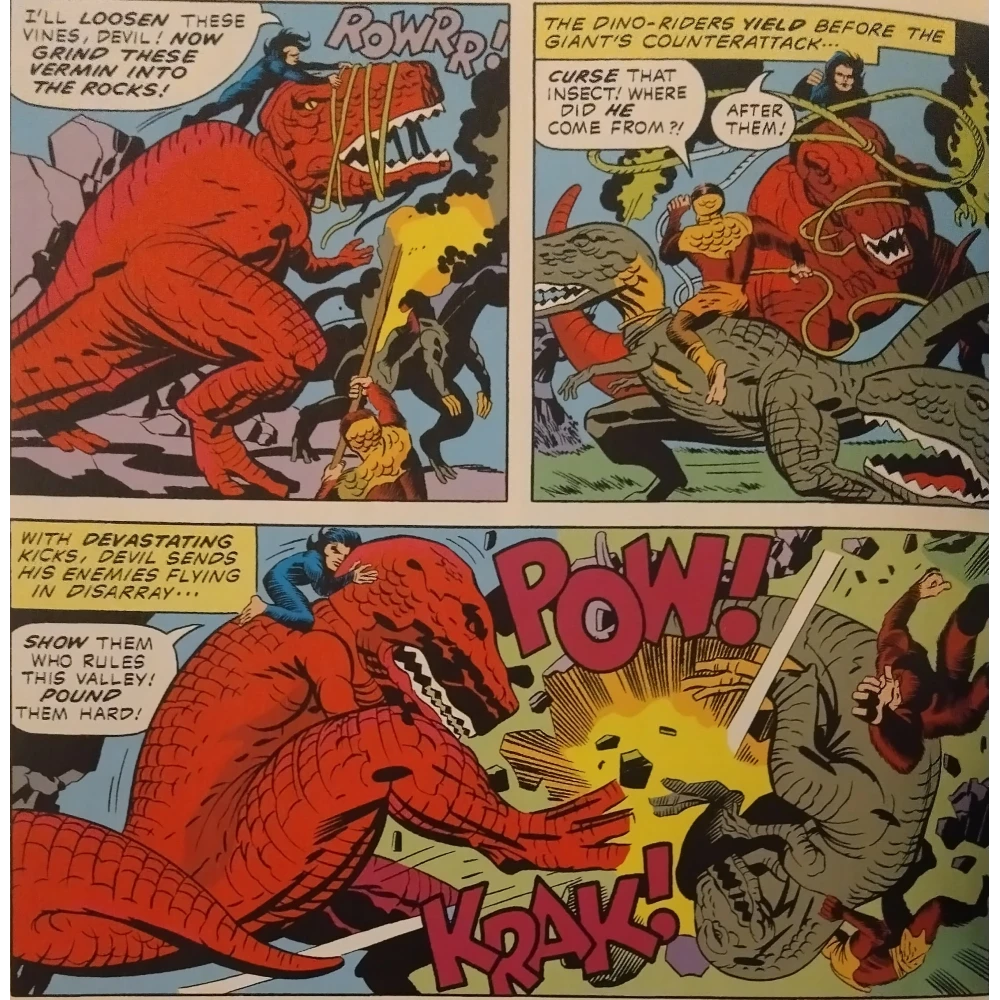
In a column at the end of each issue labeled "Dinosaur Dispatches," Kirby outlines his vision for the comic, which is essentially to plumb this untapped prehistoric era and introduce readers to what may have happened at that time in earth's primordial past. His purpose, it seems, is to be as realistic as possible from a scientific angle, setting these narratives shortly after the dawn of time. Mankind is on the rise, surrounded by danger on every side. Moon Boy of the Small-Folk has found companionship and protection in his "brother," the crimson Devil Dinosaur, whose skin has been forever reddened by fire, like a sunburn that won't heal. They are our guides through this past world, what Kirby terms the "X-Age." In one column, Kirby envisions what amounts to an entire line of books exploring this era, bandying about possibilities such as Greek and Roman superheroes or sea-faring warriors wandering into the Bermuda Triangle. A touch of history and a dash of mythology to generate a new era of reading material.
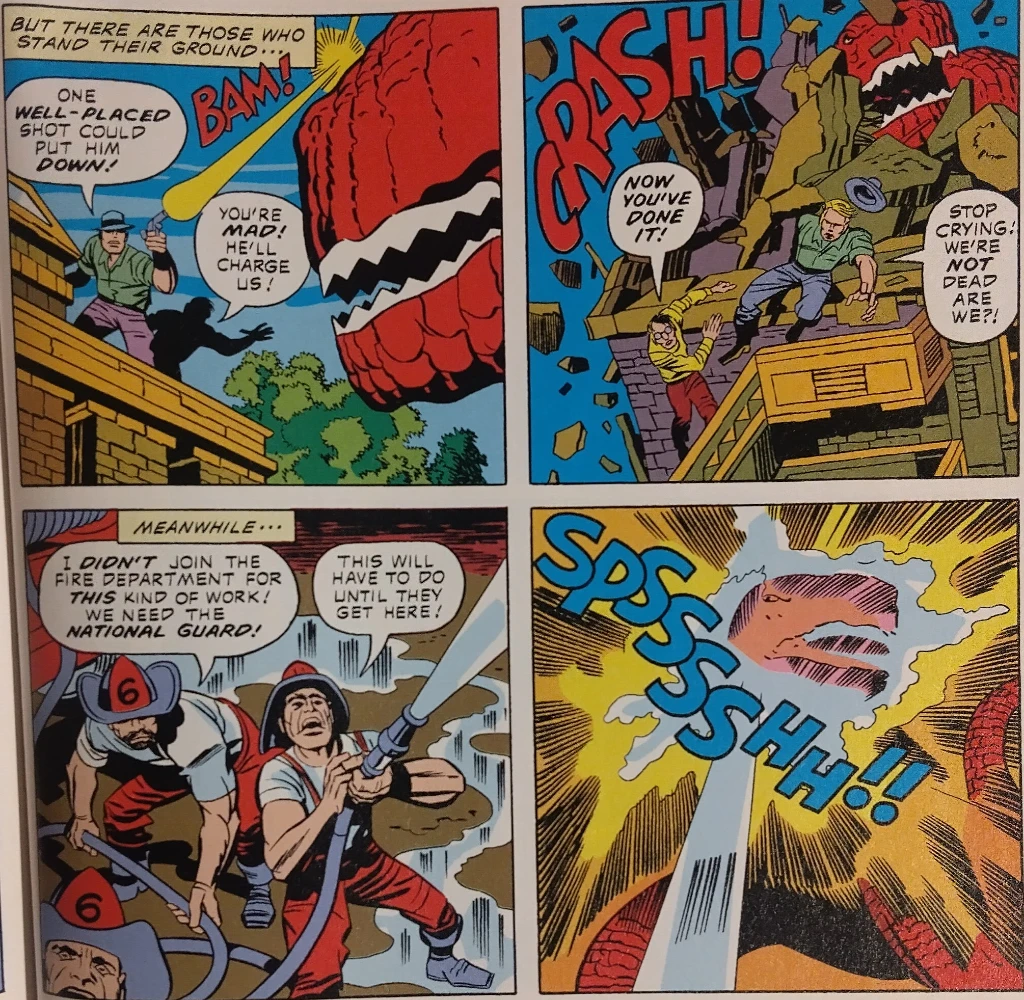
It's an ambitious vision, and as far as I understand it, the broader idea never came to fruition. Devil Dinosaur itself was cancelled after only nine issues, and by the time you reach that final story, Kirby seems to have long abandoned his idea of exploring humanity's history with much realism. In case you need evidence, the final issue features Devil (as his friends call him) thrown into a time warp by a witch and winding up in 1970s Nevada, where he tramps through a town while being fired upon by armed citizens and the military.
So, yeah, not terribly realistic.
Again, we're not given much of an overarching story, Kirby more interested in exploring distinct concepts or relationships rather than writing an ongoing plot. Running ideas weave their way through, but he generally wants to see how Moon-Boy (his fictional precursor to modern man) lived in this bygone era, surviving against seemingly insurmountable odds. It seems having the fairly intelligent T-Rex constantly keep the primitive youth safe from other ravenous dinosaurs quickly soured as a plot point for Kirby, so after a few issues where Devil battles rival dinos, we're quickly introduced to sci-fi elements. Aliens. A sentient computer. That time warp referenced above. Kirby's throwing whatever he can into this thing, which feels like a final hurrah for him at Marvel.
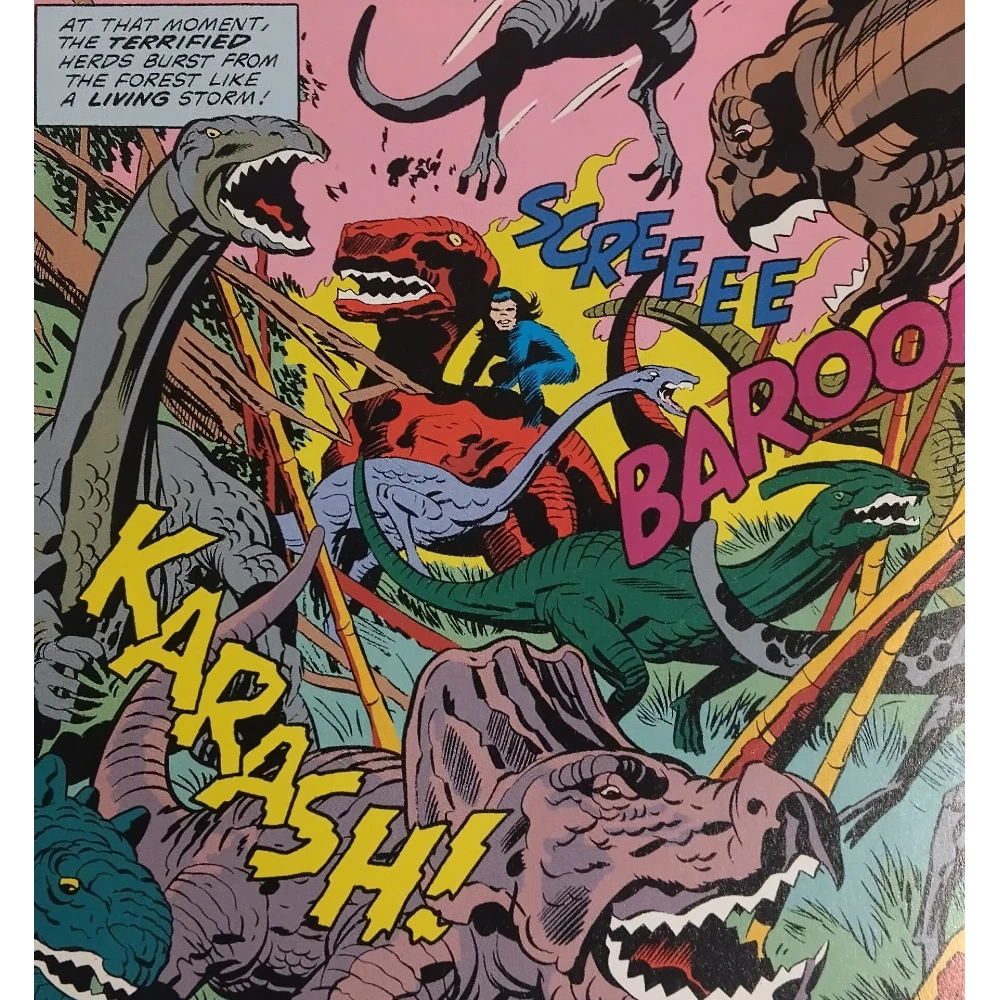
As in other stories, this is Kirby unfettered. His imagination is allowed to run wild, and part of me wonders if he inadvertently confined himself through his more realistic approach initially, deciding to abandon that as soon as he could in favor of stronger visuals. For all the weirdness on display, and despite its fairly divisive nature amongst fans at the time, Devil Dinosaur is earnest in its artistic appeal. Kirby, in his earliest issues, makes a great argument for why the book should have stayed in prehistoric times with prehistoric characters by wringing as much realism as he can from the details, his titular scarlet saurian notwithstanding. Rocks, trees, and plants create a vibrant and unique landscape that our characters constantly interact with, whether its Moon-Boy swinging along tree branches or dinosaurs gliding through dangerous waters.
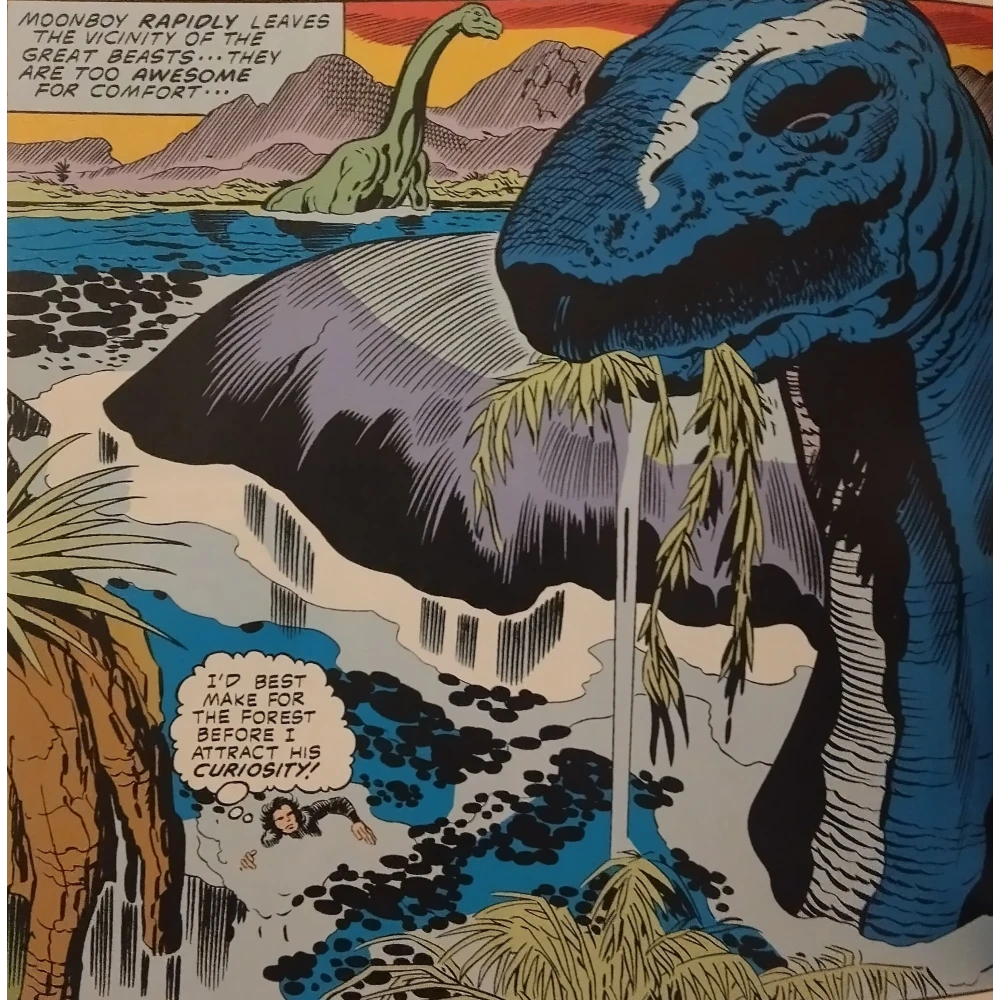
I'm of a divided mind when it comes to Kirby's sci-fi inclusions. They occur so suddenly and unexpectedly that they undermine the concept Kirby was just discussing a few issues prior; heck, in the column featured in the issue immediately preceding the first alien appearance, Kirby writes about developing stories where "there should be enough fact to give the reader an intimate sense of history." And, then, boom! Aliens. Of course, there's not much story to be found if you just followed Devil and Moon-Boy across nine issues of galavanting through pretty scenery and either avoiding or confronting dinosaurs and rival humanoids intent on killing and/or eating them. The bent towards science fiction does jumpstart a bit of plot in the middle of the series, with Kirby creating a fairly clever twist on the Adam and Eve narrative from Genesis.
Such plotting generates a new concept for the series–what if extraterrestrial technology had an impact on early Earth history?–though that question is so similar to Eternals, I assume Kirby intentionally prevented himself from probing the idea deeper. Still, the notion has merit and gives a decent reason for why the sci-fi elements should be included in a book that started off as one comic artist's somewhat realistic rendition of primeval Earth. I personally don't put stock in the Adam/Eve twist, but in those thought experiment terms, it generates, at least, an intriguing idea. It's that attempt to provide an explanation for certain unknown or unexplored facets of human development, and in true Kirby fashion, he decides the best way to describe the unknown is through aliens and fantastical technology.
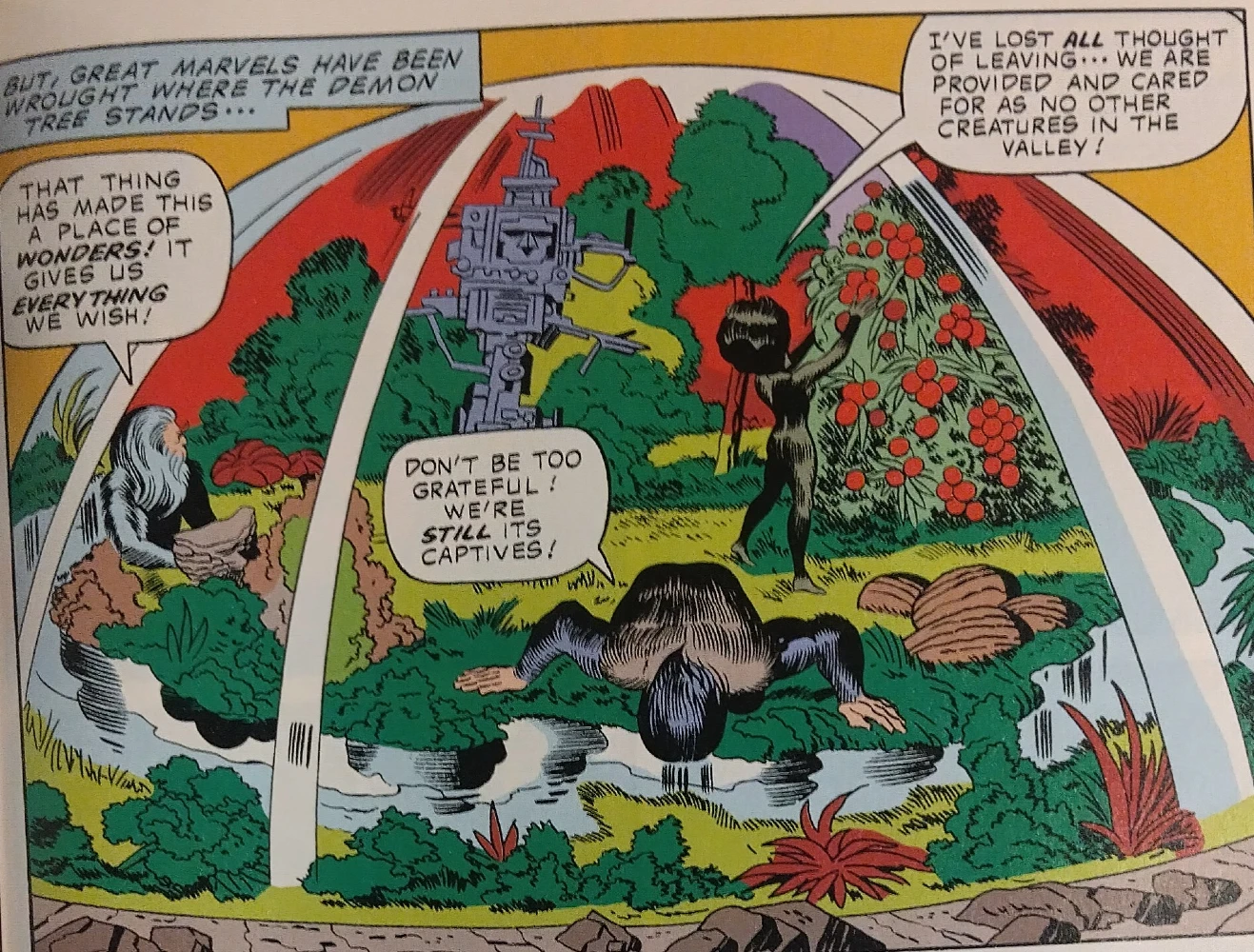
A blend of both worlds–the future tech and the primitive Earth setting–would have been, in my estimation, Kirby's best route had this series continued. Sending Devil to then-modern America seems a step in the wrong direction, a bit too outlandish for the series. Stick to the prehistoric era, have your noble Small-Folk hero and his trusty saurian steed, and send them up against dinosaurs and aliens both in a way to facilitate ideas about humanity's development and the possible extra help they received from folks beyond the stars. Sounds like a workable premise. Problematically, Kirby jumps from concept to concept, never relying on one idea enough to carry the series along. Maybe he was bored?
Additionally, the premise itself doesn't facilitate storytelling as well as having developing human or superhuman characters. Moon-Boy and Devil don't have much of a goal outside of staying alive. They share a bond, and Devil is shown to be far more intelligent than his prehistoric peers, but they've no determined goal. There's no society to jumpstart, tyrant to overthrow, progress to be made. They have enemies–fellow cave-dwellers, dinos, and aliens–but conflict arises as different sides grapple for survival. You're not gonna see Moon-Boy throw on a cape and swear to avenge his dead parents or Devil pursue a career in photography while worrying over asking a female tyrannosaur to prom. No real sense of growth to be found.
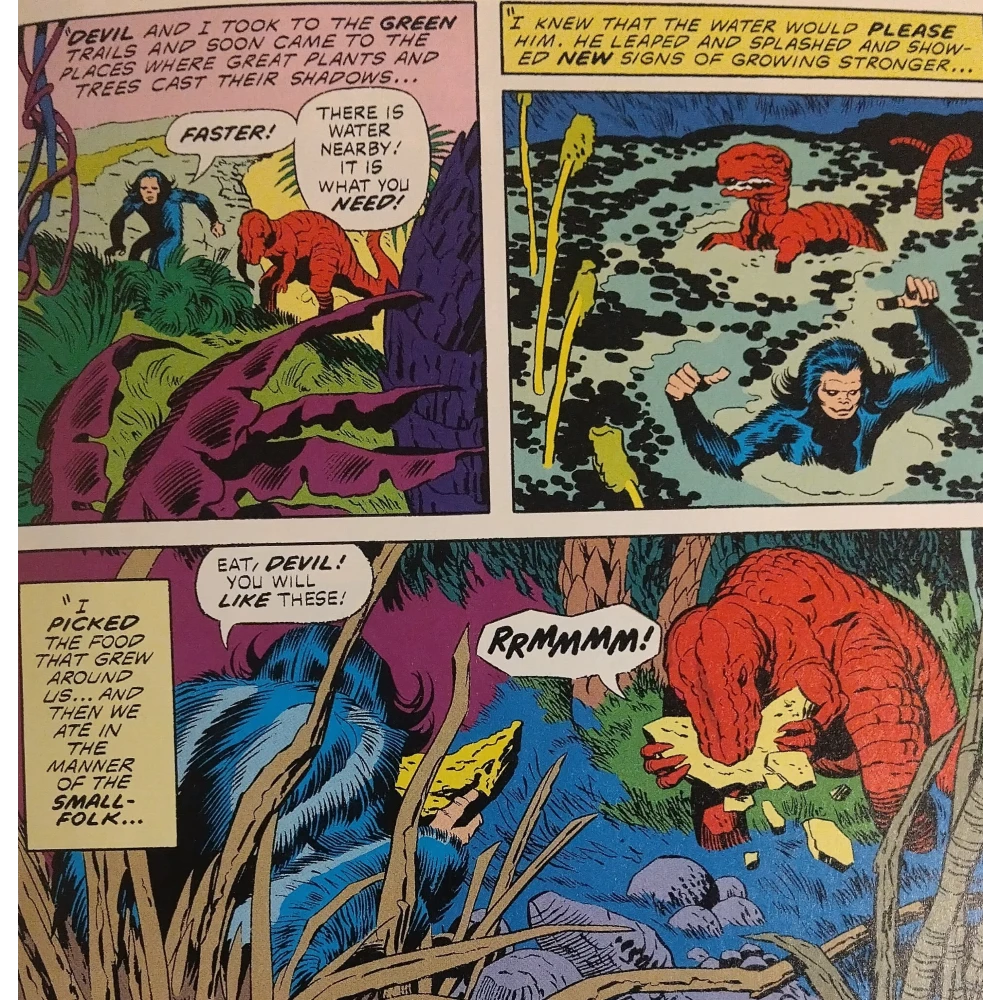
Sure, you can relate to the pair from a certain perspective. Most of us don't live in the hunter-gatherer societies of Moon-Boy's era, but readers can recognize the need for food, shelter, and companionship. Factions compete for resources, Moon-Boy seeks friendship with a more powerful ally, and folks generally try to skirt around danger. On Maslow's hierarchy of needs, they exist on that bottom portion, fulfilling whatever physiological concerns they have. Unfortunately, most great stories deal with segments a few steps up the pyramid, particularly where identity and self-actualization are concerned, and neither of our protagonists find themselves struggle with those deeper needs.
1978 marked the birth of Devil Dinosaur and Moon-Boy; it also marked the end of Kirby's second stint with Marvel. For three years, Kirby stoked the same fires of creative genius which had benefited him during the 60s. Yet something was missing. I'd argue it was a lack of boundaries, letting Kirby's artistic side flourish while not curtailing the more obvious issues with his writing and storytelling. This era didn't mark the end of Kirby's association with comics–he'd work with independent companies such as Pacific Comics and Eclipse Comics–but it did see the end of his collaboration with either of the powerhouse titans in the publishing industry. I wish I could be more celebratory of Devil Dinosaur, that it was a career defining book which fans remember fondly. It's actually later incarnations of dear old Devil readers likely know with more interest, though the seeds Kirby planted here don't deserve to be forgotten.