Random Reviews: Saga of the Swamp Thing (Book Two)
Building on previous issues, this volume probes more deeply into a monster's search for meaning
—by Nathan on August 11, 2026—
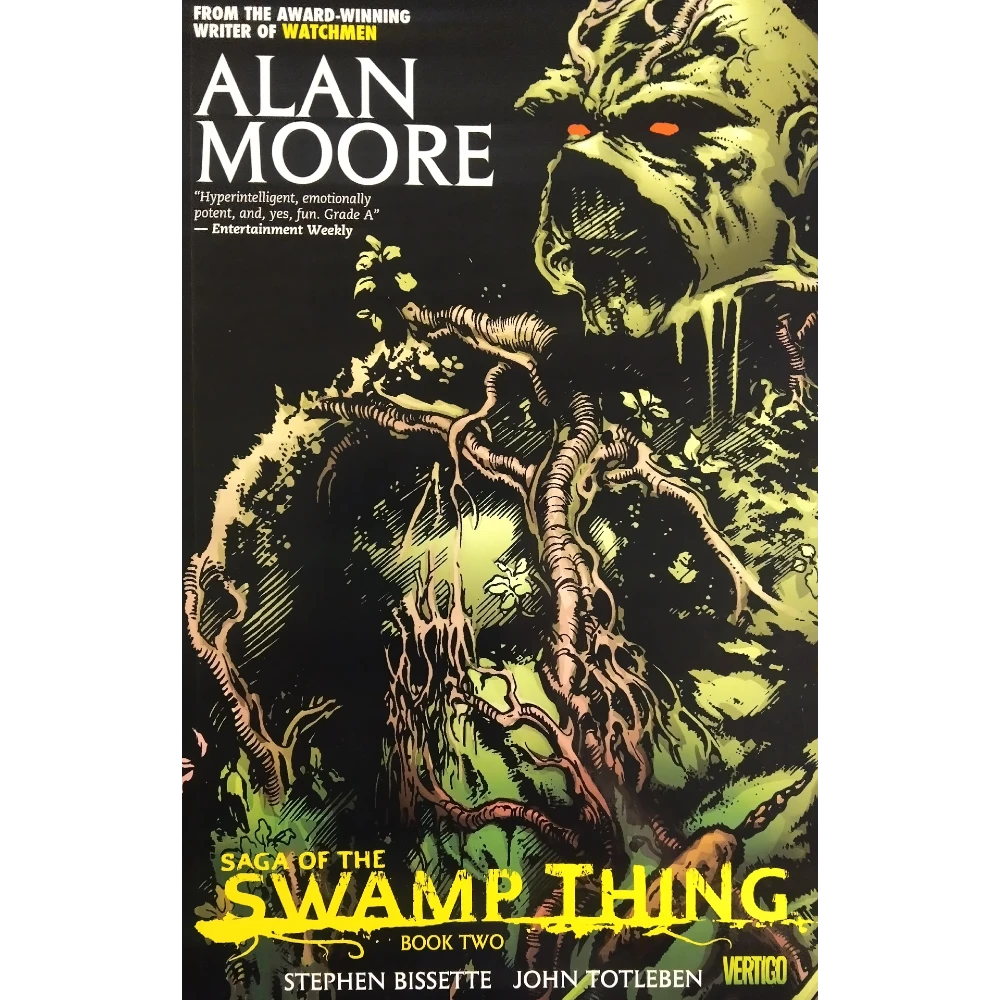
Two years ago, I reviewed the first of six volumes collecting Alan Moore's run on the muck monster known as Swamp Thing. Originally created by Len Wein and Berni Wrightson, the claggy creature was introduced as Alec Holland, a scientist whose body was forever warped by a sabotaged science experiment. Under Wein and Wrightson, Holland's tale was one of terror, Swamp Thing seeking a place in a world bent on obliterating him while yearning to win back his humanity.
Under Moore, all that changed.
Moore's most famous contribution, an issue titled "The Anatomy Lesson," revealed that Swamp Thing actually was not Alec Holland after all. In a move that changed the character's entire context, Moore introduced the twist that Swampy was just a living vegetative monster imbued with Holland's memories. The wife he thought he'd had? Not his. The life he thought he could reclaim? Not his. No chance to return to humanity if you were never human to begin with.
That twist reverberated across the issues in the first volume I reviewed, and the ripples continue across the issues collected here. Swamp Thing, as we'll see, has not yet fully reconciled the stunning news that has turned his life inside out, and our shambling, misshapen monster continues a path towards understanding and identity, achingly answering the question of just who, or what, he is with every squelchy step.
Saga of the Swamp Thing (Book Two)
Writer: Alan Moore
Pencilers: Shawn McManus, Steve Bissette, Rick Veitch, Ron Randall
Inkers: Shawn McManus, John Totleben, Alfredo Alcala, Ron Randall
Colorist: Tatjana Wood
Letterer: John Costanza
Issues: The Saga of the Swamp Thing #28-34 and Swamp Thing Annual #2
Volume Publication Date: September 2012
Issue Publication Dates: September 1984-March 1985
Publisher: Vertigo (DC Comics imprint)
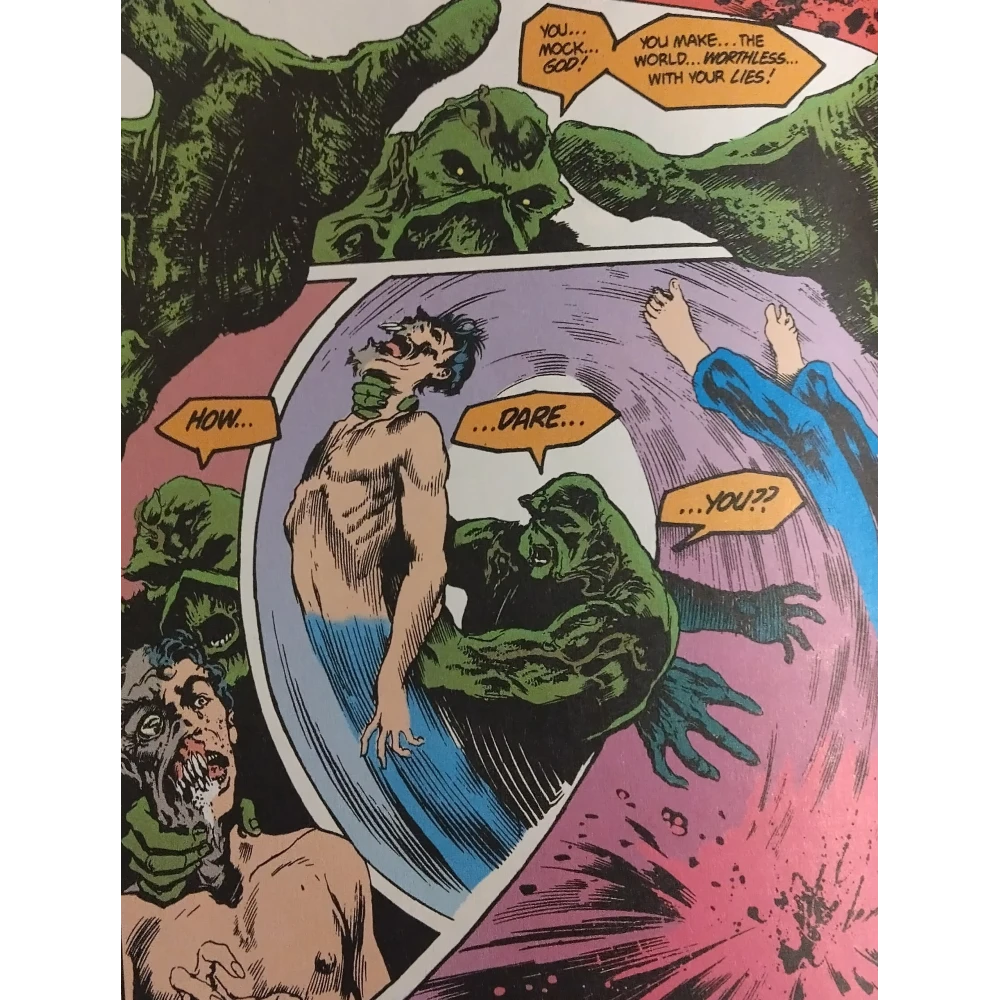
Previously published editions of this volume were subtitled "Love and Death," which this trade reveals is a fairly apt description. Both concepts are woven through these issues like intertwined vines, and the unifying factor connecting these ideas is Swamp Thing's exploration of himself in relation to those themes and feelings. Having defeated the Flouronic Man by the end of the previous volume, Swamp Thing has found a renewed sense of purpose as protector of "the green." He is, as one story establishes, an "earth elemental," something that I only assume Moore and other writers fleshed out over time, but the underlying truth is this: Swamp Thing is something beyond human, connected to a primordial skein tethering an aspect of creation, and yet he desperately yearns to be human.
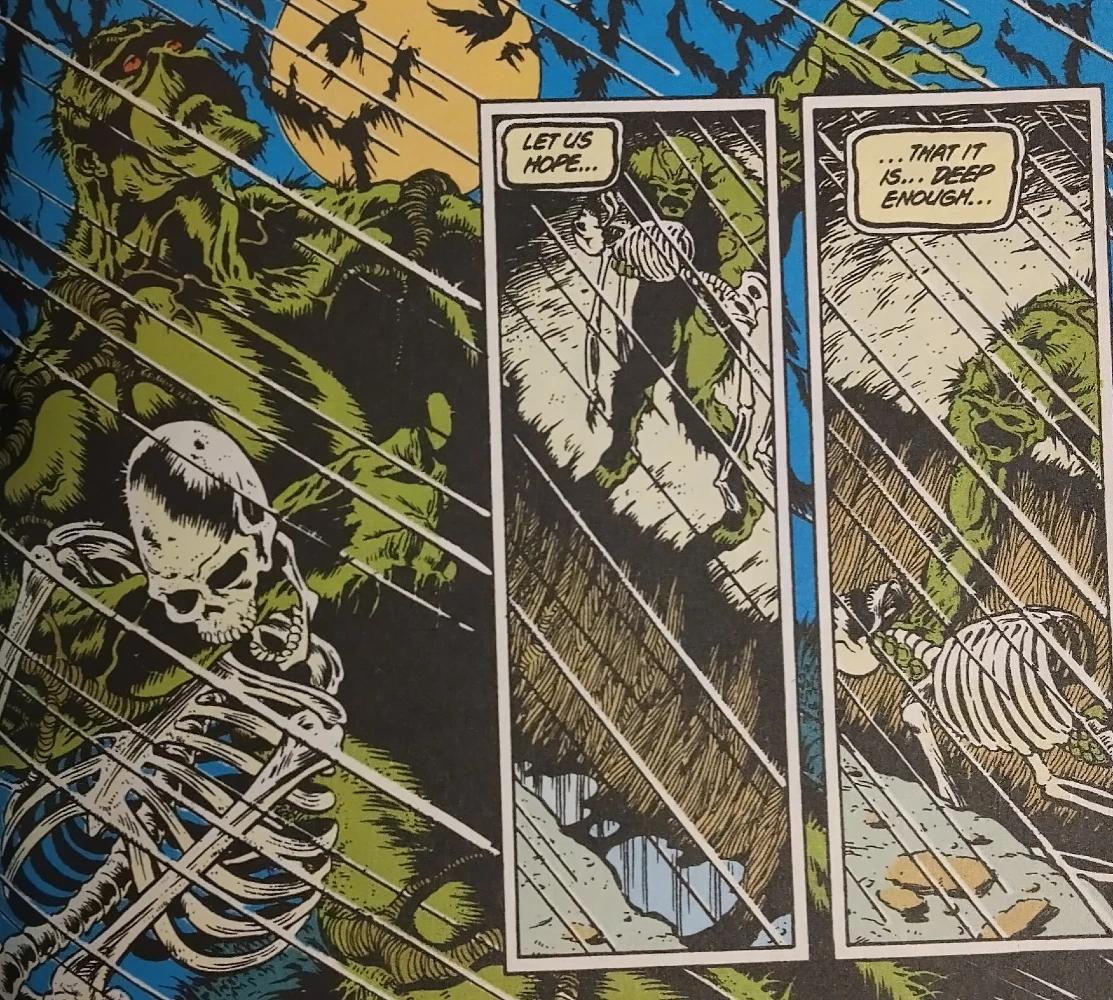
Not physically human, mind. He knows he is beyond obtaining mortal physicality, and if his growing acceptance of his current form in the last few issues wasn't convincing enough, Moore literally buries the point by having Swampy deposit Alec Holland's skeleton in a grave in the volume's opening issue. The point is metatextual, Moore definitively establishing that his crude creature is its own being entirely, influenced by his "implanted" memories and experiences, yet needing to move into a new understanding of himself. "I will not be haunted by myself," he says. The scene is a fitting coda to Swamp Thing's journey thus far.
Regardless, it appears the humanity imprinted upon Swamp Thing at his moment of birth has etched its way into his soul, and Moore explores this notion in engaging ways. Deep empathy dwells within him, driving him to rescue those he loves and battle evils which threaten the lives of his friends. By providing his protagonist emotions, Moore entangles Swamp Thing in the grim reality that he often feels more deeply than the actual humans, or former humans, around him. A monster he may be in person, but Swamp Thing rightfully rages against the cold, vengeful machinations of a "resurrected" Anton Arcane, his arch-nemesis, and his disregard for human life; he expresses sorrow over injustice; he even feels regret when he visits Hell and sees the fate of a man he murdered in an earlier issue.
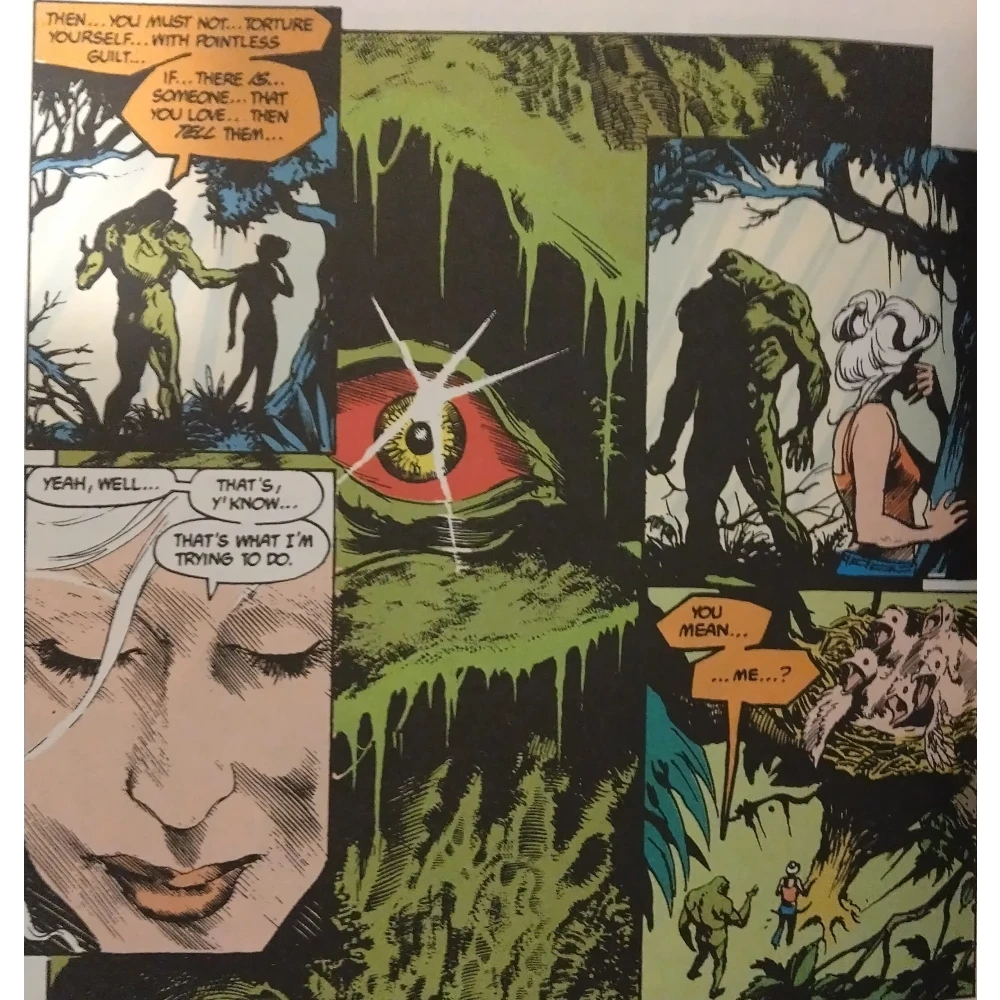
Swampy is most significantly stirred by his growing affection for Abby Arcane, Arcane's niece and wife of Matt Cable, the FBI agent originally tasked with capturing the creature back in the 70s. Moore cleverly skirts around any potential issues of marital infidelity (much to poor Matt's misfortune), establishing a budding relationship between not-Alec and Abby in a psychedelic issue layered with symbolism, metaphor, and the trippiest art anyone could supply to stand-in for a loving partnership between two people…or one person and one mossy, mucky monster. Moore provides enough initial conflict between Swampy's physical inhumanity and his deeply human emotions, and though some may find his and Abby's relationship uncomfortable (she's gonna kiss those grimy lips, really?), it emphasizes an aspect of Alec's humanity which still affects Swampy Thing's personality and existence.
Abby becomes a driving force across these issues, and her relationships with Swamp Thing and Matt turn her into, if anything, the title's deuteragonist. Having already been impacted by her experiences as Arcane's niece, Abby continues to find herself in perilous and otherworldly situations, especially when Arcane, seemingly killed in Moore's first issue, returns to plague her and Swampy further. She suffers physically and spiritually, Steve Bissette painstakingly drawing the title's physical horror elements out of her in a series of disturbing body horror panels. You can't quite say she only serves as a victim for the machinations of others, but the young woman often finds herself on the receiving end of tortures crafted to get at Swamp Thing.
Horror is strewn all across these pages, both in a physical sense and deeper. Artists Bissette and Rick Veitch, specifically, excel at winding all manner of decaying or dead things, bones, bugs, and beasties throughout each panel. Body horror, as noted, twists and transforms the recognizable beyond human. This is a genre predicated on what's unfair–it isn't fair that Alec Holland died, that Abby is still haunted by her uncle, that Swamp Thing trudges along in search of an identity, even that our protagonist must descend to a type of hell to bring back the soul of a loved one. It isn't fair that unbridled evil leeches into the beautiful and happy and distorts them from the inside out. And yet it happens anyway. It happens, and our characters must learn to live with the impact, learn to live despite the impact. The physical ugliness mirrors darker, internal realities, the outside reflecting a deeply disturbing inside.
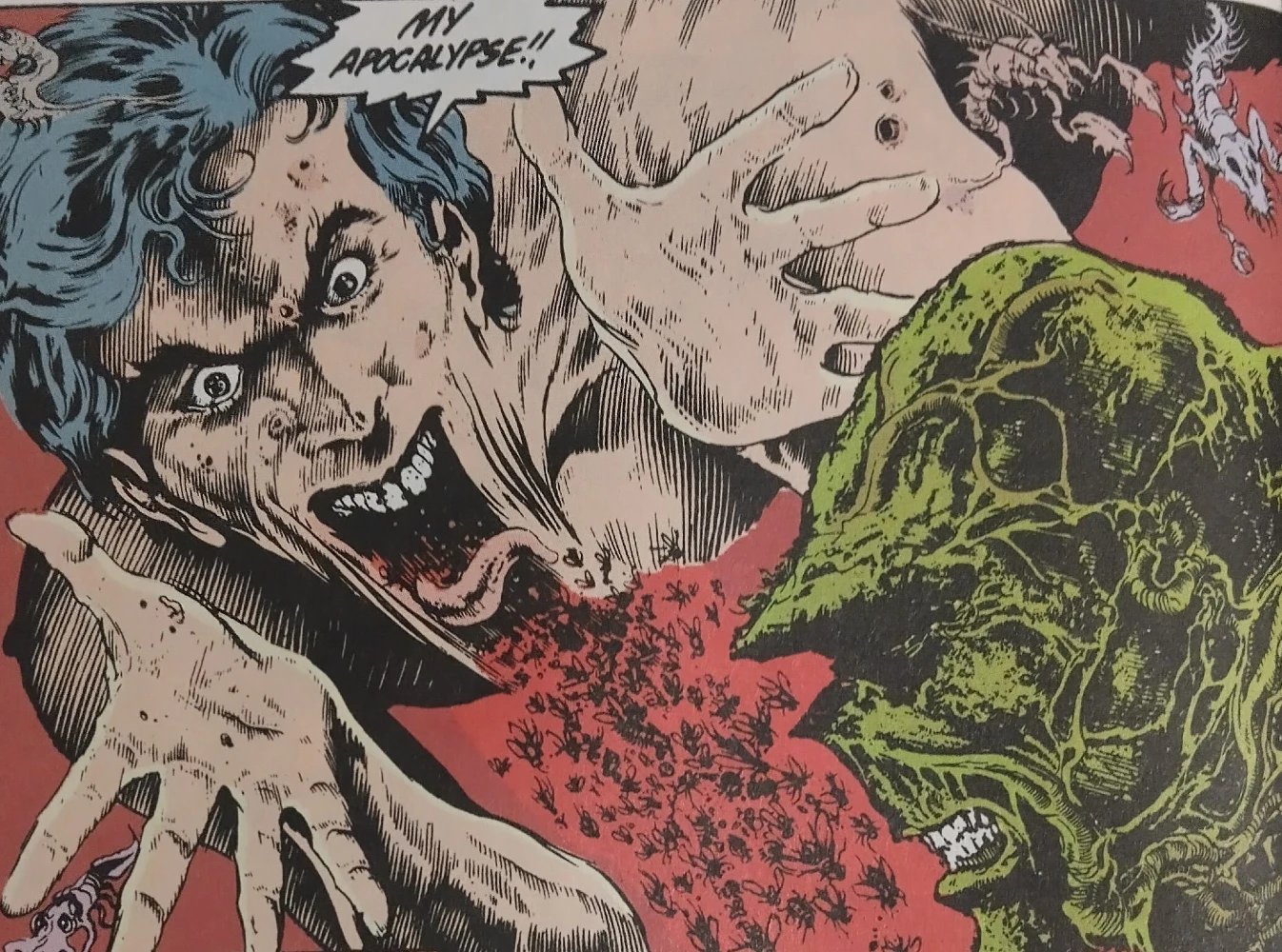
Moore, as he subjects audiences to the macabre and as he shapes Swamp Things's story, is navigating the best way to leave his own indelible mark on the title. He's already altered the trajectory of Swamp Thing's history forever–to go back and undo what he's done would tragically affect the character's development over the last forty years. But with such a groundbreaking change deployed so early, Moore is now in a space of establishment–he must now find his groove, and it isn't just by cramming as many horrifying visuals into the panels as possible.
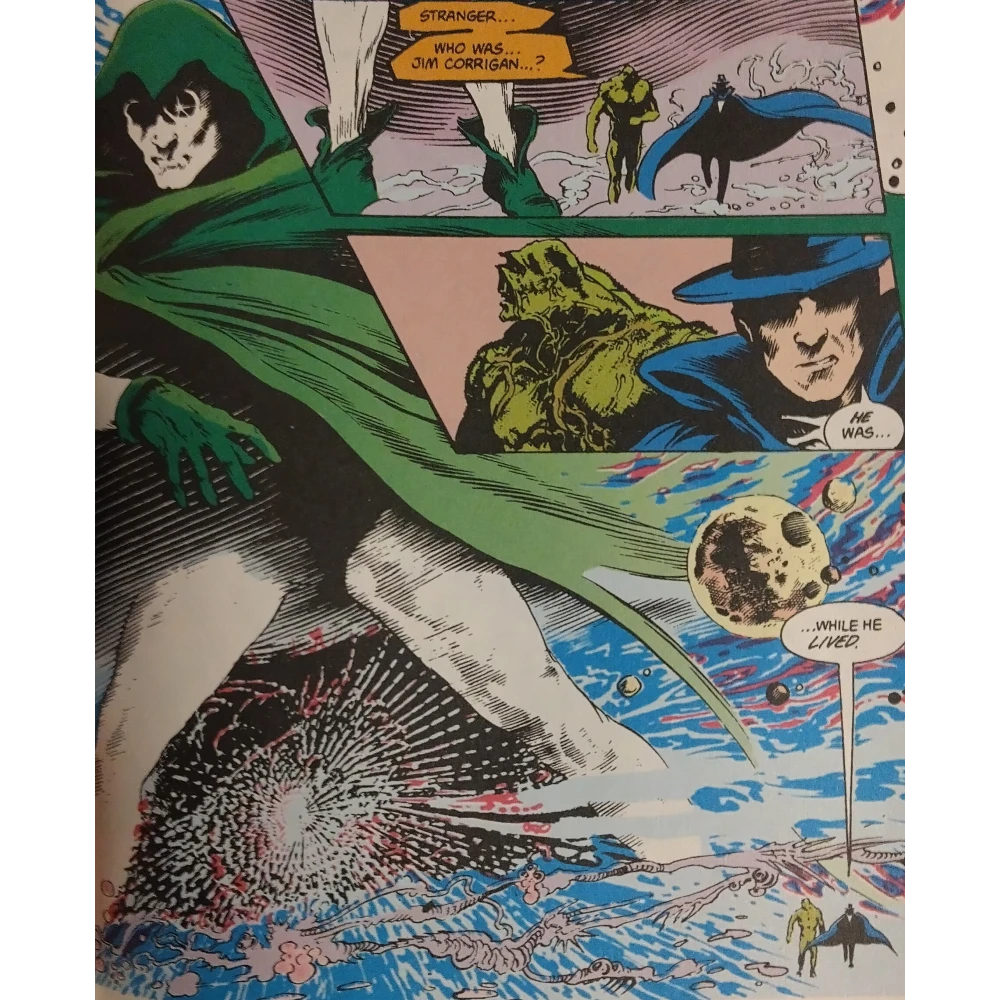
What Moore chooses to do, as these issues showcase, is toe the line between creating his own mythology and being respectful regarding what has come before, often finding ways to combine those two visions. He's indebted to what Wein and Wrightson created, but he takes a few of their concepts and toys with them in intriguing ways, such as using an issue homaging the original House of Secrets series where Swamp Thing debuted to bring back Alex Olsen, Wein and Wrightson's prototypical muck monster. Another standalone issue references comic strip Pogo in a mostly whimsical story that nevertheless allows Moore to give vent to darker inclinations. Even Swampy's trip to hell draws in established DC characters Etrigan the Demon, Deadman, and Phantom Stranger, aligning them in a united DC cosmology others have explored more deeply. Moore cleverly takes the toys he's been given and finds new, exciting, engaging ways to combine them.
I intend on working through the remaining volumes covering Moore's run at a much quicker pace than I took to get to this second collection. In closing this volume, these issues leave our central character in an intriguing place: given new purpose as an elemental protector, Swamp Thing nevertheless aches for some of the human emotions which still resonate from Alec Holland's memories and experiences. The body may be buried, but the heart lives on within Swamp Thing, following him through his adventures, or more accurately, guiding him as he unravels the complexities behind love and death.