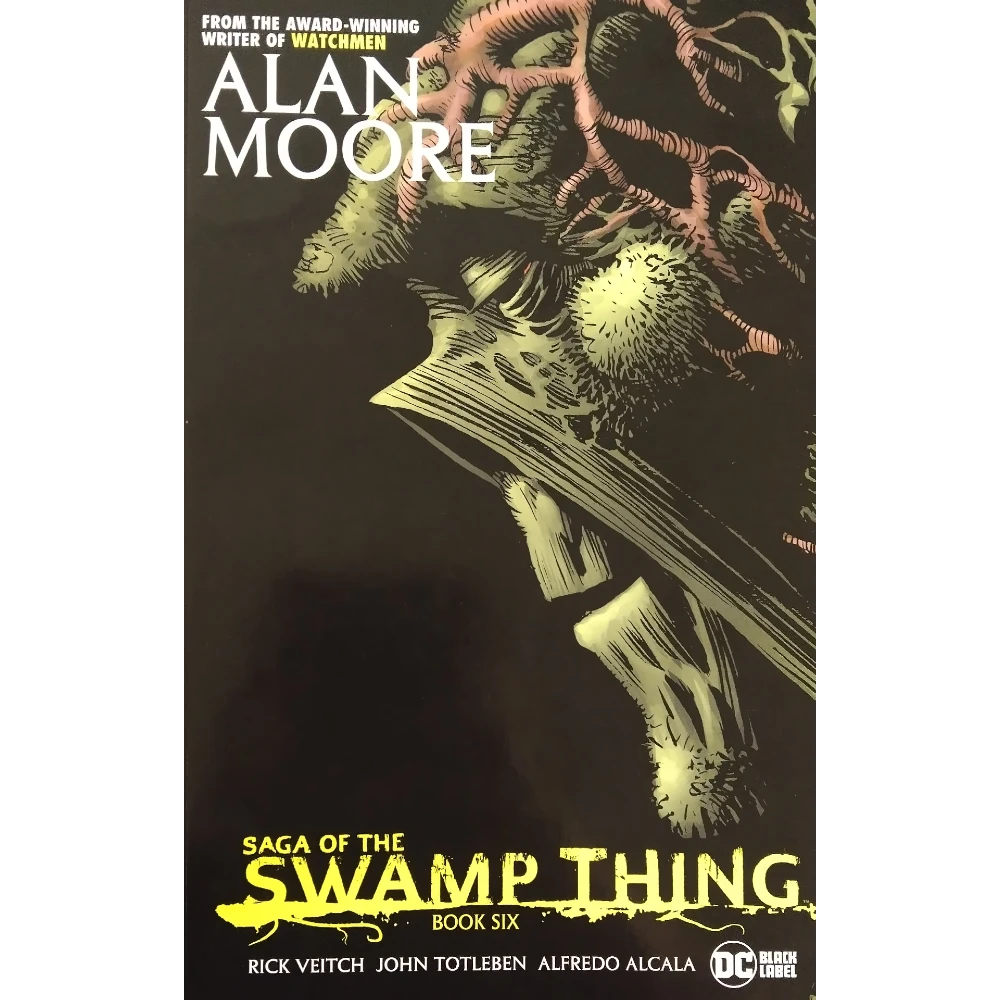
Random Reviews: Saga of the Swamp Thing (Book Six)
These issues draw Alan Moore's run to a near-perfect close that neatly cements an enduring legacy
—by Nathan on November 21, 2026—
It's like the old saying goes:
All Swamp Things must come to an end.
Alan Moore's seminal run on this sophisticated horror title may be the first time in quite a while that I sat down and read a writer's run on a title start to finish in a (fairly) consistent manner. And when I say "run," I mean an author's dedicated time on a book, crafting a narrative from start to finish. So I'm not counting, for example, James Hudnall's contributions to Strikeforce: Morituri or a limited series like Jack Kirby's Devil Dinosaur. I'm talking the same level as Chris Claremont on X-Men, Frank Miller on Daredevil, or Robert Kirkman on Invincible. Meatier bibliographies.
Moore wrote 45 issues of Swamp Thing, and if you look at the smaller portions I've reviewed the last months, you'll see the total impact those three-and-a-half years had on the character. In only his second issue, Moore completely recontextualized Swamp Thing, tearing him out by the roots, replanting his purpose, pruning characters no longer needed. Swamp Thing was a growing garden in Moore's hands, displaying powers never before seen and latching onto aspects of his humanity (or lack thereof) never explored. These arcs eclipsed the scope of any Swamp Thing story which came before them.
In the wake of Moore's epic crossover arc with Crisis on Infinite Earths, not-Alec-Holland returned to Earth, finding his lady love Abby Holland née Arcane currently held prisoner in Gotham. Rushing to her rescue, Swampy became his most monstrous, turning the city into a literal jungle by tapping into his innate eldritch powers. People were helpless, the GCPD was helpless, even the city's Dark Knight defender was helpless.
But not everyone. A few folks turned to mogul Lex Luthor for liberation, and armed with his experience staring down metahumans (albeit, largely unsuccessfully), the LexCorp founder invented a weapon to disrupt Swamp Thing's connection with Earth. Unable to tap into his beautiful world, Swamp Thing's conscience was forced to flee…beyond Earth. "Swamp Thing in Space" may not have been the most obvious direction for Moore's final issues to take, but it's the arc which sees the final flowers blossom in the writer's garden.
Saga of the Swamp Thing (Book Six)
Writers: Alan Moore, Steve Bissette, John Totleben, and Rick Veitch
Pencilers: Rich Veitch and John Totleben
Inkers: Alfredo Alcala and John Totleben
Colorists: Adrienne Roy and Tatjana Wood
Letterers: John Costanza and Richard Bruning
Issues: Swamp Thing #57-64
Volume Publication Date: May 2014
Issue Publication Dates: February 1987-September 1987
Publisher: Vertigo (DC Comics imprint)
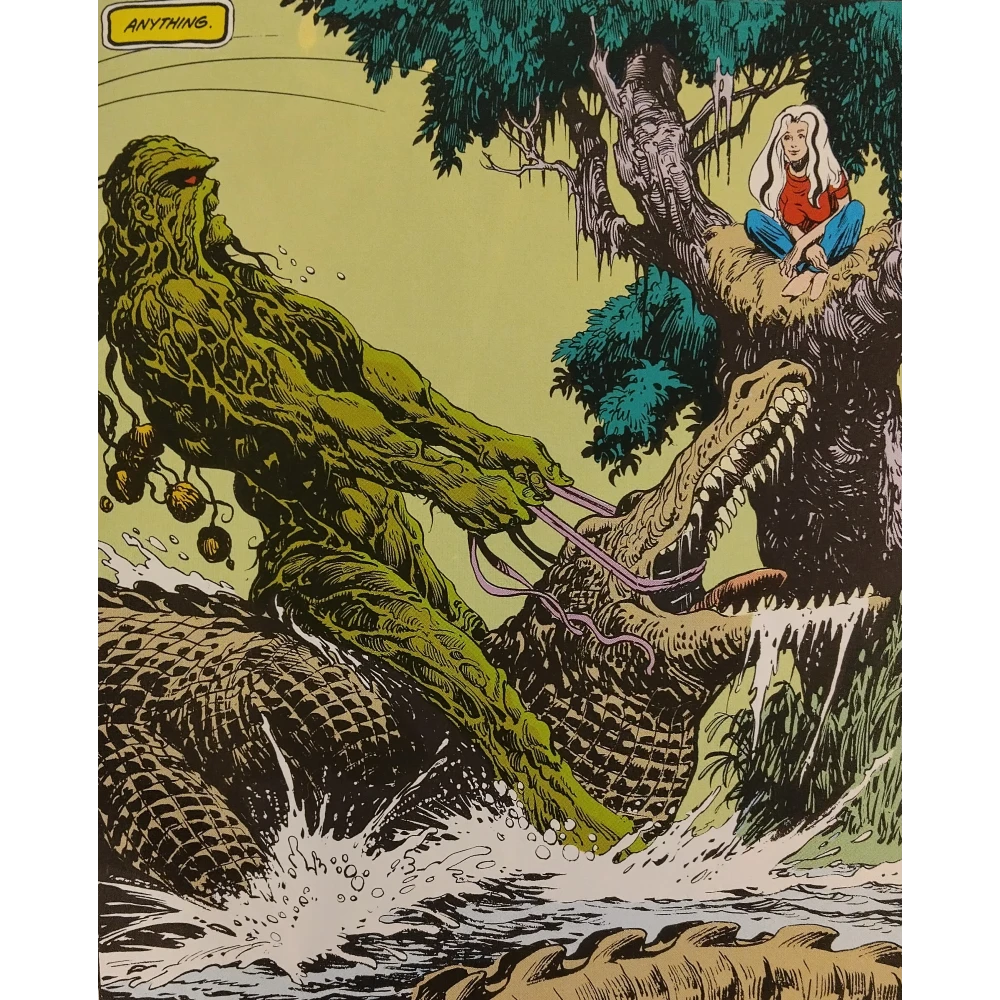
With some help from his artistic partners (including an issue guest-written by Rick Veitch, perhaps foreshadowing his own then-upcoming run on Swamp Thing), Moore brings his time writing DC's premiere muck monster (not counting Clayface) to a close. This volume provides as much a reflection on Moore's entire run on the title as it does a final arc, pulling pieces together which genuinely create closure.
My opening image spoils a major plot point: yes, Swamp Thing returns to Earth, despite Luthor's machinations. He finds a way back. What modern-day hero would endure his own spacefaring Odyssey and not return to the land he calls home? Keeping Swampy away from his beloved marshes and wife would be cruel. Instead, he's brought home, and Moore's final issue is the perfect send-off for the character, given all Swampy and Abby have been through, given all his growth. I'll throw it on a list of my favorite final issues in any series, along with Kurt Busiek and Alex Ross' Marvels and Mark Waid and Leinil Francis Yu's Superman: Birthright.
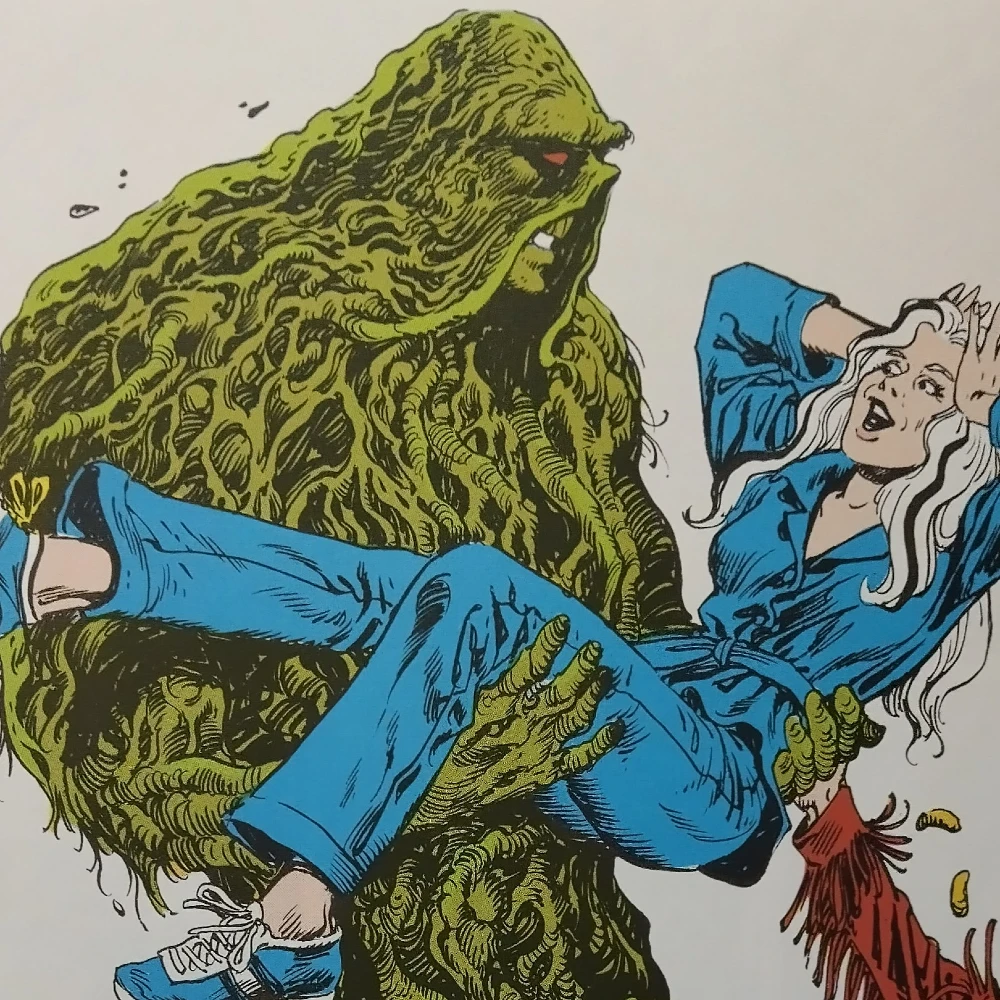
It's difficult calling this run "sweet" or even "nice." Moore's stories have been constructed on horror, of bodies bent, demons drifting by, monsters marching upon civil society. Veitch, Bissette, and Totlebon have not shied away from prying the human form in many a misshapen direction, showing monsters cleaving through the innocent, splaying out shadows and sludge to darken panels and pages. And yet Moore's final issue is a triumphant assertion of Swamp Thing's character, of a creature not quite a man who's sought after some facet of humanity and found it, in both the arms of the woman he loves and a purpose in upholding the Earth. You genuinely believe no one would ever need to write another Swamp Thing issue after this, Moore's finale feels that definitive.
The path reaching that last issue is just as compelling. Moore had closed Swampy's Gotham adventure by launching the character into space. I'd complained slightly that the fifth volume's closing issue, "My Blue Heaven," should have been this volume's opener. Having now read this collection, I stand by that assertion. Even in terms of art alone, the "Sci-fi Swamp Thing" issues lend themselves a uniqueness not seen in past installments and deserve to be read together–Adrienne Roy and Tatjana Wood supply swathes of color (heavy blues, reds, and greens) not utilized in as closely-knit patches previously. Each planet Swampy visits–from Rann, to J586, to an ancient colossus large enough to be a celestial body–feels distinct, and color makes all the difference in some cases.
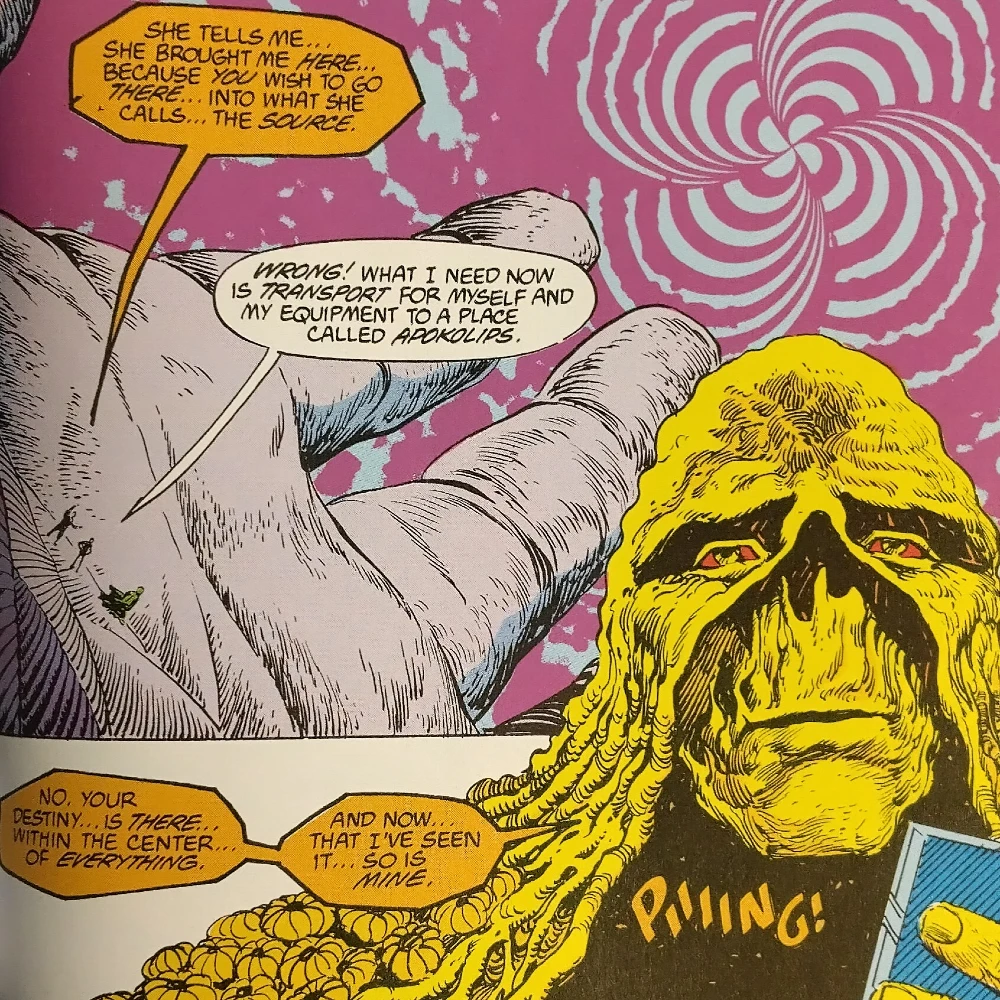
Some reviews I've read ding these issues a bit for the move into science fiction territory, believing they don't feel as tonally appropriate to the series' horror status quo. I wasn't bothered. Moore genuinely swings for the fences with these issues, perhaps wanting to end his series with something grand and different than anything he did previously. On a personal level, I felt fulfilled by these issues, primarily because Moore takes the parable-esque storytelling device he used so often on the rest of the series and transplants it to other planets.
Instead of werewolves standing in for women or a radioactive man showcasing the effects of toxic waste, Moore allows aliens and machines to convey his lessons. A two-issue arc on the planet Rann, where the heroic Adam Strange lives (some of the time) with wife Alanna, touches on not only ecological devastation but democratic intrigue and the politics of biological birth. Take your pick of the ideas presented here: Rann's "alliance" with the Hawkpeople of Thanagar a stand-in for tensions between real countries? Alanna's pregnancy, the first for the planet in years, a commentary on sterilization? Rann's dwindling resources a nod to our own grappling with famine?
(though that one's more of a gimme: "Here too? It's like Africa…" Adam mutters at one point, killing any subtlety with words rather than ray guns)
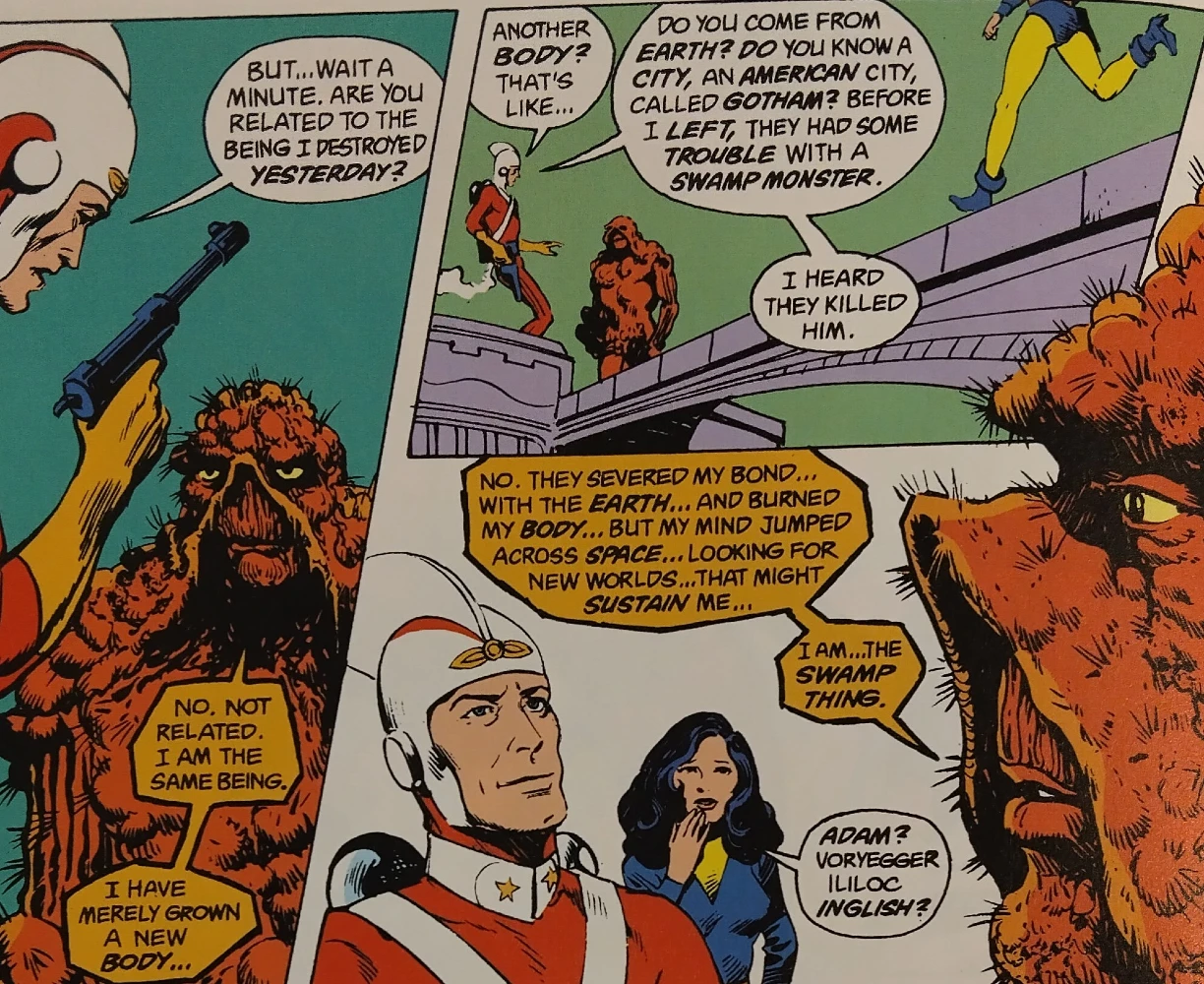
Deep in space, away from an Earth that fears him, Swamp Thing is given ample opportunity to flourish in ways not yet explored. On Rann, he uses his abilities to sew life rather than violence. On J586, he gives that planet's Green Lantern much-needed companionship. I'm not certain if this was Moore's intention, but Swampy feels, at times, most like a hero in some of these issues–perhaps atoning for some of his actions taken in Gotham–even though he's behaved heroically on Earth. Or maybe it's because, out here in the far reaches of space among various extraterrestrial lifeforms, it's Swamp Thing who winds up appearing the most human, in nature at least, or even just to the reader, likely more able to identify with the Earth-originating protagonist rather than some of the extraterrestrial characters.
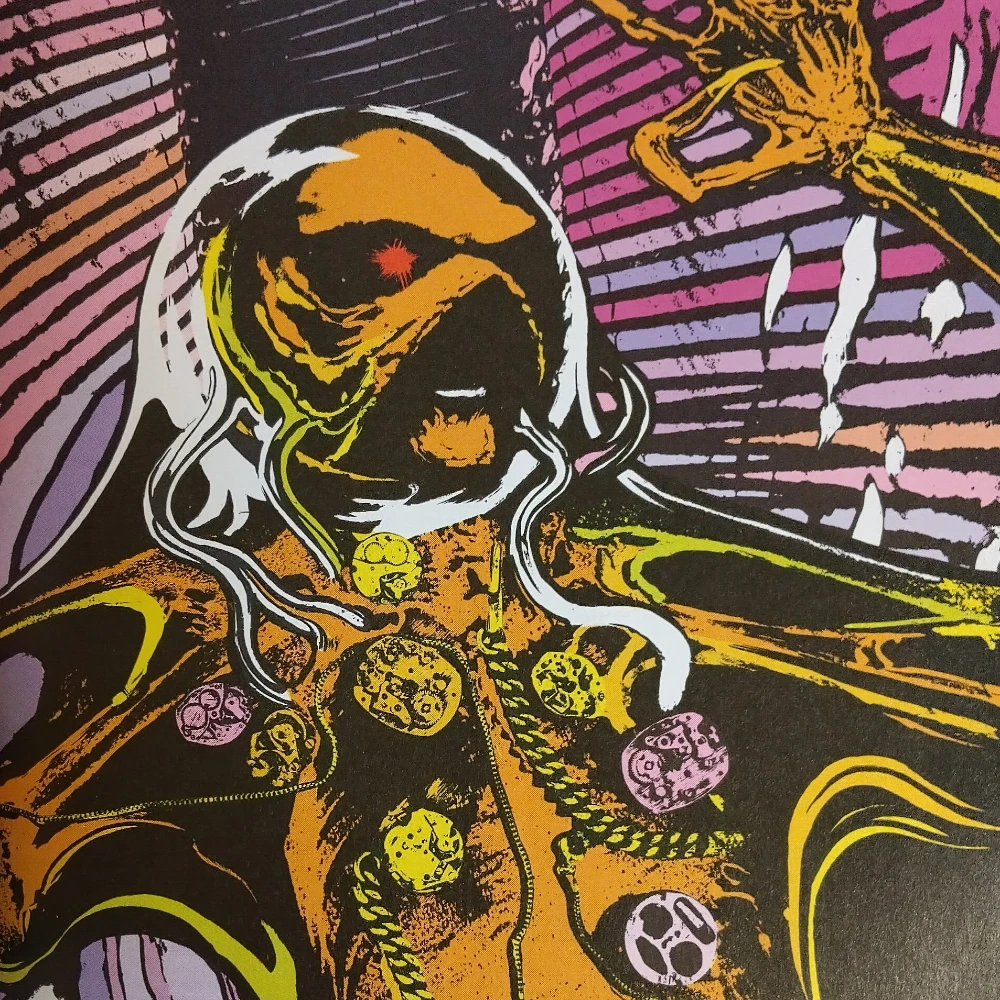
As in his earthbound installments, Moore deftly intertwines horror and humanity. The planet J586 is a lovely world to live, populated by living plant-based organisms whose existence descends into chaos when Swampy's conscience invades and attempts to control its fauna...namely, those living plant-based organisms. Like in the Gotham arc, Swamp Thing is presented as the aggressor, but this is a far less intentional showing. He's more like a disease spreading across the planet, upending the regular rhythms of life and exposing the planet's underlying fragility. In a previous issue, Swamp Thing's conscience is usurped and exploited for resources by a sentient spaceship, John Totleben's art taking on a uniquely abstract portrayal of the vicious takeover, as if Moore intentionally downplayed the brutality of how Swampy is stripped of himself and left the painful particulars to the reader's imagination.
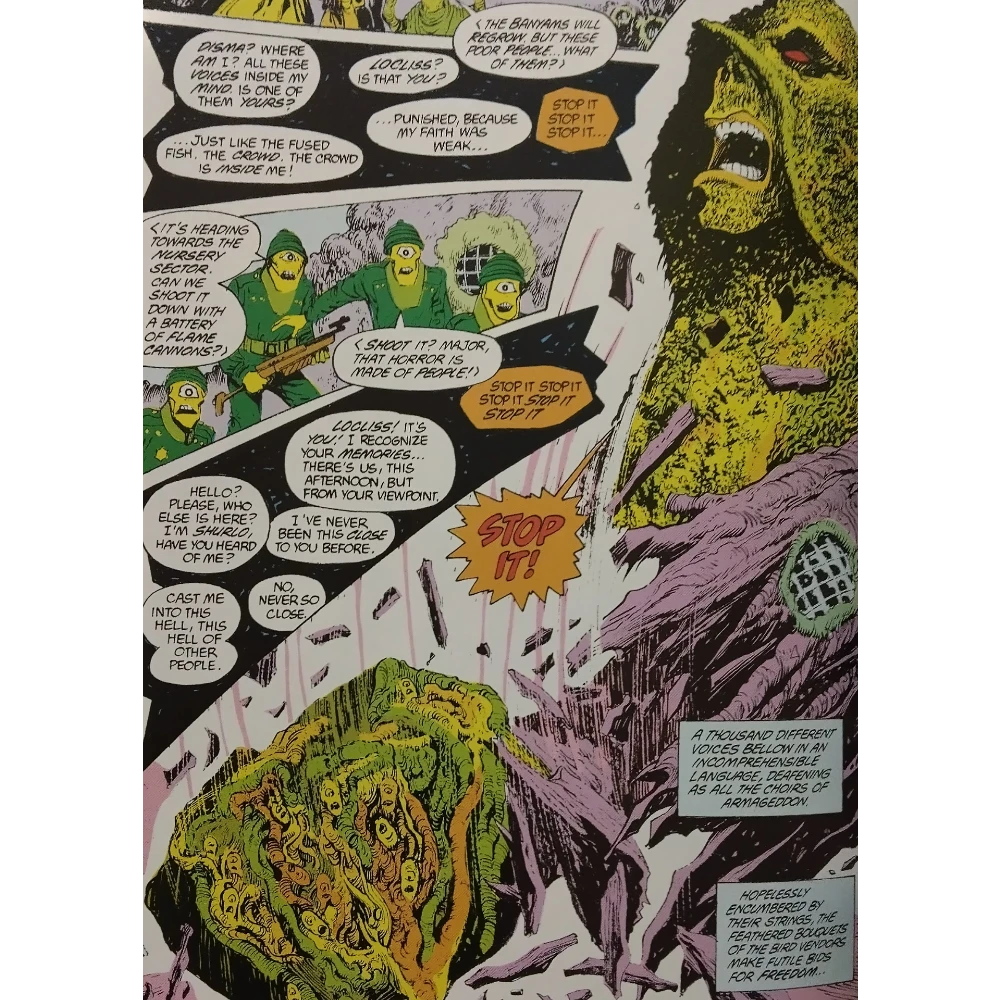
Again, these are all parables, nods, more or less, to the realities folks on Earth face on a regular basis, relatable aspects of reality shown through a shimmering lens of sci-fi fantasy. Hunger, exploitation, hysteria. The fear of being separate and alone, and the fear of being known. The fear of knowing and of not knowing. All surge through Swamp Thing and the aliens he encounters. Whereas several of Moore's earlier issues tapped into uniquely American horror–the U.S.'s dealings with toxic waste, racism, poor treatment of women–this space saga stretches beyond borders. As Swamp Thing's experiences broaden, so do those affected by the pains he ponders, leading to a growing sense of purpose upon arriving home.
That Swamp Thing is, largely, presented as a incorporeal form only stretches Moore's capacity for his and his artists' imaginations. Swampy makes bodies out of plant-people, foreign wildlife, wires, widening his capabilities beyond what they've been on Earth. Our artists seem to take satisfaction in seeing how they can craft a recognizable Swamp Thing from orange flora on Rann, yellow growth sprouting from an alien colossus, or a series of fibrous wires Swampy's conscience becomes hopefully entangled in for a time. All of Swamp Thing's forms are unique, changing each arc, just to keep us more engaged as he drifts ever closer to home.
On that homefront, Moore does what he can to pull other strands to a close as he wraps up his run. Largely, he's successful, drawing in a few supporting characters utilized decently to give them a few final pages, just so they're allowed a proper send-off alongside Swamp Thing and Abby. Not every idea works the same–Moore crafts one issue through the lens of an antagonist whose fate I thought was sealed, bringing in a very, very early secondary "antagonist" even later in that issue who hasn't been seen for quite some time (even prior to his run). Perhaps he felt compelled to offer a final word on these folks as well? Their appearances feel a tad forced, as if Moore really wanted to wrap up all possible loose vines, his and others.
But where his stories and characters find genuine endings, Moore does a standout job. On the whole, I'd likely rank his Swamp Thing work higher than Watchmen and V for Vendetta. Both are great series, well-written and artistically brilliant, but as a narrative, Swamp Thing just shines. Planting a central character who is given more than ample opportunity to grow and develop beyond his initial conceit, watering with a small yet necessary cast allowed growth and change, bathing issues in the light of relatable allegories stabbing at deeper truths, and supplying rich art plumbing the depths of horror (nutritious!), Moore, Veitch, Bissette, and Totlebon let the series take root and spread, changing the landscape of comics forever. There are several ways to read the series–individual issues, volumes, a box set, a slipcase set to be released next year–DC keeping Swamp Thing "evergreen" all these years. Plenty of copies to go around, and I recommend that anyone looking for something fresh and ripe pick up and appreciate the entire run.