(Strand)om Stories: Excalibur Classic (vol. 1): The Sword is Drawn Review
These opening issues utilize grief as a springboard for connection in drawing British and mutant characters together
—by Nathan on November 14, 2026—
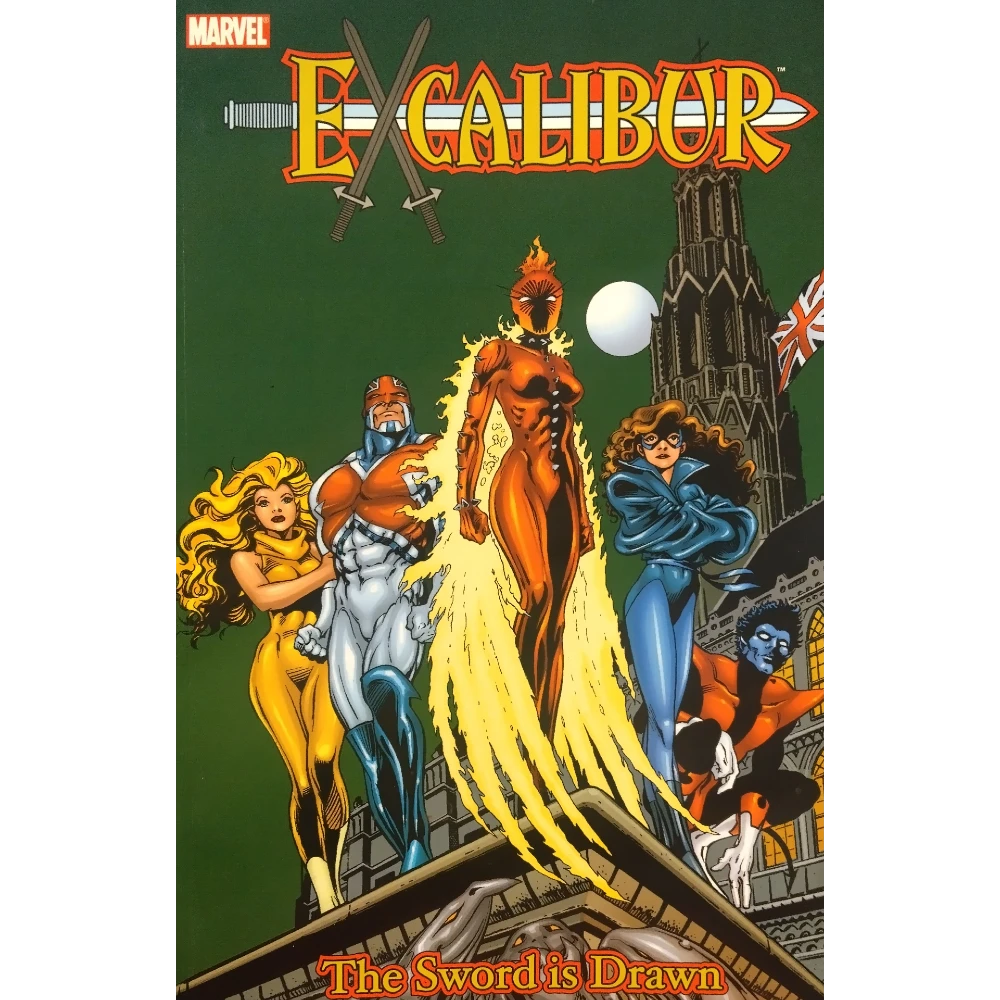
Within the last year, I have explored a certain facet of Marvel's universe dealing with characters who protect shores other than America's. With all these costumed guys and gals operating out of New York, you'd think the U.S. had a monopoly on superhuman adventurers.
Not quite, guv'nor.
Across the pond, there exists Brian Braddock, whose journeys haven't just been limited to his own Britain. Over a variety of issues, in Captain Britain's own series and elsewhere, several writers have worked to untangle just who this British Brian should be as a character. He's helped King Arthur, battled insane gamemaster Arcade, been killed and resurrected, and saved not only his universe but an entirely different reality from annihilation.
For some of this molding–perhaps the most significant pieces–we have Alan Moore to thank, though Jamie Delano did what he could to give his own spin on the mythos Moore made (it should be noted, however, Moore himself is somewhat indebted to Steven Parkhouse and David Thorpe's previous plotting). As is often his wont, Moore stripped Brian to his essentials (quite literally, and painfully!), building him up in power and confidence to face a multiversal threat.
But Brian's on solid ground now–he has his girlfriend Meggan, his sister Betsy. Things are stable, right?
Wrong. As this volume opens, Betsy has recently (supposedly) died, you see, along with several other X-Men (supposedly) in one those of big, big, big Uncanny X-Men crossover arcs Chris Claremont and other folks wrote and illustrated. We'll get to those someday, I promise. But, for now, we're wallowing in the aftermath, as Brian and others find themselves in the wake of the X-Men's (supposed) loss…and wondering where to go from here.
Excalibur Classic (vol. 1): The Sword is Drawn
Writer: Chris Claremont
Penciler: Alan Davis
Inkers: Paul Neary and Mark Farmer
Colorists: Glynis Oliver
Letterers: Tom Orzechowski and Lou Buhalis
Issues Collected: Excalibur Special Edition #1 and Excalibur #1-5
Volume Publication Date: November 2005
Issue Publication Dates: April 1988, October 1988-February 1989
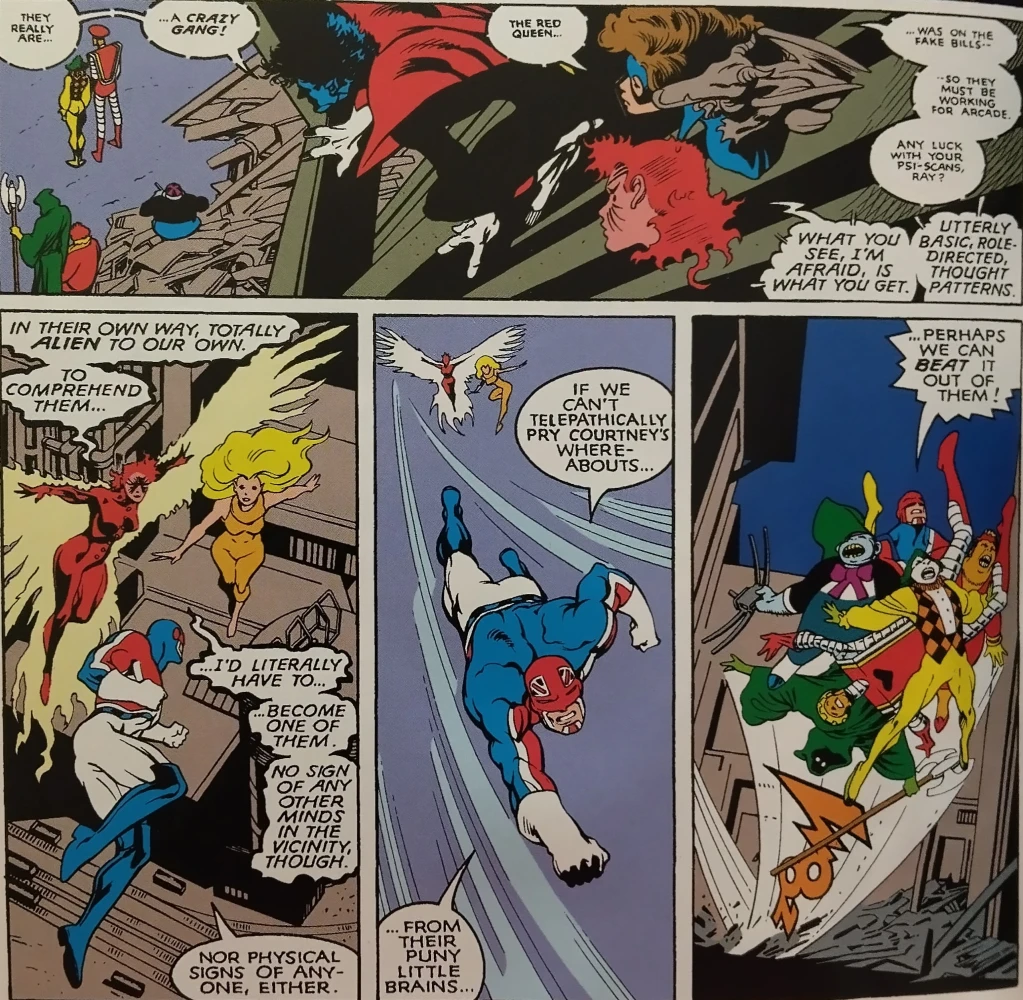
These first issues provide Brian with a full circle moment in that Claremont, who co-created the character with Herb Trimpe, returns to Captain Britain's life; in a parallel full circle moment, Claremont finds himself creating yet another mutant team for Marvel (though maybe "mutant adjacent" works better–at least, within the bounds of Marvel's "mutantdom"). Brian's life is much more complex than where Claremont originally left it, and Marvel's X-Men sector of their universe was becoming a fairly complicated corner as well. Claremont is thus in a position where he is relying on strands of history, both his own and others', to weave something new.
The aforementioned loss of the X-Men is what brings our heroes together, their seeming deaths giving birth to a new team of adventurers and, given time, friends. Paralleling his creation of the New Mutants, Claremont devotes an entire "special" issue to forming Excalibur, alongside Alan Davis, no stranger to Captain Britain's escapades. Though not a graphic novel in name, "The Sword is Drawn" visually feels akin to Marvel's classic line of high-end comics, Davis' recognizable character work done over with vibrant colors that give the issue a greater level of artistic sophistication.
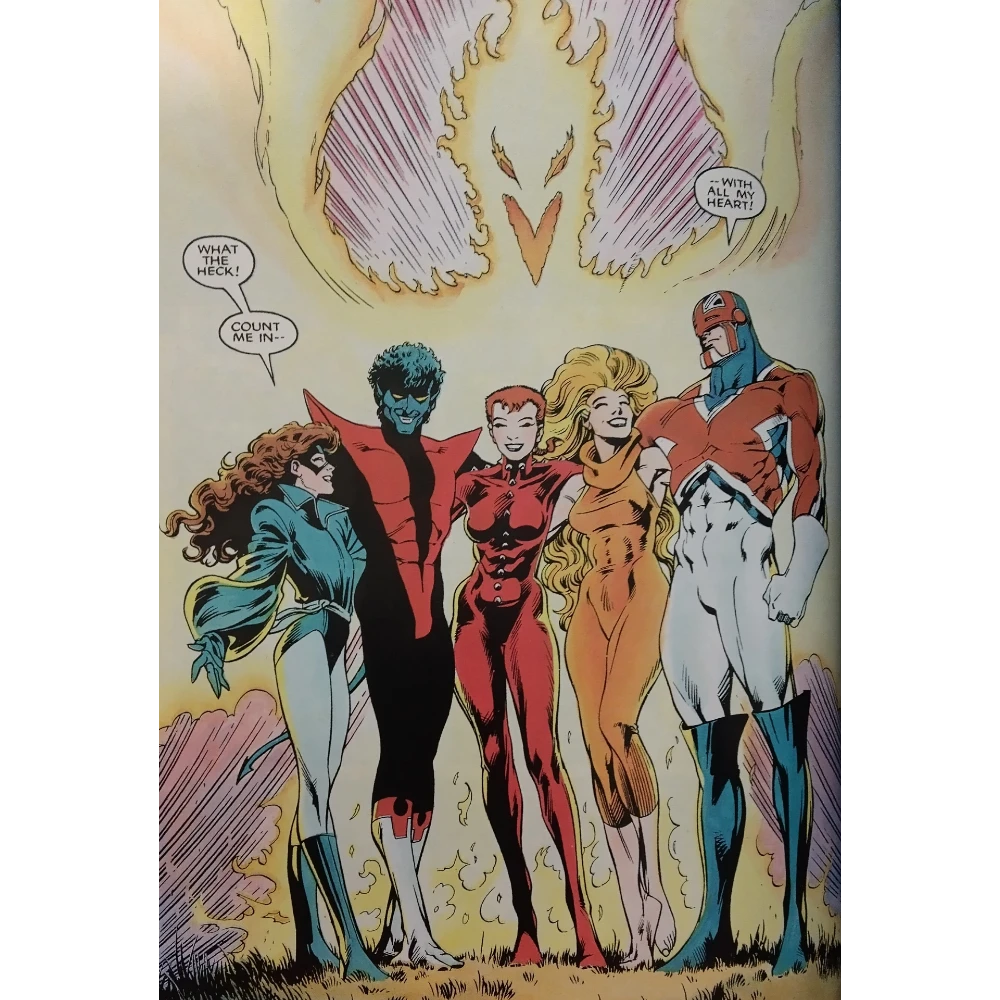
That special, and the subsequent first issues of Excalibur's ongoing series, pull together the central theme of Claremont's work: broken heroes, torn apart by grief, finding solace and healing through shared tragedy, regardless of difficulty. Claremont looks at these characters, finds their weak points, and temporarily exploits them to ratchet the drama. Captain Braddock, shredded by not only his sister Betsy's death during "Fall of the Mutants but wracked by a kind of PTSD from his own lethal experience at the hands of the Fury, turns to alcohol to numb himself. Nightcrawler intentionally places himself in dangerous situations, accused by Kitty Pryde of wanting to hurry and "catch up" to their fallen friends. Kitty herself dreams of the X-Men's return, waking to the horror of reality, while also dealing with her own temporary struggle to remain tangible.
You feel as if Claremont planned this from the start, as a way of not only continuing with the X-Men franchise after their seeming demise (they'd all return, naturally) but in finding a way to draw these characters together under a similar thematic umbrella. Unlike the original X-Men and New Mutants, who could bond over their shared adolescence and their growing awareness of the world's unfairness, or even the second generation X-Men, whose geographic diversity formed an underlying tether, the members of Excalibur seem a little mismatched. We've got a British superhero, a young Jewish woman, a blue dude from Germany, the British guy's alien girlfriend, and a woman from the future. Kitty, Rachel Summers, and Nightcrawler were X-Men, but Nightcrawler doesn't even know who Captain Britain is, and Brian and Meggan aren't mutants. This seems like a strange combination.
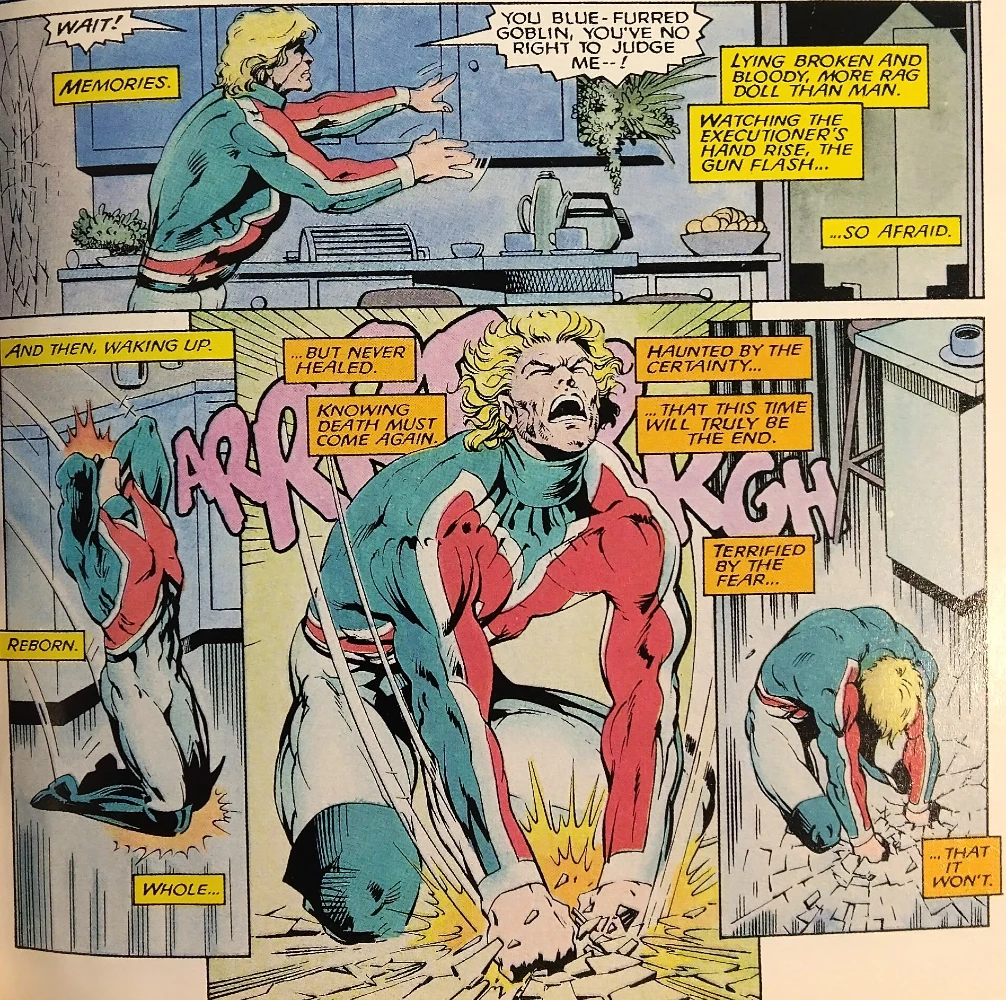
Which is why the unification through grief becomes all the more powerful. As wonderful as the X-Men and the New Mutants are, their mutual associations are originally obvious, a little surface level at first. For this particular team, a cursory connection won't do, Claremont choosing to instead rely on past history and character traits already put in place to help define the group as a whole, doing us the honor of digging a little deeper into our protagonists' hearts and heads to defend why such a team is necessary.
Our heroes, to form Excalibur, realize they each possess a brokenness that can only be healed in community with one another. Rachel throws out all of Brian's alcohol, much to his chagrin initially, but for his betterment overall; Nightcrawler and Meggan bond over their different physical features, seen as something of a barrier between Meggan and the stiff-lipped captain despite her desire to love him as much as she can; Rachel, ever the misfit from the future, and Kitty, mourning her X-Men friends, find solace in their friendship, something to ground them to the present time and place. The team realizes they can, as a unit, continue carrying the torch of Charles Xavier's dream following the seeming deaths of his pupils. They need each other, for to be separate at this moment would generate further loss and harm. Carrying on Xavier's dream may defend the idea of a new mutant team; striving together in shared grief even better defends this particular roster of heroes.
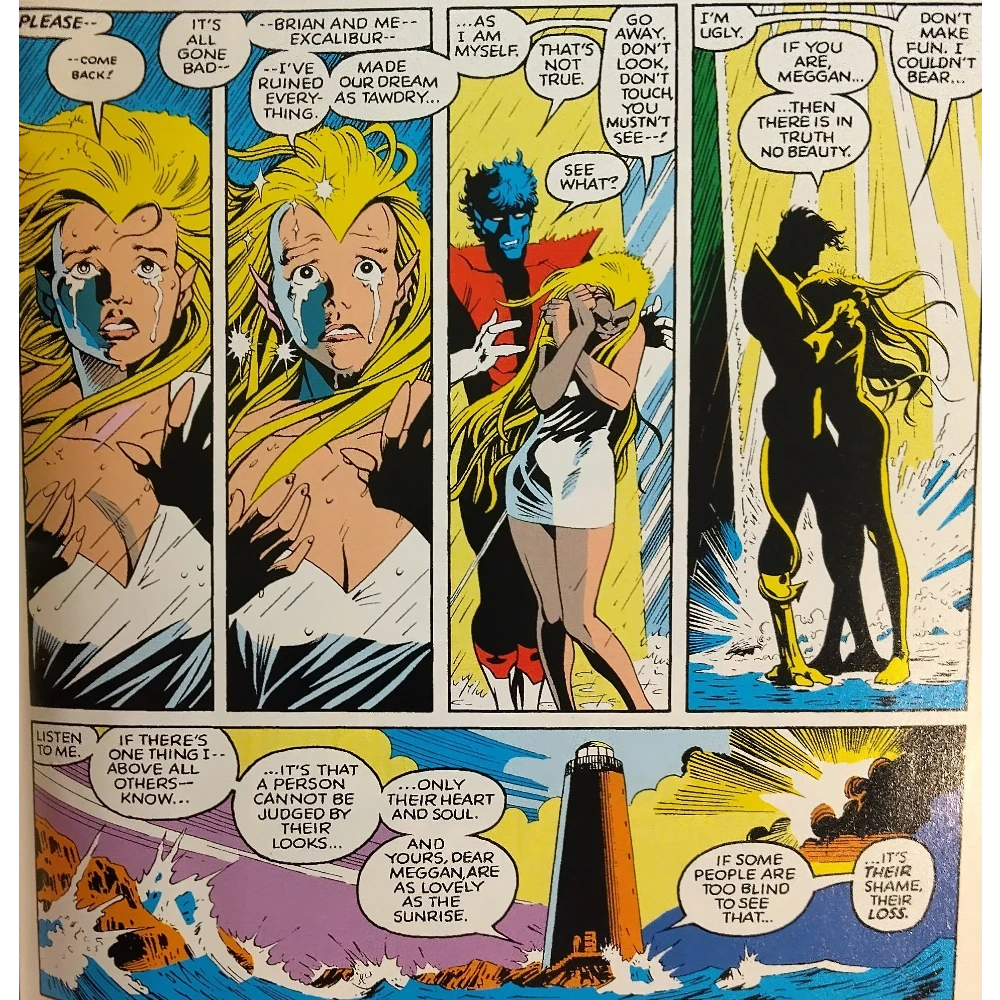
Naturally, such a community brings with it a host of challenges, which Claremont begins sorting through in these opening issues. Brian's lighthouse home becomes Exalibur's very original headquarters (and that's not sarcasm–it's a cool location), the team needing to cooperate with not just assigning space but determining mundane details such as morning routines. Though they bond over their physical appearances, Nightcrawler and Meggan form a relationship which hints at something deeper, indicating a plot thread to cause Brian no shortage of consternation (however, in fairness, Claremont juggles this idea with an old female friend who reappears in Captain Britain's life). Kitty at one point runs off to chase down Rachel, throwing her team into a bit of panic and trouble when they're forced to track her down next. The tensions between teammates are a necessary part of their formation, very human frictions which develop in any relationship (haven't we all been rubbed the wrong way by the family member who snores, the friend who won't text back, the coworker who eats chips too loudly?) and help maintain a certain groundedness to Excalibur's exploits.
In crafting those exploits, Claremont relies on more than just grief, connecting characters to other previously told tales which provide fodder for his plots. He draws in Technet, characters created by Alan Moore for his Captain Britain run, utilizes old Captain Britain foes Arcade and Vixen, connects a short arc to Rachel's former enslavement to Mojo, and features Brian's old ally Saturnyne. The plots and references feel organically connected to what has been developed before, though Claremont is a tad more engaged in drawing in Brian's mythos than the mutant side of things. Aside from an appearance by the Juggernaut, no other X-Men-related character pops up outside the Excalibur team. As a reader who's' tried catching on some of Captain Britain's history preceding this series, I enjoyed the nods, though a bit of balance from the X-side of the universe would have been appreciated. #MoreMutantRepresentation
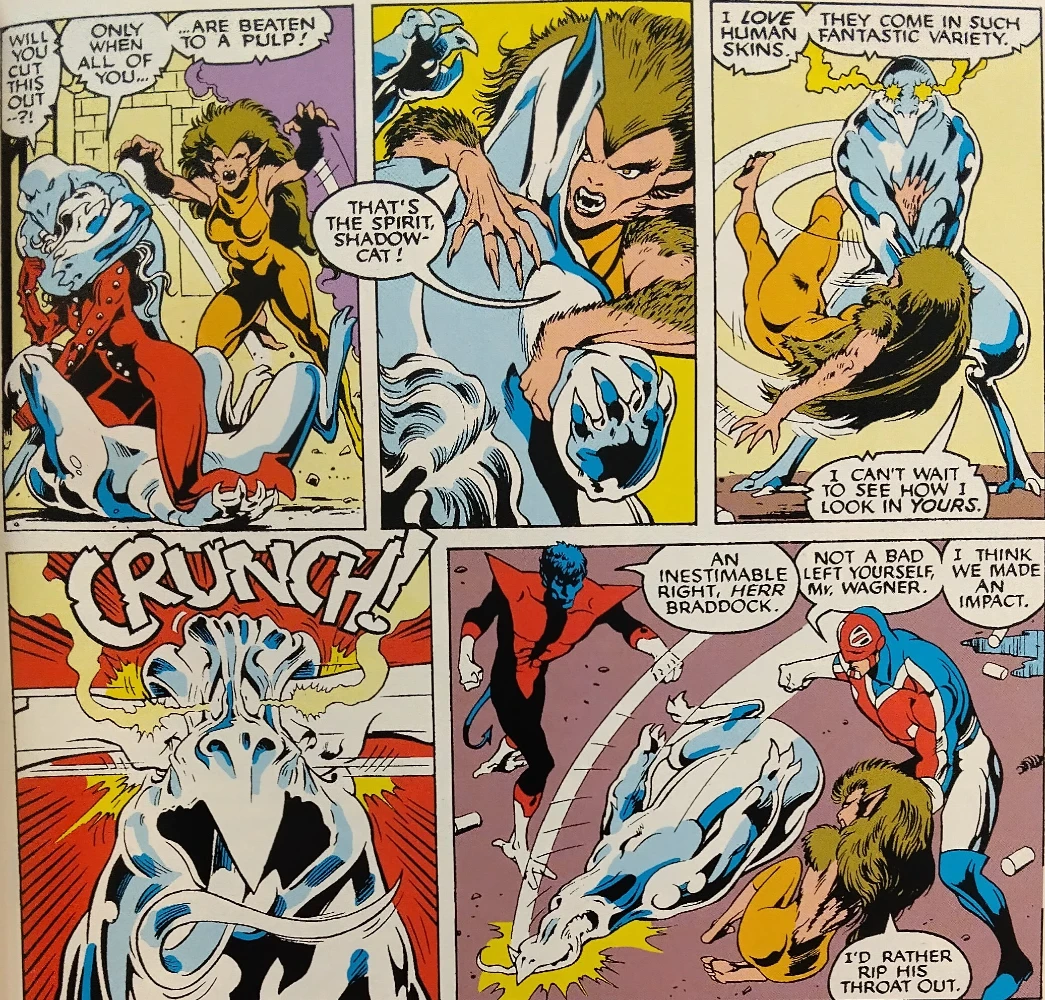
I picked up this volume as the cheapest way to engage with some of Excalibur's earliest issues (the inaugural Epic Collection and omnibus are both fairly pricey), so while we're only given a taste of the classic team, it's a good taste. Kinda like fish'n'chips rolled into comic book format. I'm mainly here for Captain Britain, as I've enjoyed the work done on him by Claremont, Parkhouse, Thorpe, Moore, and Delano and wanted to see where his adventures took him next. Like King Arthur drawing his ancient sword from the stone, I drew this book from my shelf. While I wasn't endowed with any noble privileges or crowns, I was granted a look at a classic writer returning to a character made more complicated in his absence, that development feeding into the tragedies and the responses to those tragedies which draw Brian and his allies into this seemingly disparate yet surprisingly attuned family of heroes.