(Strand)om Stories: X-Men: Days of Future Present Review
Some narrative confusion and complexity dampens the human heart central to this multi-part crossover
—by Nathan on August 9, 2026—
Franklin Richards, the son of the Fantastic Four's Reed Richards and Susan Storm, was one of the stars of the late 90s X-Men crossover titled "Onslaught." Featuring a psychic supervillain made from the dark thoughts and obsessions of both Charles "Professor X" Xavier and Erik "Magneto" Lensherr, Onslaught represented the biggest bad writers like Scott Lobdell and Mark Waid could cook up, the ultimate evil for a combined Marvel Universe to confront.
Okay, not the whole universe. This isn't Thanos or the Magus. More like a bunch of Avengers, those X-guys-and-gals, and the FF. But it was a lot of dudes! And a bunch of 'em died!
Or so folks were kinda led to think. More on that in the future.
Reading "Onslaught" cast my mind back to a different Franklin-centric comic I remembered reading years ago. As some recent posts have reflected on stories I read as a young pup, I wanted to continue that trend, using Franklin as the anchor point for this review. I'm not too shored up on my "Franklin Richards history" overall, other than knowing he's a really powerful mutant who's never been allowed to grow beyond teenage status, at least not yet. But, in a totally different reality created by Chris Claremont and John Byrne, fans were given a peek at fully-fledged adult Franklin Richards.
That was Earth-811, the universe presented in the classic "Days of Future Past," which saw Earth-616 X-heroes try and prevent a future where mutants were herded into prison camps. In that universe, Franklin was, seemingly, killed by Sentinels…and yet he's here, in the present Marvel timeline. We've got a mystery on our hands, but it's less a "Whodunnit?" and more a "Whoisit?"
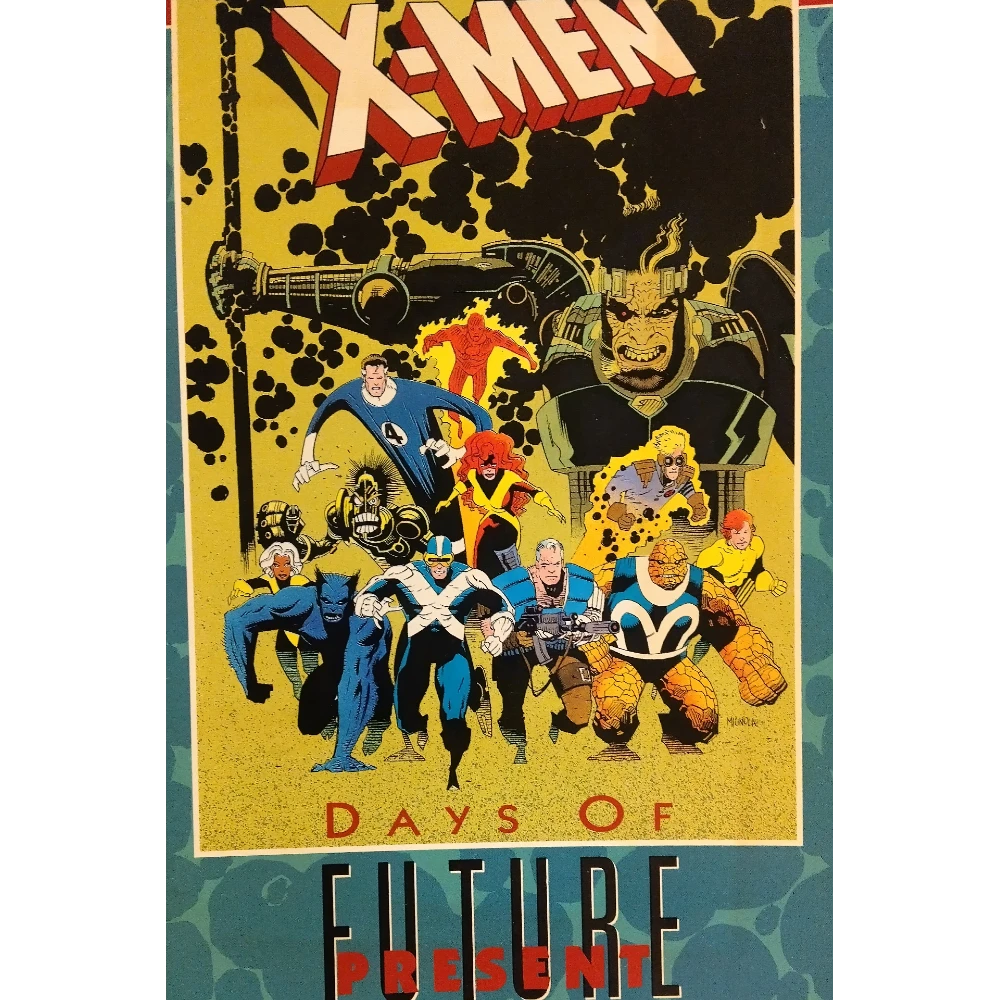
X-Men: Days of Future Present
Writers: Walt Simonson, Bob Harras, Louise Simonson, and Chris Claremont
Pencilers: Jackson Guice, Terry Shoemaker, Chris Wozniak, Jon Bogdanove, and Art Adams
Inkers: Geoff Isherwood, Scott Williams, Al Milgrom, Art Thibert, Harry Candelario, Dan Green, Art Adams, Steve Moncuse, and Bob Wiacek
Colorists: Richard Rasche and Brad Vancata
Letterers: Pat Brosseau, Joe Rosen, Kevin Cunningham, Tom Orzechowski, and Tomoko Saito
Issues Collected: Fantastic Four Annual #23, X-Factor Annual #5, New Mutants Annual #6, and X-Men Annual #14
Volume Publication Date: May 1991
Issue Publication Date: July 1990
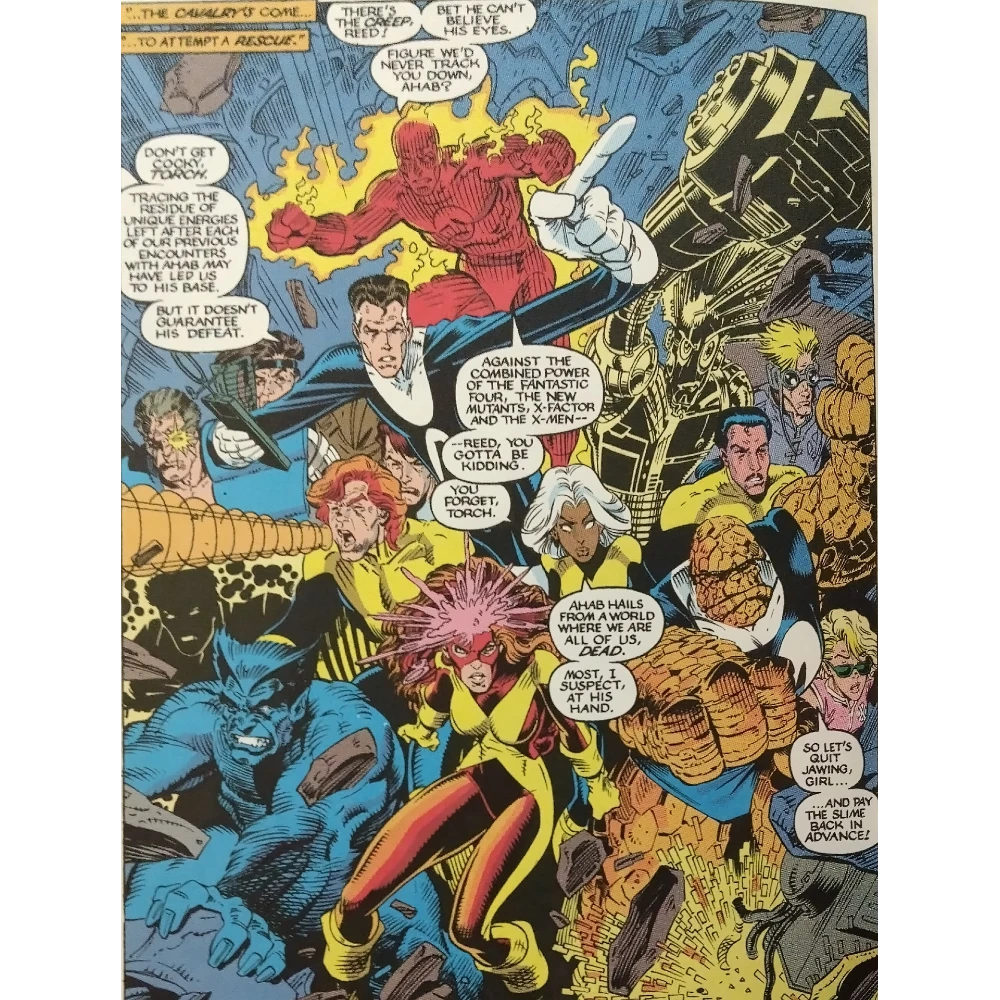
I love a good alternate future (or, heck, even a bad alternate future–which most of them usually are!). I love when writers can take a concept in a present continuity and project it, cleverly, onto some point in the future. The beauty is in the details. "Days of Future Past" is a classic story, but it also allowed Claremont and Byrne to show a world where Magneto was the wheelchair-bound leader of the X-Men, Colossus and Kitty Pryde were married, and Scott Summers and Jean Grey had a daughter. Those kinds of details draw the reader deeper into the tale's reality, make it a more solid place to exist. And when you can base that idea off a singular concept, it makes the narrative all the more straightforward. No unnecessary entanglement in all the timey-wimey particulars.
"Days of Future Present" provides us a wrinkle, in that regard. Where Claremont and Byrne sent Kitty Pryde into the past to prevent certain circumstances, our writers reintroduce Earth-811's Franklin Richards to the past as well, but with a more complex premise. Because our heroes aren't concerned with changing the present to impact the future; they're trying to stop folks from the future from encroaching on their present.
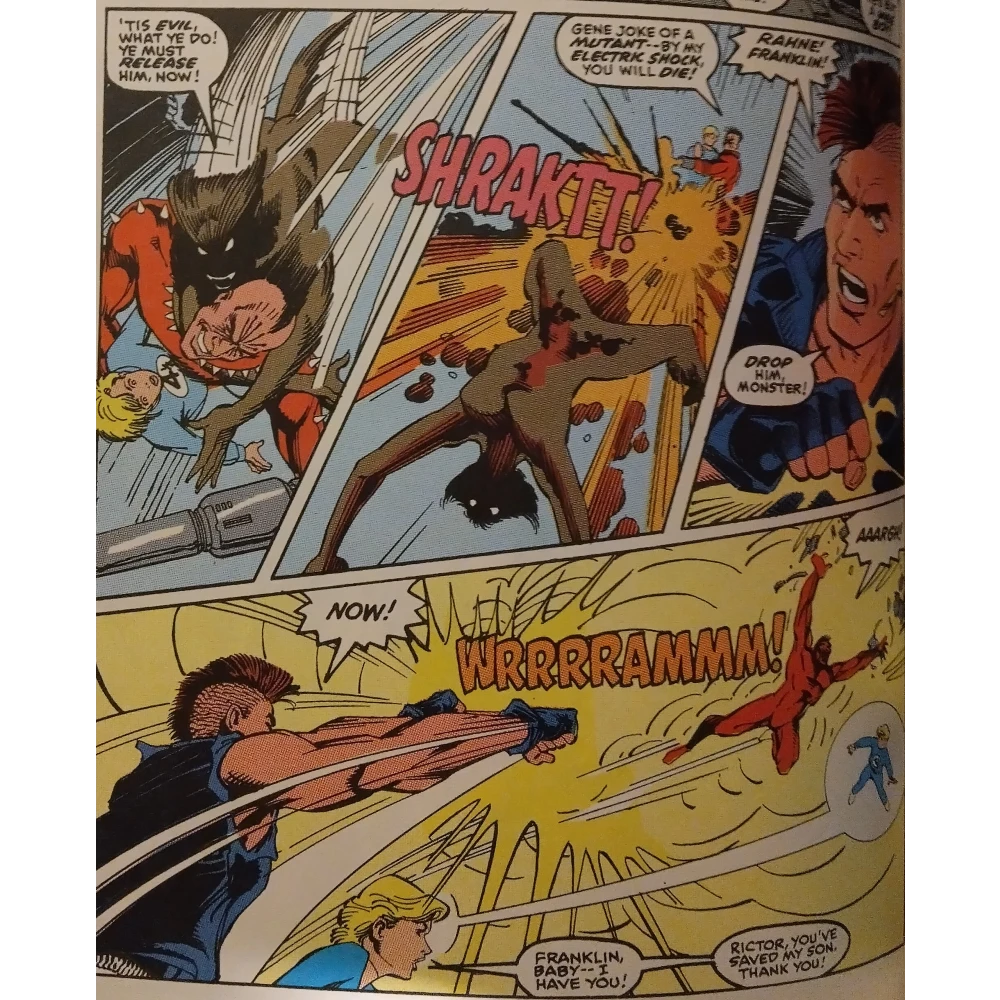
I can't tell you if I enjoyed this narrative when I first read it years ago, but this most recent readthrough didn't cement it as a fan favorite. It's the problem with sequels: you are trying to follow up one of the most impactful X-Men stories ever written by expanding, ever so slightly, on the universe generated there. Additionally, those timey-wimey components provide complications which some of this story attempts to justify, struggling to do so.
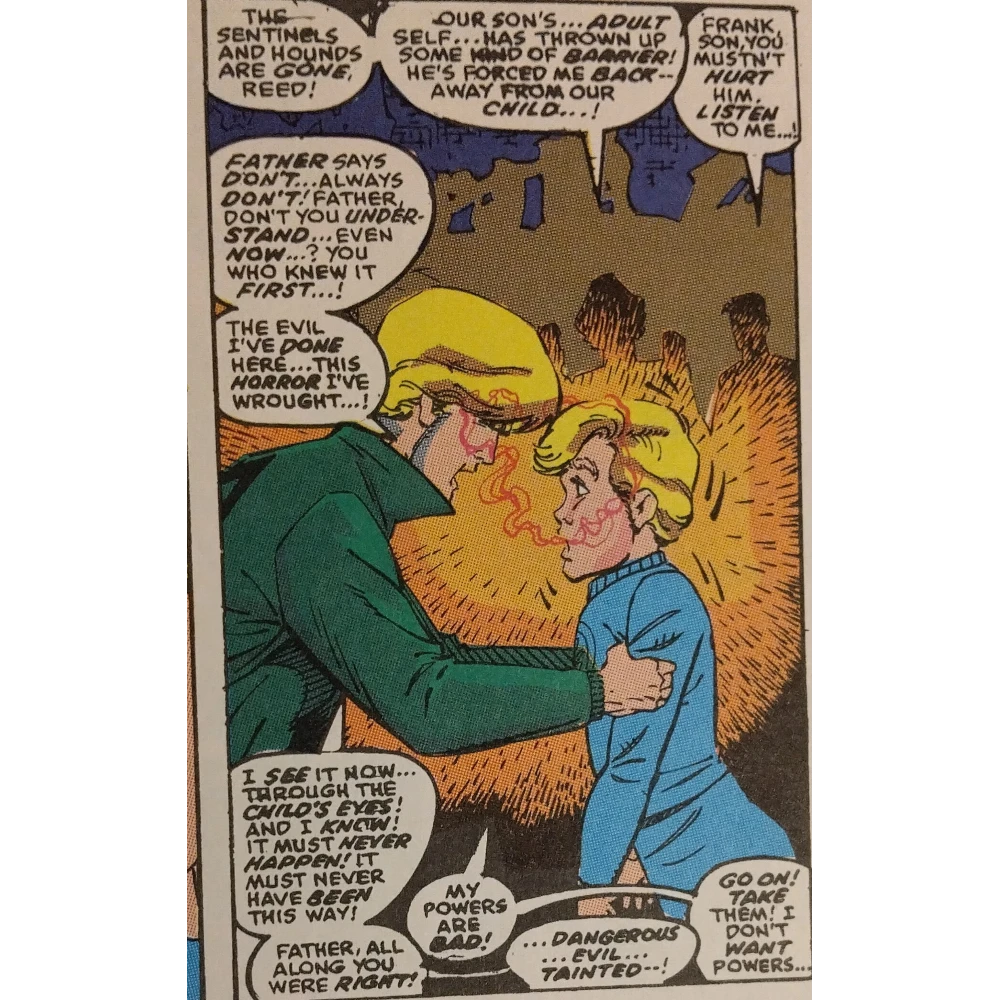
The older Franklin, having seemingly returned from the dead (murdered by Sentinels in a flashback in an earlier Uncanny X-Men issue), appears in the then-present, attempting to reconfigure elements of Earth-616 to those of his distorted memory. His attempts at reconciliation, founded on temperamental emotions, are resisted by his fantastic family and their uncanny allies, who are trying to understand the young man and just, darn it, talk to him. A little family sit-down is all they want. Is that too much to ask?
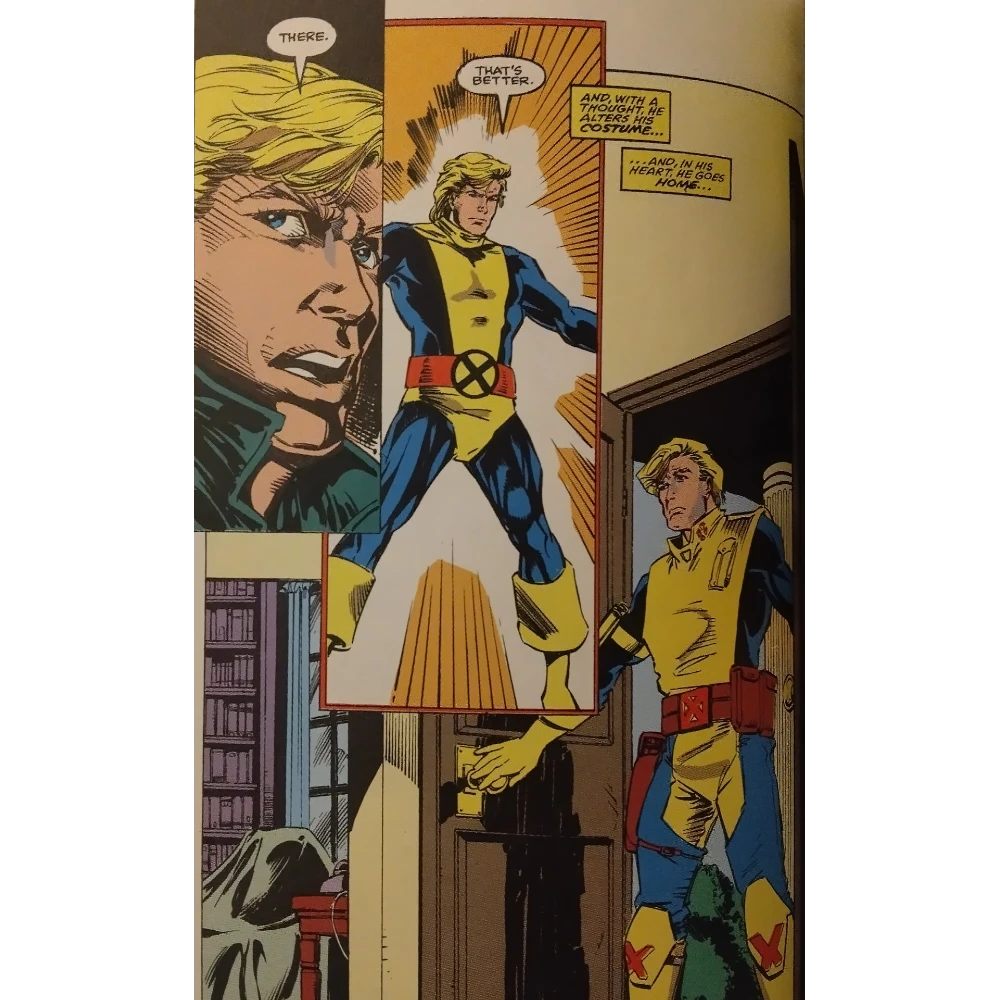
There is, at the center of this arc, an emotional core which works fairly well. Earth-811 Franklin is lost, scared, uncertain of this present world he's in, and given his abilities, believes peace can be found by sculpting it to his image. He recreates the Baxter Building, redesigns his family, sets himself up as the leader of a New Mutants-esque group of youthful heroes. Yet his struggle for peace within his own identity creates fractures in the way things are, causing conflict. Just because your teenage son wants to borrow reality's keys, it doesn't mean you give them to him if you know he's gonna crash. And yet you should help somehow. For all his power, Franklin's just lost.
Our writers all recognize the potential interplay "Days of Future Past" generated by drawing Franklin into the mutant side of the Marvel Universe. Like a 90s X-Men/Avengers crossover I recently reviewed, the next generation provides that tether; instead of Quicksilver and Crystal's daughter Luna serving as the bridge, our future versions of Franklin and Rachel Summers provide that connection. Rachel, though more at home in the 616 reality (one of the crossover's best, quieter scenes sees her partake in a hamburger and fries, superheroics momentarily set aside), is nevertheless a stranger; this allows her to sympathize with Franklin, find companionship in their shared displacement from a different reality.
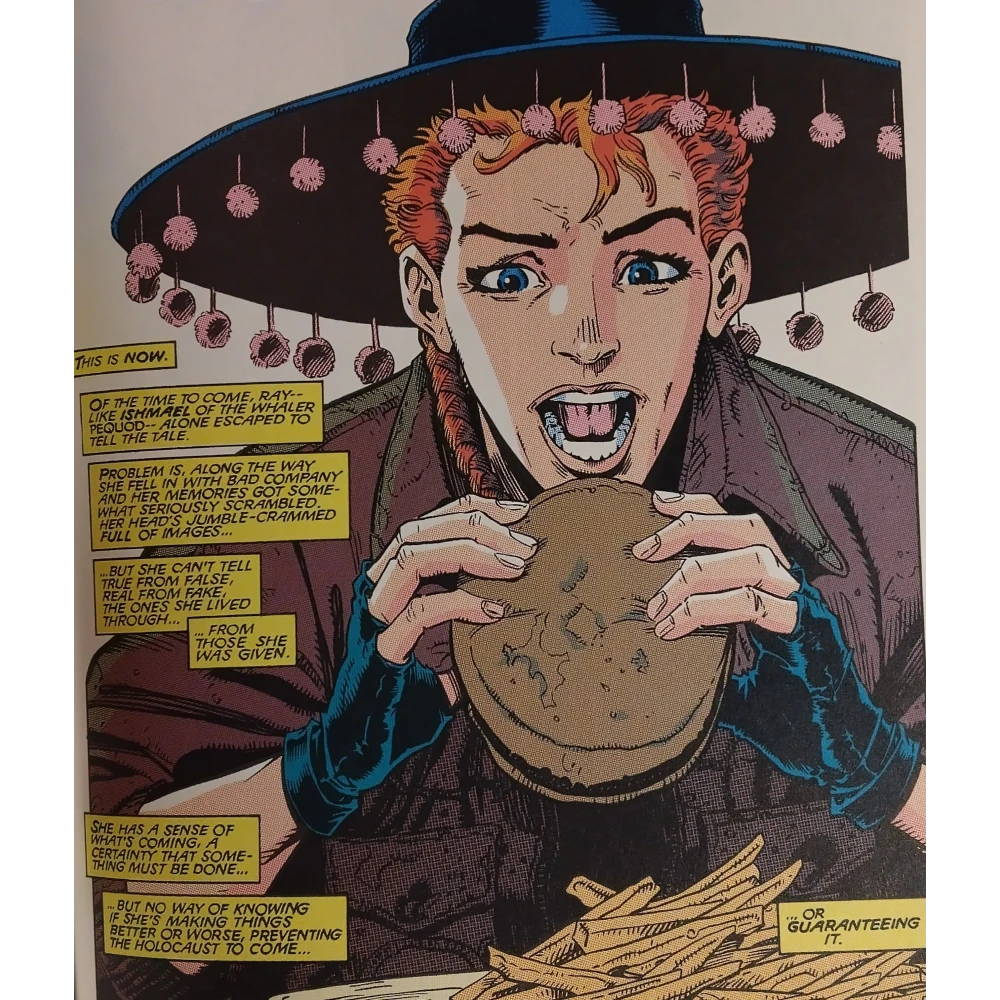
Aside from Franklin, Rachel serves as the arc's most compelling character. At this particular time, Jean and Scott are unaware she's their daughter from Franklin's future, a future where they never had their son Nathan (who appears in the present reality as an infant and in his alt future form as Cable). Revelations surrounding Rachel's backstory cause her a similar identity dysfunction to Franklin, especially as she's momentarily coaxed back into her "Days of Future Past" occupation as a mutant-hunting "hound." Strife abounds for both of our youthful heroes as the FF and X-Men try to wrap their heads around just what the heck is going on with these time traveling teenagers.
Which is where this particular arc begins to lose me.
I'm not gonna claim to comprehend many of the rules of time travel, but I feel I understand a few basics, and this arc toys with those basics a bit. It tosses around some chronological dissonance which renders a chunk of the plot confusing instead of compelling. Or maybe our writers are brilliant, and I just don't understand time travel enough. One moment in particular seems to create a "grandfather paradox," and though an argument can be made against it after a fashion, some dialogue seems to confirm what is actually happening. The resulting complication transforms a potentially compelling sequence into a confusing one, wrenching my imagination to focus on the seemingly haphazard particulars rather than the developing drama.
Hindsight also winds up becoming an unintended enemy. The blame cannot be put squarely on the writers for this, but knowing the last few decades of comics certainly creates a few blips. Cable for one, had not yet been revealed as Scott and Jean's son from the future, meaning a particular form of conflict Rachel endures which could also apply to him in this arc is negated. Additionally, nowhere can Cable express any bewilderment at seeing his infant self, and one character notes Cable's similarities to villain Ahab (something the grim hunter himself later teases as well), a hypothesis which goes absolutely nowhere. It seems a cruel facet to complain about, given the writers' obliviousness to future developments, but it does lend the arc a certain awkwardness in hindsight.
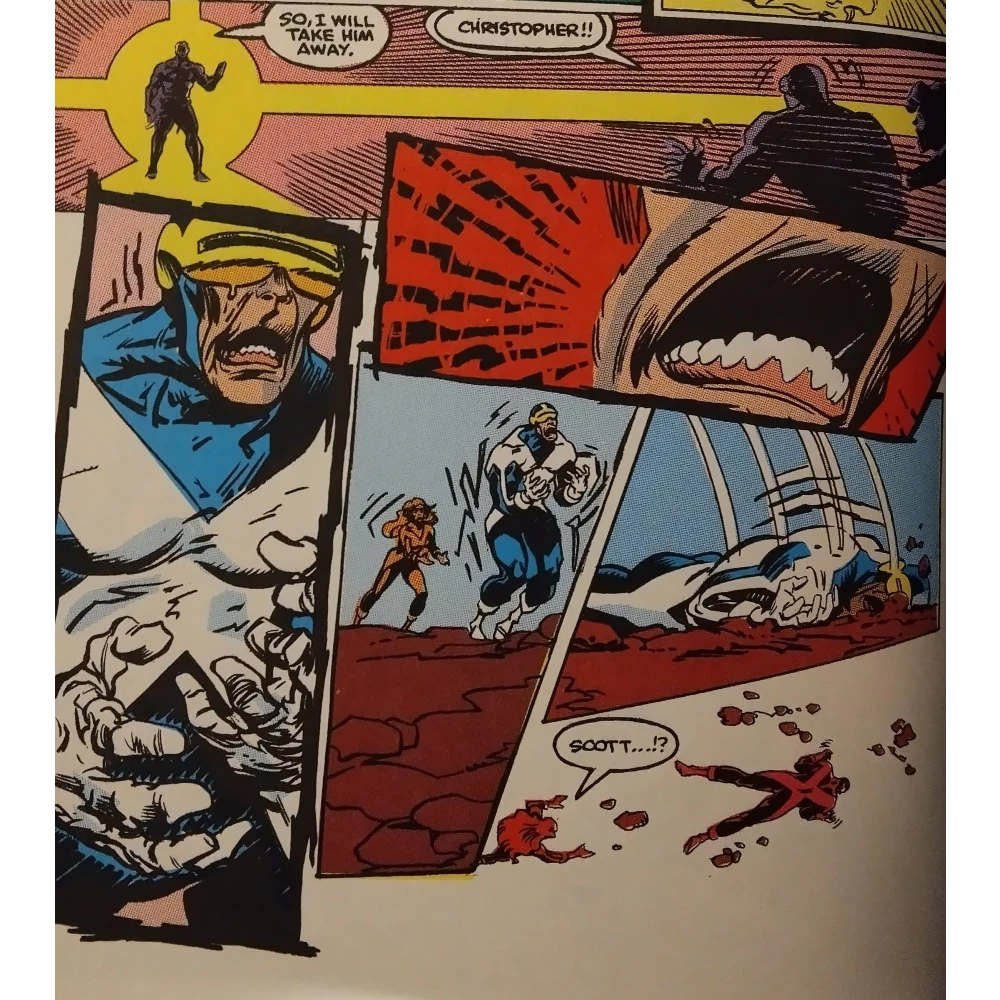
Where awkwardness cannot be found is in the art. These annuals bridge the era between 80s sophistication and 90s grimdarkness, nestling in a comfortable middle. Art Adams transforms two heroes temporarily into Ahab's "hounds," and darn it if they don't look cool (creating, maybe, the one lingering image in my mind from this story). Jon Bogdanove ends the X-Factor annual with a fantastically detailed Cyclops collapsing after (infant) Nathan is kidnapped, his face looking haggard. Genuine artistic moments such as these help move along what can occasionally be a confusing plot.
As I said, there is a character-driven core to these annuals, found in the lost and listless Franklin Richards, a young man with phenomenal power trying to set the world right by how he sees it, even at the expense of others. How our writers close his particular narrative is actually one of the arc's finer moments, providing a decent little twist to make sense of some of the pieces. But those fuzzy time travel rules still remain, mussing parts of the narrative with some additional, unnecessary confusion. The time travel itself, establishing this crossover as a sequel to an X-Men classic, is an absolute necessity, drawing the FF and the X-Men deeper into conflict with Franklin. But when our writers try to get a little clever, they wind up stumbling over the chronological chords they weave, not the kind of quantum entanglement you're looking for.