(Strand)om Stories: Captain America and The Falcon: Madbomb Review
Characterization is sidelined in an epic arc which thoughtfully considers American morality
—by Nathan on July 3, 2026—
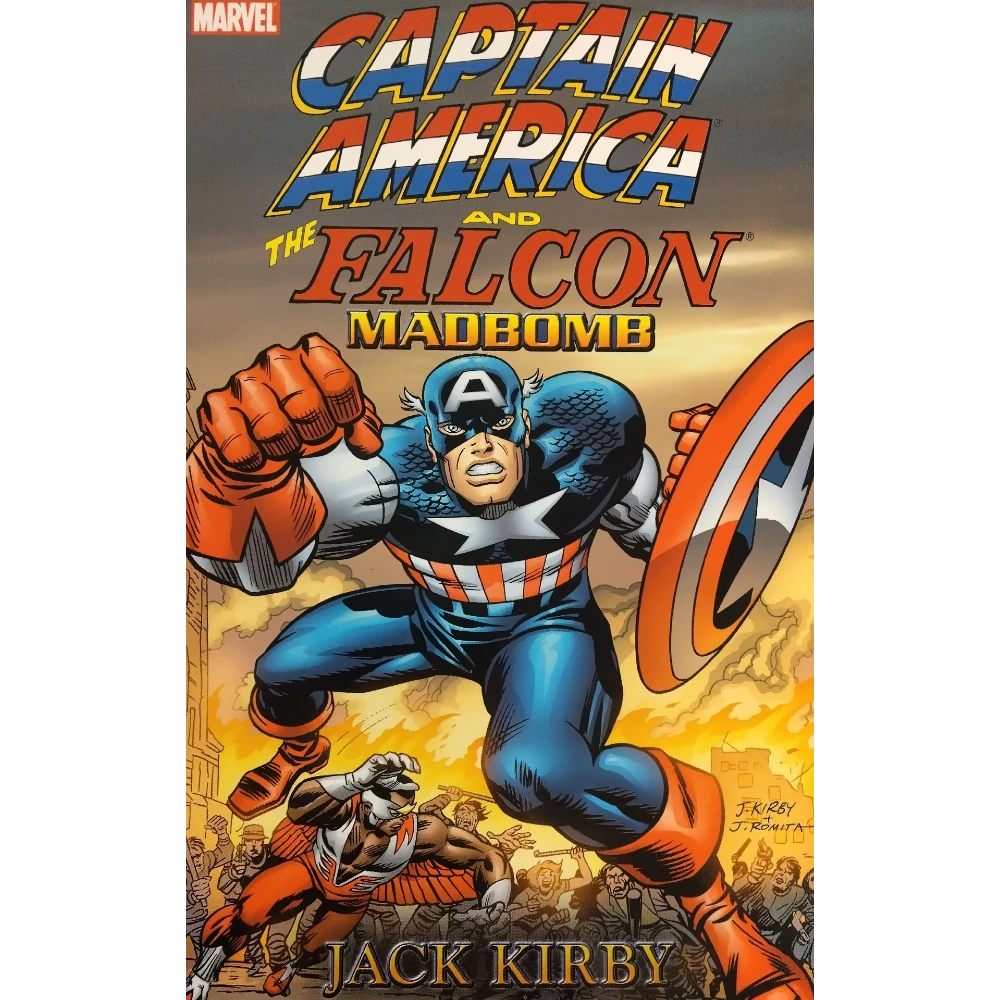
For this blog, the Independence Day holiday has become an opportunity for me to examine stories starring that stalwart protector of truth, justice, and the American way (whatever that definition may be): Steve Rogers, the Man with the Plan himself, Captain America. Though I took a hiatus between a few installments (mainly because the star-spangled superhero's Marvel Knights series was such a poor showing of the good captain's character), I've spent the last two years celebrating the 4th of July by reveling in Cap comics (good Cap comics!)…though I've generally posted them on the 3rd to account for the busyness of the holiday.
This year is no different, though there is a twist.
2026 marks the nation's 250th birthday, its semiquincentennial, if we're being linguistically technical. 50 years ago, for America's bicentennial, the nation celebrated in various ways, from plays, to rock and country concerts, parades, a covered wagon train, and comics. Yes, that time-tested tradition of sophisticated literary fiction jumped on the bandwagon–or, perhaps, the covered wagon–to help light all those candles on America's big ole birthday cake (figuratively speaking, of course). The likes of Spider-Man and Superman helped ring in the bicentennial, and Marvel even produced a special bicentennial wall calendar.
Not to be left out, a super-soldier named after the nation joined the festivities. Under his co-creator Jack Kirby, having returned to Marvel after a stint at rival DC, Cap embarked on new adventures with his partner the Falcon. I've picked up three trades collecting Kirby's run on the title, and I intend to review one of each during this three-day 4th of July weekend. First up, we've got an arc leading to Cap's 200th issue to kick off that 200th anniversary with a sinister plot involving the titular Madbomb, a creation some very vile villains intend to use to destroy the country on its biggest birthday bash thus far.
Captain America and the Falcon: Madbomb
Writer: Jack Kirby
Penciler: Jack Kirby
Inkers: Frank Giacoia and D. Bruce Berry
Colorists: Janice Cohen, Phil Rachelson, Michelle Wolfman, and Don Warfield
Letterers: John Costanza, Gaspar Saladino, and D. Bruce Berry
Issues Collected: Captain America #193-200
Volume Publication Date: February 2016
Issue Publication Dates: October 1975-May 1976
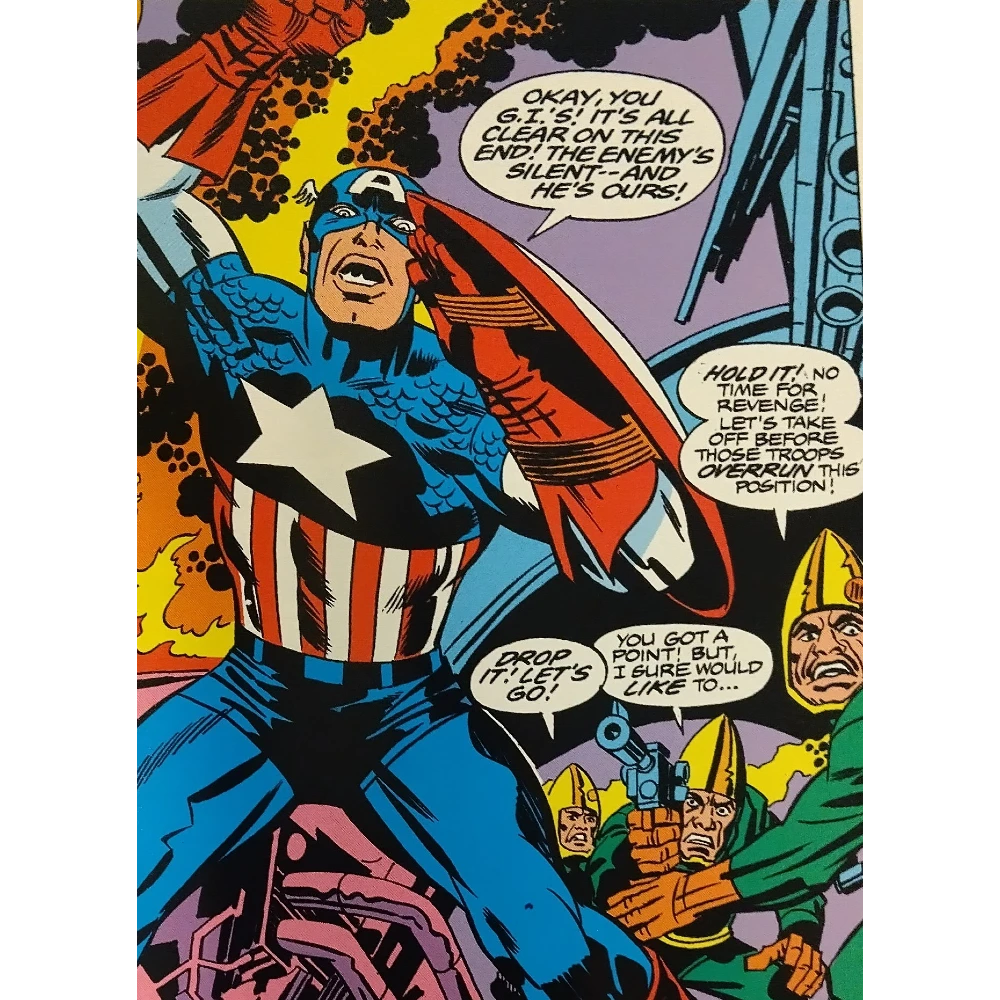
Though opinions of fiction are generally subjective, I'm not sure if you'll find many folks arguing that Kirby's return to Marvel produced the same quality of work as his earlier stints. In the 60s, Kirby co-created famed heroes such as the Hulk, Fantastic Four, and X-Men, the legacy of which seems incomparable. In the 70s, Kirby delivered the thoughtful yet woefully unfinished Eternals, a somewhat tonally awkward take on Black Panther, and the adventures of a big red dinosaur. I've not explored the latter series (though y'all should stayed tuned!), but "Devil Dinosaur" just doesn't resonate with the same seismic significance of Kirby's earlier creations.
Similar to his Black Panther stint, Kirby takes over this title and guides Cap in a different direction than previously established in "Madbomb": aside from a few references to SHIELD, these issues feel largely divorced from the primary Marvel Universe. Unlike Eternals, they take place within the confines of Earth-616, but Kirby seems reluctant to allow any other corner of the company to touch his work. Outside of Falcon, no discernible Marvel character joins the ruckus. New supporting cast members, new villains, and US army soldiers rather than SHIELD agents form the rank-and-file of Kirby's characters. Instead of receiving orders from Nick Fury, Cap and Falcon are brought into the mix by a man heavily implied to be Henry Kissinger. Steve and Sam are on their own in a great big world that promises to fall apart at any moment, should this arc's villains get their way.
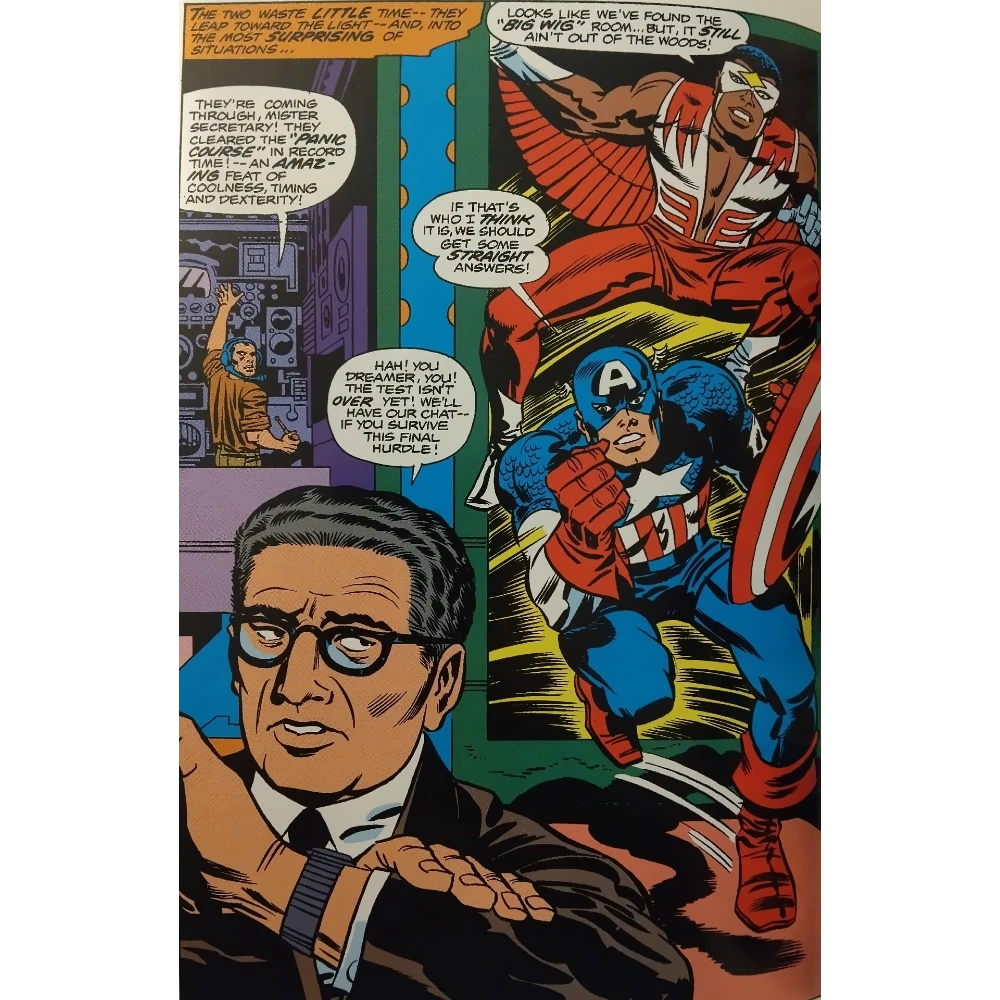
Without needing to kowtow to every other caped crusader in the funny books, Kirby can enlist the help of some real world drama to drive his story along. A series of Madbombs, each bigger than the last, threatens to hijack the brains of Americans and turn them against each other, with vicious results. Kirby provides an extended sequence of violence as even Cap and the Falcon become momentarily afflicted, a devastated New York block showing the consequences of what Madbombs of escalating size could cause. The threat may be sci-fi in appearance–these bombs are appropriately named, using weaponized artificial brains (ewwww…)–but it's grounded in genuine human nature. Our villains aren't supervillains or aliens; they're elitists, intelligent and rich people who think themselves superior to the common rabble and have decided to strike against society by turning their most primitive instincts and fears against them.
In the months leading up to America's birthday, Kirby crafts a story that sees the worst of American excesses threaten to topple her by distorting the very principles upon which the country was founded. In place of brotherhood, we're given division. In place of respect, we're given hate. Societal and racial lines are made canyons under the influence of the Mindbomb. It's not subtle commentary (case in point: one of the issues is titled "1984"), and though I prefer themes which are less forcefully vocalized, I found myself less bothered than usual. Kirby doesn't necessarily attach his story's themes to real world society at large, and though the interpretation is quite obviously directed one way (it's bad to hate people, folks), it's still presented in a thoughtful manner that focuses on inserting theme into the story rather than having the narrative become subservient to Kirby's message.
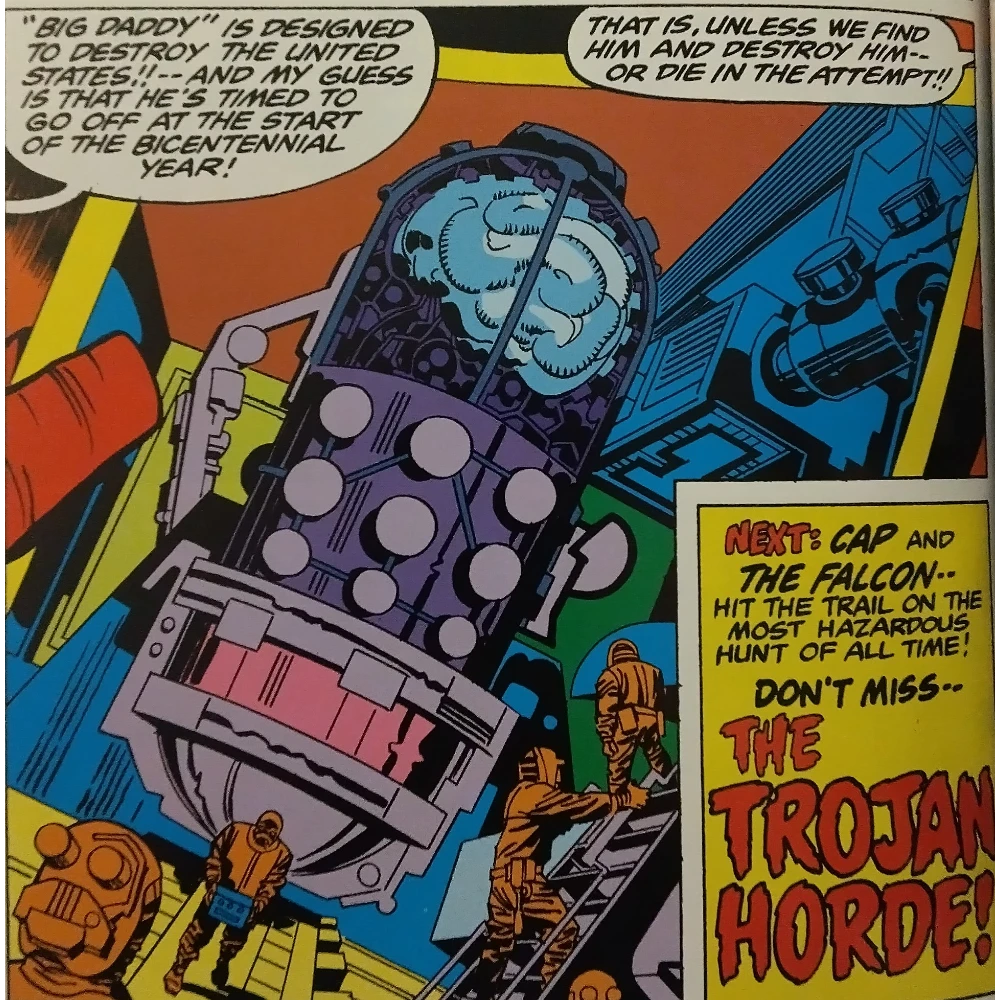
Kirby is generally at his best when he can tap into his sci-fi quirks and develop narratives which demand vibrant machines, grand inventions, and weapons which extrapolate reality to more imaginative forms. For a series like Eternals, Kirby can go wild on high-minded concepts which fit the series' cosmic premise. For a more grounded title like Captain America, Kirby is tasked with some restraint, asked to find that balance between crazy and conventional. He seeks that balance here, stumbling in some places. When Cap and Falcon are taken prisoner by the elitist villains in an underground headquarters, they're subject to a deadly roller derby in which they must compete for a literal pot of gold…and their lives! It's Kirby's attempt, I assume, to appeal to his audiences the same way he had a gang of long-haired, motorcycle-riding hippies live in a massive tree-house city/commune outside Metropolis in Jimmy Olsen. But the attempt feels awkward, something a bit too grounded in reality not given enough of a kooky sci-fi "oomph" to make it more palatable.
Take Kirby's Mindbomb as a counter example, a destructive weapon powered by increasingly larger artificial brains. Brains and bombs are human enough concepts, yet combined, they become something more horrifically futuristic in a way the idea of a "deadly derby" fails to encapsulate. Inhuman thought weaponized against human reason. It becomes symbolic of Kirby's primary point, of people with power using the rest of humanity's more basic instincts to further their own ends by overriding their morality. In the opening scene, Cap and Falcon even turn against each other, slinging some slightly inflammatory language as they try to actively kill one another.
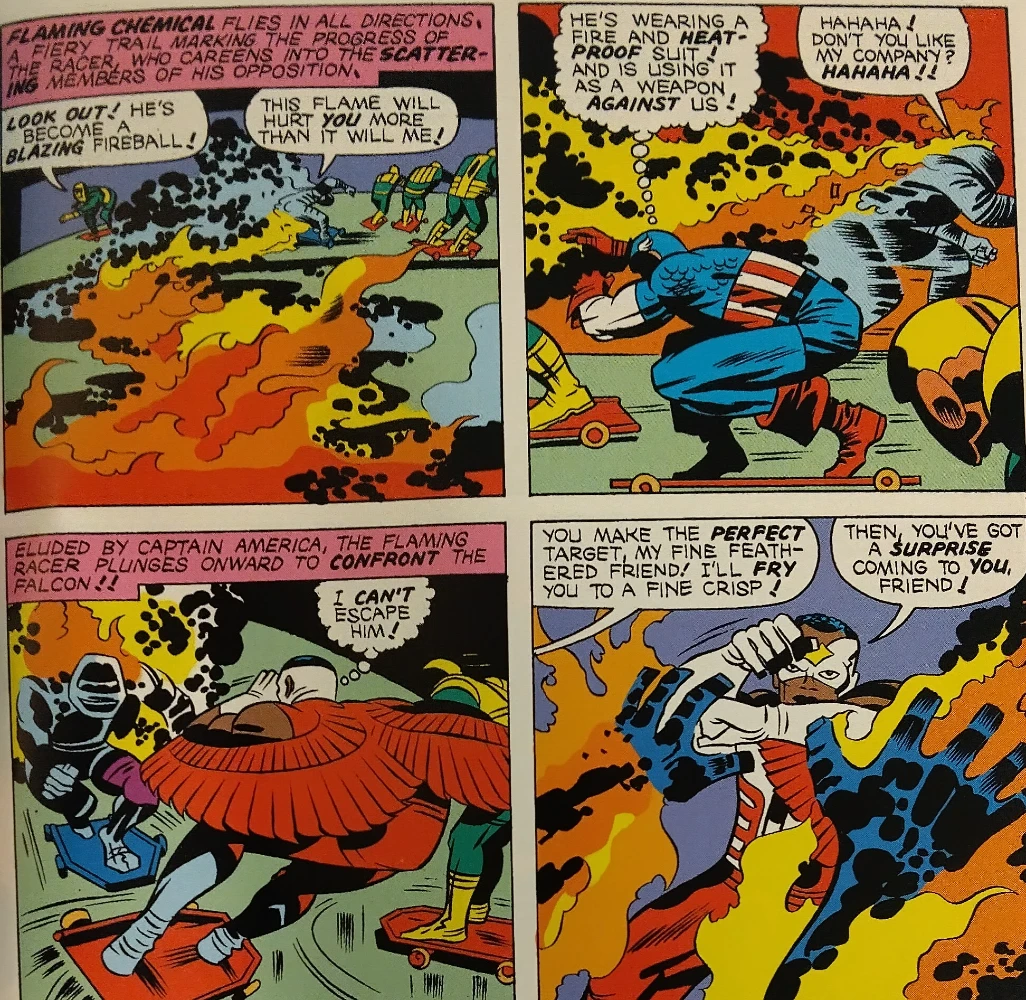
As characters, when their thoughts aren't remotely hijacked, Cap and Falcon are stalwart defenders all through the arc. They're not given much in the way of personality beyond their common goal, except for a somewhat awkward subplot thrown in part way that gives Steve a slight shot at romance. Both heroes are here for the good of the country, regardless of the risks they take or dangers they encounter. If anything, Steve shows the most emotion towards his shield when an elitist villain uses it for the roller derby from hell, contrasting the nobility which it represents with the ugly brutality of the gladiatorial spectacle in which Cap and Sam participate.
Also somewhat awkward is an additional motivation given our central villain that's blatantly stated at the arc's beginning and left pretty much untouched until the narrative's final pages. Without giving specific spoilers, I'll note it provides said villain more of a personal reason to hate Steve Rogers (not Captain America, mind you, Steve Rogers) in an attempt, I'd wager, to generate greater stakes for Cap. That Kirby doesn't refer to this motivation again until a fairly convenient spot near the arc's end dampens its effectiveness; I feel his main antagonist has enough reason to strike against America, by extension giving Cap enough reason to stop him, without trying to draw them both deeper into the conflict. It's coincidental and convenient, really having no impact on the arc until the moment Kirby wants it to.
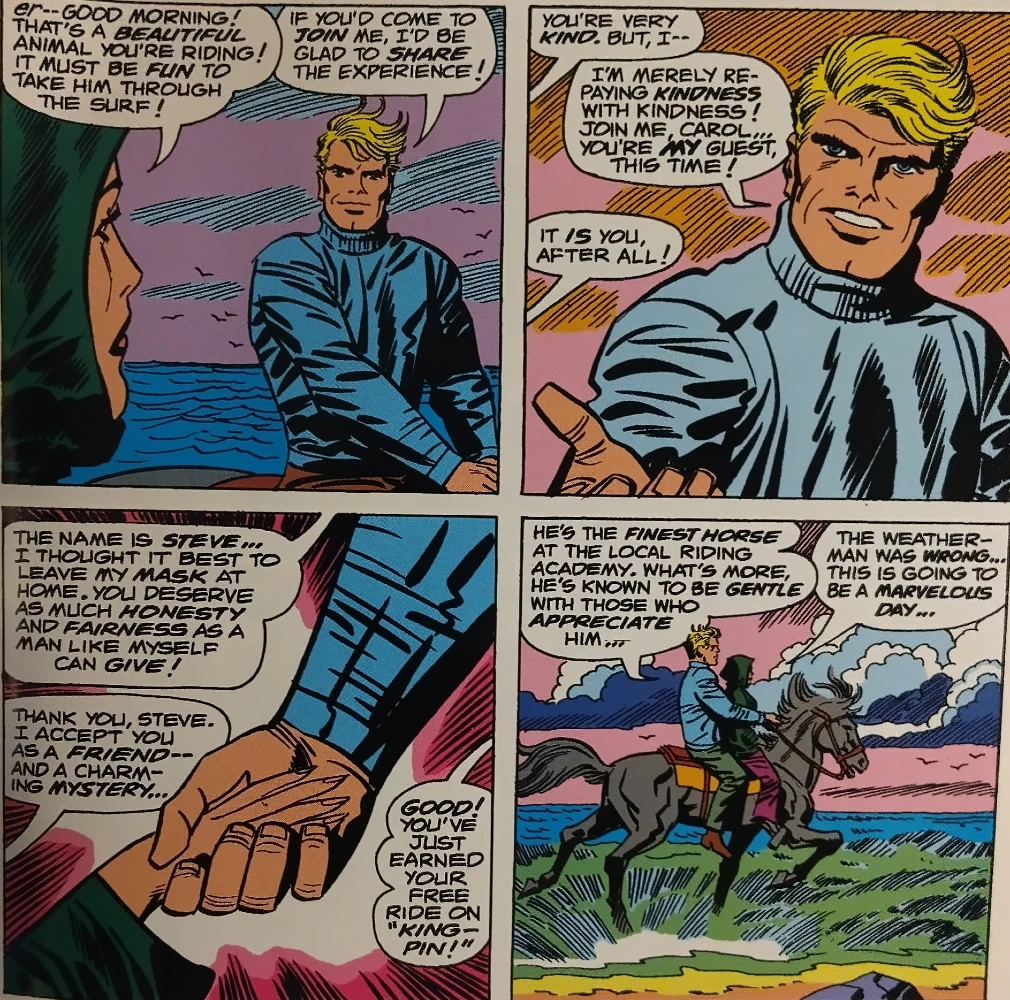
Though Kirby's work post-DC isn't as fondly remembered, this first Captain America arc is still a pretty decent read. The iconic writer/artist tends to prioritize his plot and themes over his characters, though he does endeavor to bring a more personal angle to Cap's involvement by giving him a brief love interest and a closer connection to the arc's main adversary. Neither effort is necessary. This is Captain America, defender of all freedom. Point him at a group of elitist terrorists and let the fists fly. It's really all you need. Against that is painted an interesting take on human nature and preventing hate from destabilizing the very institution we spend this holiday weekend celebrating. This is where the arc's depth can be found, a rallying cry for folks to remember the principles upon which America was founded, regardless of the enemies within interested in distorting or destroying them.