(Strand)om Stories: The Silver Surfer: The Ultimate Cosmic Experience Review
The ending feels like a misfire, but most of this graphic novel teems with strong moments and characters
—by Nathan on July 27, 2026—
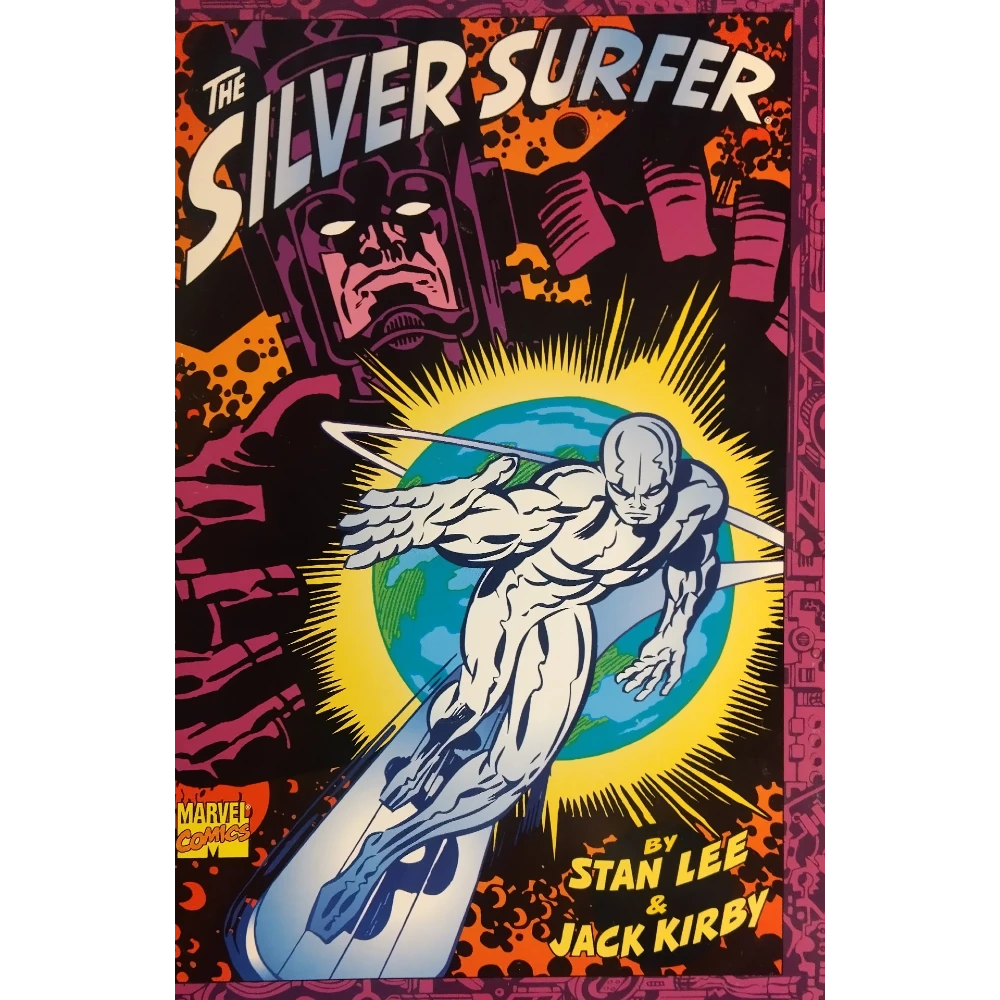
Don't let that subtitle-free cover fool you, dear reader. We are, truly, without a doubt, absolutely heading into the "ultimate cosmic experience" today
Wadda ya mean I'm oversellin' it?
That term, "graphic novel," has been applied broadly in the realm of comic reading, but I will always contend that it's meant to have a simple definition: a self-contained comic often reaching a greater page count and (purely subjectively) featuring a higher technical level of art and storytelling over your regular issue. All graphic novels are comics, but not all comics are graphic novels. I'd even argue that multi-issue arcs and series shouldn't be called "graphic novels," though folks have claimed that narratives such as Don McGregor's "Panther's Rage" and Alan Moore and Dave Gibbons' Watchmen deserve the title because of their singular, consistent vision. Both are great comics. They are not, based on my own definition, graphic novels.
Today, we review a tale which fits the above qualifications. One of Marvel's first forays into the singular story format, actually.
Preceding Jim Starlin's The Death of Captain Marvel, the company's first oversized graphic novel, today's tale is historic for more than just representing Marvel's official entrance into the world of "book-length" storytelling. The Silver Surfer: The Ultimate Cosmic Experience may be a first in some ways, but it was also the final collaboration between comic superstars Stan Lee and Jack Kirby. Creators of fan-favorites the Fantastic Four, X-Men, the Hulk, and others, the pair had split when Kirby headed for supposedly greener pastures at DC. His return to Marvel, where he wrote and illustrated a handful of series, is not looked upon as fondly. Three years into this latest stint, he left again…
…but not before creating one more story with his old friend, Stanley "Stan Lee" Lieber.
The Silver Surfer: The Ultimate Cosmic Experience
Writer: Stan Lee
Penciler: Jack Kirby
Inker: Joe Sinnott
Colorist: Glynis Wein
Letterer: Jon Costanza
Issue Collected: Fireside Book Series #11
Volume Publication Date: December 1997
Issue Publication Date: August 1978
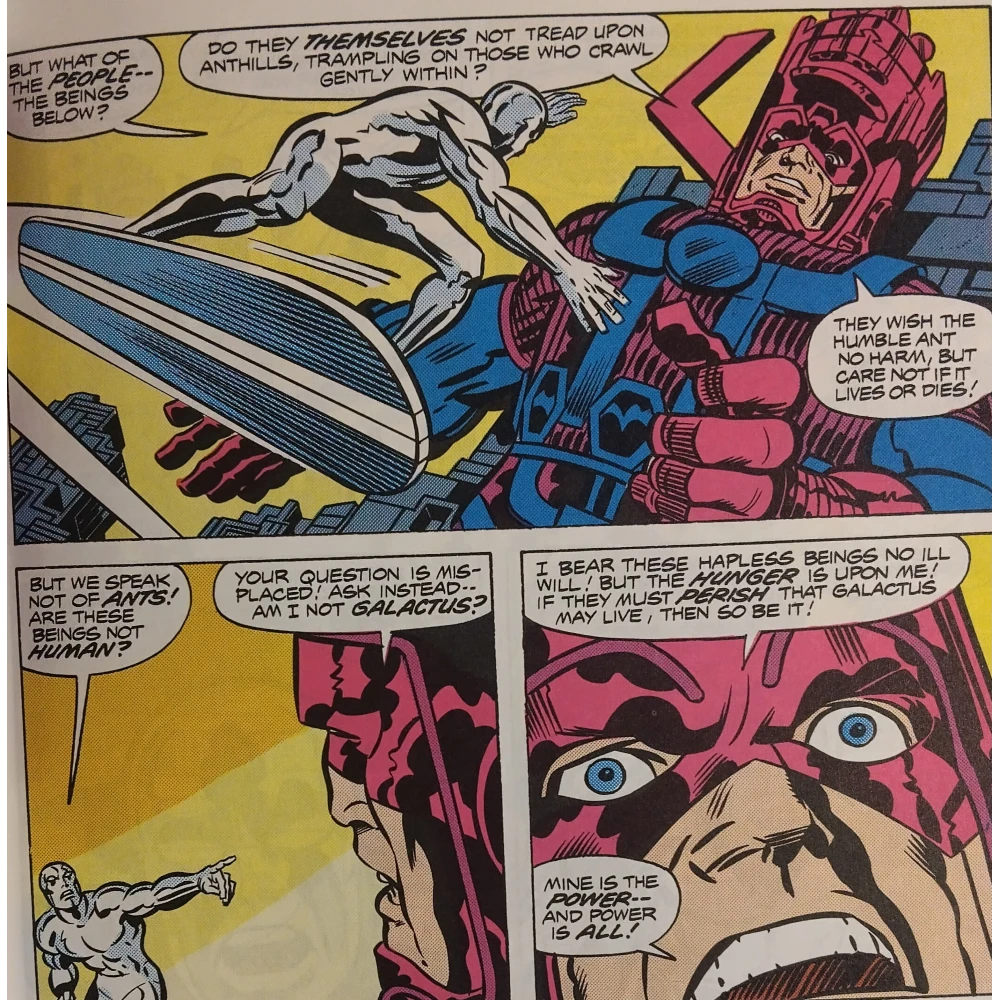
Originally published as the last in a line of paperbacks called Marvel Fireside Books, Ultimate Cosmic Experience was that imprint's only original entry, the other volumes dedicated to retelling the origins and early appearances of different heroes and villains. The collection we're reviewing is a different edition from that original printing–as if you couldn't tell from the cover–but the guts are the same.
And guts are something Norrin Radd has in spades.
I initially read that this final collaboration between two stars of the Silver Age of comics was, largely, a retelling of their famed "Galactus Trilogy," featuring the Silver Surfer pulling a Benedict Arnold on his former boss Galactus (though this is like a good Benedict Arnold, not a "betray your country to the enemy" deal). Calling this 100-page epic a "retelling," however, really sells it short. Only the opening pages handle the "retelling," and even that's a bit of a stretch because we're dealing with Earth-7888, a whole different reality where the Fantastic Four don't even exist. It's actually the same universe where Lee and Moebius' two-issue Silver Surfer: Parable takes place, this graphic novel serving as a prequel to that story. Like in the iconic Lee/Kirby trilogy, Norrin tells Galactus off, and the hungry giant strands his former herald on Earth…but then we're treated to a different tale.
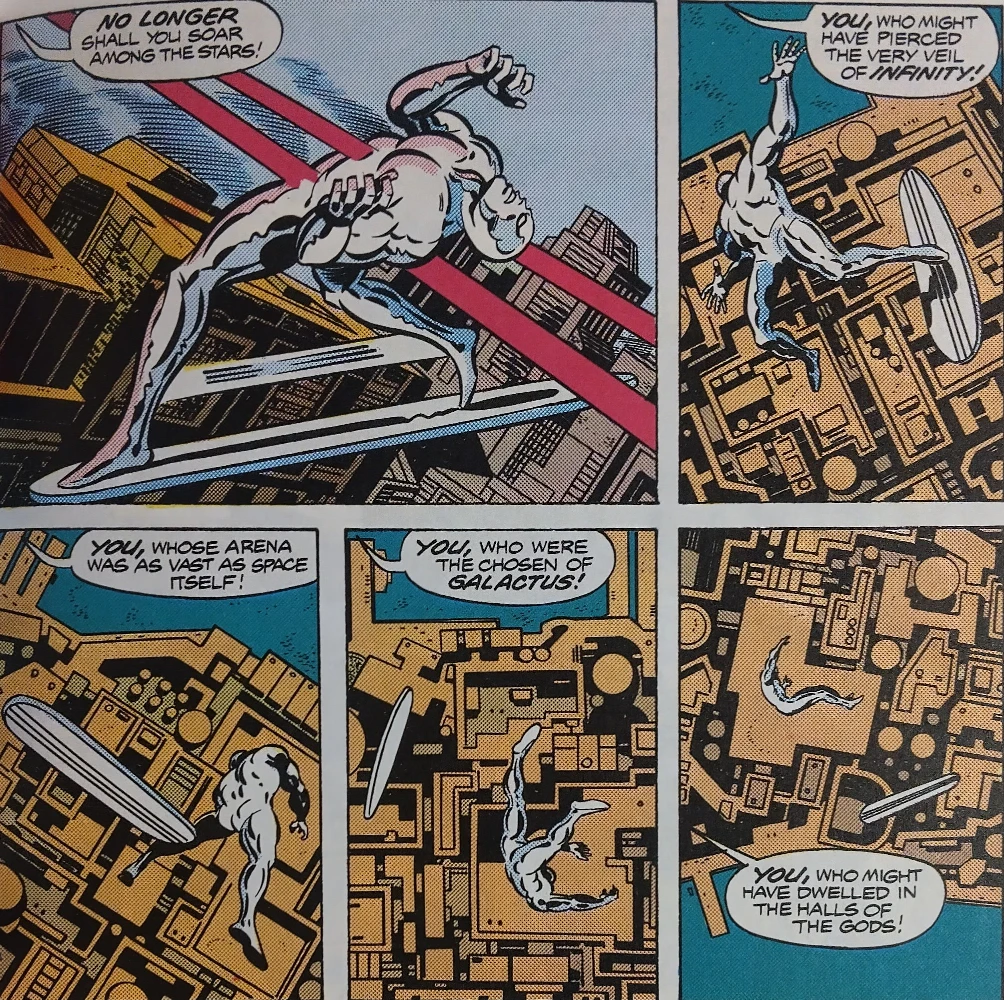
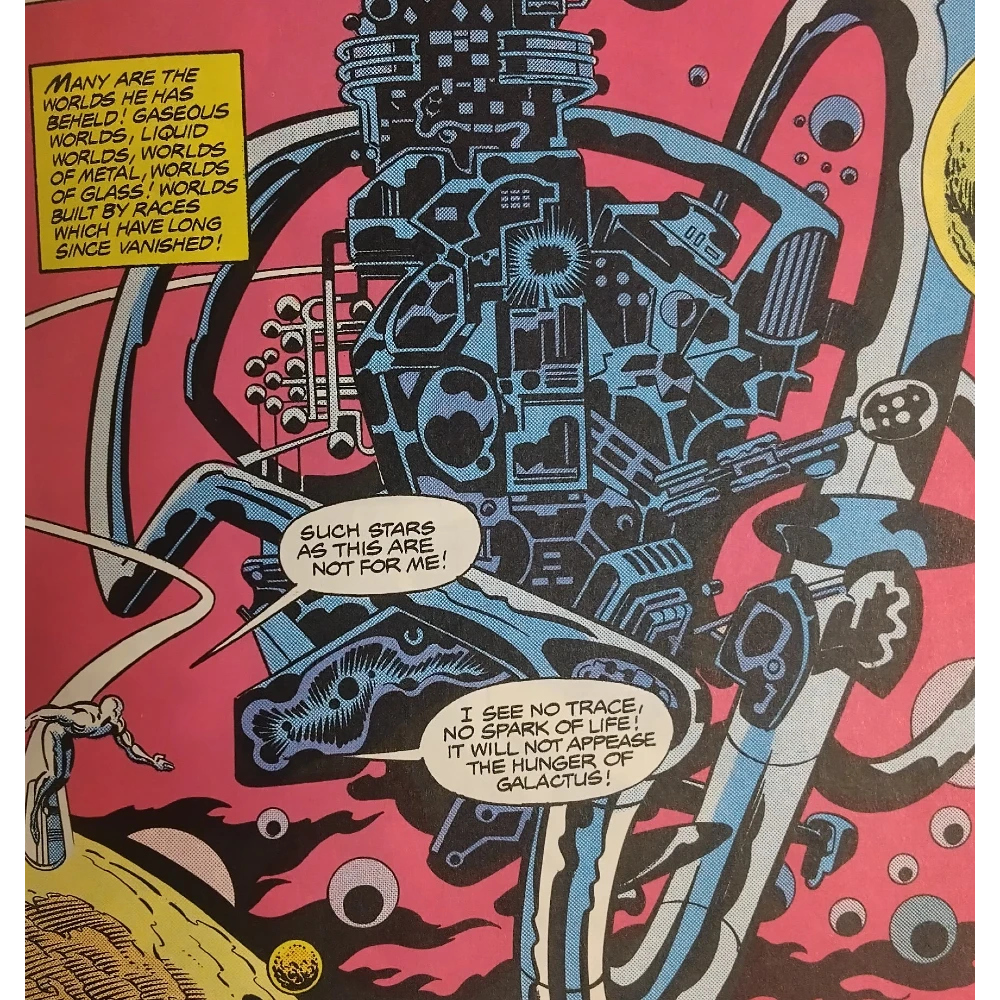
"Different" but not entirely "unfamiliar." This is a Silver Surfer comic, naturally, and even if it feels somewhat more poignant than your typical Surfer issue, you'll find some theming consistent with other stories. Lee is at his boisterous best, words cutting across the pages in his vociferous attempts at nailing the human heart and Norrin's simultaneous bewilderment by and interest in humanity. But where John Buscema had the honor of illustrating the first several issues of the celestial sky-rider's own series, Norrin's co-creator Kirby is given a crack at this solo Surfer story. His work is as detailed and impressive as ever, particularly in representing the magnitude of Galactus' might…
…yet it's Lee's script which allows Kirby to find the perfect balance between the majestic and the mundane. This is Lee firing on all cylinders, and though I can sound like a cantankerous old man when describing his verbose style, I found I was far more interested in his work for this narrative than I have been for other issues. Perhaps it's the 100 pages Lee is given to do more than cram pat statements into twenty-two page issues. At nearly five times the length of a standard comic, Ultimate Cosmic Experience ensures Lee and Kirby can actually do some character work in this narrative beyond mere soliloquy.
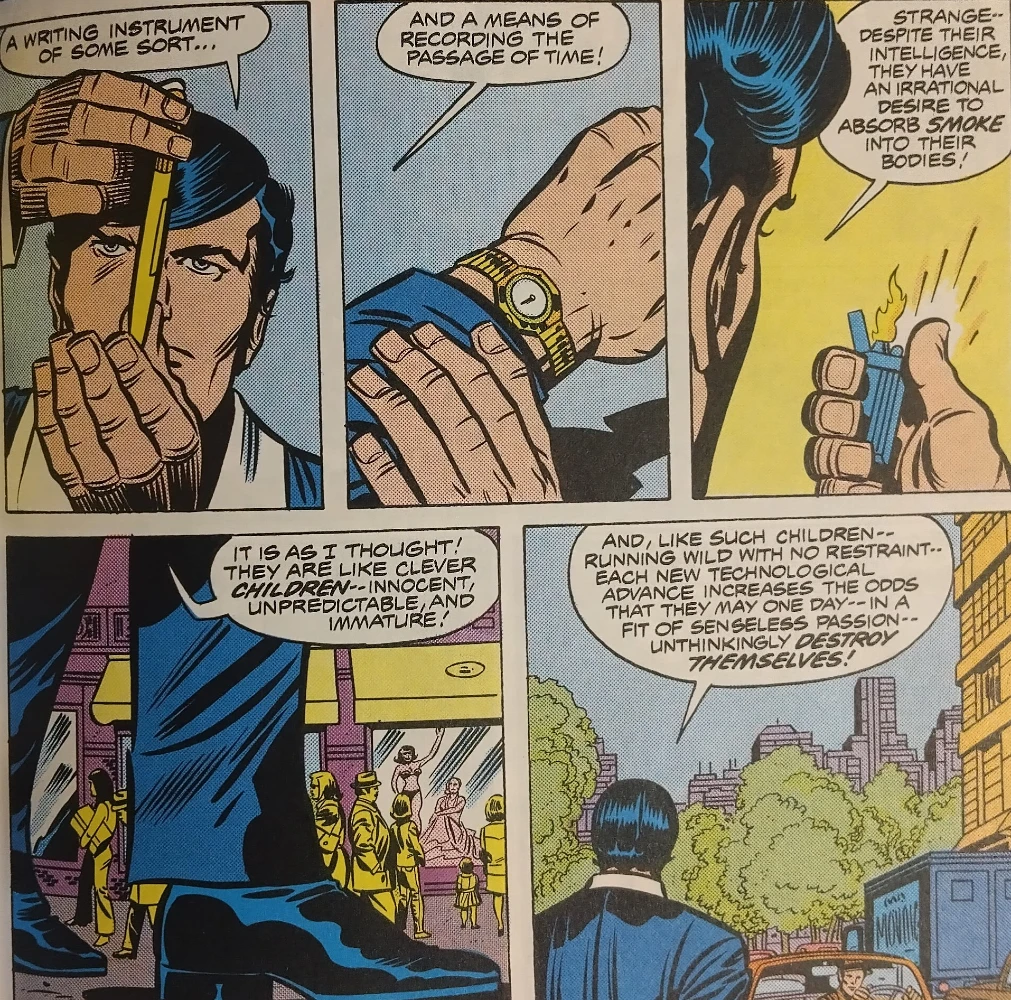
Take a scene where the Surfer, shortly after his stranding, modifies his appearance to pass himself off as a human. He briefly walks among fellow Earthlings, attempting to adopt their customs, understand their mannerisms, much like the Beyonder would do a handful of years later. The disguise lasts briefly, but for a few pages, Lee and Kirby have this star-spawned champion mingle with humanity. Later scenes see the Surfer attempt to dialogue with a fairly petulant fellow and his wife and, shortly thereafter, face fire from several military forces–these are the graphic novel's more standard moments, scenes readers certainly saw in other narratives.
Yet it's the quieter moments where Lee elicits the greatest emotional resonance. The Surfer always served as the character through which Lee voiced his greatest critiques toward humanity's foibles, finding in the trapped extraterrestrial a figure who could relate to us while simultaneously expressing astonishment at our self-destructive tendencies. Lee makes apparent the Surfer's struggle to reconcile his affection for humanity with his occasional cynicism; we are, in his viewpoint, worth saving, unique enough for him to prevent the all-eating Galactus from destroying (a feat he accomplishes twice in this tale). But he knows we're still gonna try and knock him out of the sky any chance we get. And he actively saves the Earth time and again. I guess that's why he's a superhero, seeking peace within (or despite) the paradox.
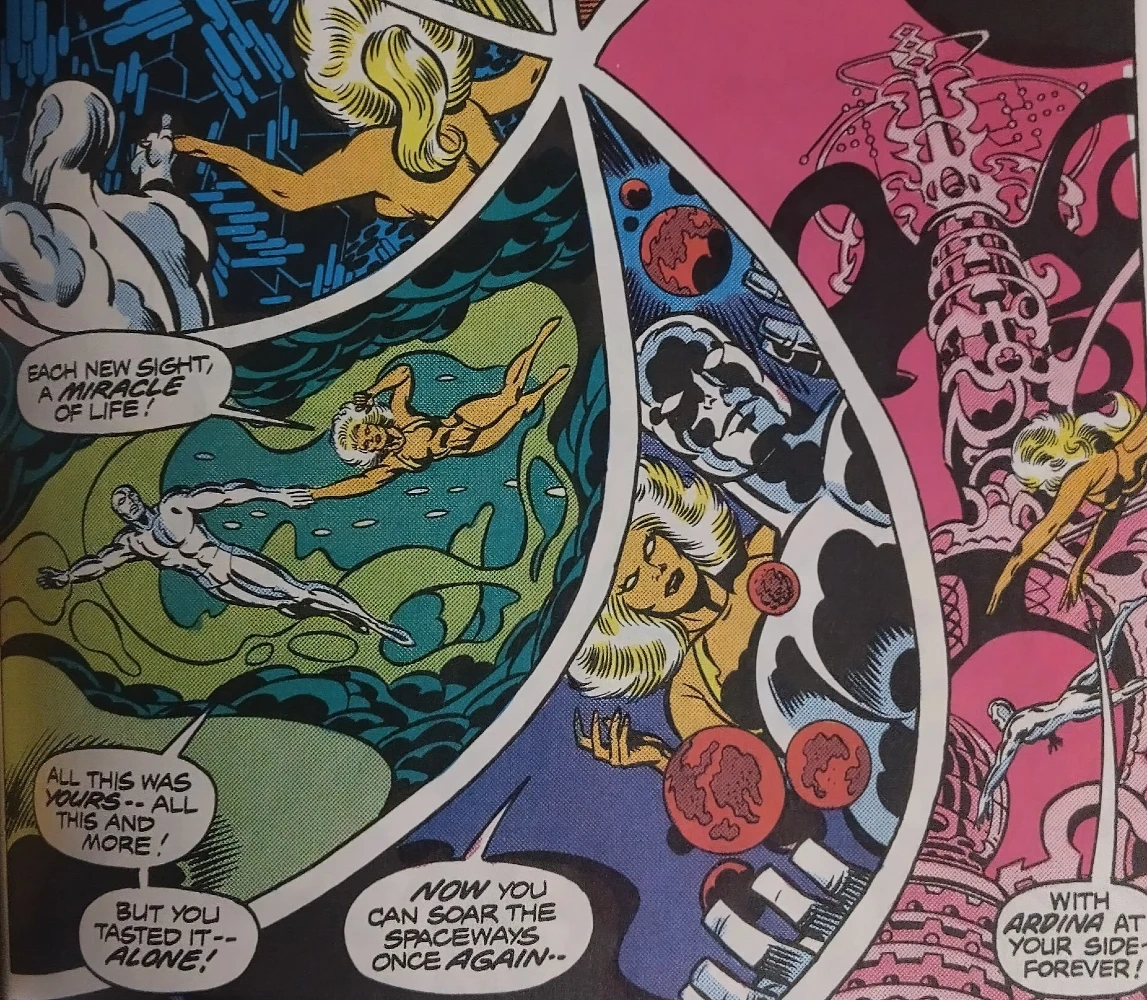
Lee endeavors some juxtaposition with the Surfer through introducing Ardina, essentially a clone of Shalla-Bal and, as Galactus' new herald, Norrin's female counterpart. Picture Julia Garner with a golden sheen instead of silver during her turn as the MCU's Surfer. Sent by Galactus to persuade Norrin to rejoin the hungry, hungry cosmic entity, Ardina provides counterpoints to Norrin's, not nearly as convinced as the Surfer as to humanity's worth. No great loss, our destruction, to her. Through Ardina, Lee and Kirby delve into a quite literal whirlwind romance, neatly holding the seemingly incongruous facets of Ardina's mission with the genuine interest she develops for the Surfer.
With Ardina also comes the graphic novel's weakest aspect: Lee, for as nicely as he crafts Norrin's heroics, feels convinced he really has only one ending to shoot for, and it's a disappointing final few pages he develops. You can argue it's a Pyrrhic victory, constructed upon Norrin's character, which is true. I generally enjoy a conclusion which feels consistent with a narrative's internal continuity. My struggle here is that these last pages are deflating and frustrating, placing the Surfer in a ridiculously difficult position that allows Galactus more than a modicum of satisfaction. There's a compromise and sacrifice involved, which, again, tie into Norrin's character as a hero who has come to love humanity, but the cost is high, perhaps too high. Perhaps it's because no named character experiences the benefit of a certain weighty decision, leaving the ending to stew in its own frustration.
I could also make the argument the ending is somewhat trite in how it deals with the fate of a particular character. In hindsight, and without providing too much detail, that personal conclusion feels fairly predictable, reminding me of a similar move Jeph Loeb and Tim Sale made in their wonderful Superman For All Seasons. It's a plot point which reduces a character after their effectiveness is mostly utilized, a somewhat harsh cessation of meaning and development. For both narratives, similar to this graphic novel's conclusion, these character arcs intend to heighten menace for our villain, yet in Lee and Kirby's case, such a decision presents Galactus as this nigh unbeatable adversary. I mean, he kind of is, but the entire point of the original "Galactus Trilogy" and this graphic novel's opening pages is to showcase even this cosmic entity's vulnerabilities in the face of the human spirit. Maybe it's because there are no humans to help the Surfer that Galactus' menace and assurance of success is magnified here.
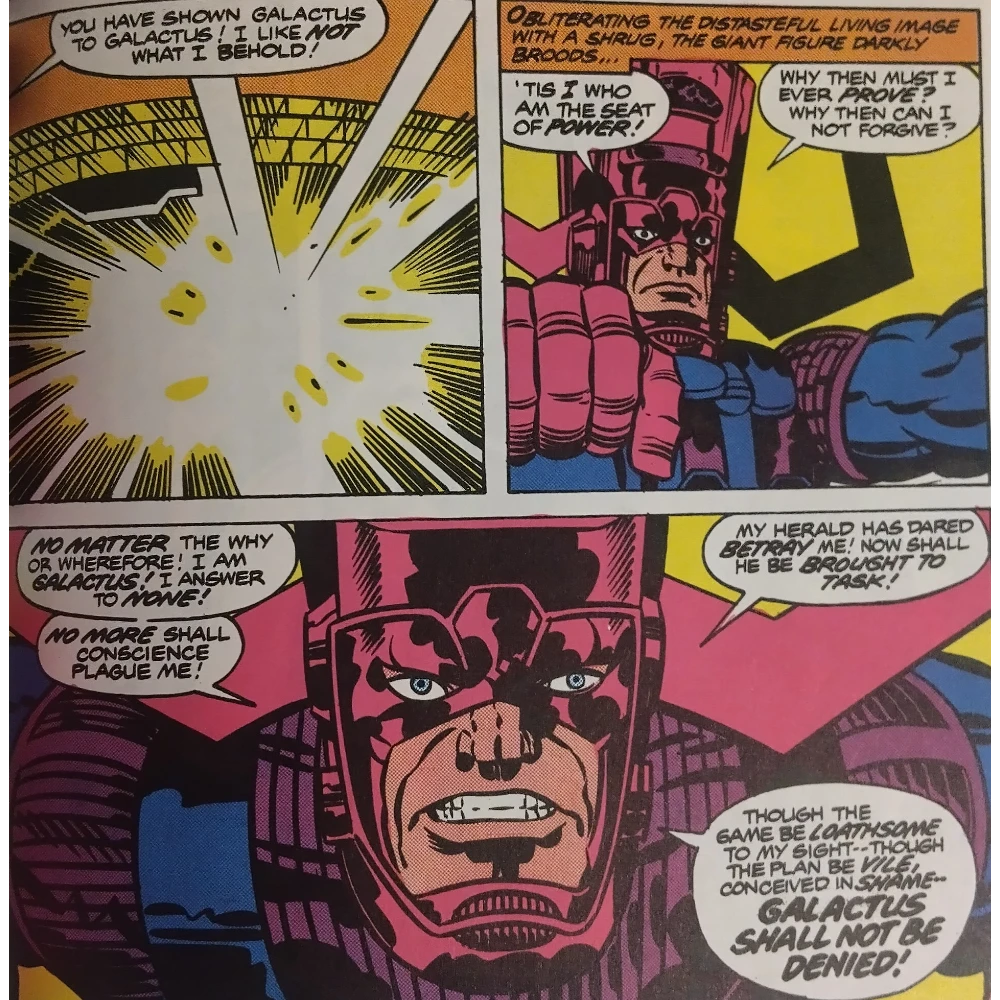
Which is disappointing, because though Galactus is the prime mover of the narrative's conflict, he also becomes one of Lee's more interesting characters for most of the graphic novel. Between the Surfer and Ardina, he feels like the character who receives a significant burst of development, as Lee positions him as somewhat…emotional? Galactus actually takes stock of his role, recognizes the devastation he generates, even empathizes with the Surfer. Other comics have presented him as a colder titan always following destiny's path; this version recognizes he could deviate if he so chose, selecting instead to submerge the little voice in the back of his head that represents his eternal hunger pangs. Here, Galactus isn't just a force of nature guided by hunger; he works actively toward the fulfillment of his destiny.
So out of 100 pages, we have 10 or so which kinda bug the heck outta me. They're the final 10, which make them weightier, but 90 out of 100 is still an A. Maybe we dock it a teensy bit more for some of the same-old, same-old material found in other Silver Surfer comics. But what this isn't is a retelling. Don't let other descriptions fool you. The Ultimate Cosmic Experience, though perhaps not fully living up to its title's lofty claim, does certainly provide an experience. A silver-skinned flyer who must fight for a humanity that fears him; a golden-skinned herald who finds love in a man she must betray; a giant who feels the responsibility of the fate he's been handed. Characters are properly thoughtful here, and with the extended pages, Lee and Kirby, for their final adventure together, create something that feels properly balanced between the majesty of a cosmic spectacle and the groundedness of human drama.