Sterling Starways: Silver Surfer #4 Review
A beautiful cover and wonderfully detailed art cannot make up for multiple narrative conveniences
—by Nathan on March 22, 2026—
When last we encountered the earth-trapped Norrin Radd, the shining centurion was given his heart's greatest desire by the manipulative Mephisto: freedom…and the love of Shalla-Bal which would certainly come with that freedom. The Silver Surfer resisted the demon's temptations, thwarting the villain's schemes to twist and break the powerful love between Norrin and Shalla-Bal. Some bonds defied distance, as the two showed.
Four issues into the Surfer's titular series, and you know the gimmick by now: he's a tragic figure, given to Shakespearean soliloquies, mourning his lot in life. He'd tear his hair out if silvery strands grew from his chrome dome. He can't escape Earth, he can't reach his true love, he's left to wander among us pitiable mortals. Woe is he! And, perhaps, woe are we for sitting through such repetition.
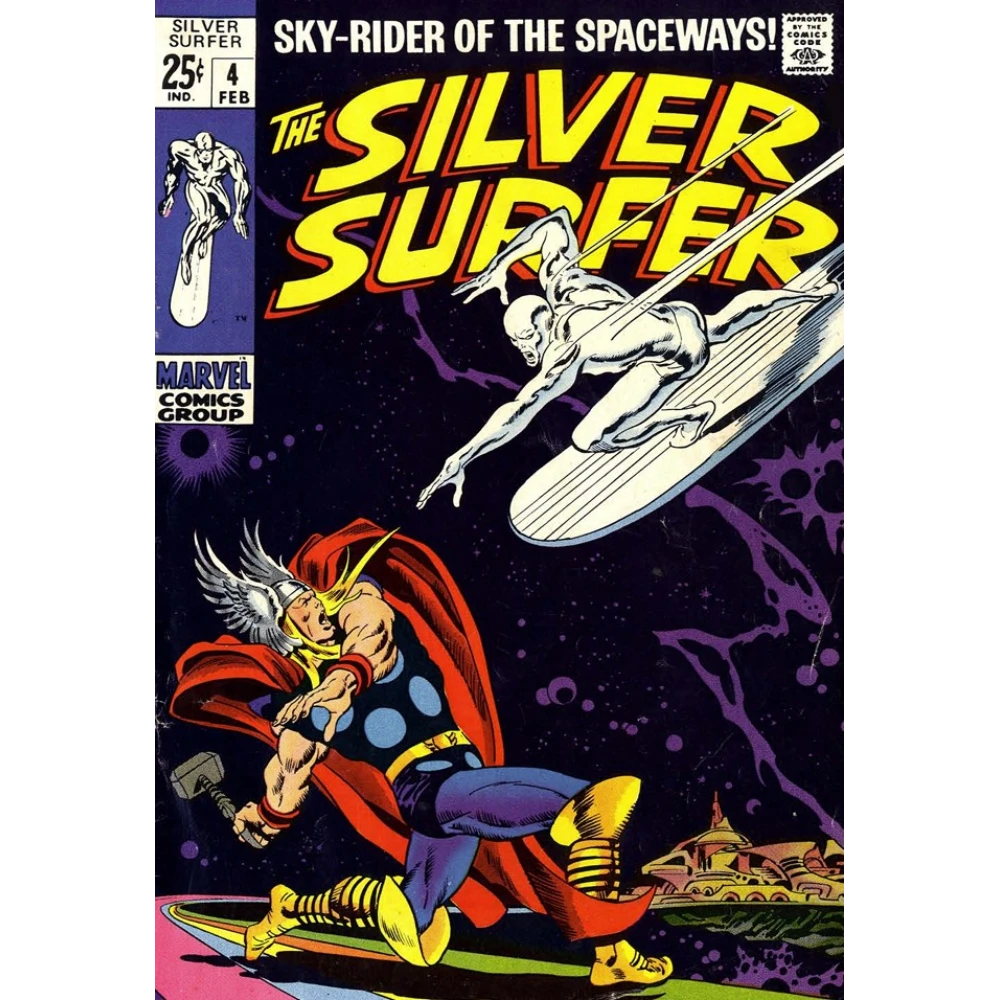
Yet you can't help but glance at John Buscema's awe-inspiring cover for this issue and feel a twinge of hope. The Surfer, swooping towards the Asgardian deity known as Thor. The God of Thunder, pulling his arm back, ready to strike with mighty Mjolnir. And around them, a space untethered from the rest of reality, shining Asgard in the distance, the Rainbow Bridge firmly beneath Thor's feet. Maybe, you wonder (Maybe, I wondered), this issue will wind away from the common threads Stan Lee has pursued so far, following a different, serpentine path, like Ouroboros himself.
All ye who have not abandoned hope, enter here.
"The Good, the Bad, and the Uncanny"
Writer: Stan Lee
Pencilers: John Buscema and Howard Purcell
Inkers: Sal Buscema and Paul Reinman
Colorist: Bill Everett
Letterers: Artie Simek and Herb Cooper
Issue: Silver Surfer #4
Issue Publication Date: February 1969
Now that ye who have not abandoned hope have entered (probably a better line for my review of last issue's Inferno-esque escapades), let me start by saying your travels and travails were for naught: this ain't a great issue. Not even the back-up strip is all that rewarding, and though I've been a little critical of other "Tales of the Watcher" entries, this one is the least interesting.
Silver Surfer #3 is a genuinely gripping issue, driven by the primary antagonist Lee and Buscema create. Mephisto is a vampire-looking demon who plays upon the Surfer's innate goodness in a battle for his soul, and the Surfer's dismissal of the villain's temptations is a great showing of his heroic willingness to suffer for others. Sure, he complains and cries a bit too much about his current predicament, but he's a character defined by his nobility in the face of overwhelming evil.
To paraphrase that one Spongebob meme: "Wanna see Lee do it again?"
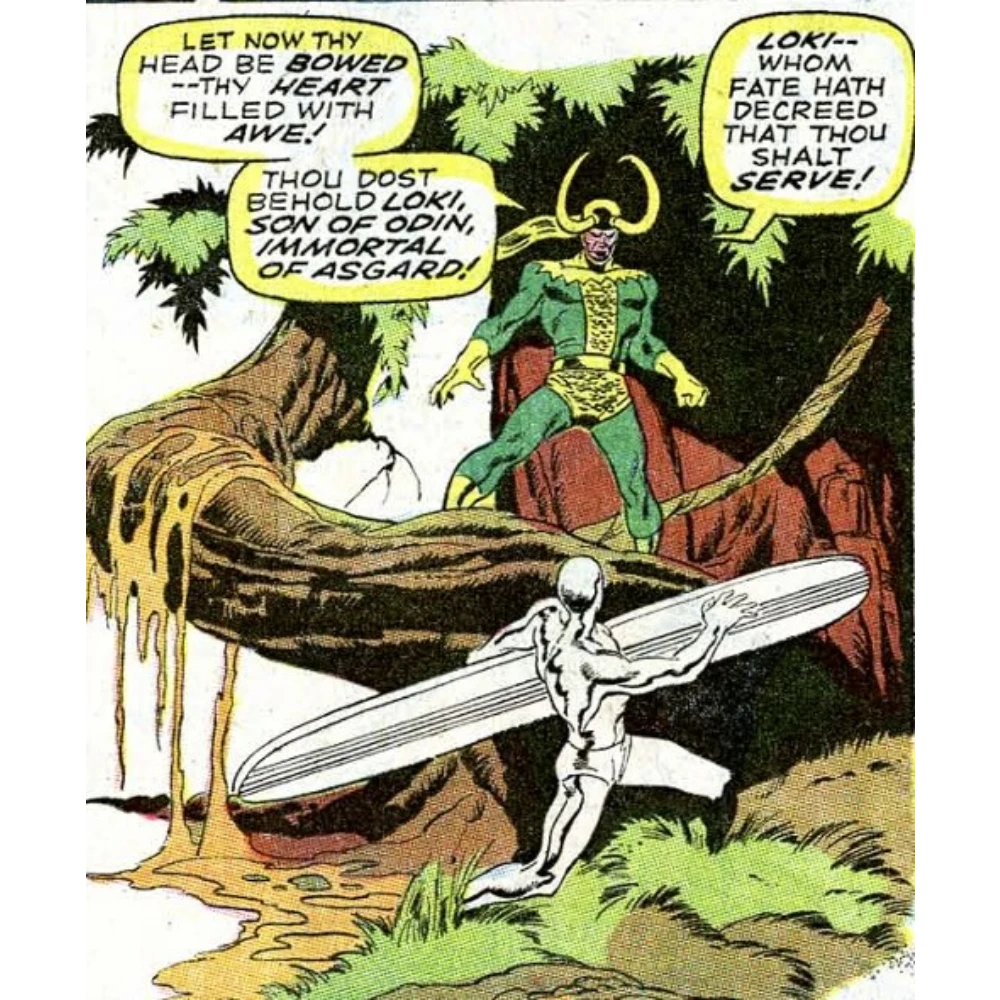
In seeking an individual powerful enough to battle and destroy his irksome brother, the Norse god of trickery and deceit, Loki Laufeyson, deems the Surfer the perfect mark. Watching the shimmering hero bash himself against the confines of his planetary prison, Loki devises a scheme: he will promise the Surfer his freedom, and Shalla-Bal, if only the Surfer serves Loki in the small matter of fratricide.
Mephisto may not have asked the Surfer to commit murder, but the parallels between these schemes are strong enough. Even Loki, looking over the Surfer's history, comments on such, hastily remarking how he will succeed where Mephisto failed. The specifics are different, but we're following essentially the same trail: a villain seeks to manipulate the Surfer into pledging his allegiance…and I guess Loki is superior, because he actually convinces the Surfer to fight Thor. How else were we going to reach the moment represented by that glorious cover!
Problematically, Lee has to move mountains of convenience to allow this scenario to play out. For a thirty-nine page story, you'd think this wouldn't be an issue. Yet twenty-three pages pass before the Surfer even meets Thor, and another five go by before one of our combatants initiates the scuffle. Most of those proceeding pages detail movement between Loki and Surfer, including a battle in which the Surfer deems Thor's adopted brother dangerous enough to be a global threat.
And yet Norrin Radd is still convinced by the God of Lies.
The Mephisto ploy works, in my mind, because he's genuine in who he is. He makes no scruples about testing the Surfer's spirit, relishing in whatever internal division he can create, however briefly. But Loki's schemes hinge on (as Loki's schemes often do) trickery, and I am not convinced by Lee's writing that the Surfer, once presented with Loki's offer, would willingly bow to the devious deity's plot. I can understand that he has never met Loki or Thor until now and may have little to no comprehension of Norse mythology; they're blank slates to him. Given that, I am still not thoroughly convinced that Lee has Loki paint himself and his brother in a manner the Surfer would willingly believe. We are meant to see, once the Surfer and Thor meet, that Loki manipulates a few emotions to steer them towards physical combat, which is more subtly done by Lee, but it's not enough to answer for Norrin's ongoing obliviousness.
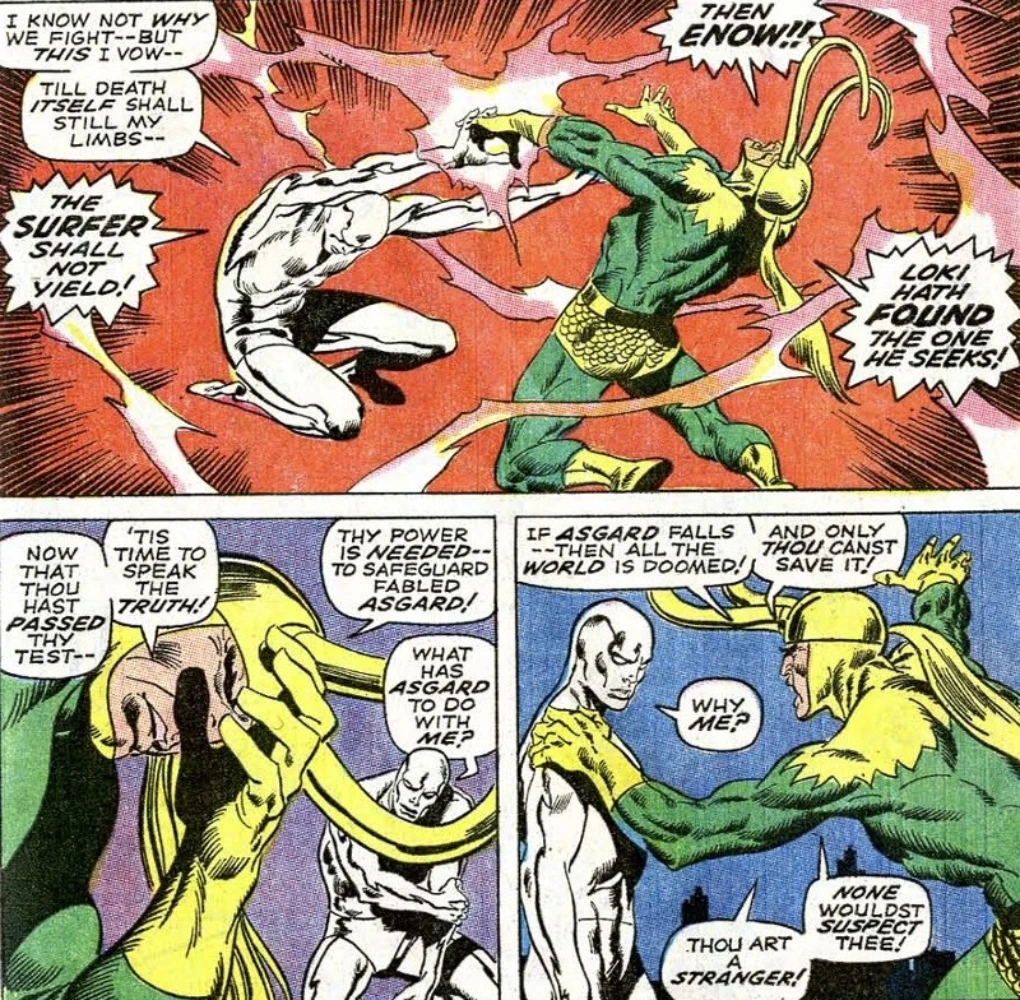
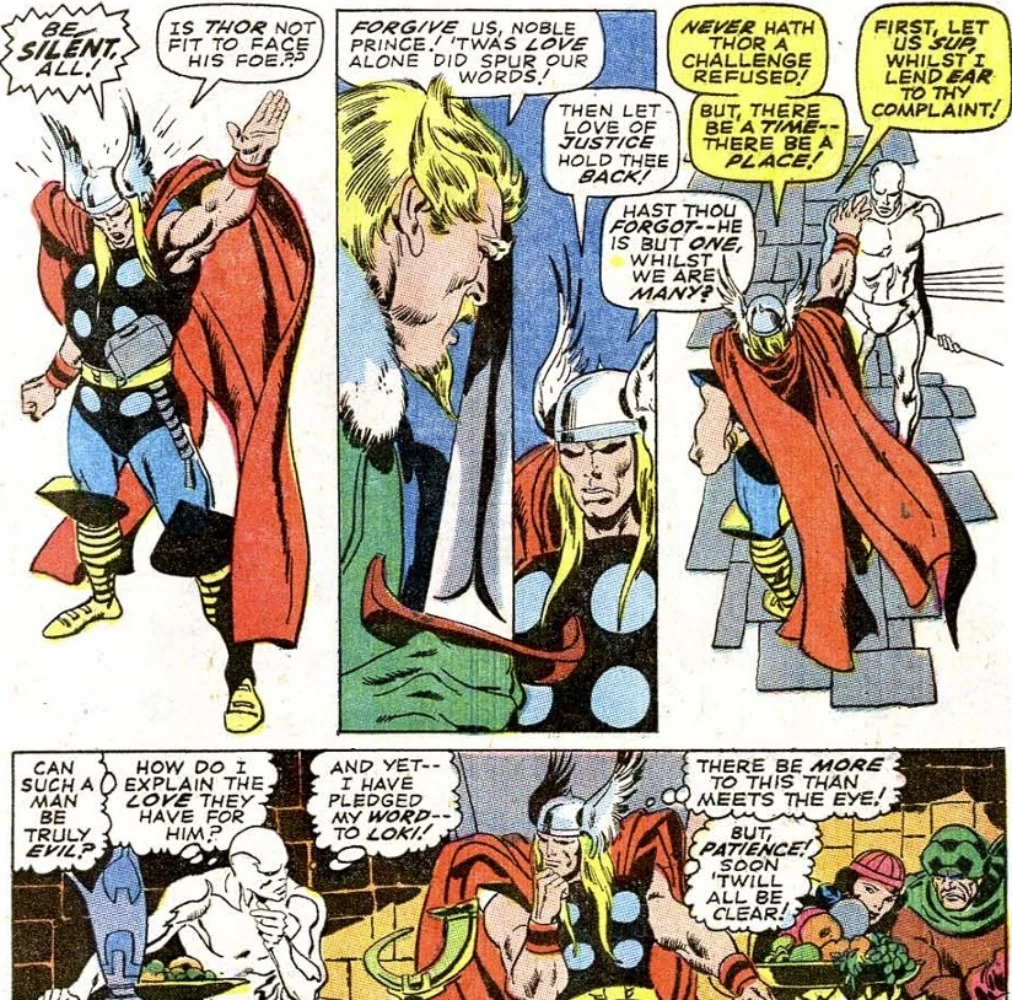
Where Lee does succeed is sewing a sense of doubt in the Surfer, perhaps to balance out some of Norrin's foolishness. Not enough to prevent the upcoming cataclysm between the two heroes, yet just enough to provide impetus for their later truce. Each man carries a general nobility about himself, which Norrin's clouded-brain attempts to perceive when engaging with Thor, especially as he sees the effect the Thunder God has on his fellow Asgardians. These are his most rational moments, and were it not for Loki, you could believe the Surfer wouldn't remain as ignorant as he does.
It takes twenty-three pages for these two to meet, twenty-eight for them to start tussling, and I genuinely believe that Lee really just wanted the Surfer and Thor to come to blows and devised a convenient method of reaching that scenario. I get it: comics do this all the time, devising coincidences through which brief battles happen before the true villain is revealed. Interestingly, we're given a much less satisfying ending than "Surfer and Thor team up and beat the crap outta Loki." Lee's conclusion is tinged with more of his patented moroseness, the Surfer cheated out of both his hope for freedom and any chance at justly smiting the trickster. In this way, he does subvert expectations somewhat, though it does make for a brisk, abrupt conclusion.
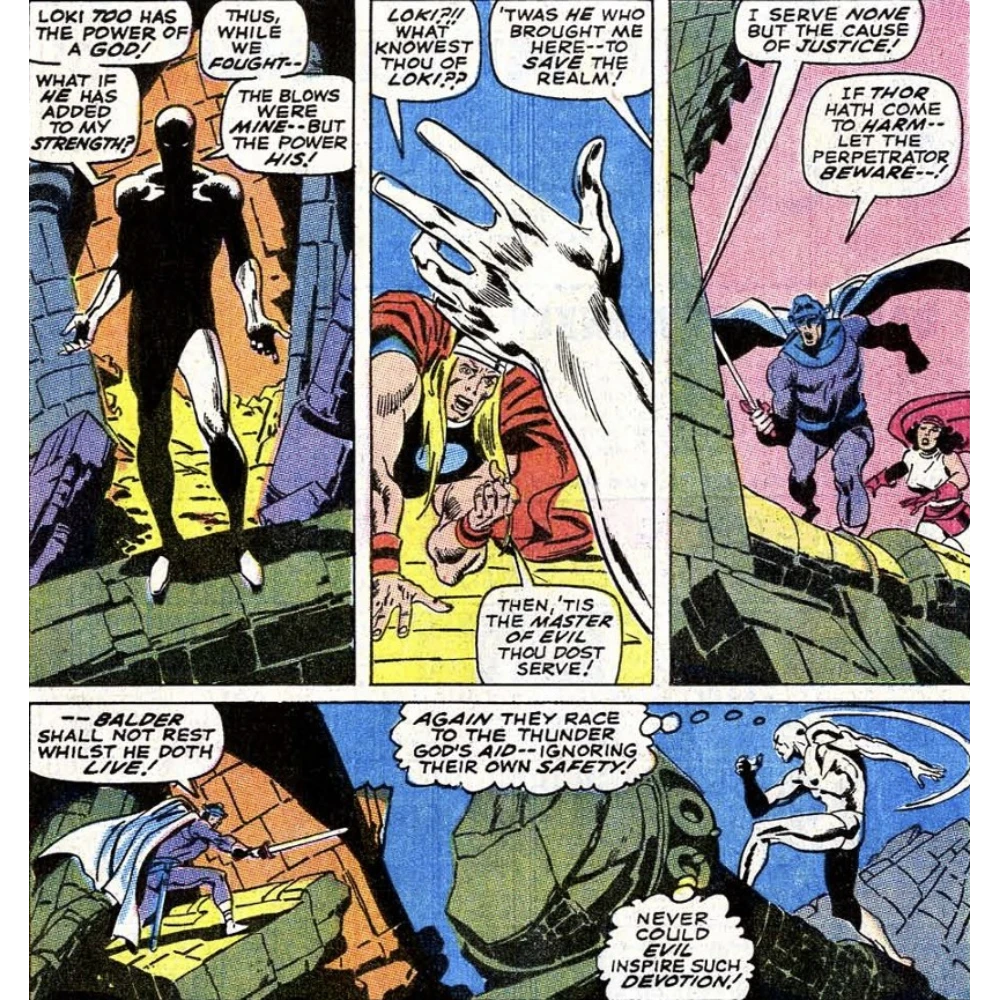
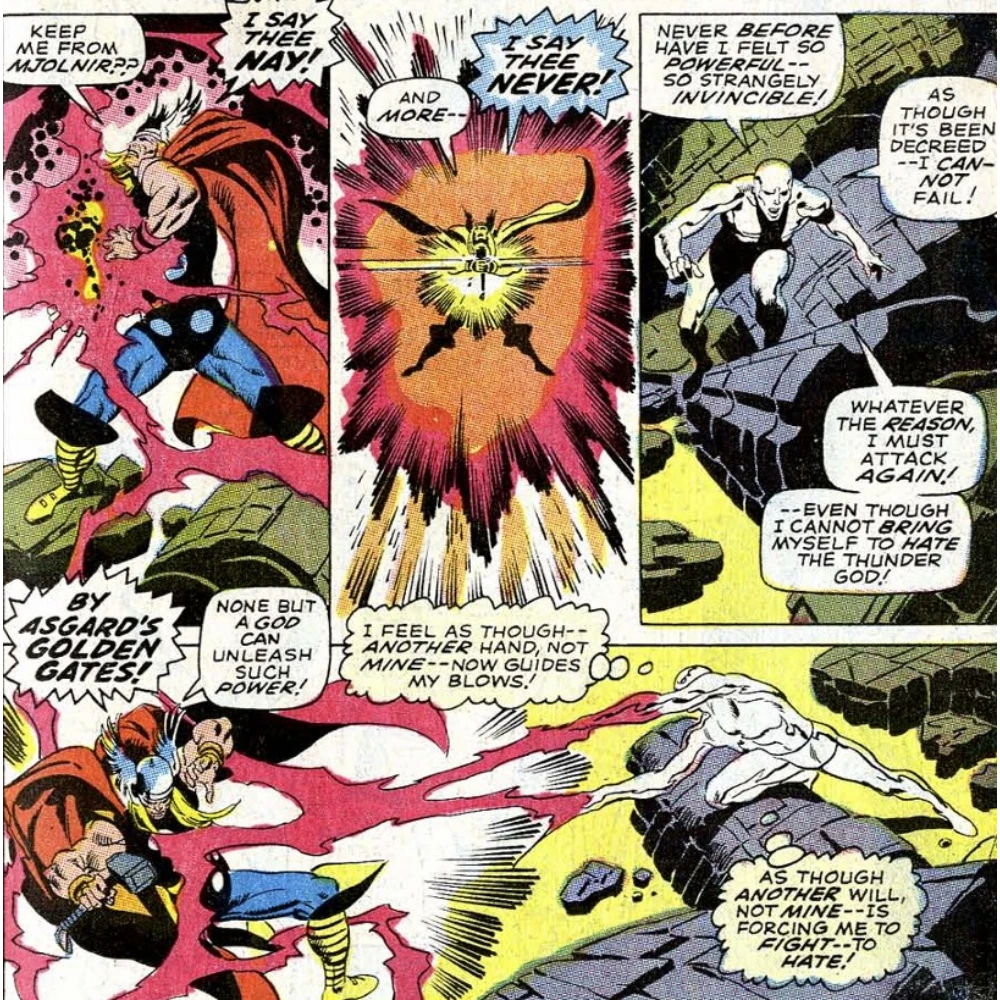
The question should linger then: "Does the fight itself–if this is what we spent twenty-eight pages building towards–justify the waiting?" If you enjoy having John Buscema pencil an eleven-page battle between two superpowers, then yes, it is. Buscema does a great job, pitting the Surfer's blazing energies versus Thor's arcing lightning; ancient structures are blasted by high-powered beams; the Surfer successfully strips Thor of his enchanted hammer. It isn't a one-sided showdown, but you get the full scope of the Surfer's abilities and come to believe he could verily smite the God of Thunder if he wanted (but only with some behind-the-scenes help from Loki). It's a spectacle, in other words, well worth a read. Bill Everett's colors cast battle damage upon the general gleam of Asgard, turning part of the fabled homeland of the Norse pantheon into a scarred battleground. A great setting for a pretty decent fight, even if I wish quicker momentum had propelled us towards it.
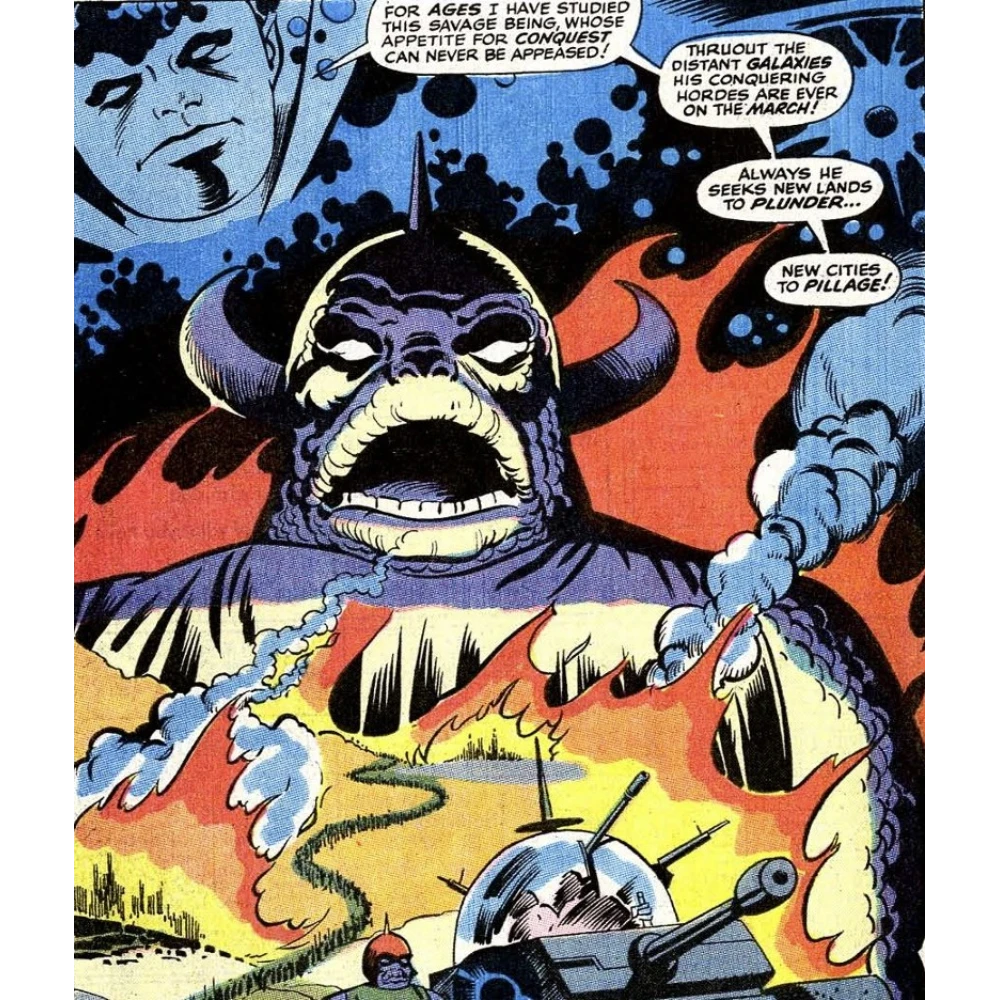
As frustrating as the main event may be, the tacked-on back-up piece is even more disappointing. I was actually encouraged to see that this tale, a reprint of part of Amazing Adult Fantasy #9, featured Tim Boo Ba, an alien creature I fondly recall from Marvel's Fin Fang Four (which, though written for younger readers, is a hilarious comedic one-shot well deserving of a review in the future). Knowing Lee's penchant for pulling in Cold War-era politics, I was interested in seeing how the despot would be made relatable to actual world events. In short: he isn't. The back-up isn't so much a story as it is a series of panels noting how dictatorial Tim Boo Ba is, his cruelty hammered and hammered until a natural disaster ends his despotism. There's a bit of a twist ending, but otherwise, this is just ten pages harping on how awful Tim Boo Ba is before his pathetic demise. Parallels can be found between the overlord and actual tyrants, but there's nothing here to make anyone draw any interpretations other than the most generic "bad guy with power is a monster" message.
Come for the cover, and while you're at it, stay for the cover. Buscema's talents are utilized well–his best image is a half-page panel where the Surfer sits in an African jungle, surrounded by detailed depictions of wildlife–but Lee cannot coax a story out of his central concept to match. He wanted two guys with a penchant for pontificating to fight, and he got it. Yet the reason is harebrained, beyond forced. A child would be able to convince the Surfer why he shouldn't fight Thor for all the evidence Loki provides that he should. Maybe Norrin Radd should have been sent to battle Tim Boo Ba instead, but then again, fate was the mightiest foe faced by anyone in this issue.