Spider-view: "Fall of the Hammer" (Spider-Man 2099, Part 9)
This crossover frustratingly exchanges character for spectacle, some strong moments failing to bear the weight of its shortcomings
—by Nathan on May 2, 2026—
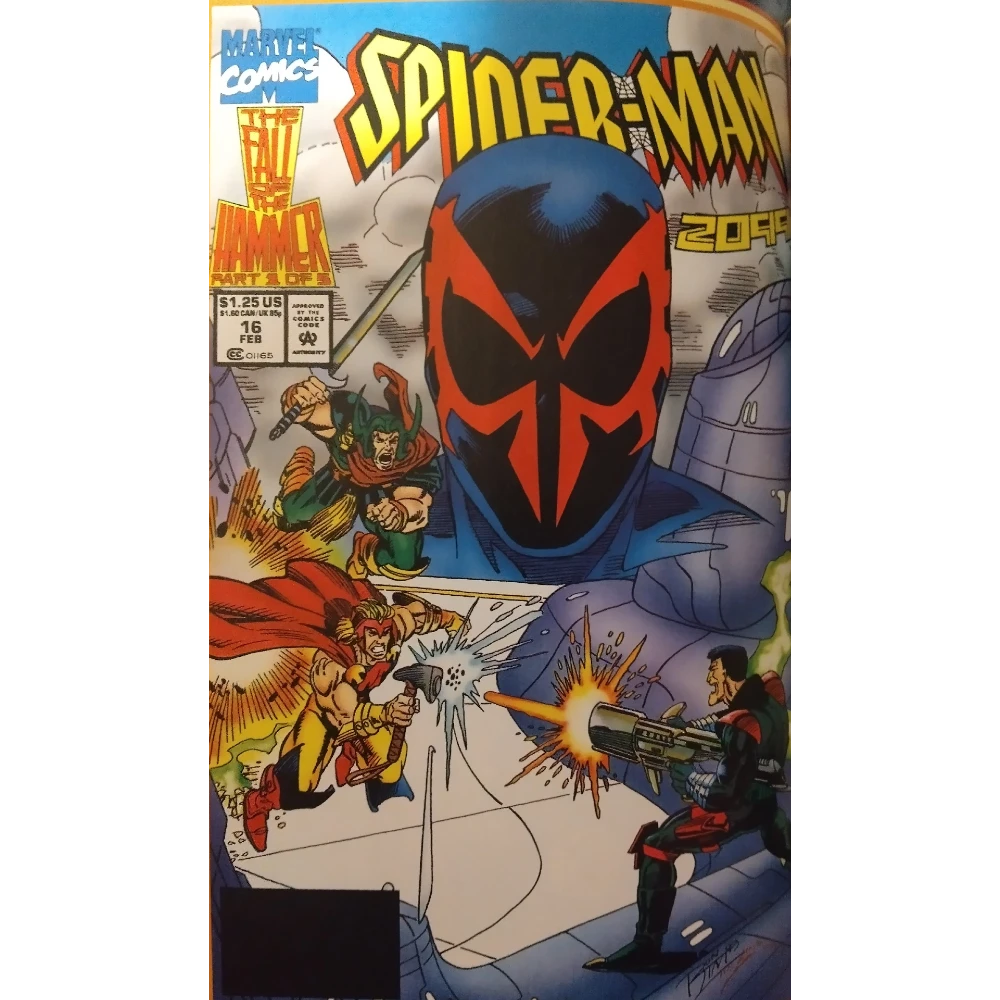
As we find ourselves, once again, drawn into Miguel O'Hara's futuristic sphere of influence, we finally arrive at one of those pivotal "It's all been leading to this" moments.
Back in Miguel's second-ever issue, he was rescued by a dude claiming to be a "Thorite," a worshipper of the Norse God of Thunder. Thor, at some point after the fabled "Age of Heroes" where Peter Parker's original Spidey lived, had left Earth, never to be seen again on Midgard. Yet, hope lingered, and under the oppressive practices of Alchemax, there arose a cry for a savior wielding fabled Mjolnir. Thor would, one day, return, saving the faithful.
Peter David has touched on these religious notions in other narratives, placing Miguel in a position where his Spider-Man has been proclaimed a harbinger of the mighty Thunder God. He's leaned into the role a bit as well, using his influence to strike back at those who would oppress the Downtown portion of New York, a section literally beneath the fancier, shinier face of the city. In this crossover arc we're reviewing today, those hints and threads finally come together in the 2099 Universe's first major event, announcing the arrival of a certain blond-haired, hammer-wielding hero, whose (re?)appearance either spells salvation or disaster for everyone involved.
"Fall of the Hammer"
Writers: Peter David, Pat Mills, Tony Skinner, John Francis Moore
Pencilers: Rick Leonardi, Grant Miehm, Ron Lim, Pat Broderick, Tom Morgan
Inkers: Al Williamson, Keith Williams, James Sanders III, John Nyberg, Jimmy Palmiotti
Colorists: Steve Buccellato, Gina Going, Tom Smith, Christie Scheele, Ian Laughlin
Letterers: Rick Parker, Ken Lopez, Phil Felix, John Costanza, Loretta Krol
Issues: Spider-Man 2099 #15-16, Ravage 2099 #16, X-Men 2099 #5, Doom 2099 #14, and Punisher 2099 #14
Publication Dates: January 1994-February 1994
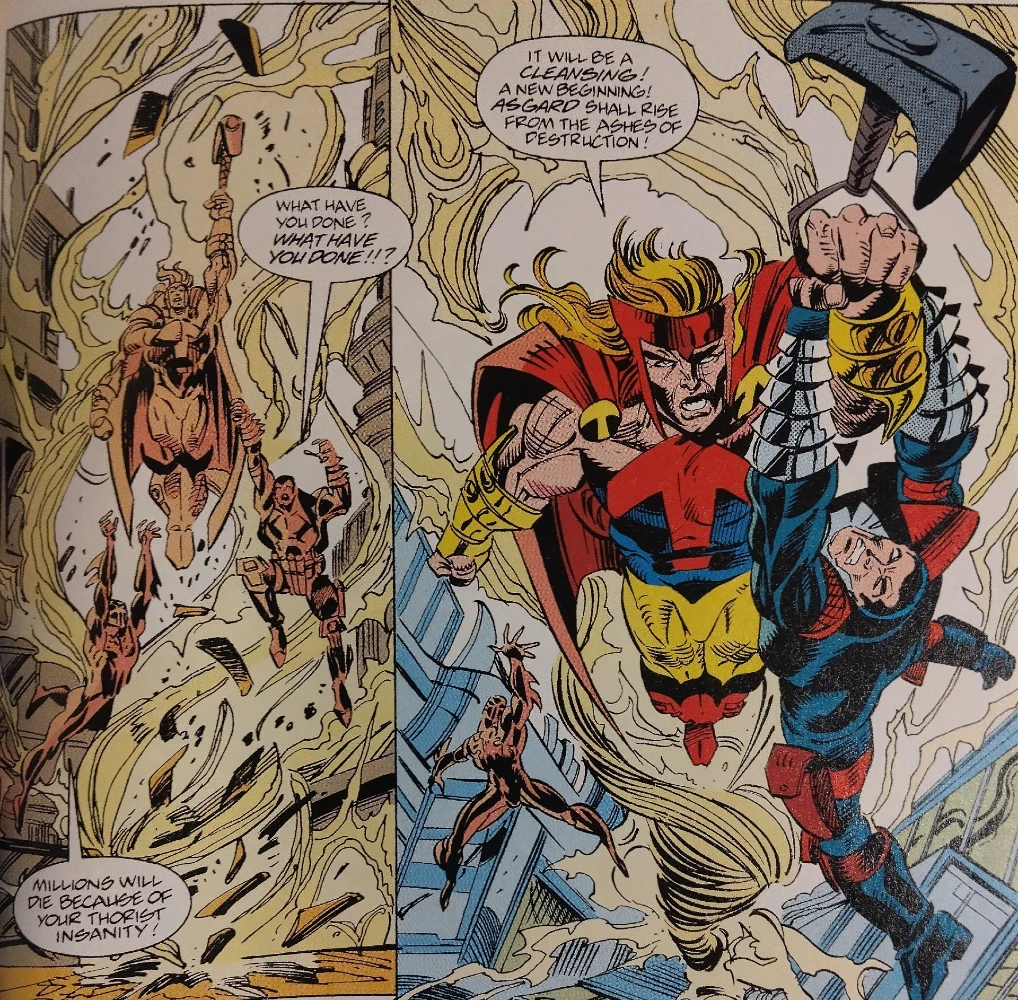
When I first got into the 2099 Universe, about seventeen years ago, I remember feeling excited for what this story promised. I received the first trade years before picking up the second, and in the time between, re-read those initial Spider-Man 2099 issues and really appreciating all the hints Peter David dropped for this event. The build-up surrounding Thorites believing in Spider-Man as the true herald of their god, along with Miguel's denial of his role, became an engaging subplot, particularly as Miguel, also reluctant in his role as a hero representing the oppressed masses, became more comfortable in these conjoined positions.
I also remembered being disappointed when I finally read this arc, that the payoff wasn't exactly what I expected it to be. I wondered, before recently re-reading "Fall of the Hammer," whether I'd react the same way. Having now done so, I can certainly say that, by Odin's beard, this stuff still isn't great. But it isn't awful.
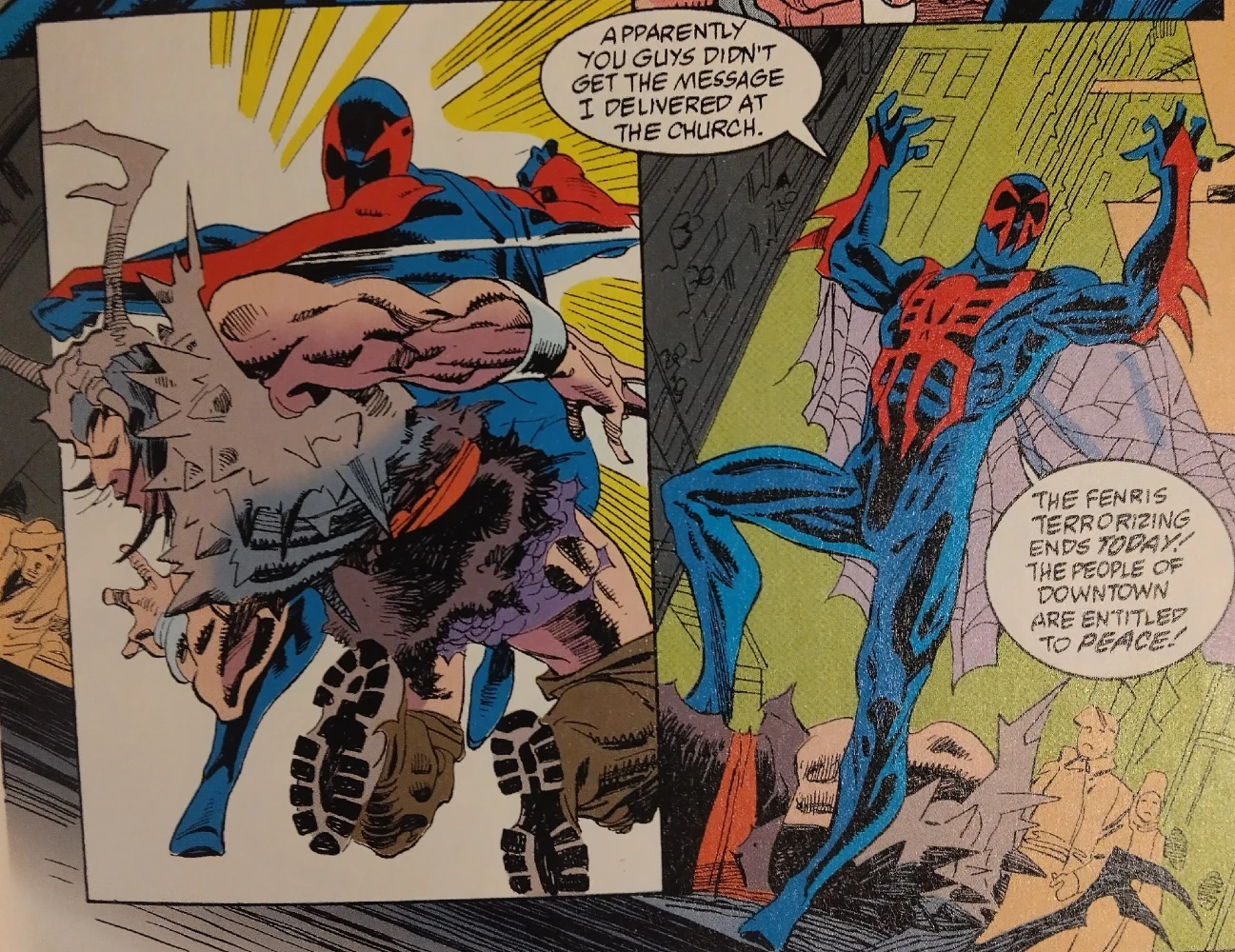
I'm gonna try not to spoil the exact revelations this narrative provides, but I will note that it does fulfill the brief by delivering us a Thor, along with a few other "Aesir," as the high-falutin god refers to his fellow Norse deities. The exact nature of their appearance is revealed by the story's end, and it's this revelation which thoroughly bugged me the first time I read it. I felt duped. Read into that how you will.
This second time around, however, I found myself not nonplussed by the seeming deception, likely because I recalled, generally, how the story ran. I also realized, to my own benefit, that the ending provides the point this narrative is trying to make: Thor's appearance ends up being further evidence of the manipulative ways Alchemax and her superiors keep bending the world of 2099 to its will, providing the guise of salvation under the auspices of their own motivations. Religion weaponized for the sake of capitalism.
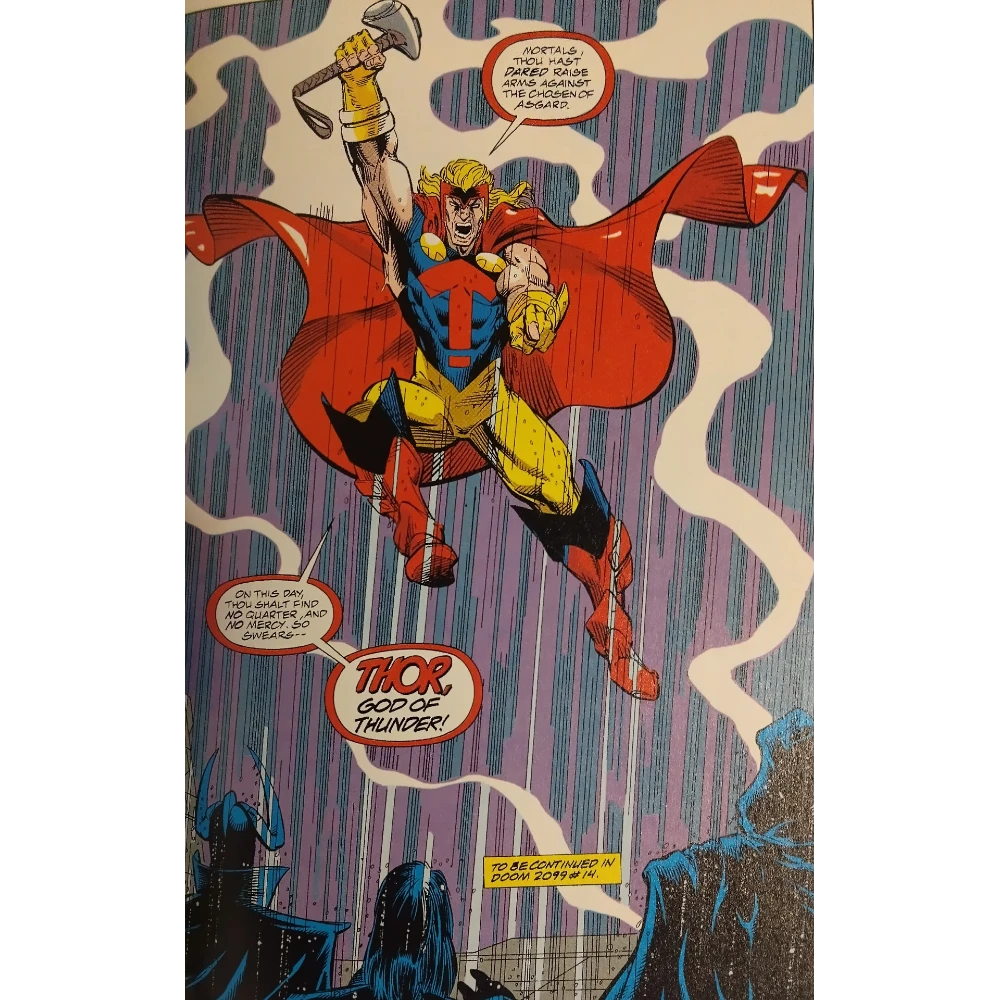
It's an interesting theme, and I will touch upon it later, but I do want to comment more on the overarching narrative first. This is a five-part crossover (six if you count the "prelude" Spider-Man 2099 issue I've included), drawing together the principal 2099 players: Spidey, the future's version of the X-Men, Ravage (a character co-created by Stan Lee), the Punisher (Jake Gallows, not Frank Castle), and Doctor Doom (who may or may not be the original Doctor Doom launched into the future). The plot is introduced fairly well, our seemingly resurrected gods posing an actual threat through the technological ark known as Valhalla, be it through ecological means (as posed by Ravage and the X-Men) or through the brutality of the Aesir. The truth becomes apparent quickly: Thor is not the saving messiah people hoped he would be. And not in a "I'm here to liberate you from your brokenness rather than your oppressors" way. More in a "I'm here for me and me only" way. Less New Testament, more No Testament.
Each issue adds to the ongoing narrative, and with all our characters in fairly close proximity, no one ever feels left out for too long. Team-ups allow characters to fight together–such as Spidey and the Punisher, or Ravage and the X-Men–and intentions are laid out in a pretty straightforward fashion. Ravage worries about the ongoing ecological threat Valhalla poses, the Punisher possesses a personal vendetta involving the murder of a loved one (but when doesn't that feature into the Punisher's personality?), and Doom seeks a certain amount of power for himself (but when doesn't that feature into Doom's personality?). Nothing much to think about here, but at least characters follow their established characteristics.
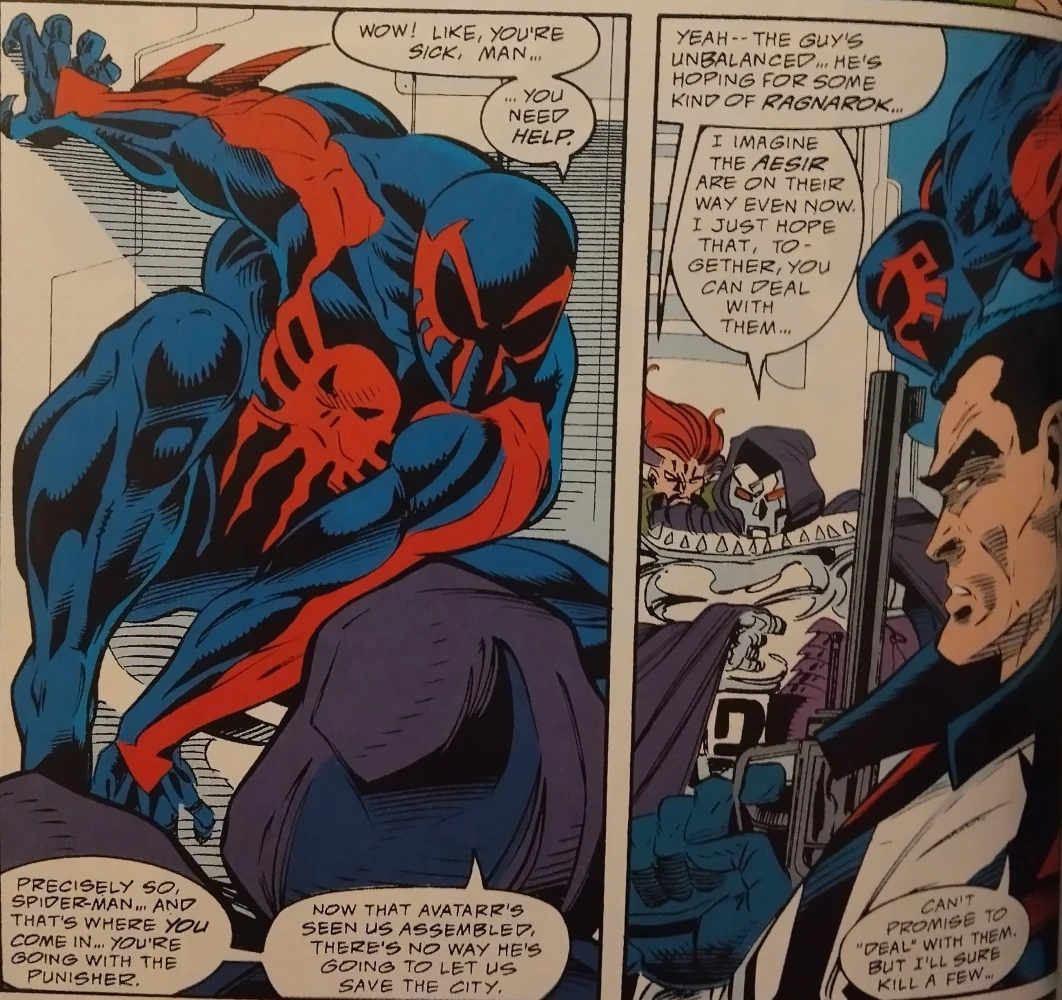
This arc's weakest aspect is that it doesn't find anything terribly interesting to say about its heroes while moving the plot ahead. We're given some interesting moments to consider–Pat Mills and Tony Skinner eschew the traditional Spidey/Punisher relationship by having Miguel support Jake's more lethal method of handling Aesir warriors, for example–but aside from strands of dialogue and a few noteworthy panels referencing previous narratives, the writers don't seem invested in furthering individual arcs (and, as a note, before you argue that my Spidey example contradicts the "established characteristics" comment above, I'll mention Miguel's version of our web-headed hero isn't against, at least, letting bad guys bite the big one–see his fight with the Vulture). We're here for the action, to see how the machinations of men and the designs of deities combine to spell havoc for our heroes.
To that extent, the arc can feel slow. Action occurs between scenes of Thor and other Aesir pontificating, and skirmishes between adversaries feel inconsequential at moments. The arc tends to follow the whole "Maximum Carnage" strategy of fight sequences, where no one gains the upper hand for long or where battles do little to actually further the plot. People fight, they come apart, they chat, they fight again. This may be due to the arc's crossover nature, with writers needing to shift focus to different characters and get their takes on similar narrative moments, thus disrupting some of the pacing.
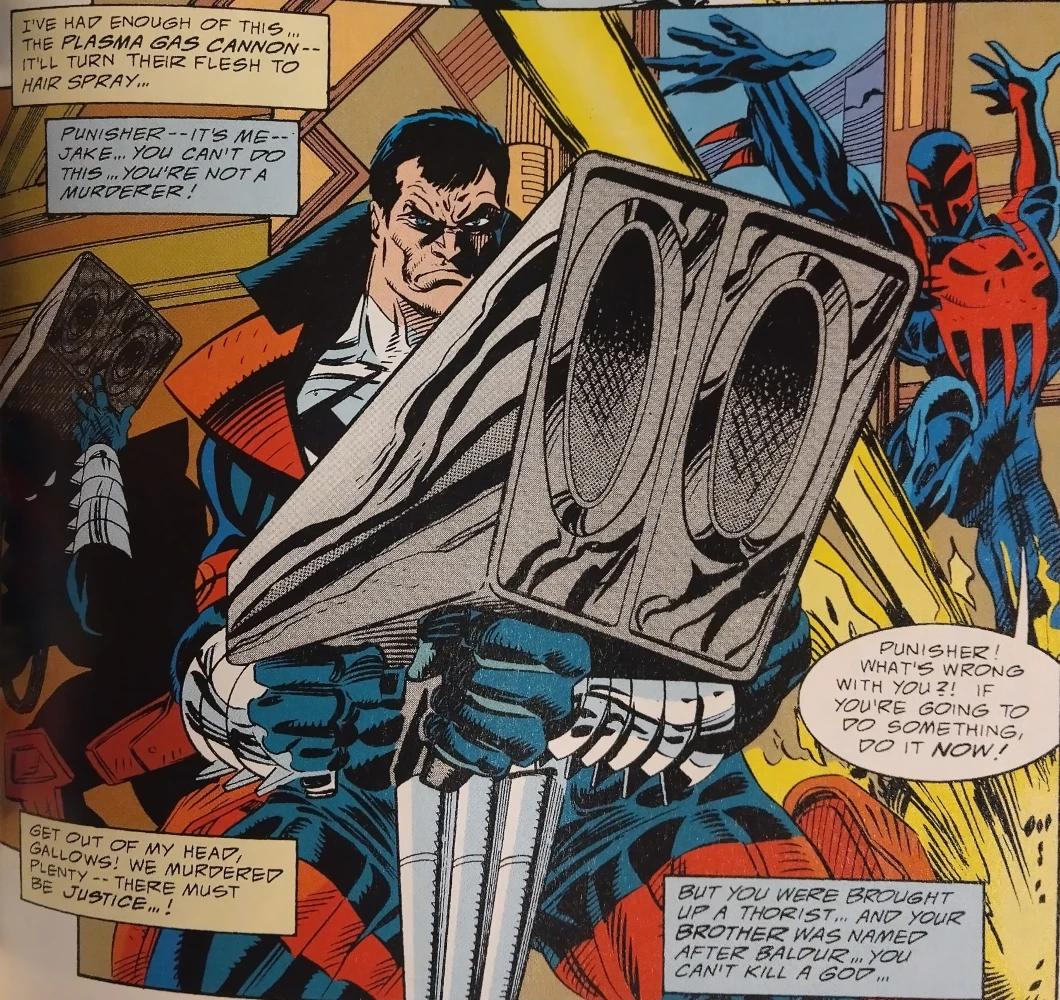
Where "Fall of the Hammer" provides intrigue is in its exploration of the theme I referenced above: again, without diving too deep into spoilers, our writers generate a scenario that calls into question the Thorite belief we've seen develop, particularly in previous Spider-Man 2099 issues. Their savior has arrived, but he's not what they expected, and though I won't reveal how, Thor is tethered to a plot involving Alchemax. To see a company so powerful that they actively manipulate religious faith through the appearance of that faith's symbol of hope, turning it in on itself and denying people the hope they desire to continue advancing their own aims is beyond grim. You're able to read in to such a plot and pull out relevant themes. You sympathize for the people caught up in belief that ended up betraying them, and you feel rage against a corporation that would tread on something so precious.
Each of the writers, in their own way, weave this into the crossover, but Peter David provides the strongest notions and most interesting elements of plot. His style of writing draws in humor and pathos in equal measure, sounding crisp when compared to some of the more stilted efforts by his compatriots. Where the notion of faith betrayed is handled well, other elements aren't as fresh, with John Francis Moore bungling the ecological threat Valhalla possesses by speaking about it too generically to generate interest. Understandably, this is an attempt to add more real-world relevance to the arc, but it's thrown in so casually you assume it was considered off the cuff as a "hot button topic" and added to force some interested ears to perk up. Even today, the notion is still relevant, but a handful of blatant references a theme does not make.
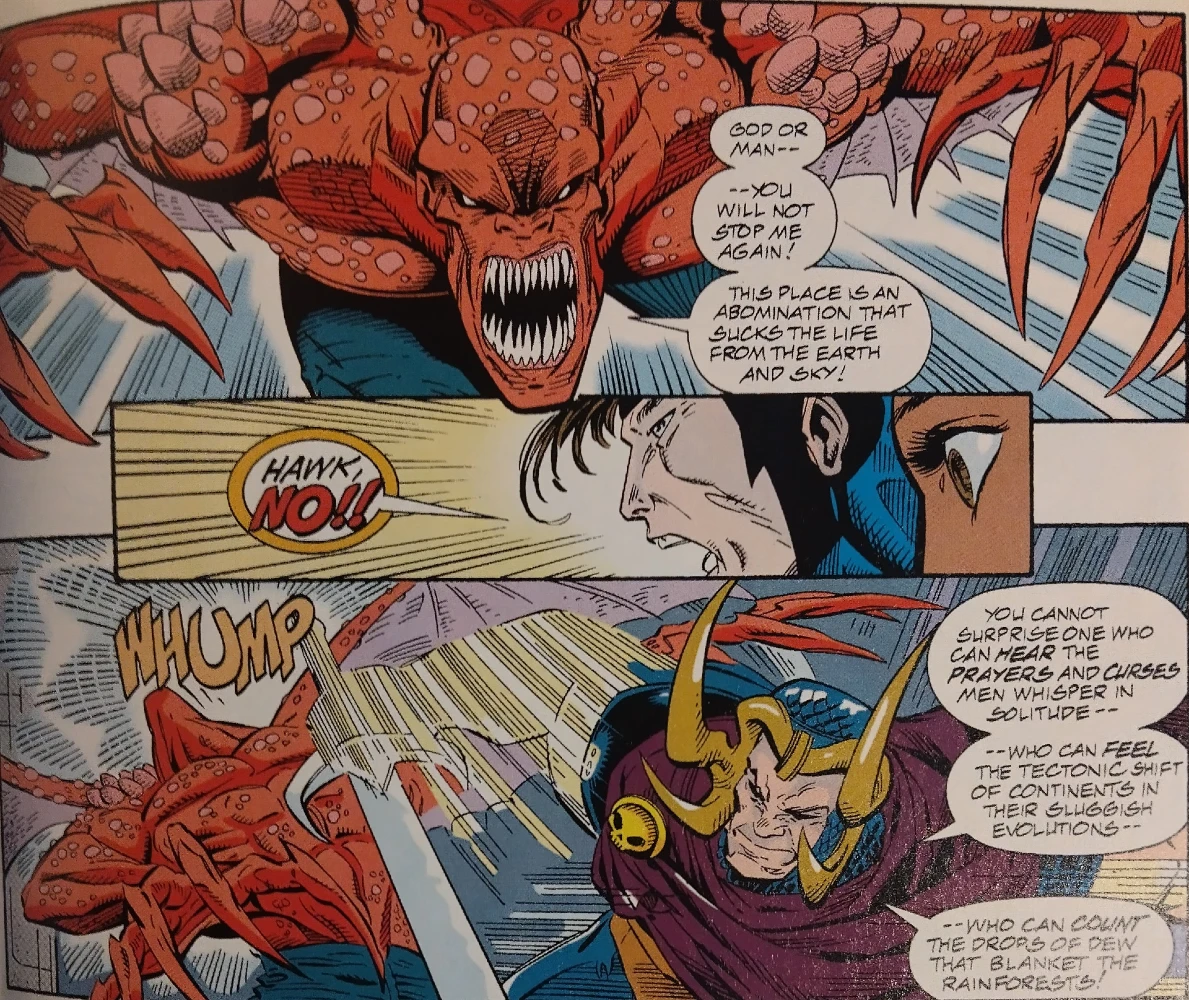
In Norse mythology, there is an obscure god named Forseti who settled disputes as a fair arbiter. Alas, the same cannot be said for human reviewers of comic books. I'll admit, I came into this narrative looking askance at it already, which is certainly far from impartial. Were I to hold a scale, I could add some entertaining character moments, some decent action, an interesting premise, and a valid theme onto one side. On the other side, I would pile pacing issues, otherwise lackluster characterization, and some mishandled thematic elements. The scale would tip downwards against this crossover's credibility. Elements work, especially when Peter David is at the helm. But with all the plot development and worldbuilding which has led to this crossover–its importance, perhaps admittedly, overdone by my own imagination–I find that more ends up falling here than just the titular hammer.