Distinguished Critique: Jimmy Olsen Adventures by Jack Kirby (vol. 2) Review
These issues showcase a creator who just wants to tell fun stories, even at the cost of complexity
—by Nathan on July 7, 2026—
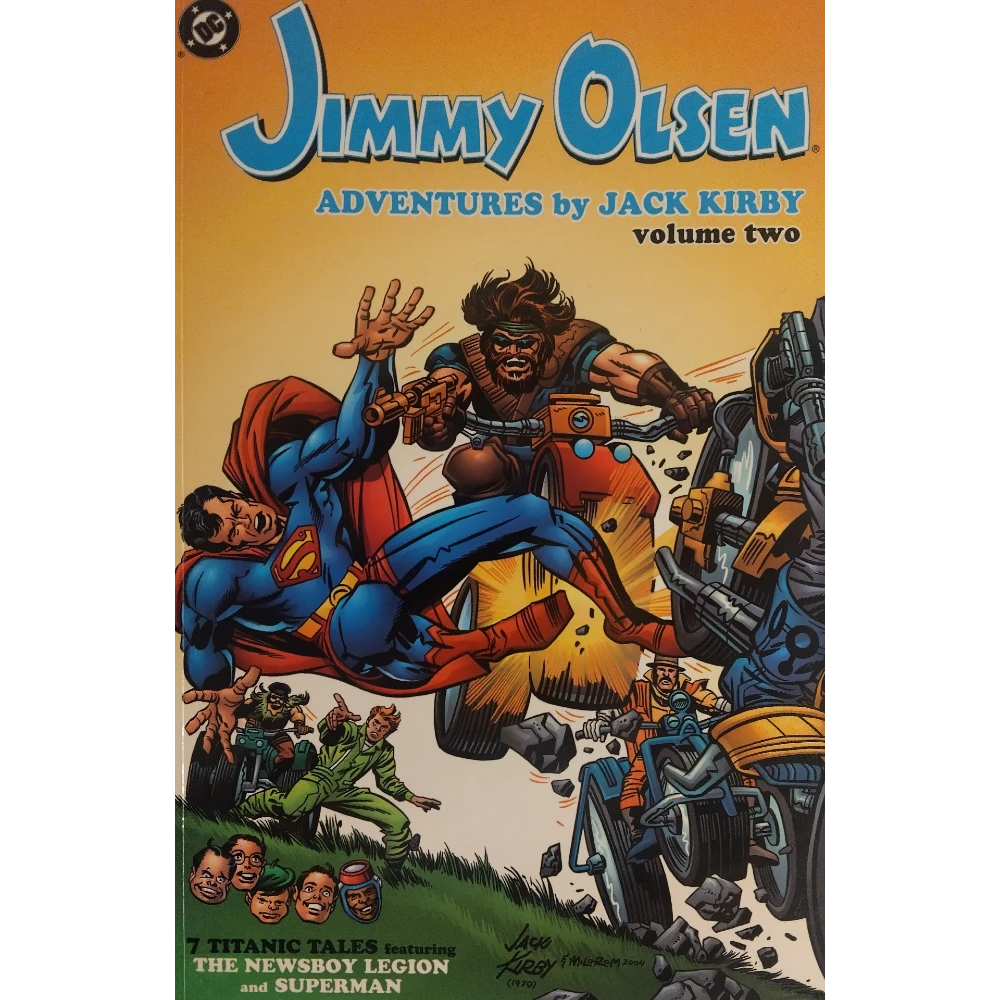
When I reviewed the first volume of Jack Kirby's contributions to Superman's Pal, Jimmy Olsen, I called those issues earnest and creative. Here was Jack "King" Kirby, the guy who'd co-created Captain America and the Fantastic Four, having found his way to DC after frustrations with Marvel (and Stan Lee). Even on a book titled after and starring Superman's buddy from the Daily Bugle, you can bet Kirby was going to go all-in and enthusiastically deliver the same kind of grandiosity seen during his Marvel heyday.
Which is absolutely what you get.
Because Kirby was the focus of a trilogy of "(Strand)om Stories" reviews I posted to celebrate the United States' semiquincentennial, I decided to check out other narratives he wrote and illustrated, specifically on the DC side of things (though I'm not quite finished with his Marvel contributions during the mid-70s). We're a few years before he returned to Marvel to handle Captain America, among other series, but as the 70s dawned, so did the King's influence rise upon readers of the Superman family of titles. Yet even as he delivered Jimmy Olsen's adventures, Kirby was plotting, bigger ideas circling in the background, waiting for an official unveiling.
Jimmy Olsen Adventures by Jack Kirby (vol. 2)
Writers: Jack Kirby, John Albano, and Nelson E. Birdwell
Pencilers: Jack Kirby and Win Mortimer
Inkers: Vince Colletta, Murphy Anderson, Mike Royer, and Henry Scarpelli
Colorist: Uncredited
Letterers: John Costanza, Howard Ferguson, Mike Royer, and Joe Letterese
Issues: Superman's Pal, Jimmy Olsen #142-148 and material from Superman's Pal, Jimmy Olsen #150
Publication Dates: October 1971-April 1972, June 1972
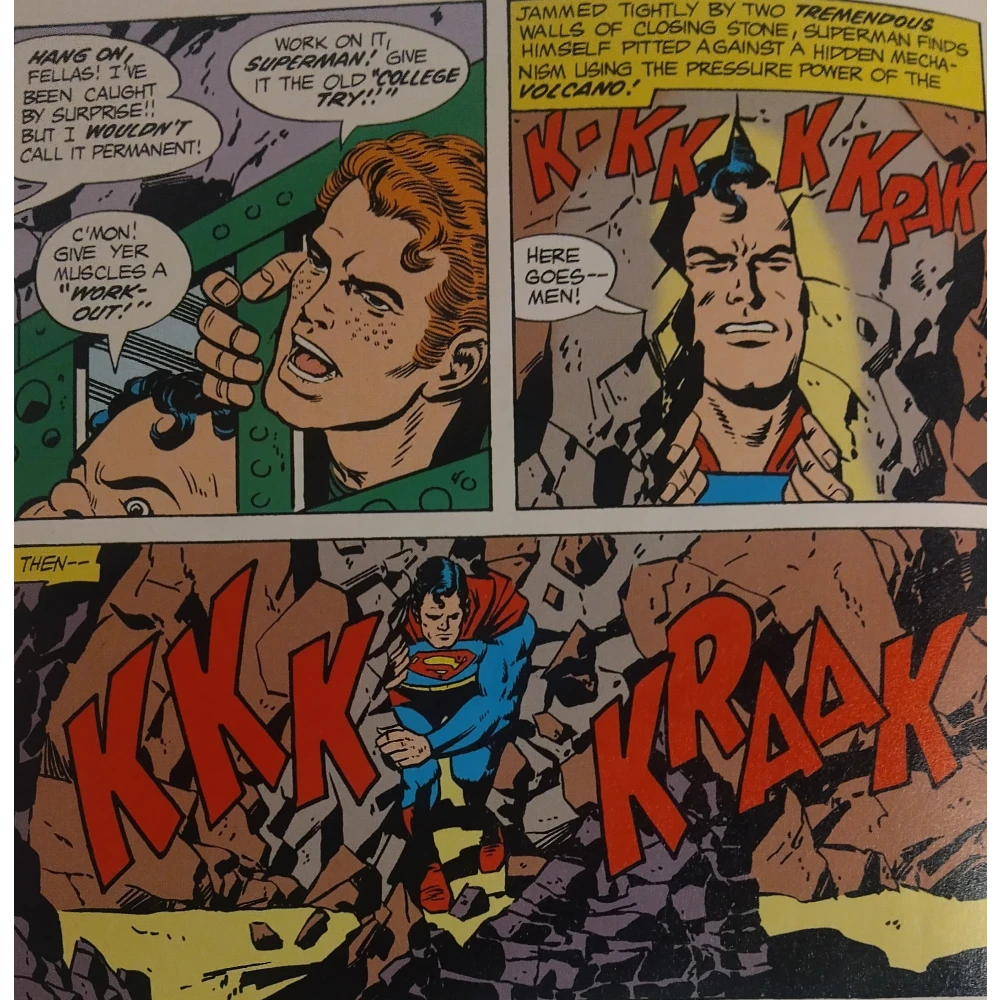
If I wanted to be somewhat ostentatious in titling this review, I probably would have called it something to the effect of "Jack Kirby: Portrait of a Man Contesting Confinment." Kirby's imagination, in any of his work, has rarely been a problem. He has big ideas which he can transform into tangible images; his art, though perhaps simplistic by certain modern standards, manages to capture the breadth of his thoughts. Look no further than his towering Celestials in Eternals or the Mindbomb in Captain America. Like the weapon used by elitist terrorists in that latter tale, Jack Kirby's mind was the greatest weapon in his artistic arsenal, only matched by his ability to translate mental images to the physical page.
Yet that concept of confinement, whether of his own doing or imposed by others, seems to consistently creep into his 70s work as an enemy Kirby fought tooth-and-nail. On Eternals, Kirby scaled philosophical heights on a journey readers weren't interested enough in joining; on Black Panther, it may have been (based on my own subjective perspective) him taking a character in a wholly different direction than generally accepted that didn't appeal to readers (which is an opinion I share, in this case). I've noted elsewhere that Kirby didn't readily adapt to the narrative contours of the age in which he was creating, rebelling against constraint. Yet that attitude, though it helped create a consistency to his linework (when it wasn't being worked over by other artists), also generated struggle.
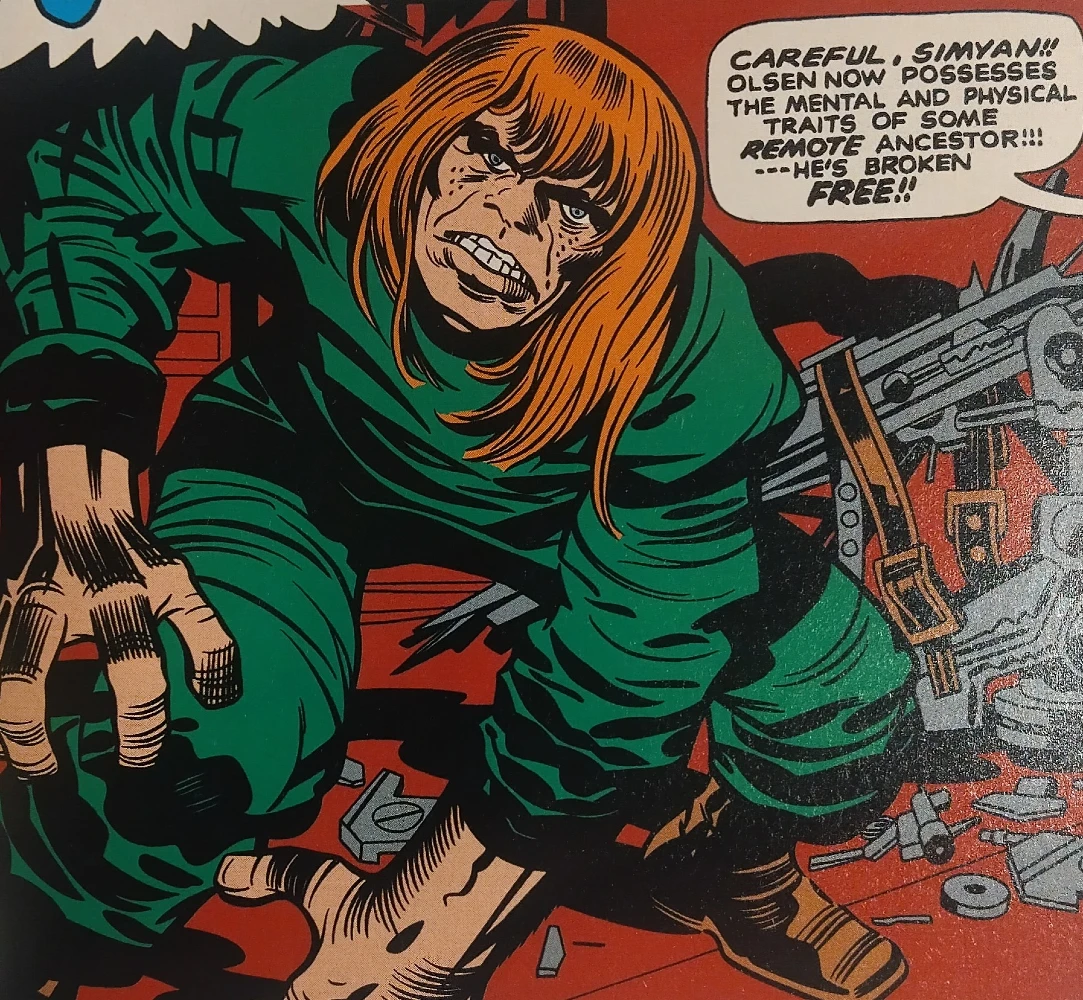
On Jimmy Olsen, you find a creator who does not want to play ball with the given standards on the title. Except for one issue (see the above image), which Mark Evanier notes in an introduction was likely a concession on Kirby's part, Jimmy doesn't transform into anything weird or inhuman, a staple of the title prior to Kirby's involvement (which makes me wonder if the appearance of a hulking Jimmy Olsen clone in the previous volume was his clever workaround of that trope). Kirby's come in, been given control of a title, and he wants to write and draw it the way he wants to write and draw it, darn it! He has a larger story at play, introduced in earlier issues and continued here, as he established a growing Fourth World mythology. What was more important: conceding to the powers-that-be that wanted Jimmy to turn into giants and werewolves? Or seeding the introduction to a villain who'd become one of DC's key antagonists? History certainly favors one perspective.
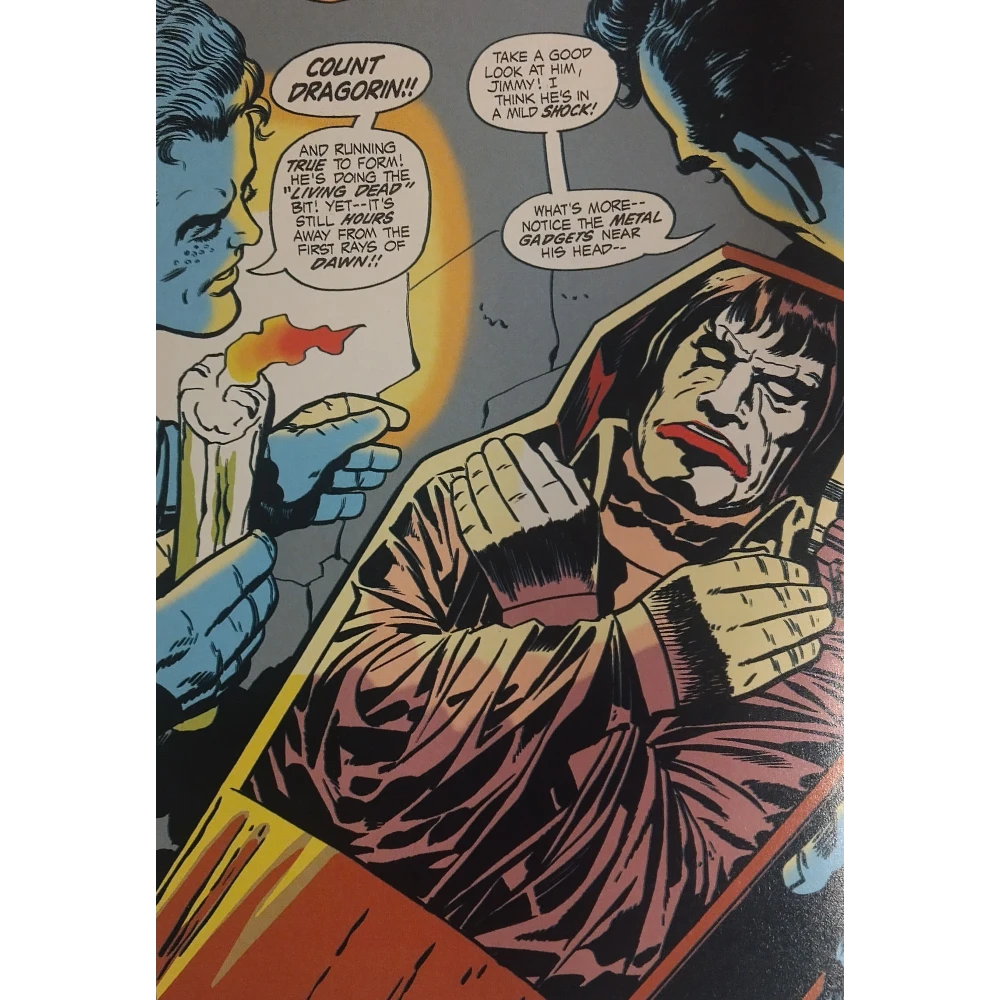
As in the first volume, Kirby keeps looking for what will be interesting and appealing not just to readers but his own storytelling ambitions. To that end, he develops an arc that features seeming vampires and werewolves as adversaries; telling this tale shortly before the Comic Code Authority allowed actual monsters to appear, Kirby is forced to provide a clever twist on the concept (his "Count Dragorin" is clearly a Dracula stand-in in all but name), yet this enhances the idea rather than letting Kirby dip into a paint-by-numbers vampire romp. Jimmy may be Superman's pal, but he and the stalwart Newsboy Legion are largely given their own adventures, separate from where the Man of Steel journeys. The Last Son of Krypton provides a helping hand on occasion, but perhaps more than even in the first volume, Kirby's young characters are self-reliant, often getting themselves out of the scrapes they get themselves into first.
Superman's primary function is to catalyze Kirby's ongoing Fourth World saga, which he does by reintroducing readers to the Boom Tube (originally introduced in the concurrently published Forever People) and seeding in some conflict. Darkseid pops up, Superman visits Supertown (where everyone is as super as he is) and chats with Highfather on New Genesis, and agents of Apokolips conspire against humanity. You get inklings of a growing schism between Darkseid's forces and humanity, a burgeoning war of which the good folks of Earth are unaware. The depth of Kirby's concepts are to be revealed elsewhere, but here, he can at least play a little.
Outside of his involvement in the developing "Fourth World" saga, Superman feels like a surprisingly insignificant part of the series. As noted, his lack of involvement does allow Jimmy and the Newsboys Legion their own agency, but it prevents Superman from embracing any interesting facets of his own character. He's around when trouble arises, using a litany of abilities to help folks when needed, but there are no subplots involving him or any important personal developments which affect his character. Clark Kent is basically a non-entity, showing up for a few pages in this volume's first issue before bowing out entirely.
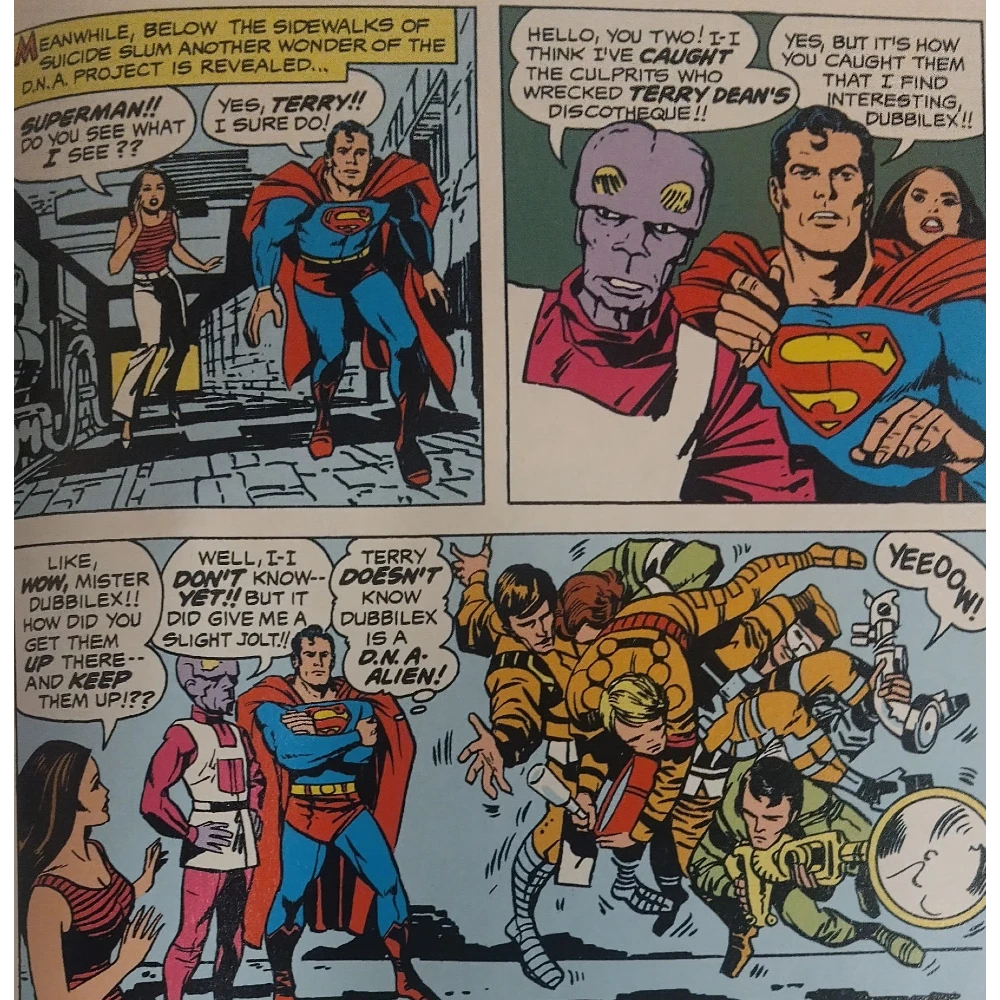
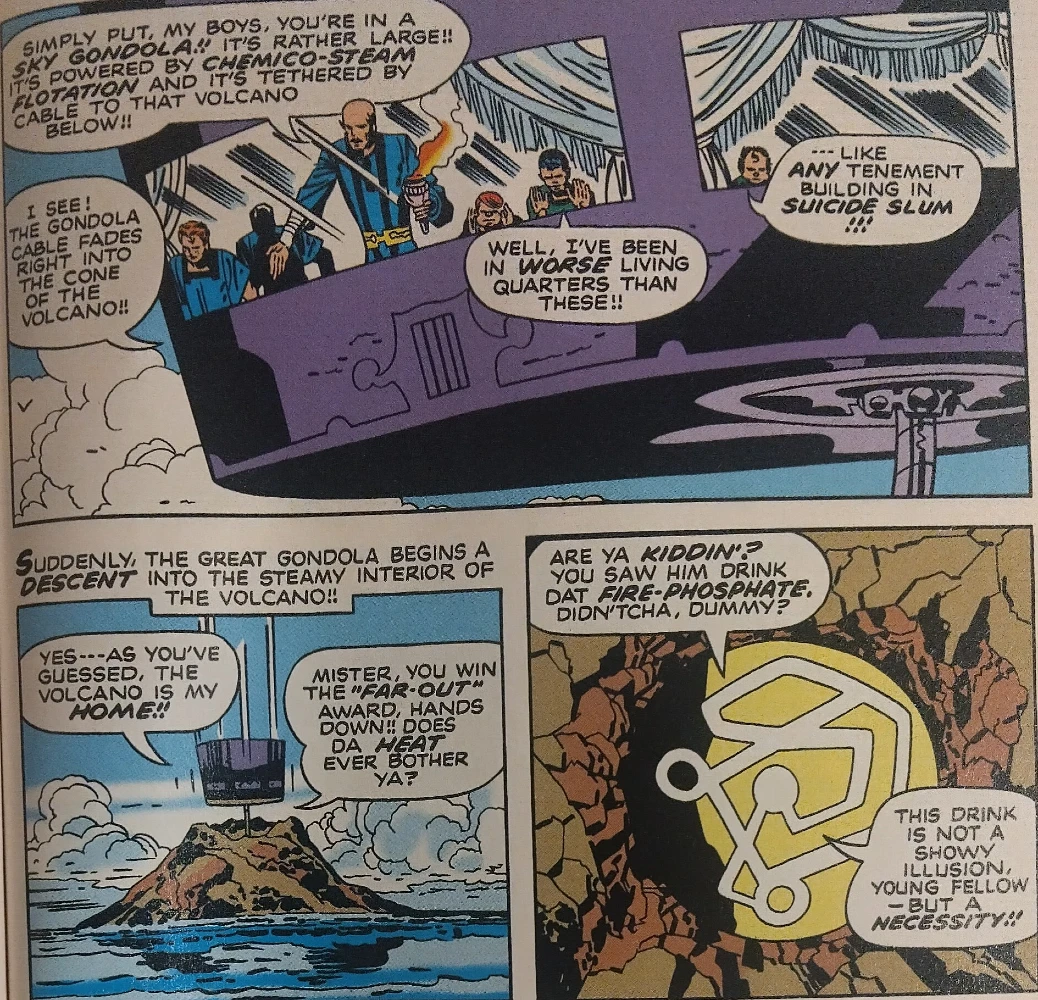
Kirby seems far more interested in doing what he can to embrace the wild and wondrous spirit which has imbued so many of his comics. He carries on a theme of genetic mutation from the first volume, culminating in a scene where a temporarily mutated Jimmy Olsen leads a rebellion of synthesized creatures against their Darkseid-devoted creators. His most significant antagonist is a volcano-dwelling madman (named "Victor Volcanum," naturally, perhaps the most on-the-nose name for a Kirby-created villain since that other Victor, "von Doom"!) who has achieved immortality by guzzling lava. Ideas are thrown in at a breakneck pace, new enemies and conflicts and creatures popping up without any context, all because Kirby wants them to.
You have to respect his imagination, even if it doesn't lend these narratives much significance in the way of characterization or complex storytelling. It's beyond fine to enjoy the fun of each narrative–mutated Jimmy Olsen rampaging around with monsters in tow! The Newsboy Legion exploring a Loch Ness legend! Superman rescuing his pal Jimmy Olsen and Jimmy Olsen's pals from Victor Volcanum's volcano!–but you cannot head into these issues expecting earth-shattering revelations (save the actual seismic terror Volcanum threatens) or new perspectives on classic characters. Perhaps Kirby's most inventive trick is a series of short pieces tacked on to a few issues detailing the history of the DNA Project introduced in prior issues; these provide a bit of intentional worldbuilding, teasing a glimpse at a deeper chronology in a fun manner.
DC was in the process of revamping their heroes, such as having Dennis O'Neil and Neal Adams update some aspects of Superman in his own title, similar to their legendary rejuvenation of Green Arrow and Green Lantern. I'm not aware if Kirby wasn't given the memo, told to ignore it, forgot to incorporate changes, or just plain chose not to. Nothing changes here for anyone. Given my assertion of "Kirby not wanting to play ball" above, I could see this being an intentional choice on his part. This is Kirby doing as Kirby was wont to do, and similar to what fans would see in his Eternals, Black Panther, or Captain America series for Marvel, his work is fairly isolated from the rest of the DC Universe. Siloed and separate, these stories, even if they lack some depth, provide the King a creative jungle to swing around and stretch himself in as he battles for a level of control he had been denied elsewhere.