(Strand)om Stories: The Tomb of Dracula (vol. 1) Review
Some stilted storytelling crashes against the strengths of a deadly, decently developed Dracula
—by Nathan on December 6, 2025—
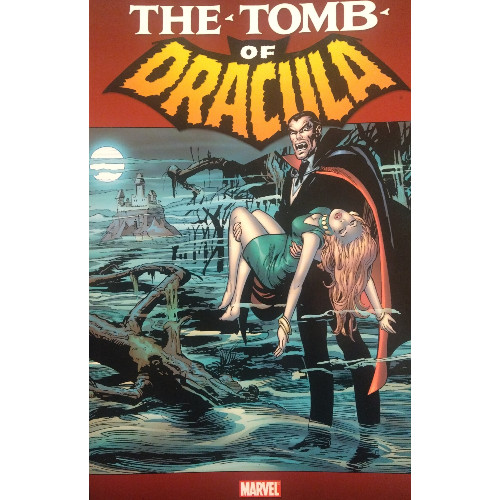
Welcome back to the crypt, everybody.
We spent a small portion of November examining vampire stories–wrong month, I know, I know–most recently exploring the adventures of Andrew Bennett, DC's star of their early 80s "I…Vampire!" arc in the horror anthology House of Mystery. I don't know if many people would label "I…Vampire!" a classic (though it's a fairly entertaining narrative), but I am aware of one horror series fans look to as quintessential, from DC's main rival:
The Tomb of Dracula.
In 1971, thanks in part to Stan Lee and Gil Kane's trilogy of Amazing Spider-Man issues focused on drugs, the Comics Code had loosened some of its standards, allowing publishers to tell slightly more pointed stories, such as Dennis O'Neil and Neal Adam's famous "Speedy is a drug addict" tale during their Green Lantern/Green Arrow run. These looser standards also applied to certain types of monsters, some of which had been prohibited. Maybe muck monsters like Swamp Thing were fine material to peddle to kids, but vampires, werewolves, and ghouls had been denied.
Until 1971.
Stan Lee and Roy Thomas decided that, with these looser rules, Marvel had a prime opportunity to embrace some of horror's greatest monsters, let the company diversify itself from just the tried-and-true superhero mags they'd been producing for close to a decade. Some of these new books–starring Jack Russell as the Werewolf-by-Night, Johnny Blaze as Ghost Rider, and Frankenstein's Monster as, well, himself–cast their fright-faced central characters as heroes, physical monsters combating different evils. But one book would feature a monstrous madman cast in a different mold.
Tomb of Dracula ran for 70 issues, and according to comic historian Les Daniels, is the most commercially successful (and possibly longest-running) comic series the company produced with an antagonist as the title character. The series has been collected in various formats, including black-white Essentials, colorized Masterwork volumes, two massive (and massively out-of-print) omnibuses, and a handful of (also largely out-of-print) complete collections. I don't intend to complete the Count's creepy, cunning misadventures, settling for this volume collecting the first twelve issues of the classic series. Perhaps appropriately enough for a series starring a vampire, I just wanted a nibble…and I promise not to become too bloodthirstily ravenous.
The Tomb of Dracula (vol. 1)
Writers: Marv Wolfman, Gerry Conway, and Gardner Fox
Penciler: Gene Colan
Inkers: Gene Colan, Tom Palmer, Vince Colletta, Ernie Chan, and Jack Abel
Colorists: Tom Palmer, Glynis Wein, and Petra Goldberg
Letterers: John Costanza, Artie Simek, Charlotte Jetter, and Tom Orzechowski
Issues Collected: Tomb of Dracula #1-12
Volume Publication Date: January 2010
Issue Publication Dates: April 1972-May 1972, July 1972, September 1972, November 1972, January 1973, March 1973, May 1973-September 1973
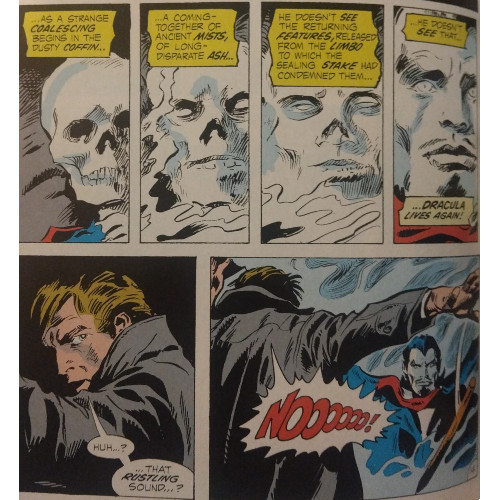
Though I've written a few reviews covering vampire-centric comics, this is the first where Dracula, self-proclaimed lord of those bloodsucking beasties, makes a significant appearance. He popped up as the main antagonist of Batman and Dracula: Red Rain, responsible for kicking off the events which inspired the next two graphic novels. But like many of his ilk, he wound up on the receiving end of a wooden stake. Other narratives I've reviewed recently have been derived from concepts put forth by vampire narratives, including Bram Stoker's original novel, but have provided their own twists, such as "the vampire is an American-Jewish writer living in New York" or "the vampire is a 400-year-old adventurer hunting his ex-girlfriend, who's the real evil vampire."
Today, we're scoping out the original vampire comic series, the first issues of which laid the foundation for the many years of stories to come, including some characters original to the series and others adapted from Stoker's classic novel. I've never read Dracula, so this review will be less about comparing the comic to its inspiration and more a reflection (which real vampires can't see!) on the issues themselves.
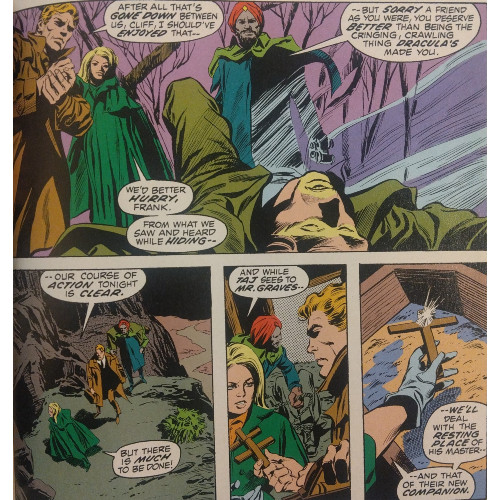
Dracula, though not the hero, is the series' principal character; everything that happens revolves around and relies largely on him and his predilection for drinking blood. Awoken from a decades-long slumber by Clifton Graves, friend of Frank Drake, Dracula's unwitting descendant, the lord of vampires strikes out against this present world, looking to satiate his hunger by drinking the lifeblood of every person he can sink his fangs into, principally women.
Even with the benefits the slight relaxation the Comics Code had on acceptable publishing material, certain restraints mean that this comic cannot present itself as dark and disturbing as it wants to be…which, for the younger reading populace at the time, was probably for the best. Our writers, accompanied by the ever-brilliant Gene Colan on pencils, focus a significant portion of pages to Dracula and his horrific habits, often obscuring the actual bites and slaking of thirst. What is not presented is perhaps more horrifying than what is displayed, the restrictions allowing the imagination to fill in the gaps provided.
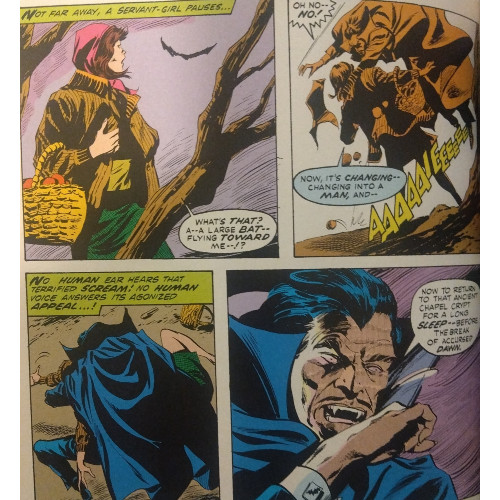
I have no idea if this is intentional, but Dracula's attention specifically towards women feels, to me, a somewhat subtle piece of social commentary done by our writers. The caustic commentator could remark that, by setting women up as fairly easy prey for Dracula, our writers turn female characters into simple victims. I'd prefer to see these attacks through a lens of injustice; Dracula is a predator, stalking women in bat form down darkened streets prior to attacking them. He kills men as well, but his fairly single-minded focus on young women feels like a disturbing obsession which goes beyond simply the need to feed. He's intentionally brutal in these targeted attacks, overcome by an arrogance which propels him forward with every step or wing flap.
The attacks set Dracula up as a particularly disturbing villain, one who takes a viciously personal hand in the deaths or vampiric transformations of his victims and often seeks revenge on those he believes has wronged him (though, in the case of a motorcycle gang who beat him senseless in one issue, I can't say I felt overt sympathy for those particular victims). As the issues develop, you see efforts to humanize the lord of vampires, specifically from Marv Wolfman, who is the strongest of the three writers (so don't let his last name fool ya!). A scene where Dracula is actually helped by a priest and taken in by a family after said motorcycle gang beating temporarily sees the bloodsucking sinner engage in characteristics such as humility and gratitude. Shocking, I know, but they allow ol' Drac a decent well-roundedness that I'm left curious about–did such humanity permeate further issues?

Part of me hopes they did, because even though Dracula is the main focus, the issues themselves largely center on the efforts of the series' heroes to murder the original bat-man, and this is where the volume shuffles along a little haphazardly. After a fairly rewarding set-up in the series' inaugural issue, casting Frank Drake as a tragic hero now unfortunately caught up in this hunt for his adversarial ancestor, the series putters along, never too worried about anyone not named "Dracula." Motivations are quickly established–the good guys want to put a permanent end to Dracula's thirsty rampage–but that quest becomes the core of who these characters are, especially Frank, who is given little personality outside his crusade.
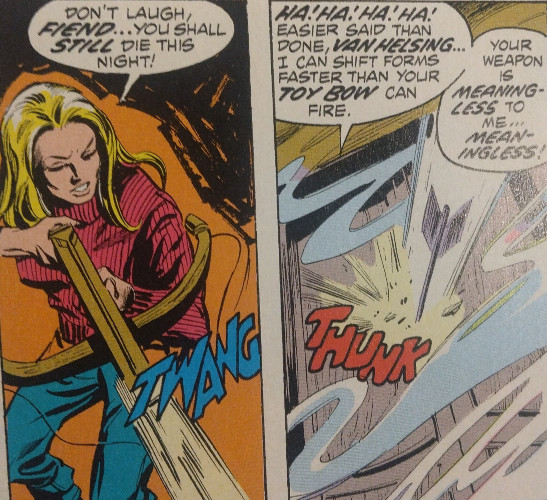
Other characters appear–Rachel van Helsing, granddaughter of famed vampire hunter Abraham van Helsing; Quincy Harker, an older, paralyzed vampire hunter; Clifton Graves, Frank's former friend hypnotized into total servitude by Dracula–and receive a touch of development (the most significant being a blossoming romance between Frank and Rachel), but they feel far less important than the series' titular terror. Perhaps most notably, these issues introduced readers to the vampire hunter known as Blade, presented as a one-man army who stays incredibly cool under fire. He's a highlight of the later issues, presented as a more legitimate threat against Dracula and other bloodsuckers.
Not that he has much to compete against in that department.
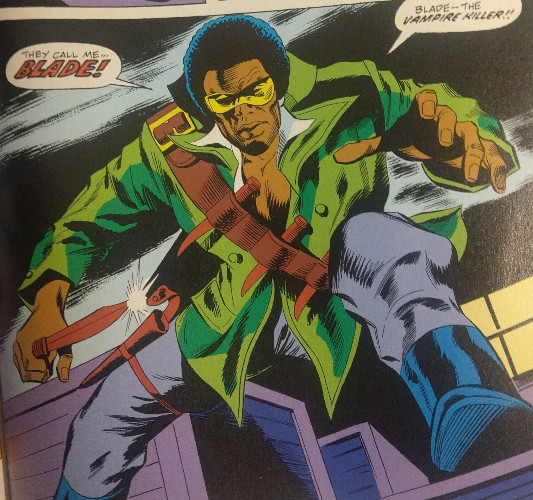
Our heroes spend the vast majority of these issues either planning to kill Dracula or attempting to kill Dracula, and given that the series ran for 70 issues, you can easily guess how successful they are here. I don't know the twists and turns other creators provided the series during its original run, but the storytelling outside Dracula's characterization feels relatively repetitive and stilted. Dracula flies around some, bites people, encounters our heroes; they try to kill him, fail, and then regroup to plan again. Sure, we're given variations on that particular plot–a few issues focus on time travel, Dracula uses surrogate enemies against the good guys (including a group of hypnotized, knife-wielding children!), and Dracula makes a few other enemies besides Frank and his friends–but the basics feel similar throughout.
Our writers also play a little loose with the rules, something I also discussed with DC's "I…Vampire!" stories. They seem beholden to typical vampire lore–no reflections, no sunlight, sleeping during the day, stake to the heart, crosses and garlic–until it becomes convenient for them to bend those rules. Yeah, a wooden bolt from a crossbow will absolutely kill Dracula…but every time someone tries to shoot him, he turns into mist or a bat and flies away! Elsewhere, our heroes conjure other tricks that can't ever seem to kill Dracula, though they can often momentarily injure or distract to allow one or the other party to escape and maintain their stalemate in a "I'll get you next time!" fashion, though there's always another next time following the first next time. I've read the series really hit its stride in the issues after those collected here, so maybe I'm just settling for the volume with some lackluster content.
The series may be called Tomb of Dracula, but the vampire lord is really unearthed and allowed to rise in these issues. He's the main character, a villain you come to love to hate, a parasite driven into our modern world and forced to fulfill his ghoulish urges while contending with the descendants of old foes and motorcycle gangs (and I never did mention the one guy trapped in an iron lung!). Tonally, our writers work well with Colan to achieve desired spookiness, maintained not only through grim feedings but Colan's take on locales such as foggy streets, grim castles, and creaky mansions, as well as subject matter such as brainwashed kids, a legion of rats, and fights between bats. The plots can feel a little threadbare at times, and our heroes need some gussying up in the strategy department, but if you're reading this comic, it probably isn't for the vampire hunters. You're reading this for the vampire they're hunting, and he becomes a character you can certainly count on.
Ah-ah-ah!