Distinguished Critique: I…Vampire! Review
A thoroughly entertaining run of issues succeeds in telling an offbeat saga that sometimes stumbles over coincidence
—by Nathan on December 2, 2025—
I think I could have some form of "comic book kleptomania," because I occasionally find volumes have wound up in my collection without me completely remembering how. Okay, I don't possess the urge to steal comics–I've either been gifted or purchased everything in my collection–but some comics have just…become part of my collection, drifting in on some long-forgotten breeze, and I don't fully recall where they came from or where I was when I purchased them…or, more likely, why I purchased them.
Take today's volume as an example. I have a vague memory of stumbling upon it when browsing the shelves at a Half-Price Books, but I can't give an exact reason as to what caught my attention. I'm not terribly fond of horror comics, though I'll pick up something a little creepier now and again. My only thought is I saw this volume, noted J.M. DeMatteis' name on the cover, and figured that my appreciation of DeMatteis would generate interest in this story. Some undetermined amount of time later, I've finally read it.
I have touched on, fairly recently, a few other DeMatteis stories centered on vampires, one a Spectacular Spider-Man annual, the other a two-issue tale from Marvel focused on a Jewish-American writer with a hankering for blood (yeah, really). Those stories reminded me of this volume (as well as one other monster-focused collection I have which I hope to discuss in the near future), and I elected to keep the DeMatteis train chugging along. Though I completely overshot the best season in which to write horror-centric reviews, I still wanted to take a nip at this tale. I'm not a vampire; I'm just a humble writer, but I'm always eager to peer beneath a story's skin and see what gets its blood pumping and flowing.
I…Vampire!
Writers: J.M. DeMatteis, Bruce Jones, Dan Mishkin, Gary Cohn, Mike W. Barr
Pencilers: Tom Sutton, Ernie Colón, Adrian Gonzales, Paris Cullins, Jim Aparo
Inkers: Tom Sutton, Ernie Colón, Adrian Gonzales, Jim Aparo
Colorists: Adrienne Roy
Letterers: John Costanza, Gaspar Saladino, Annette Kawecki, Duncan Andrews, Ben Oda, Todd Klein, Adam Kubert, and Jim Aparo
Issues: House of Mystery #290-291, #293, #295, #297, #299, #302-319, and The Brave and the Bold #195
Publication Dates: March 1981-April 1981, June 1981, August 1981, October 1981, December 1981, March 1982-August 1983

Normally, when I look at a volume of comics collecting a singular story guided by five writers, five pencilers, four inkers, and a small army of letterers (props to Adrienne Roy for staying on as the only colorist!), I get a little concerned. That brings to my mind images of disjointed storytelling, plots left to writhe in agony while another writer shapes the narrative his way, and art which fluctuates in style and detail. A thoroughly unrewarding mess.
Which is not what we're offered here.
I didn't walk away from I…Vampire! proclaiming that I had found a diamond in the rough, an unsung fable of epic proportions that genuinely deserves more fanfare and praise than I've heard it receive…though, to be honest, I've never heard anyone discuss this story, so I should be fair and say it does deserve more than I've heard, as that threshold is abysmally low. You hear people discuss horror classic comics, they bring up Marvel's Tomb of Dracula or Werewolf by Night or DC's Swamp Thing. Not an ongoing narrative about one vampire's desperate attempts at preventing his ex-girlfriend from turning the world into bloodsucking parasites.

So lemme start off by saying: I…Vampire does deserve more fanfare and praise.
J.M. DeMatteis leans into his greatest weapon, strong characters the reader empathizes with, to construct the first few issues of the series. We're introduced to Andrew Bennett, who's been a vampire for 400 years and desperately working against the woman he turned into a vampire all those centuries ago. Mary, Queen of Blood, and her disciples of the Blood Red Moon, seeks to reshape the world in her image, and it seems to only be Andrew and a handful of allies who are willing to stop her.
Concurrently with these House of Mystery issues, I've been reading a batch of Tomb of Dracula issues, which I plan to review soon. The problem I quickly developed with that series was its seeming repetitive nature: our heroes hunt Dracula, find Dracula, and then fail to kill Dracula, all to keep the series perpetuating as long as it can. I was slightly concerned, as Bruce Jones took over for DeMatteis, that'd we see a similar problem: recurring plots, all to generate the same basic narrative structure in a seemingly endless string of issues which never truly slake the reader's thirst for fulfillment. Fortunately, that never became a problem.
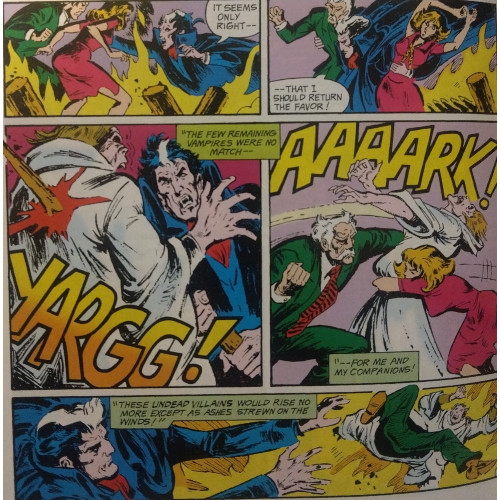
DeMatteis and Jones stand out as the best writers on this narrative, because they understand who their characters are and the directions they want to go. There is always, always an endgame in sight, a final chapter waiting in the wings. It may take a while to get there, but the paths used to reach that point end up being more entertaining than I initially figured. Part of this, specifically from Jones and later writers Dan Mishkin and Gary Cohn, occurs when our writers lean into an appropriate amount of absurdity. Jones develops an entire arc where Andrew chases "his" Mary across time, popping up at significant points in history, such as during the Jack the Ripper slayings, and revisiting his own past in an effort to stop her from altering the present. A time travel trip thrown into our blood-and-fangs horror mag! You betcha! And it works, utterly surprisingly, because of the characters we're becoming more involved with across the issues.
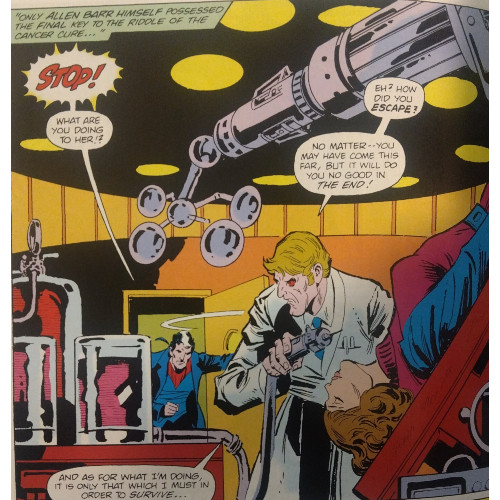
Early on, you get the sense that, while DeMatteis and then other writers had that ending in sight, they weren't quite certain how to reach that point or how long it would take. Thus, several early chapters feel more like one-and-done issues, the story as a whole taking some time to build into slightly longer arcs. None of these issues read terribly poorly, and several of them take a "human interest" angle–Andrew and his allies fight vampires who are also white supremacists, find a cult of religious vampires, encounter a young family who suffer for aiding Andrew–emphasizing not just our central characters but others they run into during their fight against Mary and her ilk. The "vampire cult" may be a work of fiction, but there's enough application of real world evils, such as racism, unlawful scientific experimentation, and serial murder, which bleeds (sorry) into the fantastical vampirism to provide these stories more heft.
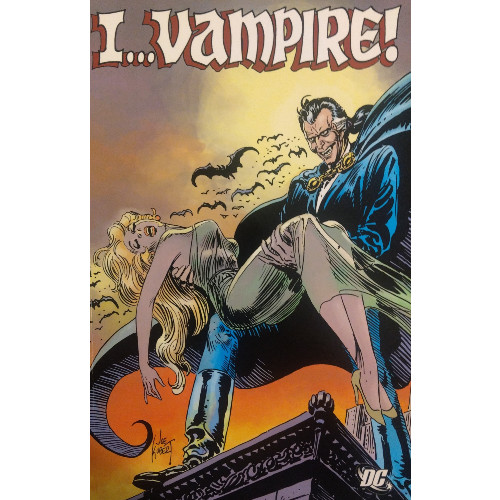
Andrew is a unique character, a vampire who, unlike some of his toothy counterparts, isn't the villain. Don't let Joe Kubert's cover for this collection deceive you; Andrew is a vampire with a heart of gold…just so long as nobody drives a stake through it. He has the same weaknesses and tendencies as your typical vampire–he can't walk in sunlight, he craves the thirst of blood-yet he resists his urges and endures his curse with the hope that, someday, he'll find peace with himself…if he can ever beat Mary's scheme.
DeMatteis hints at an interesting theme regarding Andrew's character, but Jones plays with it across his issues, allowing Andrew decent wrestling over the guilt of his current circumstances. He knows he's culpable for Mary's current condition, and he feels responsible for hunting her down. He lives in a world oblivious to her threat, and with allies Deborah Dancer and Dmitri Mishkin (no relation to one of this volume's writers), finds himself with few resources to continue the fight. Jones fully understands the weight Andrew deals with, not just of his own urges, but of his tangled relationship with Mary: can he save her from herself? Is there a chance the vampiress can be redeemed? Or will he ultimately be forced to end her threat permanently? These questions make up most of Andrew's arc, as his dogged determination is bound up in his old emotions for his long lost love.
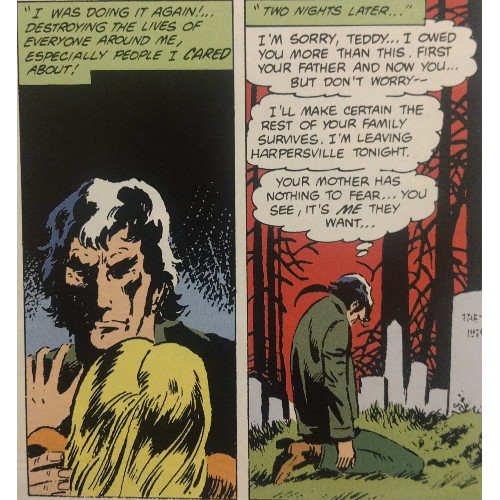
His allies, Deborah and Dmitri, are empathetic enough, staunch supporters of Andrew's cause who, as you learn, have their own personal histories wrapped up in his and Mary's conflict in unexpected ways. Each of the writers touch on these two, revealing who they are in pieces throughout the issues, grounding their current devotion and love for our heroic vampire in decently revealed past events. That they each, in a sense, receive complete story arcs is an added bonus, their own conclusions fittingly paralleling Andrew's by time the series has run its course. I won't give away specifics, but the conclusion does feel appropriate for everyone involved, answering those questions I mentioned above and fulfilling the promise DeMatteis implicitly makes at the start of the series: Andrew's hunted Mary for 400 years…and, in some way, that hunt ends.
Where these House of Mystery issues can stumble is in some of the specifics; DeMatteis and Jones endeavor to introduce a vampiric mythology, based around a certain set of classic rules (the stake to the heart, the blood-drinking, etc.) tailored specifically to Andrew and Mary's situation. The problem, as it happens in a handful of issues, is that the writers end up breaking their own rules in order to create tension. A stake to the heart effectively kills a vampire…until Jones uses the method on Andrew to create a cliffhanger, offhandedly explaining that "you cannot truly kill what is already dead," even though the same trick works on every other vampire that gets killed in the series. A few moments like this occur across the story, offering the writers a convenient "have your Halloween candy and eat it too" way to place Andrew in situations he should not escape but allowing him a convenient method of doing so.
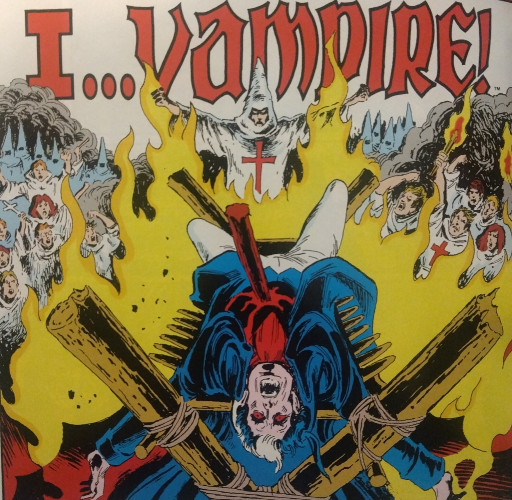
These coincidences may momentarily lower the "stakes," but aside from these scruples, I found more to appreciate about Andrew Bennett's arc than I originally believed. He's a virtuous vampire–calling to mind Doug Moench's "not all vampires are evil" assertion in his and Kelley Jones' "Batman: Vampire" graphic novels–a hero who suffers from the same affliction as his adversaries but is unwilling to become as twisted as they are. This series packs in several grim twists and turns, surprising changes in genre, and some thoroughly engaging characters, and even though the assembled creative team is a multitude, they somehow never stray from the story's singular, sometimes disturbing, surprisingly rewarding focus.