Distinguished Critique: Legion of Superheroes: The Great Darkness Saga Review
Paul Levitz's classic epic is a near perfect representation of DC's heroes of the future
—by Nathan on March 9, 2026—
Anytime I think of the Legion of Superheroes, I fondly recall an early 2000s animated series that premiered on Warner Brothers' Kids' WB programming block on Saturday mornings. My younger sister and I spent a few fantastic years waking up early and soaking in shows, and though my craving for Marvel content was eventually quenched through their short-lived Spectacular Spider-Man series, it was generally DC that dominated the airwaves. Krypto the Superdog. The Batman (still my favorite show to this day). And The Legion of Superheroes.
(Loonatics Unleashed was also great. And does anyone remember Eon Kid? Wish we'd gotten a second season of that show…)
My knowledge of the Legion until their animated debut was fairly limited…not that it's changed much. Before watching the show, I knew who some of the principal players were–Lighting Lad, Saturn Girl, Cosmic Boy, Brainiac-5–and little bits of lore, largely thanks to a DC Encyclopedia I borrowed a few times from the library. But outside maybe one errant volume of comics I picked up, I never really got into the team. I thought the show was great, tackling group dynamics and toying with future versions of certain DC characters, but that love never translated over to the comics.
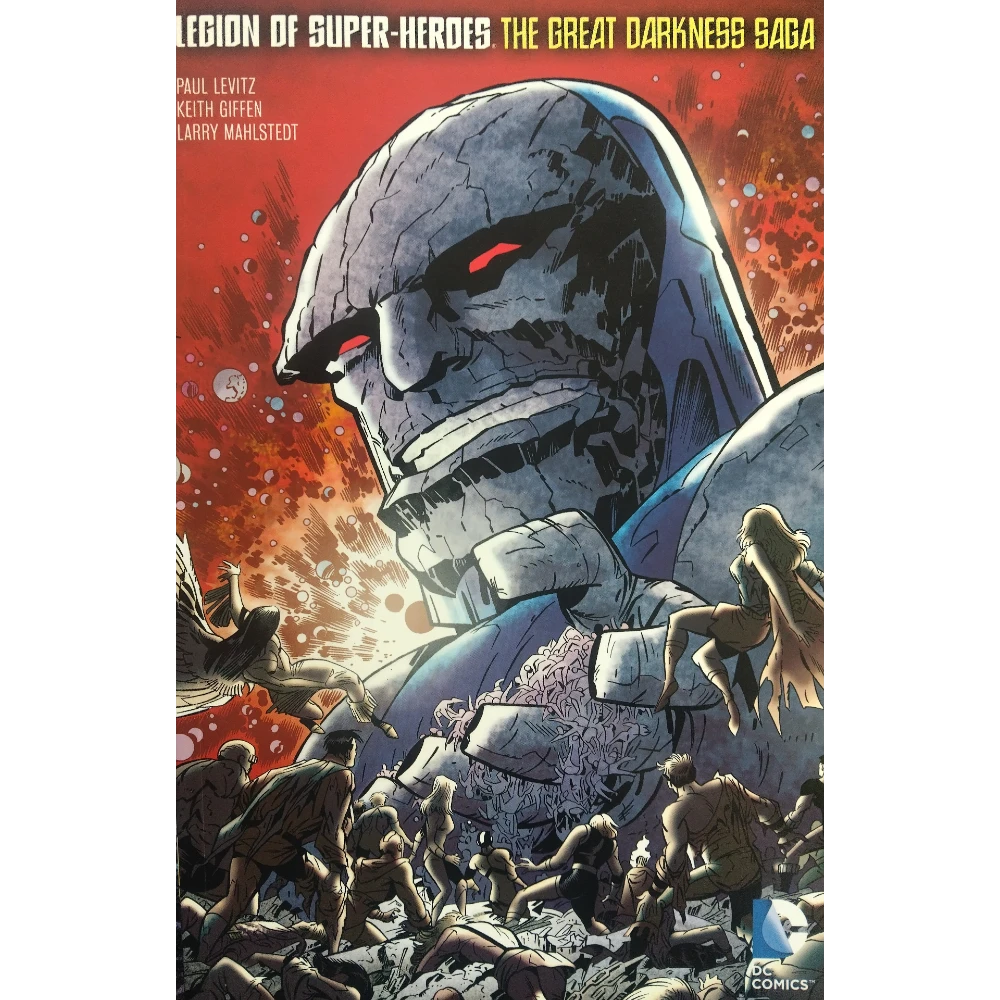
A few years back, I found the volume we're reviewing today in a bookstore and, needing a few early 80s comics for a graduate thesis I wrote on comics, decided to give the Legion's most well-known narrative a spin: "The Great Darkness Saga." Written by Paul Levitz, author of a few other DC stories I've recently reviewed, during his second stint on the title, this multi-chapter epic is considered the high water mark of Legion narratives and a staple of famed DC Comics stories. I'm reading it largely divorced from the Legion history surrounding it, reviewing its standalone strengths as Levitz works with a few artistic partners to develop a saga which remains, to this day, seemingly unmatched.
Legion of Superheroes: The Great Darkness Saga
Writer: Paul Levitz
Pencilers: Keith Giffen, Pat Broderick, Howard Bender, and Carmine Infantino
Inkers: Larry Mahlstedt, Bruce D. Patterson, Rodin Rodriguez, and Dave Hunt
Colorists: Carl Gafford and Gene D'Angelo
Letterers: John Costanza, Bruce D. Patterson, Ben Oda, Adam Kubert, Annette Kawecki, Todd Klein, and Janice Chang
Issues: Legion of Superheroes #284-296 and Legion of Superheroes Annual #1
Publication Dates: February 1982-February 1983
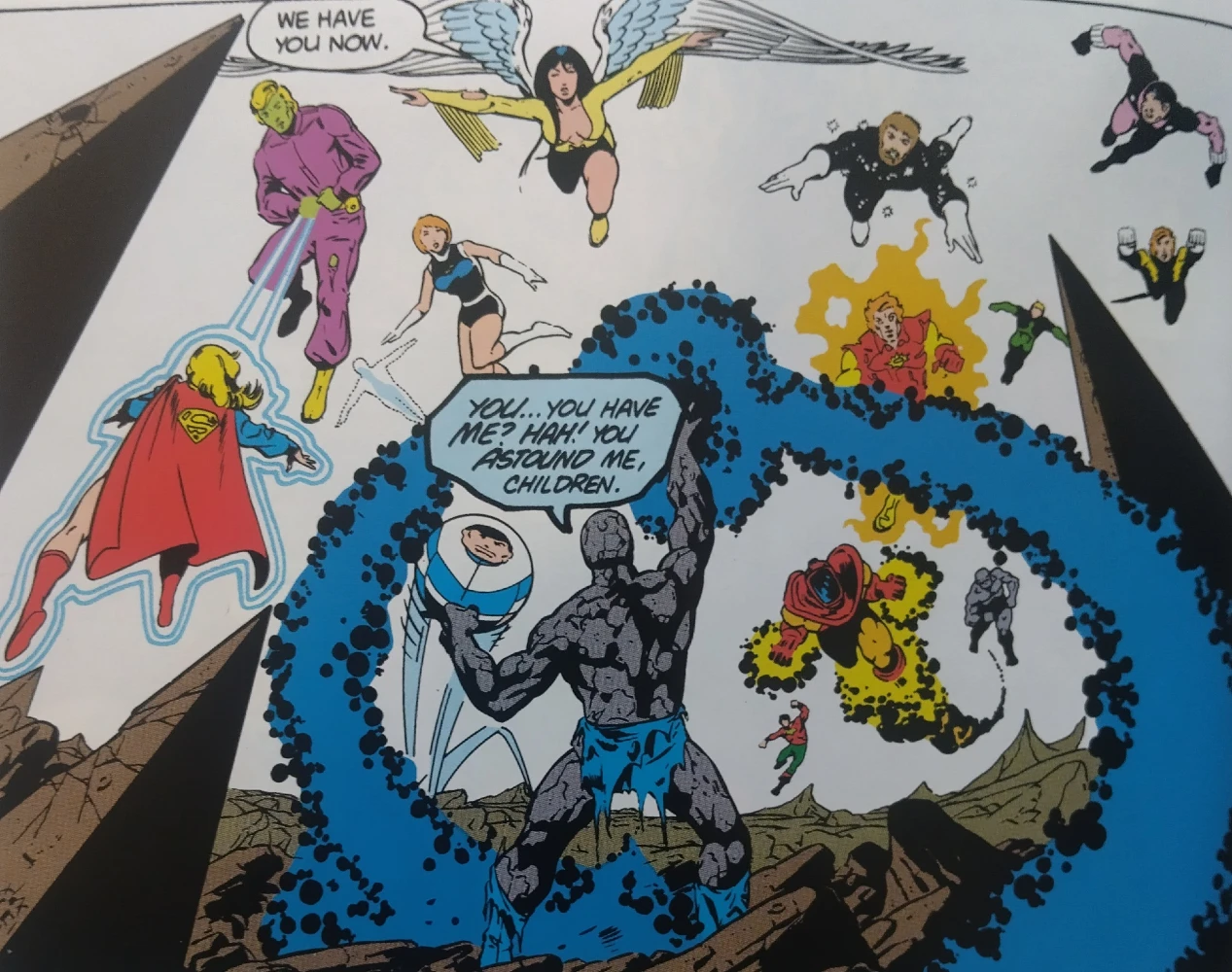
The "Saga," I would argue, retains its popularity through the strength of the narrative told, which I'll discuss, but I'm first going to address the grim, gray New God in the room: the story's success, I would also argue, is in part reliant on its dramatic reveal, that the mastermind behind the various events which plague our heroes is none other than Jack Kirby's lord of Apokolips, the dreaded Darkseid, initially introduced during the King's stint on Superman's Pal, Jimmy Olsen, of all books. The story has become so synonymous with that particular revelation that, as you can see, Darkseid's visage is printed boldly on the front of this collected edition, as it is on earlier trades, DC doing absolutely nothing to prevent it from being known before you flip a single page. I would wager most people reading this story nowadays do so knowing full well of Darkseid's involvement. It's a twist like Jean Grey's transformation into Dark Phoenix, Bucky Barnes' "resurrection" as the Winter Soldier, or Gwen Stacy's death–you probably heard of this one long before you ever read the comic.
But that doesn't limit or hinder the story's staying power.
I can only imagine being a reader while the "Saga" was originally published, wondering who the narrative's purported villain is, this enigmatic, enshrouded figure called only "master," a silhouette sending his minions to do his dirty work until finally revealing himself. The twist hinges on readers' familiarity with Kirby's mythology and Darkseid's status as a supreme DC villain, perhaps enhanced by the notion that few creators had used him outside Kirby's ongoing "Fourth World" saga and, when doing so, always in the then-present DC Universe. Years before he became a staple villain in DC's post-Crisis universe, Darkseid slipped the bounds of Kirby's influence and ravaged worlds in a time wholly unfamiliar with him and his particular brand of evil.
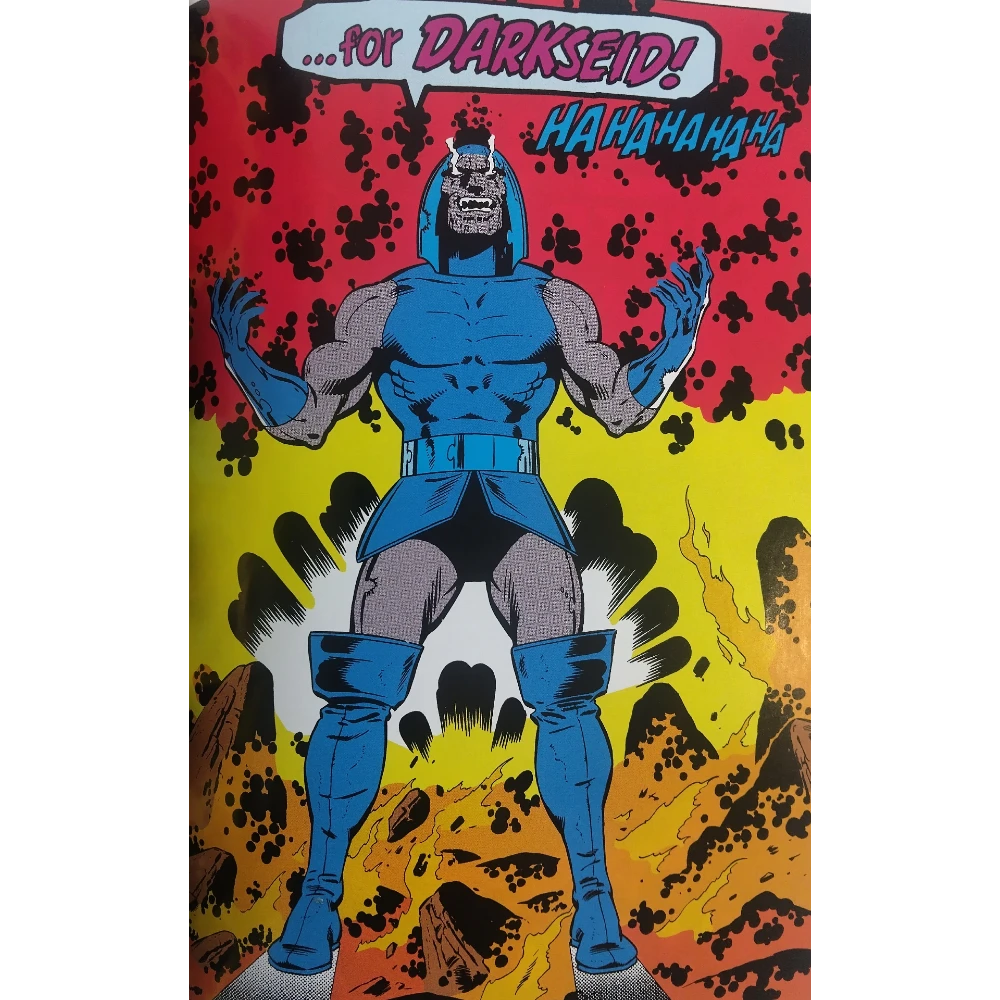
Though knowing of the twist itself, I found myself captivated by the build-up that Levitz and his pencilers, chief among them Pat Broderick and Keith Giffen, contribute to the proceedings. Even before the "Saga" begins in earnest, the creators string a series of scenes meant to pique interest and draw the reader's attention to something amiss. A planet in ruins, a figure in darkness, a slow gathering of resources and strength…the "Saga" moves ever forward, slowly at first, sitting at the periphery of trouble, before yanking our Legion in full force. Darkseid's "servants of darkness," each a corrupted version of a DC character (presenting a fun conundrum for readers trying to decipher their identities as well), battle our Legionnaires at various points, always seemingly one step ahead or endowed with power enough to drag Darkseid's plan forward, wicked step by wicked step, culminating in a conflict worthy of the tale's epic proportions. It's darn good storytelling, taking its time to intrigue the reader before answering your questions powerfully and with purpose.
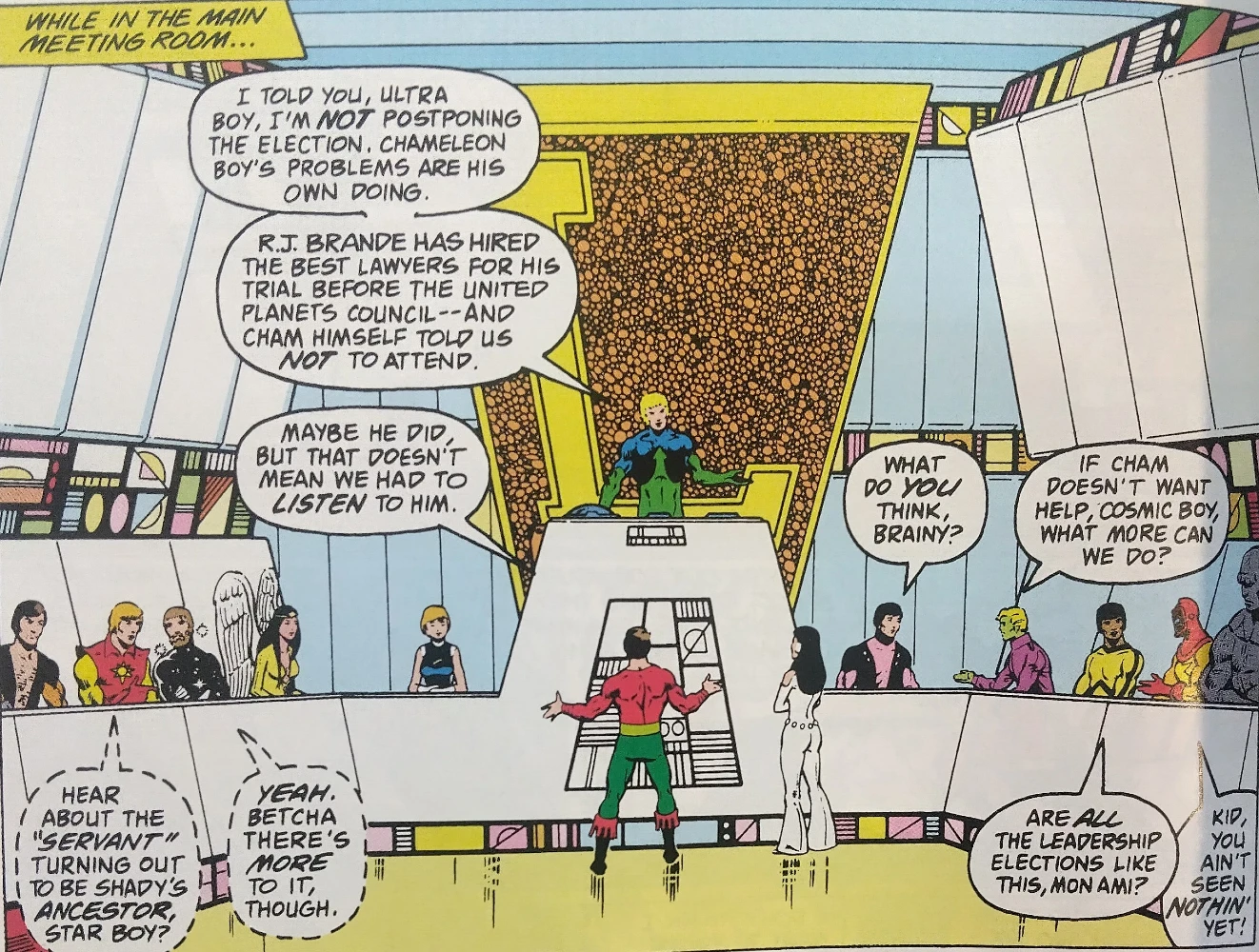
I'll return to the plot momentarily, but I must discuss how important Levitz's characters are to the ever-growing conflict. This collection includes several issues preceding the "Saga," each essential for not only building toward Darkseid's ultimate scheme but for involving us in the lives of our Legionnaires. The uninitiated, such as myself, won't find themselves awkwardly plunged into the middle of star-spanning adventures; much has come before this narrative, but Levitz gracefully draws the reader in, quickly establishing committed romantic relationships, burgeoning friendships, the hierarchy of power within the Legion, and their relationship with the United Planets and the earthbound Science Police. Collectively, the Legion is forced to rely on its members through physical conflict, internal political upheavals, a headquarters run amok, and the ramifications of each other's mistakes.
Levitz, Broderick, and Giffen capably balance a hefty dose of action with integral character moments, often utilizing the drama to highlight the strength of relationships. When Chameleon Boy leads a subset of Legionnaires on an ill-advised mission, he accidentally strands the crew on a frozen, barren planetoid; his error leads to a battle for survival against the elements and an unexpected opportunity for romance blossoming between Shrinking Violet and Colossal Boy…plus seeming affections between Saturn Girl, wife of Lightning Lad, and Timber Wolf, beloved of Lightning Lad's sister. The conflict this generates permeates the volume, affecting other members of the team and causing moments of disruption. Elsewhere, Brainiac-5 is persistently frustrated at several seeming failures regarding Legionnaire Matter Eater Lad and the villain Computo, the latter causing the team strife during an included annual. Within each physical fight is an opportunity for internal turmoil, the story finding great strength in relying on these intertwined tortures.
I've noted previously that I find team books often struggle between telling an engaging story and making sure our collective characters receive enough attention. Chris Claremont hit his stride early with X-Men, as did Marv Wolfman with the relaunched New Teen Titans, and Levitz, perhaps drawing from Claremont's experience, manages to imbue the "Saga" with the varied personalities his central heroes need to feel distinguishable. Blok serves as a somewhat oblivious yet reliable member of the Legion, a consistent friend for the heart-torn Timber Wolf; the new Invisible Kid is given various opportunities to prove himself as the "greenest" member of the team, plunged into the fight of his life when Darkseid's forces marshal; Lightning Lad, stricken with an illness perhaps caused by the stress he's felt as Legion leader, is tasked with overcoming his physical frailties, all the while encouraged by Saturn Girl, herself embroiled in the aforementioned conflict with Timber Wolf. These characters are endowed with struggles, with strengths and weaknesses, and they all feel real.
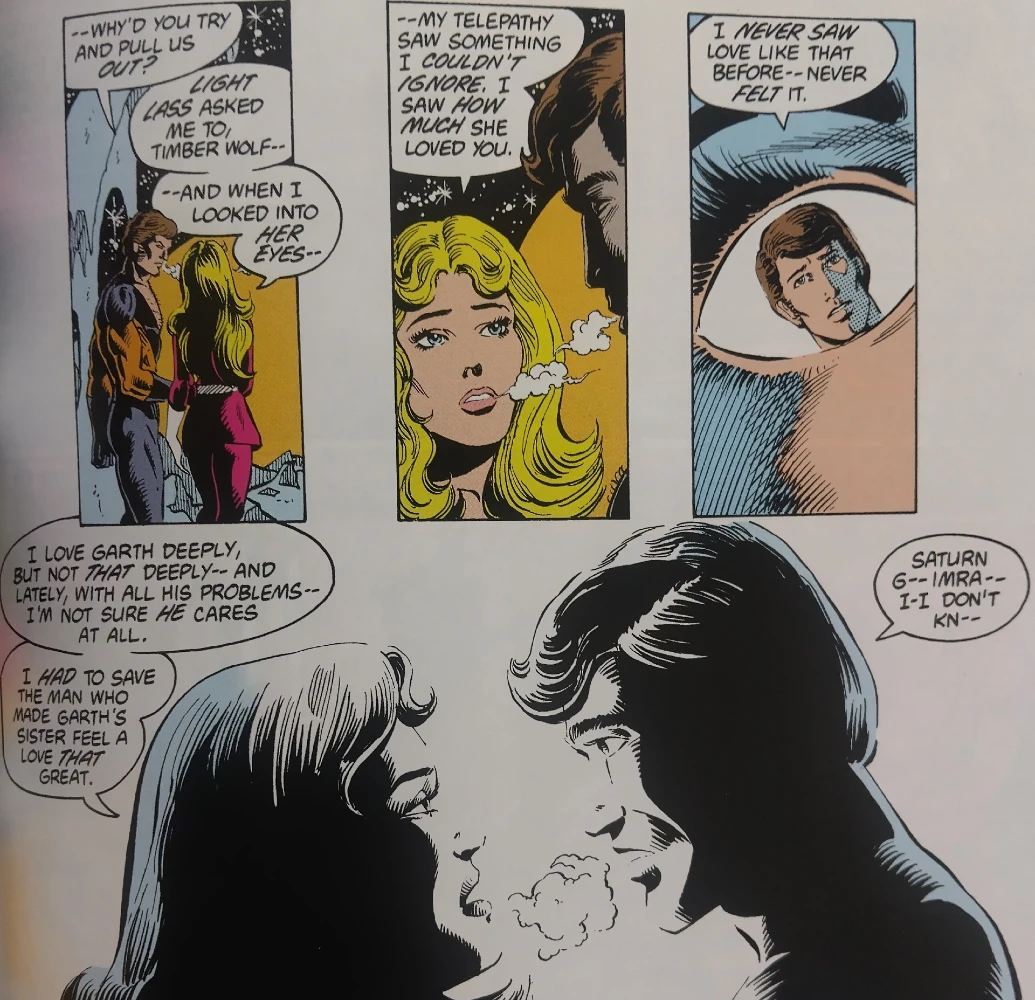
What helps is their status as "young adults," which feels like a unique place for comic characters to exist in at the time. The team, which started out as a crew of costumed teenagers, has aged out of that particular bracket–they're not like the Teen Titans, who feel the need to prove they're not children anymore. The Legion has done that; they're young adults, getting married and falling in love and learning to be a self-sufficient band of defenders. They're not children raging against the unfairness of the status quo but are instead maturing members of society learning to either live within that unfairness or confront it best they can. Levitz doesn't need to treat them with kids' gloves, which he doesn't. Maybe maturation is still necessary for some–see the reference to Chameleon Boy's near-fatal mission–but it's a different kind of growth than what you'd see with teen sidekicks. They've no mentors whose shadows they must grow out from under; they're more focused on creating legacies of their own.
Likewise, Darkseid himself seeks to cast an enduring shadow, large enough to blanket the universe. The impact of his presence is felt strongly across the "Saga," and the final conflict Levtiz and Giffen conceive of is appropriately massive in scope, drawing in not only empowered minions to fight our heroes but various sundry Legionnaires to stave off the Lord of Apokolips' forces. A giant-sized finale largely concludes the conflict in a satisfying manner, save for a few moments that feels coincidental. Levitz seems aware that he and Giffen are creating evil on a scale that seems almost impossible to plausibly defeat, so a few moments are sewn in earlier issues to try and give the Legion an advantage. Those moments work well enough, but they do remove some of the ultimate triumph from our heroes, placing the Legion in a bit of a holding pattern against Darkseid until other forces can deliver a much-needed bit of forward momentum.
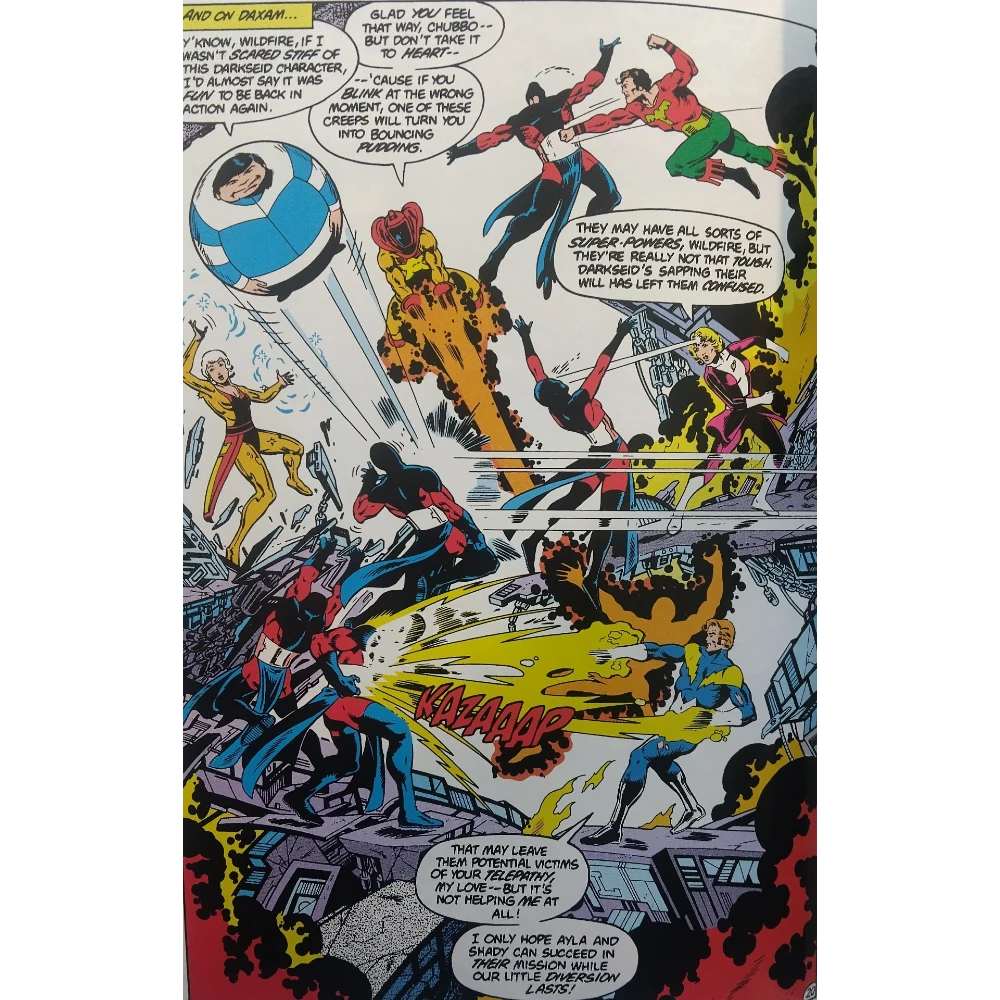
Keith Giffen delivers the lion's share of the art in this volume, allowing for the entire narrative to feel wonderfully consistent in style. Pat Broderick pencils a few early chapters, but it's Giffen who comes in swinging, carrying readers into and through the "Saga." Layouts feel more inventive, lines more sharp that Broderick's. Benefited by Larry Mahlstedt's inking, Giffen evolves across these issues and steers himself towards a style I feel I'm more familiar with in his brief work with Ann Nocenti on Daredevil and a few issues of John Ostrander's Suicide Squad.
There are reasons why "The Great Darkness Saga" is considered the epitome of Legion comics history. The writing, the art, the plot, and the characterization all work together wonderfully to create a unique narrative. For the uninitiated, if you're fine with skipping over some Legion continuity, this is a strong story to begin with. Darkseid's presence, whether encountered as a surprise or known before reading, seeds well-wrought menace across the entire "Saga," asking our Legionnaires to challenge themselves, physically and emotionally, against conflict from within and without. It's those heroes who serve as the center upon which the rest of the story clings, engaging revelations notwithstanding, their humanity pushing them forward and their growth, maturing them in age and character, placing them in unique positions to confront Darkseid's evil. Several of them may work under the titles "Lad," "Lass," "Boy," or "Girl," but "men" and "women" prove to be just as fitting appellations.