Distinguished Critique: Batman: Blind Justice Review
These anniversary issues refreshingly challenge the definition of what makes a Batman comic
—by Nathan on March 3, 2026—
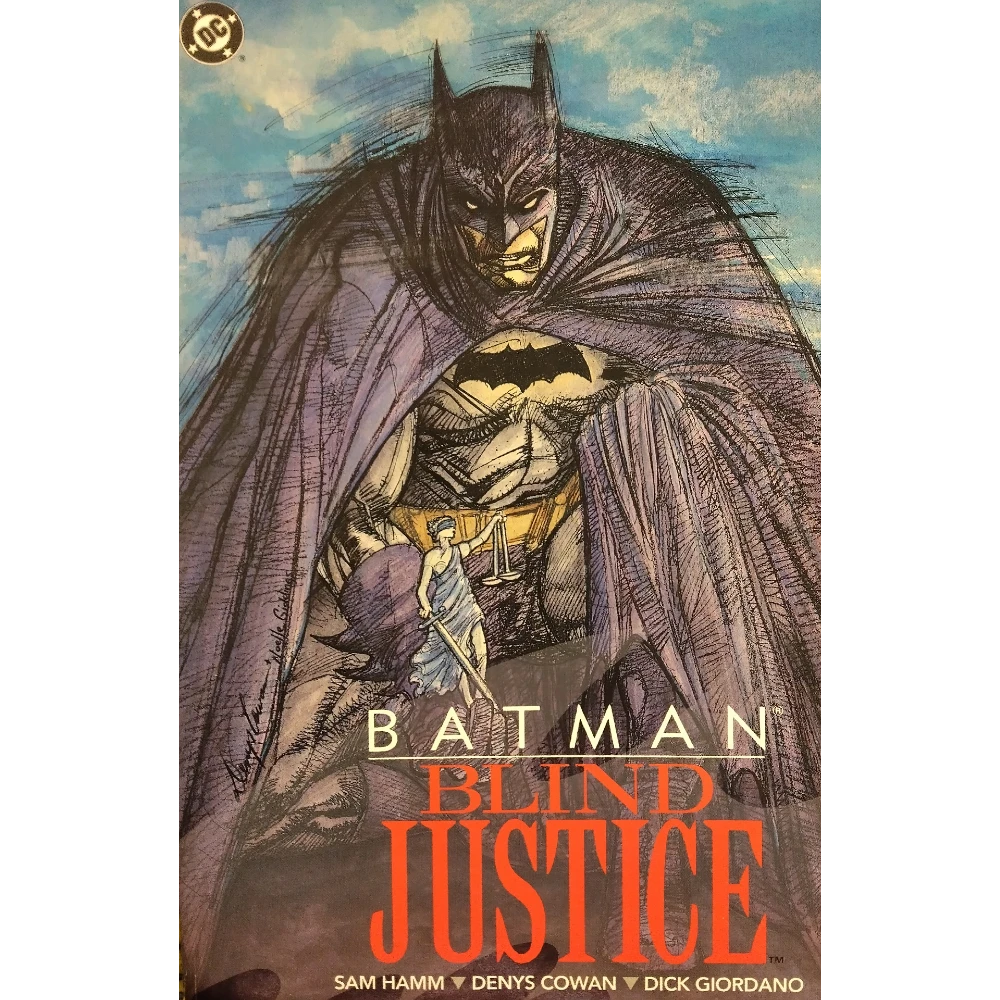
For a while now, my Batman reviews have been concretely set in one of two decades: the 80s or the 90s. It's been Frank Miller's vision of young Batman and old Batman vs. stories clearly influenced by him, such as a few Legends of the Dark Knight arcs and a trilogy of graphic novels where Batman became a vampire. All share this vision of a Batman who has changed from a goofy, campy cartoon of a character to the gritty, prowling vigilante initially reintroduced by Dennis O'Neil and Neal Adams.
Beginning today, we're crossing the bridge between those decades.
I have wanted, for a few years now, to find some excuse (or invent some excuse) to review "Knightfall," a celebrated Batman arc from the 90s. A while back, before I dove into reviewing comics consistently, I read through most of "Knightfall" for the first time, savoring the epic which writers like Doug Moench, Chuck Dixon, and Alan Grant developed. In the time since, I've explored more of the Dark Knight's fabled history and have dabbled a bit in that other, ultra-popular DC crossover from the 90s: "The Death of Superman." Reading the second arc in that crossover, "Funeral for a Friend" (or, if it suits you, "World Without a Superman") a short time ago, I felt the ol' neurons firing and itching for "Knightfall." I had read how one big dude toppled DC's strongest champion…I wanted to read how another one toppled their greatest.
Yeah, I just said it. Fight me.
So this site's about to become a bit of a Bat-cave for a couple of weeks as I transition from the 80s to the 90s in full force. Instead of diving headfirst beneath Wayne Manor, I wanted to do some exploratory spelunking, build a bit of momentum and lead up to Bane breaking the Bat's back. So I have carefully selected (or, in other words, picked from what I already owned) some stories I feel, in some shape or form, relate to "Knightfall." The connections are tenuous in some places–I chose today's story because it features a supporting character who later interacted with Tim Drake in his first solo series, which I also plan to review in a few posts. But they serve as a bit of a bridge from the late 80s to the early 90s, creeping ever closer to that fateful encounter between Bruce Wayne and a wicked kneecap.
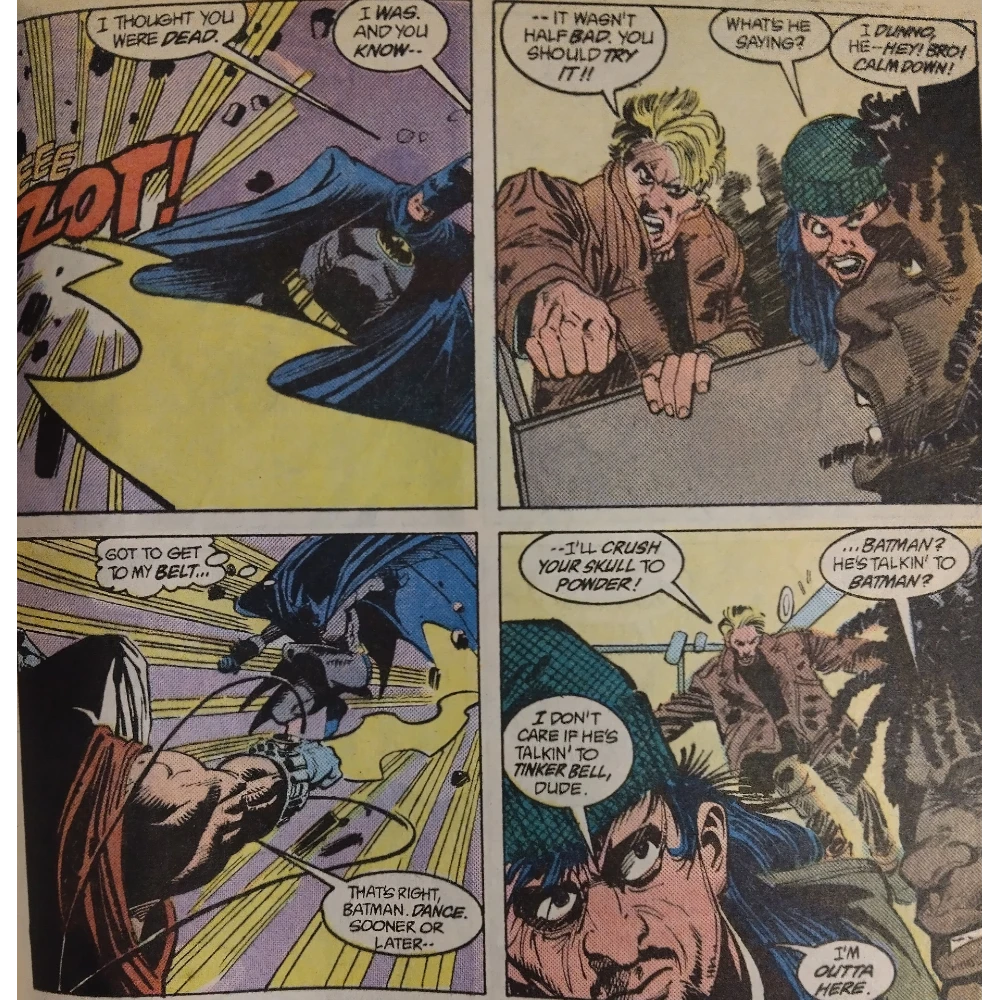
It also doesn't hurt that today's story features a young blond man who takes on the mantle of Batman following Bruce suffering a traumatic physical injury. Oh, and a big guy in a mask.
Batman: Blind Justice
Writer: Sam Hamm
Penciler: Denys Cowan
Inkers: Dick Giordano and Frank McLaughlin
Colorist: Adrienne Roy
Letterer: Todd Klein
Issues: Detective Comics #598-600
Publication Dates: March 1989-April 1989
"To my mind, the job was one of interpretation, not creation: my task was not to reinvent this familiar figure, just reintroduce him to a modern mass audience. The trick was figuring out which version of Batman to reintroduce."
So explains Sam Hamm in an introduction to the volume I own collecting this three-part anniversary story arc, celebrating 50 years of a certain Dark Knight Detective. Funny thing is, Hamm isn't talking about "Blind Justice." He's talking about Tim Burton's 1989 Batman film, for which Hamm contributed early versions of the script. But those words seem almost equally as applicable to this narrative, which Dennis O'Neil tapped Hamm to write, pairing him with O'Neil's partner-in-crime on The Question, Denys Cowan. The story was Hamm's first foray into comics, a concept which shaped, fairly or not, my assessment while reading it.
Hamm is foremost a screenwriter, and though I know overlap exists between writing for film and writing for comics, I'm not aware of the idiosyncrasies. Bringing in someone familiar with developing stories for film and having them create comics is not a unique idea in general–check out J. Michael Straczynski's work on Amazing Spider-Man or Thor or Kevin Smith's Daredevil work as examples–but I assume it was even less common in the late 80s. Comics, like films, are visual by nature, and when paired with a strong artist, you can create a movie on paper. Strong scenes, graceful dialogue, well-rounded characters.
"Blind Justice" winds up being something of a very unique experiment not just for Hamm but for Batman overall, because as his narrative unwinds, Hamm works to strike at that very concept he discusses with the film in his introduction: a reintroduction–or, perhaps, more of a reevaluation–of who Batman is. Though slotted within Batman's very own mainstream Detective Comics series, these three issues, two of which are 80-pages in length, show how a man unfamiliar with the comics process endeavors to bring his own vision to the page, uncluttered by years of continuity, developing a story which feels unique.
The results are fairly fascinating.
Hamm's script makes for a surprisingly refreshing read in that he's not tackling this story as a comic book writer. Yes, tropes filter their way into the story here and there, fisticuffs and dream sequences and other trademarks of classic tales, but Hamm is far less reliant on maintaining the status quo. Read in a vacuum, you'd be forgiven for temporarily believing "Blind Justice" takes place in a separate universe. I am not aware if O'Neil or other DC executives explicitly gave Hamm carte blanche to write whatever he wanted, but Hamm develops a story which feels far more freeing than your average comic book narrative. Together, these three issues feel like a standalone Batman movie…mostly.
The bones of the plot aren't all that unique to the medium. Bruce interacts with a young woman hoping to find her brother, eventually revealed to have been mentally hijacked by the story's primary antagonist. Batman does some digging, fights a big dude in a mask, works to unravel the mystery behind who this guy is and how he's connected to Wayne Industries. A dock fight gives Denys Cowan a few pages to craft a fistfight/wrestle between Batman and this new "Bonecrusher" villain; other pages are filled with wires and machines as a central form of technology wraps itself around the plot; the plot moves at a "slow burn" sort of place, with a few nicely placed twists strung throughout. We get a few brain swaps, a villain hurts his henchmen just to prove how evil he is, and clues are seeded early on which help make sense of the plot later. It's just fairly well-written, if not fairly standard, material you'd find in action adventure movies, with a dash of grounded sci-fi and urban vigilantism.
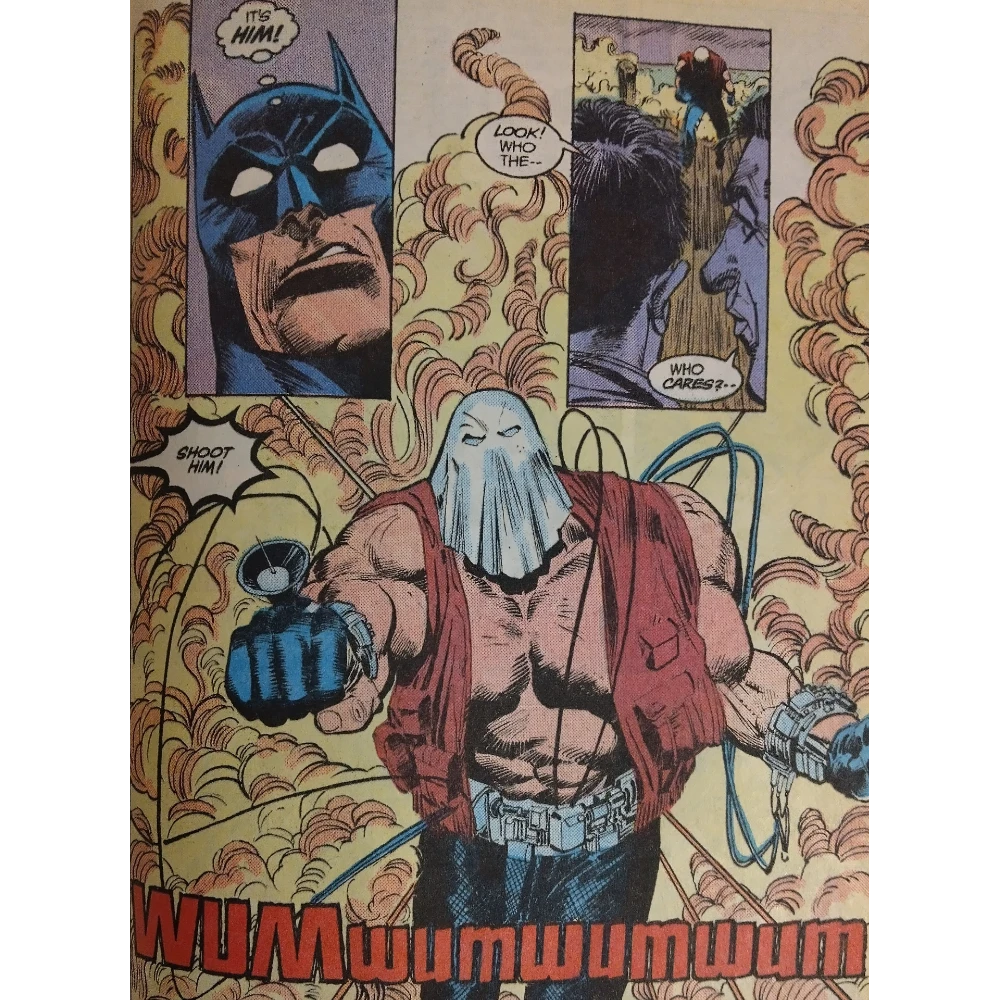
But beneath the fairly standard outerwear exists another layer, and it's here where Hamm finds freedom to explore. One aspect which has always struck me as interesting, maybe odd, sometimes good, but often not about comic book movies is their fluctuating reverence to the source material. We geeks tend to, I believe, appreciate that our continuity remain, well, continuous, so if you're going to adapt a character or plot, you stick to it as much as you can and only make changes if they serve the greater story. The Mandarin revealed to be a British actor in Iron Man 3? Absolute hogwash (though, having just watched Wonder Man, I fully support the redemption of Trevor Slattery as a character). Having Thomas Wayne interact with the Gotham underworld to bend an outcome in his favor in The Batman? Worth exploring. It has to make sense for the story.
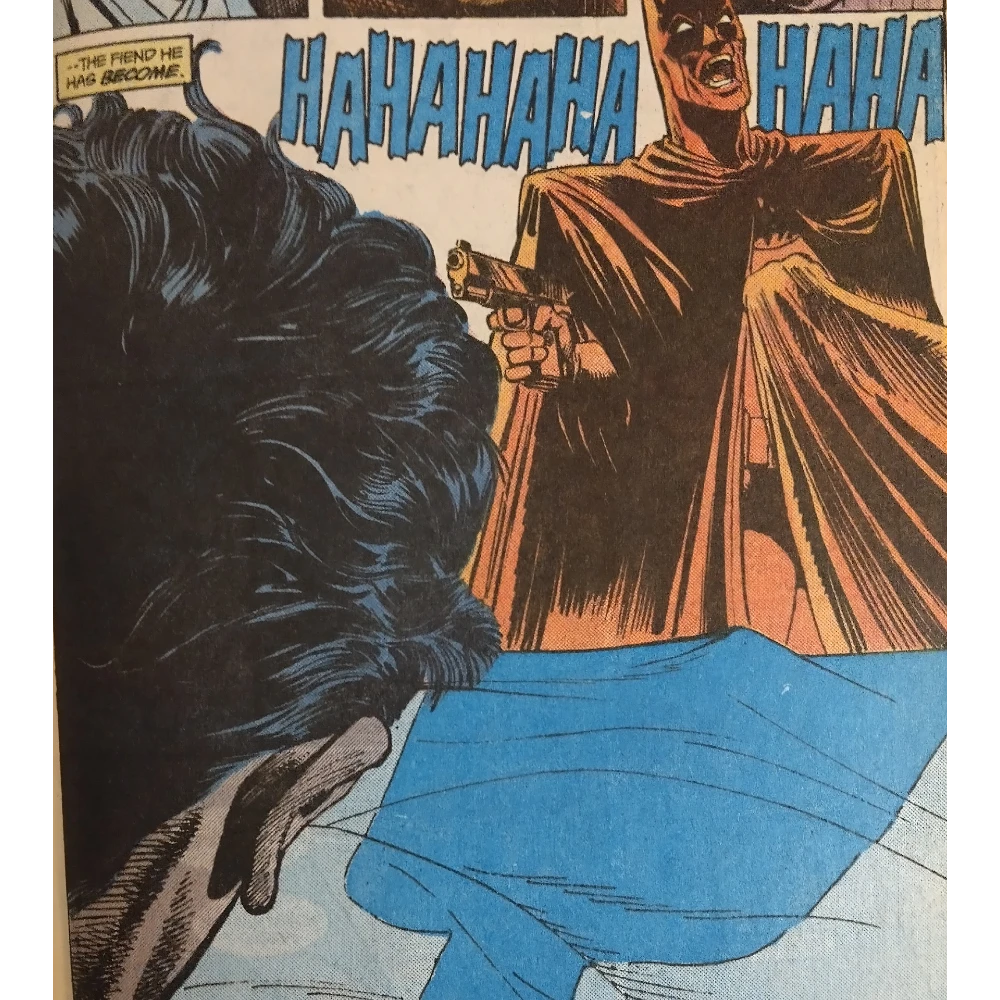
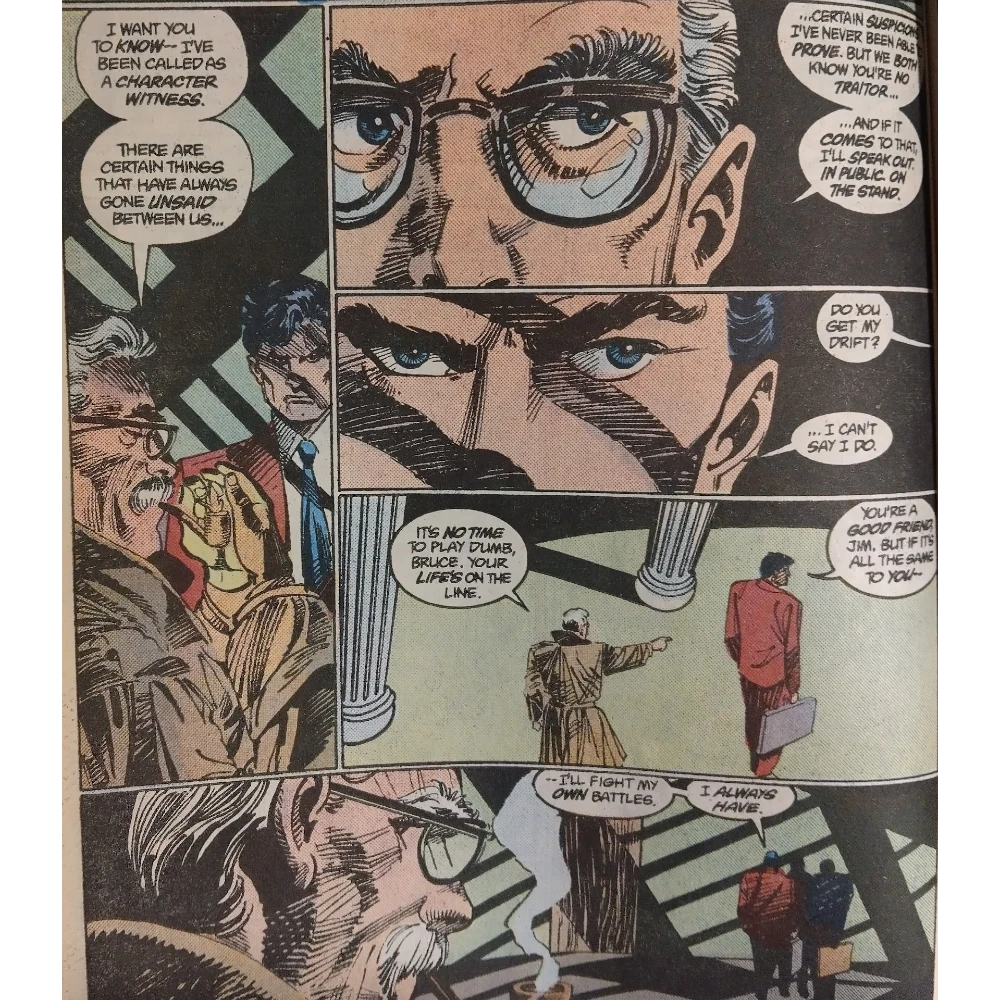
This is what Hamm does so well in this three-part tale. He takes the regular, normal pieces of Batman and toys with them, explores the possibilities. One of his best scenes comes in the form of a brief interaction between Bruce Wayne and Jim Gordon. In this meeting, Gordon all but tells Bruce he knows the billionaire industrialist is Batman. I'm certain other writers had hinted at such knowledge before, but Hamm brings us to the very edge of Gordon admitting he knows. Too far, some may say. A perfect length, I would argue. Hamm adds to the plausibility of the scenario–it makes sense that Gordon, as good a police officer as he is, would put two and two together, but it also makes sense that would never fully divulge his hypothesis. But he would do more than hint, especially in a situation such as the one Hamm presents, in which friction exists between the two men. Gordon is shrewd enough to reveal Bruce's identity, despite his loyalty, if he had no other option, and I think Hamm capitalizes on it in an intriguing manner.
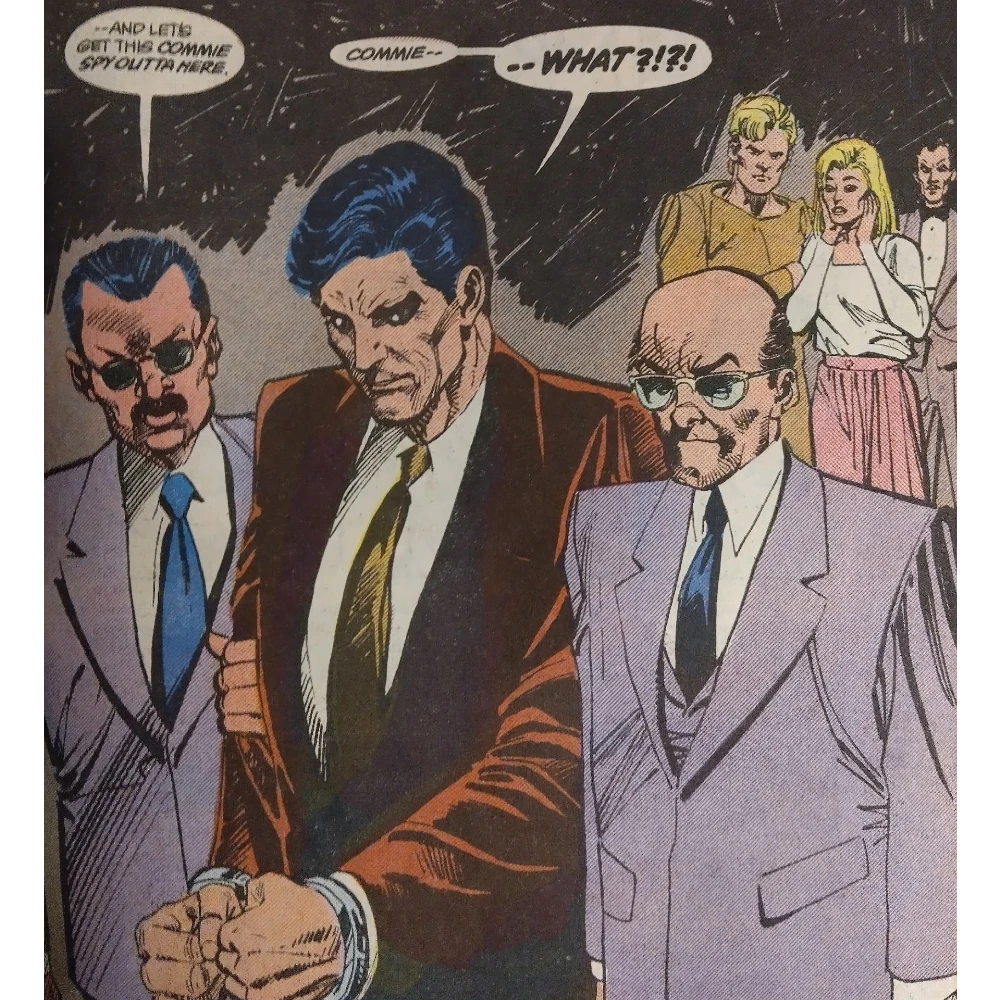
Elsewhere, a significant portion of the plot hinges on Bruce's arrest for supposedly being a Communist spy, and it's here Hamm really gets his mileage out of toying with the status quo. An investigation digs into Bruce's travels abroad as a younger man, again jeopardizing his long-defended secret; Bruce is shot and placed in critical condition outside a courthouse; Bruce comes within seconds of revealing his identity to Jeannie Bowen, a woman he believes he could have a future with. In true comic fashion, any revelations or alterations are proven impermanent–Bruce's secret remains safe, he heals nicely, the young woman leaves his life. But for several genuine panels, Hamm pushes the storytelling envelope, promising seemingly eternal consequences to these actions, maybe even an ending to the Batman mythos.
Is it problematic that Hamm must eventually bend to the whim of trope and industry and pull back his developments so as to abide by the perpetual "no ending"s mantra of ongoing comic series? No, because he's interested in holding your attention the moment those developments happen. Bruce Wayne, his identity uncovered by his biggest police ally? Bruce Wayne, shot and near death?? Bruce Wayne, in a stable romantic relationship??? This doesn't happen to Batman! But it could. And that's the brilliance of how Hamm works, pushing those possibilities just enough to excite the imagination, to challenge the common and known.
Outside Gordon and Alfred, Hamm is also less interested in dealing with repeating characters, be they sidekicks or adversaries. New villains, such as Bonecrusher, are utilized heavily; Jeannie is a love interest who doesn't masquerade as a cat burglar; her brother Roy stands in as a sidekick, especially when he temporarily takes on the role of Batman after Bruce is shot; and Henri Ducard–Liam Neeson's "alter ego" in Batman Begins–straddles the line between mentor and adversary. Around Bruce is created this new cast, sloughing off the Joker and Two-Face in favor of an assassin with a high-powered rifle, a brilliant scientist, and homegrown muscle men. Like the concepts he plays with, Hamm is constructing a playground populated by characters he can more easily wield and maneuver, without fully bowing to the crown of continuity.
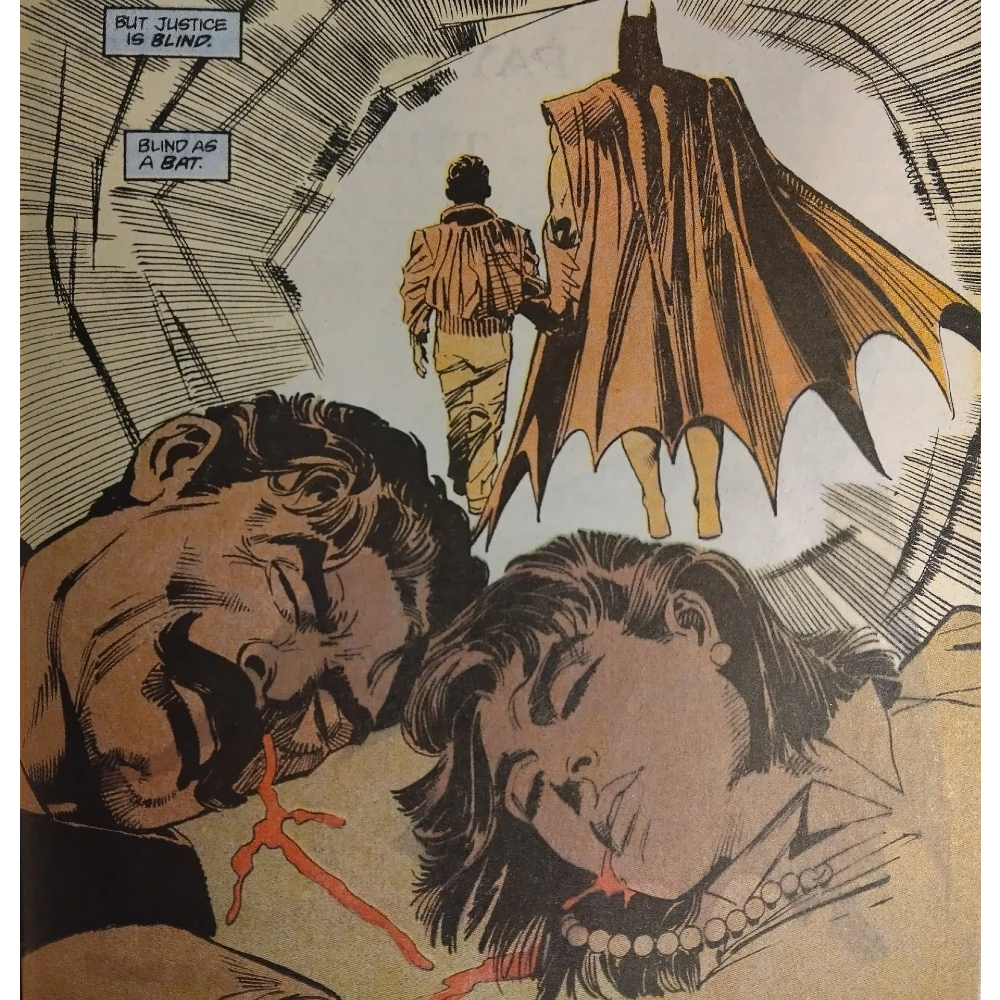
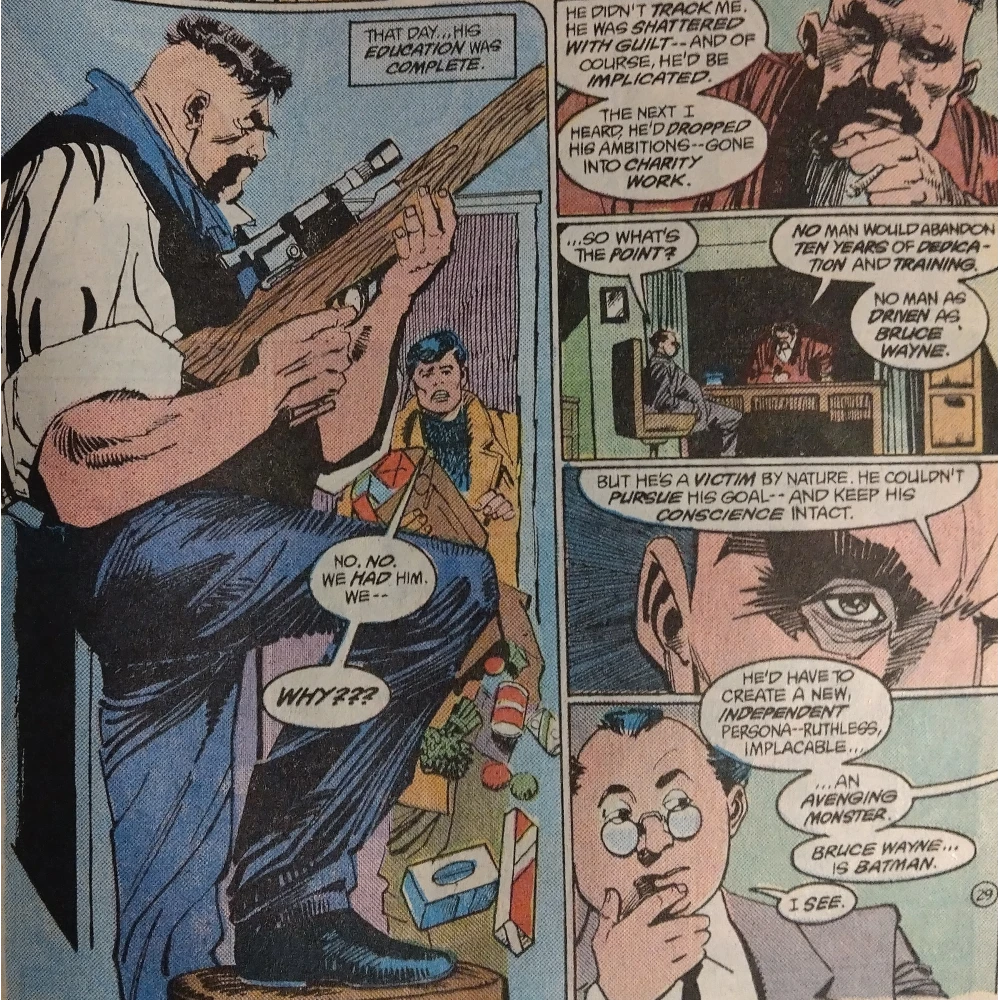
Within all this newness and reorganization, Hamm is working to get at that "reintroduction" concept. This isn't a story for readers who want to see Batman clean the Penguin's clock again or want Robin to swing in on a line cracking some joke or another. Those are fantastic in their own right, but this is meant to be a different take. Perhaps the most consistently familiar element Hamm weaves in is through Cowan's depictions of Bruce's parents' deaths, always surreal and dreamlike. Through these scenes, a deep sense of guilt weighs upon Bruce, guilt over what he's allowed himself to become, guilt over what his parents' deaths pushed him towards. Ducard, part way through the story, recognizes this, positing Batman is an independent side of Bruce developed in response to the dedication, the obsession, borne from his parents' deaths, something he can never release.
There's a pessimistic quality to such an outlook, and this factors into Hamm's ending. I've not heard chatter online discussing it as controversial, though if this book were spoken of more frequently, I'm sure it would be referenced at least, debated at most. The ending, avoiding spoilers, is Pyrrhic for Bruce, in more ways than one, hinging on a compromise created by him and encouraged by another character to keep Batman in play. The ending only steeps Bruce further in that sense of guilt, allowing him to feel the weight of consequence and responsibility when he chooses to put his obsession for his identity as the Dark Knight over all other priorities. And yet Hamm leaves the door open for readers to explore whether, despite consequences, Bruce is actually wrong in making the sacrifices necessary to be Batman…as a thought experiment, it's intriguing, but the particulars do ask a lot of Bruce, leaving me mildly frustrated with the execution.
There's plenty here for Batman fans to resonate and find familiar…enough to make me wonder if this is one reason why "Blind Justice" seems to be overlooked. As I noted tongue-in-cheek-like in the intro, this is a story where Batman fights a big masked dude, Bruce suffers an injury, and a blond guy takes on the cape and cowl temporarily. Differences abound between this tale and "Knightfall," but I could see where some similarities make "Blind Justice" feel less unique, even if it broached certain ideas first. It could also be fans have never reacted incredibly warmly to an "outsider" like Hamm coming in and crafting these anniversary issues. All that is pure speculation. I found Hamm's voice refreshing, his narrative surprising. Some of what we're given is fairly standard in comics, Batman comics specifically, but we're also allowed an opportunity to wonder. Hamm pushes against the status quo where he can, and though it never buckles under him, he provides enough material for fans to consider thoughtfully, an interpretation of the Dark Knight which should give some pause and make them question if Batman the character, the notion, the idea couldn't be challenged more consistently in the ways Hamm challenges him here.