Distinguished Critique: Catwoman by Jim Balent (Book 1) Review
Poor pacing aside, these issues ensnare a renowned thief in a gray cat's cradle of morality
—by Nathan on August 4, 2026—
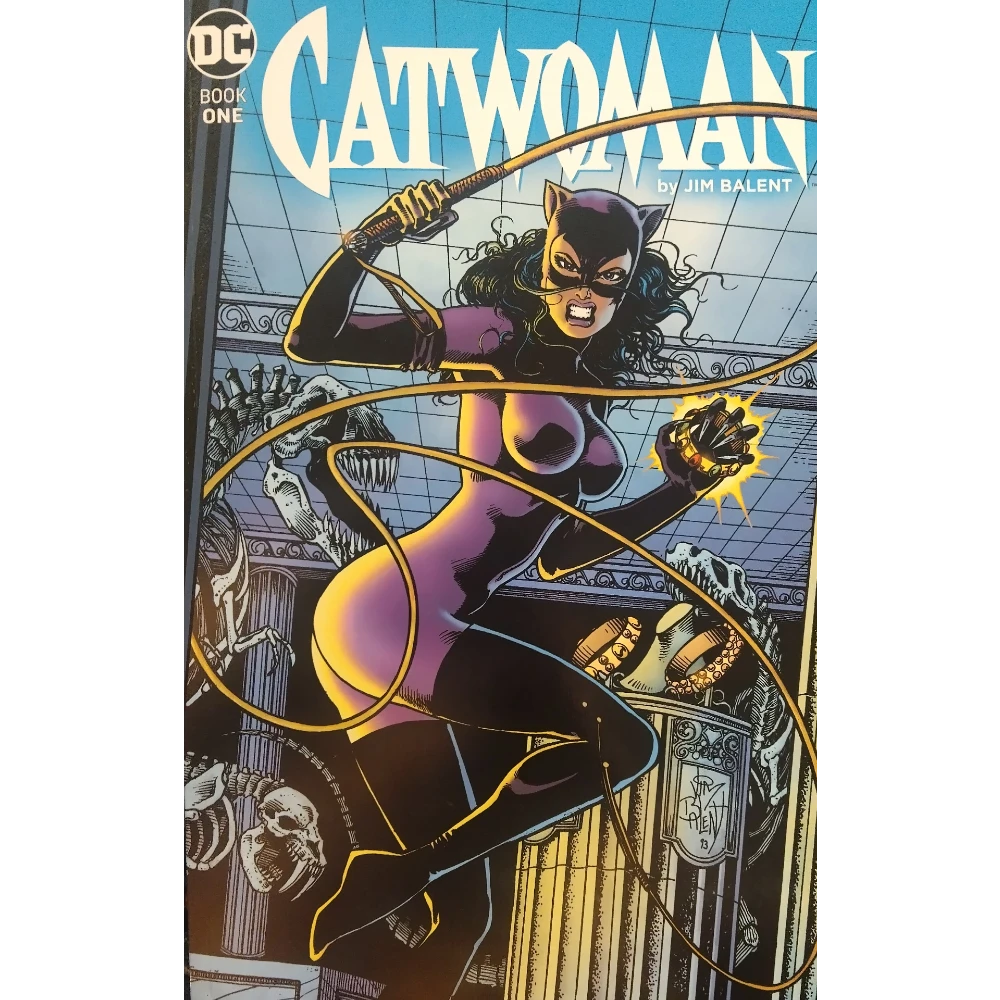
As the 80s drew to a close, DC decided that, among their various characters receiving post-Crisis on Infinite Earths updates and reboots, a certain cat burglar deserved a facelift of her own. Or maybe it was the opposite? I dunno, what do you call it when you decide to give your Dark Knight Detective's most morally ambiguous love interest an even more dubious background and morals?
Mindy Newell and J.J. Birch, latching onto a concept introduced by Frank Miller in "Batman: Year One," expounded upon the post-Crisis Selina Kyle, giving her a sister, making her responsible for a wayward orphan, and targeting her criminal energies towards slightly more justifiable ends…if only "slightly." Taking down an underground sleaze counts, right? Even if it's violent and involves breaking the law?
Selina had made a few appearances between that series and her first ongoing series, courtesy of Jo Duffy and Jim Balent. I have not reviewed those narratives, as they've been collected alongside with "Her Sister's Keeper" in a DC Finest volume I do not own, so I'm jumping ahead to the first several issues of this ongoing title. It's thematically appropriate, as these issues dovetail with the mounting "Knightfall" crossover. As this series opens, Batman has fallen to Bane, Gotham is falling to Bane, and Azrael wants Bane to fall to him…
…and we'll see how many lives our titular cat burglar uses to slink through the fallout.
Catwoman by Jim Balent (Book 1)
Writers: Jo Duffy and Chuck Dixon
Penciler: Jim Balent
Inkers: Dick Giordano, Ande Parks, Rick Burchett, and Bob Smith
Colorist: Buzz Setzer
Letterer: Bob Pinaha
Issues: Catwoman #1-13
Publication Dates: August 1993-August 1994
The reason why this volume isn't called "Catwoman by Jo Duffy and Jim Balent (Book 1)," I assume, is because Chuck Dixon slips in to give us a "Knightsend" tie-in issue (more on that whole arc in a later review). Otherwise, Duffy writes every issue included here. Her name missing on the cover is an awkward exclusion, matched only by the odd decision to excise at least Batman #503-504 from the material collected here, which complete a four-part Catwoman/AzBats arc. Several issues here deal with the overarching "Knightfall" narrative, yet it's really those missing issues you need to create a complete story.
From its opening pages, Catwoman, as a spinoff Batman title, is entrenched in "Knightfall," yet it's here Duffy writes some of her most solid material. I tend to complain that spinoff issues feel forced into a mold, demanding a writer walk a tightrope, cat-like, between developing their own narrative while remaining tethered to the larger crossover. Since Catwoman debuted in the midst of "Knightfall," its first issue published the month after Bruce Wayne's back was broken by Bane, it can more readily slip into that narrative, using some conflict generated by Bane to fuel the first few issues.
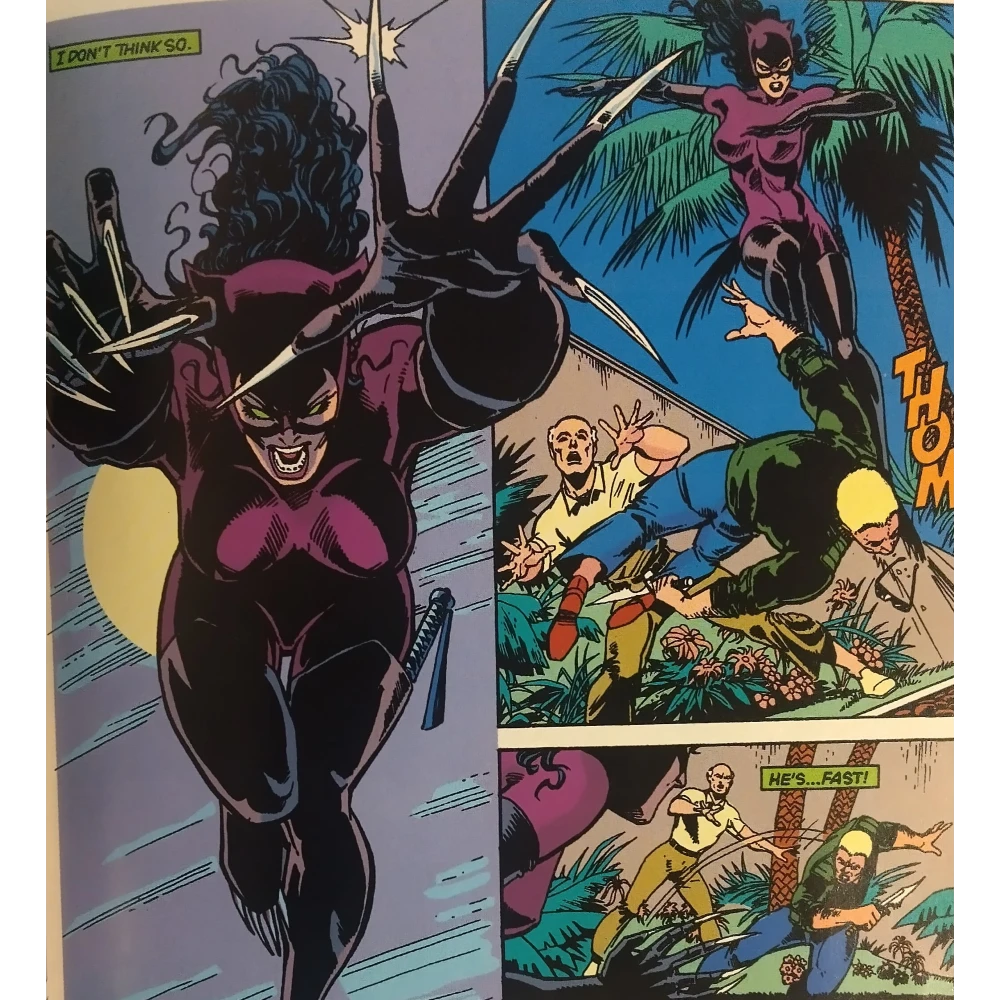
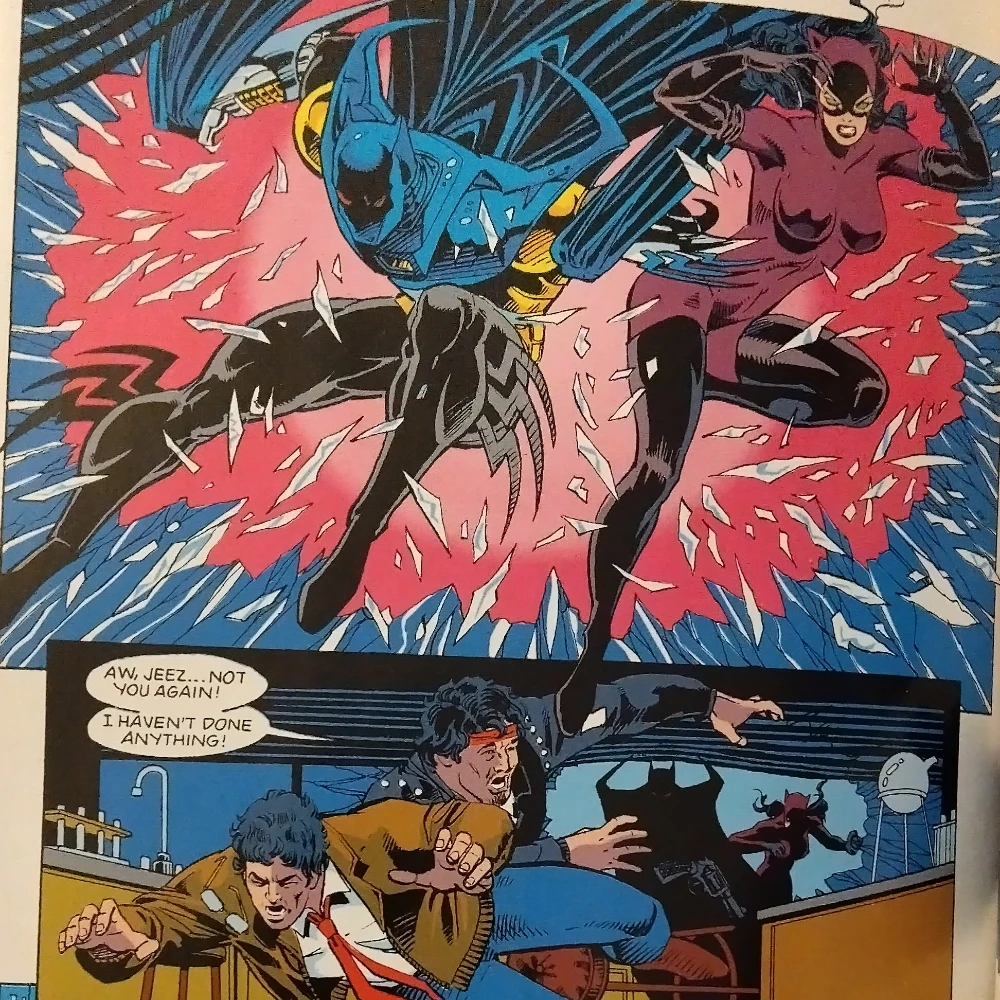
Duffy genuinely considers how the events of "Knightfall" and its subsequent arcs would impact Selina and her thieving lifestyle, and while some elements are relegated to mere cameo (AzBats pops up on the splash page of one issue without having any impact on the story unfolding within), other pieces more directly involve Selina. She "winds up" on a plane Bruce Wayne takes to Santa Prisca, the island of Bane's birth, tracking down an assassin the back-cracking brute sent after her. Her paths cross with Jean-Paul Valley's version of Batman, her familiarity with the original alerting her to the differences between himself and Bruce (outside of the obvious, like the weaponized suit of armor). As the volume closes, an adventure of hers even intersects with (spoilers!) two competing Batman duking it out over the cowl.
But more on that in the far future.
This way of writing allows Catwoman to be present during important "Knightfall" developments without it ever feeling like the crossover is hampering Duffy's own narratives. The result is fairly seamless (even if those missing Batman issues would make transitions between a few issues feel more fluid). Catwoman's final adventure featured in this volume, for example, involves a villain Jean-Paul Valley hunts, yet said villain's inclusion feels integral to Selina's own journey to help a friend. Duffy just manages to make the bigger Batman pieces feel important to her own plotting.
In terms of Selina's character, Duffy's take on Catwoman is as a thief with a heart of gold who cannot keep her sticky paws out of trouble, even if it's for noble reasons. Selina has her bent towards the occasional bad habit, but most of these issues see her in the guise of a saint-ish thief, a female Robin Hood, as it were. She's not giving back to the poor, per se, but she wants to aid the disheartened and disenfranchised. Everything, naturally, involves thievery, turning this volume into a series of heists that run from Gotham to Santa Prisca and relying on Selina working either on her own or with a small supporting cast, including, amusingly, her own butler.
As far as concepts go, Duffy simultaneously restricts herself and finds mileage out of this morally gray Catwoman (who forgoes the actual gray outfit from "Her Sister's Keeper" for her iconic purple jumpsuit). In the series' first issue, Duffy has Catwoman describe herself as Batman's "greatest" and "most deadly" enemy, and while you could chalk that up to Selina's possible arrogance, she says it with such a straight face (as one can be illustrated) you assume this is Duffy's consideration as well. Selinia, as far as I'm aware, has never broken Bruce's back, tormented him psychologically, or beaten one of his sidekicks to death. If this truly is Selina's own perspective of herself, it doesn't really describe the incredibly quick transition she makes from "most deadly" enemy to aspiring social justice warrior that happens in these issues.
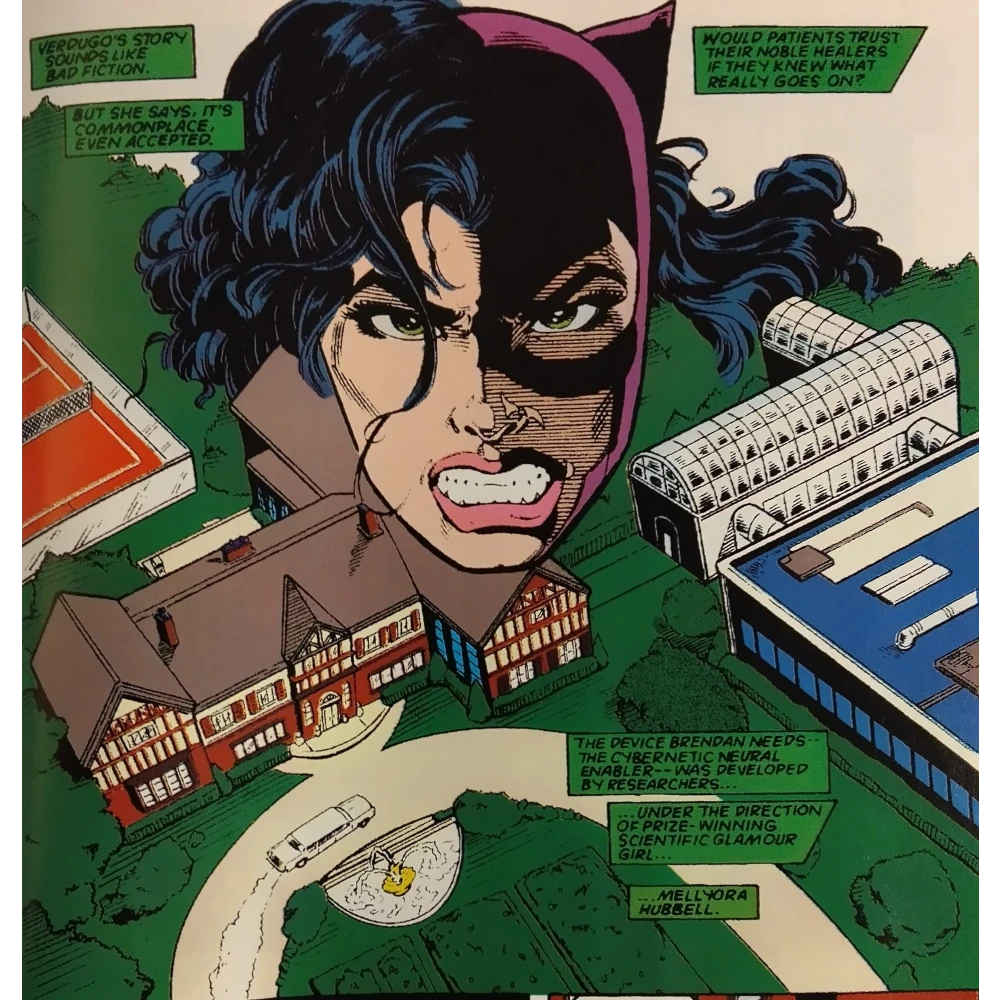
As I noted, Selina can behave selfishly. She begins the series in Bane's employ, slyly palming some prizes for herself and, after a bombing following Bane ferreting out her duplicity, tracking down her former employer's hired hitman. It's all about revenge. By the time Selina finishes her Caribbean adventure, Bane has been beaten into near catatonia by AzBats, yet it isn't a lack of employment opportunities which drives Catwoman desperately to fight for the angels. Selina's never been an out-and-out villain, per se (despite her own claim to the contrary), and Duffy does follow up her penchant for kindness by having her temporarily take in a different runaway orphan than Miller gave her. The seeds are there, I'm saying.
But there's a speedy transition between Selina's return from Santa Prisca and her embracing nobler intentions. These intentions don't seem terribly out of character, necessarily. She steals a poisonous compound to help an animal activist group; she steals medical technology for that injured friend; she even saves the life of an enemy who then attempts to kill her (talk about ungrateful). Again, Selina has never been a villain. But to go from selfish cat burglar to morally ambiguous thief interested in taking down corrupt businesspeople, money-hungry researchers, and street toughs feels like it needs additional context or development beforehand. The jump is too quick.
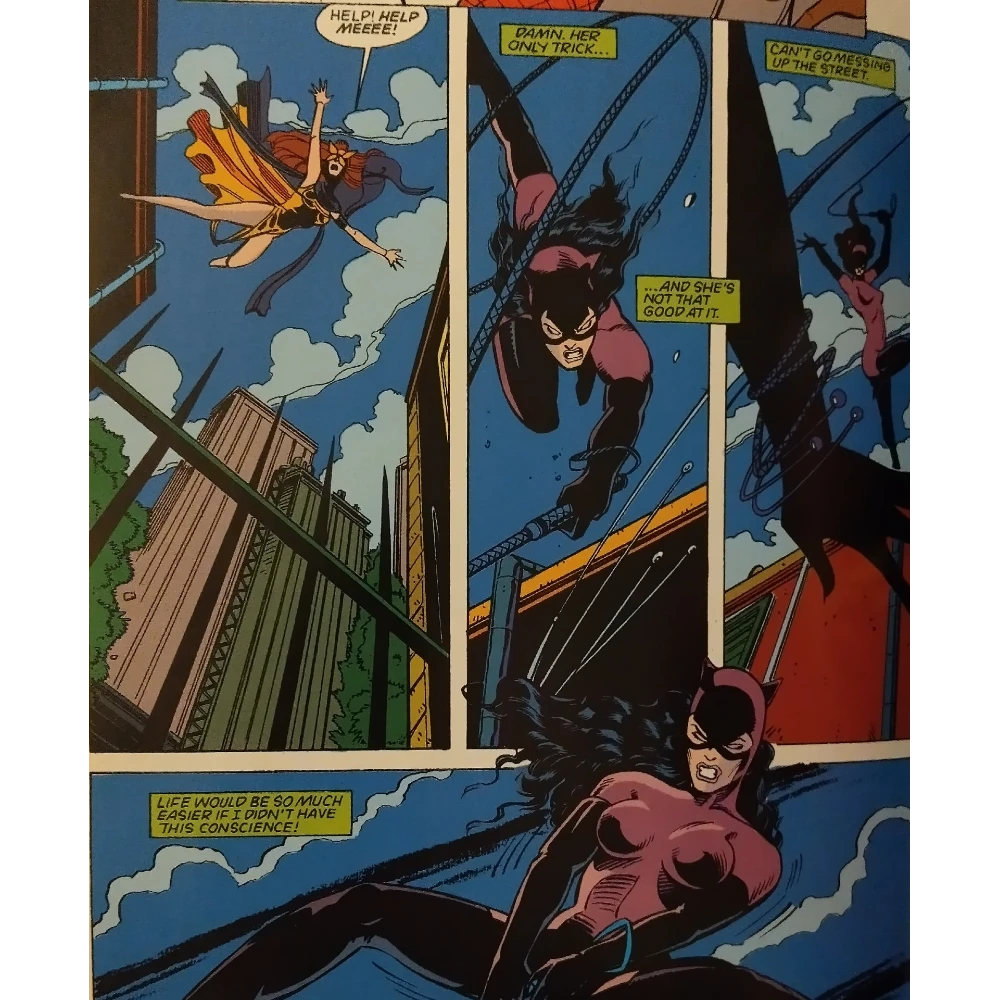
To her credit, Duffy recognizes that there are aspects here which need to keep Selina in that gray area. She's more heroic, sure, defending certain causes, but she's not going to follow the book or obey the law. She doesn't go the full "kill/maim bad guys" route that guys like Green Arrow or Anarky take, but she has no qualms with pilfering. Duffy doesn't lay it on too thick with any moral argument against thievery or even have Selina question her actions, which feels like a solid choice. Catwoman whimpering over the inevitability of needing to steal a device or bauble for the betterment of a cause would become old fairly quickly. She remains staunchly straightforward with the morality, or lack thereof, of her actions. Catwoman's a thief; she steals, regardless of the reason.
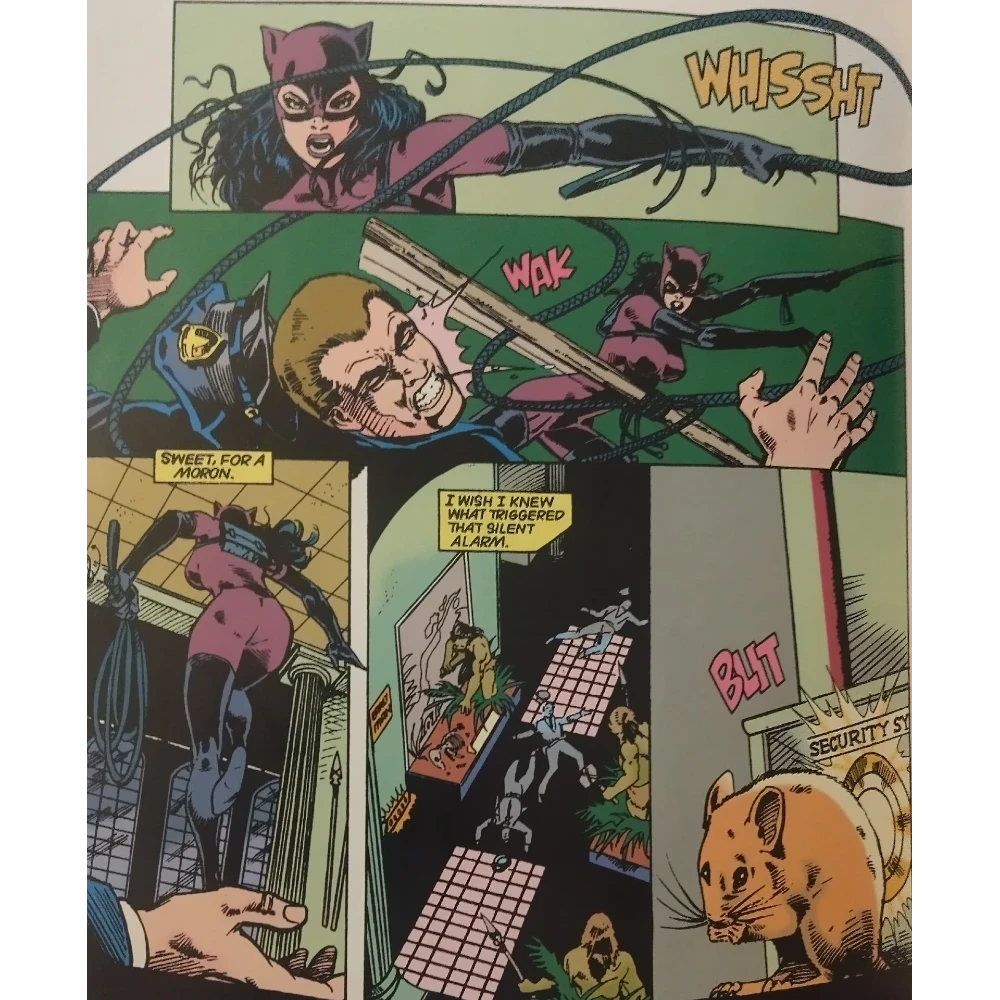
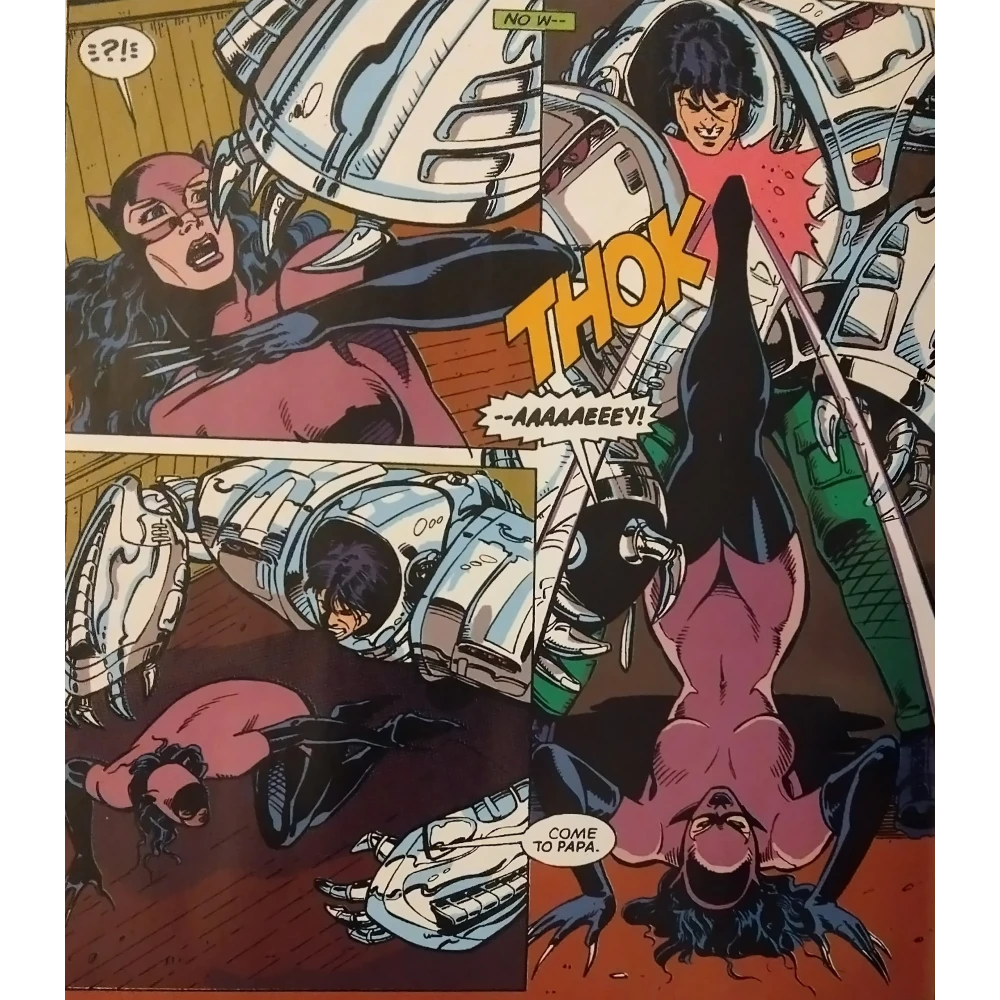
Though Duffy's name should appear on this cover, the billing goes to Jim Balent, primarily for the consistency of his artwork. I didn't walk away from this volume thinking he created anything iconic or wowing from an artistic perspective. He has good storytelling skills, keeping narratives clean. Occasionally, either by his own choice or Duffy's prompting, Balent will lean into the tried-and-true emphasis on over-the-top visuals this decade was infamous for, such as exoskeleton-suited soldiers. But most of the work he's given is nicely grounded, steering Catwoman away from excess and allowing his visuals to fit within the heist/thriller vibes Duffy is developing. Less aliens and time travel and more speedboats, a seeming island paradise, disguises, and gadgets.
So. Catwoman. Batman's greatest enemy? No so much. A thief turning towards heroism? A better definition. Duffy is attempting to develop a socially conscious Catwoman, a Catwoman for the 90s, who steals from the rich and keeps some for herself while also giving some to the poor. Though it's less money she steals and more medical devices and drums of toxic chemicals. She's more about saving than just aiding financially, perhaps palming a pearl or two for herself when she isn't tracking down assassins sent by back-breaking bad guys. The angle is a fine one, bolstered by Balent's grounded portrayal of Selina's adventures, yet it's established too speedily. There's no wrestling over whether this is a wise career move for the longtime thief to make. I don't know which of Catwoman's nine lives she's using in this crusade, but she should learn to slow down a bit, enjoy the journey, before she winds up wasting one of them.