(Strand)om Stories: Captain America and The Falcon: The Swine Review
Some sillier concepts prevent the potential depth of these stories from fully taking root
—by Nathan on July 5, 2026—
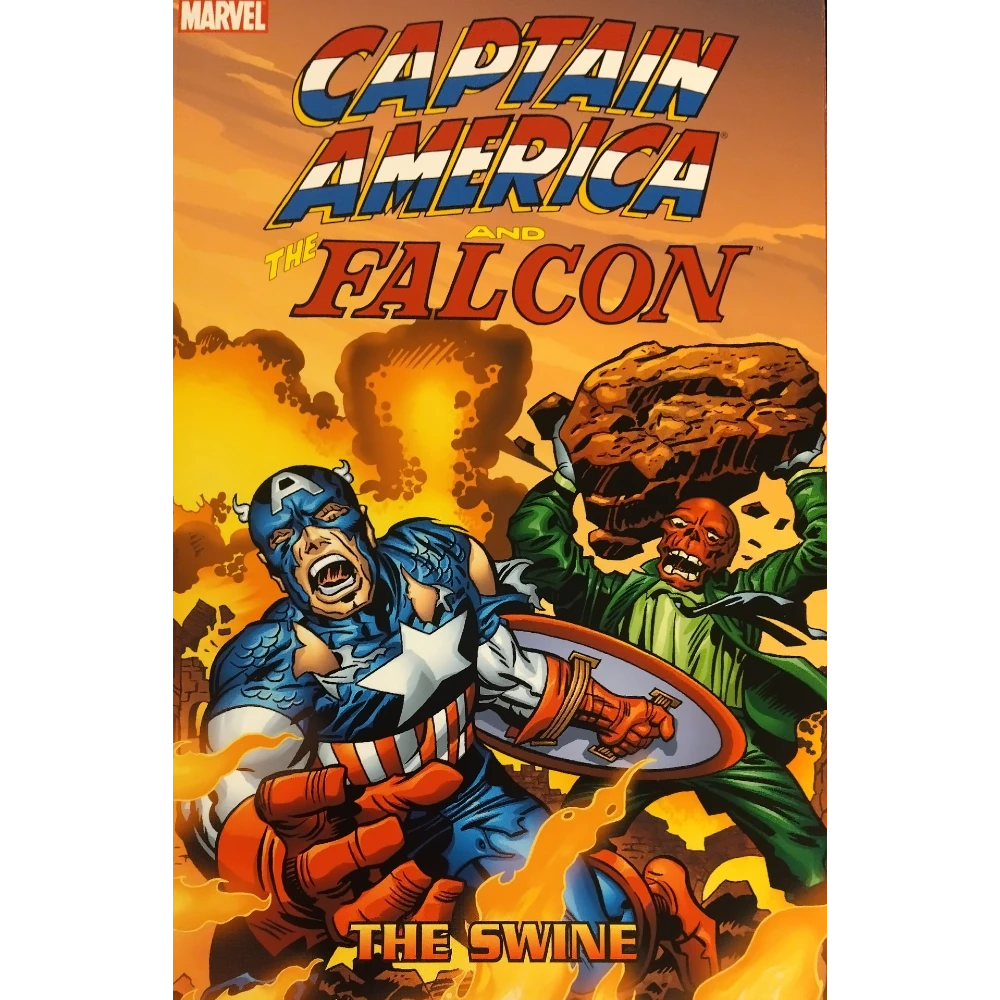
Sam Wilson's airborne alter ego joins us once again as we wrap up this Independence Day weekend by reviewing the third and final volume collecting Jack Kirby's 1970s Captain America run.
The consensus so far? Divided. Kiby's opening arc, "Madbomb," is a fairly invigorating romp, grounding a sci-fi drama in a genuine examination of American morality. His "Bicentennial Battles" one-shot is also a decent celebration of the American spirit during the nation's 200th anniversary. His other issues, however, have been middling at best. Even "Madbomb" and "Bicentennial Battles" had their awkward moments.
For this third volume, we dive into the final issues of Kirby's run, along with two annuals separate from the rest of the action. In complete control of a character he co-created decades earlier, Kirby provides one final "hurrah" in a volume that evidences both the strengths and weaknesses of this era in the artist's career.
Captain America and The Falcon: The Swine
Writer: Jack Kirby
Penciler: Jack Kirby
Inkers: Frank Giacoia, John Verpoorten, Mike Royer, Dan Green, and John Tartaglione
Colorists: Petra Goldberg, George Roussos, Glynis Wein, Sam Kato, and Janice Cohen
Letterer: Jim Novak, Mike Royer, and Gaspar Saladino
Issues Collected: Captain America #206-214 and Captain America Annuals #3-4
Volume Publication Date: January 2006
Issue Publication Dates: August 1976, February 1977-November 1977
It feels crass to knock Kirby's work, but know that I don't provide criticism against his passion or workmanship. Across all three volumes, you see a man who genuinely loves this character and genuinely loves comics and is trying to juggle the efforts of writing, penciling, and editing this book. Archie Goodwin and Marv Wolfman are credited as "consulting editors," but it seems Kirby was firmly engaged in producing each of these issues.
Which may be where the trouble lies.
As much as folks will critique Stan Lee's showboat personality for damaging his collaboration with guys like Kirby and Steve Ditko, and as much credit as both Kirby and Ditko deserve not only for designing classic characters and illustrating classic stories but guiding those narratives well, the writer/artist combination worked for a reason. Two men, two voices on a story. And then you add in an editor. Here, Kirby fills all the slots, reaching a level of influence that means his say-so goes for these narratives. Kirby doesn't strike me as having been the most selfish or stubborn of men, but these issues showcase a comic creator who could have used some guidance at this stage.
One criticism I see hurled at Kirby's 70s stint at Marvel and even material he'd produce for Pacific Comics in the 80s is that, as he grew older, he remained stuck in the mindset of his youth. I discussed this briefly in my "Bicentennial Battles" review, but the notion exists that Kirby just did not grow with the times. As creators came on the scene who started pushing the comics medium towards maturation in subject matter and artistic proficiency, Kirby remained Kirby. It's why DC redrew his character's faces on Superman's Pal, Jimmy Olsen, to maintain their own artistic standards over his style. It's one reason why his post-60s books didn't sell as well. It's why these issues feel like a man holding onto the fringes of his identity while the world around him changes.
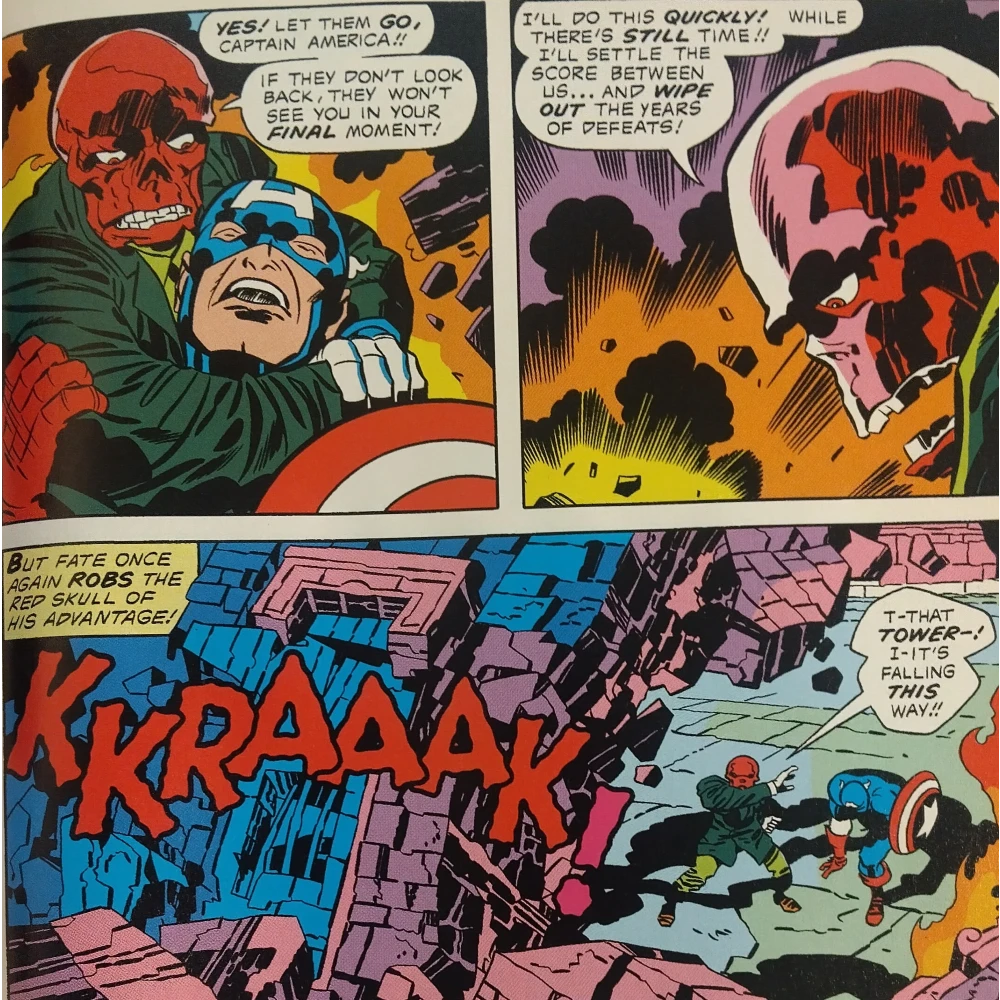
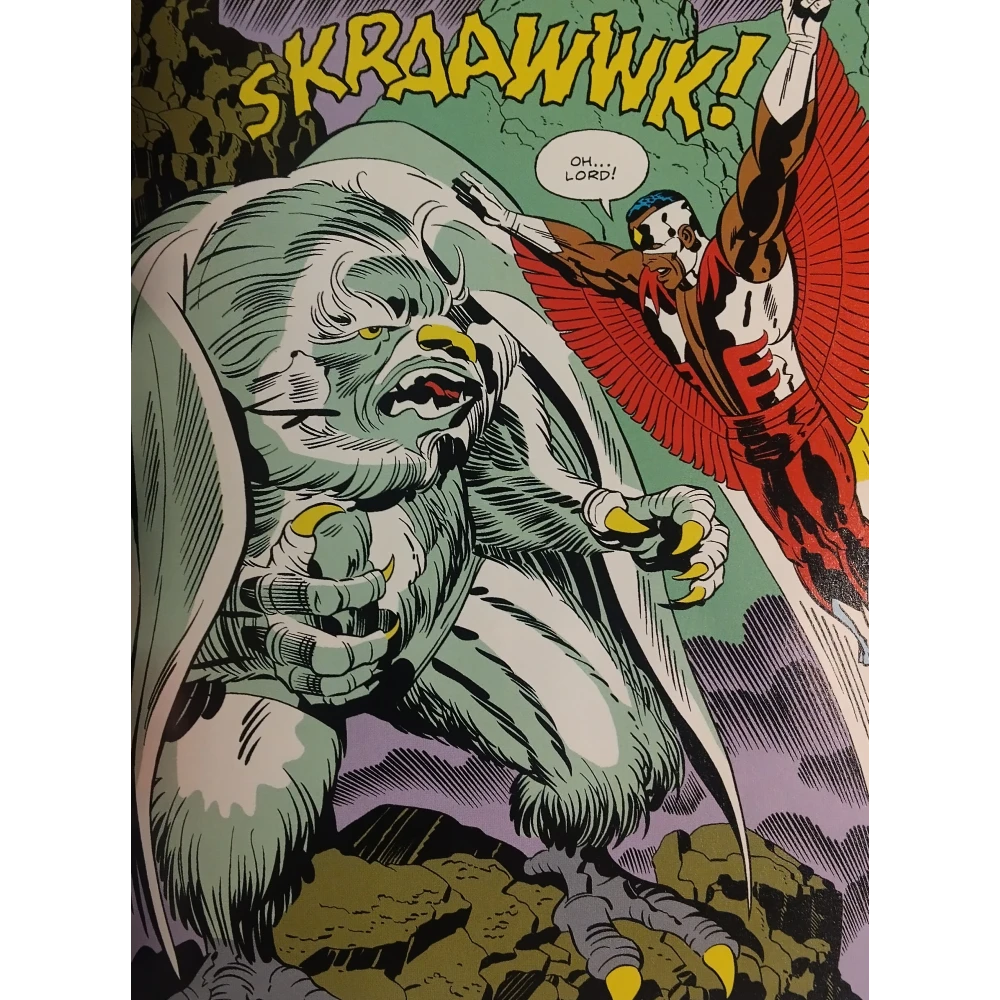
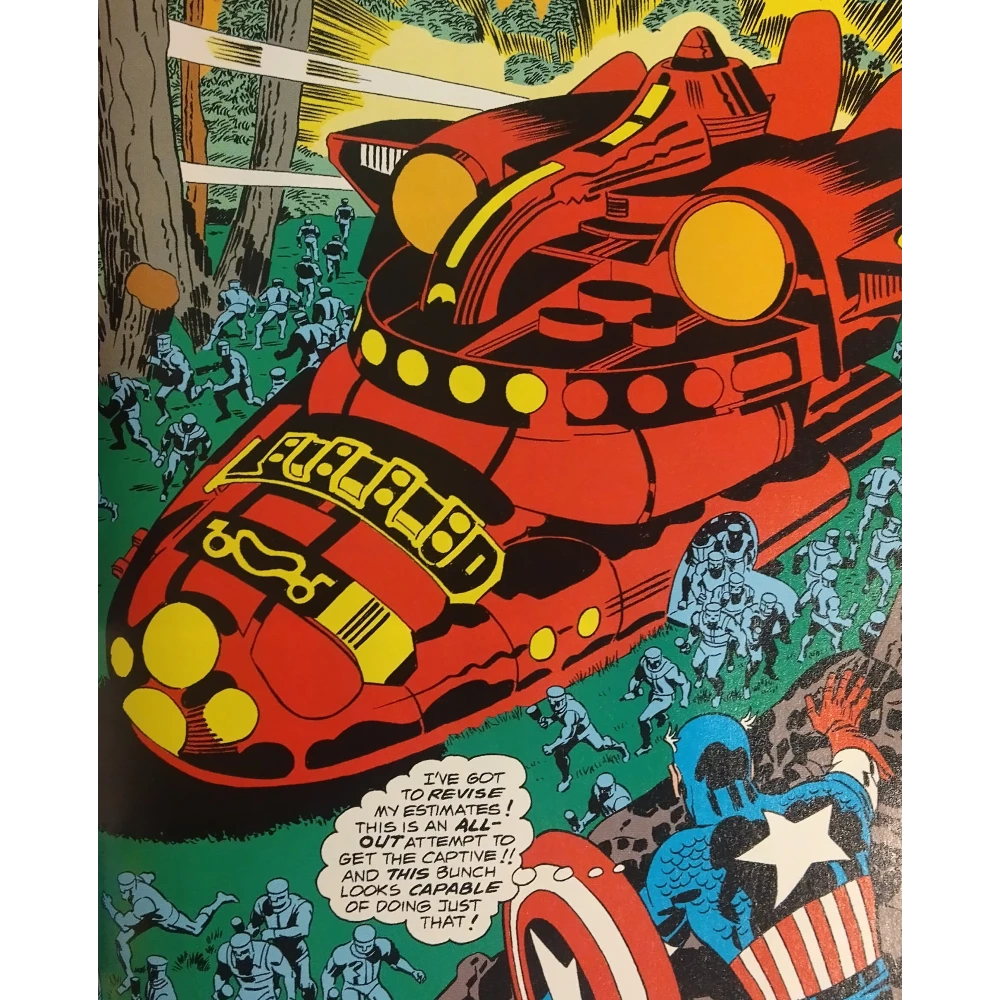
Again, there's little wrong from an artistic standpoint to be found here. These issues show Kirby in the same style he always used. That's perfectly alright for these tales. We get Kirby drawing Captain America in battle against the Red Skull as he did back in the day; we get wonderful machines drawn with all kinds of pipes and doodads as you'd see in other Kirby comics such as Fantastic Four; we get craggy aliens and otherworldly ships. Kirby looks like Kirby, as he should. The day you tell me you don't want to read a Jack Kirby comic because it has "Kirby crackle," you may want to consider picking up a novel. This is what it's going to look like.
Yes, I made the comment about maturing artistry above, with guys like John Byrne, Frank Miller, Neal Adams, and José Luis García-López delivering a level of detail at this time that aped the realism of the human body. Kirby's work can feel somewhat caricature-ish by comparison. But to ask Kirby to try anything else artistically feels wrong, even if he means his work could come across as a tad dated.
What seems a bit more reasonable to expect is a swing towards somewhat more mature storytelling methods. I feel Kirby largely exhibited that during "Madbomb," which latched onto the entertainingly bizarre idea of bombs powered by synthetic brains and married it with an examination of humanity's penchant for selfishness. Story and theme delightfully intertwined. It's fairly blunt, but it works. You never find that same synthesis here. The tales are entertaining, whether it's Cap facing Arnim Zola and his mutated monsters for the first time, Steve Rogers dealing with temporary blindness, or an annual where Cap and a local yokel find an alien fugitive who may or may not be a criminal. But around some fun premises are tricks which aren't as tried-and-true as they should be.
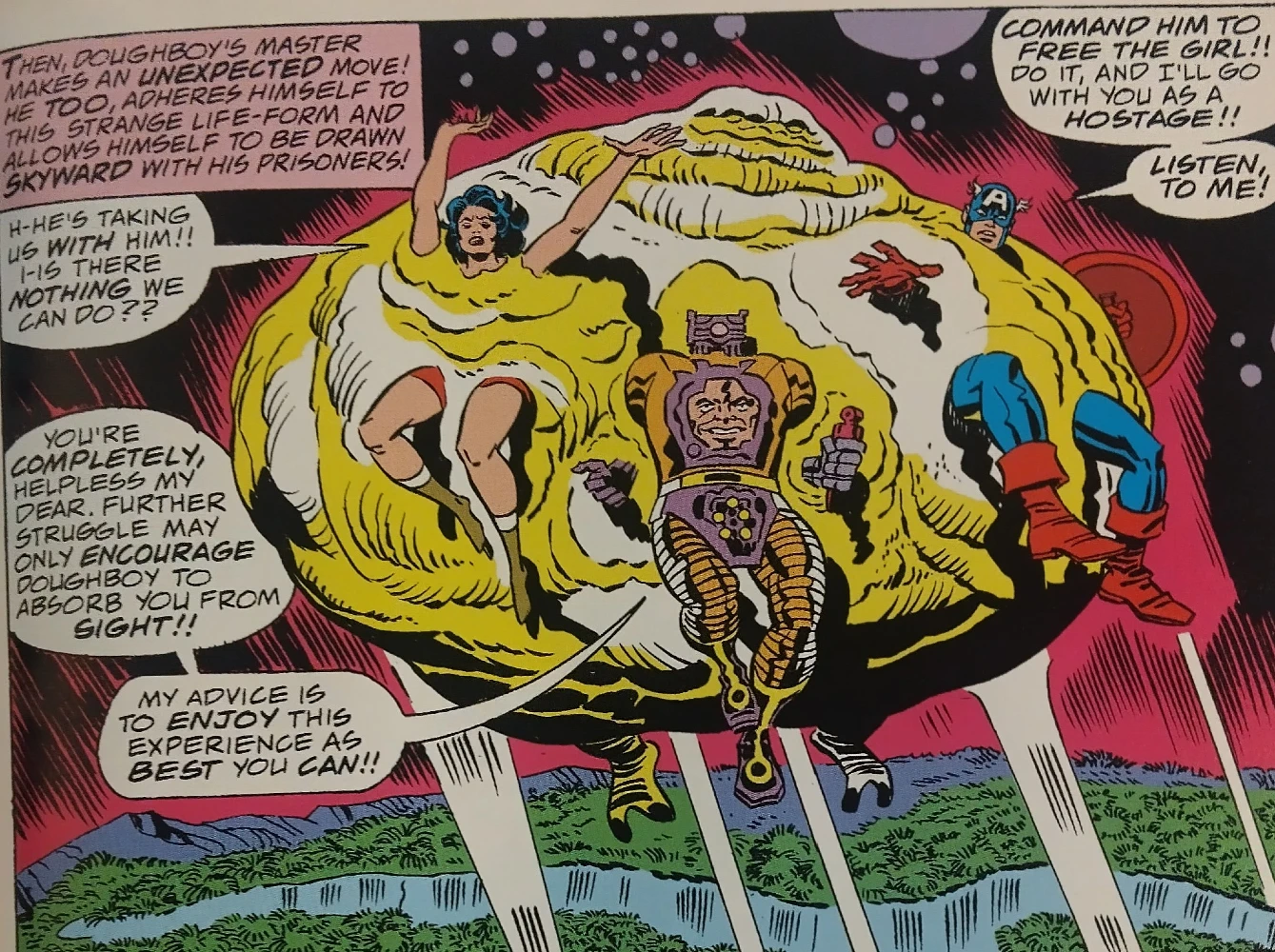
Take Kirby's titular arc, for example, focusing on "the Swine," an aptly-named South American dictator. Kirby works to fashion a story of human suffering and Cap's genuine attempts to end oppression and misery. The set-up is solid, the execution allowing Kirby to tangle with some darker themes than you'd see in his earlier output. Yet as the story progresses, we're introduced to monsters in the South American jungles, with one such beastie kicking off an arc involving an entire conspiracy involving Cap, Falcon, SHIELD, Sharon Carter and a host of other monsters. It comes out of left field, given some unnecessary dramatics and a plot twist that I can't decide is either brilliantly corny or ridiculous (it delivers shades of James Robinson and Paul Smith's JSA: The Golden Age, which I have criticized for its version of the same twist).
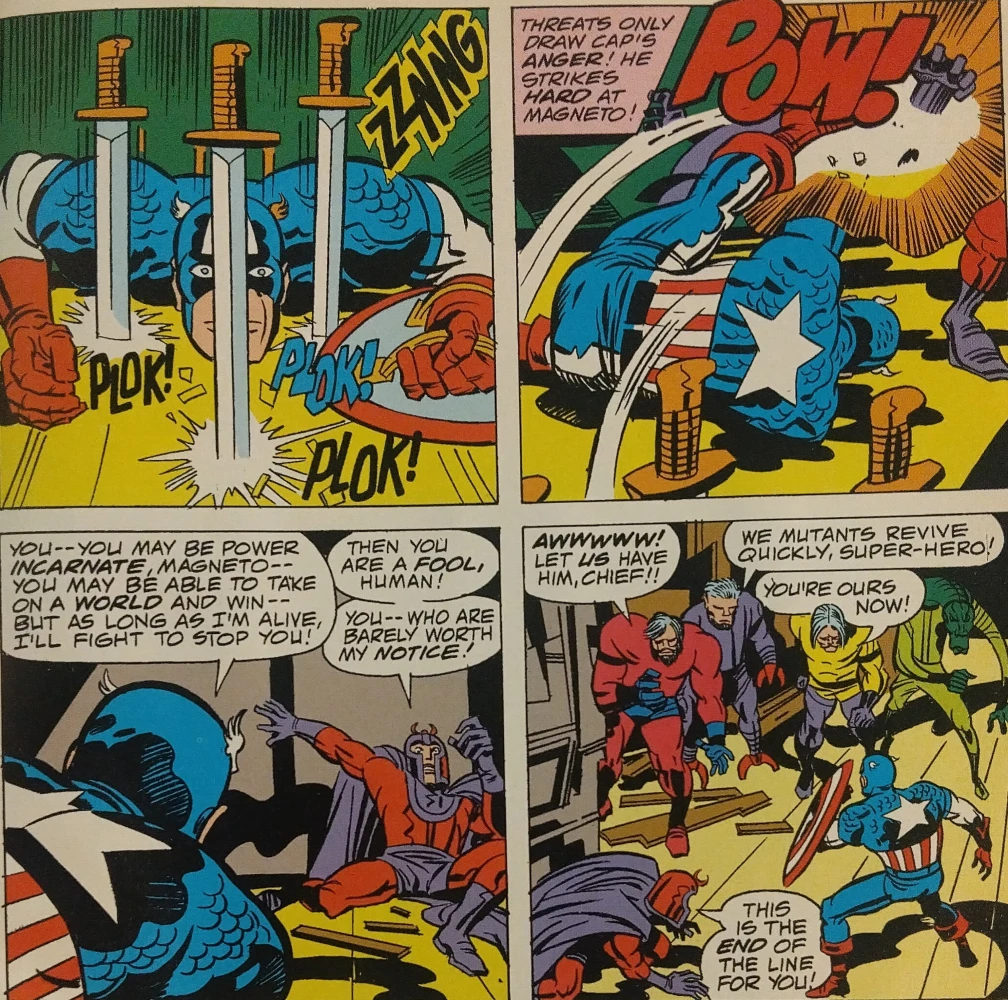
The critique comes down to the dichotomy between Kirby's ideas and his execution of them. Having Cap face off against a South American dictator and his brutal regime is a solid plot, letting Kirby hone in on Cap's prevailing nations of justice and freedom…but he can't help but drop in a monster mash to derive tension from elsewhere. An annual where Cap squares off against Magneto in a fight for a mutant's future is stymied by a new Brotherhood of Evil Mutants with bizarrely designed and named members and a Master of Magnetism completely lacking the nuance provided by Chris Claremont. That plot twist I referenced above, similar to Robinson and Smith's execution, feels "jump the shark," Kirby going straight for the most outlandish premise he can create without considering more plausible alternatives. There's shades of a solid plot there involving a transferred brain in a piloted robot, but the identity of said brain's previous owner causes less genuine surprise and more frustrated bafflement.
There's something about "Madbomb" that worked for me which doesn't translate over to these issues. Kirby achieved a decent injection of sophistication while holding onto those Silver Age tropes and images which don't work as well here. He tries, but monsters which pop up in the middle of Cap crushing a dictatorship feel tonally off-putting. Arnim Zola's a master geneticist, so what does he do? He creates "Doughboy," an entity that looks like living putty. Kirby's going full-bore with his imagination, as always, but he's lost the synthesis between ideas and storytelling. There are moments where he can achieve some of that same human element–you feel for the mutant Cap tries protecting against Magneto, and a plot twist in one annual involving an alien leads a supporting cast member to an unfortunate fate–but there's too much that feels, dare I say it, goofy.
Whenever I read older comics, such as the Lee/Ditko or Lee/Kirby material from the 60s, I always try to tell myself that beneath the art and verbose dialogue is a story scratching at a deeper itch. Lee may not be able to wring all the emotion out of Uncle Ben's death, but you can peer under the surface and see the story he's telling about a young man reacting to the violent, tragic loss of a loved one. Likewise, Kirby may not just have the writing and artistic chops to fully convey the meaning of his stories here without wandering a bit too deep into the territory of Silver Age silliness, but you see what he's trying to do. His hero stands against cruelty, his villains manipulate the building blocks of life, his mutants just want to be treated like people too. Those notions exist, and while I always appreciate the chance to grasp an author's intentions without being told directly, Kirby finds he trades some deeper storytelling opportunities for brain transplants, giant monsters, and Doughboy.