Fantastic (Four)ays: Fantastic Four #4 Review
Two eras of comics collide, reintroducing an old hero you quickly learn to love to dislike
—by Nathan on February 10, 2026—
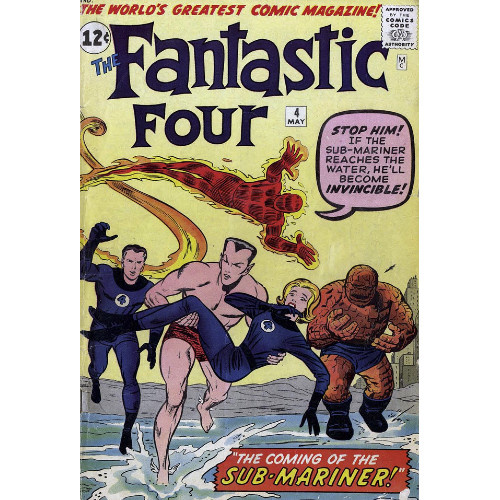
In their third-ever issue, the Fantastic Four watched as they were reduced to three: Johnny Storm, the Human Torch, pushed to his limit by his teammate Ben Grimm's taunting, flew off in a rage, swearing the group off forever (four-ever?). It's a trick Lee would turn to time and again in his career–a character making a dramatic decision or announcement that things were going to change for good. Peter Parker would never be Spider-Man again! Matt Murdock would never tell Karen Page he was Daredevil! Scott Summers and Jean Grey would never confess their love for each other!
In comics, however, permanence is rarely permanent.
We find our hot-headed hero this issue hiding away from his teammates, while the rest of the group seeks out the temperamental teen. As Johnny drifts, he comes into contact with a fellow who, turns out, is a living legend…and just as volatile as our Human Torch. With a bit of a shave, Johnny reveals a wandering derelict to be Namor, the Atlantean Sub-Mariner, and once his memories are restored, the Scourge of the Seven Seas seeks his people…
…and doesn't find them. He finds his kingdom, ruined. And just as the Fantastic Four are reunited, up comes the haughty Prince of Atlantis, threatening to tear not only the Four apart but the rest of humanity in a desperate, driven act of revenge.
"The Coming of the Submariner"
Writer: Stan Lee
Penciler: Jack Kirby
Inker: Sal Brodsky
Colorist: Stan Goldberg
Letterer: Artie Simek
Issue: Fantastic Four #4
Issue Publication Date: May 1962
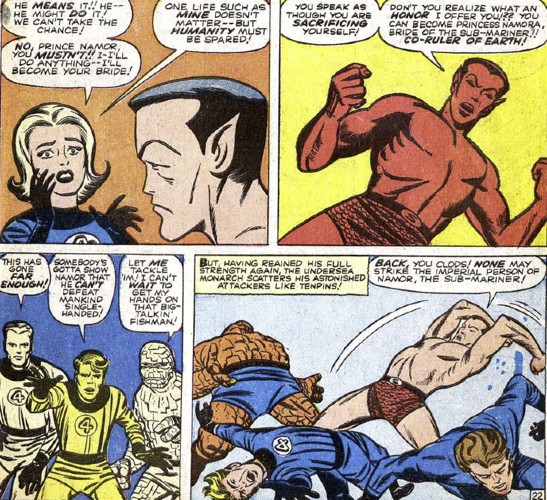
Lee and Kirby are telling two tales this issue, one focused on the search for Johnny, the other focused on the fight against Namor, and they find these tales intertwine through the impetuous youngest member of our famed quartet. He's the lynchpin connecting these stories, and though the most surprising aspect of this issue is the return of the Sub-Mariner, Johnny provides this narrative its center.
I couldn't tell you if fans of this issue when it was originally published were shocked to see Namor on the cover–I assume that at least a portion of the FF's fanbase were old enough to remember the Sub-Mariner from his initial appearances during the Golden Age. Created as one of Marvel's first superheroes in 1939's Marvel Comics #1 alongside the original, android Human Torch, the Sub-Mariner had been a World War II hero, fighting solo and with other heroes such as the Torch, Captain America, Bucky, and Miss America in the All-Winners Squad (he even fought against some of them to, as evidenced by the famous battle between Namor and the Torch in New York). The character had not popped up in comics, as far as I understand it, since 1955, his appearance here marking his debut in the brand-new Silver Age of Comics initiated by the Fantastic Four's creation.
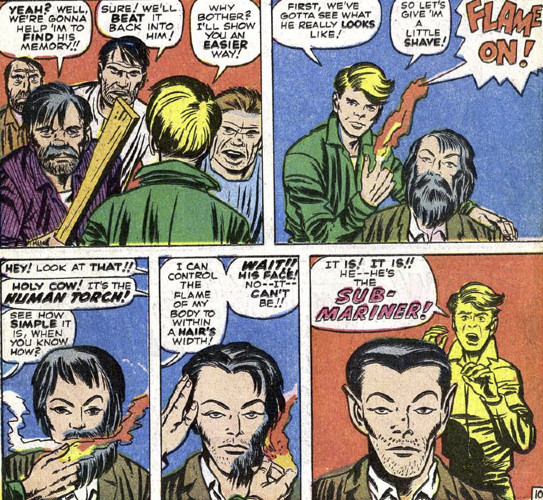
I've not read any of those older comics, so I'm not certain if that Namor vacillated between hero, anti-hero, and villain. In FF #4, Lee takes this older hero and transforms him into the issue's antagonist, a merman stricken with the internal venom of arrogance and the external plight of loss to shape his anger towards humanity. You don't need to know Namor's history to identify with the character, Lee doing a decent job to make the fishy fella a fairly complex figure. His arrogance is downright frustrating, practically batting the male FF members away at one point and telling them "None may strike the imperial person of Namor, the Sub-Mariner!" The self-referential talk, the highfalutin epithets, the absolutist tone of "None may" all work together to create a discordant perspective towards the guy. He's just so boastful, so self-assured, so demanding, that he's easy to dislike.
And yet…there's a slight turn towards empathy as well. Maybe it's because he was a hero at some point–a history not noted much here–that I feel the Sub-Mariner deserves, not so much a pass, but greater examination. He's not angry for no reason; seeking his people, Namor discovers they've fled his ruined kingdom, devastated by nuclear testing. His home destroyed, his people scattered, Namor swears vengeance on the planet…and acts accordingly. I won't argue his methods are applause-worthy, but you can understand him. Imagine you're an amnesiac whose memory is suddenly restored, and you head home to find the family you've forgotten, yet they aren't home because someone drove them out. Even if he doesn't acknowledge the eradication as intentional, Namor's emotions are justified, providing him greater characterization than just "bragging fish dude."
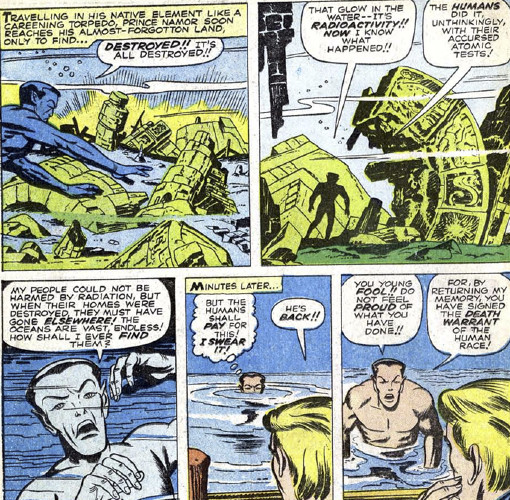
Namor's insertion here is Lee and Kirby tipping their hats to the era of old, noting the basis on which the then-current Marvel Universe was constructed, an idea later reinforced through the reintroduction of Captain America. By pulling in Namor, they're legitimizing those Golden Age comics and making them canon, blurring the lines between past and present. Namor, who fought in the very war where nuclear weaponry debuted, has become a victim of its effects. His reawakening draws him into a world which is both new and unfamiliar, a situation somewhat similar to that of Steve Rogers. Such a return also teases other possibilities–if Namor could return, couldn't Cap? The original Human Torch? Bucky?
Naw. Not Bucky.
I referenced Johnny as the lynchpin for this issue, serving as the catalyst for both the FF's involvement in much of the issue and the reason for Namor's memories being restored. Again, like the nuclear testing, the consequences of Johnny's actions are unintended: he's just trying to assist Namor, thinking a quick dip will heal the Sub-Mariner's forgetfulness (where he gets that logic, I have no idea). Though he doesn't acknowledge his culpability, Johnny does spend the rest of the issue finding some way to rectify the mistake he unwittingly made. There's also a bit of historical catharsis in Johnny being the one to defeat Namor at the issue's end, calling to mind his namesake's rivalry with the salty seadog.
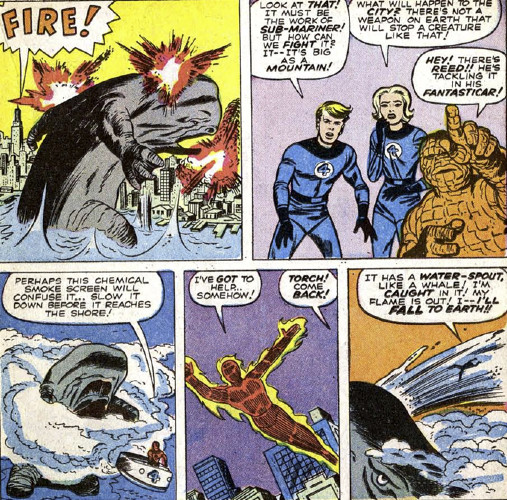
Johnny's teammates are given opportunities to engage with this issue as well–Reed does little against Namor physically, but he leads the charge to find their AWOL teammate in the issue's opening pages. Perhaps his most significant contribution comes late in the issue, as he defends Sue against an infatuated Sub-Mariner, thus unknowingly generating one of the longest-lasting rivalries in Marvel's history. Sue, not nearly as taken with the prince as he is with her (at least, not in this issue) nevertheless says she'll accompany Namor if he just leaves humanity alone. Namor scoffs at her sacrificial request, but her selflessness should be acknowledged despite his derision. She is not an object to be won, though Namor would see her as such (he chastises her seeming sacrifice, stressing the honor to be bestowed upon her as his queen), Lee paralleling Sue's consideration with the prince's pompous posture.
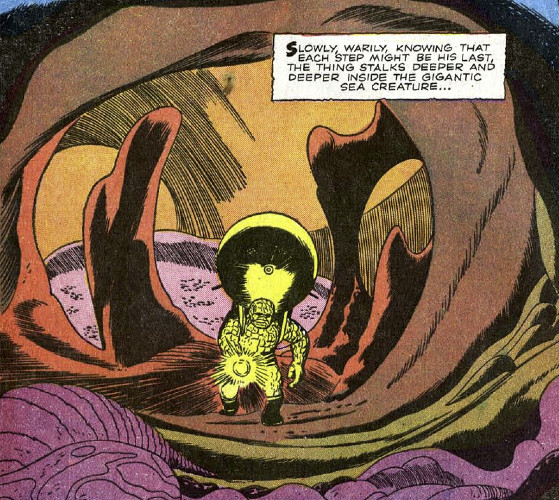
Ben is this issue's oddest character, providing both a few engaging panels with some fairly flummoxing moments. Momentarily transforming into a human early in the issue, Ben exults in his appearance before falling into despair when he becomes a craggy ogre again; still, this does not stop the Thing from using his strength and invulnerability to carry a nuclear bomb into the gullet of Giganto, a kaiju-sized creature which puts the Mole Man's favorite monster of the same name to shame. It's a fun juxtaposition of Ben's character, one moment offering the fleshy, emotional portion of the Thing behind the rocky exterior, the next showcasing the heroic, noble warrior whose hardened hide and prodigious strength can heft a nuke and journey down the throat of a primordial whale like a voluntary, modern-day Jonah.
Lee gives Ben a bit of a darker bent early in the issue, as his own search for the Torch is encouraged by festering anger. We've seen the two squabble like brothers before, but the sheer hate coursing through Ben's veins is disturbing. Finding and cornering the Torch, Ben fully intends to bruise him, and though Lee's dialogue has the Thing play it off as "just rough[ing]...up a little" to teach Johnny "who's boss, once and for all," his intentions are displayed as far more harmful. There's genuine anger backing this guy, heartfelt rage from a grown man with enhanced strength towards a teenager. The scene does nicely dovetail with Ben's brief transformation into a human, cooling him off, but man, there's a cruelty here I just don't quite understand. I feel Lee is exaggerating (I know! Stan Lee? Exaggerating? Preposterous!) and playing up the intensity, but it reads oddly from my perspective.
Aside from one awkward Thing, this issue presents a fairly entertaining tale centered on a revived Golden Age hero and the Silver Age version of his rival responsible for "resurrecting" the forgetful Atlantean. The Golden and Silver Ages connect in this issue, breaking a barrier between the past and the present and making for a heckuva interesting crossover which would pay dividends down the line through the reintroduction of other Golden Age characters, the threads of forbidden romance and the subsequent rivalry between Namor and Reed, and Namor's own ongoing saga as he searched for his people. "I've got a hunch he'll be back," Ben, speaking of the Sub-Mariner, morosely prophesizes in the final panel. Like the tide, Namor would go back out to sea…but like the tide, he'd find his way back to shore, again and again, a conflicted character, both a hero and antihero in a world far different from the one where he crushed Nazi U-boats.