(Strand)om Stories: Squadron Supreme Review
Mark Gruenwald's magnum opus remains highly readable, thoughtful, and entertaining, deserving of deep appreciation
—by Nathan on May 31, 2026—
In one of my recent reviews, I tackled a volume collecting several DC graphic novels from Paul Dini and Alex Ross. Focusing on individual members of the Justice League, these graphic novels pitted some of DC's greatest heroes against some genuine real world threats. Instead of stopping Brainiac from adding Metropolis to his collection of shrunken cities, Superman tried to shrink the gap between the hungry and the fed by delivering food worldwide to impoverished nations. Instead of punching the Riddler's lights out, a certain Dark Knight strove to unravel the riddle of gentrification and how, as Bruce Wayne and Batman both, he could use his vast resources to grapple with inequality.
Integral to each of these graphic novels, as I discussed, was the humanity emphasized by each hero. Visually, Alex Ross painted a swath of emotions on our protagonists. Narratively, Dini focused on his characters' limitations. Not even Superman could end global hunger in a day; not even Wonder Woman could eradicate injustice. Each graphic novel ended with some problem intact–some problem the real world continues to face–with our heroes meant to inspire hope rather than provide permanent salvation.
Which brings me to the Squadron Supreme.
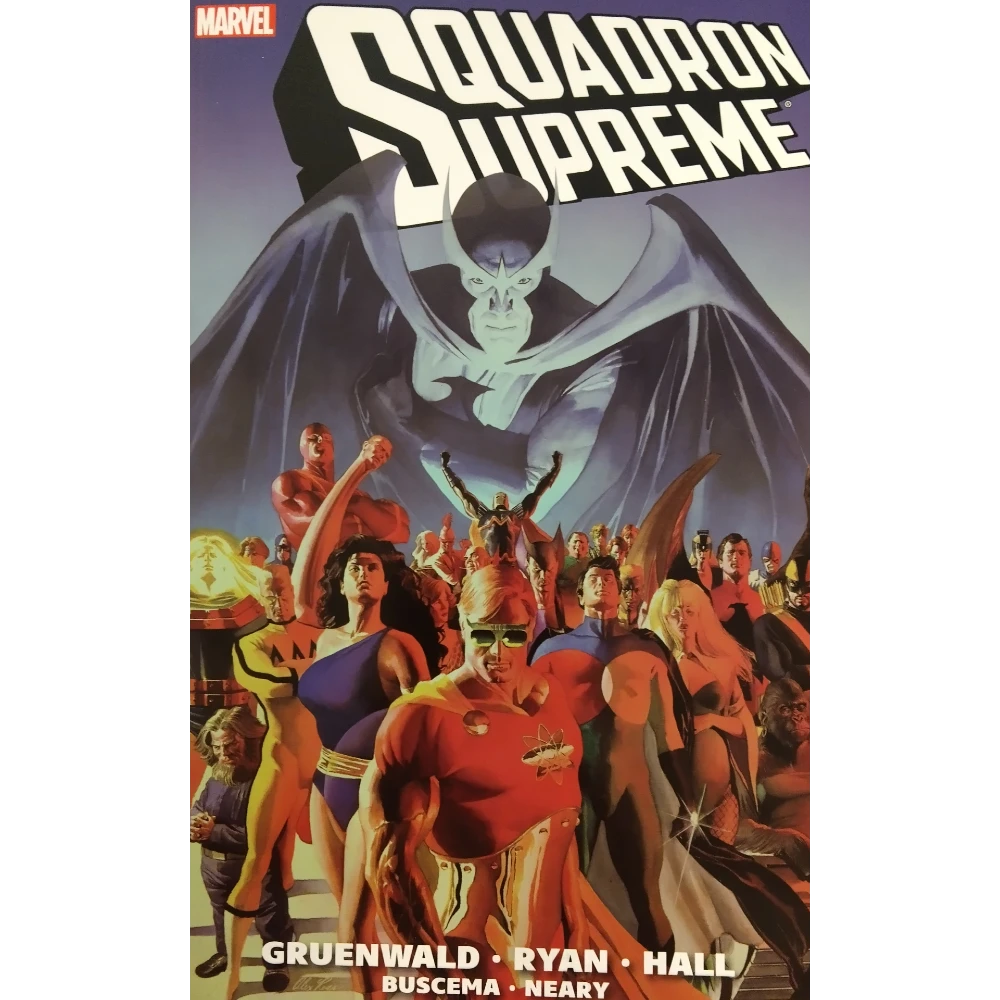
Created by Roy Thomas and John Buscema in Avengers as not-so-subtle parodies of the Distinguished Competition's greatest heroes, the Squadron Supreme was a heroic version of the previously introduced Squadron Sinister. Popping up briefly in a few different titles, the Squadron faced their greatest defeat at the hands of Overmind, who mentally controlled the team in a Defenders arc which left their homeworld, Earth-712, decimated.
Lifelong Justice League fan and famed Captain America writer Mark Gruenwald saw potential in this concept. Never writing for his much-loved League prior to his untimely passing in the 90s, Gruenwald was nevertheless given the next best thing: a twelve-issue limited series starring folks based on the League. In the wake of cataclysmic disaster, the Squadron has determined to take matters into their own gloved hands, promising to not only fix the world but to make life better for everyone. And all in a year's time.
We'll see if they'll succeed where the Justice League failed.
Squadron Supreme
Writer: Mark Gruenwald
Pencilers: Bob Hall, Paul Ryan, John Buscema, and Paul Neary
Inkers: John Beatty, Sam de la Rosa, Jackson Guice, Keith Williams, and Dennis Janke
Colorists: Christie Scheele, Mark Philips, Bob Sharen, Michael Higgins, and Ken Feduniewicz
Letterers: Janice Chiang, John Workman, Rick Parker, Diana Albers
Issues Collected: Squadron Supreme #1-12 and Captain America #314
Volume Publication Date: May 2013
Issue Publication Dates: September 1985-August 1986
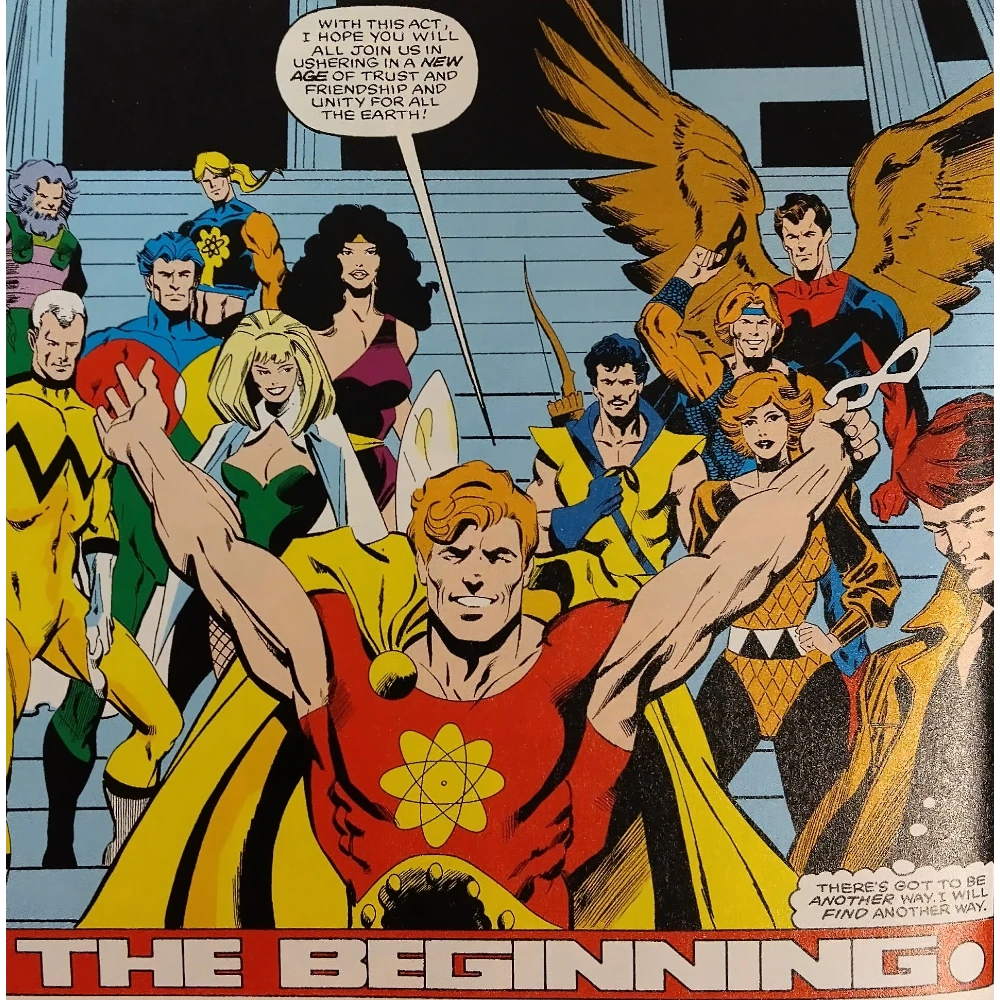
I first read Squadron Supreme on a whim a handful of years ago, and it quickly cemented itself as one of my favorite Marvel limited series from the 80s, if not one of my favorite Marvel comics of all time. I dove in largely blind, knowing I was reading a team introduced as a parody concept, unaware just how seriously Gruenwald took the concept and how layered he developed his narrative. Published shortly before Alan Moore and Dave Gibbons' Watchmen and around the same time as other widely influential and beloved comics, Squadron Supreme feels overshadowed by peers which received far more attention and acclaim upon publication. The series isn't exactly a hidden gem, but it still feels underrated. It shouldn't be.
Shortly after finishing this book for the first time, I also read DC's first Injustice series, based on the hit video game. Squadron Supreme–featuring a guy based on Batman fighting against the seemingly fascist policies instituted by a guy based on Superman–has a similar premise, but it far more deftly explores familiar themes, about forty years prior to Injustice, over a much more brief issue count. This series is a complete narrative, from start to finish, that feels wholly unlike any Marvel comic produced during the same period.
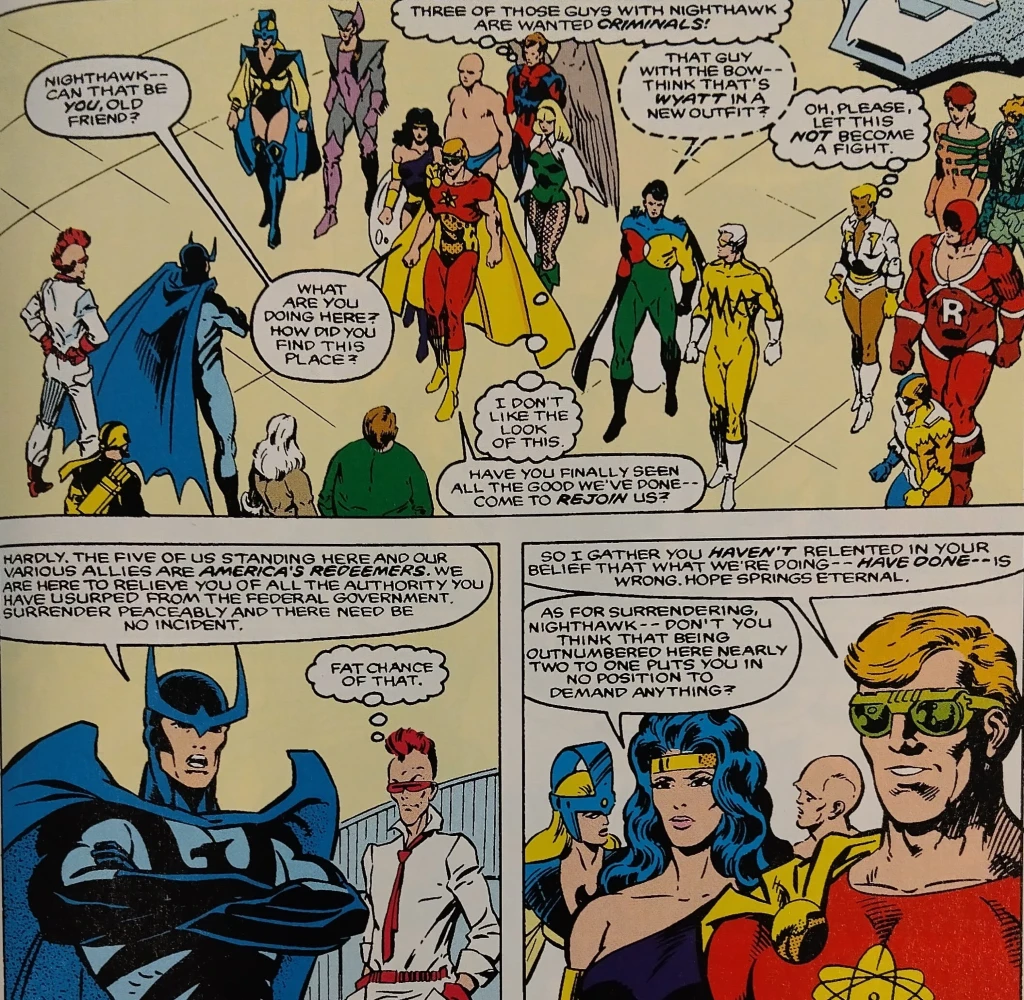
Whereas Dini and Ross' graphic novels hinged on its heroes' humanity through failure, Gruenwald approaches that concept from the extreme other end. Promising to not only restore the damage they inflicted but to end the tyrannies of hunger, crime, disease, and even death, the Squadron embarks on a year-long mission to make their homeworld a utopia. Yet it's through exploring the establishment of this paradise on Earth that Gruenwald highlights the dangers of men and women, even supermen and women, playing God in this fashion. The Squadron doesn't exactly create heaven on Earth, but the team makes significant steps towards that end, and what seems like a too-good-to-be-true blessing begins unraveling and displaying a darker truth.
If the idea of superheroes eradicating even death sounds obnoxious, it's supposed to. The Squadron develops stakes that are so noble yet so outlandish, you wouldn't be remiss if you didn't trust them. Yet as the series progresses, Gruenwald moves their plans along in a pretty definitive direction. Again, the focus isn't failure by not delivering on a promise; it's highlighting their humanity through the potential for success. As these characters plan to guide the world into a new age, they can't help but compromise their principles by essentially the beginning of their plan. They're humans with post-human ambitions, and perfection can't be created out of imperfection. This is where the series becomes powerfully philosophical. Gruenwald rightfully recognizes the complexities inherent in some of the Squadron's policies–the elimination of guns, behavior modification for criminals, suspended animation–and willfully explores them, both the inherent benefits and hidden limitations.
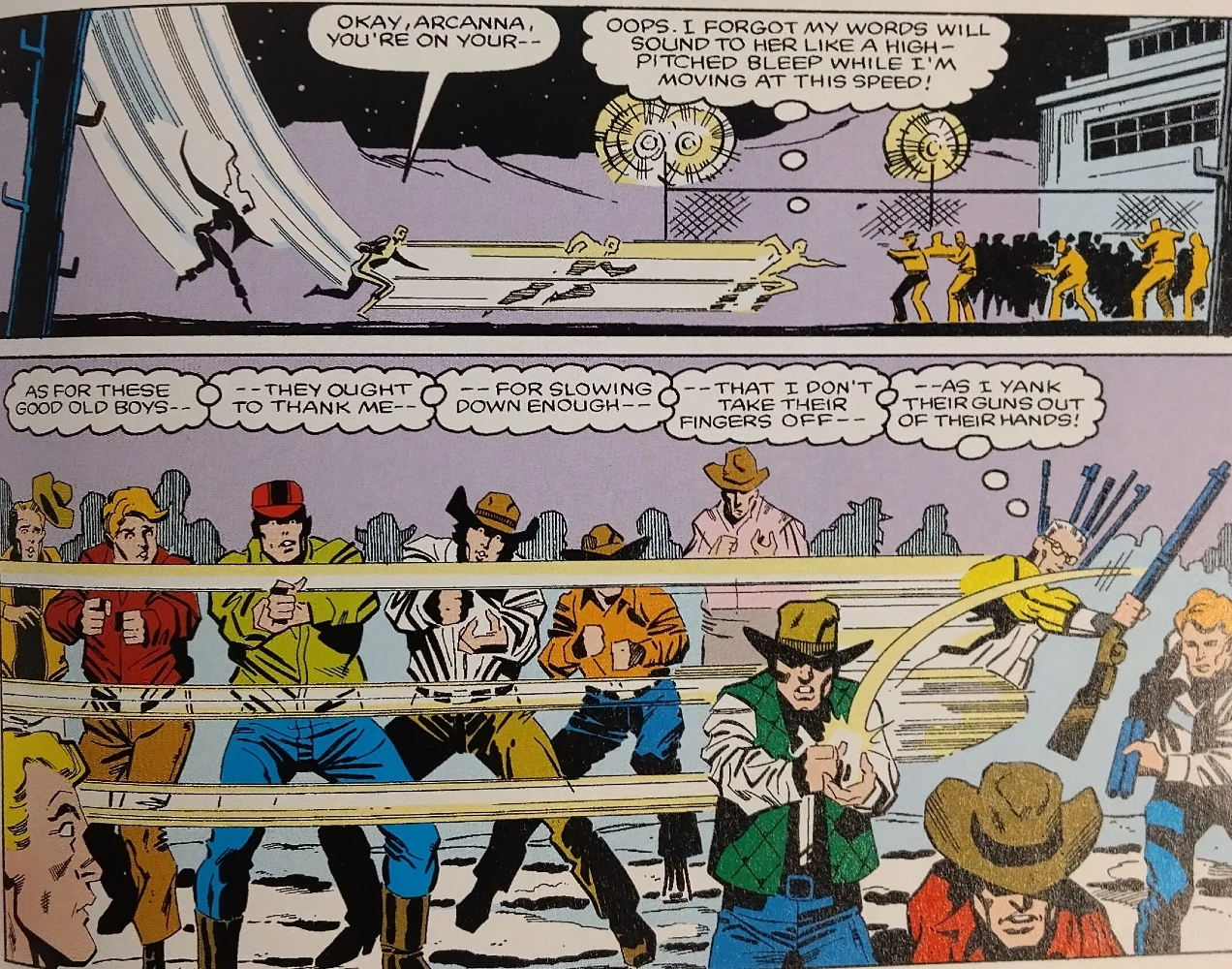
Kyle Richmind's Nighthawk opposes the team from the start, abandoning the Squadron fairly early on, and not even team leader Hyperion can convince him otherwise. Within the Squadron, Gruenwald maneuvers his pieces effectively, with characters developing genuine qualms with some of their activities while others staunchly defend their actions. Power Princess, ever defensive of Hyperion, rushes to his aid whenever an argument develops. The somewhat passive Green Lantern pastiche Dr. Spectrum, after accidentally murdering a powered individual with his gem, finds his perspective colored by his experiences. These characters run the gamut of opinions and reactions, and Gruenwald's ability to keep these on display makes even sequences dependent on heavy dialogue intriguing. This isn't Spider-Man debating the Punisher for the umpteenth time whether murder is wrong–the reader should, hopefully, agree with Spidey in those situations, thus eliminating any thoughtfulness a writer could conjure from the argument. Gruenwald smartly presents us with solutions which, on their face, seem positive and plausible, yet he approaches deeper notions which should cause a certain amount of consternation, showing the divide between philosophy and practice.
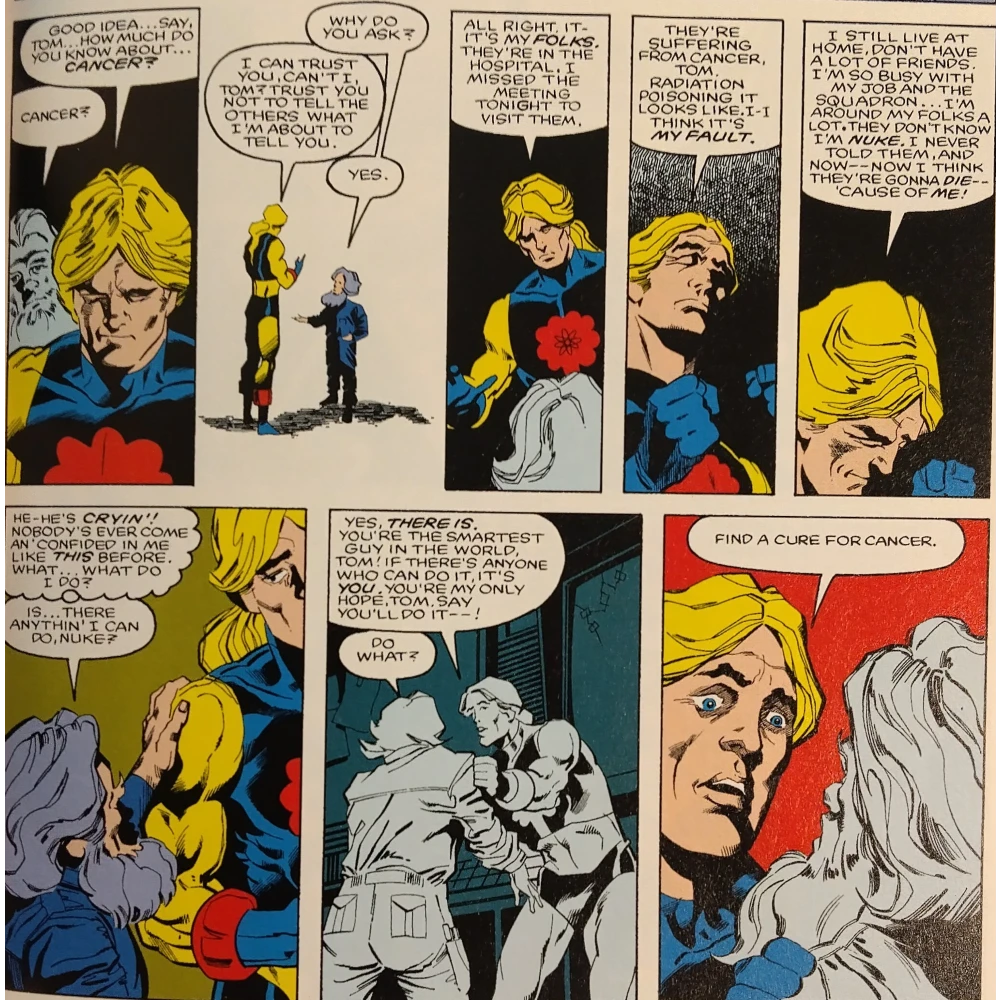
Gruenwald's most effective storytelling habit occurs when compromise enters the picture, powerfully puncturing the Squadron's good-hearted intentions. You can talk about the positive impact of "behavior modification" on criminals until you're blue in the face, but what about free will? And what happens when a Squadron member decides to use the process on a teammate? Or how about when a behaviorally modified criminal is compelled to keep a secret to protect a Squadron member intent on betraying the rest of the team? In one issue, speedster the Whizzer uses a gun after the Squadron has enforced a complete "no gun" policy; in another, Tom Thumb is asked to turn on a member in exchange for a cure for cancer. Situations are presented which demand these characters either follow the principles they've set or bend the rules they may now feel imprisoned by.
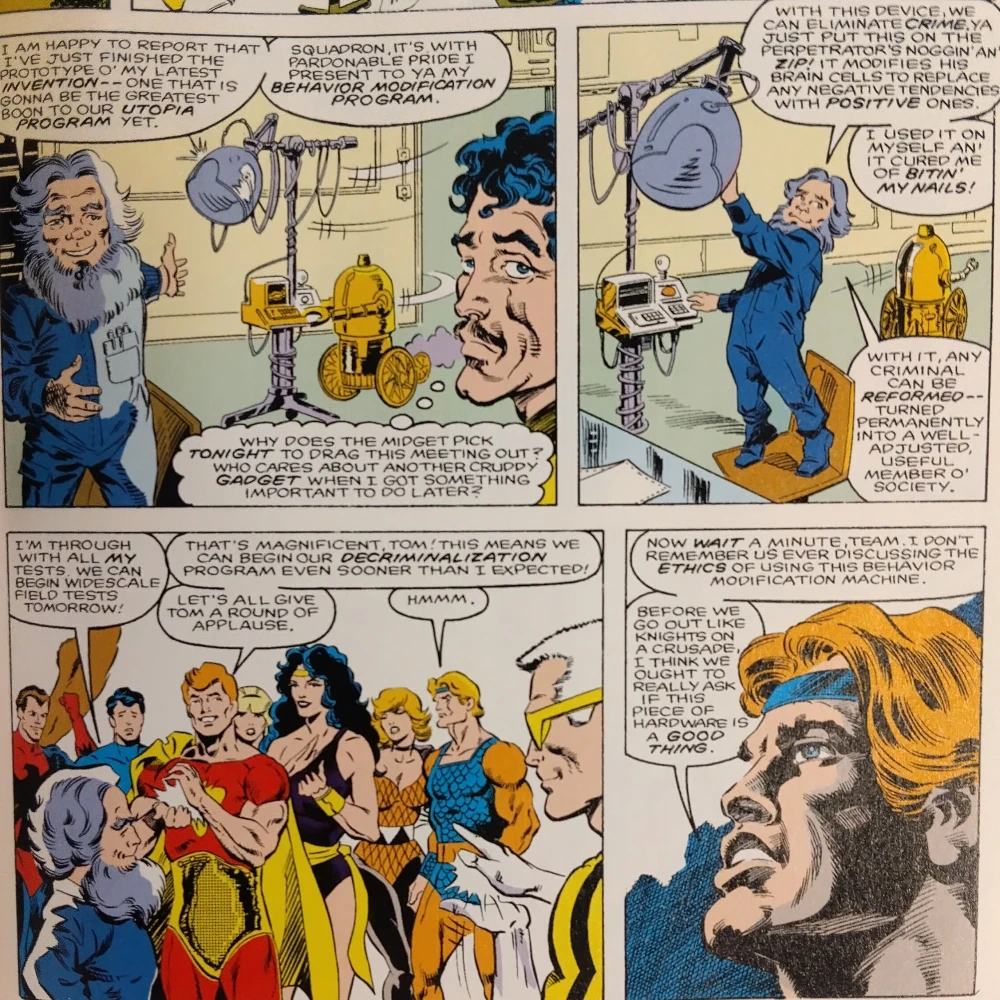
It's this complexity which makes reading the series so engaging. Gruenwald wonderfully weaves in layers of conflict, with early situations coming back to haunt, threaten, or affect characters later. Ideas that seem so simple at first are revealed to be more complex than expected. The beauty is in the subtlety here. The comic can be blunt at moments, but it's in the unspoken details where Gruenwald entices the reader. Nowhere is the term "brainwashing" used, yet Gruenwald knows "behavior modification" won't quite dampen reader suspicions. When Hyperion condones Spectrum for murder, you know he's already crossed a line by not enforcing a standard behavioral policy for the rest of the team. Even a simple omission of truth, such as Arcanna not divulging a pregnancy, later returns to create maximum brutal irony.
Consequences aren't overturned with the flip of a page, lingering beyond the moment they occur. A brainwashed Squadron member remains mentally affected for the rest of the series; characters are injured and killed (without the promise of any of that resurrection hogwash); relationships and trusts are broken. There's no singular villain here to cause chaos, not exactly, with the primary threats of the book being the distortion of belief and philosophy and godlike ambitions played out by all-too human heroes. The Squadron hands out rose-colored glasses like they're candy, promising a better future, only seeing the thorns encircling the frames when their eyes begin to bleed. The intentions are good-hearted, yet they're implemented before all the ramifications are considered, and it's in this lack of consideration that characters continually find themselves hampered.
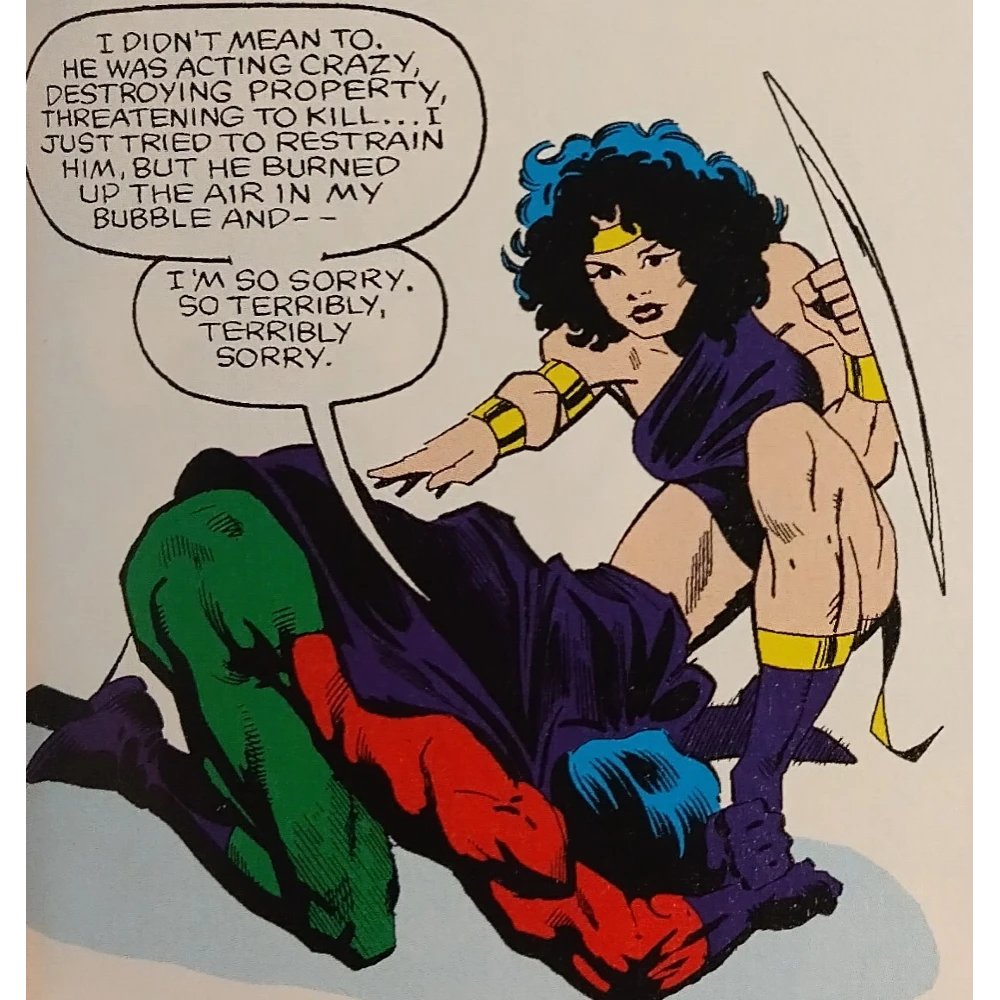
Where Gruenwald also succeeds is in taking the Squadron's core concept–parodies of the Justice League–and extending that amusing premise in serious directions. Wonder Woman parody Power Princess is married to a soldier she rescued from a sinking ship; unlike Steve Trevor, this man has aged while the Princess remains young, and his ailing health become an important plot point late in the series. Firestorm parody Nuke, it's revealed, leaks enough radiation to give his parents and one other character cancer, setting off events which affect the entire series. Green Arrow stand-in Golden Archer loves the Black Canary-inspired Lady Lark, their romance moving beyond the eternal "will they, won't they" found in other comics and impacting a few very important issues.
Some of these details feel like they're used for how obvious they are, such as Nighthawk and Hyperion butting heads Dark Knight Returns-style or Spectrum and Whizzer being friends like Green Lantern and the Flash, but they add to the series' brilliance. Gruenwald takes characters originally created to poke fun at the Distinguished Competition and makes them their own people, while allowing them to retain their core identities as Justice League knockoffs. He stretches them beyond their original intent, letting them feel like actual developed characters than just "Marvel's version of [fill in the blank]," while reminding us of their roots.
The whole series is brilliant, from the way it draws natural conclusions from these League-inspired heroes which DC would never explore, to how it tackles genuine problems faced in reality. There's no one solution Squadron Supreme offers–to be fair, Gruenwald is more interested in establishing what shouldn't be done–but that isn't the point. We're offered human characters with superhuman abilities who decide to play God, fostering the enhancement of an entire world that never asked them to do so in the first place. Despite their abilities and intentions, their humanity puts them at odds with their intentions, physical and moral limitations impacting their mission. All of this is explored in-depth by Gruenwald, who has, in my opinion, written the best and most complex Justice League story put to paper…for Marvel! Mark Waid, a fellow Captain America writer, may have written what's considered the definitive Justice League epic in Kingdom Come, but Gruenwald exposed the potential for such deconstructionist storytelling involving the League years earlier and for a rival company.
Gruenwald, by all accounts, was immensely proud of series, to the extent he had his ashes mixed in with printer's ink used in this trade's first edition (which, I don't believe, is the edition I own), going way beyond giving the traditional "blood, sweat, and tears" for a project. I said this series wasn't a hidden gem, but it absolutely deserves to be more widely read. Crackling with thematic heft, deep characterization, and a well-considered plot, Squadron Supreme deserves a spot on your shelf next to "Daredevil: Born Again," "The Dark Phoenix Saga," Walt Simonson's Thor, and other mighty Marvel epics from the 80s.