Spider-view: "Trial by Jury"
Despite some slow pacing, this arc deals with multiple forms of neatly woven conflict
—by Nathan on March 26, 2026—
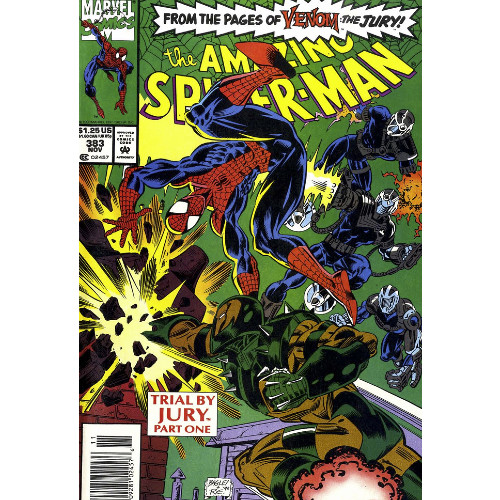
After his first defeat at the hands of Spider-Man, Venom was imprisoned in the Vault, a supermax facility in the Colorado Rockies constructed specifically for big bad villains like himself. Murdering a guard, Hugh Taylor, Venom escaped and went on to wreck all kindsa havoc for all kindsa people before becoming a anti-hero in his own books, blah-by-blah. You know what happened after that.
Hugh's father, Orwell Taylor, took none too kindly to his son's murder, forming an armored vigilante group called the Jury to take down one Edward Brock and his alien alter ego. The group was none too successful, Venom getting away from their clutches scot-free.
Orwell, terribly displeased at this development, elected to go a different direction. In Amazing Spider-Man #382, right as Peter wrapped up a battle with the smarter-than-usual Hulk, Orwell and his band of gunslingers arrived in New York, ready to tackle a new target: ol' Web-Slinger hisself. They may call themselves the Jury, but it appears this band of metal mercenaries have no problems playing judge…and possibly executioner as well.
"Trial by Jury"
Writer: David Michelinie
Penciler: Mark Bagley
Inkers: Randy Emberlin and Al Milgrom
Colorists: Bob Sharen
Letterers: Rick Parker
Issues: Amazing Spider-Man #383-385
Publication Dates: November 1993-January 1994
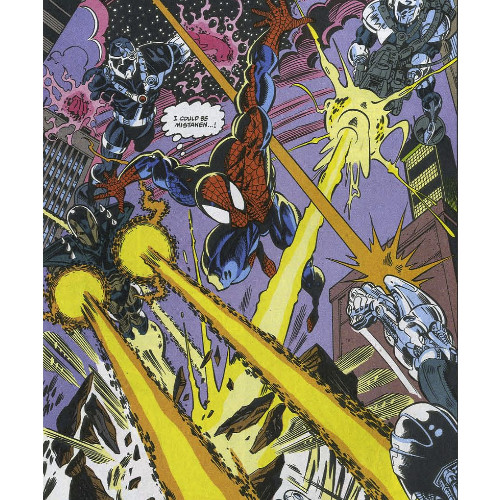
Michelinie and Bagley aptly pack a whole lotta material in these three issues, with an engaging main narrative undergirded by some necessary subplotting and character development happening around the edges. Spidey may be the guy pulled in front of the Jury, but he's not the only one facing trials in these issues.
Though Orwell Taylor had been introduced previously, Michelinie provides him the pages needed to flesh out who he is as a villain–his motivations (avenging his son) had been introduced previously in Venom: Lethal Protector, but in these issues, we get to see the kind of screwball Spidey's messing with. Orwell's sense of justice is taken to extremes as he decides, after failing to murder the guy actually responsible for murdering his son, he's going to target the guy he blames as responsible for the existence of the guy responsible for murdering his son!
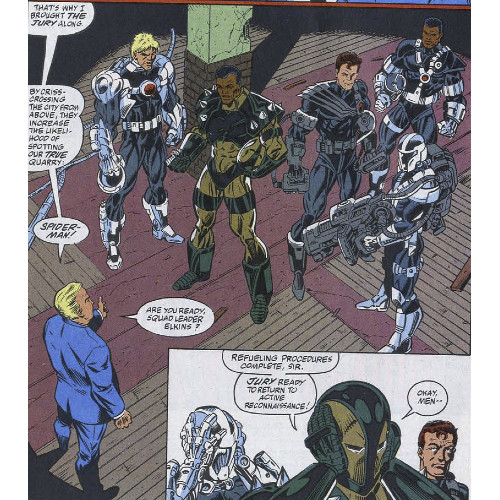
I was initially hesitant with such logic–I felt it was a tad too threadbare, Michelinie finding some outlandish way to bring over a character he'd used previously, possibly in a way to tether his Venom work more strongly to Spider-Man. I mean, yeah, from a continuity perspective it works–the second chapter gives us a whole rundown on how Spidey brought the symbiote outfit back with him from Battleworld, which bonded to Eddie Brock, who not only murdered Orwell's son but also contributed to the creation of Carnage, who most recently slaughtered a buncha New Yorkers with several other supervillains. If you want to follow Orwell's labyrinthine trail all the way back, sure, you could argue you'd wind up at Spider-Man. But it's a heckuva stretch, isn't it?
I believe, however, this is what Michelinie is working towards, and it not only lends credence to the concept that Orwell, though posing in the name of justice, is really our issue's primary antagonist–if not an outright villain–but it also allows a defecting Jury's member own arc some additional weight. Orwell is off his rocker, yet Michelinie weaves in his villainy subtly enough to make him appear, initially, as just a misguided rich guy. You never agree with the guy, but you do start to think that there could be some deeper "logic" rolling around Orwell's brain. You think, maybe, he'll come to his senses and recognize the depth of his actions…and then he has Spider-Man trussed up and stuck in front of a kangaroo court, and you begin going "Oh, no, wait, this guy's just nuts." It's fun plotting on Michelinie's part, and it makes Orwell's nefariousness feel intentionally teased.
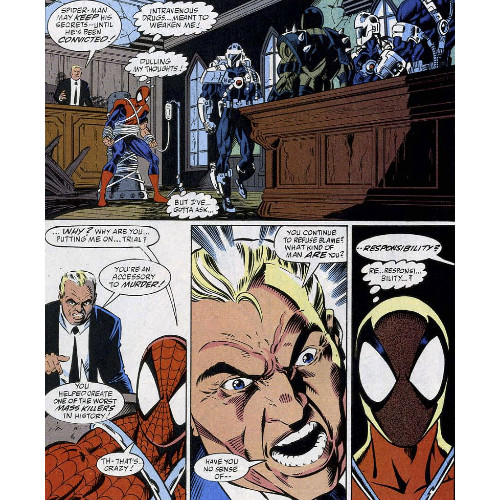
The development Michelinie allows Orwell extends somewhat to the Jury, a group of Hugh's former friends and military squadmates who've bought into Mr. Taylor's crazy revenge scheme…mostly. Most of the Jury are just armored goons with different codenames, slight variations in their armor, and some alterations in their weaponry. They fly around, fire different lasers, and team up to fight Spidey. We don't get much in the way of characterization, save for their diehard diligence to Orwell's scheme. Hugh was their friend, too, and they'll do whatever they can to make sure "justice" (see: revenge) is passed.
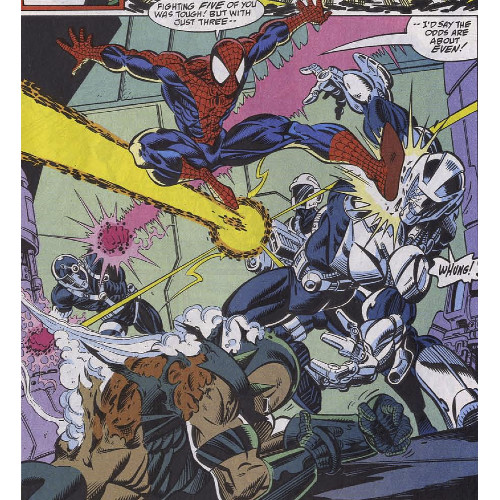
Though each member of the Jury feels fairly indistinguishable from the others, Michelinie gives Mark Bagley–who originally designed the crew for Venom: Lethal Protector–the freedom to showcase their weaponry in combat with Spidey. Bagley's work is fairly fluid across these pages, and I don't just mean because Spidey shoots webbing. He dodges lasers by a hair's breadth and punches mooks clear across the room. Bagley seems to have considered how well the Jury would appear in fight scenes such as these, employing their various tools and weapons and drawing bits of glass when Spidey shatters at least one helmet. Is there an edgy 90s-ness to the whole thing? Sure, but you get the sense Bagley's intentionally factored the edginess into the designs, providing them a practicality to the story beyond "dude in armored suit needs a cool gun."
Michelinie toys some with the emotions and motivations of one Jury member named Ramshot, and it's here we're allowed some additional characterization. Again, like with Orwell, I eyed Ramshot warily as he began to show signs of a conscience. I often find the "one villain character has doubts and begins questioning his fellow villains' judgement" trope a tad unbelievable, particularly because it usually happens late in narratives and is generally used to provide our hero(es) some means of convenient escape. You have to convince me the once-evil character has genuinely deliberated and truly doubts his former course of action in order to make the necessary change of heart seem reasonable. Last minute switches of allegiance don't work as well for me.
Michelinie plays around with Ramshot's character significantly enough to make the change believable, sewing scenes through all three issues to convince me of the level of Ramshot's doubt by time he makes the ol' moral switcheroo. The "change of heart" is intended to play a hand in the plot, allowing Spider-Man somewhat of an ally to give him an upper hand against the Jury, but even if you can tell Michelinie is moving in that direction, he plants the concept early enough for it to have time to grow.
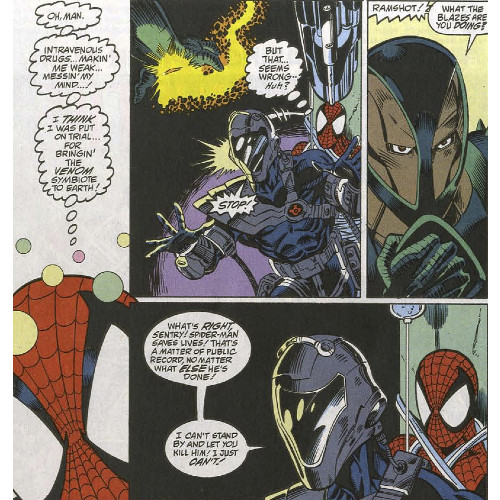
Spidey's own sense of perpetual guilt is briefly brought into play as he's captured and drugged by the Jury, leading to a somewhat interesting mental duel between a piece of him which resists the drugs and part of him which feels responsible for the chaos caused by Venom and Carnage. This internal battle could be better executed–part of this is because a decent chunk of Michelinie's second issue is given over to a recap of Venom's history. Though it traces the character's creation and narrative path, it slows the issue down considerably; not even Bagley's detailed art can save the reader from appreciable exposition.
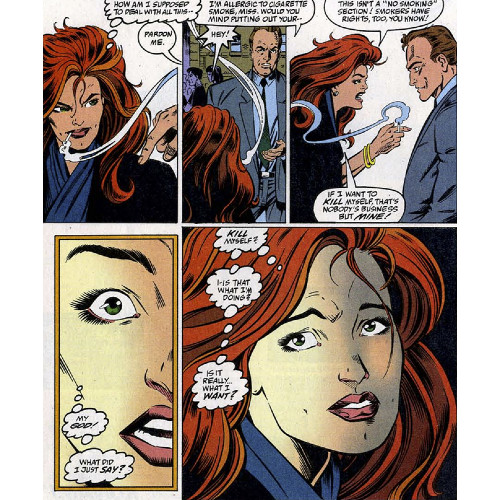
I mentioned early on that Spidey isn't the only one facing trials in these issues, as MJ and Aunt May are given their own worthwhile subplots. I've, very minutely, referenced Michelinie's ongoing "MJ smokes" arc, which finally culminates in this trilogy of issues. I really have no opinion on the smoking itself–readers have commented over the years that it was an ugly little way of allowing MJ conflict, a physical manifestation of her anxieties over being married to a superhero. I've reviewed these issues so infrequently that I've not paid much attention to its development, other than when it popped up periodically in a few arcs. The resolution to the plot feels somewhat forced, Michelinie suddenly pulling in a supporting cast member to shock MJ out of the bad habit. I find nothing wrong with MJ learning a harsh lesson about the realities of smoking and determining to find other, healthier methods of coping, but there's a level of shock value Michelinie attempts which just feels manipulative.
Elsewhere, we get a bit I'm sure folks would have never thought they'd see: May Parker, detective! Made suspicious by her brother- and sister-in-law's sudden reappearance, she begins digging into them to see if they're who they really say they are. This gives that particular subplot some momentum, but more importantly, it unfolds as a fairly insightful look into May Parker's character. Sure, it gives her something to do, like the smoking gives MJ a problem to resolve, but it taps into May's own sense of tenacity. Her digging and refusing to stop at dead ends provides the reader the notion that Peter may get his responsibility from Uncle Ben, but he gets his determination and stick-to-it-ness from his dear aunt.
Decent conflict is given each of our principal players and in uniquely different measures, whether it's fighting armored goons, battling an addiction, or digging up dirt on one's extended family. Momentum is nicely provided to different plots–MJ's smoking, the mystery of Peter's parents, Orwell Taylor's revenge–even if it isn't consistent. Yeah, some of the second issue slogs a little as Michelinie indulges in wringing out some history (most of it his own!), but otherwise, he and Bagley keeps the action and tension moving at a decent clip. Spider-Man may be brought before a jury, but I've got the verdict and the gavel, and I'm saying this arc is largely innocent of any major complaints.