Distinguished Critique: Robin: Flying Solo Review
Tim Drake's further adventures see him work within nicely crafted and displayed independence
—by Nathan on September 13, 2026—
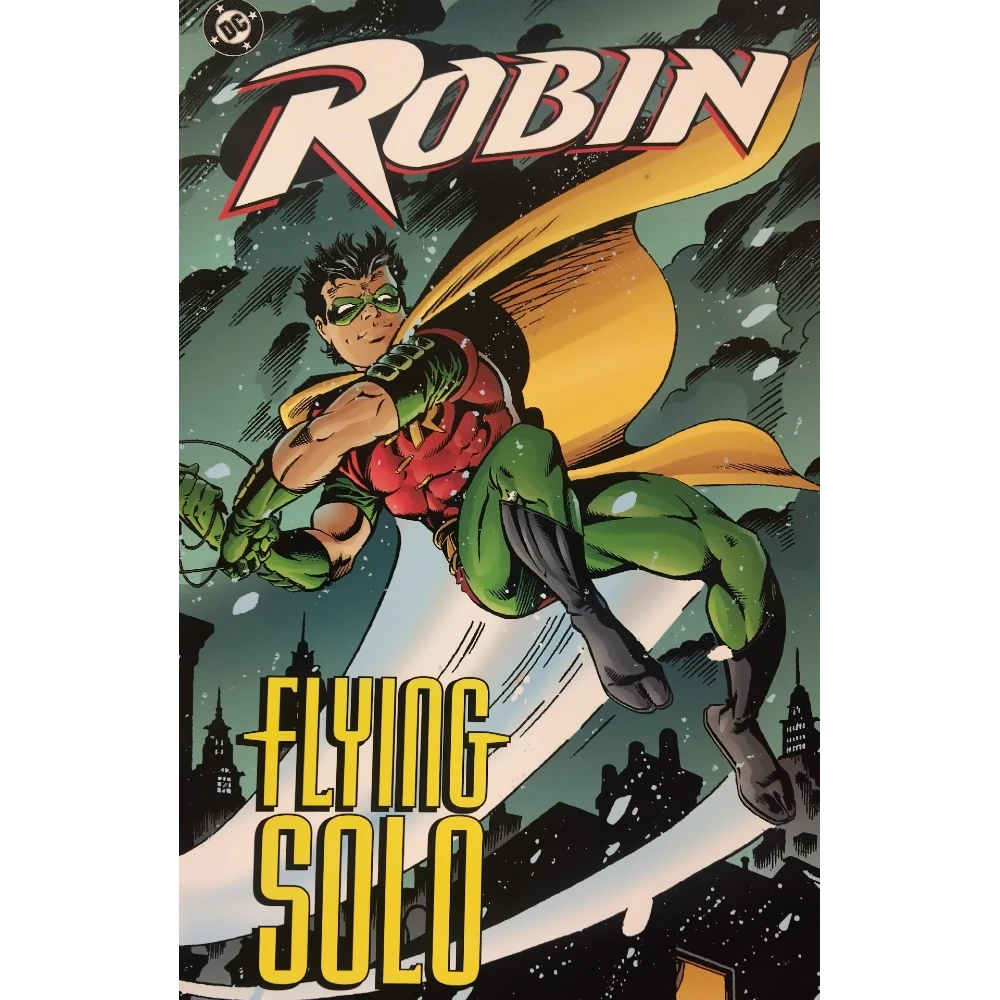
When last we left our brave Gothamites in the trenches of the "Knightfall" saga, Jean Paul Valley, the former Azrael, had assumed the mantle of the Batman from the broken Bruce Wayne. Jean Paul quickly establishes himself as a different animal altogether from the original incarnation–he wears an armored suit, kicks the crap out of Bane, tries to beat the fur off of Catwoman, and winds up crossing a few other ethical lines Bruce has sworn to stay away from.
And he's locked a certain Boy Wonder out of the Batcave.
The issues we're reviewing today, marking the beginning of Tim Drake's first-ever ongoing series as Robin following a trilogy of limited series, happen concurrently with the events of "Knightquest," the second arc in the overarching saga. Much like Azrael fills the Batman role uniquely, Tim is different from the Robins before him–he possesses a tempered version of the impulsive spirit which plagued Jason Todd, bringing a wealth of technological know-how to aid his crimefighting activities. With Bruce currently out of the country (more on that arc in a future post) and AzBats rampaging in his own way, Robin is allowed the opportunity to fly a little more freely. He doesn't necessarily want to, but with the situation being what it is, Tim makes the decision to take all the learning and training he's received since he first assumed the Robin identity to be more than just a sidekick waiting for Batman to return.
Robin: Flying Solo
Writer: Chuck Dixon
Pencilers: Tom Grummett and Phil Jimenez
Inkers: Ray Kryssing, Scott Hanna, Bruce Patterson, Romeo Tanghal, and Peter Gross
Colorists: Adrienne Roy and Tom McGraw
Letterers: Tim Harkins, Albert DeGuzman, and Ken Bruzenak
Issues: Robin #1-6 and material from Showcase '94 #5-6
Publication Dates: November 1993-December 1993, February 1994-June 1994
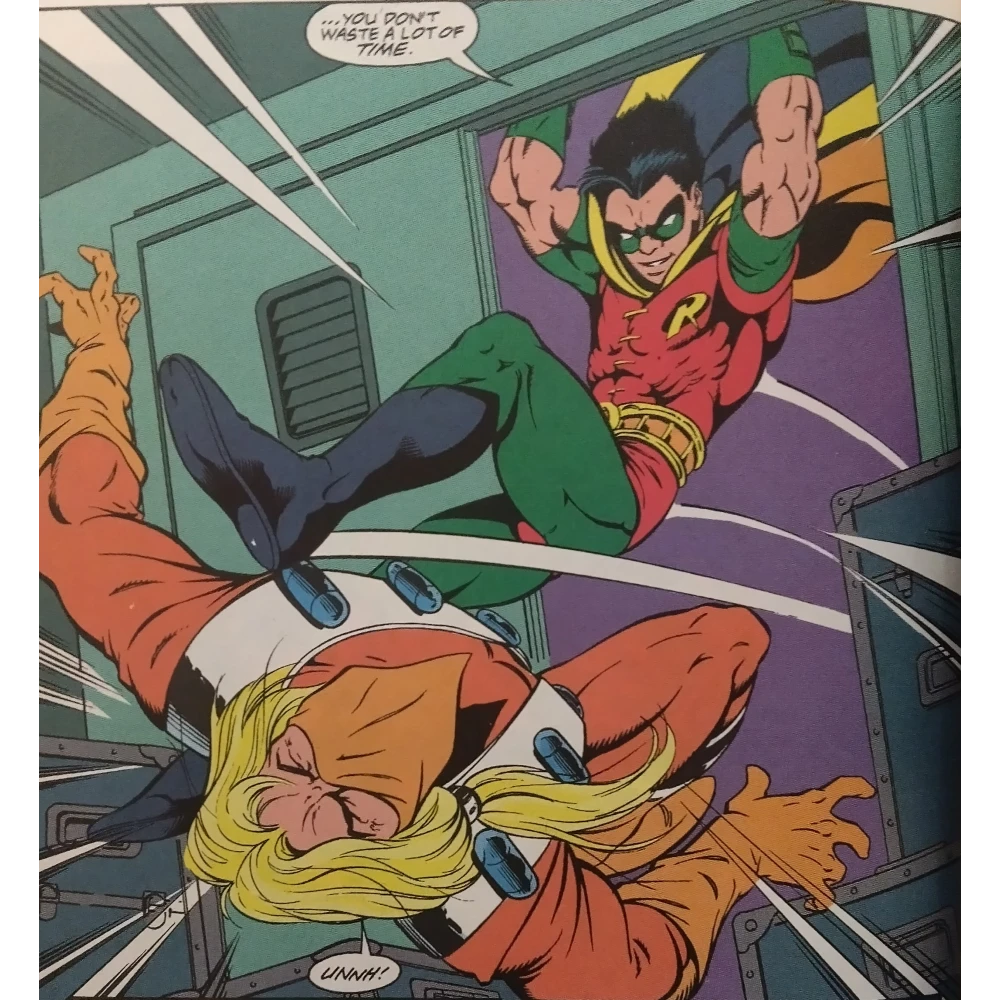
Perhaps mercifully, the man formerly known as Azrael takes up very little real estate in this volume.
Not that Moench, Dixon, and Grant's examination of Jean Paul's Caped Crusader (with an emphasis on "Crusader") hasn't been fun to read. Out of much of the 90s material I've examined lately, including crossovers specifically, "Knightfall" does not suffer from some of the same egregious flaws as its contemporaries (cough Marvel! cough Image! cough) and maintains higher quality writing and art. Reading all the components involved has been more entertaining than a slog, and these first few Robin issues, helmed by Chuck Dixon, are engaging, in part, because of how well Tim is allowed to exist on his own.
You can imagine for yourself what Jean Paul's doing during these issues (or, better yet, go pick up "Knightquest" in one of its sundry publications!); aside from confronting Tim as the volume opens and appearing briefly in the Showcase issues, his presence is negligible. The mercy I referenced above comes less from the fact that Jean Paul's consistent presence would be annoying and more that it would hamper Tim's development, cramp his style. That Tim's activities, it seems, fly below Jean Paul's radar is as good an indication as any to his own arrogance and Tim's growth. Let the little Robin handle two-bit thugs. Our new Batman has bigger fish to fillet.
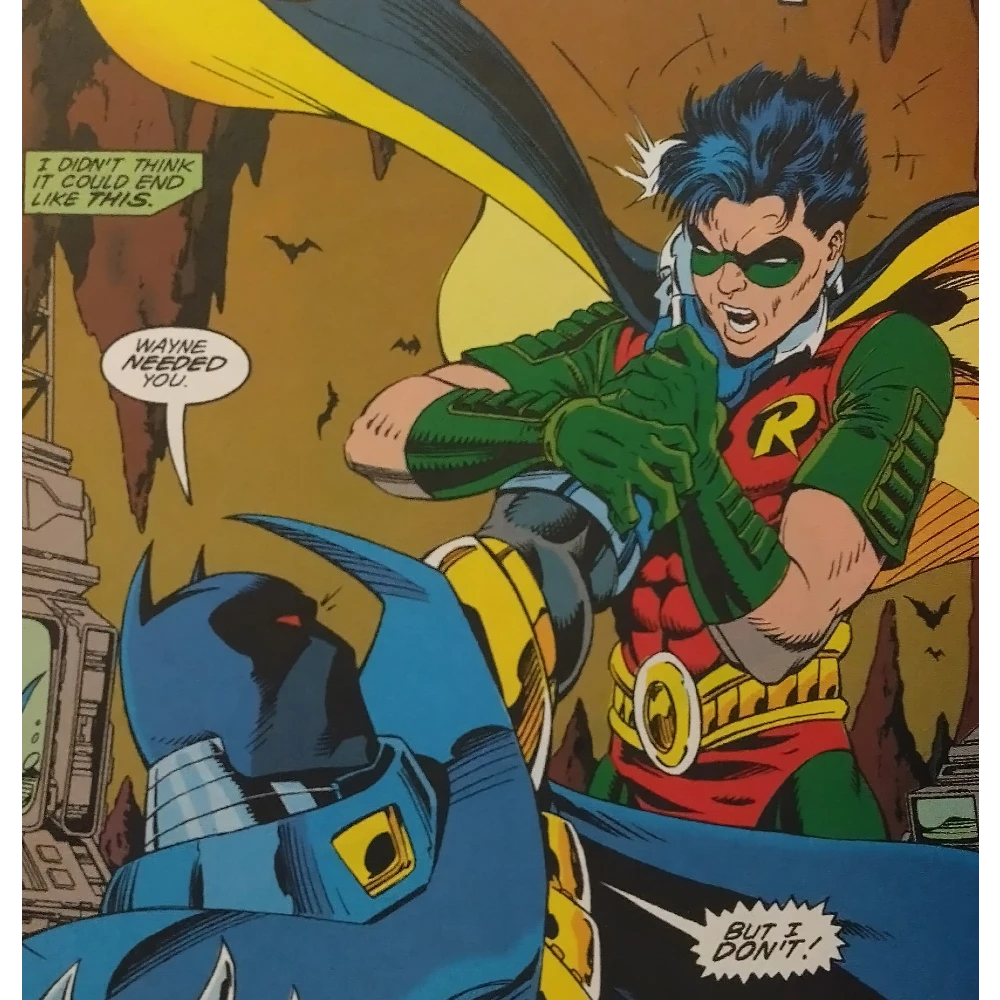
Free as the bird he's named after, the third Robin pulls away from the simple sidekick status. As previous stories attest, such as a dramatic altercation with the Joker, Tim's no slouch in the crimefighting department. Shepherded by Dixon, who brought the boy through the three original limited series, Tim continues gaining confidence as a hero. That term "hero" is important. Tim is no longer simply Batman's ward or following in Bruce's footsteps. He's got his own journey to face, and without the keys to the cave, he's forced to look elsewhere for purpose other than being the "and Robin" half of the Dynamic Duo. With Bruce far outside the city, Tim has only himself to rely on…mostly. No Nightwing, no Batgirl. An occasional phone call with Alfred is all the connection Tim has to the extended Bat-family at this point. There's the matter of a fellow teenager in tights, but we'll get to her later. For now, the bulk of responsibility rests on Robin…
…in both his vigilante and personal identities. Dixon finds external conflict through costumed criminals, but he throws around more of those nagging internal frustrations as Tim weighs his costumed responsibilities against his private life. I entered this volume assuming Tim would be devastated by Jean Paul's refusal of his help, looking to hamper the new Batman or keep consistent surveillance on him. Tim does not do this. I wouldn't necessarily complain that Tim should be watching out for Azrael every other second of the day, just to keep tabs on the cape and cowl's ruthless inheritor, but I wondered if his energies should be focused towards Jean Paul a tad more (though Dixon works to justify this by having Tim operate under the belief that he's severing ties with this new Batman, ending their partnership rather than feeling responsible for how the vigilante behaves).
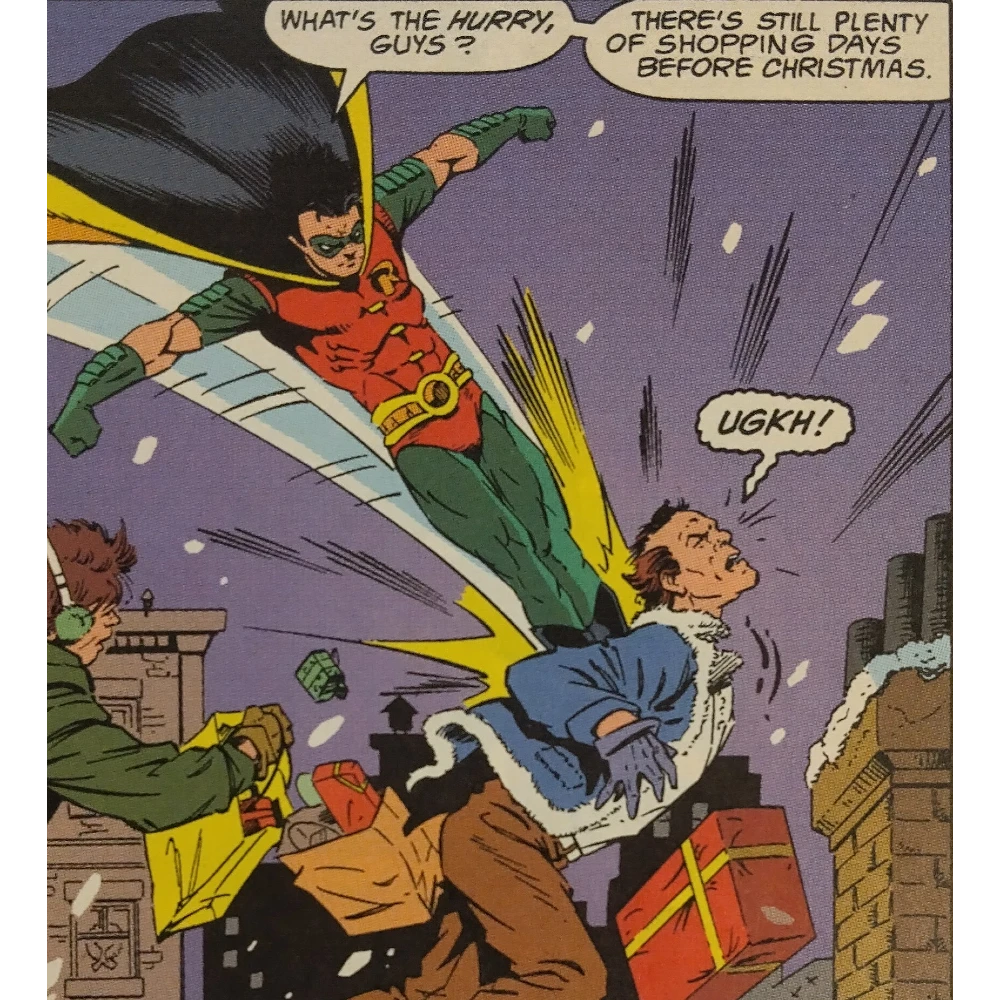
I say that isn't a complaint because what Dixon provides us instead is that wonderful interplay between the two halves of Tim's life. Our Robin may fight crime, but he's also a teenager, attending school, obsessing over and testing the limits of his brand-new car, and dating a young woman named Ariana, filling that classic role like most youthful superheroes who choose to trounce villains while making sure they finish their homework. Tim's focus isn't on the entirety of Gotham; he ferrets out crime where he can, usually of a lower-level variety, leaving big guys like the Joker to AzBats. Previous narratives had seen Tim take on increasing levels of criminality during his "baptism of fire" phase in earning the Robin role. Now that Tim's confidence is established, Dixon doesn't need to rely on heavy stakes to tell engaging stories.
Dixon often shows those two pieces of Tim can't be separated easily. Attending a school mixer with Ariana is great until masked thugs decide to steal some rich kids' cars, throwing Tim into an investigation that tends to supersede his date nights. A few conversations between himself and Ariana hone in on that agonizing tension between throwing the costume aside to embrace normalcy and fulfilling what Tim feels is his due diligence to Gotham (Ariana is, of course, ignorant of Tim's dual identity, coming to her own conclusions as to why he flakes on her repeatedly). The mask often comes first for our bird-based Boy Wonder, which is somewhat cliche and yet the only way Dixon can move any plots forward. How much fun would it be to watch Cluemaster rob banks while Tim takes Ariana to the movies?
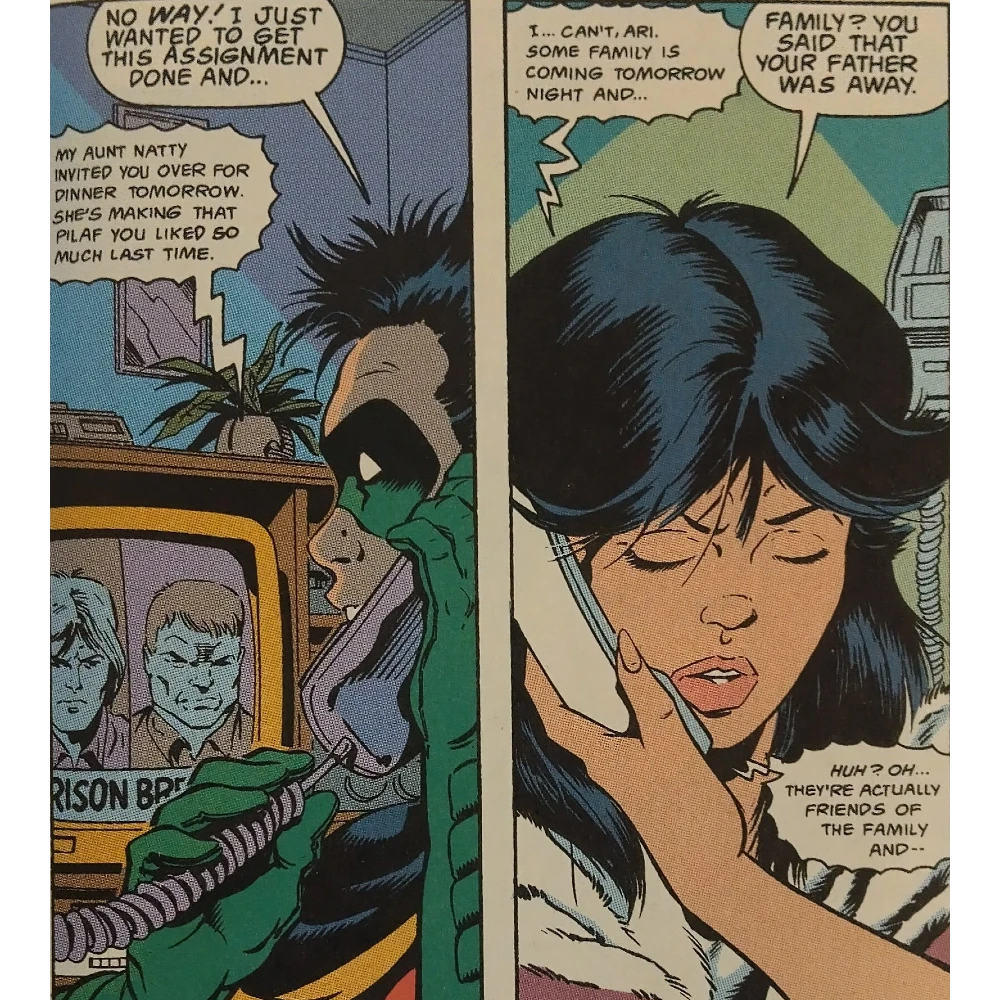
In continuing to establish Tim's presence, Dixon works in a cast that complements the young man's adventures outside just villains and a long-suffering girlfriend. The villains are important: "lower-level" I may have called them above, but they're different enough from the central crooks Batman trounces to provide Robin a more unique (though not necessarily better) class of criminals. Some of these guys are straight-up losers, like the Cluemaster and Electrocutioner, but even losers need to be cleaned off the streets with the new Batman's more discriminating perspective of his priorities. But the rest of Tim's supporting cast members, including sheriff deputy "Shotgun" Smith and Cluemaster's daughter Stephanie, help expand the scope of Tim's world. Smith provides Robin a foil to Bruce's relationship with James Gordon, while Stephanie, as the vigilante Spoiler, provides a helping hand to a young hero she clearly admires, throwing a slight wrinkle into Tim's relationship with Ariana. It's that chasm-causing interplay again: one girl can only understand him as Tim, while the other can only understand him as Robin.
The only person who can fully understand Robin (outside of Batman, probably) is the Boy Wonder himself, and Dixon nicely emphasizes how well the young man has grown as a hero. I've already noted that he's moving away from the sidekick aspect of his role, continuing the growth developed in his limited series. Yet even here another step is taken as Robin, having "flown the coop," engages in an impressive display of hard-won self-reliance. He successfully nails a band of robbers single-handedly and takes down a group of car thieves. A three-part arc told from the Huntress' perspective paints Robin as confidence personified, nimble and intelligent while maintaining an air of heroic professionalism. In Dixon's most tense sequence, Robin finds himself buried alive in a large box with another individual (I'm being coy with details for non-Stephanie spoiler reasons), putting all his training to use to conserve air for them both in the hopes of survival.
Do they? I'm not telling.
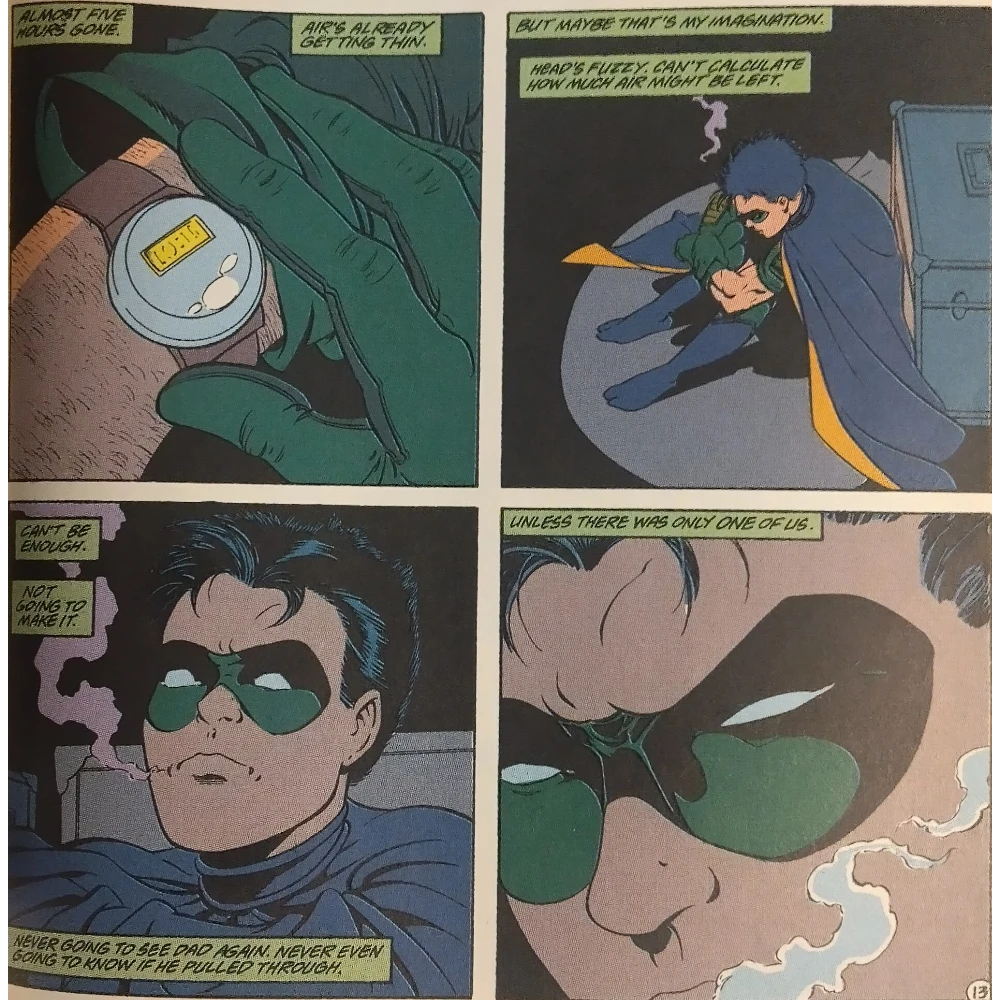
For all the positive qualities he provides Tim, Dixon isn't above giving our young hero weaknesses in both his personal and "professional" lives, again, achieving that dynamic intertwining between them. Not even the Boy Wonder can maintain the most factual fib when flaking on his girlfriend repeatedly; he winds up getting pulled over by a cop while taking his "Redbird" out for a spin; it's a bit of brashness which gets him buried alive in the first place. Far from perfect, yet growing. It's the teenage element, given a vigilante facelift–Tim may make the same mistakes as other teenagers, like driving recklessly, but he'll make those mistakes in classic comic book form. It's not Tim getting pulled over while borrowing his dad's car; it's Robin, driving his very own version of the Batmobile. This is the line our acrobatic Boy Wonder walks. He is a kid, after all. A kid drawn into extraordinary circumstances, but a kid nonetheless. Not like he's Batman or anything.
This volume does a surprising amount of legwork continuing to establish Tim Drake as a credible member of the Bat-family. He'd proven himself on multiple occasions already, with and without the help of Bruce Wayne's alter ego, but these issues watch Tim launch himself into a new realm of independence. Forced independence, thanks to Azrael, but Tim finds himself worthy of the challenge anyway. We'll see more of him as we continue through the rest of the "Knightfall" saga, especially as the Boy Wonder finds himself paired with yet another man other than Bruce Wayne donning the cape and cowl.