Distinguished Critique: The Ray: In a Blaze of Power Review
Creative ideas struggle to find footing here, leaving this series to rely on commonplace tropes to create an easy, familiar reading experience
—by Nathan on January 31, 2026—
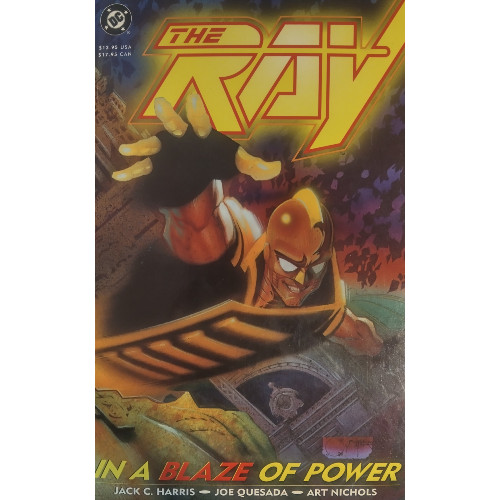
Joe Quesada was one of the architects behind an important DC character during the 90s, the armored crusader known as Azrael, and in anticipation of reading Azrael's adventures before and during the acclaimed "Knightfall saga" (which I hope to get to a little later this year), I wanted to see what else Quesada had cooked up during the 90s. I'm familiar with his Marvel Knights work on Daredevil shortly before the end of the 20th century, but I wanted to dig a bit into the era around his Azrael work. This is how I stumbled upon Ash, Quesada and Jimmy Palmiotti's superhero firefighter developed for their own publishing company, Event Comics. And if fire wasn't enough illumination for this tunnel I'm exploring, we're getting a double dose of lighting with a guy named Ray.
Yeah, "Ray," son of "The Ray," who takes on "The Ray" identity in this comic. I'll explain as we go along.
Quesada worked with writer Jack C. Harris on this six-issue limited series in the early 90s, creating a "legacy" version of an older hero. I draw the line at saying "classic," because I don't know if the original Ray falls under that category. If anyone knows for sure and wants to, eh, shed some light on that particular subject, just let me know. I say that to make clear I'm not reading this because I'm a fan of the original Ray or his son Ray. I saw this volume in a used bookstore and picked it up, and because I've read something else of Quesada's fairly recently, I decided to read this too.
It's kind of a nice opportunity, diving into a narrative about a character I'm not really familiar with, as opposed to reviewing another volume of Batman or Superman comics. I can't say Ray as the Ray came out of this as one of my all-time favorite heroes, but this was refreshing, looking in on the early development of a character set to fill his father's boots.
The Ray: In a Blaze of Power
Writer: Jack C. Harris
Penciler: Joe Quesada and Art Nichols
Inker: Art Nichols
Colorist: John Cebollero
Letterer: Steve Haynie
Issues: The Ray #1-6
Publication Dates: February 1992-July 1992
There is a line–and I do mean "line," as in "extending indefinitely on both sides" as opposed to the kind of figure which extends indefinitely in a single direction, which is a "ray"–between creating something new and repurposing something tried and true. Any time you reboot a comic character, you find yourself walking this particular line, determining how best to take a character and imbue them with the classic elements that defined an earlier version of that character while also drawing them into the newness of the present moment. The best examples of these kinds of stories are the ones which keep the protagonist's best characteristics while surrounding them with a world and events which feel appropriate to the present time. It's one reason why I love Mark Waid and Leinil Francis Yu's Superman: Birthright: the comic manages to maintain Superman's core characteristics while placing him a world clearly influenced by terrorist attacks such as 9/11 and other then-modern elements.
Such is the task sitting in front of Jack C. Harris and Joe Quesada in developing Ray Terrill as a character. He's a legacy hero, replacing his father, intending to carry on a former hero's name and attempting to do so in his own manner, in his own world, far different from the one his father originally operated in as a superhero. He carries a mantle while blazing his own path of glory…and power. He's also, in some respects, a copy of other heroes before him, not just his father, and here is where the line blurs.
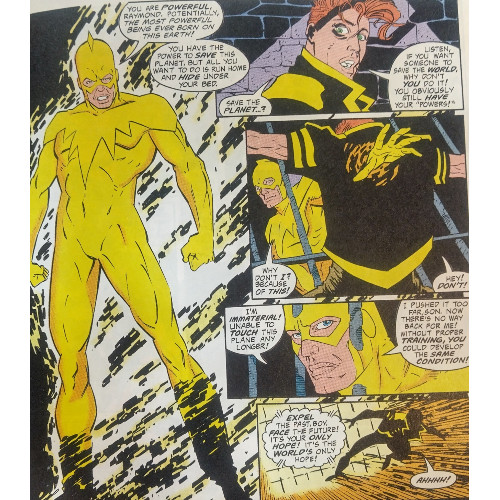
Ray (the young man) is very much influenced by the "young man who becomes a superhero" trope that you recognize from other characters such as Spider-Man. I've made that argument before in discussing youthful heroes such as Firestar, the Rocketeer, and Invincible, noting how they feel influenced by my Web-Headed friend. They're all young, torn between the destiny of costumes and abilities and the desire to live a normal existence. They all experience growing pains in becoming comfortable with their abilities, usually taking a literal "learning curve" in the "trying not to crash while flying" department. It's what you've come to expect from comics of this stripe, and in this manner, Ray is no different from his peers.
He's maybe a few years removed from being a teenager, our Ray, faced with the troubles of the world, including financial burdens and the seemingly distant affection of a female former best friend who enters his life years after their childhood friendship dissolved. He endeavors to learn about his powers, fly without crashing, and faces his first real supervillain in one of those "superhero initially loses but comes back to win the second fight" match-ups. A lot of material is cribbed from other sources, turning this series into a "If you've read one, you've read 'em all" narrative.
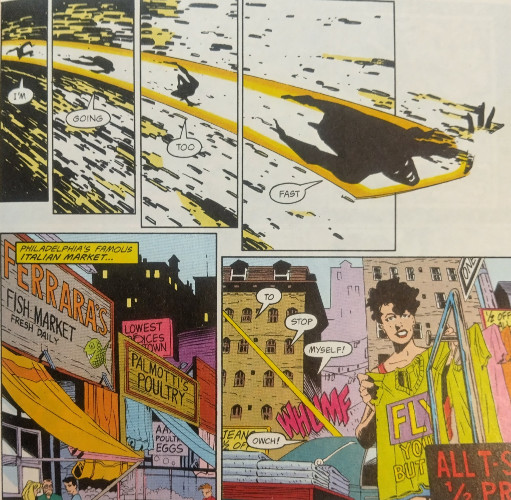
Not that it's a sin to rest on what is common and known; certainly, the genre familiarity Harris and Quesada fill this series with makes it an easy, nonthreatening read, which some may have felt was necessary to introduce a new version of an old hero. And I'm not saying that Harris and Quesada ineffectively tell an origin story across six issues–the bumps and bruises are necessary for Ray to learn about himself and effectively harness his abilities. Some of the tropes are reused because they work–who wants to see Ray land perfectly the first time or stop bank robbers without a bit of collateral damage? It's all for him to maintain his humanity and relatability with the audience, so it's difficult to completely begrudge Harris and Quesada for the series' repetitive nature.
Amusingly, where Harris and Quesada do attempt to weave in some creative aspects, they find their results more frustrated than with the common story beats they inject. They set Ray up as a young man who had been a childhood celebrity, his father having kept him perpetually in the dark (yes, metaphorically, but I also really mean literally) thanks to some unknown "disease" that made his body adverse to sunlight. Much of the story is Ray discovering the truth behind his father's intentions…which is not an uncommon plot development, but Harris and Quesada are trying to use the idea in a deeper manner. You are supposed to trust that, as Ray embraces his abilities and learns more about his father, he grows emotionally as well, coming to a better understanding as to why his father behaved the way he did and the unintended effects that had on Ray growing up. He has some trauma to work through, especially as the truth becomes clearer.
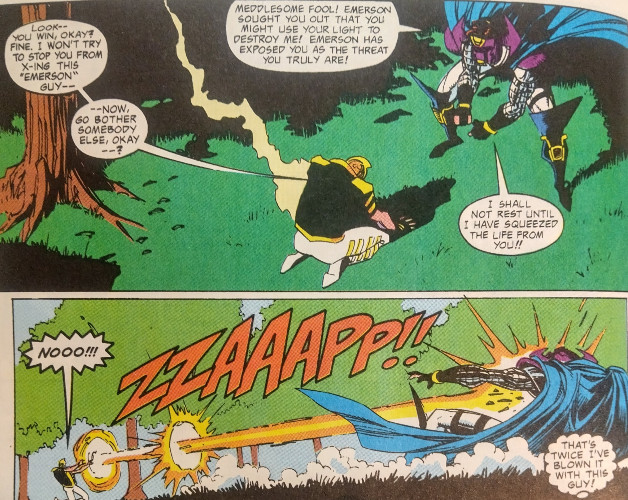
What ends up introducing those aforementioned frustrations is that, along with telling an origin story and dealing with Ray's past, Harris and Quesada also throw in various other ideas which don't mesh with the narrative they're detailing. With just six issues to tackle this story, they try inserting other plot points–a new villain for Ray to face, the introduction of a government conspiracy, a strange dimension Ray finds himself in–which add unnecessary tangles to the plot. The ideas themselves have some merit but how they're incorporated weakens the impact–the villain is thrown in about halfway through the series, the dimension appears in the final issue, and the conspiracy, though utilized more effectively across all six issues, affects the series' tone. There is a plot simmering in the background which Harris teases decently and fleshes out in later issues, but by time he starts providing answers to some of his questions, he's made matters more complicated than necessary and loses direction like our hero Ray finds himself doing on those first few attempts at flying.
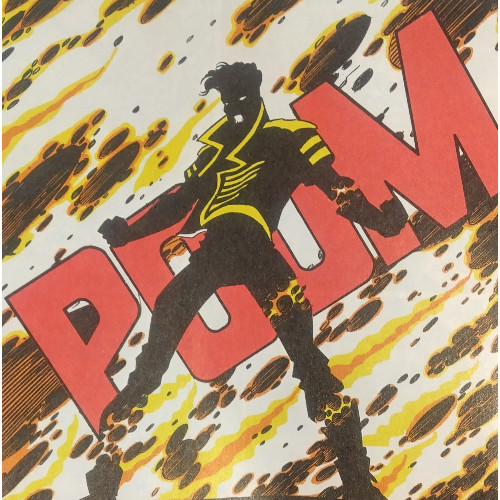
Quesada's art is much like the rest of the series: fairly inoffensive if not commonplace. He's not yet completely developed the style readers would see in Ash and Daredevil. Traces of his later look can be seen here, particularly in how he details faces, but nothing Quesada puts on paper would overly entice the reader or make them believe he was destined for greatness at this point as an artist. If anything, inker Art Nichols and colorist John Cebollero are the series' artistic stars, particularly when they play with light and shadow, tethering the art into Ray's abilities and making him shine on the page.
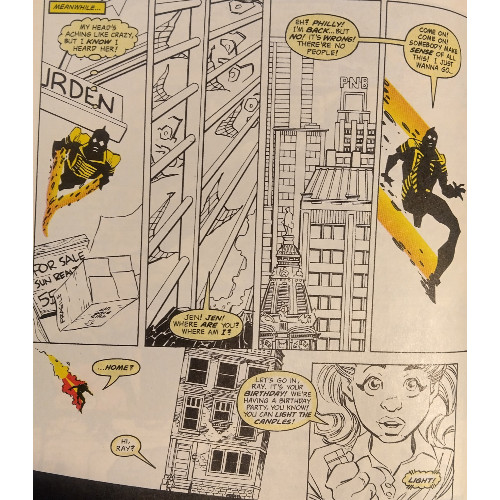
The series does what it can to showcase Ray (both the young man and the hero) as an interesting character–he's given conflicts, both external and internal, challenges to overcome, reasons to relate to him. Yet it's a story we've seen several times before, and though Harris and Quesada have clearly read the rule book on "Superhero Origin 101," they don't enough to differentiate Ray from the many, many other characters out there whose stories follow the same worn path. What unique ideas they do throw in end up at odds with the classic elements, put together in a slapdash manner instead of resulting in a coherent narrative. As I mentioned, this isn't "bad." If you want a story that checks off all the boxes, this is it. It's not earthshaking, not even a little groundbreaking. They create a guy named Ray and then show him that line I mentioned earlier…instead of balancing on it, Ray decides to stay on one side, where he and the creators know they're safe.