Random Reviews: Starslayer: The Log of the Jolly Roger
Mike Grell provides a fantasy classic a sci-fi twist in the first issues of this 80s series
—by Nathan on September 17, 2026—
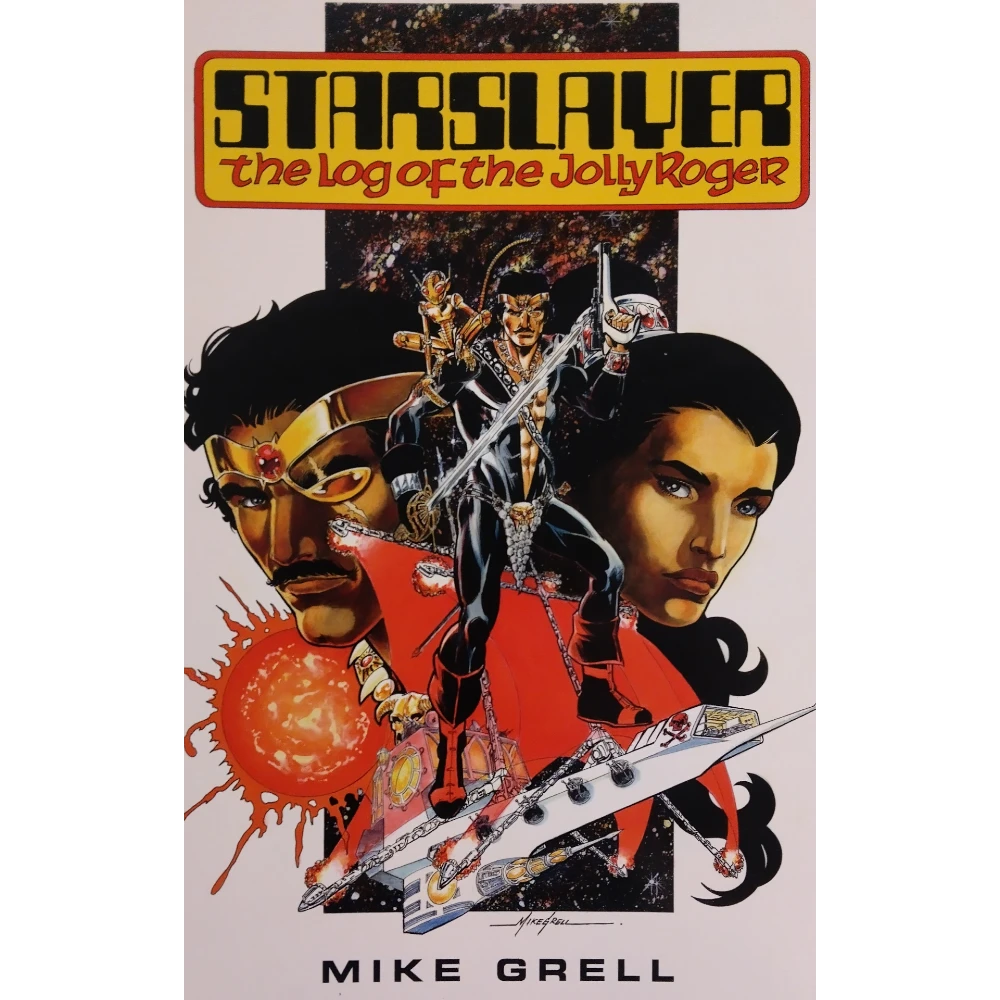
A handful of posts ago, we witnessed Mike Grell grab a soldier from a specific era of time and transport him to an era different from his own, watching Trevor Morgan's first staggering steps as he, with the stability of an infant, grew accustomed to a new world.
Today, we're going to witness Grell do it again.
I'm being somewhat reductive, of course. Grell's Starslayer is more than just a ripoff of his acclaimed DC Comics series Warlord, but similarities exist. In a way, Starslayer is the inverse of the idea, which Grell himself attested to: rather than pulling the then-present day pilot into a past influenced by prehistory, he whisks a warrior of a bygone age into the far-flung future. Maybe they waved at each other as they passed by on the timestream.
Grell was actually slated to publish Starslayer with DC in the late 70s, working on it concurrently with Warlord, but the infamous "DC Implosion" of 1978 led to several scrapped titles and more scrapped ideas. Grell eventually found his way to Pacific Comics, where he published the first six issues, Starslayer serving as the launching point for Dave Stevens' Rocketeer. After that sixth issue, however, Grell was persuaded to join Chicago-based First Comics, where he handled issues 7 and 8 before passing the torch to John Ostrander, who would introduce his character GrimJack in a series of back-up strips.
Lotta moving parts, lotta details to keep track of…but, fortunately for us, we have the distinguished honor of examining all eight issues today, packaged in one neat collection. No digging through those longboxes trying to remember which issues were published by Pacific or First. These are actually "The Director's Cut" issues, reprints of Grell's original work by Acclaim Comics, collected by Dark Horse.
So to sum up: we've got a series, originally planned for one publisher, actually produced between two other publishers, with the first eight issues reprinted by a fourth publisher, followed by this collected edition from a fifth. Oof. Feels like I've been yanked between time periods myself. But let's set the shifting publication details aside and see how well Grell crafts the mirror image of his original DC Comics idea.
Starslayer: The Log of the Jolly Roger
Writer: Mike Grell
Penciler: Mike Grell and Lenin Delsol
Inkers: Mike Grell and Mike Gustovich (original issues); Claire Hawbaker, Jeff Albrecht, Frank McLaughlin and Tim Burgard (Director's Cut issues)
Colorists: Steve Oliff and Janice Cohen (original issues); Rob Prior (Director's Cut issues)
Letterers: Mike Grell and Peter Iro (original issues); Steve Haynie (Director's Cut issues)
Issues: Starslayer: The Director's Cut #1-8
Volume Publication Date: May 2017
Issue Publication Dates: February 1982, April 1982, June 1982, August 1982, November 1982, April 1983, August 1983, September 1983 (original issues); June 1995-September 1995, December 1995 (Director's Cut issues)
Publishers: Pacific Comics (Starslayer #1-6), First Comics, (Starslayer #7-8), Acclaim Comics (Starslayer: The Director's Cut #1-8) and Dark Horse (collected edition)
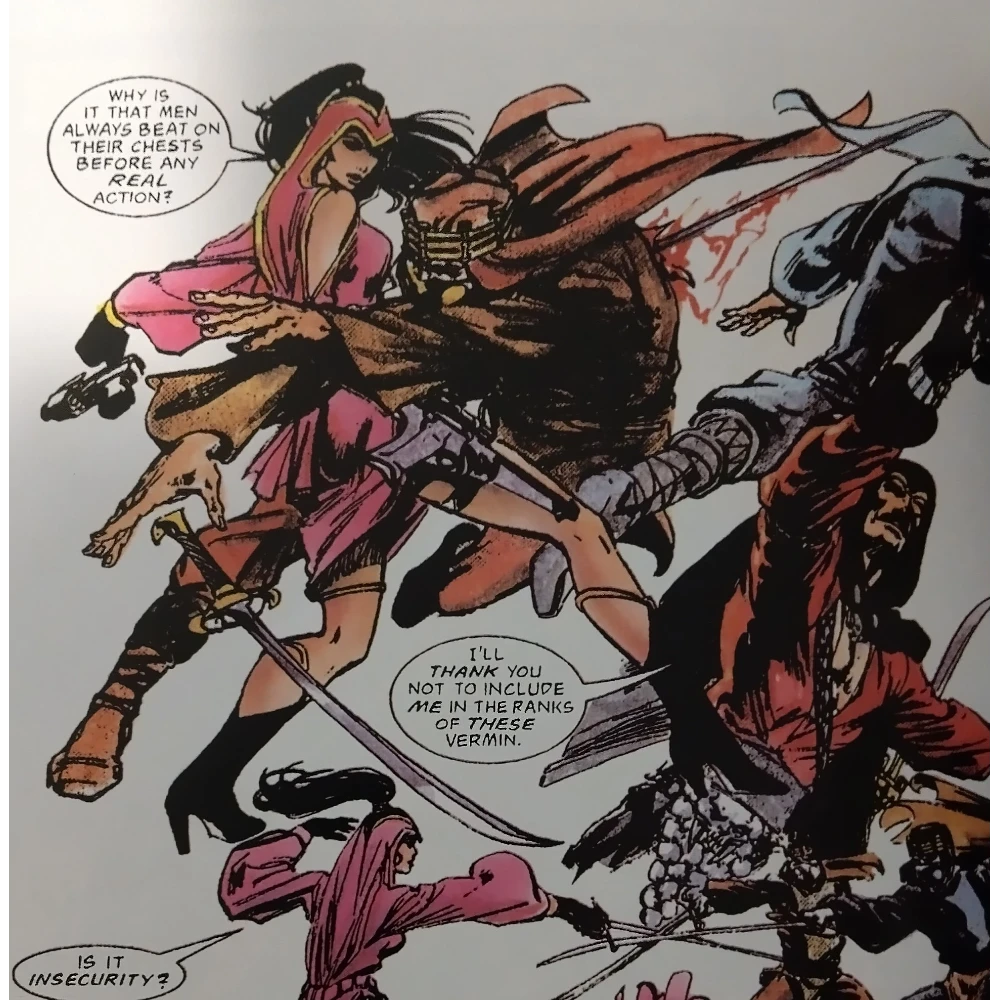
To boil Starslayer down to "mirror image of Warlord" may be reductive, as I noted in the introduction, but there is a certain ring of truth to it. Both stories deal with fighters, accustomed to their worlds and times, drawn unwilling into unfamiliar worlds and times, where they're also pulled into conflicts beyond themselves. Pilot Trevor Morgan, at least in the Warlord issues I read, never much expressed a burning desire to go home again, becoming won over by his own battle prowess. His Starslayer counterpart has other intentions.
Torin Mac Quillon is a Celtic warrior pulled out of his time moments before his death at the points of Roman spears. Brought into the far future, Torin owes his life to Tamara, a noble space pirate who describes Torin as just the kind of warrior she needs to save the universe (quite a leap from frustrating the invading Roman Empire). In this distant time, the sun is dying…and as the farthest planets succumb to frozen death, war looms ever closer. Pluto is no longer habitable? Maybe the Plutonians can find sustenance on Jupiter or Mars…but not without a fight. Tamara, understandably, wishes to prevent such a cosmic conflict.
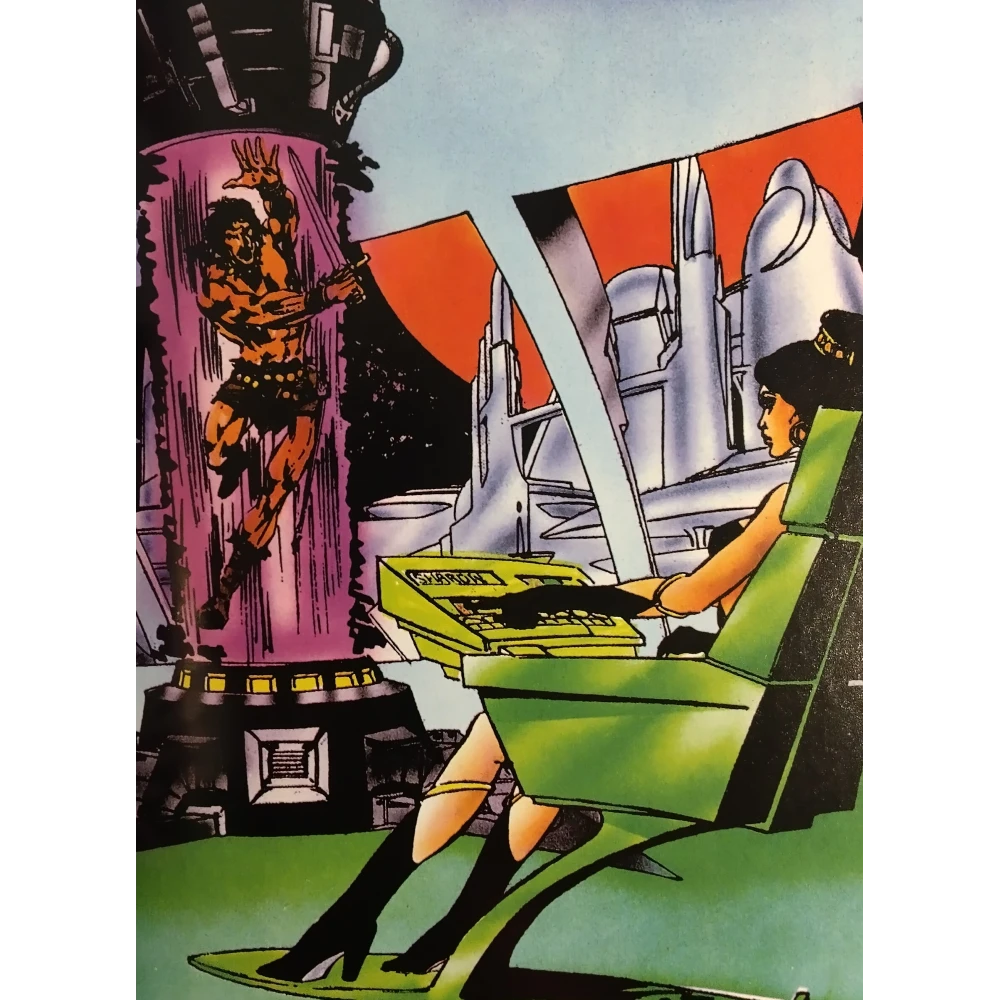
These eight issues comprise a complete story, a classic hunt for pieces of a powerful MacGuffin blended with the fish-out-of-water aspects which also make Warlord entertaining. I'd wager poor Trevor Morgan gets the bum end of the deal, as Torin need not deal with dinosaurs. His worst foes are other people and robots, but Grell makes the conflicts palpable. Admittedly, he does somewhat conveniently skirt a bit of a learning curve for Torin through some sci-fi thingamajigs, meaning Torin doesn't have to adapt nearly as much as Morgan needs to to his own surroundings. Torin's given a crash course and thrown into the deep end, though he can't quite shake a certain feeling of unease. Told the names of planets such as Mars, Venus, and Jupiter, he expresses distress that Rome, his mortal enemies, has spread its influence even beyond Earth's boundaries all these centuries later.
What nicely separates Torin's adventures from Morgan's is the emotional stakes Grell crafts for the character. Torin has the gear to help him adapt, with an energy-cutlass that reminds of a sword from his era, but he's wracked with the constant discomfort I referenced. He knows Tamara yanked him from his death, that returning to his time would spell his bloody demise. Grell dedicates an entire issue to Torin's life prior to his future-flung feats, introduction a wife and son the Celtic warrior sorely misses and would love to, somehow, find a way back to. Grell's most emotional moments see Torin gazing longingly at holographic images of his family, missing them and pledging he'll find a way back to them. Like any good hero, Torin is provided a disconnect between his ideal reality and the reality in front of him, and the question becomes one of how he'll reconcile the two.
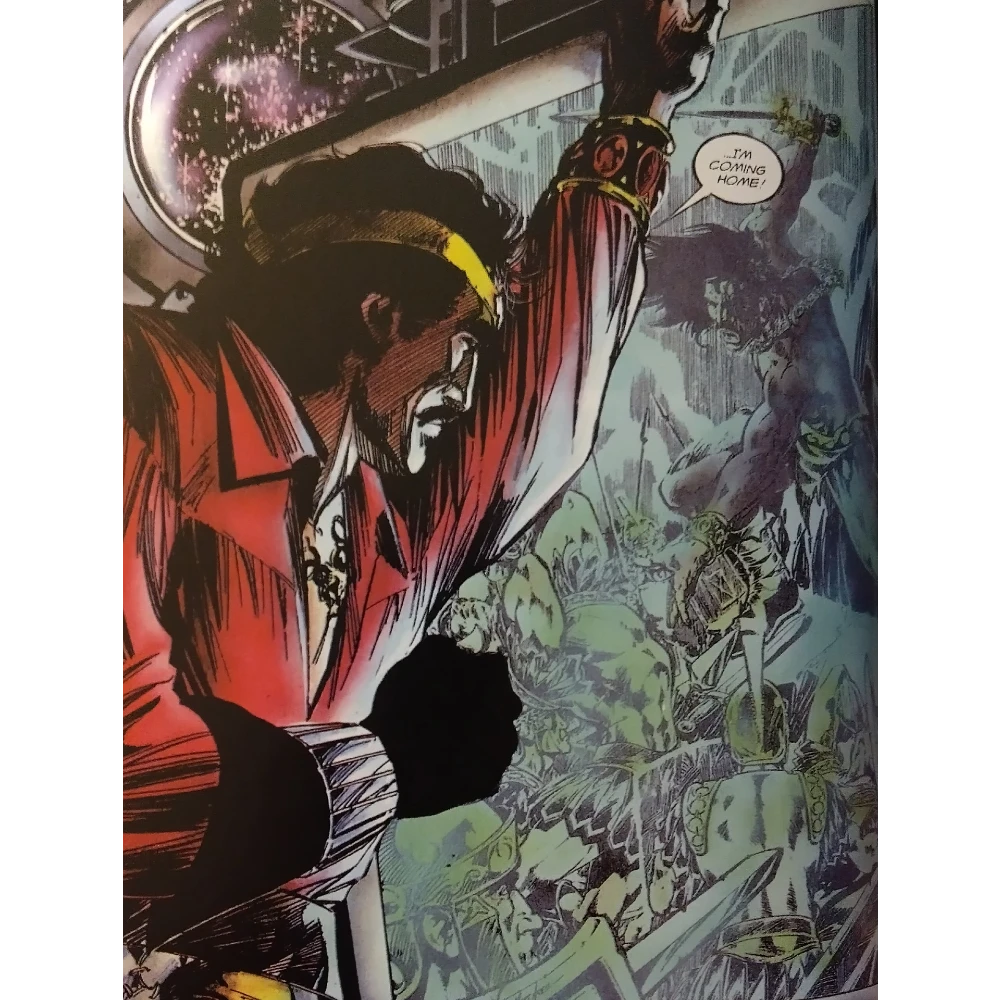
Without offering spoilers, Grell does eventually develop a thread between Torin's Celtic past and a supporting cast member, providing that character a more fulfilling arc. The character in question is key to how the narrative unfolds, yet that connection reframes just how integral they are and, perhaps more importantly, Torin's specific inclusion in the story. It's a nice touch, overwriting a particular sense of plot convenience I felt earlier in the series, and though it's a revelation which occurs late in this volume and doesn't have much room to ripple outward, the connection does retroactively reframe previous issues, making a reread more rewarding.
Grell deftly develops a universe around Torin and Tamara–literally, his backdrop is the Milky Way Galaxy, shown in its glory. Tamara's Jolly Roger slices through space past brilliant white stars and other colorful celestial bodies. Our heroes step foot upon a few planets, Grell depicting varying ecosystems depending on where their feet are planted. He's not as committed to showcasing a realistic depiction of humanity's spacefaring future as much as, say, Doug Moench and Paul Gulacy in Six from Sirius, throwing in mutated humans and a robot that feels cribbed from Xenomorph designs. A bit of the fantastic can be found here.
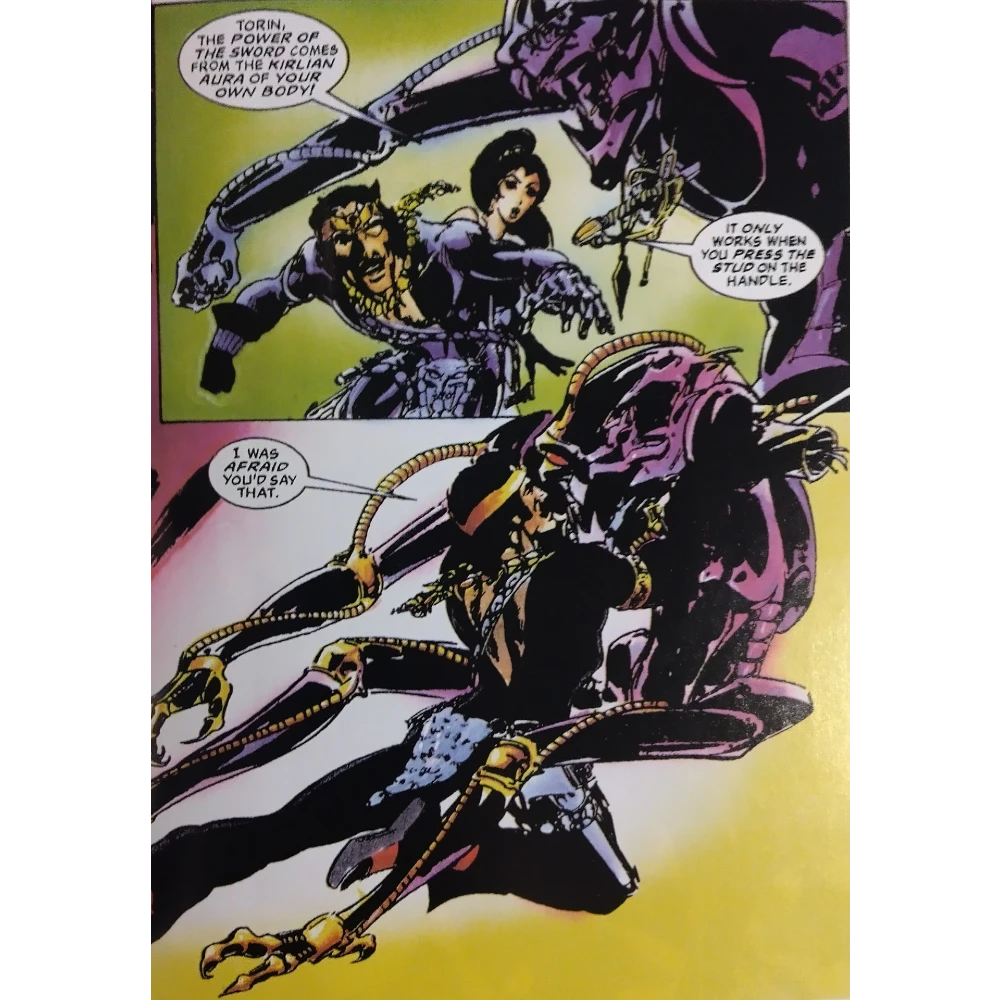
But Grell draws us into a universe that has adapted to the future while retaining some of its long-lasting aspects of identity–enslaved in one issue on a moon by inhabitants of Jupiter whose society emulates Norse customs, Torin helps cut free a slab of stone with a laser drill and then accompanies its transportation to Jupiter via spacecraft shaped like Viking longships. Ancient Norse tradition, futuristic technology, and the age-old tragedy of slavery are blended effortlessly, and Grell provides enough believability that this particular society would apply those forms and features to ever-broadening science.
It also means that, even if human physiology has evolved, human nature has not, and it's here Tamara and Torin fight their greatest enemies. The corrupt powers-that-be which serve as our ultimate antagonists pontificate recognizable reasons for their actions, justifying certain behaviors. The stakes, however, are that much higher, war and possible Armageddon on an interplanetary scale, elevating our protagonists' heroism. Self-sufficient and strong Tamara shows herself capable and willing to undergo any risk to save the universe, and Torin fights faithfully by her side. His own intentions are a little more selfish, as he expresses disinterest in the future's fate, which is an interesting addition by Grell. Tamara may be looking to preserve the future for her own sake, but Torin's hope lies in the past, seeking to save today so he can, perhaps tomorrow, return to yesterday.
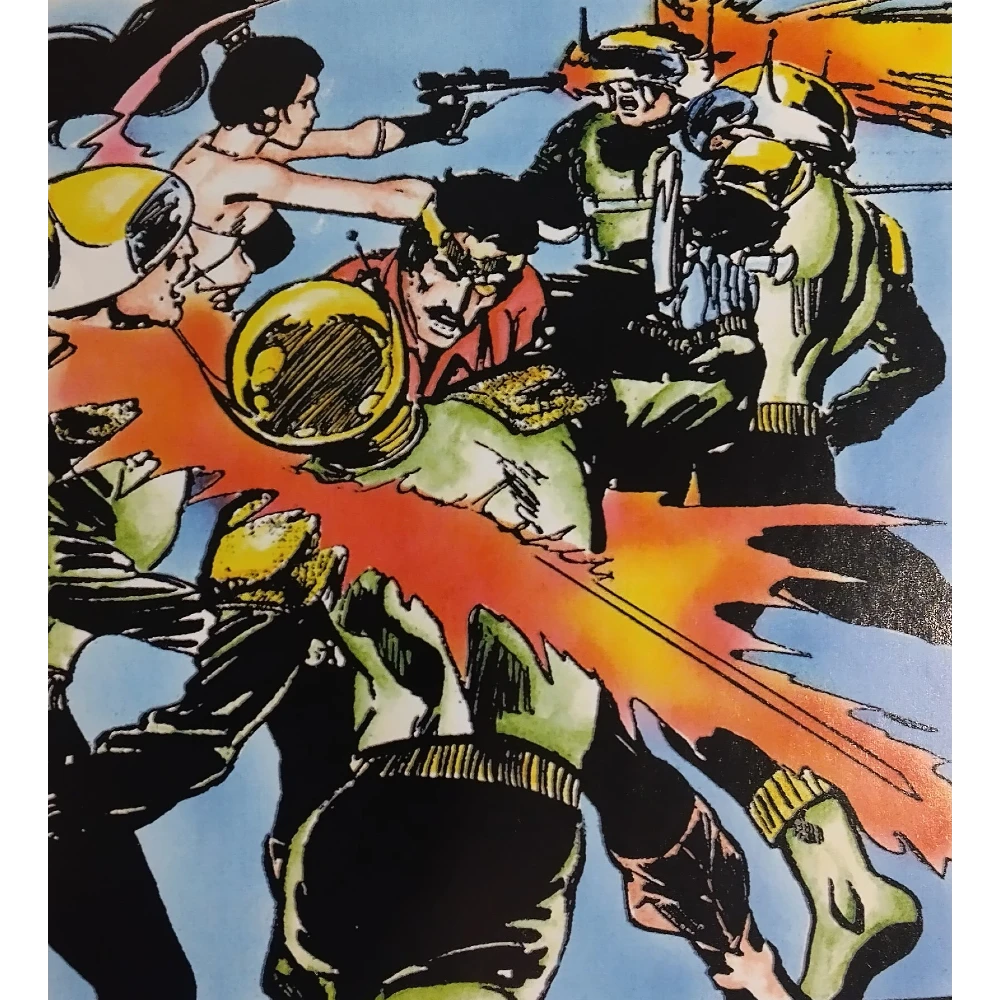
Starslayer ran for 34 issues total, largely under Ostrander's command. Those additional issues have never been collected, as far as I am aware. I could scrounge through back issues if I really wanted, but I'm a collected edition reader. Fortunately, Grell's final issue marks the completion of the story he began, wrapping up a neatly structured arc that sees our central hero adapt to his present reality in this future state; Torin's adventures would continue, but these first eight issues tell a full narrative, which means cutting myself off here provides a satisfactory ending, even if it feels a little incomplete.