Crossover Capers: Marvel Treasury Edition #28 (DC Versus Marvel Omnibus, Part 2)
Despite some clunky superhero scenes, this crossover provides an engaging understanding of our main heroes' core identities
—by Nathan on January 17, 2026—
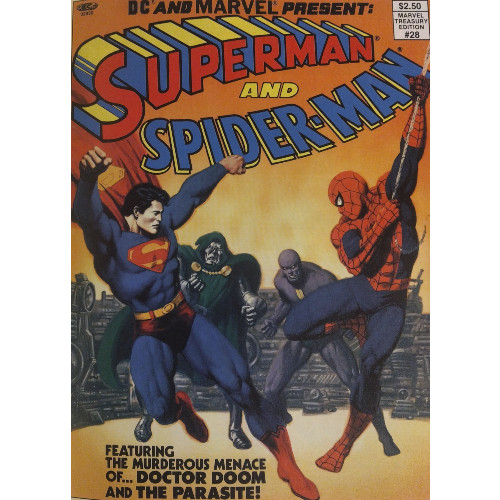
Last time we encountered the super, amazing world of Marvel/DC crossovers, we watched DC's Big Blue Boy Scout trade punches with Marvel's Web-Headed Wall-Crawler. Fans were given a surprisingly more even fight than one may have anticipated, thanks to some narrative shenanigans, but the two publishers pulled off a fun one-shot. Great inside jokes, a heckuva fight, and a pairing between two diabolical villains made for an entertaining read.
Wanna see 'em do it again?
About five-and–a-half years after Spider-Man and Superman shared the comic page, they returned in another thrilling adventure which saw them team-up, again, to face two more dastardly adversaries. Instead of Doc Ock and Lex Luthor, however, the two encountered the threat of Doctor Doom and the Parasite–yeah, kind of an odd couple, but hey, let's roll with it. And if you think Marvel and DC were resting on their laurels by pairing the same guys in a second adventure, just you wait! We've got some differences to analyze here as the two titanic publishers become more comfortable with their characters coexisting instead of always fighting for those prime supermarket selves.
"The Heroes and the Holocaust"
Writer: Jim Shooter (with Marv Wolfman credited with plot assist)
Penciler: John Buscema
Inkers: Joe Sinnott, Terry Austin, Klaus Janson, Bob McLeod, Al Milgrom, Steve Leialoha, Walter Simonson, Bob Layton, Brett Breeding, Joe Rubinstein, Bob Wiacek
Colorist: Glynis Wein
Letterer: Joe Rosen
Issue: Marvel Treasury Edition #28
Publication Date: July 1981
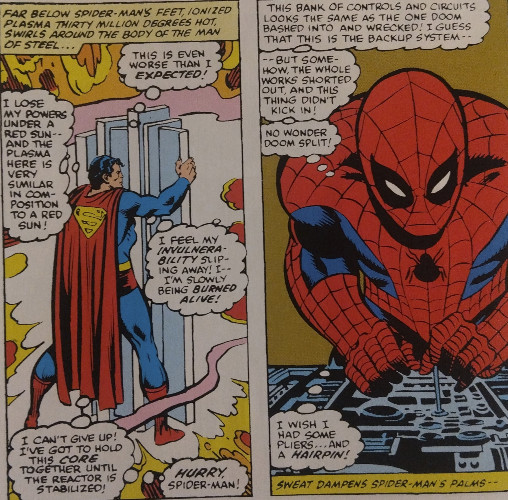
Written by then-editor-at-chief, the late Jim Shooter, and illustrated by John Buscema (and with help from an absolute murderer's row of inkers!), this lengthy one-shot surprised me shortly by revealing that–ta-da!–this tale is a sequel for the first beat-em-up between the Man of Steel and the Man of Spiders. I sorta knew the two tales existed in the same universe, but I hadn't figured this Treasury Edition would reference the previous one-shot. The comments made are fairly light, but they're enough to indicate this story is building, in a way, off the previous tale. As a fan of crossovers and how continuity bridges stories, I appreciated even the minor nods which made me feel welcome in this somewhat familiar space.
I called Conway's story "simple" in my last post, primarily because it used a good chunk of its length to set our characters up, with Superman facing Lex Luthor and Spidey fighting Doc Ock before the villains and heroes assembled. Conway and Ross Andru crafted many entertaining sequences, but the story was absolutely wrapped around bringing two iconic costumed characters together. Shooter has put more thought into his plot, wisely using the space provided to quickly introduce our heroes and villains and throw them into the master plan of the devious Dr. Doom.
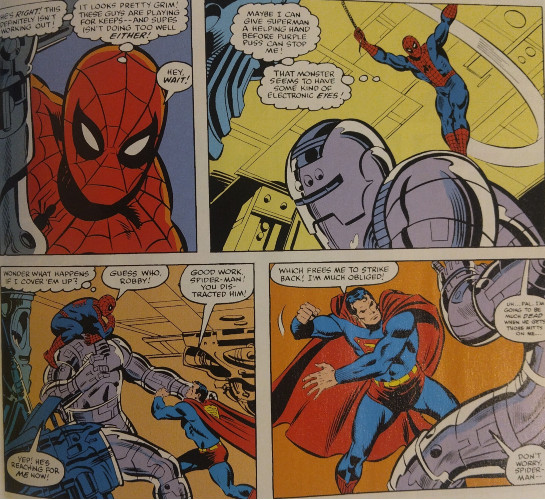
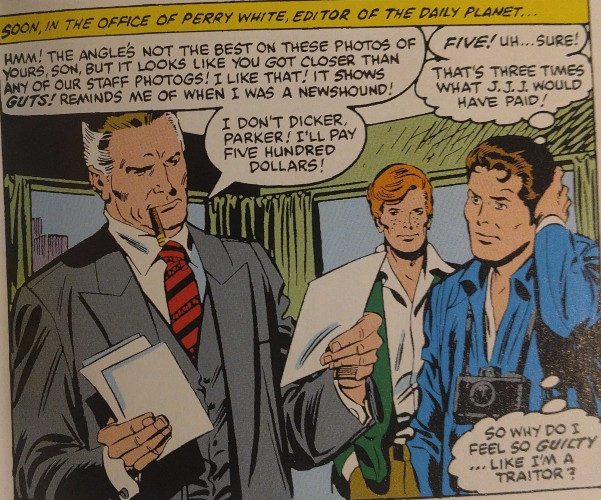
Where Shooter's story finds its greatest strength is not in Superman's muscles but in the character development he offers our heroes. While Conway's characterization could be found in small moments and references, Shooter's story relies on Peter Parker and Clark Kent just as much as it relies on Spider-Man and Superman. Both men are transplanted to the other's home city–Peter Parker to Metropolis, Clark Kent to New York–and find themselves thriving in environments different than they're used to. No longer is Peter hoping on J. Jonah Jameson's "generosity" to help him scrape enough together to pay Aunt May's medical bills; he thrives for a time at the Daily Planet, bonding well with Jimmy Olsen and feeling he is more than compensated by Perry White. And Clark Kent, though primarily in New York for his own investigation, finds he can stand up to Jameson's pushiness far easier than Peter can, winning a level of respect, perhaps even fear, which Peter can never seem to grasp.
The integration of the Marvel and DC universes feels more coherent here, as evidenced not just by Peter and Clark "infiltrating" each other's places of work, but in how other characters interact. There's a triumphant swell you feel when Superman confronts Doctor Doom in his Latverian embassy in New York, staring the tin tyrant down and easily foiling an attempt to kill the Man of Tomorrow. Superman is a guy even Doom, for all his bravado, wouldn't be stupid enough to face on his own, at least not without the "diplomatic immunity" he claims he's been given. It's enough to feel elation just knowing Superman could absolutely trounce Doom given the opportunity, crunch into him the size of a soda can. Robert Downey Jr. better watch his back for David Corenswet should this story ever be adapted to film.
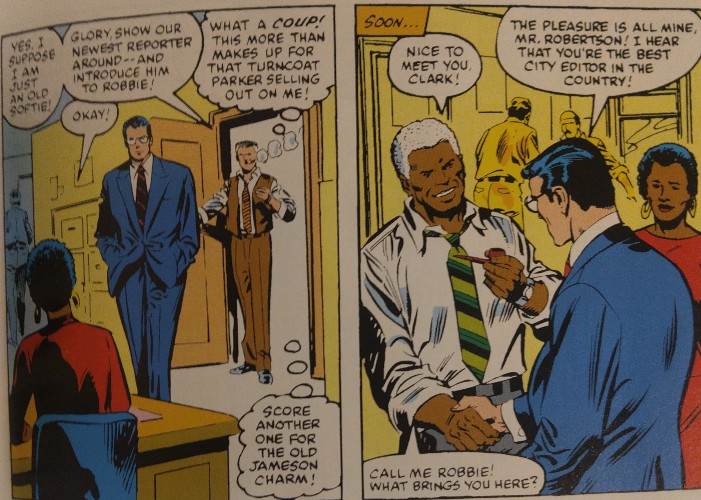
Spidey does seem to get a bit of short shrift at moments–Shooter's opening scene zeroes in on his adventures, yet when Superman comes around, it's Metropolis' favorite son who uncovers most of Doom's plot. Our Web-Head is given some nice internal turmoil as he encounters resistance from the Metropolis police, as he would in New York, finding it more difficult to acclimate to Metropolis than his own town. Shooter seems to have a knack for understanding the base qualities of the characters he's writing–Superman's nobility, Spider-Man's perpetual "Parker Luck"–and though he nicely plays with the status quo between our heroes' plainclothes personas, he doesn't stretch them much beyond their roots when they're swinging through a city or soaring over skyscrapers. The story may be better plotted than its predecessor, and Peter and Clark tend to be written well, but the superhuman shenanigans lean towards the basic side of storytelling.
I would have also appreciated more from the Parasite. Unlike Lex and Doc Ock's partnership, the Doom/Parasite combo has more of a bossman/underling flavor to it, with Parasite utilized for Doom's purposes rather than standing on his own as a worthy adversary. He pontificates about his power, but he's never given a standout moment. I was kinda hoping, in the same way Superman stood up to Doom, we'd get a definitive Spider-Man/Parasite confrontation, but that never materializes. He feels underutilized. Doom remains the tale's arch-foe, and though he is properly placed, the Parasite suffers as a result.
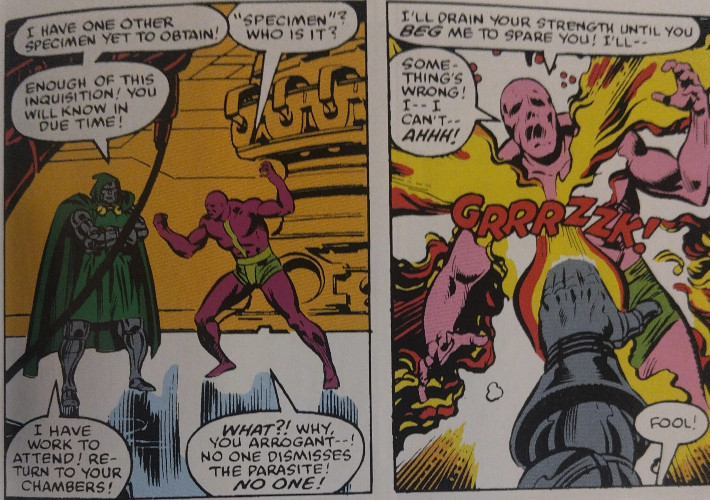
The choice for villains in general is a tad strange–you could make the argument that Doom was selected as a premiere Marvel antagonist, though he exists out of Spidey's rogues gallery (despite the fact they have clashed in the past). Perhaps because Luthor had previously been used, Shooter thought the Parasite was an admirable Superman rogue to select? I'd probably protest less if the Parasite was used in an interesting way, but he's largely cannon fodder standing between our heroes and the devious doctor.
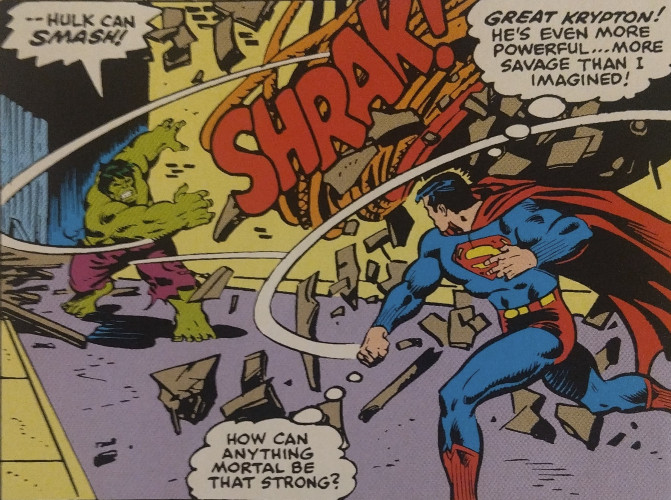
Also interesting–and, though I tend to add a negative connotation to my use of "interesting," I don't necessarily mean that utterly here–is Shooter's use of supporting cast members, specifically fellow superheroes the Hulk and Wonder Woman. The Hulk is used to a fun extent, providing a great match-up for Superman early in the issue, his involvement feeling fairly natural to the narrative where he appears and strengthening those cohesive bonds supporting the notions of a plausible combined Marvel/DC universe (known as Earth-7642). Wonder Woman, unfortunately, feels dragged into the story, seemingly added because it appears unfair for a second Marvel hero to receive some of the spotlight and not allow a second DC champion the same opportunity. Her sudden inclusion is woven less fluidly into the story, and a brief altercation between herself and Spider-Man feels forced, based on the cliche mutual ignorance which runs so prominently through superhero comics. So when I say "interesting," I mean that I appreciate Shooter's use of the Hulk, yet I find his treatment of Wonder Woman less than satisfying.
Pieces of this issue work incredibly well. Like Conway and Andru snagged that sense of wonder and joy with Spidey and Superman's first team-up, Shooter manages to keep an aspect of that excitement…though primarily through our heroes' civilian identities. Peter Parker and Clark Kent provide this story most of its gravity, enabling a fun exploration of how these men could exist, and even sometimes flourish, in each other's worlds. Superman standing up to Doc Doom is a sight to behold, and Peter palling around with Jimmy Olsen feels like a natural friendship. It creates an ache inside that makes me wish these universes were closer together, a far-fetched possibility I believe these kinds of stories use to engineer wish fulfillment and stoke the imagination. It's when Spidey slips on his suit and Superman dons his cape that the story falters a little bit–the action is fun, but Shooter finds he can't balance other characters as well. We could've used more Parasite, and I wish Wonder Woman had been utilized more significantly. But I guess that's to be expected when your writer, even with his DC credentials, is one of the top dogs at the House of Ideas!