(Strand)om Stories: Thor: Sunlight and Shadows Review (Thor-oughly 90s, Part 3)
This volume generates more interesting ideas than it does narratives, including a more intriguing hero than Thor
—by Nathan on June 27, 2026—
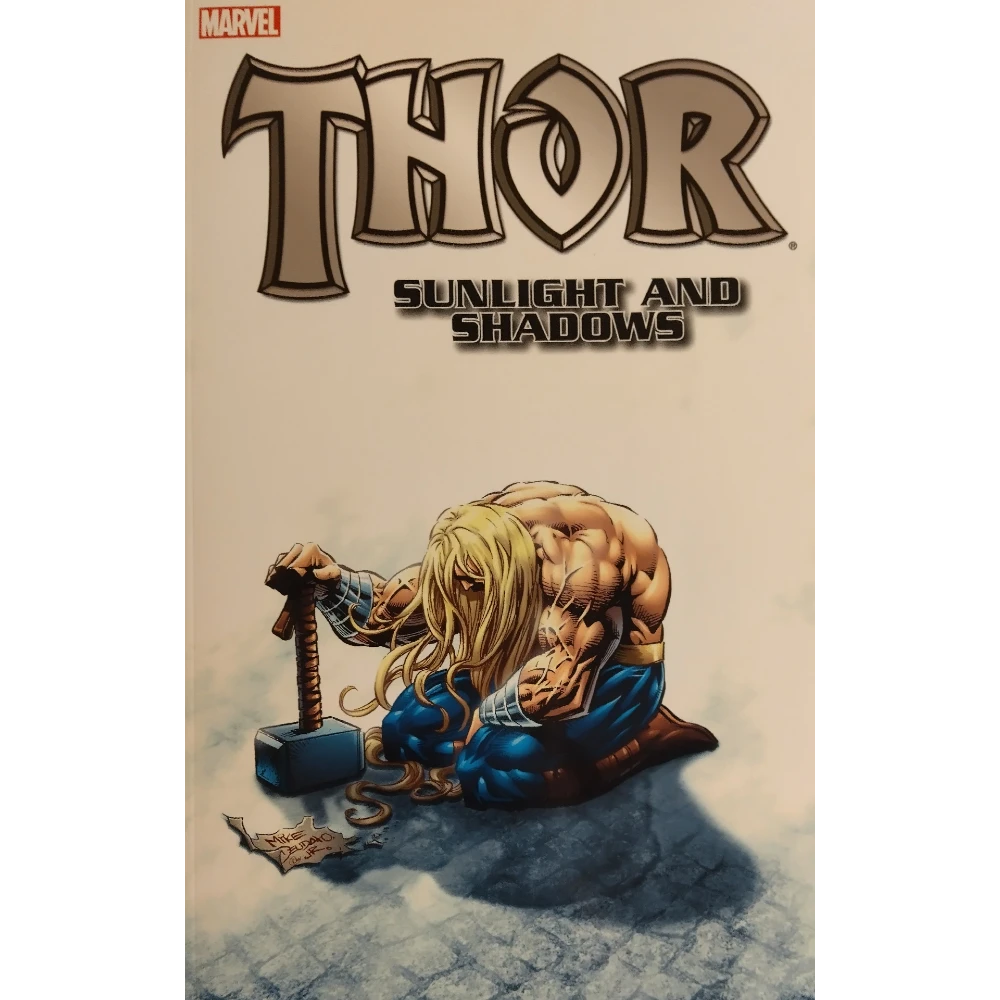
In exploring the Marvel Universe of the mid-90s, I've deviated slightly to focus on a narrative featuring Thor rather than really focusing on Thor. A four-part crossover arc saw various Avengers face the combined might of Zodiac, before a handful of Avengers and Iron Man issues revealed the state of those books in the immediate follow-up to the X-Men crossover known as "Onslaught." That volume left both the Avengers and Iron Man on the absolute front doorstep of the event, while the subject of today's review brings Thor to the same place.
When we last examined a Thor-centric volume, Warren Ellis had endeavored to rejuvenate the Norse legend by restoring some of the out-there cosmic craziness the character had been born in decades earlier. A heretofore unknown villain had destabilized Yggdrasil, the World Tree, costing Thor, the Enchantress, and other godly deities their profound abilities. Ellis, in stripping Thor of his powers, had worked to bring out that key humanity which made even a god a relatable character.
I lamented his efforts were too little too late, washed away by the oncoming "Onslaught." Before we get to that particular epic, however, we have a few issues remaining, bookending that Zodiac crossover. Writer William Messner-Loebs has taken Ellis' place, though he's still paired with Mike Deodato Jr., plus other artists. We'll have to see the kind of send-off they can give the Norse God of Thunder before Onslaught comes crashing onto the scene.
Thor: Sunlight and Shadows
Writer: William Messner-Loebs
Pencilers: Geoff Isherwood, Mike Deodato Jr., Luke Ross, Oclair Albert, Frank Toscando, Dante Bastianoni, and Pino Rinaldi
Inkers: Geoff Isherwood, Mike Deodato Jr., Rene Micheletti, Eddie Wagner, Grant Nelson, Alex Jubran, Brad Vancata, and Andy Lanning
Colorists: Marie Javins, John Kalisz, and Frank Lopez
Letterers: Michael Higgins and Jon Babcock
Issues Collected: Thor #495, #497-502
Volume Publication Date: January 2014
Issue Publication Dates: February 1996, April 1996-September 1996
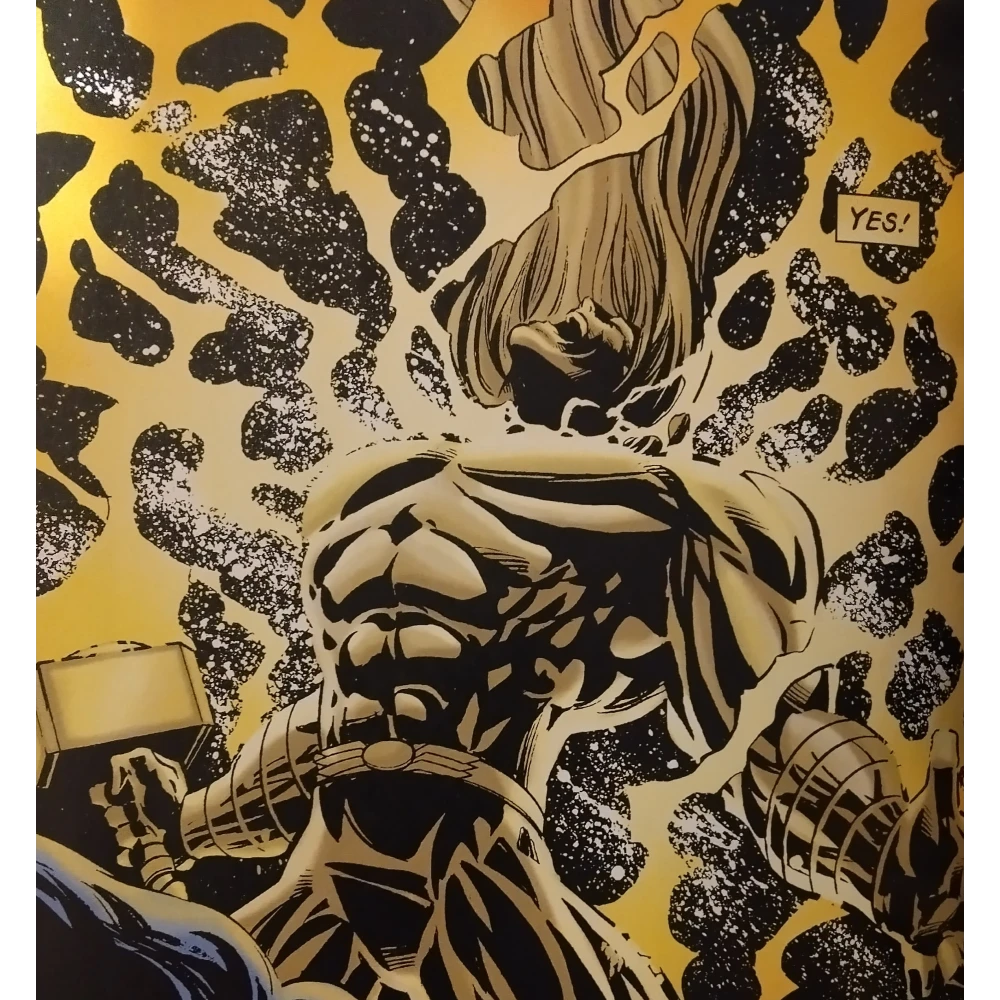
As one of the first Marvel heroes to hit that milestone 500th issue, you'd think Thor would receive something equivalent to what I assume would be an Asgardian birthday party, an uproarious celebration befitting the gods. Mead overflowing! Revelry to shake the heavens! Rabblerousery and other such nonsense! Oh, nonsense is to be found, and the heavens are shaken, but with disquiet rather than celebration. And the only spilling comes from blood and maybe a few tears.
For this is a sad way to see a god end.
Not to overly dramatize this volume's qualities–and, just to be clear, Thor doesn't die. He arrives on the cusp of "Onslaught" in this volume's final chapter, in what, instead of the double-sized 500th anniversary issue, is meant to be a fond "farewell to a living legend," as the cover itself proclaims. And yet, like other bits of this volume, it's too quiet. Fond? Perhaps in the minds of the creators. But to this reader, something feels amiss.
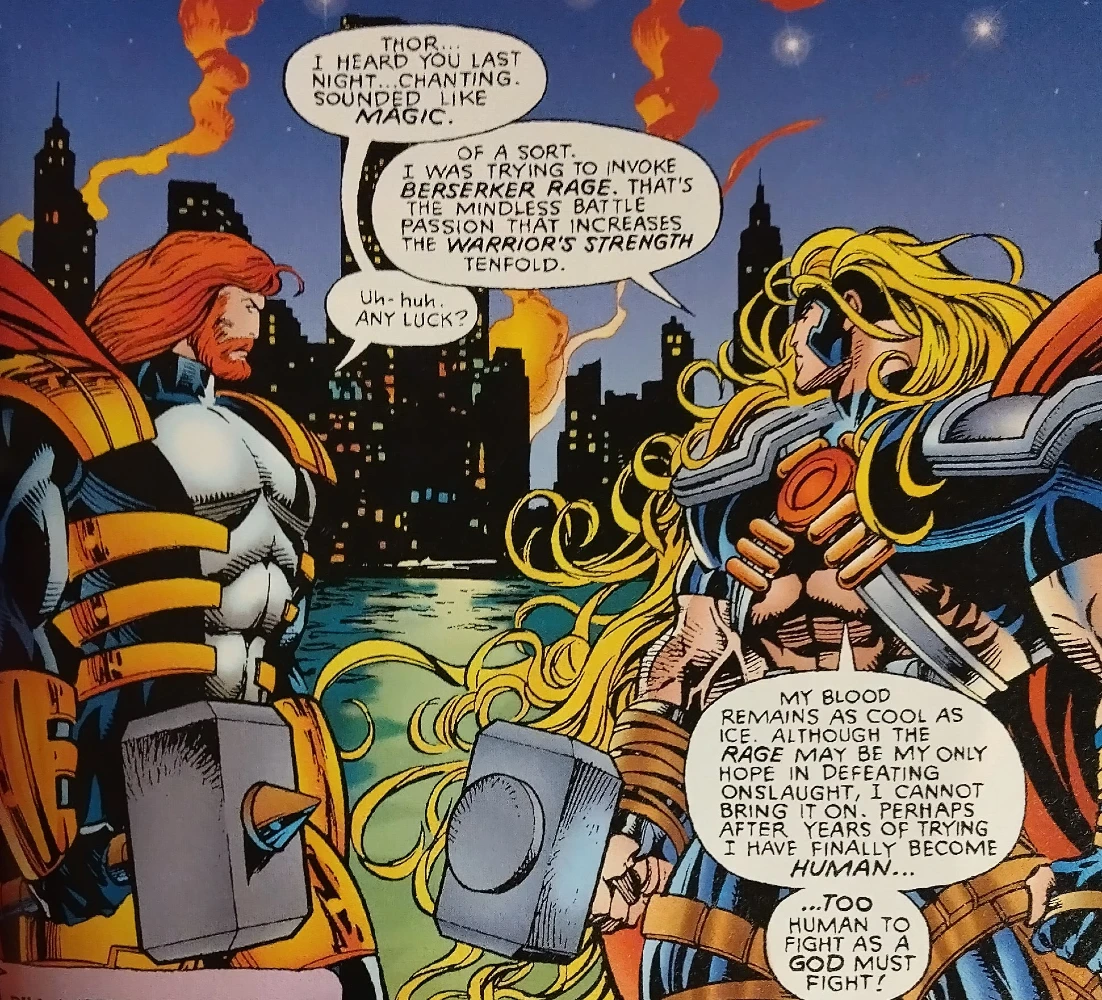
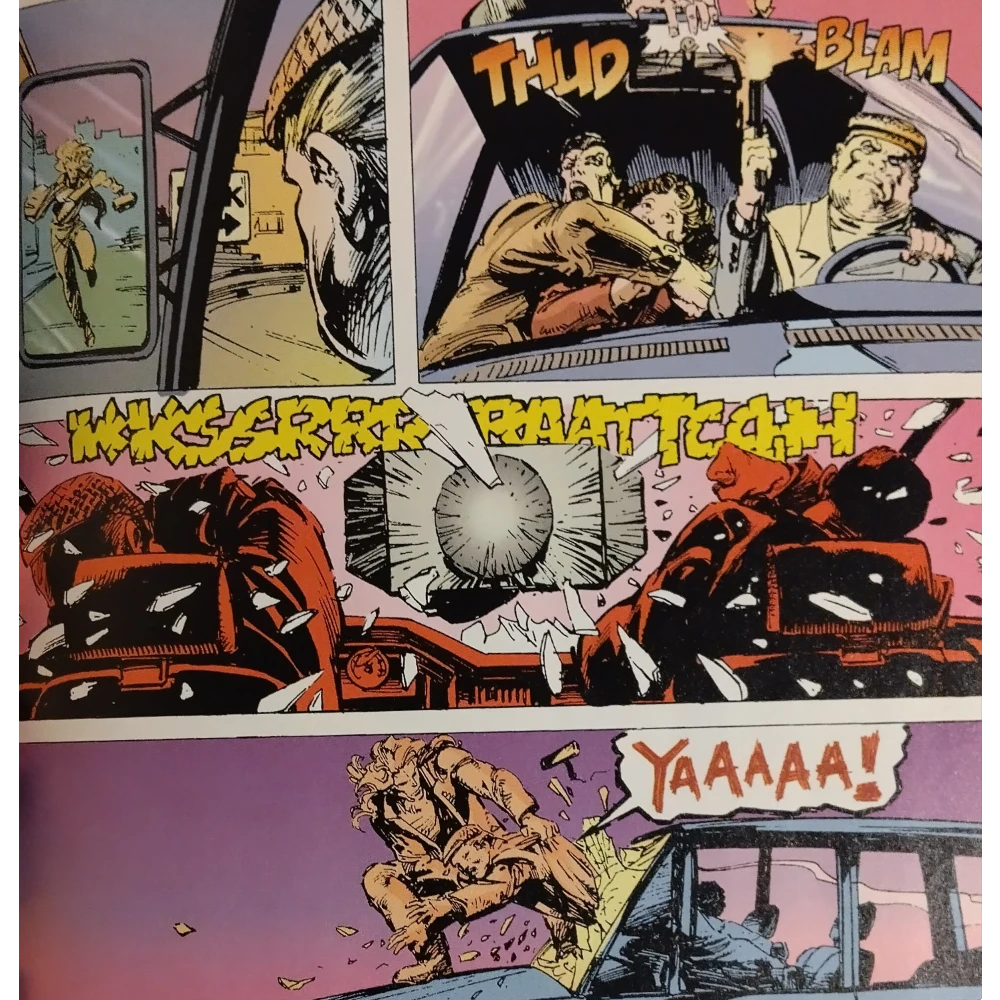
You can feel it in the comics' roots, Marvel's bones, in this era. Everything is off-kilter. Warren Ellis attempted to inject some life into Thor by exposing his humanity, but by time we get to this volume's second issue, Thor's back to his old self…mostly. His powers short out occasionally, but thanks to an event occurring in an Incredible Hulk issue, he's largely the same old Thunder God. Messner-Loebs maintains the quasi-human approach Ellis was working through, though instead of exposing Thor's humanity through his vulnerability, Messner-Loebs tries a somewhat down-to-earth approach through a few grounded adventures. Fantasy plays later into the volume, but we get several pages of Thor battling kidnappers, visiting a former friend in a trailer park, stopping a potential shooter, and serving as a rich dude's daughter's bodyguard.
There's just this sense of "Huh?" followed by a bit of "What?" snaking through this volume. I assume Messner-Loebs was aware of the impending "Onslaught" crossover and just wasn't able to shift any interesting, character-driven narratives into high gear. Of course, what's what I said about the last volume, and Ellis made a hearty attempt at his four issues. Messner-Loebs has seven, and his efforts feel less composed than Ellis'. You feel he's killing time, twiddling his thumbs, throwing around oddball ideas because he isn't sure what he's supposed to do.
Take that double-sized 500th issue, for example, serving as the final chapter in a three-issue arc that inexplicably brings Thor, the Enchantress, and a few human companions to an alternate universe Asgard, followed by a jaunt to the real deal. Some sword-and-sorcery elements are wound through the first parts, as Thor and Friends find themselves wandering an Asgard closer to, it seems, the realm's depiction in Richard Wagner's Ring Cycle, where more bloodthirsty versions of Odin and Thor await them. But that 500th issue brings Thor to a fallen Asgard, overrun by trolls and ice giants. The scale is meant to feel epic, a war for the ruins of a kingdom which Thor may restore…
…yet it comes on the heels of so much other fluff. Messner-Loebs veers sharply into "show, don't tell" territory, and while I am all for allowing the reader agency in pulling together the pieces of a story rather than having a writer force feed them material, I feel some context is necessary for properly equipping the reader. Messner-Loebs is more "show, don't tell anything," so that context is stripped away. Asgard is gone, suddenly overrun. How? No real reason. Doctor Strange pops up, for reasons thrown into a brief flashback. That alternate universe? Gone. No idea why we were there to begin with.
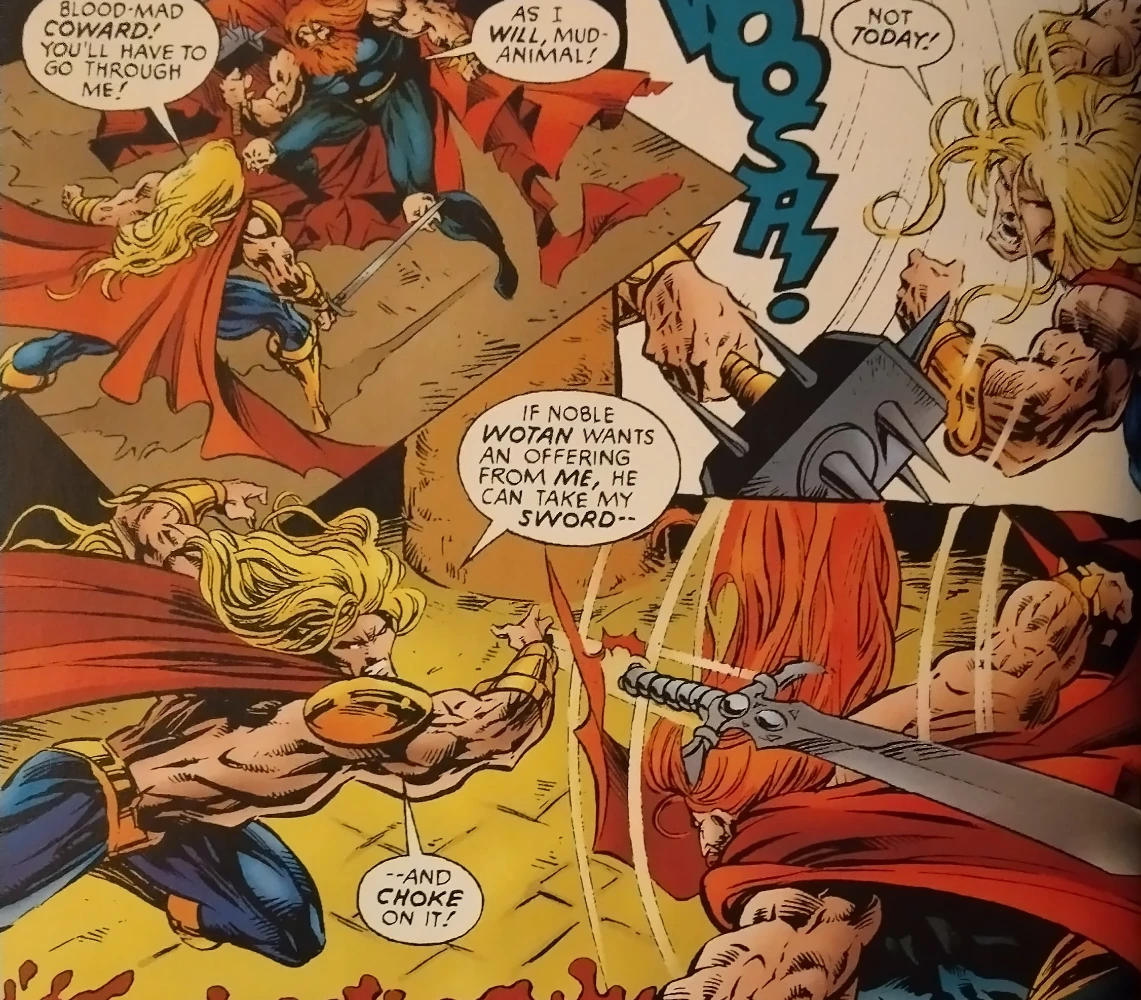
There are some genuinely interesting details Messner-Loebs sews into these stories. The idea that Thor winds up in an alternate reality and fights a version of himself who is more mythologically accurate and is, as a result, more brutal sounds great. More of that, please! Show me the fall of Asgard rather than Asgard fallen! Odin, having been stripped of his godly powers alongside his son, wanders as a derelict drunk, slowing coming into some form of his previous understanding. There's character development there! Show the struggle as Odin comes to his senses.
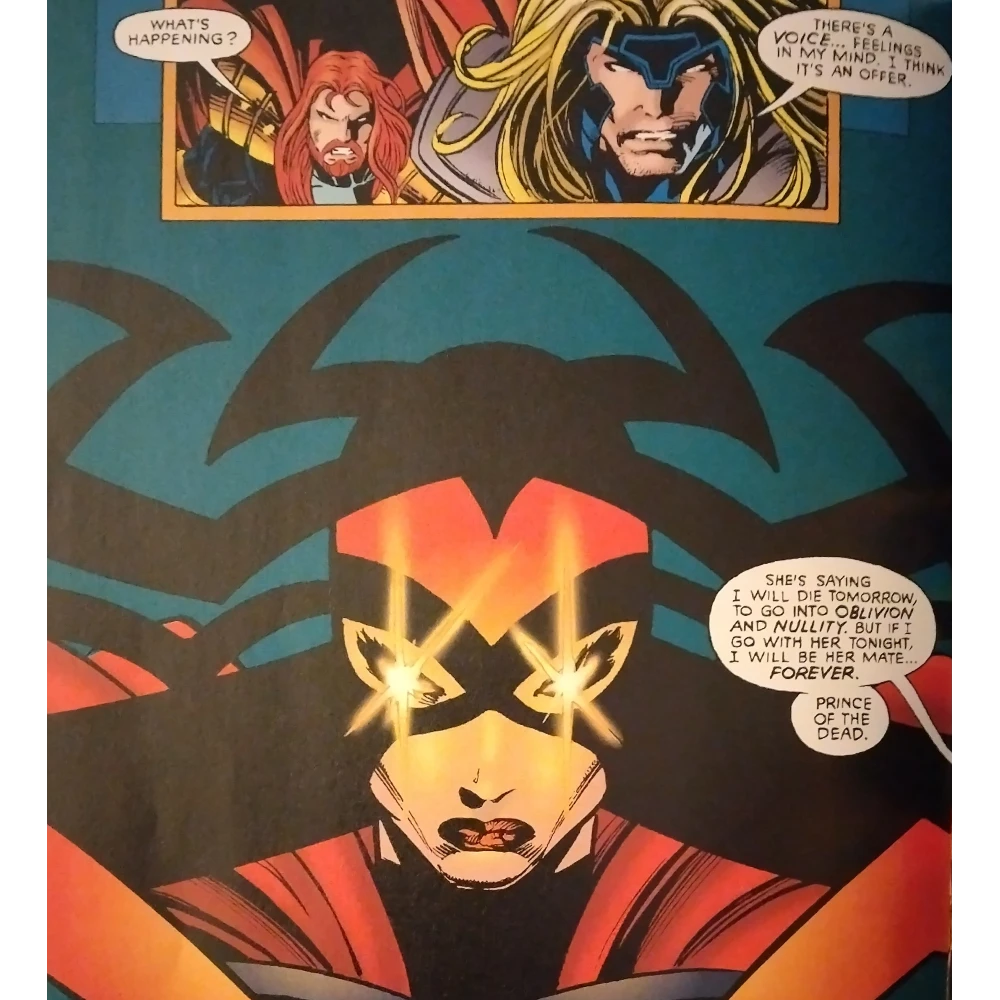
That final issue, Thor #502, is actually this complaint in microcosm. Messner-Loebs, knowing the book is coming at least to a temporary end, wants to celebrate its main star (that "fond farewell" from the cover). Yet the whole issue is this haphazard lumping in of ideas–you get the sudden appearance of frogs that I feel are a nod to Walt Simonson's celebrated run, flashbacks to Thor's childhood which make little sense in context, a brief and perplexing appearance by Hela which may foreshadow Thor's demise(?), and one last goodbye with Jane Foster secured rather conveniently. All this just happens. Messner-Loebs knows what elements can appeal to readers–an allusion to a well-received run! The appearance of a longstanding supporting character! A portent of possible doom!–yet cannot string them together in any way which feels cathartic or representative of Thor as a whole.
Surprisingly, it's through a character who isn't Thor–at least, not properly Thor–where Messner-Loebs gains the most mileage. Red Norvell, a character introduced in the 70s who temporarily gained Thor's powers, makes a surprise reappearance, gifted once again his former might. Messner-Loebs uses him decently in the last few issues, contrasting the vision of a broken man living in a trailer park receiving strength anew to turn his life around. Here, we get even the hint of development I wanted to see elsewhere, as the former cameraman, at the end of a string of bad decisions, is offered an opportunity at redemption, provided he faces it. I'm aware Red's story continued post-"Onslaught," so I look forward to seeing his adventures there…maybe even more than Thor's!
Somewhat like Ellis' run, Messner-Loebs' hits with the thud of Mjolnir dropping to the ground without anyone to pick it back up. Like Ellis, the writer has ideas which could generate engaging narratives, and though he was given a bit more space, he fails to use it effectively. And with that, Thor, along with everyone else, arrived to face the biggest bad of the 1990s…sorry, late 1990s. We haven't forgotten you, Thanos. Based on how I believe some upcoming narratives will go, I'm sure I'll find myself yearning for the days when Marvel's biggest threat was a purple dude's bling collection.