Distinguished Critique: Challengers of the Unknown Must Die! Review
Loeb and Sale's first collaboration is a unique examination of unique characters, offering a grand glimpse at greater narratives to come
—by Nathan on November 9, 2025—
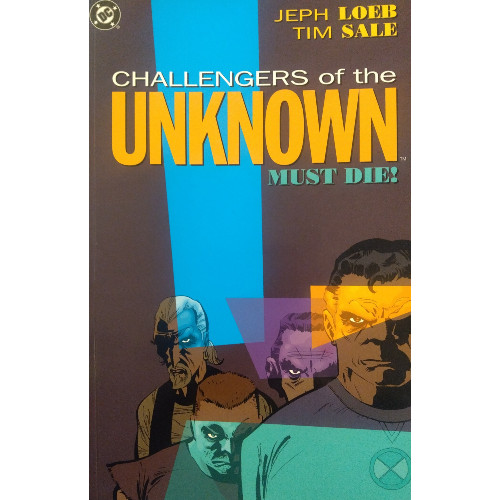
Several decades ago, Jack Kirby shot four fictional characters into the sky and, upon crash landing them, had them declare they would use that fateful experience to become acclaimed adventurers dressed in matching uniforms largely based on a single color.
I'm making mountains outta molehills, obviously, and by the title alone, you know I'm not talking about Kirby's fabulous, fine, fascinating, famous, fond, funny, future-facing…uh… something, something "Four." The similarities between Marvel's First Family and DC's Challengers of the Unknown are existent, with folks noting how Kirby saw the FF as a superhuman extension of characters and concepts he helped develop in his original Challengers of the Unknown series, but there are also major differences between the teams. The Challengers' lack of powers, for one, or the fact the original Challengers were four men: Kyle "Ace" Morgan, Matthew "Red" Ryan, Leslie "Rocky" Davis, and Walter "Prof" Haley. The lineup, as I understand it, faced a few changes over time, including a few female members (or "honorary members," some research indicates?). Without any abilities whatsoever (save, it seems, during the occasional issue or two), the "Challs," as they're affectionately referred to, were men "living on borrowed time," making the most of their second chance after surviving that plane crash.
Aside from the bit of digging I've done, I know next to nothing about these guys. I've never read a single issue from their original run, I don't remember them popping up in other DC comics I've read, save Darwyn Cooke's The New Frontier, and I couldn't tell you anything about their characterizations, their relationships, or their adventures.
My ignorance didn't prevent me picking up this volume of their early 90s adventures, an eight-issue limited series from a writer named Jeph Loeb and an artist named Tim Sale.
I love these guys. I've gushed recently about their collaborations, specifically on Batman-focused narratives, though I did decry an early Wolverine/Gambit team-up they developed. The latter is an okay series, a four-part mystery which doesn't much evidence their later greatness. This Challengers limited series, as we'll see, is a much better example of things to come...
...which is particularly astounding, as this series marks the first team-up between this dynamic duo, Loeb a screenwriter at the time and Sale fairly early in his comics career. The story goes Loeb was slated to write a Flash movie script, but once that project fell through, he was approached by DC editor-in-chief Jenette Kahn about writing a comic. Given several C-list options, he selected the "Challs" and then, looking for someone who could draw unique people, was recommended Tim Sale.
Thus, even as challengers die, legends were born.
Challengers of the Unknown Must Die!
Writer: Jeph Loeb
Penciler: Tim Sale
Inker: Tim Sale
Colorist: Lovern Kindzierski
Letterer: Bob Pinaha
Issues: Challengers of the Unknown (vol. 2) #1-8
Publication Dates: March 1991-October 1991
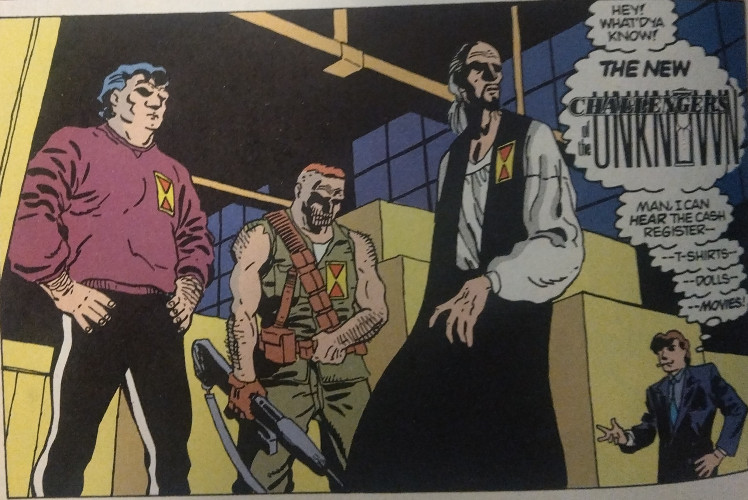
I've read Loeb headed into the series nothing about the Challengers, giving him an opportunity to adapt them to the times in a bold, new direction. I dove into this series with probably the exact same amount of knowledge, and with the sincerest of apologies to Jack Kirby, I recommend you do the same. I didn't come to this hoping Loeb and Sale did right by these characters (though I'm certain there are fans who read this through such a lens, and it's an absolutely viable perspective), but I did hope they'd get characters right. There's a difference, I'd argue, and having reached the series' other side, I found Loeb and Sale's examination of somewhat forgotten characters made for a thoroughly engaging study of genuine people, my viewpoint largely unaffected by whether they were faithful to what Kirby created decades earlier.
I kept my expectations somewhat withdrawn heading into this series, knowing that this was not only Loeb and Sale's first collaboration but Loeb's first comic ever and very early Sale material, published around the same time as his Billi 99 series with Sarah Byam at Dark Horse. To me, The Long Halloween marks the epitome of their joint efforts, published at a time where they'd developed near-perfect synergy. I expected this series, kinda like portions of their Legends of the Dark Knight Halloween specials and that Wolverine/Gambit series, to be a little rough.
Well, if I was expecting to be disappointed, I was sorely disappointed…by not being disappointed? Is…that…yeah. I wasn't disappointed.
Let's make it simple: I really enjoyed this series. If I were ranking my favorite Loeb/Sale collaborations, I'd say Long Halloween, Superman For All Seasons, and then this series take the top spots, which is kinda nuts to me, because I'm a massive Marvel guy, and these two developed a love letter to the end of the Silver Age of comics through a series centered on my favorite super-guy. But an eight-issue Challenger of the Unknown series, based around a quartet of characters I know nothing about, beats out Spidey…and Daredevil, and Captain America, etc.
I want to say, and this is just a theory, that being unfamiliar with the comics landscape from a writing perspective was a massive benefit to Loeb coming into this series. He knew, I'm certain, how to structure a story, and comics can follow a sequential format not unlike movies and television series, plus what I assume is a somewhat similar scripting format. He took the thoughts in his head–about the story, the characters, the narration–and worked them in such a way that those concepts became easily accessible through a visual medium. I can't say that with any certainty, but the fluidity with which he and Sale develop this Challengers series seems to attest to that idea.
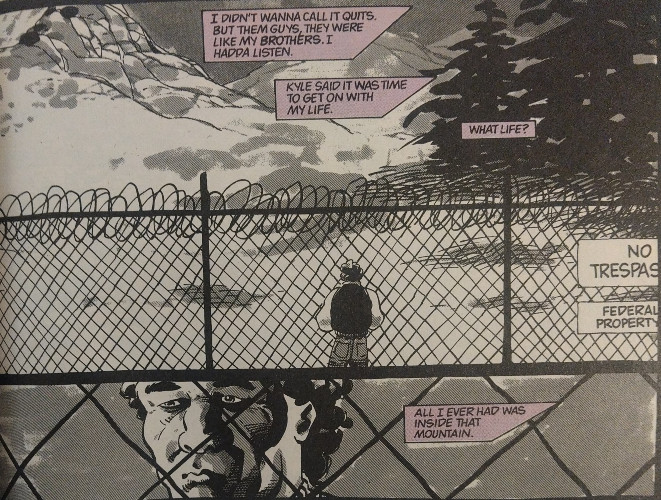
The series is wonderfully dynamic and well-structured by both men, each issue serving a unique purpose while aiding the overarching story. The series' main developmental crux, spotlighting three Challengers and their efforts in growing beyond their former lives and re-finding their purpose as people and heroes, is seen through bite-sized moments across the issues while forming an ongoing thread through the entire series. I've read a few folks disparaging the series for drawing Kirby's classic characters into the extreme silliness of the 90s, but I'll admit I personally found little to nothing overly excessive about this series, any moments of violence feeling appropriate for the narrative told and never overwhelming the read visually in that "classic" 90s style.
Which is impressive considering this story begins with a mountain exploding.
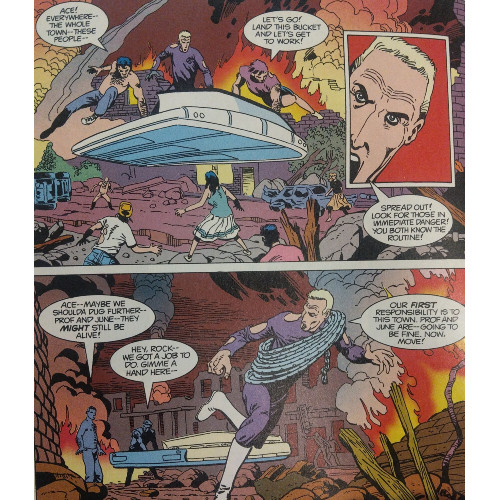
Loeb and Sale set the Challengers up as retired adventures, palling around their mountain headquarters, around which a thriving tourist town has risen. These guys (and gal) are beloved heroes, with "Challengersville" soaking up that fanaticism through paid tours, soda shops, little tchotchkes in souvenir shops, even a church named after them! All that goes kaput when their mountain headquarters explodes, devastating the town and making the Challengers of the Unknown even more known than they already were, though in a more infamous than revered sense. The three remaining members are placed on trial, and though they're acquitted, they're forced to retire, go their separate ways. No more sick royalties from the tours and tchotchkes.
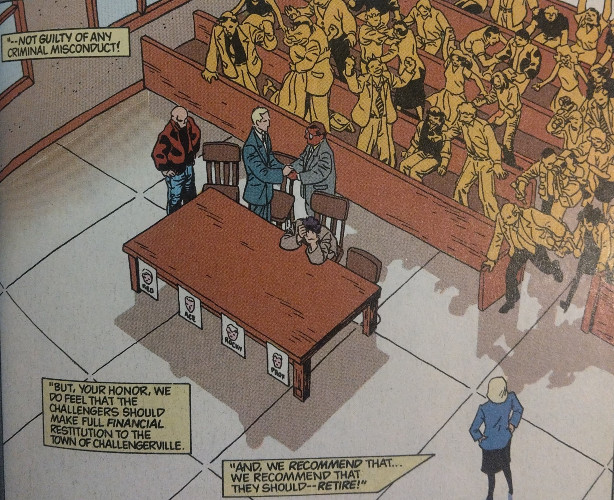
This is the framework around which Loeb and Sale develop the series, and though a larger narrative is cleverly crafted throughout, the core focus are the three survivors: Ace, Red, and Rocky. For a long time, all they've ever known is their mountain home, their friends, their purpose. They've been "living on borrowed time" for so long that maybe they've grown comfortable with the borrowing. When time demands the bills come due–seemingly permanently for a few of our adventurers–the remaining Challengers have to put things into perspective. They're not untouchable, and suddenly, a different kind of unknown is forced upon them: the unknown of mortality and, for the first time in forever, the unknown of the future.
Loeb and Sale make you feel for these men who have had the rug so viciously torn out from under them, and the series follows as they desperately try to find some semblance of wholeness away from the past–either that old rug must be returned, familiarity restored, or a new rug must replace the old. Ace, always more attuned to the occult than his friends, becomes a mystic, seeking spiritual peace and working to find internal healing through the application of magic and ritual. Rocky becomes an actor, parlaying his rugged good looks and charm into a series of successful box office hits. Red, desperate for action, turns into a hardcore vigilante and then a mercenary, reverting to a thuggish mentality from before he joined the Challengers. Each man is broken, seeking wholeness, and they try other avenues with unfulfilling results. Panels where some of the men longingly gaze at old photos of the team establish an emptiness born of the old life ripped away...something is missing, the question lingers whether restoration is possible.
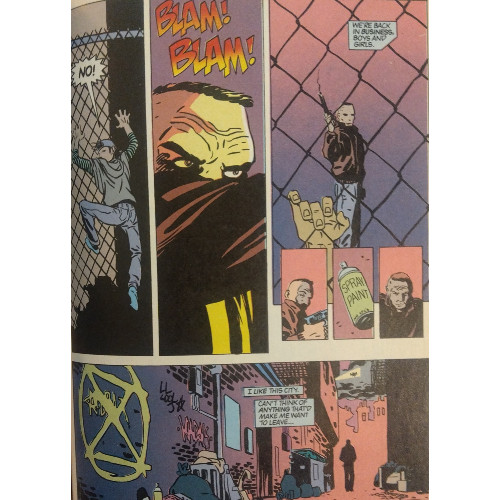
These are great character studies, written well by Loeb and given an extra dash of empathy by Sale. Even if you know nothing about these guys, you find reasons to resonate with them on deeply personal levels. You feel the loss each man experiences, the tug towards the past and the purposeness which being a Challenger brought them. You understand their efforts to crawl out of the emotional wreckage of the mountain to begin building new lives when you know, and they know, they're lying to themselves thinking they've found completeness.
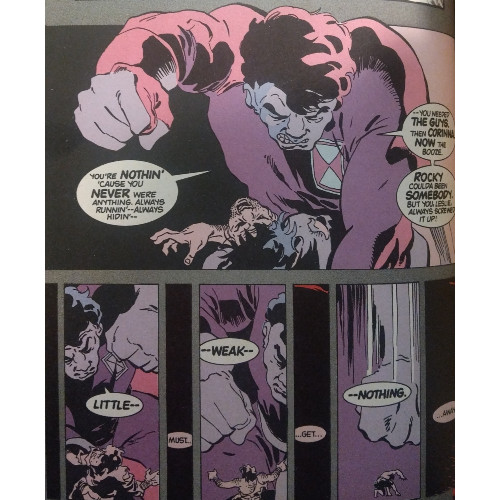
Rocky–who appears, from Loeb's perspective, to fill the same "heart and soul of the team" position as a certain blue-eyed Benjamin Grimm does for the FF–becomes the most rounded character. He dumps his acting career to explore the world with a female beau, thinking maybe love will fill the hole inside him, and eventually takes up substances, looking for the answer at the bottom of a bottle. He's the character we empathize with the most, the guy who may need the most healing and has been rocked (sorry) the most by the series' early events. The poor dude's damaged, and though Loeb never goes overboard with drumming up sympathy, he puts Rocky through the crusher…maybe suggesting you'll find diamonds once you crack him open a little.
The other remaining Challengers are forced to grow as well; Red's violent transformation is frightening to watch, particularly the glee with which he dispenses justice through violence. Of the Challengers, his actions impact the most people, not just damaging himself but using his brokenness to exact pain against others. His vigilantism may be the 90s "excessiveness" other readers find in the series, but as I noted, I feel it's well-placed. Red embracing violence doesn't highlight the positives of his transformation; if anything, it seems like a subtle slam against the wide spotlight on guys like the Punisher or Wolverine, marking Red's actions as antithetical to his own development as a human being.
I will note I found Ace's own arc the least rewarding. The Challengers, though originally steeped in sci-fi and occult narratives, feel a tad more grounded in this narrative, with Kyle's own story the big exception. He's allowed his own form of penance and emotional restitution, yet it comes at the cost of introducing mystical elements such as interdimensional gateways and spells, which I found somewhat prohibitive to appreciating his arc fully. Magic does play into the larger narrative, which Loeb and Sale unfold well enough, but it just tickled my brain in a slightly unpleasant fashion. I was reminded of my main complaint regarding Frank Miller's Daredevil run with his use of the Hand and the Chaste, inserting supernatural elements into an otherwise incredibly street-level run. The results are somewhat similar here, though Loeb is more careful in how he maneuvers those elements across the series. You can't say he doesn't develop all the pieces carefully; I'm just not fond of some of the pieces.
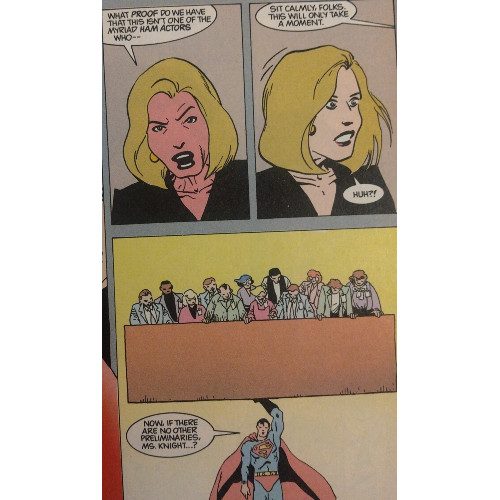
Aside from fantastic characterization and generally engaging plotting, Loeb and Sale also make the series incredibly fun, in an "irreverent but still respectful" kind of way. Loeb generally steers the series away from your typical comic book action sequences, focusing instead on his heroes, but he doesn't seem terribly beholden to continuity, history, or even in some cases, interdimensional barriers between comic universes. The series is chock full of sly and less-than-sly nods to characters such as Batman, Doctor Strange, Peter Parker, Zorro, the Question, Hawkman and Reid Fleming, the World's Toughest Milkman; visual cues are drawn from movies and artists like Steve Ditko and John Romita; Batman and Superman make cameo appearances, the latter's usage causing some brief contention around the DC office at the time, if you believe the introduction by Brian Michael Bendis. Loeb isn't looking to fit within the rules, however. We can't necessarily consider the series groundbreaking, but it doesn't bow easily to the standard tropes proliferating mainstream comics.
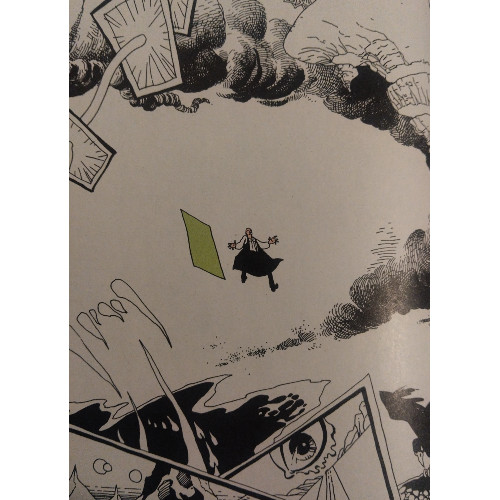
Sale, too, establishes a unique style different from what you'd see in comics at the time. He's patient and methodical, focused on background details which tell portions of the story as much as the foreground. His sense of pacing is top notch, and he supplies several unique storytelling choices, including a two-page spread constructed like a Monopoly board, a sequence where a visually small but monumentally important beat happens in the margins of a few pages, and paralleled pages fashioned like fractured stained glass which bookend the story's inciting incident and its climax. I've always enjoyed Sale's work, but here, he seems able to experiment more, toying with page structures and layouts. Both men possess an impressive amount of freedom on this series, and though they're respectful, they're not afraid to challenge (ah-ha!) some conventional notions of comic storytelling.
I came into this series with some questions and concerns, sold on Loeb and Sale's later collaborations but curious how they handled their first. "Pleasantly surprised" is how I left this series. The duo take a somewhat obscure group of characters, dust them off, dirty them up, and then polish them as each man explores his own broken state and determines the best resolution to find healing. Unbeholden to some of the conventions of the age–benefited, I believe, by Sale's relative inexperience in creating comics for a big name publisher and Loeb's own freshness in writing comics in general–the men fashion a story not for the masses but for themselves. They tell the tale they're comfortable telling, Loeb scripting in his own cinematically influenced style and Sale illustrating unique characters. Long Halloween may be my favorite story they produced as season collaborators, but this Challengers of the Unknown series may be their most creatively pure and spirited work.