Random Reviews: Classic G.I. Joe (vol. 1)
Some shallow characterization aside, these issues crank up the action in stories influenced by actual historical tensions
—by Nathan on March 24, 2026—
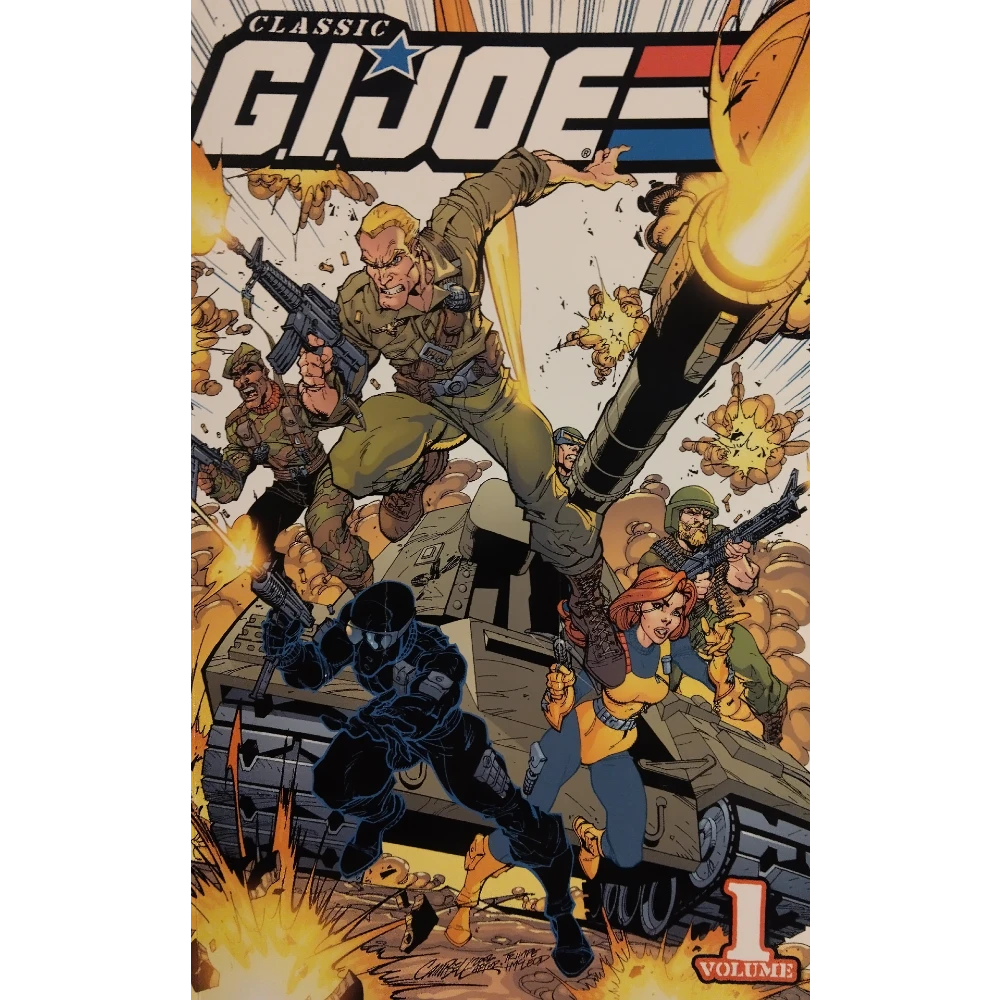
Growing up, I had exactly one G.I. Joe action figure. I received him as an Easter present one year from my grandparents, and because I didn't have any others and because I had no friends who would routinely engage in action figure combat, I often paired him with my sister's Barbie dolls. He was a bodyguard for the President, if I remember correctly, because my personality needed to inject some action and adrenaline into the proceedings. I don't even recall if I gave him a name, and he's currently gathering dust somewhere in our crawlspace. Internet sleuthing indicates his proper title is "Forward Air Control" from the Strategic Operations Forces line from around 2002-2004. Still not much of a name.
I've never had much affinity for the Joes–toys and stories based on actual combat scenarios was never really my thing. I saw the first live-action movie and the original animated film (which led to my youngest sister imitating Cobra Commander's obnoxiously nasal "Cobraaaa!" for a while), but I've never wanted to engage with the toys themselves or any of the media surrounding them. Turns out, a surefire way to get me even marginally interested in a franchise isn't through TV shows or movies; it's via my gateway drug of choice: comics. And even that's not a guarantee an interest will develop for other media. But I'll read the comics.
During the early 80s, Hasbro decided to relaunch their original G.I. Joe line of figures, and through a happenstance meeting between the presidents of both Hasbro and Marvel, it was decided to have the new line be accompanied by a comic book series. Marvel, having already found success in media-related comic series with Star Wars and Micronauts, sicced Larry Hama, writer and Vietnam vet, on the project. With the help of a few others (including Archie Goodwin, who invented Cobra and their illustrious Commander), Hama repurposed several ideas and characters he'd planned to use for a Nick Fury series, leading to such memorable characters as Scarlett, Duke, and the ever-silent Snake Eyes.
The comic, it seems, didn't have much success initially, taking off once the G.I. Joe cartoon series came on the scene. The series would run for twelve years, 155 issues, mostly written by Hama. The franchise has since been relaunched and had other series, but for today's review, we're focused on these initial issues in a volume collecting the first ten adventures of this eclectic band of veterans. Since IDW packaged these together, I've elected to nestle this under my "Random Reviews" series, similar to how I've worked with some of Marvel's "Epic" comics.
Lemme me hear you one time before we begin, for the fans:
"Yo, Joe!"
Classic G.I. Joe (vol. 1)
Writers: Larry Hama, Herb Trimpe, Steven Grant
Pencilers: Herb Trimpe, Don Perlin, Mike Vosburg
Inkers: Bob McLeod, Jack Abel, John D'Agostino, Mike Esposito, and Chic Stone
Colorists: Glynis Wein, Bob Sharen, George Roussos, Stan Goldberg, Christi Scheele, and Andy Yanchuns
Letterers: Jim Novak, Diana Albers Rick Parker, Janice Chiang, and Joe Rosen
Issues: G.I Joe: A Real American Hero #1-10
Volume Publication Date: April 2002
Issue Publication Dates: June 1982, August 1982-April 1983
Publisher: Marvel Comics (original issues), IDW (collected edition)
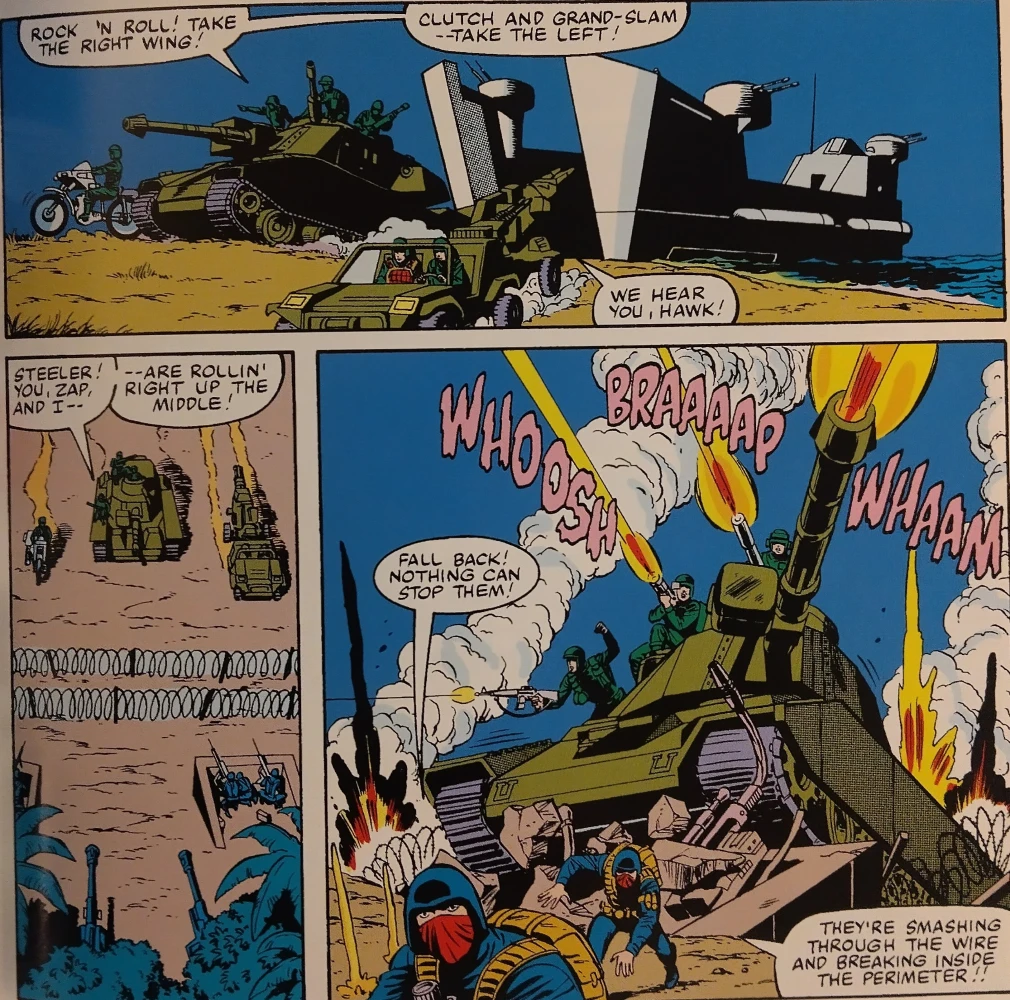
Because I'm unfamiliar with the G.I. Joe action figures and the original cartoon, I won't be using this review to comment on how well I feel Hama presents these characters based on beloved adaptations. Knowing the development he initially put into the characters, and knowing the contributions of other Marvel creatives that helped influenced other media, I would argue that the comic is, in some ways, the source material. I'm not aware what the show took from the comics, and the comic existed to sell toys, but I'm more interested in seeing how Hama handled original ideas and original characters, regardless of their advertising purposes.
Reading this volume, however, that notion of "sell toys" always lingered in the back of my head, but less in a conflicting way and more in a curious manner. I just wondered how much of this comic would feel like a ham-fisted advertisement aimed at kids. Could a genuinely interesting story be told that felt more than lip service to a line of products? I'm happy to note that Hama never seems to try and wedge in awkward advertisements for figures and playsets. I honestly don't know the full scope of the toyline, so when a Joe member uses a jetpack or the crew operates an experimental tank or a giant all-terrain vehicle, I didn't automatically react with "Oh, this is used here to promote the toy version." Each character appearance, each vehicle and piece of equipment used, serves the narrative told.
Hama's greatest weapon isn't an experimental tank or rocket launcher–it's the seriousness with which he paints these narratives. One can only wonder if Archie Goodwin, when developing Cobra, took a few hints from Marvel's other famed terrorist organization, Hydra. Masked men in matching uniforms serving the designs of their fanatical, fascist leader. Yet even with the parallels between Cobra and their possible Earth-616 counterpart, Hama treats the group as a genuine threat. They kidnap politicians, orchestrate possible assassinations, fund rogue revolutionaries who threaten to use nuclear ordinance, partake in all manner of schemes to either upend political stability or harm the lives of innocent people. They are, in a way, like any other comic book villain engaging in any other scheme. But their general lack of fantastical doomsday devices and advanced technology gives these issues a grittier undertone, as if Cobra (or a close variation) would exist in our universe.
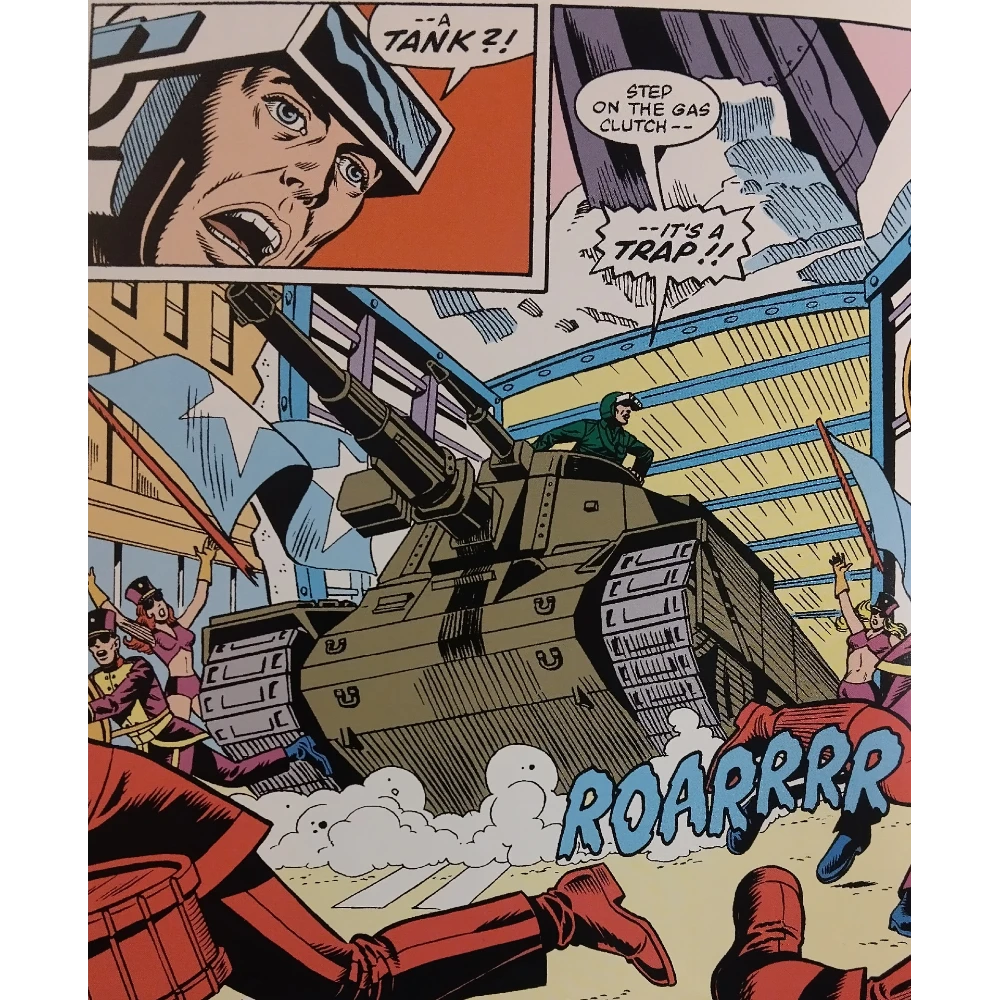
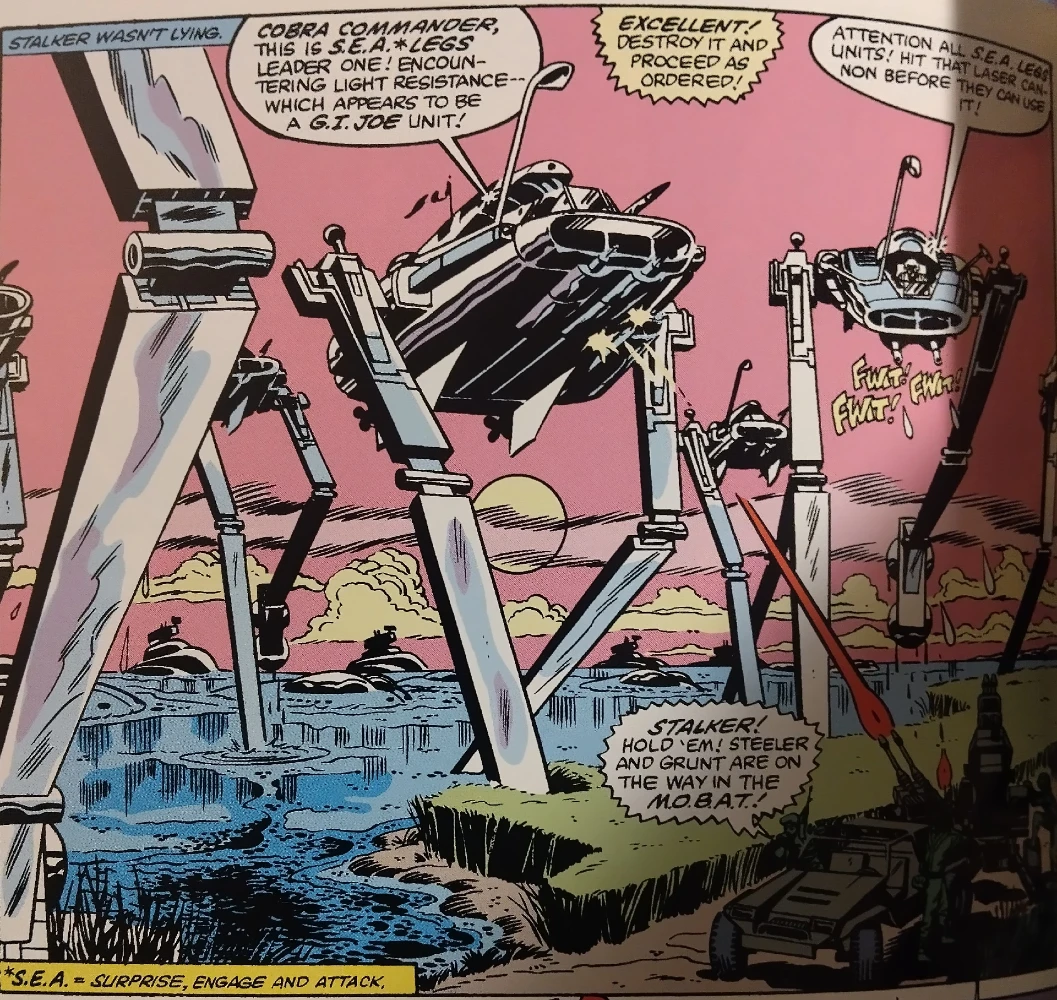
At moments, Hama and Trimpe engage in some technological fantasy (I did say "general lack" above), such as Trimpe giving Cobra an undersea headquarters and AT-AT-Walker-style combat vehicles and Hama turning a video arcade laser into a genuine weapon. When Trimpe utilizes such a move, the reasoning feels based less on storytelling and more in the artist indulging in surprising and cool visuals–which, Trimpe being an artist, feels fair from him. Long-legged combat vehicles rising from the ocean looks awesome, but the image does lack the logic Hama utilizes. Hama may give us a deadly arcade laser, but it's woven into a narrative centered on a small American town brainwashed into serving Cobra, the sci-fi piece providing an asset to the story. Hama's more grounded approach means that anything even remotely fantastical finds its roots in genuine military tactics and political strife, from Cobra's interrogation techniques, to a trap disguised as a parade float, to a booby-trap laden command center.
Supporting Hama's largely realistic vision of the team is his reliance on Cold War-era politics, which further enhances the impact of these issues. A tense two-parter sees the Joes team with an elite Russian platoon in the Afghanistan mountains, some physical fighting and squabbling over values momentarily set aside for a valiant effort against Cobra. Still, tensions remain between the teams, and though they are brief allies, they understand they come from different worlds with viewpoints that are, at the time, incompatible. Elsewhere, Hama pits the Joes against homegrown revolutionaries who wish to strike against Communist enemies, allowing division to exist between different American forces which, in some ways, have similar feelings about the same foes. All characters are human, and even different sides can find some common ground, but enough differences exist that diplomacy often falls short in providing resolution. If anything, the overwhelming threat of Coba becomes a catch-all enemy that nearly everyone else, American or Russian, can determine is a menace needed to be thwarted. It isn't terribly deep in the way of Hama providing commentary on actual conflict, but it's enough to offer each narrative propulsion.
Though not a unique trope to this style of fiction, a certain unsettledness pops up periodically for our heroes. Hama and Trimpe both have characters remark on the unfairness of the situations they find themselves in, whether Trimpe's troops wish for less frigid climes for one mission or Hama's heroes comment on the risks they take in an "And for what?" fashion. Even other military-based comics have commented on this, the status of the soldier as an involuntary weapon or tool in a conflict larger than they are, like chess pieces moved by more influential players. They're pawns in a global game, and though they believe the cause, they can't help but lean into their human sides now and again. The lack of sleep, the harsh conditions, the go-go-go mentality creates sympathy for these soldiers.
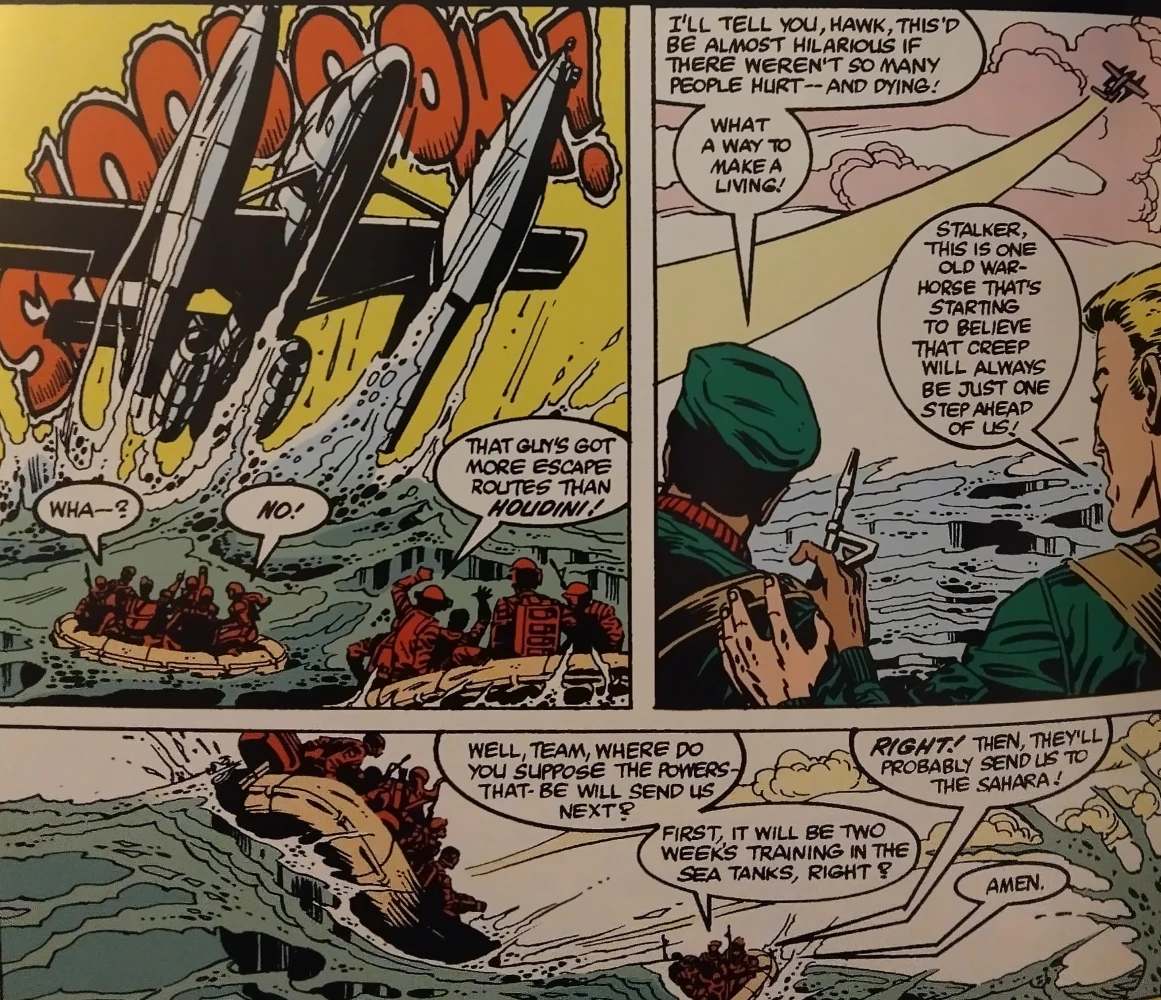
Because that's what they are, soldiers, and even under Hama's deftness, that's largely what they remain. Moments allow some character building and personality, but these characters are fairly static at this point. We're allowed a brief glimpse into the past of the silent, enigmatic Snake Eyes, but that's really all we learn about any of our heroes. Scarlett stands out because she's the one female member of the team, Hawk's the leader of the group, and everyone else follows orders. I assume some restrictions were given to Hama on the part of Hasbro with how he could treat the characters–Snake Eyes isn't gonna give the sacrifice play any time soon–but it does mean a certain amount of flatness. No one undergoes a personal arc where they change some preconceived notions, come to grips with their own mortality, or endure any difficult situation would constitute growth.
Static our Joes may be, but the action isn't. Yarn after yarn sends them to the farthest locations on Earth, duking it out eternally with the ever-present menace of Cobra. They're fun, these stories, and thoughtful at moments when Hama can capitalize on the real-world tensions fueling these issues. Cobra, like the animal they're named after, are a slippery bunch, meaning any victories are temporary, until the next issue's skirmish. For kids of the day, that seems to have been enough to generate a lasting interest in the title, given its longevity. I don't intend on following the series through its conclusion, but there's enough fun to be found here that I'd certainly consider picking up at least one more volume, even just to see where next the Joes go.