(Strand)om Stories: X-Factor Visionaries by Peter David (vols. 1-4) Review
When left on his own, Peter David re-energizes a mutant team with well-developed characters and nicely crafted commentary
—by Nathan on January 21, 2026—
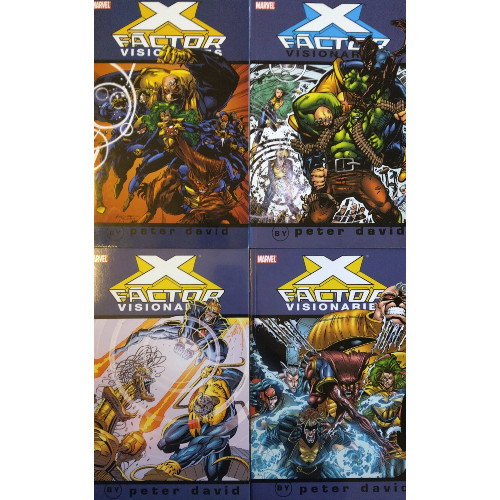
Nearly four years ago, I reviewed an Epic Collection gathering the first nine issues of X-Men spinoff title X-Factor, plus several other assorted issues laying the groundwork for this new mutant team. Composed of the five original X-Men members, X-Factor was a group of mutants posing as non-mutants tasked with hunting down other mutants, when their real aim was actually removing and protecting those mutants it seemed they were persecuting.
In my review, I gave the concept credit, but I found it difficult to swallow from a practical perspective. I also did not speak terribly highly of the whole "Let's bring Jean Grey back from the 'dead' and reframe the events of 'The Dark Phoenix Saga.'" Did not appreciate that at all. Subsequent issues and arcs have been collected sporadically in other Epics, which I have not yet picked up, so we're facing a bit of a gap between those inaugural issues, published in 1986, and the first run from Peter David, published between 1991-1993.
David, of course, was best known for his work on The Incredible Hulk, though my appreciation for his Spider-Man 2099 material is what invites us into this review today. I was curious, having read a few of his 2099 arcs relatively recently, whether the same tone, voice, and characterization which makes Miguel O'Hara such a fun protagonist permeated these issues as well. Though collected in other, larger editions, I found four Visionaries volumes at a fairly cheap price and decided to give them a read and make that determination.
I would have loved to write about a single volume collecting David's run, but like an errant thread of DNA providing a young teenager optic blasts or pyrokinesis, life provided other plans. I do believe it's easier to assess David's run in its totality, hence why I'm covering multiple volumes in a single post; it's not something I'm as fond of doing as reviewing a whole narrative in a single volume, and I've not done it often, but my hope was to cover David's total time on the book, and this is the best way to reach that goal, given the circumstances.
Speaking of circumstances, we find X-Factor in very odd ones as David's run opens: this is not the original team, to start. No, the OG five have been replaced by other heroes. They've also found themself on an interesting side of the law–not as criminals, but perhaps, as cooperative cronies. Strange place for a mutant to be.
X-Factor Visionaries by Peter David (vols. 1-4)
Writer: Peter David
Pencilers: Larry Stroman, Dale Keown, Tom Raney, Kevin West, Brandon Peterson, Derek Robertson, Joe Madureira, Jim Fern, Rurik Tyler, Mark Pacella, Jae Lee, Joe Quesada, Chris Batista, and Larry Shoemaker
Inkers: Al Milgrom, Mark Farmer, Andrew Pepoy, and Mark McKenna
Colorists: Glynis Oliver, Gina Going, Kelly Corvese, Kevin Tinsley, Brad Vancata, Glynis Oliver, Marie Javins, Ariane Lenshoek, and Joe Rosas
Letterers: Michael Heisler, Joe Rosen, Dave Sharpe, Richard Starkings, Steve Dutro, and Lois Buhalis
Issues Collected: X-Factor #71-89, X-Factor Annual #7-8, and Incredible Hulk #390-392
Volume Publication Dates: January 2005, February 2007, October 2007, June 2008
Issue Publication Dates: October 1991-March 1993, May 1993
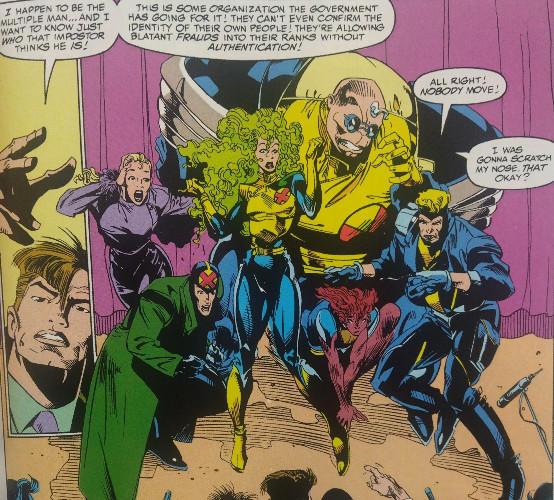
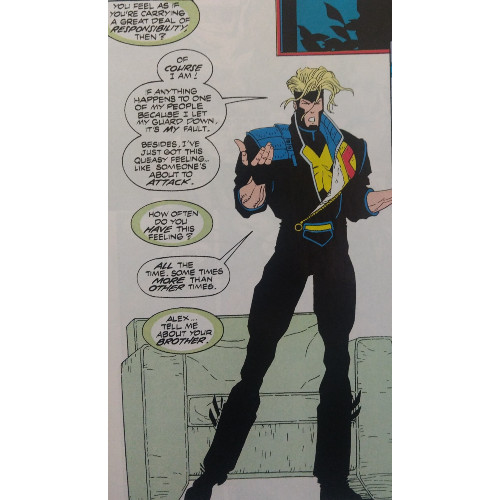
One of David's last issues on his run–number #87, specifically, illustrated by a young Joe Quesada–is essentially the thesis of his whole run writ large: these characters are damaged, they're sort of in denial about being damaged, and they may not be willing to work through the difficulties necessary to find healing. Reading this confirmed for me that some of my own notions of these mutants were on the right track, not to pat myself on the back, but to reinforce the idea that David could write strong characters (and quite literally–one dude here is codenamed Strong Guy), in both individual and team settings.
David comes in with a vision, with X-Factor having been shaken up after defeating enemy the Shadow King and the original members returning to the X-Men (which, I assume, was partially an editorial decision so Chris Claremont and Jim Lee could relaunch X-Men). We're given an oddball batch of players–Cyclops' brother Havok, his girlfriend Polaris, the feral Wolfsbane, the strong guy, uh, Strong Guy, and the duplicating Multiple Man. These are characters with pasts steeped in X-Men lore, such as Havok and Polaris' obvious romantic history and Wolfsbane's former association with the New Mutants (X-Force, at the time), an eclectic bunch brought under the aegis of government operation, serving with liaison Val Cooper as a deputized group of mutants. None of this rogue "operate out of a New York academy" or "have a secret base in the Outback" stuff.
Though, as readers would soon find, not everyone falls in line all the time.
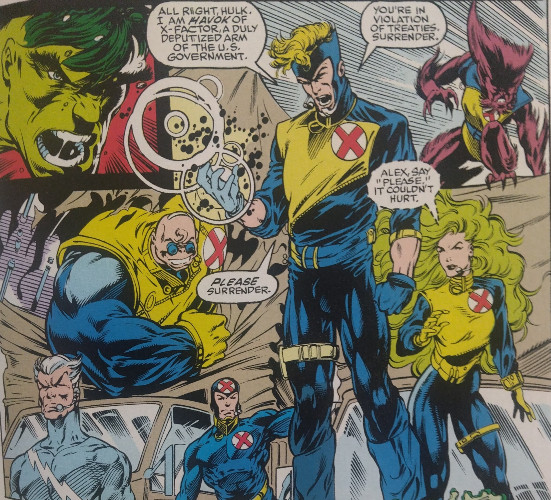
I have read, in other folk's opinions on this run, a comparison to John Ostrander's Suicide Squad, and though I've not reach much of it, I find the consideration somewhat apropos. Obviously, X-Factor wasn't out there murdering drug runners or destabilizing foreign countries (in fact, in a four-part crossover with David's Incredible Hulk, they're trying to stop the green guy and the Pantheon from destabilizing a foreign country), but they're now a mutant group operating under the auspicious of a federal institution…with all the yellow tape and paperwork which comes with such a distinctive honor.
What works well here is that David's group isn't just stuffed with brainless goons who jump whenever Cooper snaps her fingers; they're people first, and with the free will which comes with their humanity, they're able to play within the parameters. The concept is a twist on Xavier's dream, mutants helping mutants, without the cloak-and-dagger techniques used by the earliest X-Factor incarnation. These folks are provided legitimacy and a public platform, through news conferences and talk show appearances, allowing the world to see mutants differently. It means making some calculated choices and wrestling with the occasional gray area, but that just makes the reading all the more compelling.
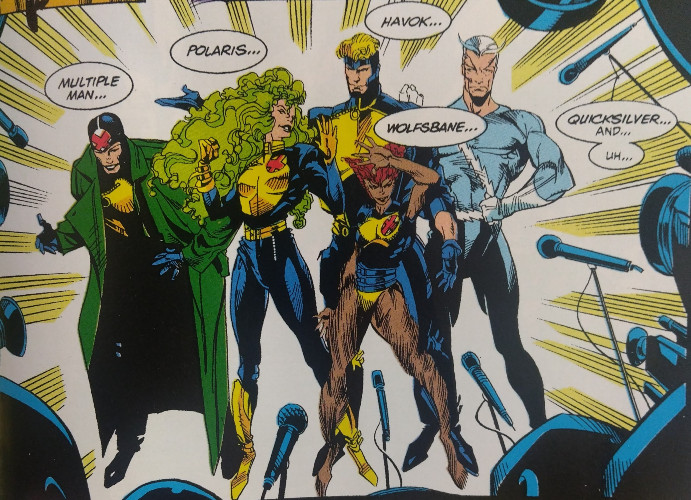
The run proves David, at this stage at least, could craft clever social commentary without becoming trite (a skill, I'd argue, his writing in later years showcased less and less). When X-Factor are tasked with defending the president of a foreign country against the Hulk and the Pantheon, with the implication that this leader may have committed atrocities against his people, David gives both sides of the argument equal weight. You want to support the Hulk for liberating people (if you trust their leader has committed those atrocities!), but maybe you don't agree that smashing through his defenses and physically forcing this guy to shape up (or outright killing him) is the proper method. Elsewhere, David draws Multiple Man and Quicksilver into a murder mystery, with the very real question of the seeming perpetrator's innocence genuinely explored. He doesn't allow an easy answer, asking the reader to trust him as he unravels each plot towards what tend to be exciting, generally satisfying, and occasionally surprising conclusions.
Mutants have always been outcasts, and X-Factor's efforts to show the world a different side of their humanity (including the interesting rebranding of their "kind" as "GeeCees," a contribution by Strong Guy) through legalized means is David's unique way of contributing to that ongoing conversation. Yet this is where tension is provided, as David is not willing to allow his characters to become mindless stooges, as I noted. When Val sends the team on a mission to protect a medical doctor responsible for a test capable of deducing the likelihood of unborn children, some members balk. Quicksilver outright refuses to attend the mission, while Wolfsbane argues against such a decision. The brief arc comes with some surprising choices at the end, ones which don't make you think of the characters any less but which provide understanding for people who feel this job occasionally places them in situations where they bear the weight of morality and must choose between right as defined organizationally or right as defined individually. These are no easy resolutions when maneuvering along (or outside) these hastily scribbled lines.
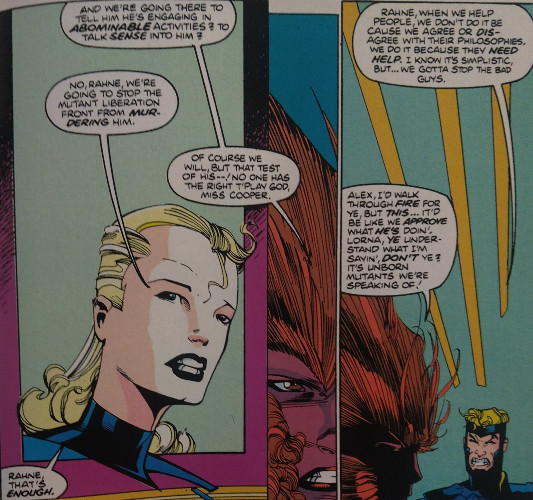
Let me reword that: the resolutions their handlers want are easy, but X-Factor is willing to take the route more difficultly traveled. They defend a boatload of mutant refugees seeking asylum in America, working to find a different solution than the official government line. When a mutant villain attacks a hospital, Havok, knowing he could either fight the guy or let him pass, instead saves the day by pulling out his checkbook. Even with the Hulk, a few folks operate outside the exact parameters of their mission, seeking a third option in a seemingly "either/or" situation. Take these fictional events and apply them however you want to real world circumstances, such as matters of race, immigration, justice, international politics, and you'll likely find X-Factor's solutions are outlandish, appropriate for comic book logic and little else. Regardless, for these stories, David often dreams up unexpected outcome, ones we could only hope existed to resolve real world struggles.
Engaging as these arcs are, they'd fall flat without the strong characters guiding them. I referenced X-Factor #87 as the distillation of David's thesis, highlighting the humanity and brokenness through which these characters operate. That issue genuinely sums up the struggles each character faces, from Strong Guy's humorous, macho charisma papering over his fears, to Alex's concerns with leading insufficiently compared his brother (that Scott Summers, I tell ya), to Quicksilver's arrogance being the result of a fast man living in a (comparatively) slow world. These factors (sorry) show up elsewhere throughout the run, though never stated as poignantly as in this issue.
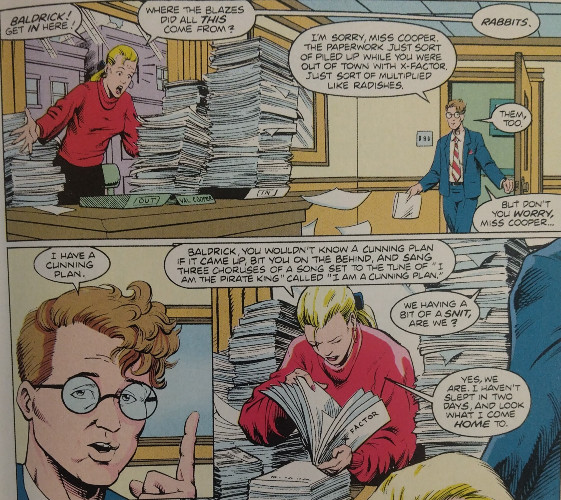
The action, rendered by several artists, at times melds together a little bit, but the skirmishes are really the wires stringing together impactful scenes of human feelings and human relationships. Wolfsbane struggles with her humanity, giving in to her more feral side at inappropriate moments and wrestling with this caged creature inside her. Quicksilver seeks reconciliation with his wife, Crystal, while Alex and Lorna explore where their current relationship is and if they can find the spark they used to have. Even Cooper, surrounded by paperwork and hot-headed mutants, is challenged, her leadership skills put to the test and possibly found wanting. Everyone receives their moments. The fights can be fun and create tension–a seeming defeat at the hands of Cypher, a character David introduced in an earlier Marvel Comics Presents narrative, creates decent stakes–but they feel more necessary than engaging.
I mentioned my curiosity above about whether David could maintain the quality found in Spider-Man 2099. He does, and a lot of that quality is found, unsurprisingly, in his humor. I've noted David's proclivity towards joking before, and he's no slouch here. I was concerned with whether his brand of hilarity would be appropriate, but I never found myself put off by his joking. Running gags include a mayo jar no one can open, the team's "Danger Room" built on a slashed government budget, and a series of related villains who each die before they can face X-Factor. This latter gag/subplot comes full circle as David ends his run, providing yet another thoroughly satisfying conclusion, stitching together seemingly random occurrences to become something well-plotted and worth the wait.
Less refined is David's contributions to the ongoing "X-Cutioner's Song" arc published across the X-books in late 1992/early 1993. Nothing changes about David's writing, but he contributes three chapters to a fourteen-part saga, which interrupt his plotting for a time. He's forced to wrangle other characters than his own, and though he provides some nice moments–a wordless series of panels focused on a seemingly hopeless Cyclops and Jean Grey is impactful–he just can't find the exact balance between his own ongoing plots and what the crossover demands of him.
This may be a gripe, but it isn't necessarily against David. He offers a run, though not free of interruption, which is balanced well between visual action, engaging messaging, strong characters (and not just in name!), and oodles of humor. If any fault can be found in David's own plotting it's that he seeds ideas late which would not see completion until his second X-Factor run…thirteen years later. But that kind of temporary derailment seems to have been somewhat standard for the guy, whether on his Hulk or Spider-Man 2099 runs. So not everything seeded breaks from the soil, but what does is allowed to grow and bloom, running wild like a young female werewolf or an arrogant, silver-haired mutant who finds life too slow otherwise.