(Strand)om Stories: X-Men: Fallen Angels Review
Strange storytelling decisions dampen an otherwise strong theme which could bolster this limited series' effectiveness
—by Nathan on September 7, 2026—
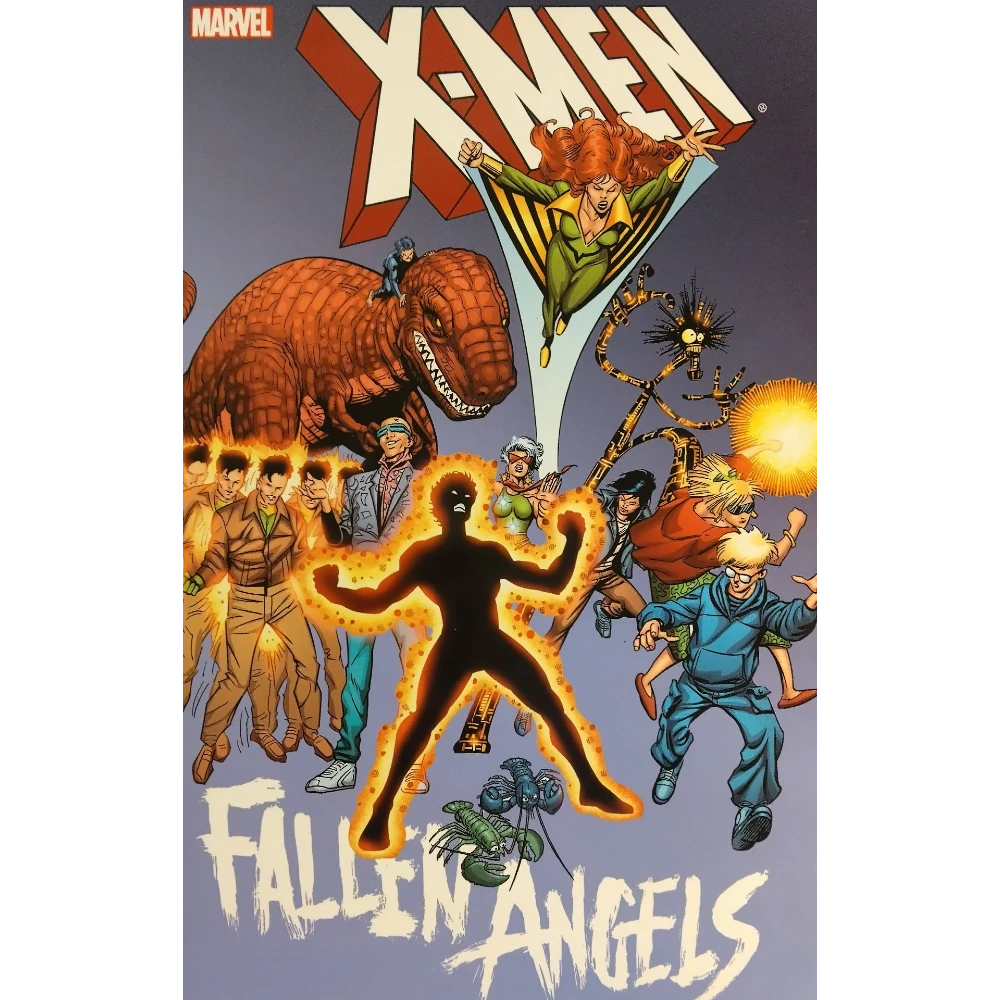
In the Christian tradition, a "fallen angel" is an angel which has been cast out of heaven, removed from the sight of God. One imagines John Milton's depiction of Lucifer, cast from a high realm eternal into fire and perdition.
No one undergoes that exact torment in this series.
The title "Fallen Angels" applies to a group you'll be meeting momentarily, a collective of mainly mutant riffraff introduced in this series by writer Jo Duffy. The name immediately brings to mind people who have been ostracized and outcast. Sounds just like those mutants, doesn't it? Though don't take the name literally–Warren Worthington III does not show up in this series.
While it bears "X-Men" in the title, Fallen Angels actually deals with individuals associated with mutantdom who weren't, at this point, members of that illustrious team. "New Mutants: Fallen Angels," you'll find, may have been the better title, as Marvel's then-adolescent adventurers appear early on, though even that is a bit of a stretch. Okay, you begin, racking your brain considering other 80s mutant heroes and groups, if neither X-Men nor the New Mutants are central to this series, then who is? X-Factor? Excalibur?
The answer, you will find, is a tad more complicated. We're not dealing with a straightforward X-Men comic today. Much in the way mutant DNA is human genetics mingled with something "x-tra," Duffy provides a series that's a little more twisty in its definition than one would expect, sort of like a double helix or those snakes on Hermes' caduceus.
X-Men: Fallen Angels
Writer: Jo Duffy
Pencilers: Kerry Gammill, Marie Severin, and Joe Staton
Inkers: Tom Palmer, Val Mayerik, and Tony DeZun
Colorist: Petra Scotese
Letterers: Jim Novak, Bill Oakley, and L.P. Gregory
Issues Collected: Fallen Angels #1-8
Volume Publication Date: November 2019
Issue Publication Dates: April 1987-November 1987
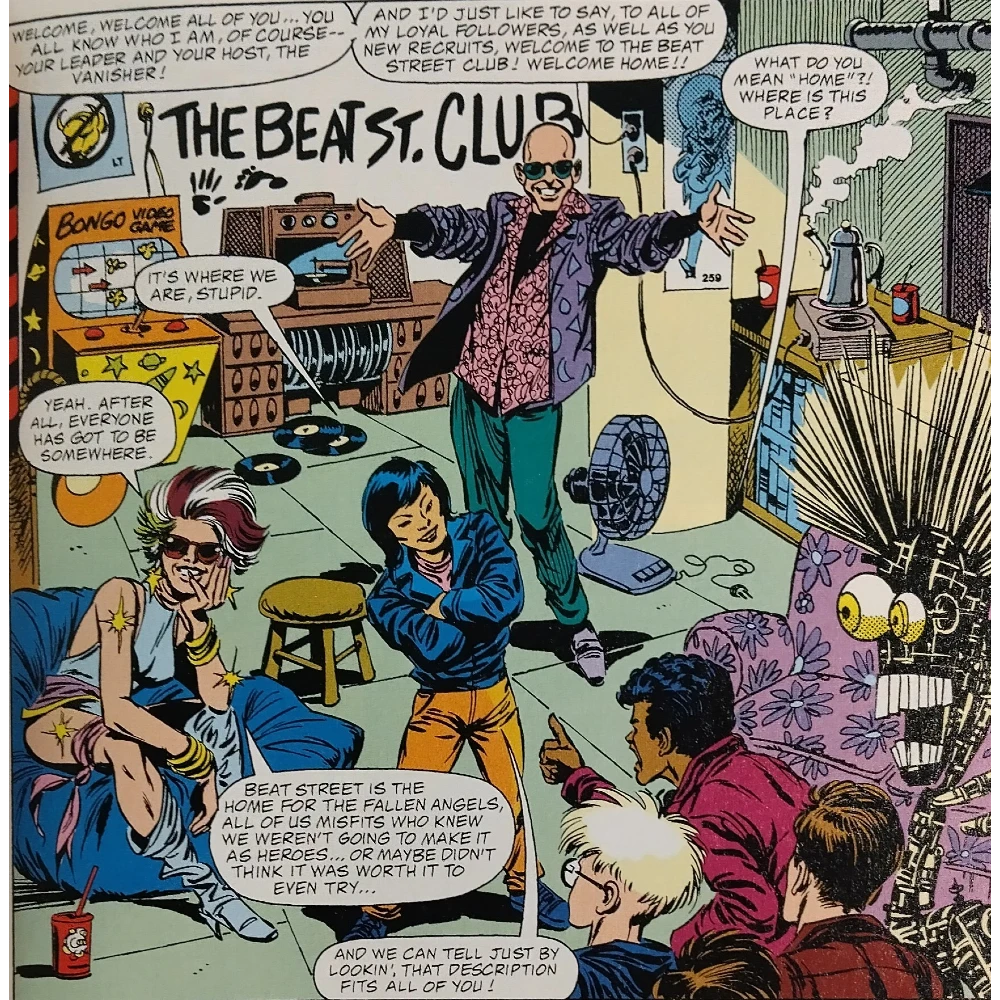
To Duffy's credit, Fallen Angels is unlike any other mutant-focused comic from the 80s you'll experience. For one, it doesn't read like a traditional comic. Oh, you're still navigating word balloons across panels, but the words themselves, the sentences, feel different. Not in a bad way, necessarily. There's more care put into their composition, more of an effort to steer away from the somewhat slapdash effect comics can have, where action is prioritized over genuine human speech. Duffy's characters feel a tad more real in that regard, though to lob in a critique, I'll note main star Sunspot does not speak in any way an actual fourteen-year-old boy would talk. When's the last time you heard a fourteen-year old say "If I let you help your comrade, another death is sure to result?" Never? Same here.
Storywise, you're pledging yourself to something unique should you plop yourself down and give this a read. While not earthshatteringly different from typical Marvel productions of the era the same way I'd argue books like Squadron Supreme and Strikeforce: Morituri were, Fallen Angels isn't interested in your dyed-in-the-wool superhero story. There aren't any villains, at least not the traditional kind. There aren't even really any heroes, at least not ones who go out and save people and right injustices. Duffy is more interested in her characters, assembling a core cast of previously established and new characters to unravel a tale of belonging and identity.
The results are more mixed than I would care to admit.
I mentioned in the introduction how this series (despite the trade's title) isn't really an X-Men, New Mutants, or X-Factor story. Readers are given characters from all corners, from the New Mutants' Roberto da Costa and Warlock, to Boom-Boom (who had been with X-Factor at the time), to pre-X-Factor Multiple Man and Banshee's daughter Siryn (who were hanging out at Muir Island). I had assumed, coming into this series, that it was a New Mutants arc, specifically because it was also published in their second omnibus. But though Roberto takes center stage, and though the New Mutants appear in the first issue, this series is not beholden to one group. Fallen Angels, at its core, is a broader mutant story.
The meaning of identity is woven through the entire narrative, with Duffy firing off a fairly strong start. Roberto, having accidentally injured New Mutants teammate Cannonball with a anger-fueled showing of strength, leaves the team, his concerns about his own self compounded by a "report card" noting his parental lineage. His father's a bad dude, see, and with his own temperamental issues, Roberto worries he himself is headed for supervillainy. Driven by fear, he abandons his friends for New York, where he is joined by Warlock and meets the Fallen Angels. Led by former X-Men enemy Vanisher, doing his best "Fagin from Oliver Twist" impression, the team is a motley crew learning to survive together.
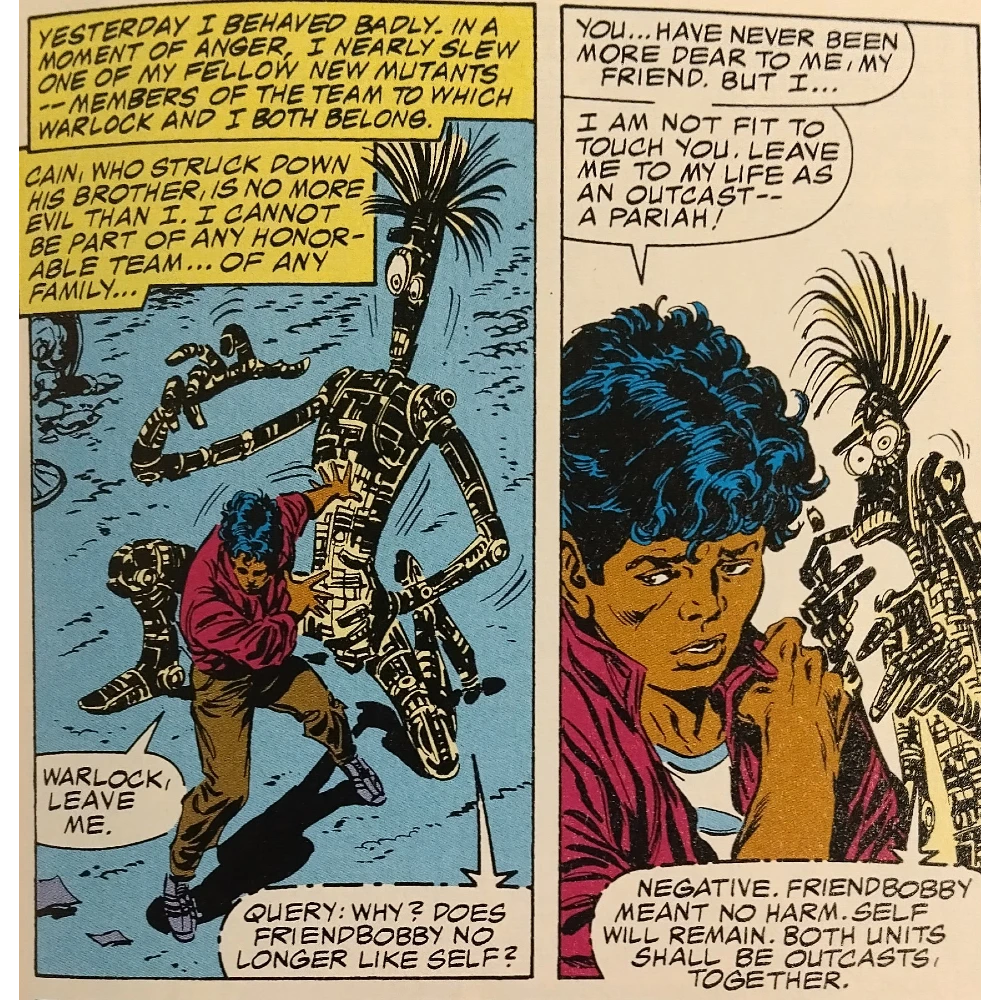
Thus established, Duffy plunges into deeper thematic waters. The whole narrative reflects on just who these characters are, what makes them who they are, and their efforts to either become reconciled with themselves or avoid some disquieting revelations. Roberto must sift through his actions as Sunspot and determine whether he really is fated to continue harming those around them. New characters Chance and Ariel deny that they're mutants at all…but is that really the case? Jamie Madrox, the Multiple Man, experiences a schism between himself and one of his duplicates, who begins asserting his own agency.
Without much tethering this series to actual heroics, Duffy can work to examine how identity plays into these characters' mindsets and abilities without the trappings of capes and cowls. How would a guy like Jamie Madrox react if one of his duplicates, who have always just been extensions of himself, began acting of his own accord? What happens when Chance and Ariel are confronted with situations that test the credibility of their beliefs? And what to do with Gomi, a boy given abilities by his cousin in a botched operation–what's he to make of his own abilities? All our characters, to an extent, are lost, looking for themselves.
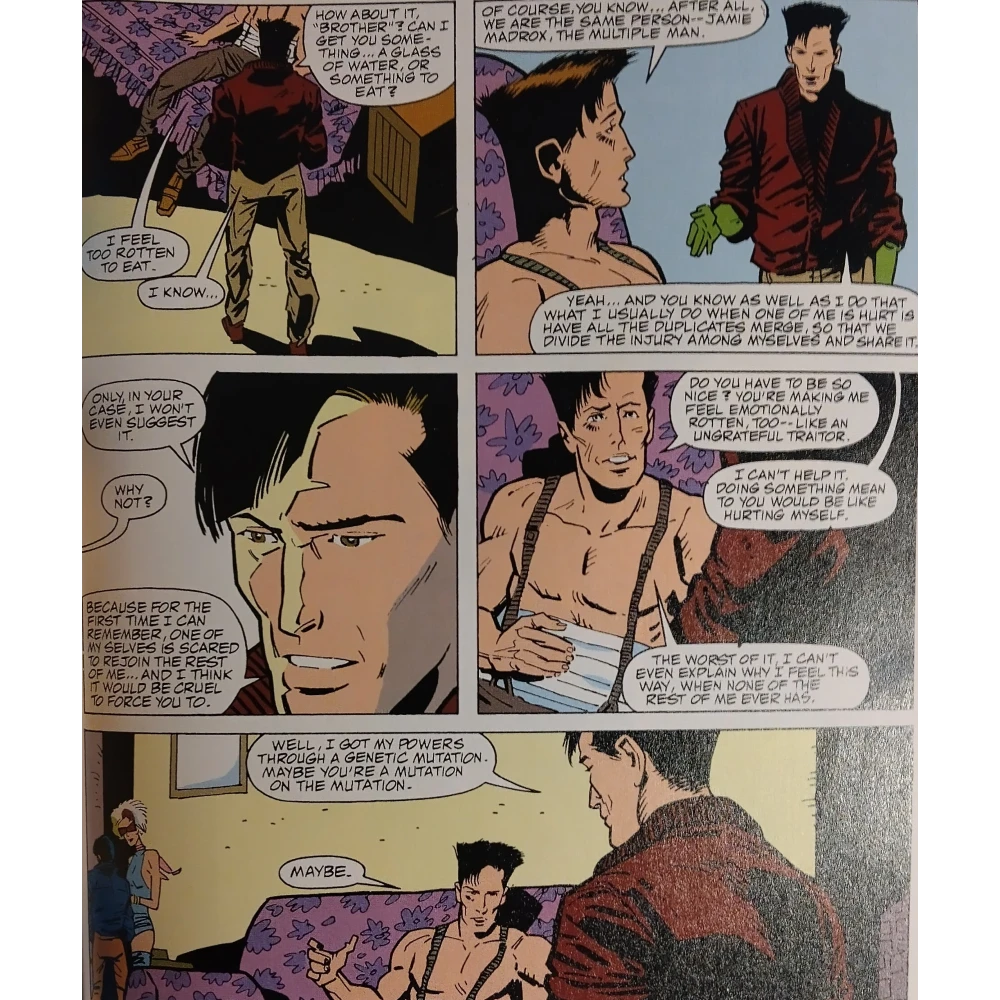
Were this a straightforward narrative concerned with that theme, I feel Duffy could have made Fallen Angels more special than it is. But I've got those "more mixed" caveats I referenced above. "Straightforward" the series may begin, but by time it ends, we get all manner of odd creative decisions that derail the stronger elements Duffy is seeding. She, understandably so, gets hooked on the "Fallen Angels" concept, Vanisher's group coming across as this welcoming place for misfits ("The Misfits," as I understand it, was actually the series' original title–maybe too on the nose?) who don't feel attached anywhere else. To an extent, her roster works–Roberto suffering from his guilt, Jamie's duplicate feeling detached from the original, Ariel and Chance denying what seem to be mutant abilities, even spritely Boom-Boom not fitting in with X-Factor. There are ways in which these youngsters aren't quite fashioned to the proper mold of other mutant groups, which is a funny idea. How worse off can you be when you feel like an outcast among the outcasts?
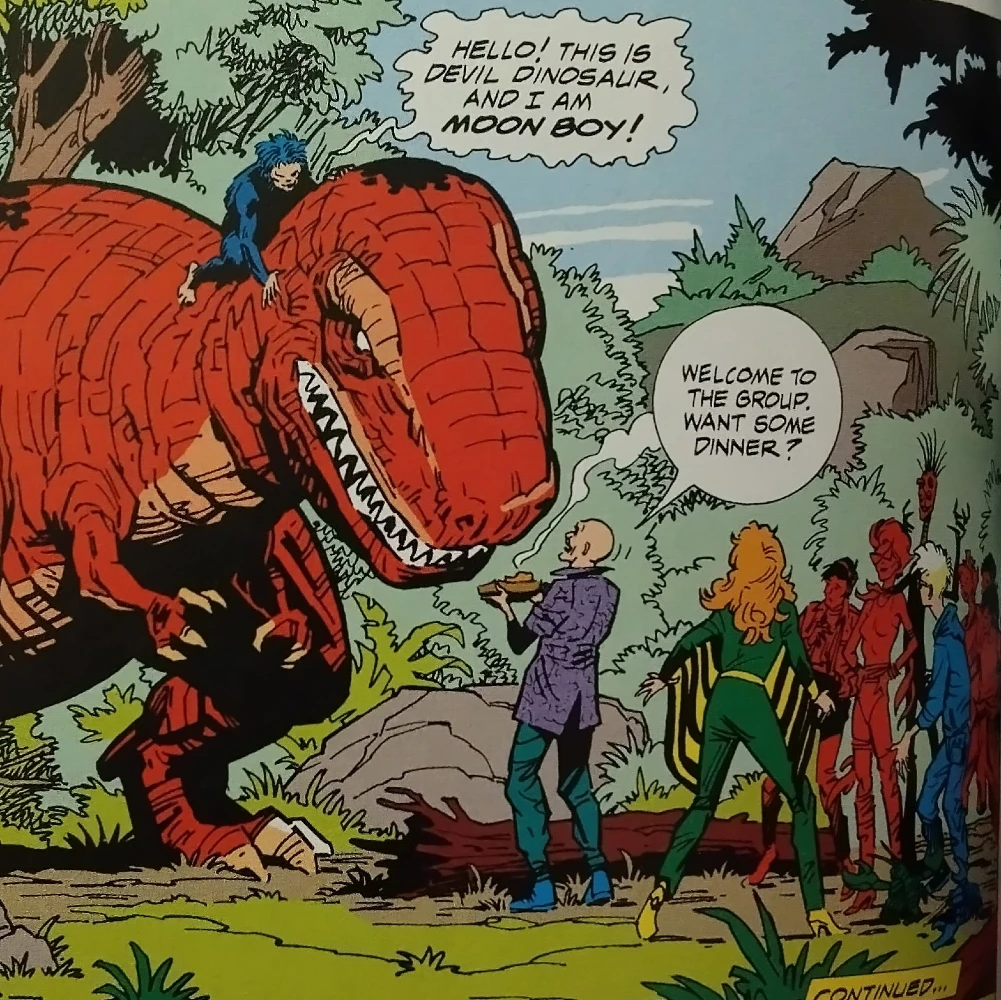
Yet Duffy's definition of "misfits" encompasses folks beyond mutants, and she begins to experiment with the term "mutant" to draw in characters normally not associated with this side of the Marvel Universe. Our Fallen Angels travel to Earth-78411 to recruit two mutants Ariel identifies, who just so happen to be Jack Kirby's Devil Dinosaur and Moon Boy. Welcome as it is to see two of Kirby's lesser received creations ushered properly into the mainstream Marvel Universe, their inclusion is strange and feels forced. The same can be said for Don and Bill, two sentient lobsters who follow Gomi around, defined as "mutants" due to their atypical shell colors for crustaceans. Duffy tries to weave in characterization for these oddballs as well–Moon Boy has a heckuva time communicating with anyone because no one speaks his language, and the lobsters express certain human emotions (one even plots revenge against Devil after an alarming incident)–but they still feel out of place. Young adults brought together because of their unique circumstances and abilities is one thing; trying to argue a dinosaur must be a mutant because he's red (which, Kirby established, was not a condition of Devil's birth) or a lobster because he's green is a whole other kettle of crustaceans.
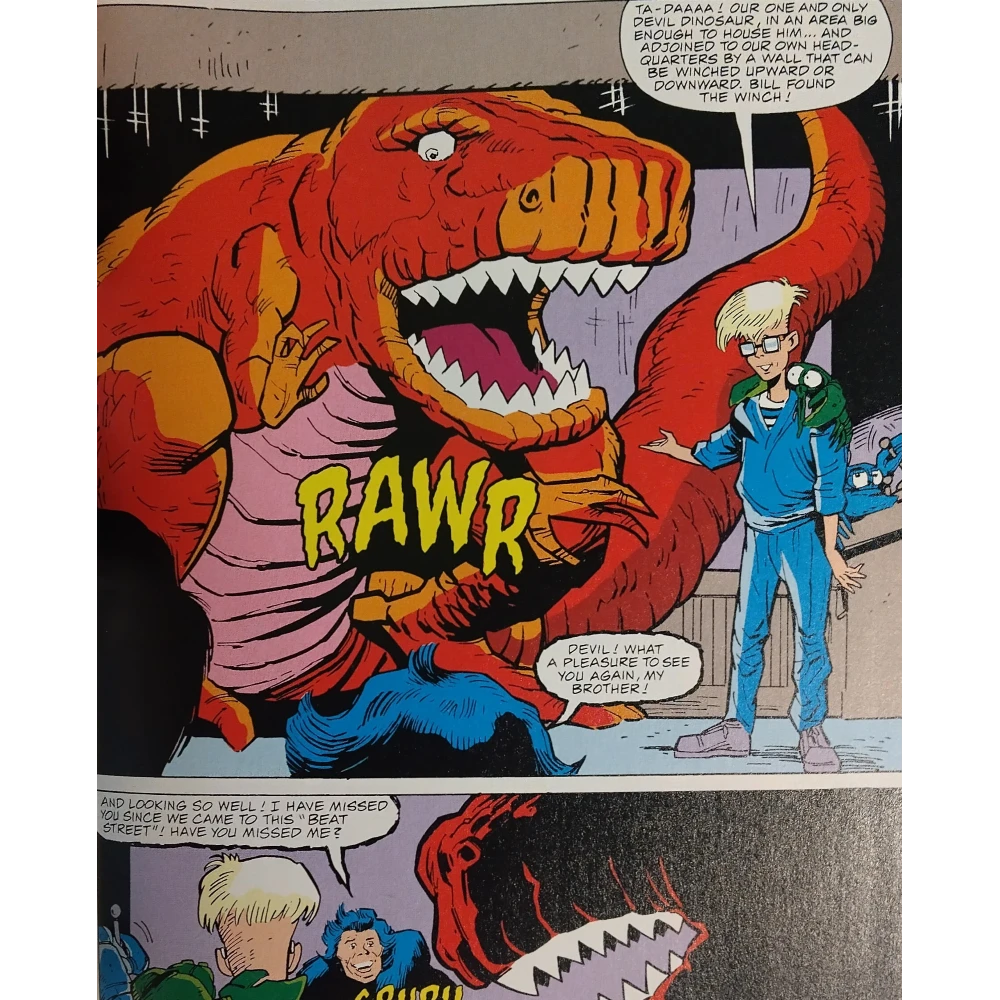
I am, generally, all for quirky comics. I've commented elsewhere on stories that mash together seemingly disparate ideas and somehow make those concepts work in collaboration. But those are narratives which weave concepts in for the service of the story instead of forcing the story into a box the writer has shaped. The use of sentient dinosaurs and lobsters feels like the latter, Duffy grasping at interesting ideas and trying to wedge them into the story without creating a narrative that can more easily encompass those concepts and characters.
The 80s were absolutely a time for comic companies to break free from the confines of traditional publishing methods and traditional storytelling conceits. You get the birth of the limited series, an emphasis on more adult themes, independent creators and companies exploding onto the scene. Plenty of superheroes, yes, but an emphasis on other kinds of characters or deconstructions of classic characters. Duffy attempts to join the throng of wildly inventive storytellers with this series, and though certain elements work, others feel unfocused. There's a core story here which doesn't feel traditional, yet it veers too sharply into experimental to congeal. Removing Sunspot from the New Mutants and pairing him with a group of misfits who aren't so concerned with fighting costumed villains as they are exploring their internal realities is a strong idea; throwing in Clifford the Big Red Dino and the escapees from Red Lobster, however, toys with the tone and tries to broadly apply a theme which should have been restricted to fewer cast members.