Random Reviews: 1000 Years of War
Despite some occasionally awkward artistry, this series' first arc provides a promising opener, blending history and faith with a post-apocalyptic setting
—by Nathan on January 19, 2026—
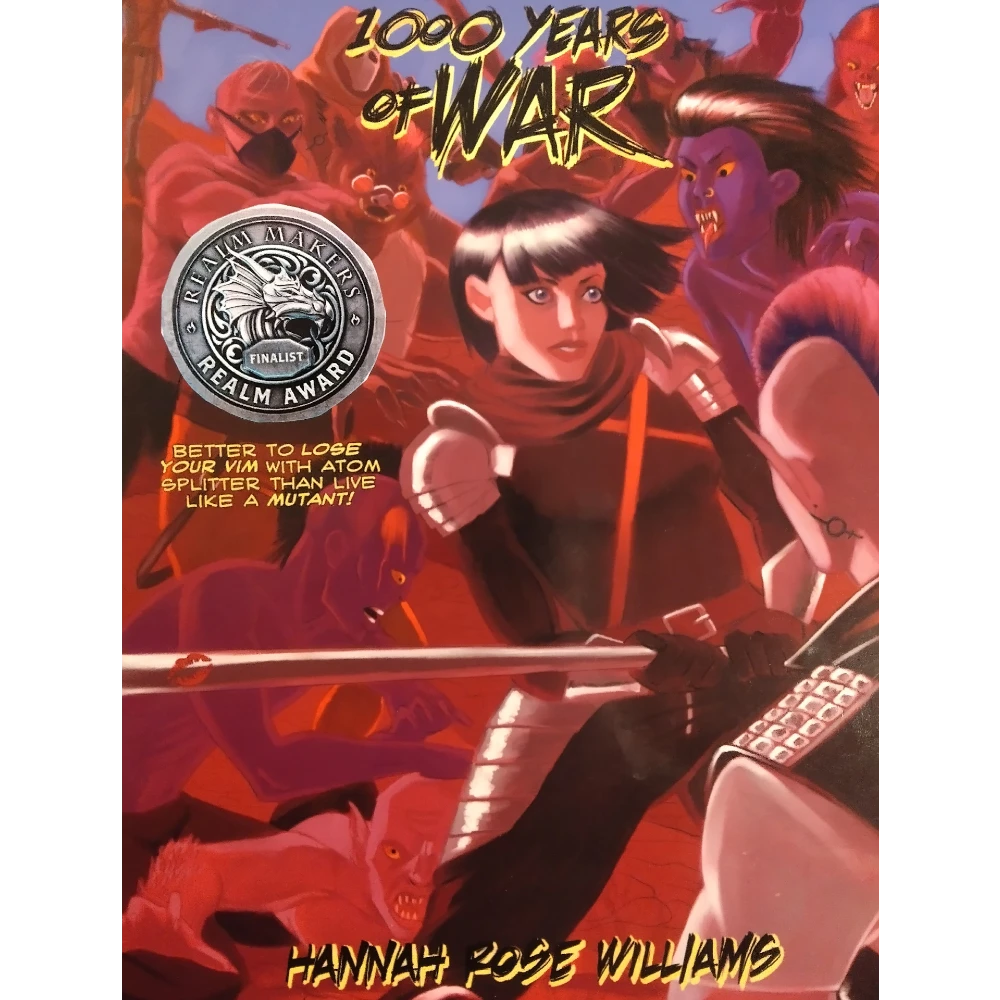
Today's review represents a first for this blog–I am dipping my toes into the world of webcomics.
I tend to have a very strict policy when it comes to reading comics: gimme a physical copy. I heavily lean on full volumes rather than issues, though I've read and reviewed my fair share of "floppies." As series such as "Crawling Back" or "Incredible Issues" will attest, I do read the occasional Marvel comic in a PDF format, but most of my digital reading is through hoopla and that's generally if I want to read a narrative I don't intend on owning or would like to read but rather not review.
I've tried reading a webcomic or two in my time, though I've found I struggle with the format, the effort of clicking through pages not as relaxing for me as flipping. But when a friend recently gifted me a collected edition of the first arc in Hannah Rose Williams' 1000 Years of War, a narrative he'd discussed with me before, I really had no excuse but to dive in across a few reading sessions.
(it seems only fair I gifted him a copy of Watchmen in return, as now it can sit on his shelf and call his name until he ultimately caves in to that well-written specimen of the genre, though in his defense, he did get 1000 Years of War signed, and I did not grace his copy with Alan Moore or Dave Gibbon's John Hancock)
The series' ComicFury profile describes 1000 Years of War as "Joan of Arc in the style of Mad Max," which is pretty close to how my friend detailed it to me. His description captivated my imagination for a story which took the centuries-old narrative of a French patron saint inspired by holy visions to wage war against the English during the Hundred Years' War and catapulted it into a grim steampunk future. I tend to appreciate stories which combine a familiar premise with a fantastical or outlandish scenario, so this seemed a good fit for my wheelhouse.
1000 Years of War
Writer: Hannah Rose Williams
Penciler: Hannah Rose Williams
Inker: Hannah Rose Williams
Colorist: Hannah Rose Williams
Letterer: Hannah Rose Williams
Issues: 1000 Years of War #1-6
Volume Publication Date: December 2024
Issue Publication Dates: May 2024-October 2024 (on Substack)
I don't think I have yet to explore a comic through this blog with distinctly Christian themes, or even a largely explicitly religious tone…or, perhaps, I should say I've not explored a comic that is generally supportive of religion. Comics I've reviewed certainly tackle philosophical or moral messages, laying out a particular author's perspective of the world. J.M. DeMatteis and Jon Muth's Moonshadow, for example, presents the titular main character's father as a godlike entity, casting him in an aloof and distant light; similarly, another narrative of DeMatteis', composed of Marvel-published issues starring Jewish-American author (and vampire!) Arthur Greenberg, were critical at times of certain aspects of the Jewish faith. For Geeks Under Grace, I tend to use a religious lens to draw out themes which I feel hint or convey the author's worldview–such as Neil Gaiman's thoughts on humanity's relationship with cosmic creators in his and John Romita Jr.'s The Eternals–but those are largely my interpretations written in a way to help align the review with the website's specifically Christian background.
Reading 1000 Years of War reminded me of a sermon I heard several years ago where the pastor speaking noted that Jesus Christ was a true feminist, citing his interaction with the Samaritan woman at the well as evidence. You're welcome to consider this interpretation as you wish, but the pastor's point was that Jesus cared for this woman as she was, noting her imperfection (multiple husbands and living with a man who was not her husband) while not condemning her for her actions and providing her with the chance at a new life, independent of her previous choices. I feel like Jo, Williams' futuristic Joan of Arc stand-in, represents a similar philosophy.
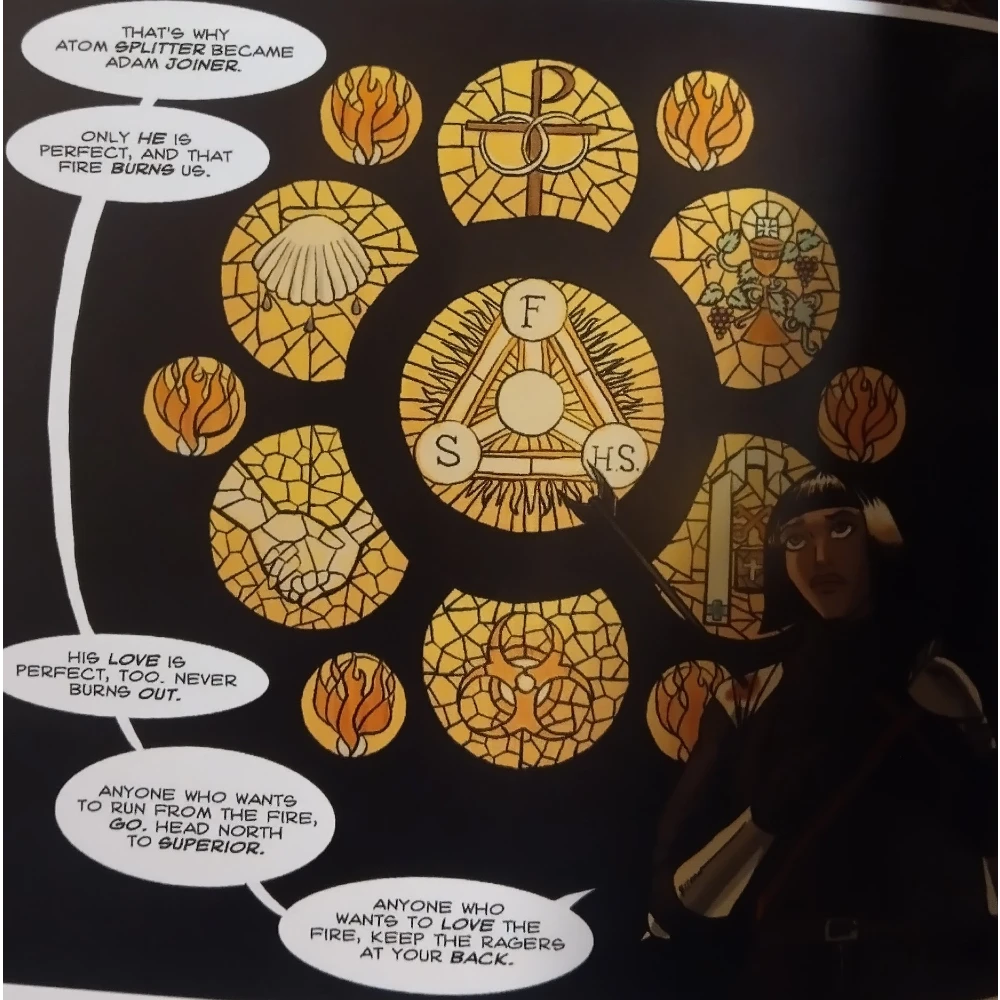
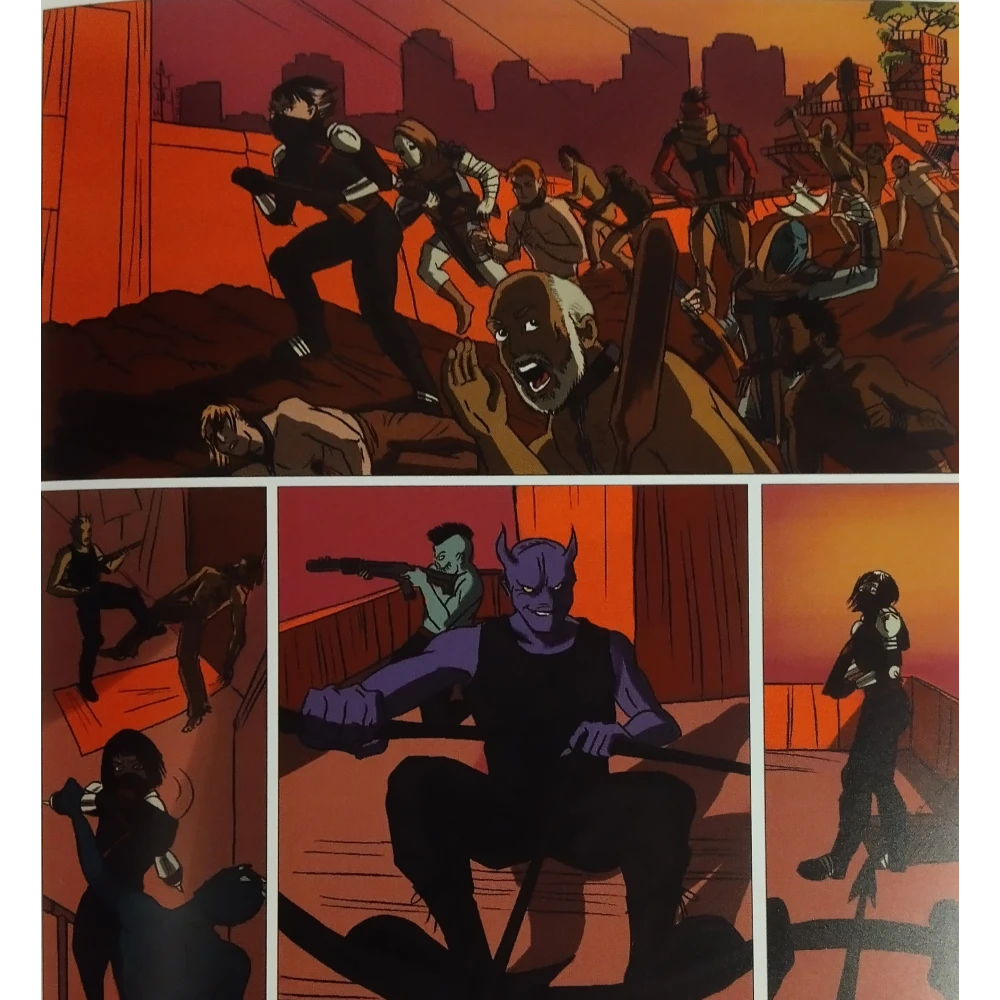
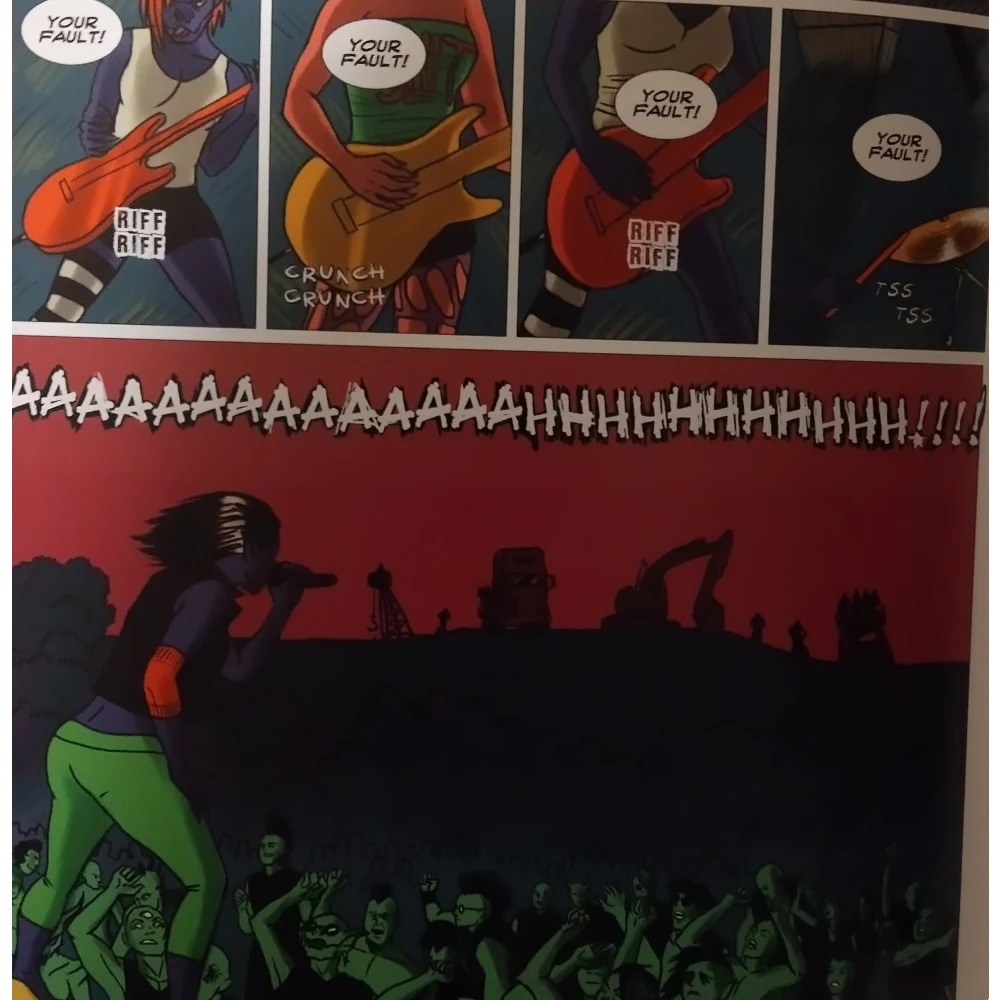
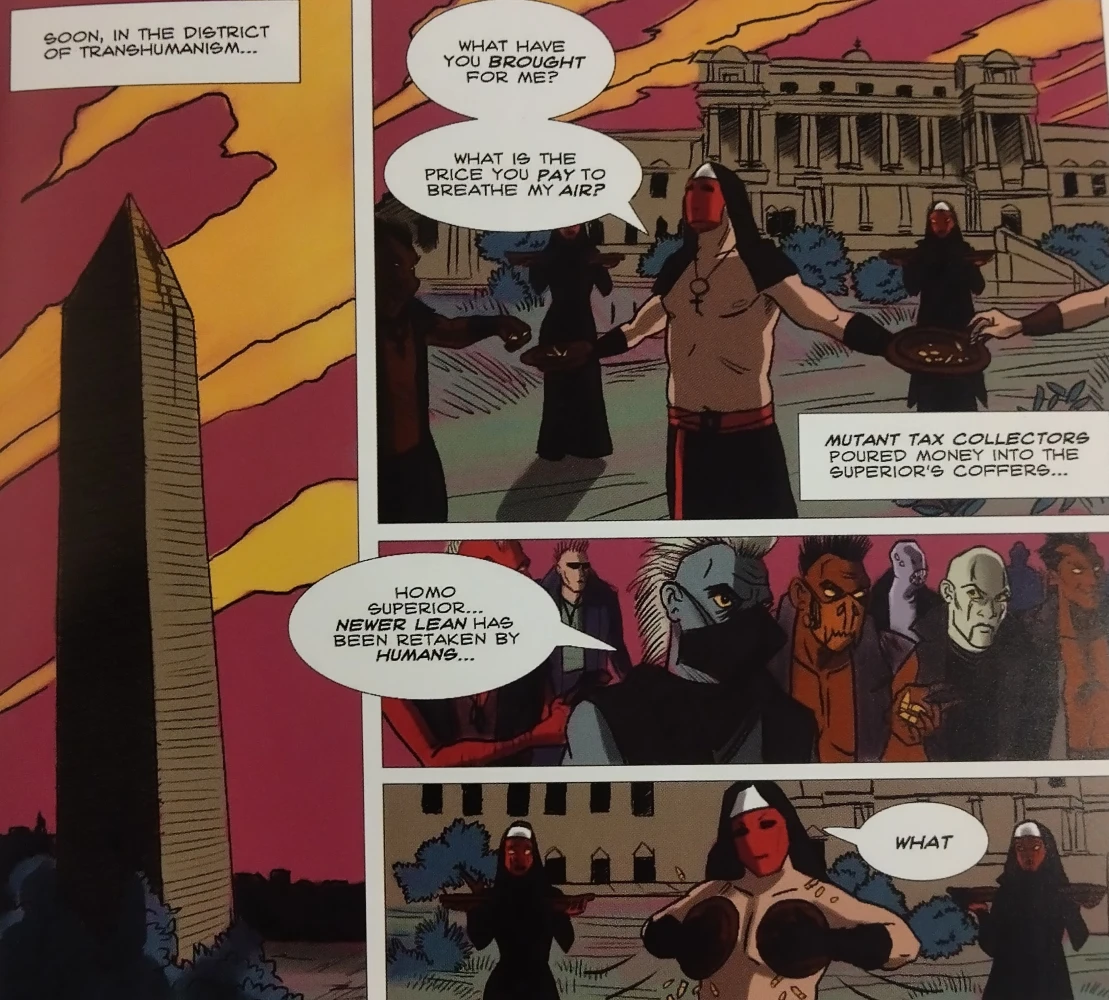
Waging a war against mutants (no, not those trademarked Marvel "mutants") at the behest of the Hammer King and driven by visions from Atom Splitter (this future's version of God), Jo the "Veek" battles hedonists and enslavers who have oppressed humanity, women in particular, imposing their own beliefs upon a dystopian America. Jo is a warrior, ignoring her father's wishes for her to marry and raise a family. She has a greater calling than what he would wish. To that end, she leads an army against mutant forces, securing fallen American cities from mutant pimps, soldiers, and in the volume's best scene, an all-female metal band.
I wasn't 100% (or maybe 1000%?) certain the exact direction this story would take concerning its perspective on the world. I tend to, by nature, lean more conservatively when it comes to certain viewpoints–I wouldn't call myself extreme or say I would go too far in a particular direction, but I'm also very comfortable with how I feel about certain philosophies and tend to rather remain comfortable than be challenged. I've also encountered plenty of stories from folks on different sides of political, religious, or philosophical aisles that want to just scream and be heard by being as loud and rude as they can. I wondered if 1000 Years of War would sound the same…
To my delight, it does not.
Williams' storytelling serves her thematic principles and her worldbuilding jointly, the story and its vision of a future, broken America allowing those themes to flourish. Dystopian futures are often intended to be fairly extreme, hypothetical versions of our own reality (note that I said "hypothetical"!), mirrors into possible visions of the world should certain drastic events occur. Do I believe, as in Williams' tortured landscape, a rampaging virus will split humanity into two factions, normal folk and mutants, and that mutants will determine procreation as awful? Of course not (note that I said "hypothetical"!). But I can read into Williams' world where certain voices are repressed, especially those who are different, where extreme views on men and women have taken hold, where violence against the unknown is encouraged by some, and see the grim mirroring. The comparison to our own conflicts on gender politics is fairly straightforward, but it's woven with enough grace and poise so that any frustrated reader will have only succeeded in causing their own consternation.
The worldbuilding, I would like to note less seriously, also allows Williams to have fun with the narrative. Dystopian futures work well when they can take what's familiar and twist it in inventive ways, particularly when the audience is allowed to identify what's been changed on their own. Jo leads a group of warriors to expel mutants from the city of "Newer Lean"; mutant arch-villain Superior (who, from what I've read, is a play on words, as the character is dressed in part of a nun habit and is a reference to "homo superior," which in this case, is a reference to those trademarked mutants) takes up residence in Washington DC, which is never named as such but shown through famous icons such as the Washington Monument and Library of Congress; even the aforementioned metal band enters the story as a seeming procession of muses or oracles, shedding dark robes to reveal instruments of total awesomeness rather than divine intervention. Additionally, Williams sprinkles her own creativity through the time-tested tradition of "fantasy world with new terminology," introducing words such as "Veek," "vim," "proster," and "Narky" to the lexicon, explaining a few but also giving readers the power of interpretation so they can understand how language has been modified in this world.
As the story unfolds, the lines between our heroes and villains are drawn fairly plainly, but where Williams finds complexity is in the slivers of gray woven throughout. Jo is approached early on by a band of so-called "zombies," attacking before being corrected on her stance–these are not zombies, but lepers. Jo's view is softened, and she provides these people–for that's what they are, above any other condition, blessed with inherent worth–with friendship and brief affection, empathy they would otherwise not receive. The mutant metal band, extremely spiteful of all men, are given a touch of empathy, particularly when one is ruthlessly killed by one of the "good guys." I believe we're meant to understand that the band has been either indoctrinated with anti-male propaganda or have actual grievances against men which they've turned into a form of extreme, obvious art. They're feminists, based on a certain definition, different from how I assume Williams would define it (though I'd be happy to be corrected), and yet they have a genuine basis upon which to build.
These core concepts are strongly tethered together, creating an intriguing narrative. We are allowed a certain amount of empathy for those whom our heroes are aligned against, and we're also allowed a bit of spite towards those with whom we're meant to be aligned. Even Jo, at moments, expresses a certain naivety, an inspiration taken from her historical counterpart, Joan of Arc herself an illiterate farmer's daughter; Jo is not, at first glance, the natural type of warrior you'd consider following, and like any good central character, not the ideal person to be a hero. Williams renders Jo's speech as "imperfect," based on how we may define "perfectly" spoken English, and she lets Jo make mistakes and face difficult decisions. Yet it's the young woman's faith in her mission, Atom Splitter, and the people she defends, as well as the significant amount of empathy she offers to those around her, which allows us to overlook such surface "imperfections" and mark her the proper hero for the time in which she acts.
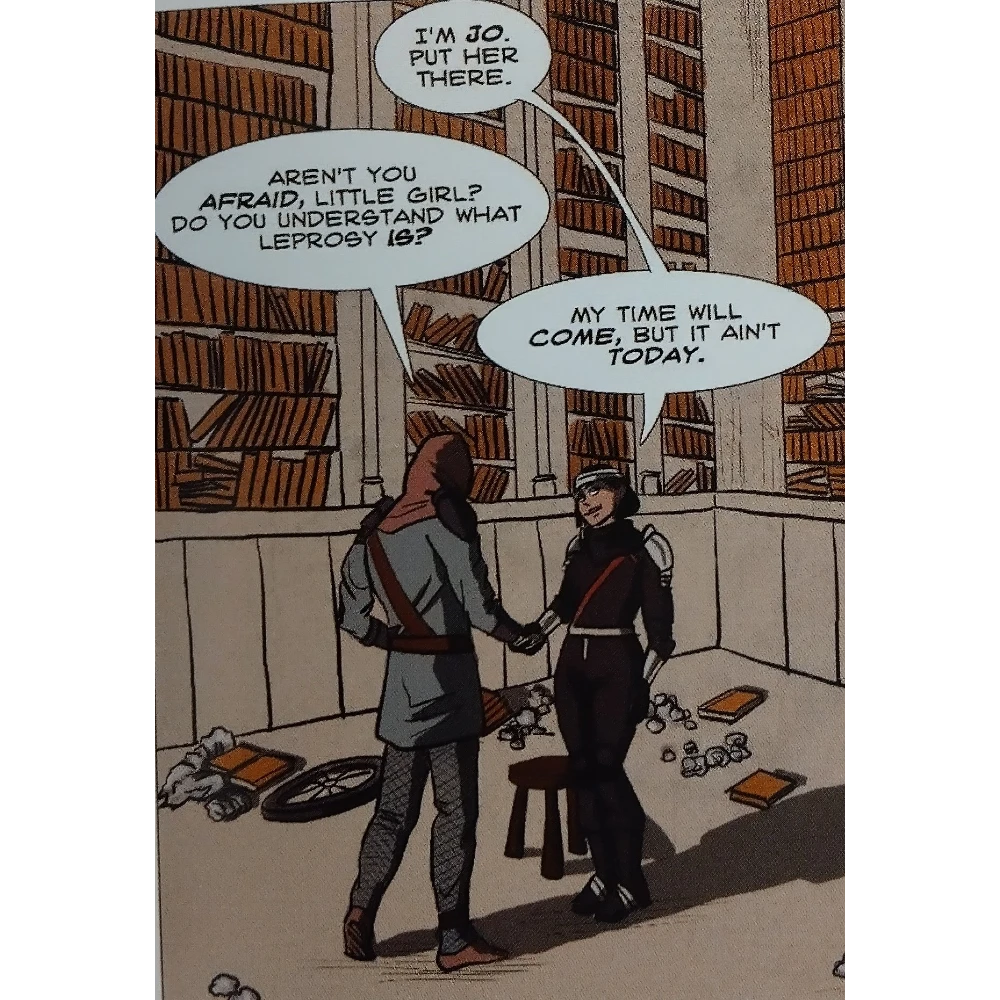
I may seem like a jerk dismissing some of the character's imperfections before moving into this paragraph with a complaint, but stay with me. I'll note I'm not familiar with anything else Williams' may have written or illustrated, and though she evidences an artistic style, the visuals do feel like an area requiring continued development. Perhaps I'm spoiled by the "industry standard" of comic art from Big Two superhero books and therefore should be less pressed to comment on an artist who hasn't had the opportunity to craft her skill in the same arena as industry professionals (though some of them are far from perfect themselves), but I found I did struggle to enjoy the art at times. There are moments where the storytelling isn't quite clear and a couple awkward renderings. Still, the pacing is maintained fairly well, characters convey appropriate emotions, and the story is largely consistent and easy to follow.
I appreciated the opportunity given to me to read this first series in 1000 Years of War. The central concept of taking a fairly well-known religious figure and transporting them into a setting far different than their historical context makes for a unique idea, and I'm interested in seeing where Williams takes additional series. As far as I can tell, she's recently finished her second foray into this shattered world…I'll have to keep an eye out on Kickstarter to see when I can pick up the next volume, take a pause out of ever-busy "vim" and enjoy the further adventures of those devoted to Atom Splitter.