Random Reviews: Moonshadow
This series prioritizes the journey over the destination, and though it can feel glutted, it's also a rewarding read
—by Nathan on November 29, 2025—
At the core of some children's and adult fiction, there can lie a singular theme: growing up. For the child, it's the story of a young person losing their innocent, naive view of the world and understanding a truer, usually darker depiction of reality. The rose-colored lenses are removed, sometimes intensely shattered, leaving a (hopefully) more mature youth with corrected vision. You hope that, somewhere, not all the fancies of childhood have been obliterated, but you wouldn't appreciate the story as much if the protagonist didn't grow as a result. If the Pevensie children returned from Narnia and resumed their school life without so much as another thought about fauns, White Queens, stone tables, or triumphant lions, C.S. Lewis' epic series wouldn't have much impact.
Likewise, adults in narratives geared to older audiences find they must grow as well. Sometimes, it means a not-so-gentle reminder of the beliefs or joys they lost as they aged–take Stephen Spielberg's Hook as an example–or it's sometimes the weight of reality politely reinforced. Like children, the adult cannot leave their formative years completely behind, gazing into the future as a cold, eternal chasm of crippling fear, but they cannot fully revert to infancy. It's because Samwise Gamgee travels to Mordo, faces Shelob, and carries Frodo up the side of a volcano that he secures the courage necessary to talk to Rosie Cotton; he came home to the Shire, he returned home, but he returned changed, for the better.
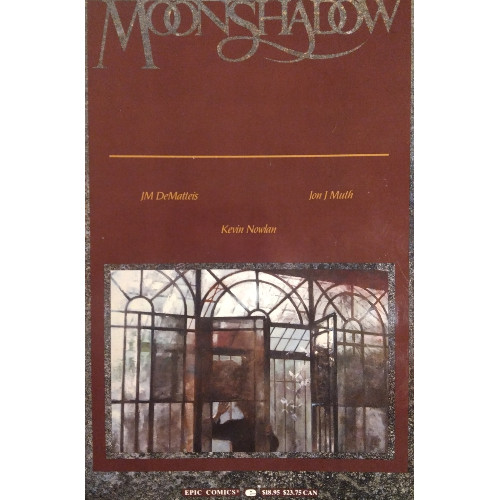
That long-winded speech brings us to the subject of today's blog: Moonshadow, a twelve-part series by J.M. DeMatteis, John J. Muth, and others, published with Marvel's Epic imprint in the late 80s, Epic, as I've noted elsewhere, specialized in creator-owned content geared towards somewhat more mature audiences than the little buggers who ripped Spider-Man and Fantastic Four off the spinner racks (though mainstream superhero comics definitely saw a maturation at this time as well). Indeed, issues of Moonshadow bore a "fairy tale for grown-ups" label, noting its content concerns, but also pointing to DeMatteis, Muth, and Nowlan's purpose: to create a fairy tale, something which stabs at the heart of "growing up," which could be recognized by older readers through the eyes of a younger man.
Moonshadow
Writer: J.M. DeMatteis
Pencilers: Jon. J. Muth, Kent Williams, Sherilyn Van Valkenburgh, and George Pratt
Inkers: Jon J. Muth, Kent Williams, Sherilyn Van Valkenburgh, and George Pratt
Colorists: Jon J. Muth, Kent Williams, Sherilyn Van Valkenburgh, and George Pratt
Letterers: Kevin Nowlan and Gaspar Saladino
Issues: Moonshadow #1-12
Volume Publication Date: March 1989
Issue Publication Dates: March 1985, May 1985, July 1985, September 1985, November 1985, January 1986, April 1986, June 1986, August 1986, October 1986, January 1987, February 1987
Publisher: Epic Comics (Marvel Comics imprint, original issues and collected edition)
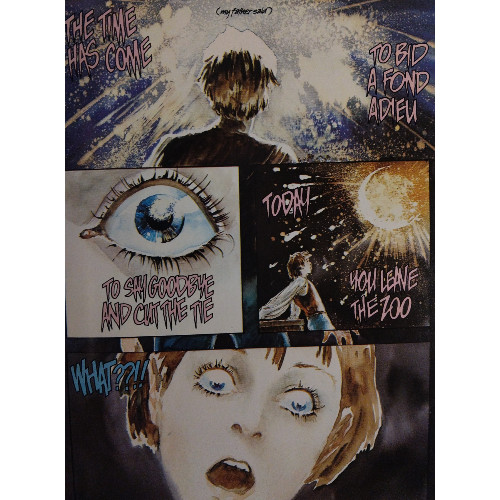
Moonshadow feels like the kind of story another protagonist of DeMatteis', Jewish vampire author Arthur Greenberg, would create. Not necessarily because its central character, the titular Moonshadow, is the son of a Jewish woman (though he is), and certainly not because it features vampires (because it doesn't), but because it's a far-fetched, fantastical odyssey that Arthur would probably rip to shreds before finishing. It feels like the outlandish bit of prose Arthur would dream up, which makes perfect sense, because the guy who created Moonshadow also created Arthur. From the same imagination spring two completely different stories that incorporate elements of religion, growth, love, and the absurd.
Moonshadow is far different from DeMatteis' "Arhur Greenberg" adventures, least of all because it's significantly longer. A twelve-issue maxi-series, eclipsing in length contemporaries such as Marvel Super Hero Secret Wars and Camelot 3000, Moonshadow is a novel in all but name. A "graphic" novel, to be sure, though the significance of DeMatteis' prose–elevated by Muth and Nowlan's visceral work (Moonshadow was one of the first fully-painted American comics)–challenges the very concept of the genre. Other works have done the same since, I'm sure, but Moonshadow feels like a pioneer in the field, blending the line between a mere illustrated comic and an actual work of structured, textual fiction.
I'll get to the story within, but the series as a whole is to be praised for what it accomplishes. I recommend interested readers find the entire series in collected edition–yes, I generally prefer volumes to singular issues, as a self-imposed rule, but Moonshadow, much like Jeff Smith's Bone or Alan Moore's Watchmen, deserves to be read fully in between the covers (preferably, both those bookending the pages and those on your bed, with a lamp providing light). It's a dense work, each issue a considerable length and taking time and concentration to read, and the importance of the story woven throughout is critical enough that having this in a single volume rather than floppies elevates the reading experience.
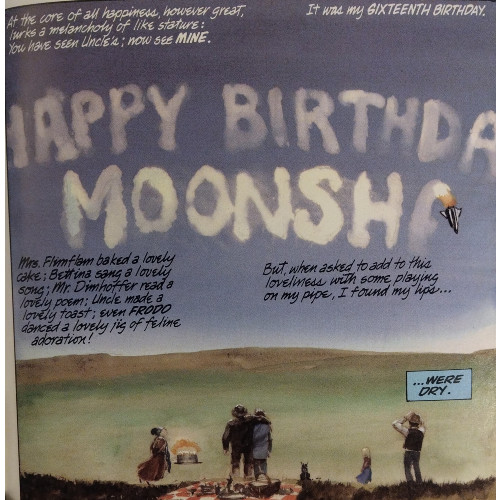
All the artists involved, but particularly John J. Muth, work to bring DeMatteis' singular vision to life, and a painted canvas could not have been a better option for this narrative. It looks in places like a bedtime story, with stars sprinkled across dark space skies, castle spires rising, small farms wedged into fields of green. This is a book you feel as you read it, and I found myself reflecting on Dave McKean's art as I journeyed further up and further in; McKean provides a similar experience in both Arkham: Asylum: A Serious House on Serious Earth and Black Orchid (which I recently reviewed and may have lingered in my mind while reading Moonshadow](), working hard to develop what I've called "an atmosphere." That sense of atmosphere permeates Moonshadow–though figures are recognizable and given definable physical characteristics, and though Muth feels at home with the concrete as equally as he is with the absurd, Moonshadow's art provides a wealth of feelings to embrace while you read.

Though it looks like a bedtime story, and in ways is intended to evoke emotional feelings of one, by no means is Moonshadow for children. There are content concerns, certainly, largely found in the crudities of a soft-looking, teddy bear-like character. But this is one of the ways in which DeMatteis is twisting your perspective, taking something dreamlike and whimsical and transforming it into a canvas through which his adult readers are meant to revisit aspects of childhood and adolescence, reflecting on their growing experiences as they watch our young protagonist embark on what he calls his "journey to awakening." Take Peter Pan or Alice in Wonderland, keep the talking rabbits and one-handed pirates, and throw in some more complex scenarios involving politics, religion, or adolescence, and you've got Moonshadow.
I've read a few reviews which critique DeMatteis for straying too far from a singular plot, seeing the series as a cacophony of ideas, scenes, and environments which ultimately fail to congeal into something fully tangible. I didn't feel as strongly about this–certainly, DeMatteis is on the warpath here when it comes to hurling concepts at the wall, grounding all sorts of developments in interstellar and fantastical visuals. Our hero Moonshadow undergoes a transition from childhood to young adulthood across these pages, but unlike four kids stepping through a wardrobe, he searches the heavens. He faces the same experiences and challenges other young adults in fiction and reality face–the frustrations of friendships, the mysteries of puberty, the smashing of those rose-colored lenses–just in much more fantastical settings.
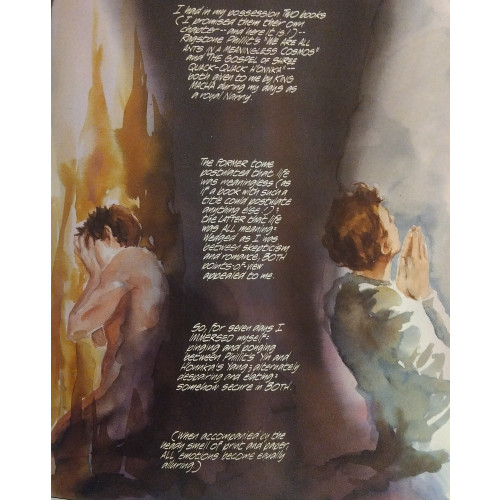
I wondered if those other reviews grasped the "awakening" aspect more specifically than the "journey," and if so, I understand their dissatisfaction. The ending can feel abrupt, and I wonder if dissatisfied readers turned to the final page with a grumbling "That's it?" I feel such grumblings disregard a vital aspect to the narrative. DeMatteis repeats the "awakening" idea repeatedly, yet always with that "journey" indicated, and once you've finished, you've realized the story is about the path Moonshadow takes, not necessarily where it leads him to. The totality of his growth as a person is not found in a single destination, but in his experiences: seeing war and death for the first time, experiencing the pangs of romance, wrestling with the (multiple) betrayal(s) of a close friend, struggling with family legacies, wandering and wondering about his father.
What makes Moonshadow's journey from innocence to awareness engaging is based in his own character. Beginning life as a fairly carefree if not outright naive child, raised by a hippie mother who married a celestial being, Moonshadow is rather ferociously thrust into reality, and we watch as he learns to navigate the unknown, largely alone but with the occasional ally. DeMatteis maintains a decent clip of highs and lows, triumphs and failures, and as he engages with the universe, Moonshadow is forced to contend with both his mother's mentorship and his self-taught techniques. He reminded me of Catherine Morland, the protagonist of Jane Austen's Northanger Abbey, a somewhat naive young woman raised on fairy tales who finds her preconceived notions of the world battered and broken and must learn to rely on a newfound sense of self, separate from what she taught herself previously.
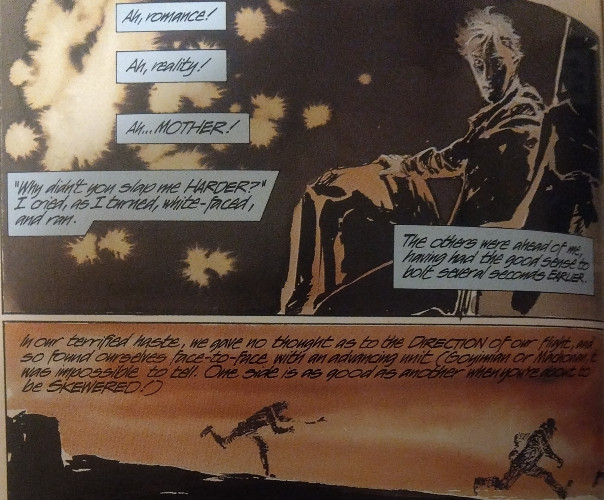
Moonshadow is not without his flaws, becoming a fairly well-rounded character. His deficits are not unreasonable, and he doesn't remain buried in his flaws. Each experience shapes him piece by piece–actual war challenges his youthful, heroic aspirations to become a soldier; a headlong fall into romance has him reconsider his fairly blind view of love; his ongoing, abusive relationship with his friend Ira–DeMatteis' oddest, oddly compelling character–and a fairly distant connection with his father (that celestial being–literally, a glowing orb with a face) batters his perspective of father figures. Moonshadow, a consistent victim of Ira's abuses, feels helpless to react or leave the guy behind–and would he? He knows nothing else.
Similar to what I discussed in my "Greenberg" review, I don't know how much of DeMatteis' own experiences snuck their way into here. I noted, in that review, how the "Greenberg" stories aptly allowed vampirism to serve as a metaphor for religious institutions; in Moonshadow, that concept of "metaphor" is made much more ethereal, left in ways to the imagination. Moonshadow's father, a member of the G'l-Doses, is often distant, popping in and out of the boy's life at seemingly random yet important intervals, providing nothing in the way of fatherly attention or affection. I could see this reflecting DeMatteis' view on God, as a distant, capricious creator, spinning us on our way and leaving us on our own. I can see the bloodshed Moonshadow encounters in skirmishes fought for very vague reasons as DeMatteis' critique against the institution of war. And I can see how Moonshadow's insistence on loving one character who should be downright unlovable (and I'm not even referring to Ira) showcases DeMatteis' hope for people, how even darker hearts have the potential to find some sort of light.
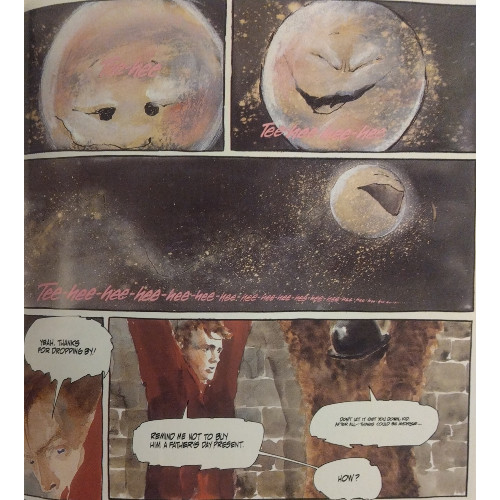
On the surface, none of this is terribly difficult to understand. The series contains a nice complexity in that it runs the gamut of adolescent experiences–romance, religion, familial and platonic relationships, heritage–but it never treats the reader like an outcast for not grasping something, nor is it trying to consciously confuse. DeMatteis' writing is smart, often poetic, but it isn't wrestling with mind-bending concepts to make a point in the way a Grant Morrison comic would. DeMatteis knows the stage he's set, he knows he's working with space opera, and therefore he allows his ideas to be filtered through that lens.
If anything (and this is probably where I agree with the other reviewers), he does falter somewhat by cramming in too much. Moonshadow's journey speaks poetically to the adolescent experience, but each issue feels like the addition of a new wrinkle, a new problem, and it does blend together at times. There are very concrete moments and very concrete messages, even amidst the aliens and other worlds, but it can feel like DeMatteis is siphoning as many examples as he can to funnel Moonshadow through. It works well, in pieces and even together at times, but it can leave you a little stuffed with ideas. Perhaps this is where those other reviewers found they struggled, particularly with the ending, feeling left with more than one message or idea to walk away with and uncertain of how to react. You're given so much to consider that, perhaps, any ending would feel incapable of surveying the breadth of Moonshadow's experiences. I understand that, if that's the case. The ending certainly provides that taste. Though I noted Moonshadow should be read as a sum of its parts, the totality of some of those pieces fit better than others–you can easily see the thread of Moonshadow's growth from the first chapter to the last, but you may be challenged by a few of the specifics. You may be able to pluck some relatable story beats, moments, and metaphors for your own reflection or application, but you'll be hard-pressed to feel so satisfied with everything.
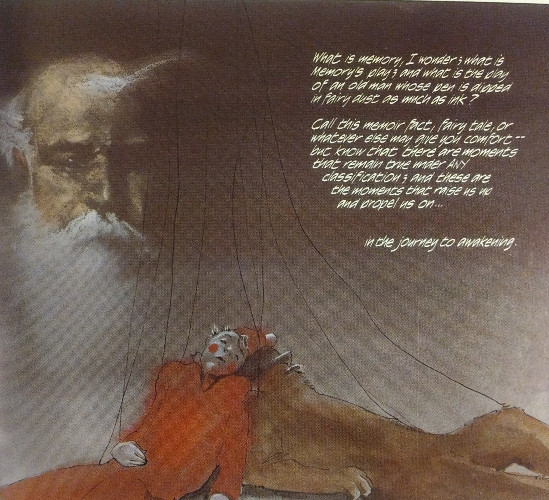
This is where I come to mention Ira, who feels, in a way, like a microcosm of everything DeMatteis' creates. Moonshadow's ridiculously abusive, sometimes-friend, sometimes-father figure, sometimes-enemy, Ira is incredibly disagreeable for most of the series. DeMatteis finds new ways to bring out his worst instincts, and Moonshadow's seemingly unshakable love for the dirtbag/fleabag/should-be-in-a-bodybag is admirable to a fault. Moonshadow's own relationship with the walking carpet serves as a good throughline for his total growth, so if that's an idea you wish to anchor yourself with while you read, go for it. But Ira as a character, downright detestable as he is, receives my singular favorite moment in the entire series, a page so shockingly poignant and touching, I was amazed. DeMatteis notes moments of change within the furry fiend throughout, but this singular second eclipses all of that. Like Moonshadow, he reaches a point where the past and present can no longer define him; he must move forward. It's great, and though it doesn't fully make up for all his prior unpleasantness, it's a solid lunge forward.
Ira also works as a microcosm for my largest complaint: Moonshadow, though engaging and thoughtful, can be ridiculously dour. I mentioned the ups and downs, triumphs and failures, and a good chunk of the plot focuses on the latter halves of those parallelisms. Ira, as noted, is often deplorable, seemingly beyond redemption, and his constant abuse towards our young protagonist is difficult to stomach at times. Elsewhere, DeMatteis heaps blow upon blow, to the point where pinpricks of light remain slight, and even as they happen, you just assume they'll be extinguished. Yes, characters often grow through adversity, but Moonshadow deals with so much, per issue, that you hope that maybe, just maybe, a bit of happiness will linger longer, but you tend to doubt it.
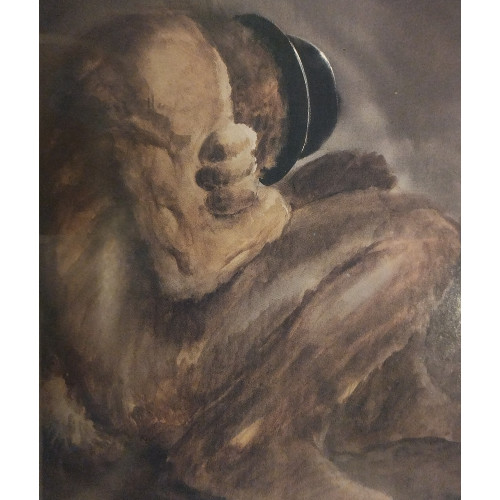
"A fairy tale for adults" is an apt description for Moonshadow, because it combines all the best elements of a fairy tale (fantasy, plucky protagonist, character growth) with more mature themes, darker content, and subject matter which Little Red Riding Hood or the Three Little Pigs never dealt with (though some of those stories are pretty messed up, man…). It looks magical, fully painted illustrations drawing you into an occasionally whimsical, often fantastical atmosphere that's responsible for populating a universe. It can get overly dark and defeating at moments, and it can feel congested with concepts, but if you can overlook those, Moonshadow is worth a read. You know, shortly after starting, the series will be about a boy growing up, like so many tales before it, and you may feel, after finishing it, that the finished product is a little lackluster. Maybe. But the journey, the actual growing which happens, is what you crack open the spine for; it's the shadow you become lost in under this particular moon.