Random Reviews: Skreemer
A thoughtful, grim tale, Skreemer watches fate manipulate the growth of a central character at the expense of another
—by Nathan on April 3, 2026—
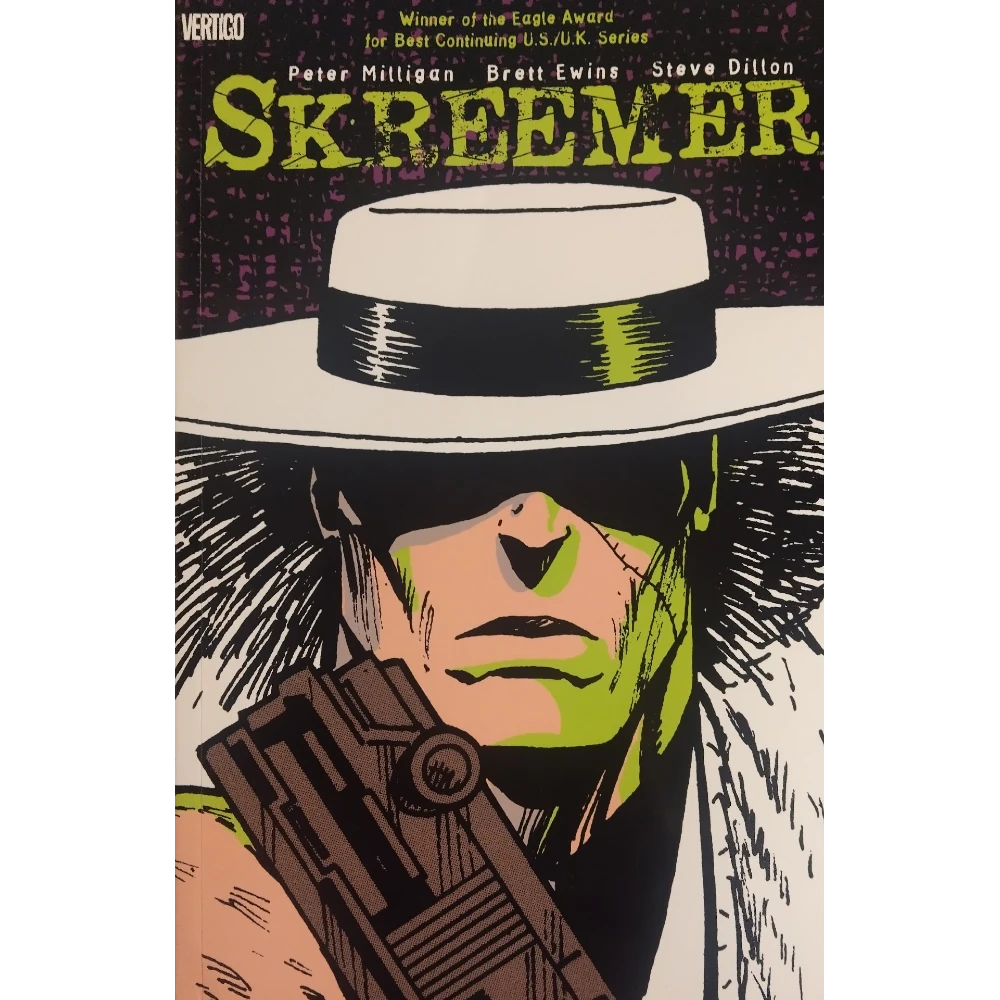
A handful of posts ago, I reviewed (some of) Peter Milligan's contributions to the early 90s Batman mythos as collected in "Dark Knight, Dark City." I praised Milligan's thoughtful if not somewhat unorthodox storytelling capabilities, highlighting his use of encroaching evils, both tangible and less so, and how such evils challenged Batman physically. Never before had I seen the Dark Knight have to slice a new airway for a choking infant. That's new levels of harrowing right there.
Reading "Dark Knight, Dark City," I was reminded of Milligan's other DC contributions after journeying over to America during the same "British Invasion" which brought over the likes of Grant Morrison, Neil Gaiman, Dave McKean, and Steve Dillon. Unlike his British contemporaries, however, Milligan went a different route in crafting his first DC project: where other writers reintroduced the reading world to updated versions of DC characters such as Animal Man, Sandman, and Black Orchid (let's even toss in Watchmen, as Moore's original idea was to revitalize characters DC picked up from Charlton Comics), Milligan decided to develop a new property not even remotely tied in to DC continuity.
Before he wrote Batman, and before he contributed his own updated DC character in the form of Shade, the Changing Man, Milligan collaborated with fellow 2000 AD compatriots Brett Ewins and Steve Dillon to create something more unique. Inspired by James Joyce, Milligan and Company crafted an award-winning series that showcased a grim vision of the future that seems perpetually influenced by mobster movies.
Skreemer
Writer: Peter Milligan
Penciler: Brett Ewins
Inker: Steve Dillon
Colorist: Tom Ziuko
Letterer: Tom Frame
Issues: Skreemer #1-6
Volume Publication Date: October 2002
Issue Publication Dates: May 1989-October 1989
Publisher: Vertigo (DC Comics imprint)
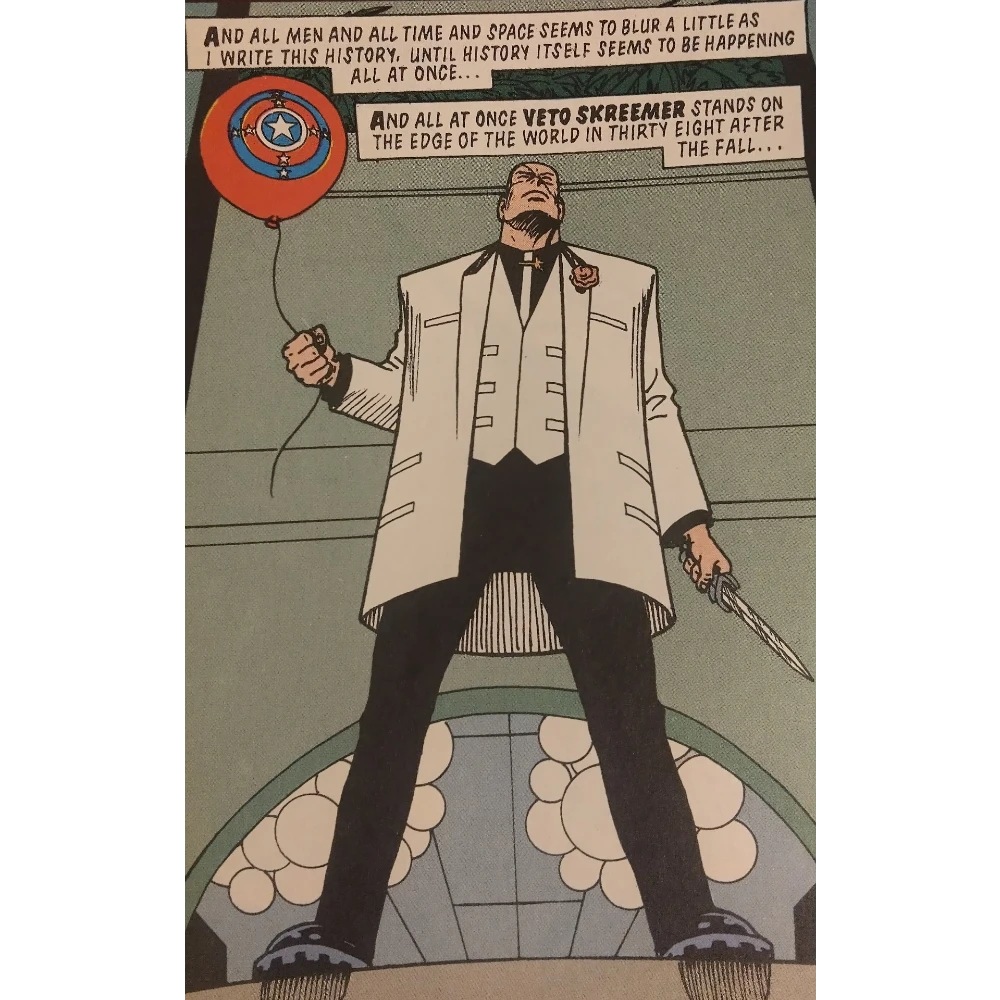
In this grim world, America has been divided up by gangs, each led by a president, each president supported by a Skreemer, which is a fancy term for "assassin." It's also the name by which Veto Skreemer goes by…and it ain't a coincidence his surname shares the same term. The man's so powerful, a giant among men, that he's become synonymous with the word. And he doesn't protect a ganglord president. Other people protect him.
Veto and his life story are told methodically in these pages by Milligan and Ewins, the past melodically intertwined with the present. We see the Skreemer go from boy, to killer, to gangster, power building ever greater. We see his friendships form and falter. We see the steps he takes to get to where he is and wonder ourselves how high he will go. Veto is an ambitious man, with a plan a decade in the making that threatens to unravel America further…but to him, this is just reestablishing a status quo he feels is eroding.
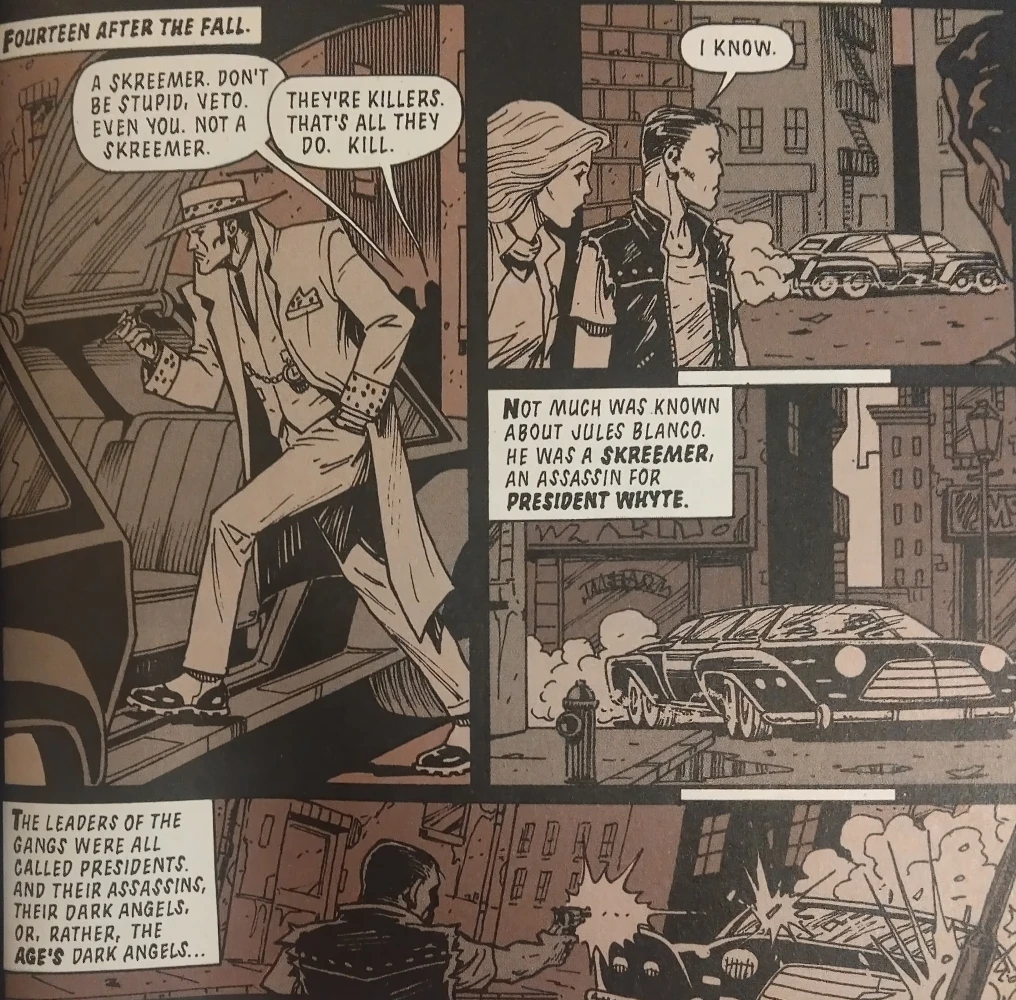
In reading a few other reviews on this series, I found the word "thoughtful" utilized in describing Skreemer. Such a word is used appropriately, as Milligan is genuine in uncovering, step by step, this giant's history, a dark puzzle which is developed piece by piece. Surrounding the whole puzzle is a border based on James Joyce's Finnegans Wake and the Irish drinking song of the same title. I'm not familiar with either, so I found the literary allusions largely lost on me, but as I understand it, you have to be an absolute genius to understand Joyce's novel, so props to Milligan for feeling inspired by it. If anything, the plot takes a few direct elements from the drinking song–featuring a seemingly dead man revived by a splash of alcohol–and uses the name "Finnegan" fairly heavily.
This is where that "thoughtfulness" enters the game: though drawn from Joyce's novel and the song, "Finnegan" refers to a family whose lives have, unknowingly, been intertwined with Veto's. We're given four strands to follow–Veto in the past, Veto in the present, the Finnegans in the past, and the Finnegans in the present–all interwoven throughout the six-issue series. The result is a topsy-turvey tale, leaping between decades and characters, demanding the reader pay attention to the details. You'd do well to remember the names of Veto's friends, the names of members of the family Finnegan, how many years have passed after "the fall" which led to the country's current state. Milligan makes enough references to keep you apprised of what's happening, but you'll need to do some dot connecting to keep it all at the forefront. And yet...it all blends together well.
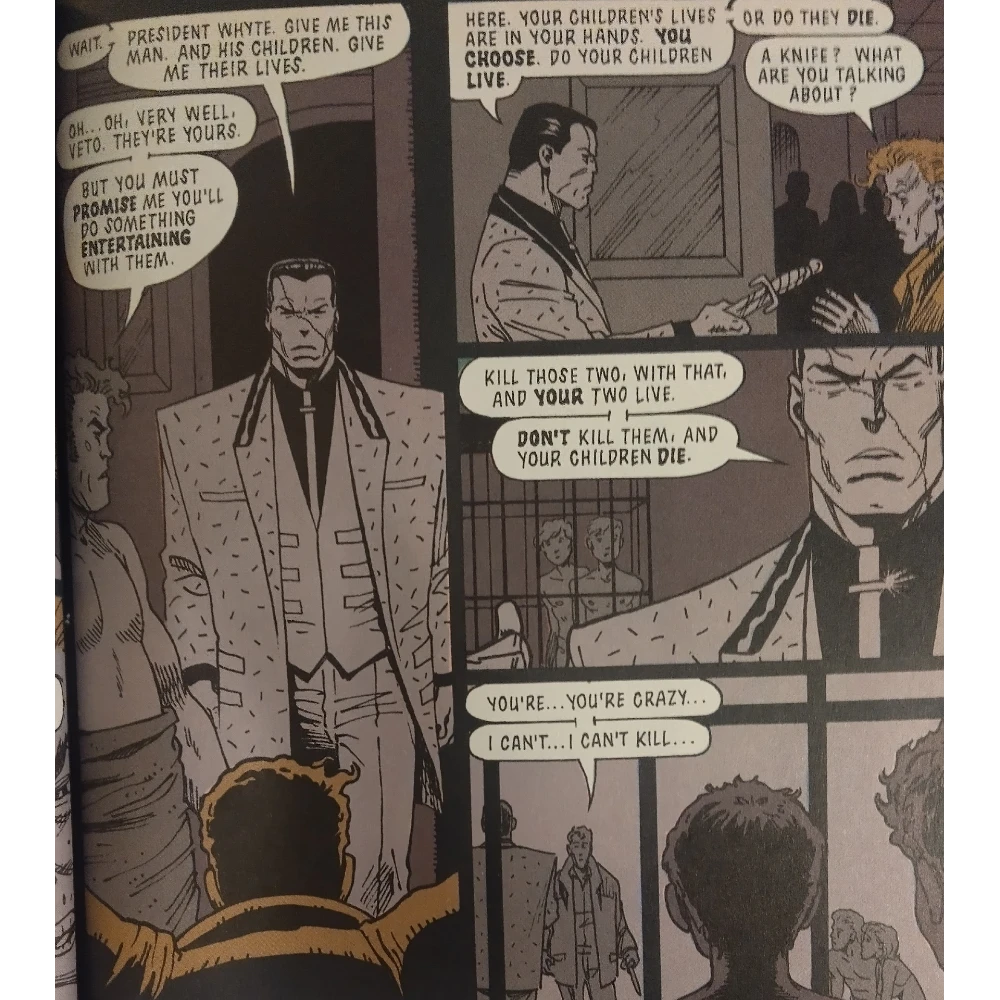
The plot, gratefully, is not intended to confuse. This isn't necessarily the high-brow hijinks you'd find from Grant Morrison or, as I understand it, some of Milligan's other work. You're asked to pay attention but respectfully so. Do that, and you're rewarded with a plot that reads fairly well, unfolds dramatically, and ends in a satisfactory matter. If you become curious how the past and present collide, stay the course! Milligan dots later pages with fulfilling payoffs that answer questions or give greater weight to earlier moments. That guy narrating the whole story? Don't worry, you'll identify him fully by the end. Wanna know how Veto got that cool scar across his face? Fear not, that will be adequately explored.
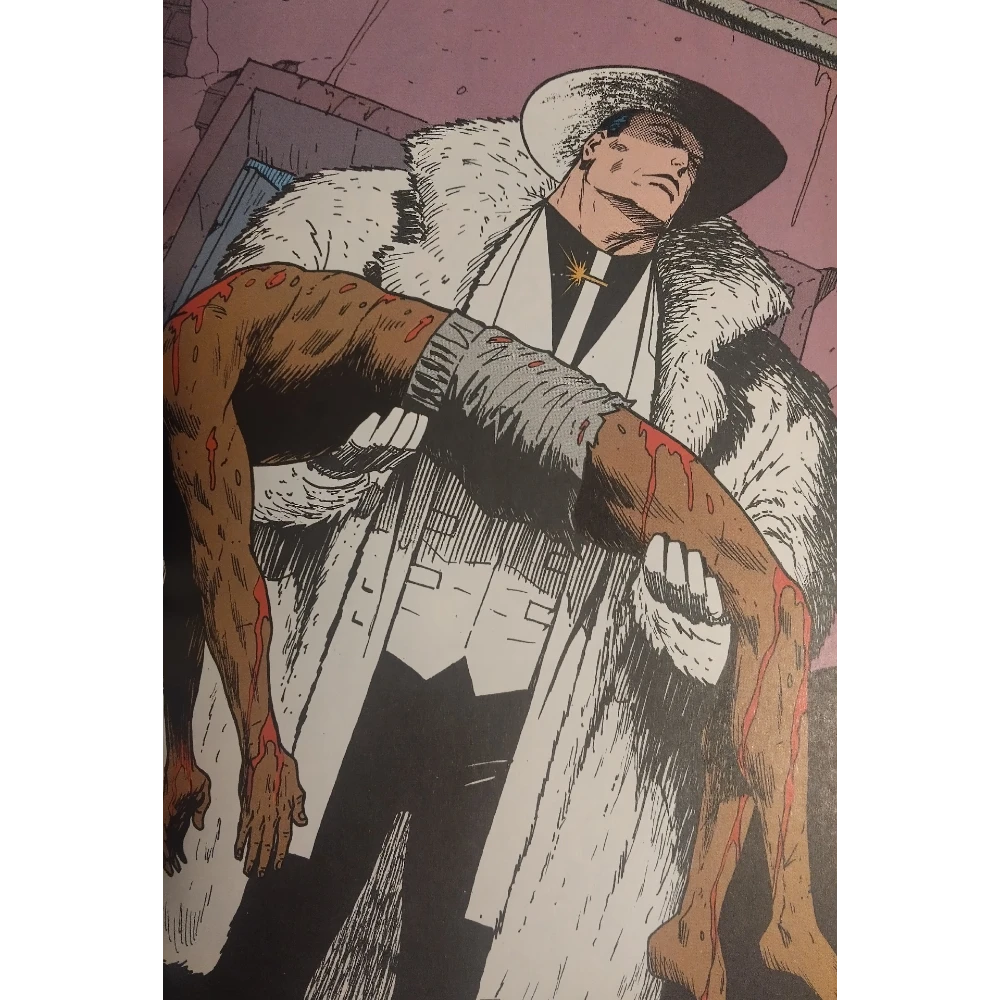
Veto, as a character, remains this solid, somewhat stoic Goliath…if somewhat physically, but especially in manner. He's not the most exciting character to follow, save for the occasional emotional outburst, but his rocky outward demeanor is what generates interest. This is the tale of his rise, and as we learn, his grapple with inevitability. Milligan does lean a little too heavily into some philosophical pandering by the narrative's end, which generates some convenience for Veto's intentions, but he otherwise weaves the character's efforts well. Once you know that ending, his actions and his temperament become clearer, and you see him in a strange light, a combination of protagonist and antagonist. There are genuine reasons to dislike Veto, but there are also strong points. An image of him carrying a wounded friend out of danger is a surprisingly touching moment, especially if you can momentarily forget the friend's face was chewed by a rat. Veto isn't heartless; he's bold, somewhat cold, wrestling with, he feels, forces beyond himself and wondering if he can turn them back. He wants to establish his legacy as immutable, and it just so happens the stone he's chosen to etch that legacy in is grounded in a violent career.
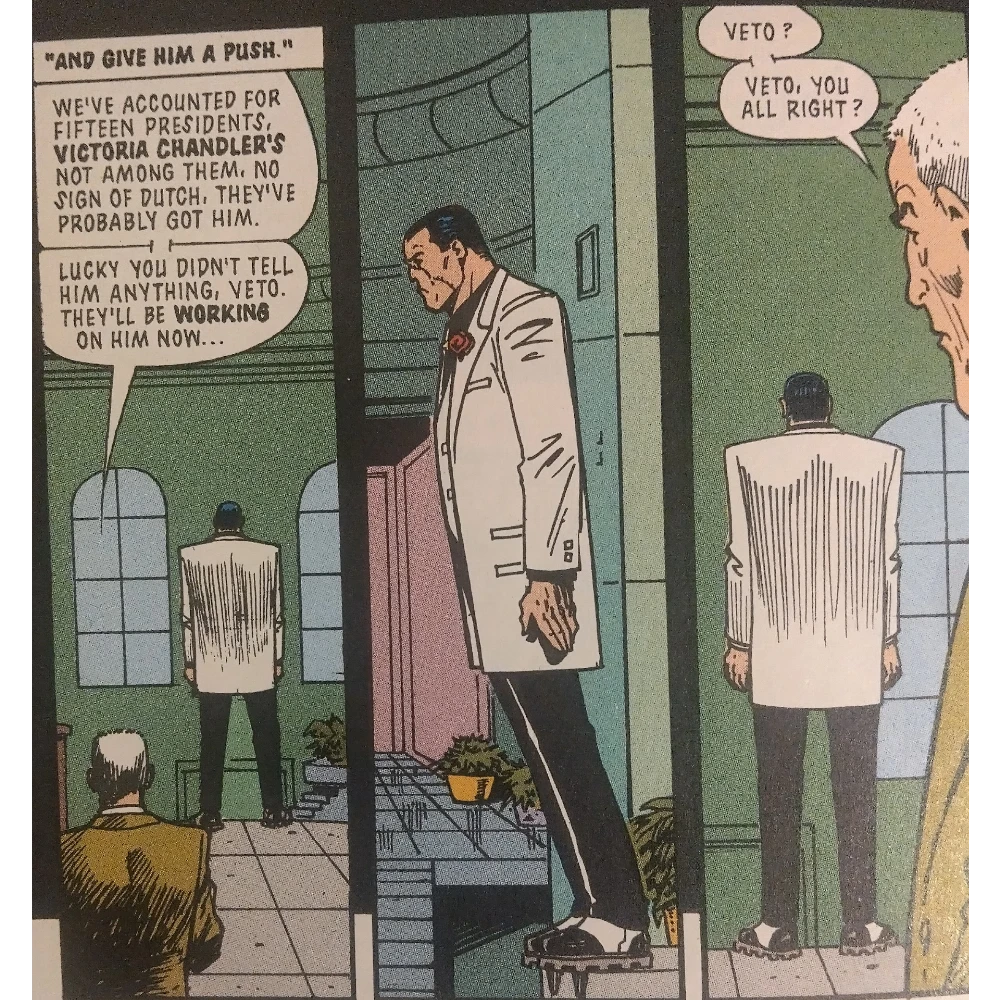
Veto's insistence on standing on a ledge in his home overlooking a yawning fall to a floor many feet below becomes a recurring image–for most of the present day scenes, Veto hardly leaves that ledge. Elsewhere, his younger self stands at the edge of a bombed-out apartment, and near the series' end, Veto brings an ally up to a rooftop to survey a city. This notion of being close to falling–physically and mentally–plagues Veto, tied into that notion of inevitability. Like Thanos subconsciously wished to be defeated in Infinity Gauntlet, Veto gives the appearance of a man who almost wishes for a downfall…but can't bring himself to take the leap. Hope, perhaps, that his ways can be maintained in this quickly degenerating world?
That hero/villain mold Veto slips into like a three-piece suit charges the reader with working to understand him, and in understanding, to debate internally about where their allegiances lie. Will you sympathize with the giant whose past has led him here, seemingly inevitably? Is that enough to atone for his sins? Or will you hope that he'll slip, or someone will push him, or gravity will somehow gain the upper hand eventually? Milligan is deft enough to allow both sides of Veto, victim and villain, play out well, and the level of volition readers assign the Skreemer will ultimately determine their interpretation. I won't provide my conclusion, but I enjoy the engagement Milligan leaves, the challenge offered in working to understand a character's motivations and allegiances.
The Finnegan family, their history scattered throughout the issues, has a strong cling to the Skreemer's schemes; fascinatingly, Milligan distorts their history as victim of precocious fate. Veto takes a physical hand in the Finnegan's torment, his actions leading to a few deaths, yet it's never his intention to draw them in. That inevitability draws them together, generating a lethal impact that's entirely circumstantial; Veto just happens to lead a raid on a bar owned by George Finnegan, for example. A few other coincidences bring them into Veto's circle, Milligan playing up the unintentional tragedy of the family's fall darkly mirroring Veto's rise. I will note I had assumed Timothy Finnegan, a central character in Milligan's present-day America, would play a different role in the story than what actually transpires. Milligan seems to hint, to me, the possibility of greater volitional involvement in the story, yet as we're lead towards the conclusion, Timothy's part shifts. His motivations are eventually explained decently enough, but he assumes a much less reactive role that I had thought. I wished he had been somewhat more integral to the plot.
"Lots of fun at Finnegan's wake," the chorus to the Irish drinking song chimes, and you'll be sure to find some fun here with this series as well. A single man's story brushes up against a family's own tale in grim ways, propelled by his own ongoing grapple with legacy. I'm sure readers won't find "become synonymous with a dystopian America's slang for assassin" much of a relatable pursuit, but there is something to be said about watching a life unfold with a dream of establishing a sense of self. It means tragedy doggedly pursues the lives of some in a way which feels brutally unfair, without much light appearing at the end of the tunnel. "Each man's life touches so many other lives," Clarence Oddbody tells George Bailey in It's a Wonderful Life. That's a less admirable fact when considering the Skreemer, who builds and builds a legacy for himself, never once caring who he must trample in constructing his temple of Veto.