Spider-view: "Lifetheft"
These issues provide an ongoing arc a fairly well-told conclusion, despite some imbalanced pacing
—by Nathan on June 23, 2026—
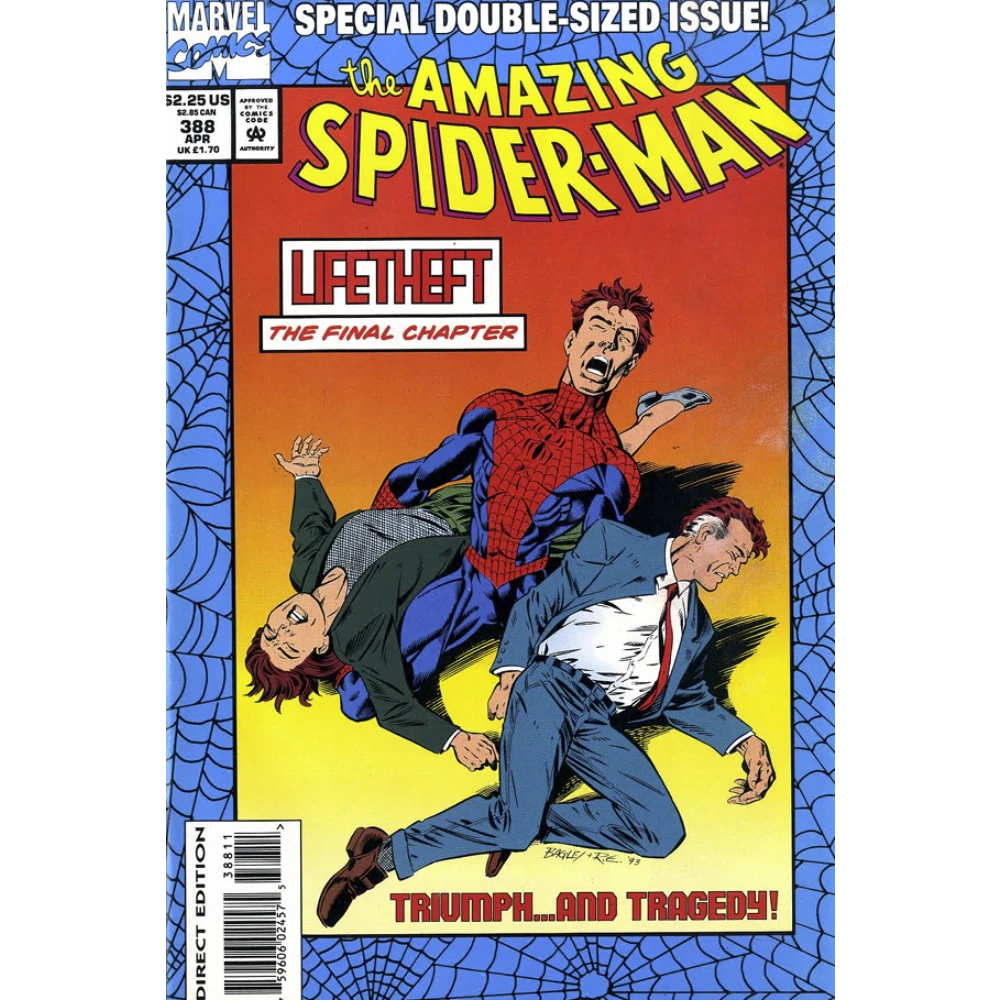
Over two years ago, I reviewed an arc which turned Peter Parker's world upside down by bringing his dead parents back into his life. The twist was shocking to both Peter and his Aunt May, both of whom long believed that Ben Parker's beloved brother and sister-and-law had died years earlier. Spidey, in an earlier annual adventure, had even cleared their names, erasing any suspicion that they worked for the Red Skull.
I've periodically crept back into the Amazing Spider-Man arcs following that revelation, slowly unpacking the mystery surrounding their sudden reappearance. Richard and Mary are doing what they can to find space in their son's life–joining him for meals and visits, encouraging him, advocating violence when Carnage and his Amazing Friends began slaughtering New Yorkers…? Over time, Peter's hope in a new and lasting relationship with his parents has given way to some tension, with Aunt May eventually hiring a private investigator to uncover whether these folks are who they say they are. Michelinie has been coy about the plot, but leading to this bombastic arc, he's revealed one thing: shadows loom on the horizon. A happy ending is not secure. But hope lingers.
Admittedly, my readthrough of these issues has been haphazard, interrupted by other reviews in other series, even other Spider-Men. But the past ASM issues have led us here, to a conclusion which marks a shift in Peter Parker's present, narratively and tonally, perhaps providing a taste of what happens when writers predicate arcs on giant twists.
"Lifetheft"
Writer: David Michelinie
Pencilers: Mark Bagley, Ron Lim, and Larry Alexander
Inkers: Randy Emberlin, Tom Palmer, and Larry Alexander
Colorists: Bob Sharen, John Kalisz, and Joe Agostinelli
Letterers: Rick Parker, Dave Sharpe, Joe Rosen, Steve Dutro, and Ken Lopez
Issues: Amazing Spider-Man #386-388
Publication Dates: February 1994-April 1994
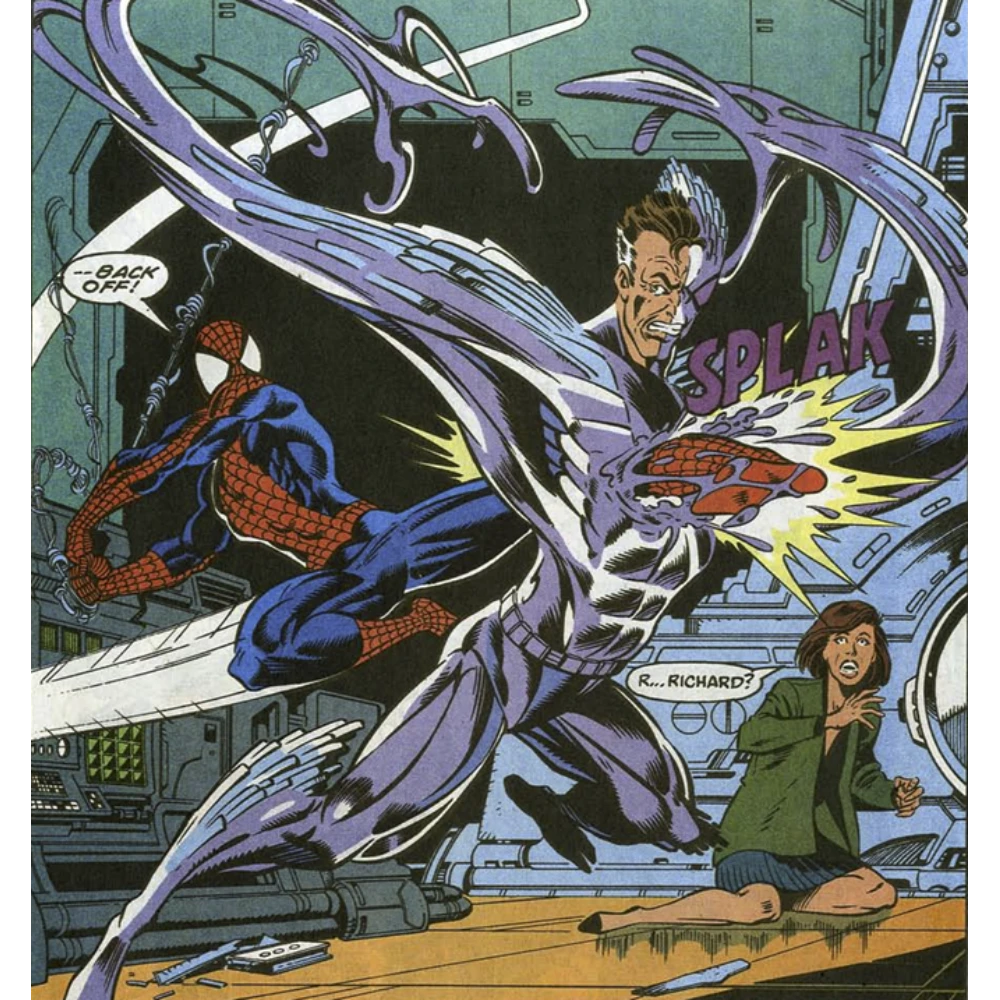
As it's been thirty-two years since this story was published, I'm gonna toss the big ol' twist out there: Peter Parker's parents…aren't Peter Parker's parents. Michelinie reveals that Richard and Mary Parker are, in fact, synthetic lifeforms, developed by the Chameleon as a method of getting revenge on Spider-Man for the death of his half-brother, Kraven the Hunter. This whole time, the man and woman Peter confided in, tried to trust and learn to love, have been weapons constructed by one of his oldest enemies…
Cue the "dum-dum-dum."
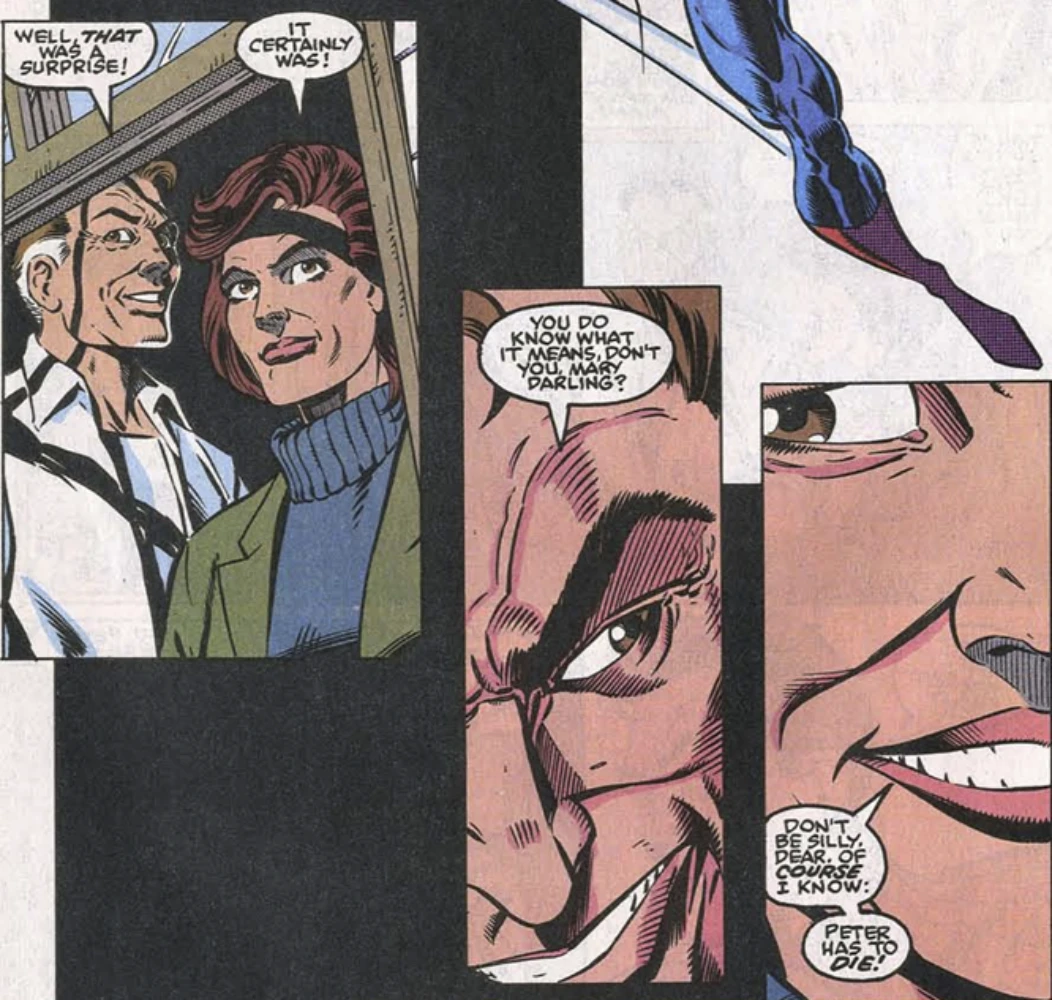
In order to appreciate this twist, you have to recognize the scope of the whole "Richard and Mary are back" narrative. I firmly believe that Michelinie planned this from the start, or at least planned that these folks weren't the real deal. A little ways down the line, we'll review an arc that deals with the fallout from his revelation, and I assume some of that was generated by an important plot point introduced after Richard and Mary's "reappearance." For now, the twist is "Chameleon created facsimile Parkers to get close to Peter and, through him, eliminate Spider-Man."
The big question, however: does it work?
Primarily because of my own reading habits, it's taken me much longer to get to this point than I anticipated, so it seems unfair to judge this story based on how well Michelinie strings the plot along. But from what memory serves, I found the preceding issues, even knowing the outcome, compelling to a point. I do believe Michelinie always knew this wasn't going to end happily; he brought in some tension by revealing Richard and Mary had seemingly survived the plane crash thought to have killed them, allowed some time for them to try and bond with Peter, and then yanked the rug out from under from Spidey and confirmed his worst suspicions by revealing the couple as fakes the entire time. In concept, I'd argue it works well enough.
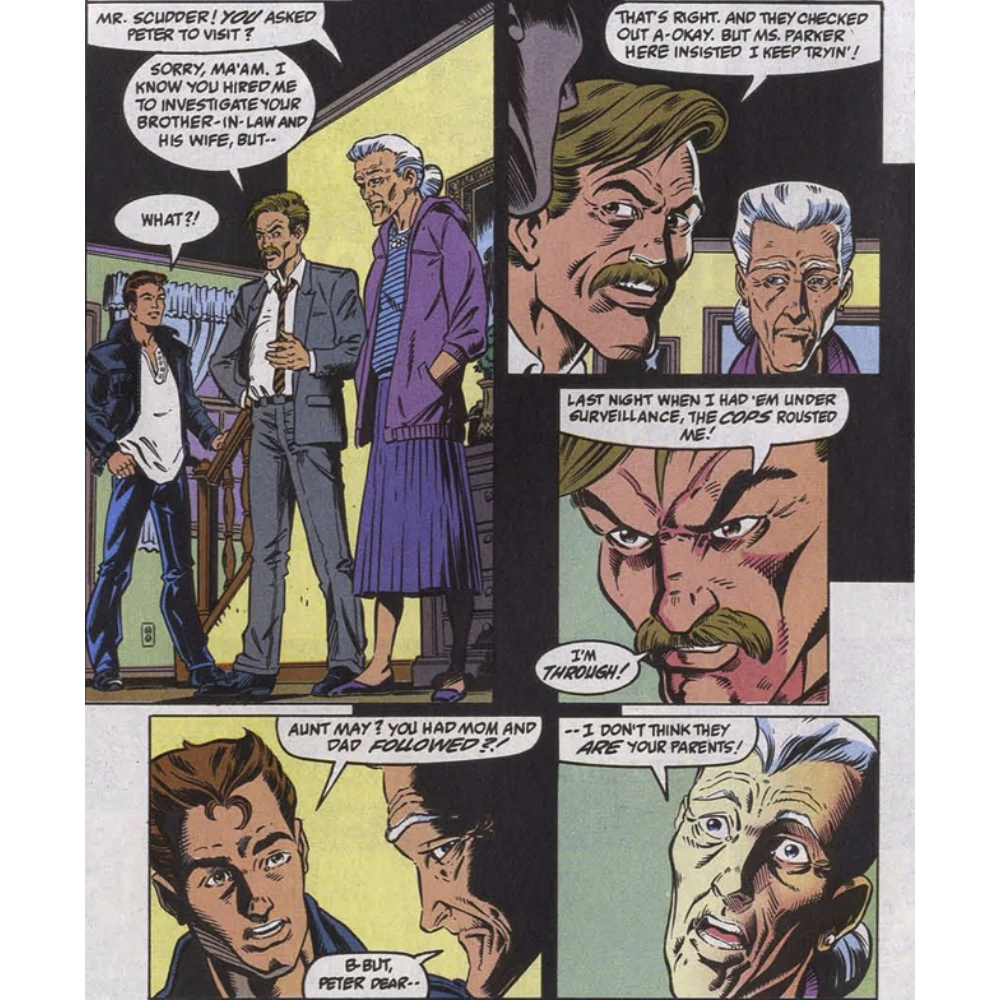
Michelinie has delivered the necessary tension, through not only Peter's gradual acceptance of his parents' reappearance, but through Aunt May's doubts as well, to bring us fairly neatly to this point. We've not ridden a rollercoaster of forced swerves and twists to reach here–a slight discomfort has always lingered within Peter, forced aside by the hope that he gets to connect with the parents he never thought he'd have. If anything, May's remained stubbornly defiant, hiring a private investigator and showing off her determined love for Peter by doing what she can to prevent crippling disappointment, which Michelinie plays off by creating conflict between herself and Peter. In an attempt to, perhaps, shield himself from a very unpleasant truth, Peter begins wondering if old age has finally caught up with May's mind. Anything to stave off the hurt.
And here we arrive anyway.
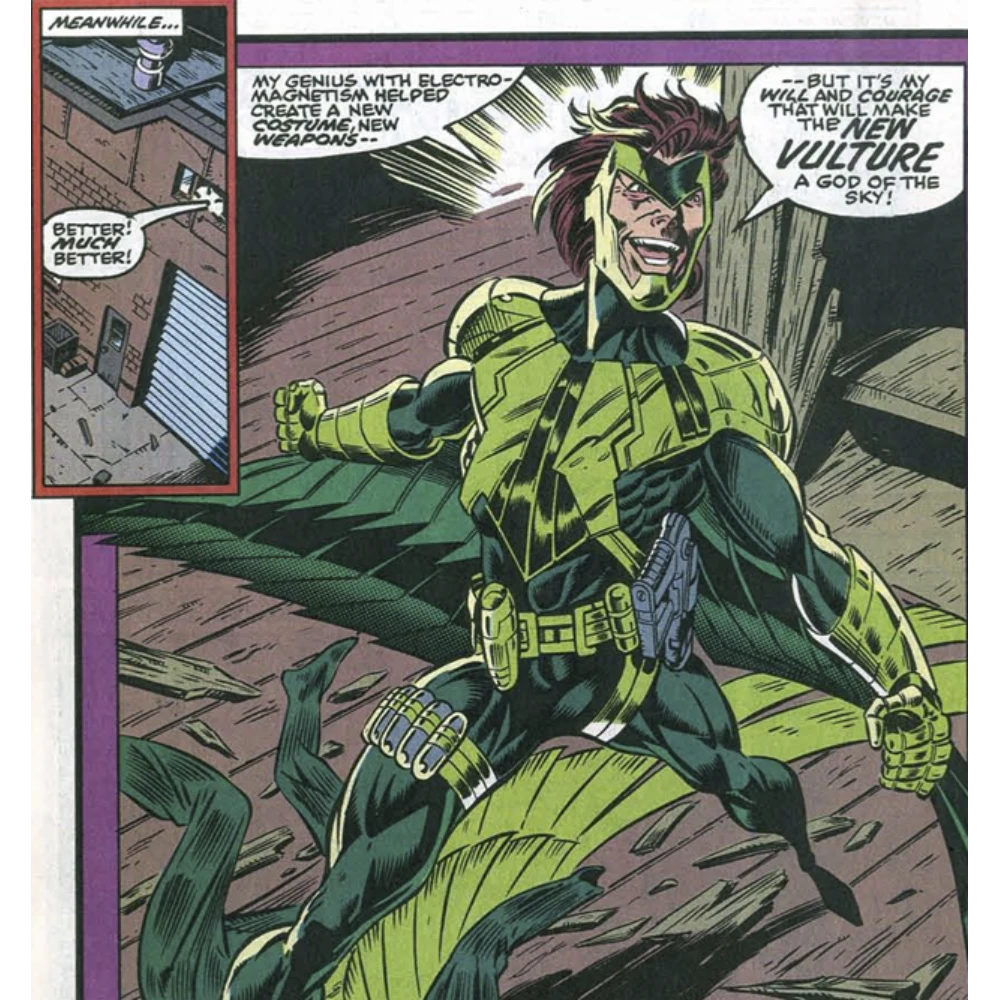
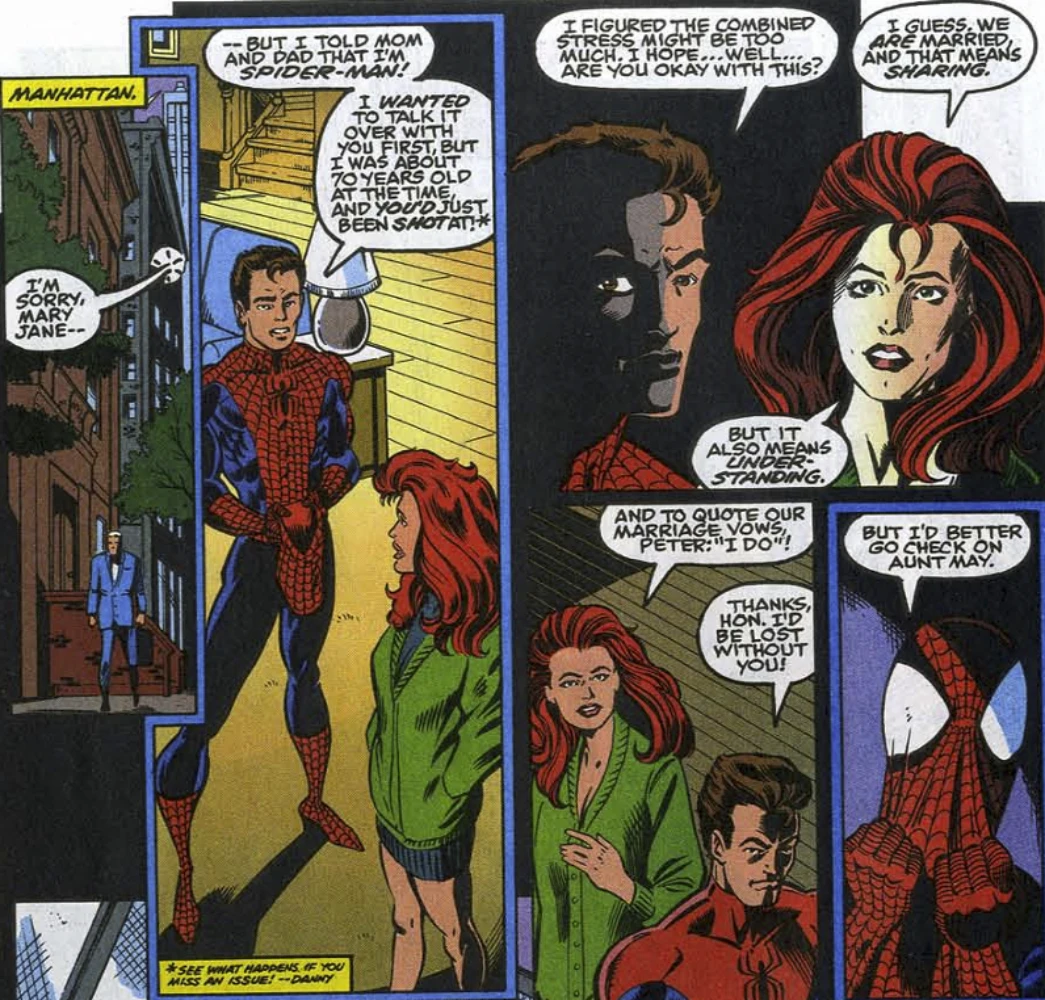
The twist is compounded at a few stages across this arc as Michelinie weaves a tale concerning the Vulture seeking to reverse his aging, latching onto Peter as a potential "donor." Old Man Peter hobbles about for a short while, but it highlights the fragility of his own existence and his need to come clean about an important decision with two important people. The scene where Peter reveals his identity to Richard and Mary just adds bludgeoning power to the later twist. A fraction of my brain wants to fault Michelinie for the convenience of it all–Peter choosing to reveal his greatest secret an issue before everything goes sideways–though Michelinie does imply that the identity reveal likely triggers some of the culminating conflict which leads to the "parents aren't real" twist.
The layering across this arc is fairly impressive. I was initially a bit doubtful about the Vulture plot, thinking the "reverse aging" bit was just a shtick to give the old buzzard a chance to gain revenge on Spidey after his defeat as part of the short-lived Sinister Syndicate. Michelinie does miss an opportunity to have Old Man Peter meet Aunt May, even just for some slight comedic effect, but the aging aspect is brought back in full-force for the finale, Michelinie using the Vulture's scheme to wrap up a necessary loose end and give the old coot a somewhat interesting narrative direction for later issues. It's just decent plotting, one element sewn earlier coming back to haunt the final pages.
That these robots are "eeevviilll robots" just makes sense. If you aren't shocked by their fakeness, you'll certainly be frustrated by their sinister programming. Of course this is all a supervillain plan! Imagine if they were just…neutral robots? Friendly robots pretending to be Spidey's parents would be downright bizarre. Having them belong to the Chameleon's scheme is just Superhero 101. It's not terribly brilliant or mind-blogging, except for perhaps the fans who believe Richard and Mary's reappearance to be legitimate. Did anyone actually believe that? Apologies to any fans who did. I assume Michelinie saw greater potential in throwing yet another wrench into Peter's life than providing him genuine happiness (which itself is hardly original). At least they aren't clones!
You'll have to excuse a bit of convenience for the twist to maintain its full impact, with the Parker robots' whole premise based on the Chameleon using Peter to get to Spider-Man. There's a way in which it makes sense, and it's absolutely necessary for the couple's return to be as impactful as it has been. Is it outlandish? Absolutely. A criminal mastermind like the Chameleon seems too smart to just hope the robots made to look like one guy's parents will get close enough for that guy to divulge information about Spider-Man. And how lucky he gets by just so happening to recreate Spider-Man's parents! Again, the fallout arc from these issues may smooth over that particular rough edge, but it's not the most brilliant premise imaginable.
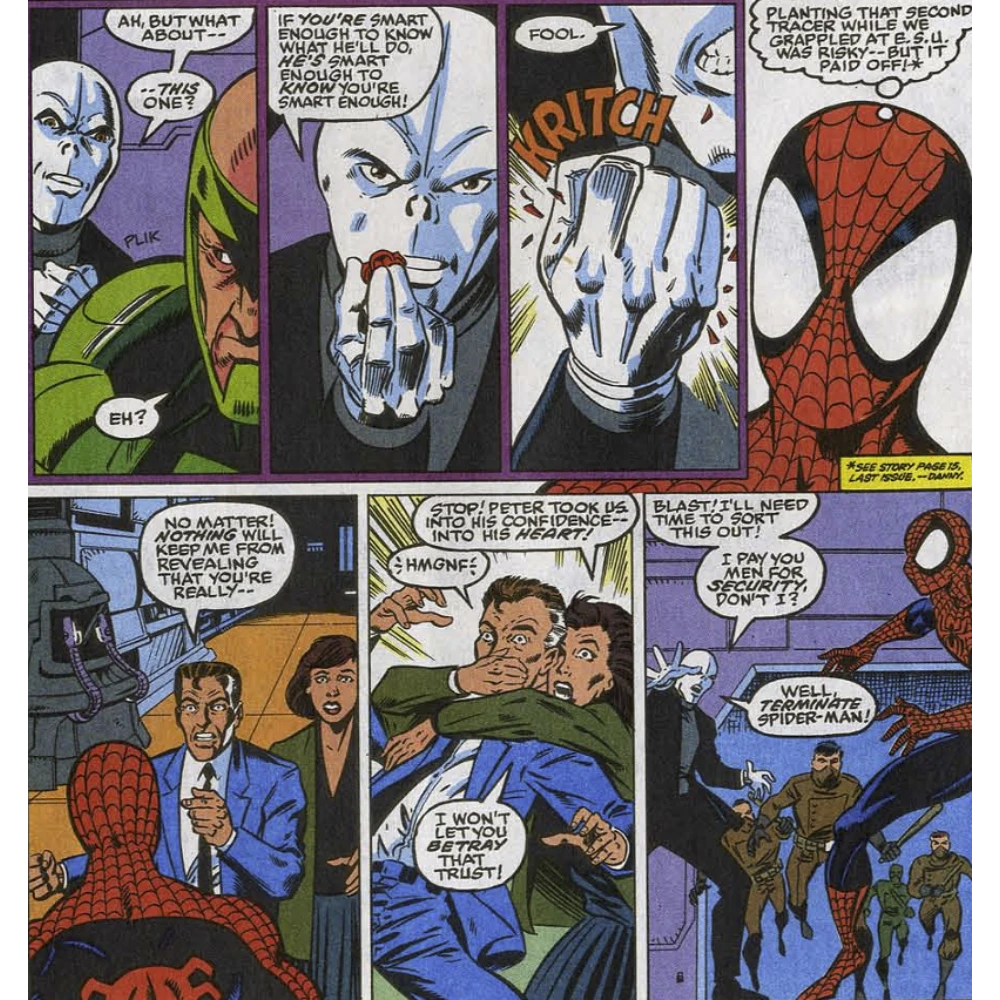
More awkward is a bit of characterization from Michelinie, focused on Mary Parker. Part way through the arc's final issue, she develops a conscience, foreshadowing a later act of rebellion she takes when her "husband" attempts to kill their "son." The idea is strong, I have no problem with that. Michelinie makes it clear that, even as a human simulacrum, she's been imbued by the Chameleon with human emotion so well that she's actually taken on some of Mary's maternal instincts towards her son. I like that little twist and the fun way it leads the Chameleon to defeat himself, in a sense. But it's not been teased sufficiently until this point, coming so late in the narrative that you fail to feel any connection with Mary that hasn't already been overturned by their shadowy programming. I say "you," but I mean "me." I just didn't connect with the concept, and even though Michelinie weaves it into his finale to a certain level of satisfaction, I wish the idea had been teased earlier.
Michelinie also tries to weave in some slight subplotting, plus a few shorter narratives in the back of this arc's third issue, none of which are terribly impressive. In his eternal struggle to give Mary Jane something to do other than worry about Peter, Michelinie has her become the target of an attempted murder by an obsessed fan–no, not Jonathan Ceasar; he's dead. Similar to how he handles Mary's sudden conscience, Michelinie spends too little time on this development; Mary Jane barely has any opportunity to process such a near-lethal circumstance, and Peter, absorbed in his own problems, comes across as callous when finally addressing it. Heck, Michelinie has MJ joke about taking up smoking again to cope! You just had her beat this, Dave! The bit, though intended to be humorous, feels a little tonally lost here.
The back-ups are nothing much to appreciate. A tussle between Chance and Cardiac reminds us how badly Marvel seemed to want Cardiac to be a big thing. He's popped up in a few of these back-of-the-issue bonus strips, and they haven't been terribly impressive. An additional Venom strip tries to provide some context for some of the villain's earliest actions, similar to an arc Michelinie told in a few annuals a while back. It reads well enough, and has some decent Ron Lim art, but it feels tacked on for the sake of justifying the issue's "Special Double-Sized" declaration on the front.
This finale to the "Peter's parents" saga isn't exactly what I would called a mixed bag. There's more good than bad, I'd wager, especially in the way Michelinie manages to craft a solid plot that culminates rather spectacularly. Certain ideas are used well throughout the arc or brought to completion. Yet others are haphazardly introduced, such as sudden changes in character or a seemingly traumatic event quickly glossed over. Even with the third issue's extended length, I guess you can't promise fans everything, especially not with such a monumental revelation in the webbed wings. Maybe if Michelinie had cut back on some fluff in the back of the "Double-Sized" issue, a few awkward character moments could have received the page count necessary to feel more organic than a pair of synthetic older Parkers.