Distinguished Critique: Sword of the Atom Review
These issues imaginatively yet imperfectly imbue a small hero with big themes
—by Nathan on September 25, 2026—
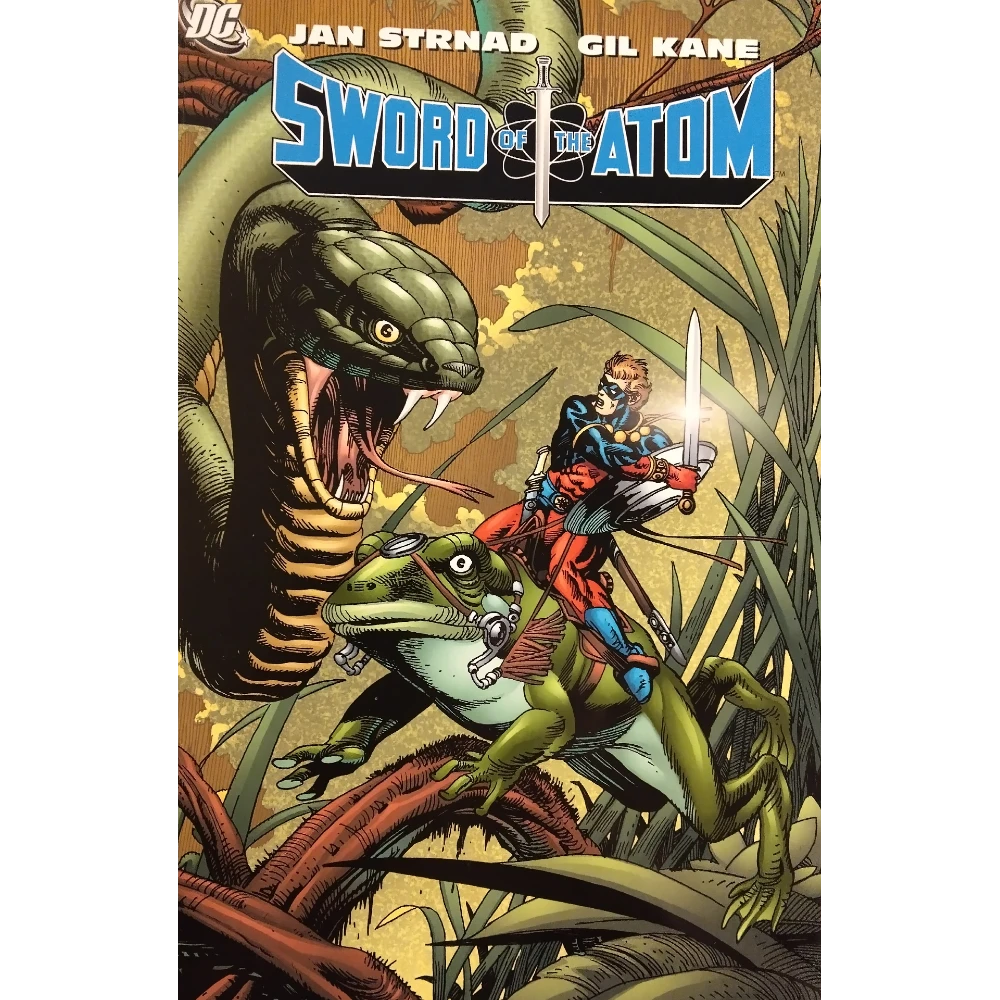
Across a few fairly recent posts, we've explored the adventures of men drawn into fantastical worlds other than the ones they've known. Travis Morgan, the Warlord, finds himself in the prehistoric world of Skataris, fighting dinosaurs and robots to bring freedom to an oppressed populace. Jim Scully, Skull the Slayer, accidentally travels with some companions through a time rift in the Bermuda triangle…and winds up fighting dinosaurs and robots.
Our pint-sized protagonist, Ray Palmer, the Atom, doesn't do battle with either flesh-hungry saurians or metal men in the series we're reviewing here, but he, too, journeys through an environment other than the place he calls home, which is why I wanted to explore his adventures today. Whereas Warlord becomes lost in a world within our Earth and Skull the Slayer in another dimension, Atom discovers a world, not so much inside or under his own, but among. It's a small world–more of a land, really–ripe for exploration and the heroic efforts of a pocket paladin.
Most stories I've read which reshaped DC's classic characters, from John Byrne's Man of Steel limited series to Dennis O'Neil's The Question, occurred in DC's post-Crisis on Infinite Earths continuity. We're turning the pages back a few years prior (mostly) to Marv Wolfman and George Perez ushering in the end of the DC Multiverse, to a collection of stories which seek to shake up Ray Palmer's status quo with the force of a split atom.
Sword of the Atom
Writer: Jan Strnad
Pencilers: Gil Kane and Pat Broderick
Inkers: Gil Kane and Dennis Janke
Colorists: Tom Ziuko and Petra Scotese
Letterers: John Costanza, Gaspar Saladino, and Albert DeGuzman
Issues: Sword of the Atom #1-4 and Sword of the Atom Special #1-3
Publication Dates: September 1983-December 1983, July 1984, May 1988
With all due respect to Jan Strnad, there's a reason why Gil Kane's name comes first on the covers and in the credits for most of the issues included in this volume. The legendary artist's starpower seems a primary reason why readers would pick up a book starring a hero who, I assume, was not the most robust DC creation in terms of personality, background, or characterization. These stories take Ray Palmer so far out of the costumed superhero element that one expects the original brief to have been created to specifically turn Ray's world inside out, to inject something new into the Atom's narrative makeup. In order to garner interest, it seems only plausible slapping the bigger star's name on the covers and credits first.
I say none of that to discredit Strnad's writing, as he works with Kane to take Ray on a whirlwind adventure that aligns nicely with the hero's core characteristics while also allowing deviation from the expected. I'm no DC fanatic, so I couldn't tell you how well-received the Atom was as a hero before these issues (especially on his own outside of the Justice League), but a shake-up such as this feels necessary to not only modernize the character but give him new life. No more traveling across phone lines and punching bad guys in the kisser. You gotta keep the shrinking, that's just a necessity, but to keep Ray shrunk like a more serious version of Wayne Szalinski and allow him to explore a small world hidden from human eyes just makes sense. Take the guy, put him in his central element (a miniaturized world), and keep him there. See what unfolds.
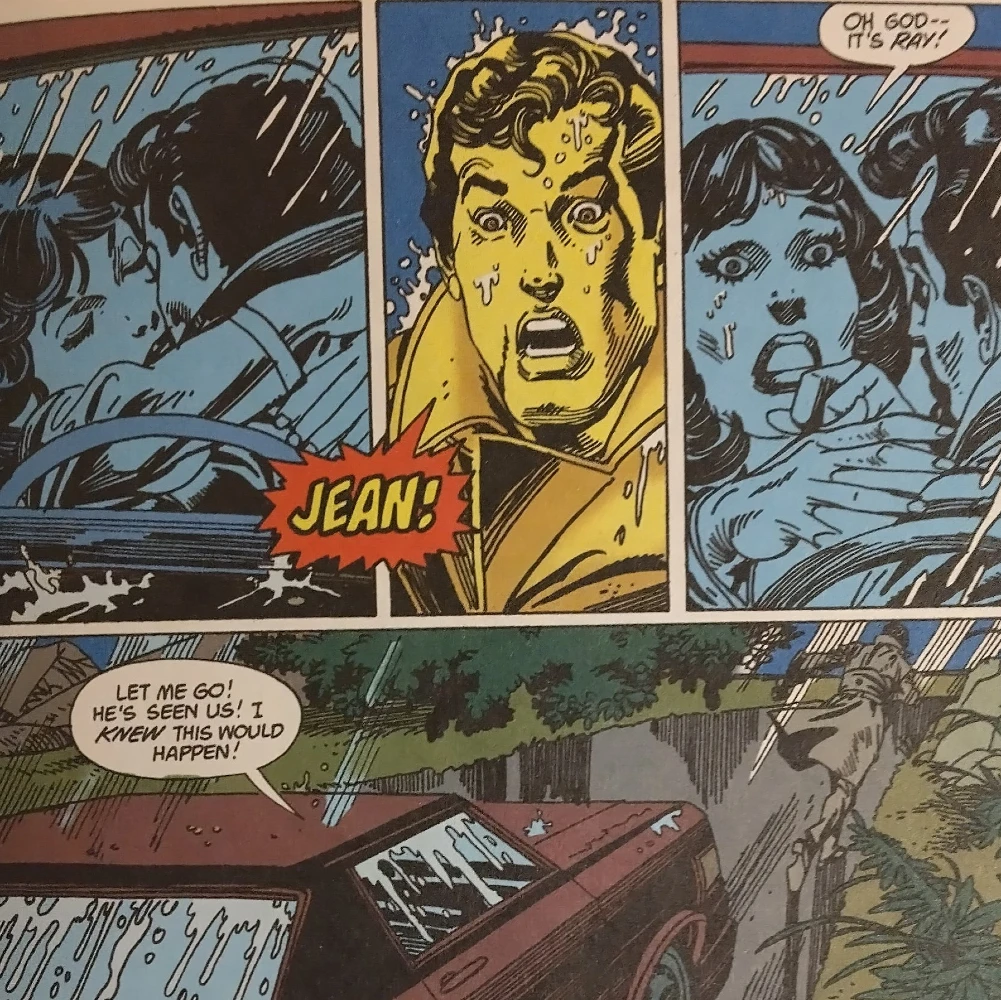
I came into these issues blind to the Atom's history, but as Strnad and Kane get their story started, even I could tell that reinvigoration is afoot. We're quickly introduced to Ray's tense marriage with Jean Loring and Ray's own efforts to distance himself from her after finding her in the arms of her law firm coworker. Very quickly, Strnad and Kane establish the human heart driving this narrative, how Ray's obsession with heroics has created tension between himself and his wife and how Ray distances himself to find peace within that tension. Like he's done so many times before, Ray shrinks away…and, thanks to an incident involving South American cocaine growers, a plane, and a lightning strike, he appears stuck in a small world with small people.
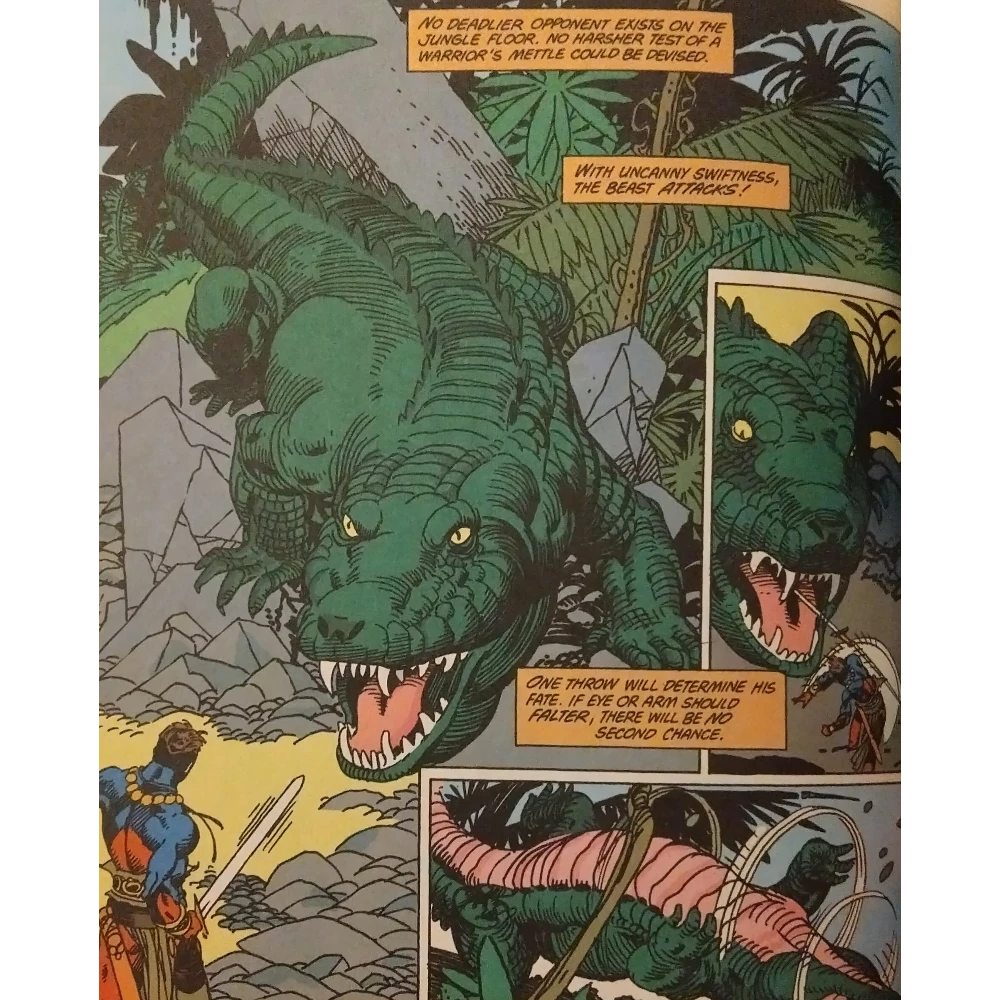
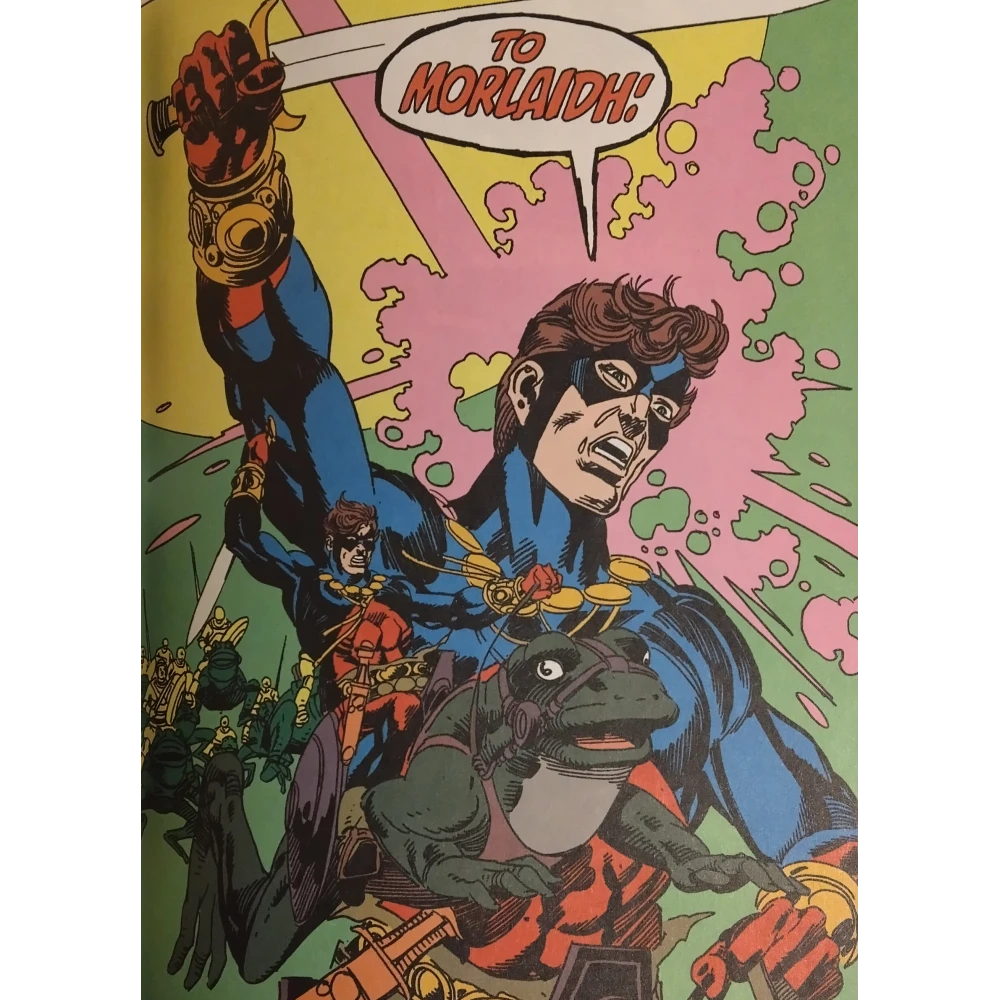
The limited series and the three Specials all work together to detail Ray's adventures as he becomes more accustomed to a world that feels like a far better fit than where he was in the land of normal-sized folks. Putting his athleticism and heroic instincts to good use, the Atom becomes embroiled in a few political dramas, meeting and falling in love with Princess Laethwen, who can wield a sword as well as anyone. Much like Travis Morgan or Mike Grell's Torin Mac Quillon, Ray must learn of this new world and his place in it as a hero, going from mild-mannered scientist to sword-swinging warrior. He rides on frogs! Battles snakes and alligators! Leads the charge against despots! Strnad seems to make an unspoken promise that he and Kane are going to show you things you've never seen in an Atom comic before…
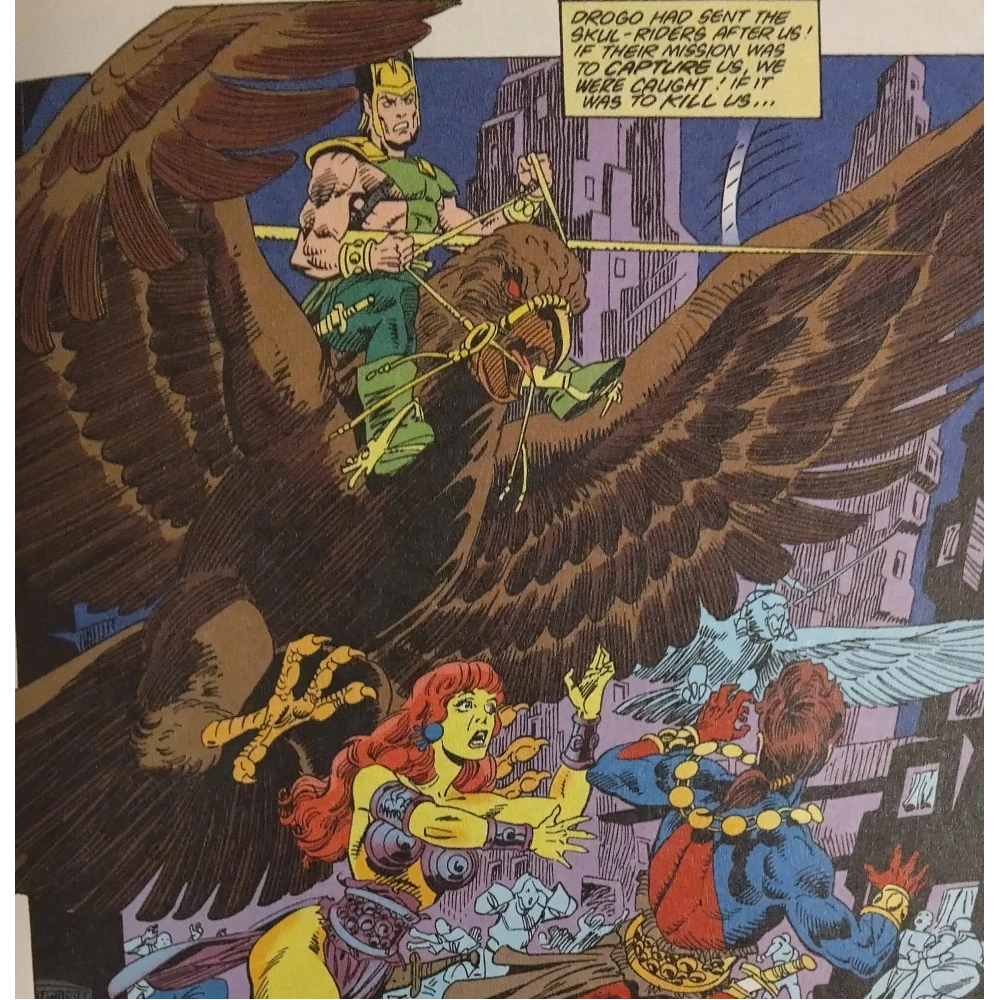
…which I can only assume is true. Had the Atom ever gone on a swords-and-sandals-style journey with bullfrogs and snakes before? No idea, but it works well here, especially if it's an original concept. Kane seems to take great delight in developing this new landscape Atom fights through, from swampy marshes to small cities such as Morlaidh. The space teems with wildlife: warriors ride birds of prey instead of horses, a swarm of rats is sicced upon Ray and an ally, the Atom comes face-to-face with a snake in his first encounter with South American predators. Kane utilizes the environment well, envisioning grasses standing taller than men and trees towering like skyscrapers. Imagine a world living in your backyard. This is the vision Kane must make tangible, and he does an admirable job. Before Pixar gave us Bug's Life or Dreamwork's Antz, Gil Kane gave us a world under our very noses.
Yet it's not just all fighting gators and riding frogs. That human story I mentioned functions to fuel this narrative, whether it's Ray's frustrations with Jean driving him into danger and, eventually, to the heart of a princess, or Jean's own burgeoning relationship with coworker Paul once it seems her marriage to Ray is all but kaput. Strnad finds some mileage in a brief "Will they/won't they?" tension, but his more direct characterization deals in how two adults cope with the wrenches they've thrown into their own marriages. How they respond, and how that response affects others around them, creates an ongoing internal conflict even as Ray fights warriors armed with swords and bows. It fits thematically, Ray's shrinking mirroring his hope to minimize his problems rather than facing them directly.
Paul himself, particularly in two of the Specials, becomes a surprisingly interesting character; though he never admits to doing wrong by Ray, he nevertheless becomes an ally, mainly driven by his love for Jean. Strnad could have easily made him unlikable and antagonistic, and though he's clearly "the other man," he's never selfish or cruel (or as unselfishness and kind as someone can be after stealing another man's wife). I didn't enter these issues thinking I'd witness a commentary on marriage, healthy or otherwise, and I was pleasantly surprised by the theme's application…mostly.
There is, somewhat understandably, some convenience or "tropiness" you might have to forgive or overlook to enjoy these issues completely. Strnad really wants to develop a relationship between Ray and Laethwen in the style of Han Solo and Princess Leia, and in order to bring this about, this particular scruffy-looking nerf herder's other commitments must die. Likewise, Strnad sacrifices a compelling character arc for another supporting cast member to manipulate the relational tensions he wants, a move I disagree with him making. That cast member has potential, but once Strnad sows the seeds he wishes to flourish, other plants which may look like flowers are torn from the roots as weeds. The plotting also requires somewhat immature behavior, primarily from Ray. Strnad wants, you can tell, to inject some complexity for older readers–how is a couple meant to respond when lovelessness moves one to betrayal?–yet his solution smacks of some convenience.
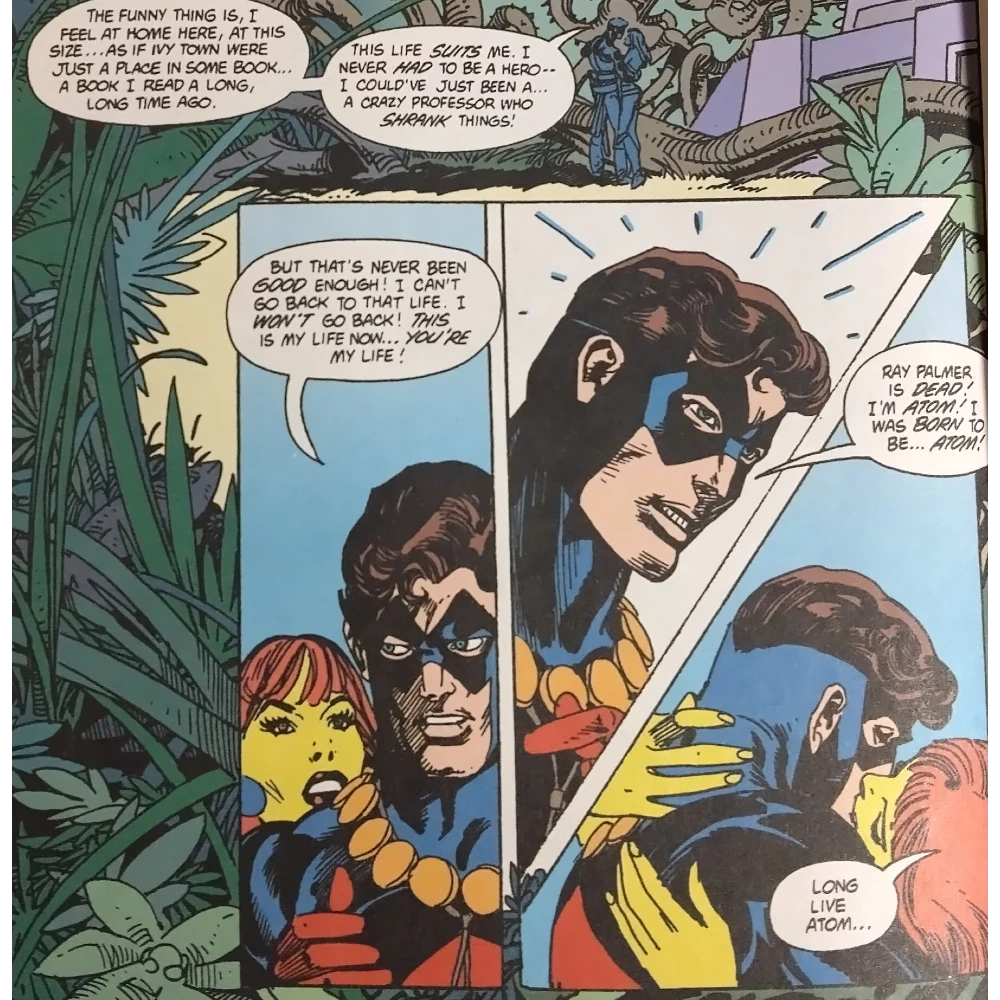
Those questions and tensions, regardless of the consistency of their strengths, do guide the full limited series and two of the Specials, meaning we're really allowed one longer narrative told in six installments. We're offered two halves, each told fairly adequately to encompass a full story. And you can't say Atom makes it through this unscathed–maybe his internal growth isn't as consistent or heroic as his size-changing abilities, but there's change here that can't be affected by radiation from a white dwarf star.
The core questions Strnad asks are good, I find. I feel both Ray and Jean are allowed opportunities to process their marital status quo, particularly in the first two Specials following up the limited series. There are ways in which they both act heroically and honorably, and even Paul, who feels the least likely to be present for some of the action, proves himself in a few dangerous situations. Strnad wants you to believe that, just maybe, a happy answer isn't guaranteed, just like some relationships in real life. It's a hard dissolution to witness, not the one you want, but it is, in some ways, reflective of reality. The tension is somewhat lost, however, when the reader recognizes the conclusion Strnad wants to happen and isn't willing to let other possibilities have a fighting chance, steering his ship in that singular direction.
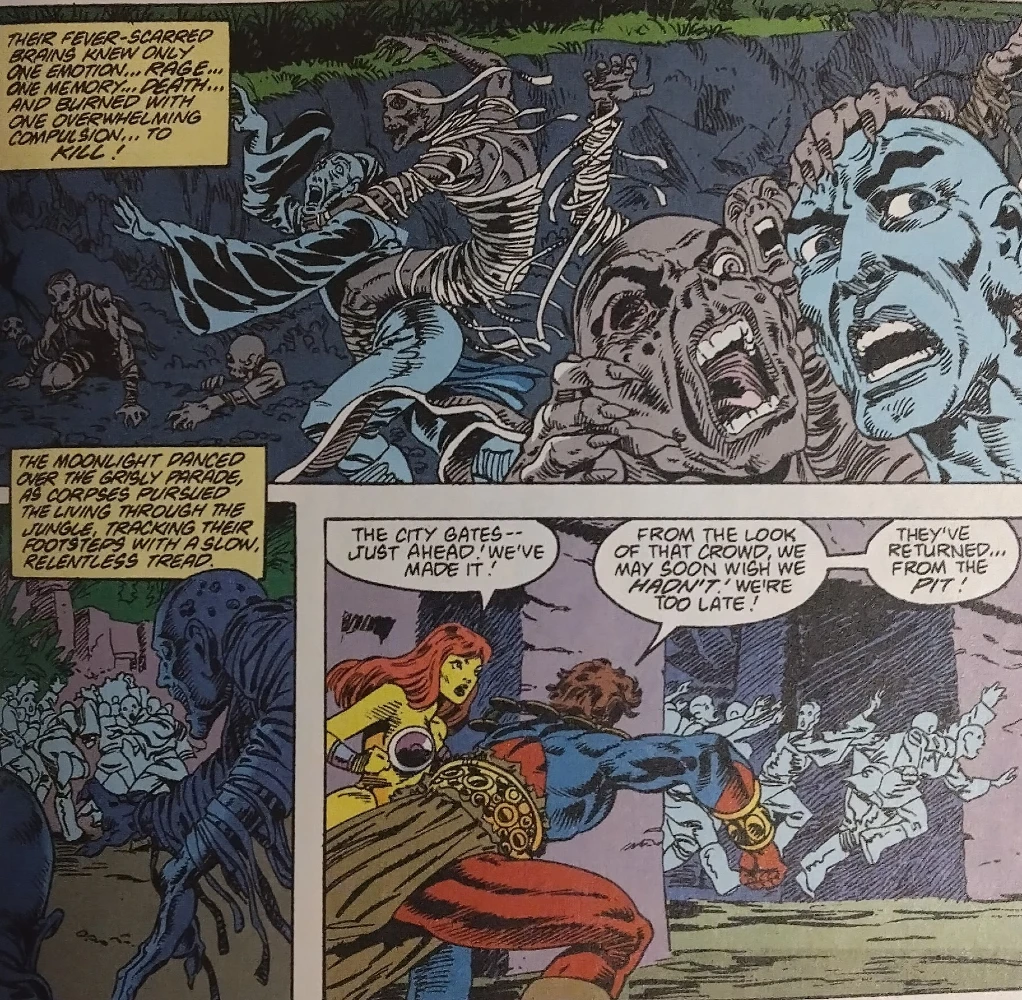
The volume's final issue, that third Special, isn't as compelling as its predecessors; while it follows up the ending of the second Special, the issue is standalone in nature and wants to do its own thing. Illustrated by Pat Broderick, who's no slouch, the third Special maintains the sword-and-sorcery tone while veering into horror territory. Pockmarked with darker themes and imagery, it would work better as a longer narrative or if Ray's adventures had been infused with horror from the beginning. The tonal shift feels sudden and lacks the same compelling tension of the other issues, especially as it disregards the supporting cast members Strnad used with Kane. Published four years after the second Special, this issue may have fallen prey to its writer's shifting interests.
I tend to credit Crisis on Infinite Earths for serving as the impetus for revitalizing many of DC's heroes, but these issues showcase that writers could revamp characters prior to that cosmic shake-up. Sword of the Atom isn't as groundbreaking or consistently entertaining as well-known takes on Superman, Batman, or Wonder Woman. And I didn't quite walk away from it with the same respect I have for Tim Truman's Hawkman or Mike Grell's Green Arrow, the twin pinnacles (to me) of B-heroes getting the facelifts they deserved. Sword of the Atom is highly imaginative, and we mainly have Gil Kane to thank for the miniature yet immersive world we explore in this volume. And we should thank Jan Strnad for the story–at times convenient, it nevertheless showcases real, adult heroes in real, adult situations that inspire growth and determination, despite some lingering immaturity.