(Strand)om Stories: Skull the Slayer Review
A promising premise with interesting characterization is lost amid clashing concepts
—by Nathan on September 23, 2026—
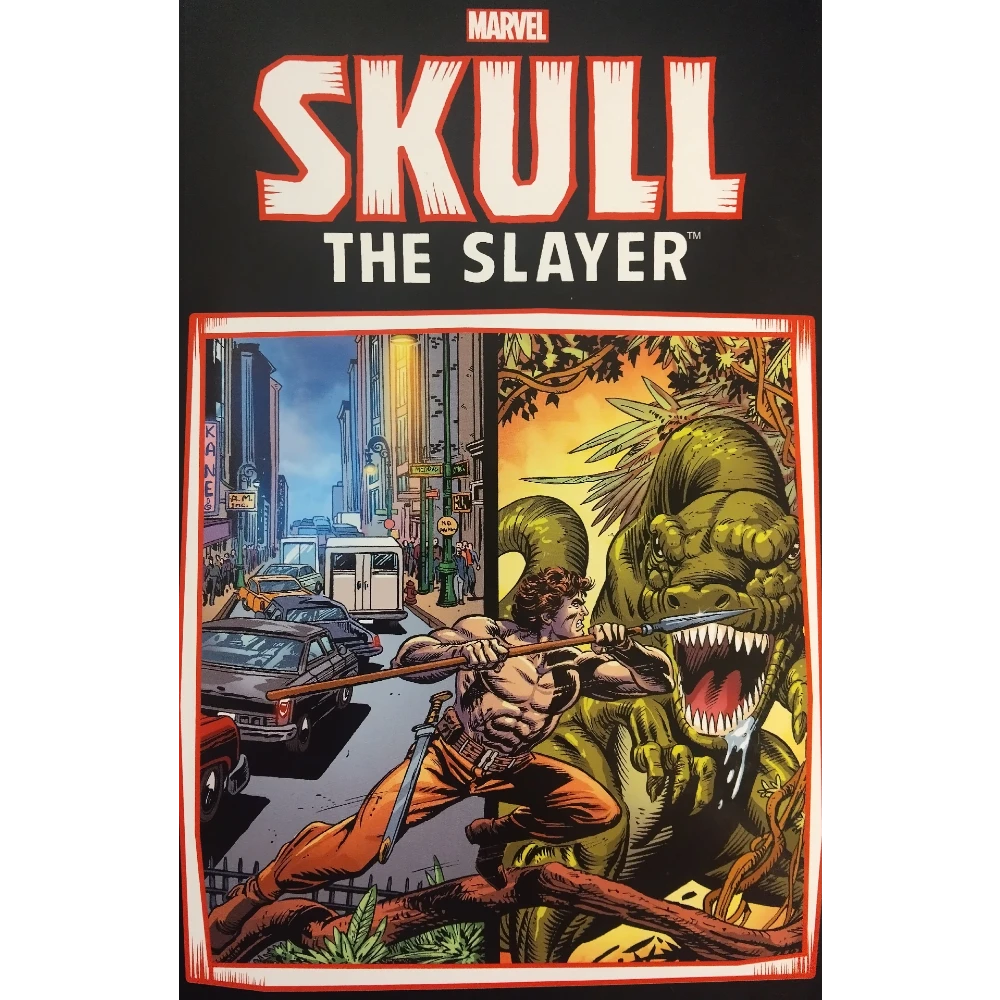
I won't lie and say that this brief "Dudes from one era winding up in another era" kick we've been on has been unintentional. As happens on this site, I tend to read certain comics and be reminded of other stories, leading to a burst of interest in checking that particular comic out. Sometimes, it's a chain reaction, hopping from one narrative to the next. Archie Goodwin and Walt Simonson's "Manhunter" arc reminded me of another "hunter-turned-mercenary" in Mike Grell's Jon Sable, which sparked recollection of his Warlord series (where Air Force pilot Travis Morgan became stranded in a prehistoric fantasy world), which led to his Starslayer series (where Celtic warrior Torin Mac Quillon was pulled into the future), which brings us here. See? There's a method to the madness.
Like with Warlord, today's review also focuses on a series about a dude drawn from the then-modern era into a land swimming in prehistory. Also like Warlord (and like a New Mutants limited series I recently reviewed), we have dinosaurs. That, too, admittedly, has been intentional. Go back to my review of Jack Kirby's Devil Dinosaur–I guess that's the "grandfather" of some of my more recent posts.
I can't admit I ever adored dinosaurs. Maybe at one time as a kid? My parents will tell you I loved Barney. That faded as I grew older. I do, as referenced in a different recent review, very much enjoy the original Jurassic Park. A theme park taken over by resurrected meat-eaters as humans desperately fight for survival? Count me in all the way. You won't see Barney bursting free of an enclosed paddock and swallowing people whole.
This series doesn't have a theme park, but it does have dinosaurs. And cavemen. And Incan warriors. And…aliens? Robots?? The Thing??? Maybe it's a theme park after all! Yeah, we've got a lot going on here as we stumble into Marvel's version of what Mike Grell was doing over at DC, though the House of Ideas beat Grell to that amber-trapped dino DNA by a few months. Sparing no expense, of course.
Skull the Slayer
Writers: Marv Wolfman, Steve Englehart, Bill Mantlo
Pencilers: Steve Gan, Sal Buscema, Ron Wilson, Ernie Cha
Inkers: Steve Gan, Pablo Marcos, Mike Esposito, Sonny Trinidad
Colorists: Marv Wolfman, Michelle Wolfman, Don Warfield, Petra Goldberg
Letterers: Pablo Marcos, Tony San Jose, Irv Watanabe, Karen Mantlo, Denise Wohl, John Costanza, Joe Rosen
Issues Collected: Skull the Slayer #1-8, Marvel Two-in-One #35-36
Volume Publication Date: April 2015
Issue Publication Dates: August 1975, November 1975, January 1976, March 1976, May 1976, July 1976, September 1976, November 1976, January 1978-February 1978
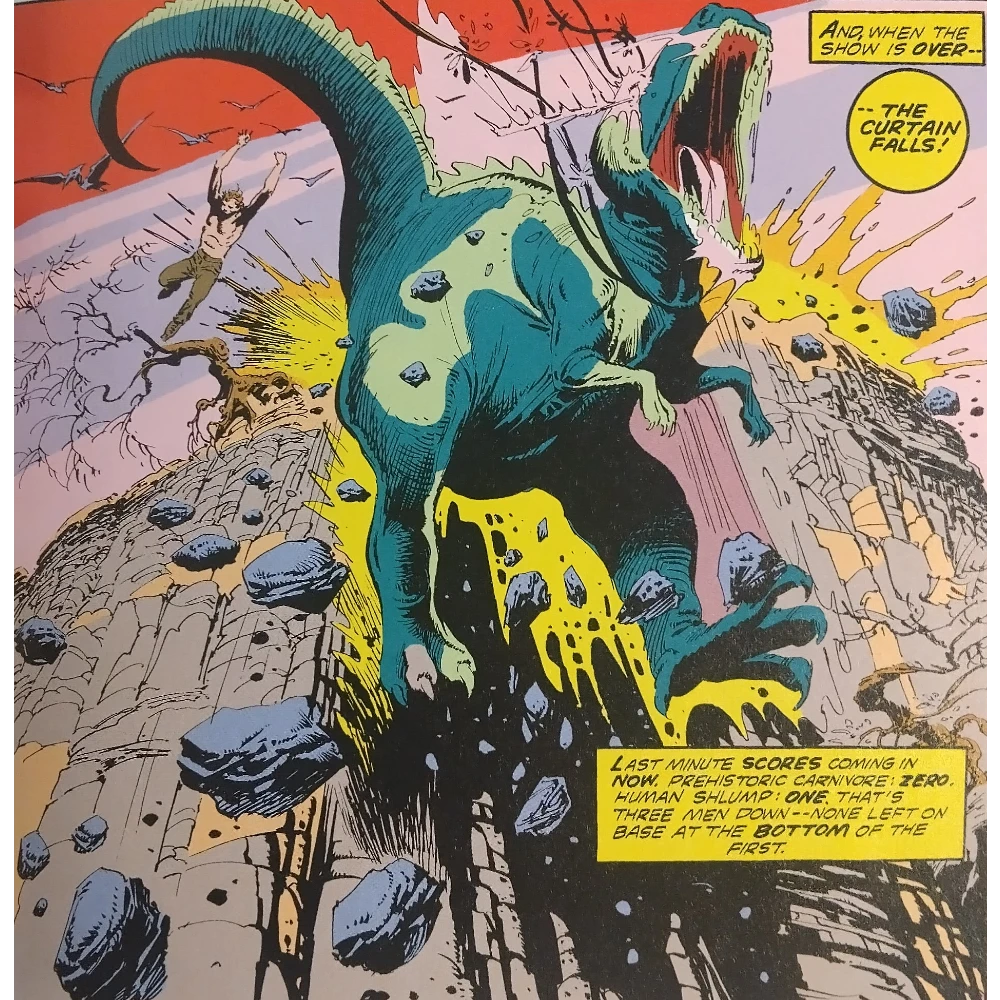
You'll recall, in Jurassic Park, that the whole mess is kicked off because programmer Dennis Nedry, a disgruntled employee, agrees to steal dino embryos for a hefty sum before trying to flee the island. Nobody on this book, as far as I am aware, stole dino embryos, but folks seemed to want to hightail it like Nedry. They were more successful. I don't believe anyone was killed by a Dilophosaurus.
The creator credits–three writers, four pencilers, four inkers, four colorists, and seven letterers–don't provide a great sense that anyone trusted this title much. Skull the Slayer lasting eight issues before being cancelled on a cliffhanger left to be wrapped up in Marvel Two-in-One is also a strong sign that there was little interest in the title, from the creators involved and readers alike. Somehow, this series was packaged into a trade, which I bought and read, and I can provide my experience some fifty years after folks picked up the initial issues.
To paraphrase the immortal words of John Hammond: "Welcome…to the Bermuda Triangle."
Many, many, many years ago.
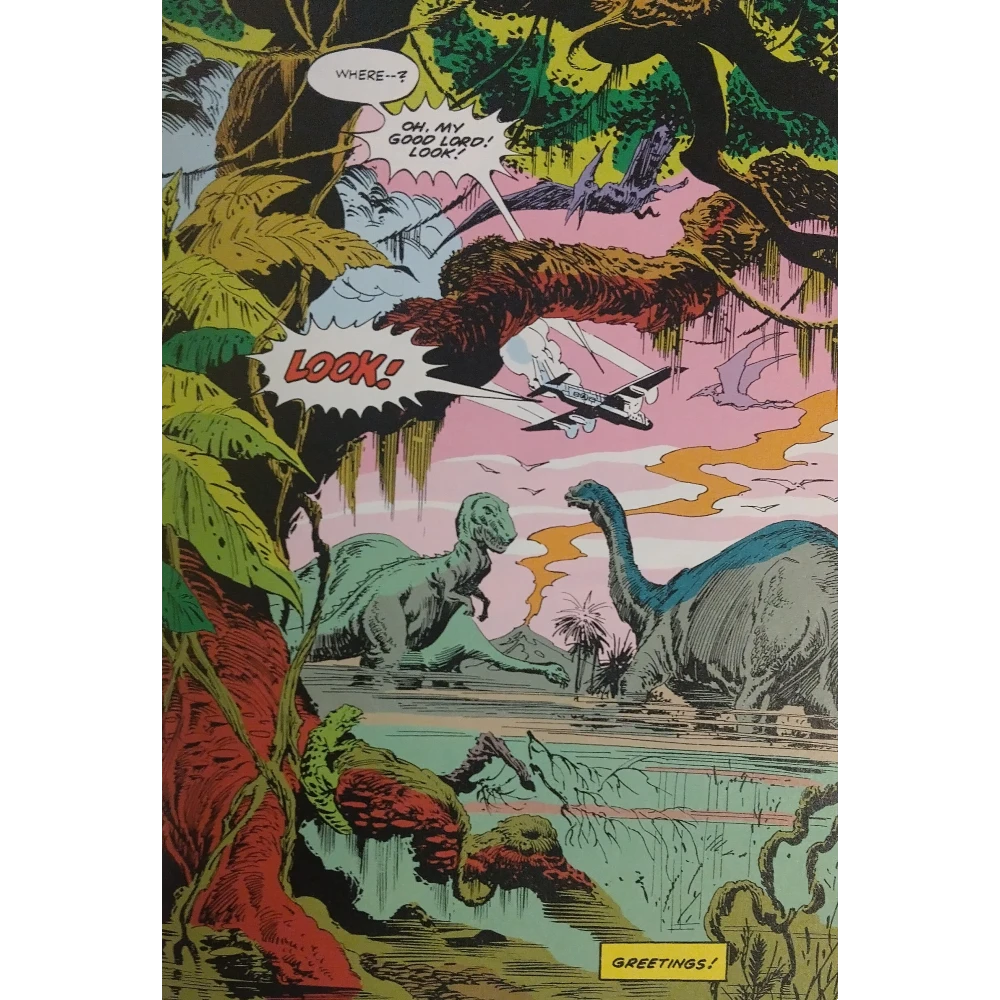
Jim Scully's our central protagonist, a Vietnam vet captured in Florida for seemingly murdering his brother (if you trust his recollection, it was actually self-defense). He and several others are aboard a military transport plane when they, inexplicably, wind up pulled into a time-warp over the Bermuda Triangle. The plane crashes, killing the pilots, but Skull (as he's called–something about being hard-headed) and his three surviving companions are alive…though not so well. They're lost, however many years in the past, stuck in a world inhabited by dinos and all those other things I referenced in the intro.
Mike Grell, in delivering Warlord, gave Travis Morgan a plot–he's this modern-day soldier who turns into a warrior, a freedom fighter, a legend. In even just the first handful of issues, Morgan undergoes an internal struggle as he realizes how much he enjoys the bloodshed he encounters and causes. Wolfman, Englehart, and Mantlo, though recognizing the need to give Scully an arc of his own, fashion one much more haphazardly. I assume none of the writers really had an end goal in mind, aside from having Scully and his companions eventually escape the confines of this prehistoric world.
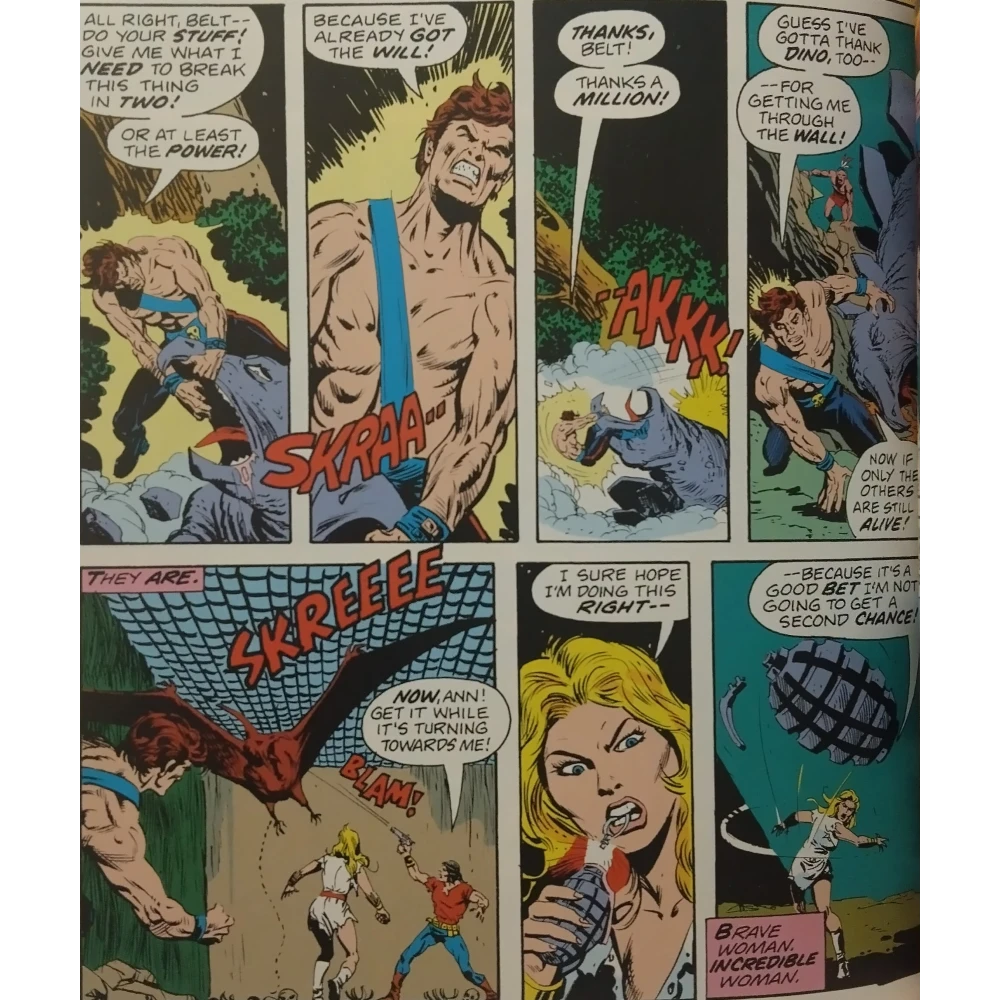
Like Morgan, Scully does transform somewhat, utilizing his prodigious skills as a soldier to help himself and his allies survive in this brutal world as they combat dinosaurs on land and sea and ancient cavemen and warriors. Jimbo's been hardened by his Vietnam experiences, perhaps losing some aspect of his humanity through war and torture. He doesn't wrestle with any bloodlust–if anything, Scully is most interested in defending himself against perceived crimes, as if his heroic actions facing down dinos and other enemies should prove to his companions that he's innocent and maybe a tad more human than they'd otherwise grant him. He's a stalwart soldier, trained well, applying those abilities (with some augmentation from a strength-enhancing belt) to their survival. He wants to be trusted.
Our writers recognize the need to utilize a supporting cast to provide tension, not only in how they perceive Scully but in their relationships with themselves and one another. You're meant to get the sense that each of these characters is hurt or feeling disquiet for a certain reason–Dr Raymond Corey is an African American physician and scientist who touches on matters of race; his assistant Ann Reynolds asserts her own independence across the book; and Jeff Turner is a young man we learn is trying to get out from under the thumb of his domineering father (a US senator). Each character is supposed to grow beyond the trappings they feel stuck in, whether race, gender, or youth. Scully's abrasive personality allows ample opportunity for them to hurl themselves against him, test their convictions and mettle.
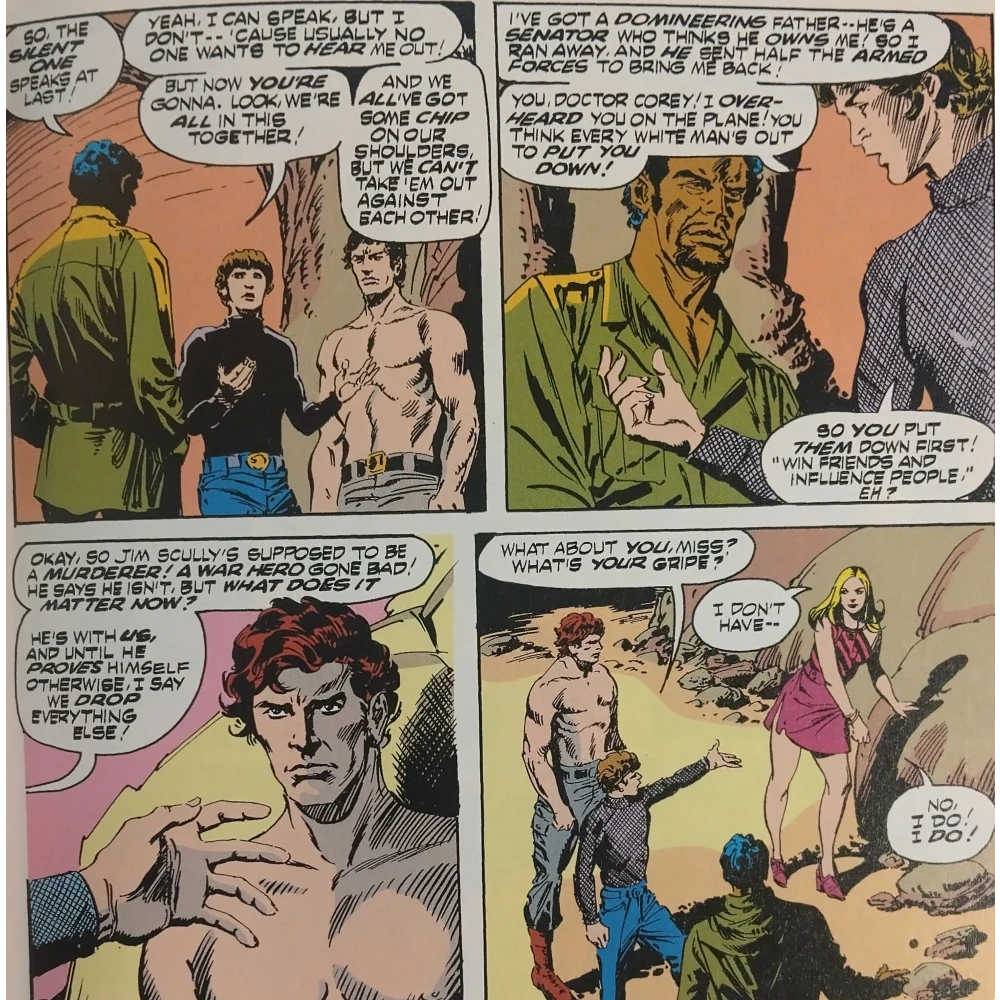
Too ample, in some cases. These three characters, though defined by their baggage, aren't given many chances to actually mature. Dr. Corey, though certainly intelligent, cannot grow past the hatred he quickly develops for Scully; likewise, the hard-headed "Skull" is unable to return the favor at any point, his own frustrations with Corey lasting basically the whole book. Additionally, though Scully deeply desires to prove his innocence, he continues verbally harping on the issue with his brother. We get it, Scully, you're not a murderer, but talking about it constantly does not a character arc make.
In terms of plotting, we get off to a fairly strong start, Wolfman introducing our characters and trapping them in the heart of this prehistoric era. He's got a lot of ideas he's tossing around, finding intrigue in how neatly he coaxes the reader into believing we're in some dinosaur-only era before–wham!–establishing aliens and a funky-looking tower that accesses other eras of time. It feels like a lot, but at least in these first few issues, there's the hint of a larger plot worming its way in the background of this survival story. You come to believe this won't just be eight issues of Skull and his friends bashing T-Rexes and Styracosauruses.
And then Wolfman leaves.
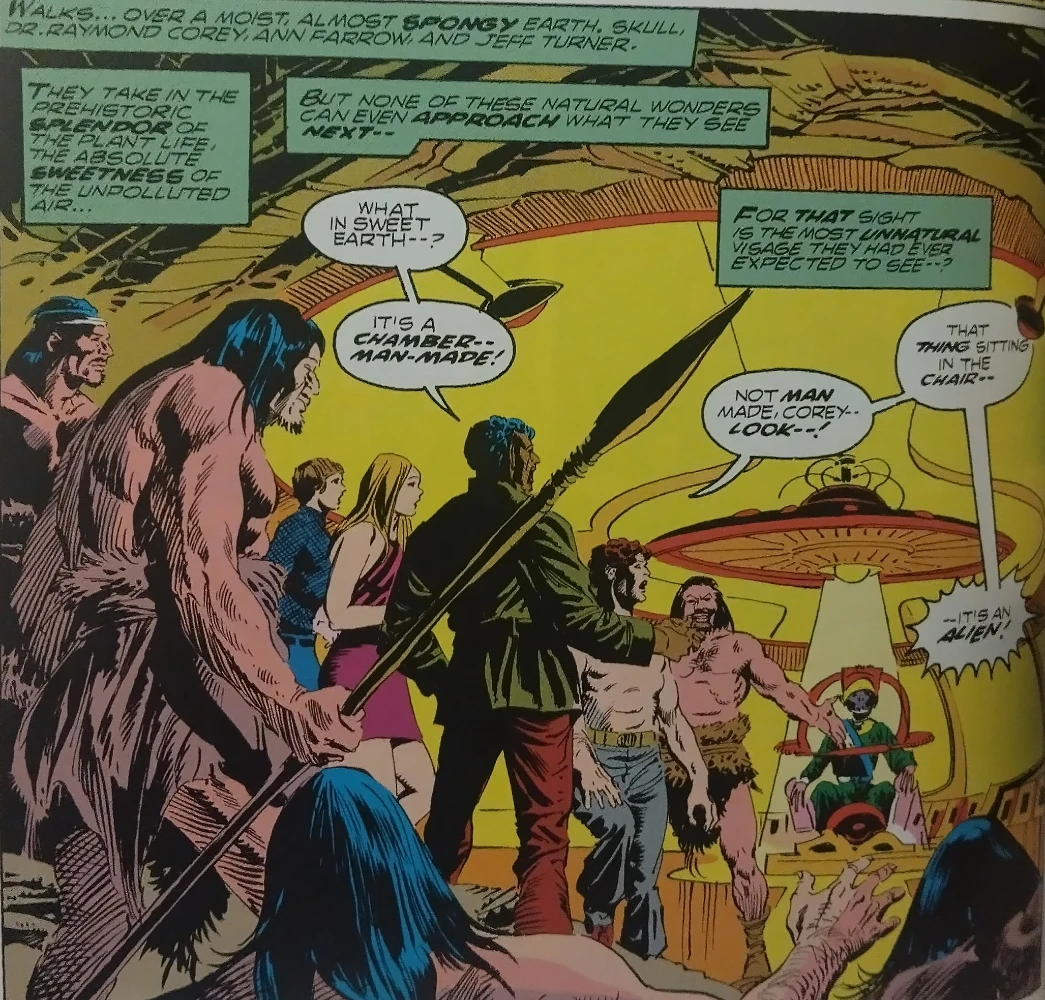
Whatever direction Wolfman was guiding our characters down vanishes as Englehart and Mantlo pick up the title. Fan as I am of Englehart's character-centric narrative style, his single-issue contribution doesn't add much, save an engaging moral dilemma, before Mantlo writes the series' second half. From here, it's downhill in quality. Mantlo churns out engaging ideas, introducing those Incan warriors, some robots, and Pterodactyl-riding samurai, but he doesn't approach this material with the same intentionality as Wolfman. He throws in concepts because they fit with the series' general tone, but any hope for a coherent plot is lost. Our characters move, from issue to issue, problem to problem. By time the series is cancelled, we're left with a cliffhanger that Wolfman, through two Marvel Two-in-One issues, wraps up.
Not to say Mantlo's ideas wouldn't work in isolation. There are some engaging elements to be found here, and on their own, they would stand fairly strongly. "Skull and Friends encounter dinosaurs," or "Skull and Friends encounter aliens," or "Skull and Friends encounter time travel" could each serve as its plot for a story but not all intertwined. But I was hoping the series would more deeply explore the ideas Wolfman had introduced, whereas Englehart and Mantlo's style is to throw more ideas into what quickly becomes a soup of too many flavors. Mantlo is to be credited with introducing some story beats outside the Triangle that have some merit, adding a bit more depth to how character backstories would influence the series moving forward. Regrettably, the series is cancelled before he can flesh those ideas out, and when Wolfman concludes the narrative, those elements have all but vanished.
Of the issues we're given, Wolfman's first three are the strongest. His narrative voice is experimental and highly detailed, calling to mind the tone of Don McGregor's "Panther's Rage." Englehart and Mantlo drop his style, choosing a more streamlined tone. What seems like hints toward an overarching plot evaporate as well, and though Englehart and Mantlo recognize Wolfman's characters, they tend to devolve into repetitive dialogue instead of focusing on well-structured drama.
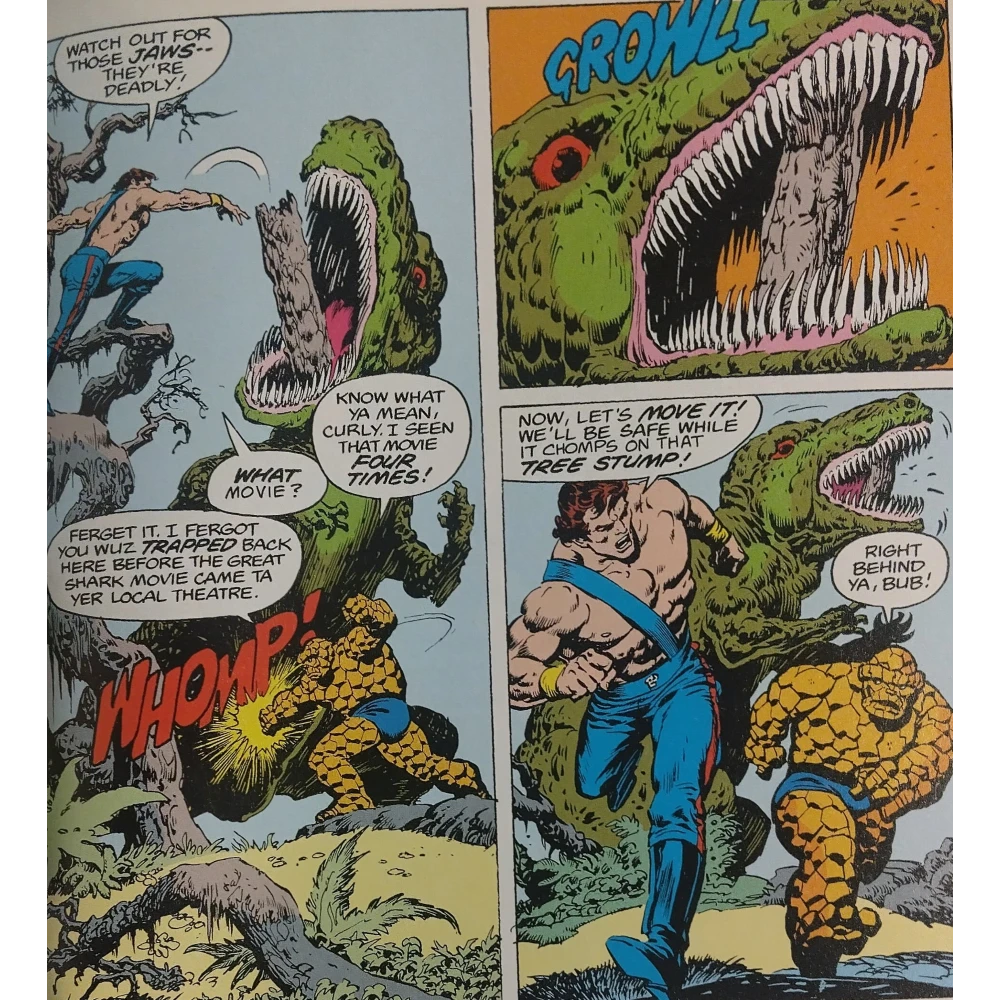
Skull the Slayer #1 kicks off its cast's prehistoric predicament with a plane crash, which feels like an apt metaphor for the series. Maybe less a "crash" and more "turbulence-influenced rough landing." Wolfman guides the plane well, yet it's Englehart and Mantlo who can't quite navigate stormier weather, forcing Wolfman into an emergency landing. There's a strong opening here, kicking off what could have been a character-centered plot about four people fighting against dinosaurs to find a way home. The concept is present here, though Wolfman has to bring in blue-eyed Ben Grimm to steer us back in that direction) A plot is teased, arcs are teased, personal growth is teased. But the simpler structure and promising potential become weighed down by a mishmash of ideas thrown willy-nilly into the blender used to turn this book into an unrecognizable sum of its parts.